Outcry
p. 57 · Read in the full issue
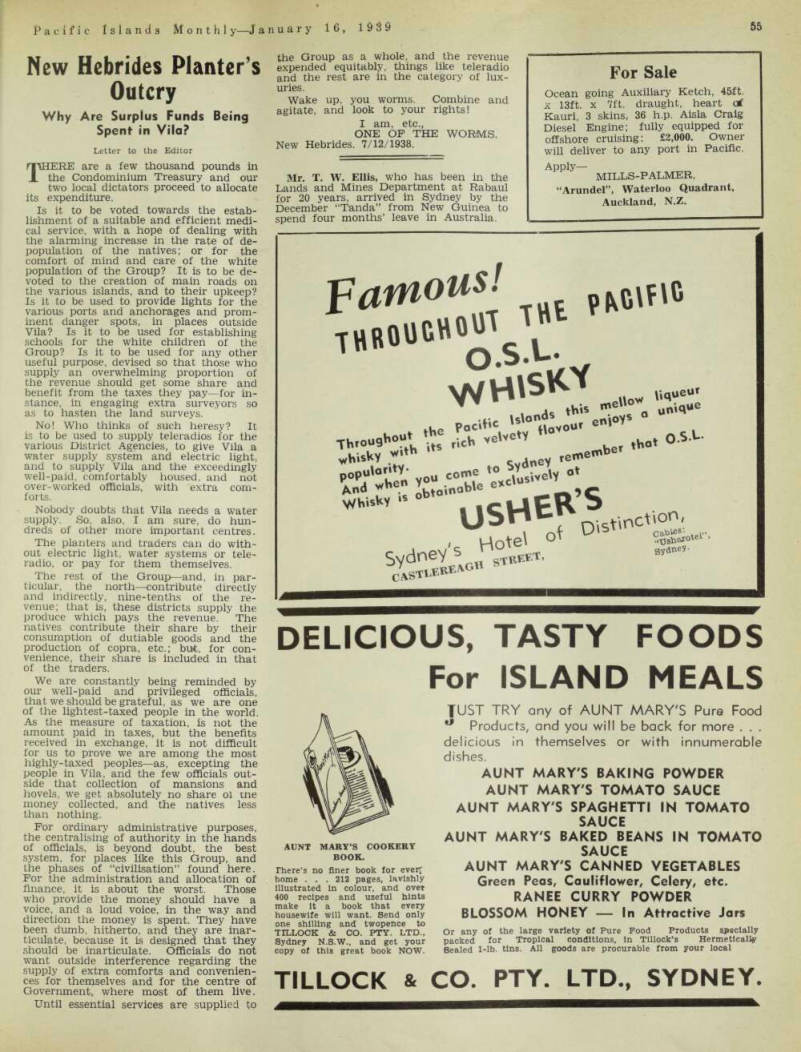
New Hebrides Planter’s Outcry Why Are Surplus Funds Being Spent in Vila?
Letter to the Editor r[ERE are a few thousand pounds in the Condominium Treasury and our two local dictators proceed to allocate its expenditure.
Is it to be voted towards the estab lishment of a suitable and efficient medi cal service, with a hope of dealing with the alarming increase in the rate of de population of the natives; or for the comfort of mind and care of the white population of the Group? It is to be de voted to the creation of main roads on the various islands, and to their upkeep?
Is it to be used to provide lights for the various ports and anchorages and prom inent danger spots, in places outside Vila? Is it to be used for establishing schools for the white children of the Group? Is it to be used for any other useful purpose, devised so that those who supply an overwhelming proportion of the revenue should get some share and benefit from the taxes they pay—for in stance, in engaging extra surveyors so as to hasten the land surveys.
No! Who thinks of such heresy? It is to be used to supply teleradios for the various District Agencies, to give Vila a water supply system and electric light, and to supply Vila and the exceedingly well-paid, comfortably housed, and not over-worked officials, with extra com forts.
Nobody doubts that Vila needs a water supply. So, also, I am sure, do hun dreds of other more important centres.
The planters and traders can do with out electric light, water systems or tele radio, or pay for them themselves.
The rest of the Group—and, in par ticular, the north —contribute directly and indirectly, nine-tenths of the re venue; that is, these districts supply the produce which pays the revenue. The natives contribute their share by their consumption of dutiable goods and the production of copra, etc.; but, for con venience, their share is included in that of the traders.
We are constantly being reminded by our well-paid and privileged officials, that we should be grateful, as we are one of the lightest-taxed people in the world.
As the measure of taxation, is not the amount paid in taxes, but the benefits received in exchange, it is not difficult for us to prove we are among the most highly-taxed peoples—as, excepting the people in Vila, and the few officials out side that collection of mansions and hovels, we get absolutely no share oi me money collected, and the natives less than nothing.
For ordinary administrative purposes, the centralising of authority in the hands of officials, is beyond doubt, the best system, for places like this Group, and the phases of “civilisation” found here.
For the administration and allocation of finance, it is about the worst. Those who provide the money should have a voice, and a loud voice, in the way and direction the money is spent. They have been dumb, hitherto, and they are inar ticulate, because it is designed that they should be inarticulate. Officials do not want outside interference regarding the supply of extra comforts and convenien ces for themselves and for the centre of Government, where most of them live.
Until essential services are supplied to
the Group as a whole, and the revenue expended equitably, things like teleradio and the rest are in the category of lux uries.
Wake up, you worms. Combine and agitate, and look to your rights!
I am, etc.,
One Of The Worms.
New Hebrides. 7/12/1938.
Mr. T. W. Ellis, who has been in the Lands and Mines Department at Rabaul for 20 years, arrived in Sydney by the December “Tanda” from New Guinea to spend four months’ leave in Australia.