Norfolk Is. Revives Whaling Industry
p. 28 · Read in the full issue
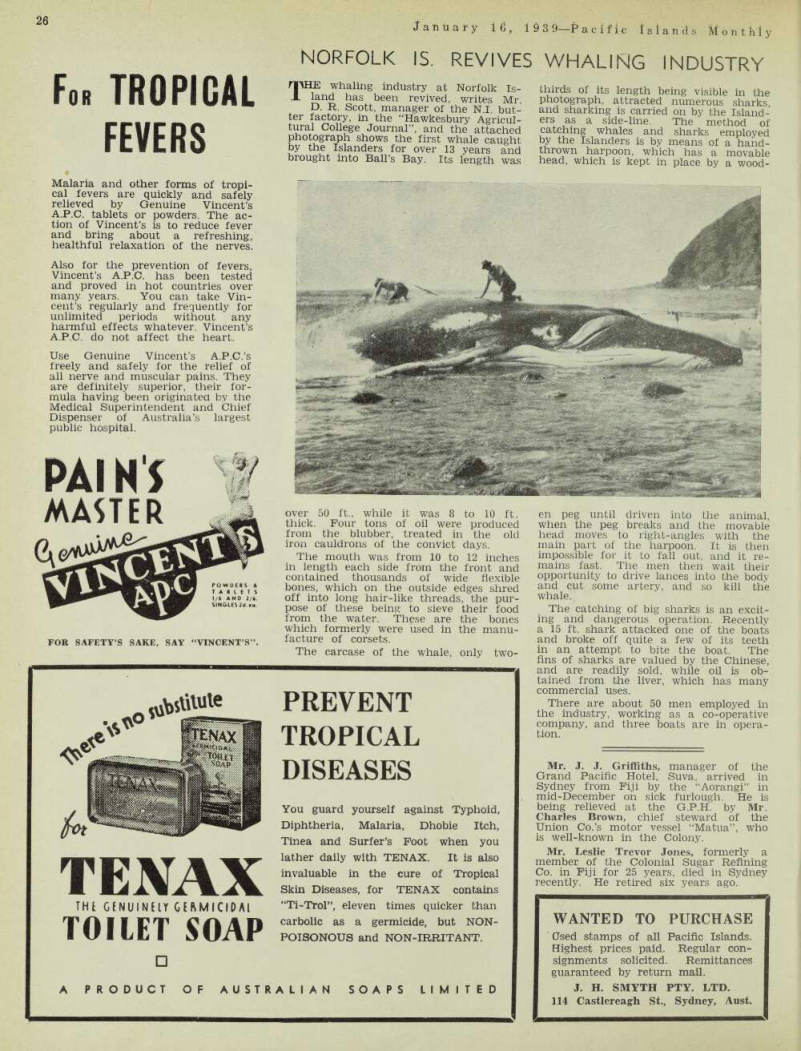
rpHE whaling industry at Norfolk Is ± land has been revived, writes Mr D. R. Scott, manager of the N.I. but ter factory, in the “Hawkesbury Agricul tural College Journal”, and the attached photograph shows the first whale caught by the Islanders for over 13 years and brought into Ball’s Bay. Its length was
over 50 ft., while it was 8 to 10 ft. thick. Four tons of oil were produced from the blubber, treated in the old iron cauldrons of the convict days.
The mouth was from 10 to 12 inches in length each side from the front and contained thousands of wide flexible bones, which on the outside edges shred off into long hair-like threads, the pur pose of these being to sieve their food from the water. These are the bones which formerly were used in the manu facture of corsets.
The carcase of the whale, only two
thirds of its length being visible in the photograph, attracted numerous sharks and sharking is carried on by the Island ers as a side-line. The method of catching whales and sharks employed by the Islanders is by means of a hand thrown harpoon, which has a movable head, which is kept in place by a wood
en peg until driven into the animal, when the peg breaks and the movable head moves to right-angles with the main part of the harpoon. It is then impossible for it to fall out, and it re mains fast. The men then wait their opportunity to drive lances into the body and cut some artery, and so kill the whale.
The catching of big sharks is an excit ing and dangerous operation. Recently a 15 ft. shark attacked one of the boats and broke off quite a few of its teeth in an attempt to bite the boat. The fins of sharks are valued by the Chinese, and are readily sold, while oil is ob tained from the liver, which has many commercial uses.
There are about 50 men employed in the industry, working as a co-operative company, and three boats are in opera tion.
Mr. J. J. Griffiths, manager of the Grand Pacific Hotel, Suva, arrived in Sydney from Fiji by the “Aorangi” in mid-December on sick furlough. He is being relieved at the G.P.H. by Mr.
Charles Brown, chief steward of the Union Co.’s motor vessel “Matua”, who is well-known in the Colony.
Mr. Leslie Trevor Jones, formerly a member of the Colonial Sugar Refining Co. in Fiji for 25 years, died in Sydney recently. He retired six years ago.