Men Who Knew Yesterday
pp. 20-23 · Read in the full issue
R. W. Gosset's Memories of Rarotonga
By Eric Ramsden
THE last of the beachcombers had not left the waterfront when R. w.
Gosset landed in Rarotonga in the early part of this century.
The island was then recovering from the turbulent days when F. J. Moss was Resident Commissioner. Moss had been succeeded by Colonel W. E. Gudgeon, C.M.G., son of Thomas Mayth Gudgeon, historian of the Maori Wars. The New 7 Zealander, then nineteen years old, was the new Administrator’s nephew.
While outwardly religious (as was the
same in other Polynesian communities). the Rarotongans at times felt the mis sionary yoke a trifle irksome. Sunday’s church parade was invariably followed by bush-beer parties in the valleys—to the annoyance of the Rev. J. J. K. Hutchens, of the L.M.S., one of the last of the missionary autocrats. Bibles were put
aside. The natives, accompanied by more tolerant European neighbours, made for the orange groves.
Queen Makea still held sway, supported by such arikis as her husband, Ngamaru Ariki, of Atiu; Karika Ariki, of Avarua; Kainuku Ariki and Pa Ariki, of Ngatan giia; and Tinomana, of Arorangi. R. J.
Seddon, New Zealand’s forceful Premier, had landed in state on the island. Makea had also been honoured by a visit from the Governor, Lord Ranfurley. Hence forth, Rarotonga was British, Any possi bility of French intervention was re moved.
Cook Island waters were still sailed by native-owned and manned schooners that made Pacific history. Vanilla was booming.
The last of the old lime and coffee groves were still in existence. Once upon a time the Rarotongans exported quantities of
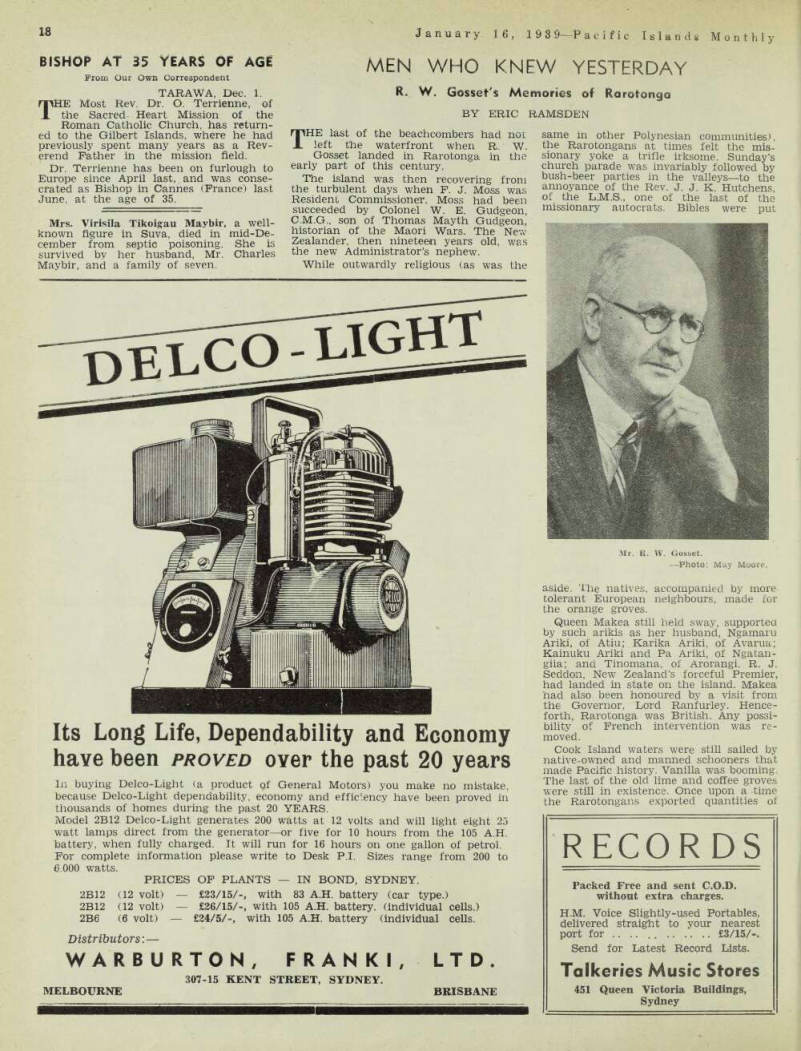
Mr. R. W. Gosset. —Photo: May Moore.
limejuice—helped with liberal additions of sea water! The latter was difficult to detect.
Tamarua Metua, last of the tohungas, resided near the ancient marae of Arai te-Tonga, where he was fed by his great granddaughter. As he had attended five annual ceremonial feasts prior to the ar rival of John Williams in 1823, some indi cation may be obtained of his age. Tam arua died about 1902.
At Arorangi, John Salmon, a member of the Tahitian-Hebrew clan, descend ants of Arii-taimai and Alexander Sal mon, a London Jew, dwelt with his wife, Tinomana, at what he called the “Royal Palace”. Salmon fancied himself as a Prince Consort. On the strength of that title he induced American traders to send him such luxuries as a buggy, then a decided novelty.
Among the sea captains then living were Taylor, a typical Yankee, Piltze and Engeleke, Germans, and Nagle, another American, whose half-caste son com manded the schooner “Maungaroa” when she was lost between Auckland and Raro tonga in 1901. All Avarua lined the beach when Captain Engeleke’s bride arrived from Germany. The couple had never previously met. The bridegroom’s brother had stood proxy for him. “It was only time that I ever saw Captain Enge leke look at all self-conscious!’ says Mr. Gosset.
The bride spoke no English. But her husband soon made her acquainted with that tongue. However, as his English was more reminiscent of the fo’castle it vastly amused his friends: at times, Mrs.
Engeleke’s choice of language was even embarrassing!
Alexander McAlister, once chief officer of the N.Z. Government steamer “Tut anekai”, resided on his plantation. Hugh McCrone Connal was then Government engineer and surveyor: he was the first man there to run a plantation on scien tific lines. Connal also built the first concrete bridge in Rarotonga. Percy Brown, manager for the Cook Islands Trading Company, soon followed his ex ample in establishing a proper planta tion.
MR. GOSSET.' can recall the wreck of the four-masted barque “Saragossa”, loaded with 4,000 tons of coal, at Mangaia in 1904. The following year the barque “Thistle” met her end at Palmer ston Island: she carried two and a half million feet of timber. He twice visited that island. John Masters, son of the original William Masters, was then living, and he gave the newcomer some infor mation that is not generally known.
For example, few know that Masters was accompanied to Palmerston Island by an Indian, who also did his share in populating the atoll. As the latter lim ped. he was given the name of Pareka.
Pareka’s presence explains the dark cast of features and glossy hair, (as distinct from their Polynesian physical char acteristics), of some of his descendants.
“The blend was a good one”, says Mr.
Gosset, “some of the Palmerston Island girls were then regarded as very pretty.”
A wheat ship, bound from Australia to California, was wrecked there in the 50’s. The first the islanders knew of it was when they saw a pair of geese on the lagoon. On visiting one of the smaller outer islands, they found some of the bodies of the 270 passengers. But already the land crabs had made short work of them. fTIHE loss of the “Maungaroa” between Jl Rarotonga and Auckland is a mystery that has never been solved. The little schooner of forty tons was lost with all
hands. “Tiro” Nagle, a half-caste, was in command.
But a satisfactory explanation was found for the wreck of the “Ngamaru Ariki”: she was piled up on the reef at Atiu and burnt. That was in accordance with Polynesian custom. The schooner bore the name of the island’s chief, (and Makea’s consort), and on his death it was thought fitting that the vessel, too, should go. Ngamaru is described by Mr.
Gosset as “a regular old savage”. In his day he had been a cannibal. On marry ing Makea, he made Rarotonga his home.
The “Takitimu”. another native schoo ner, was absent for nine months. The women had wailed and cut their hair.
But she turned up again. Mr. Gosset was once on another native craft that took three weeks to reach Aitutaki! Captain Tuana had some knowledge of latitude, but longitude was quite beyond him. The
island was passed in the night. Because of the presence of a tere on board, of about sixty people, the situation became alarming : there was a serious shortage of fresh water. But Tuana sailed back along the latitude and eventually made Aitutaki.
A friend of those days was Captain Frank Worsley, then in command of the “Countess of Ranfurly”, (which was sub sequently sold and wrecked in 1910 at the Isle of Pines). Worsley later went to the Antarctic with Shackleton, made a name for himself as an author, and secured a D.S.O. in the Great War.
He can also recall the period when the Grice Sumner vessels from Melbourne called at Rarotonga to collect labour for Malden Island. “Iti” Strickland, a gigantic member of a well-known Titutaki family, was overseer: he ruled the recruits for the guano deposits with an iron hand.
“The boys used to return, after their in
denture, burnt black”, says Mr. Gosset.
“There was no shade on Malden!”
Norwegian sailing ships were chartered in those days at a low price, both for labour and guano. The last of these ves sels he remembers at Avarua was the “Jerfalcon”. “The smell in the holds was appalling, and there the natives had to sleep, on mats, on top of the guano!”
Makea Ariki-nui Tinirau, 0.8JE., now the principal Rarotongan chief was well known to Mr. Gosset as a young man. He was closely related to Queen Makea.
Many a time the New Zealander accom panied Tinirau, “a splendid specimen of Polynesian manhood, handsome, with all the dignity and courtesy of his race”, to gather plantains in the mountains, WHILE on Rarotonga he made a col lection of artifacts, particularly stone axes and sling-stones. At one time, Mr. Gosset had more than 200 of them. Also .at Lord Ranfurly’s request, he collected specimens of bird life, which now repose in the British Museum.
The Ara Metua, the old paved road which ran round the island (and known in former times as Ara-Nui-o-Toi) in terested the visitors. Parts were then still in a good state of preservation, though constructed 700 years ago by Toi and his followers. Mr. Gosset, who is a surveyor by profession, regarded it as “a great engineering feat”.
But equally impressive was the ancient irrigation system, fine examples of which were found in Connal’s bush. Taro fields were irrigated on a succession of terraces fed from the mountain streams. Later, he saw similar work at Kulambangra, in the Solomons, also wrought, he believes, by Polynesian hands. “Their formation showed that the natives had a sound knowledge of engineering generally, and of hydraulics in particular. This is a sphere of Polynesian activity in Raro tonga into which there should be more research.”
Pa Ariki took him to the site of the murder of Anne Butcher, one of five European women who visited Rarotonga in the “Cumberland” under the command of Captain Goodenough in 1814. She was eaten at Ngatangiia, that year, because some of the crew in their search for sandalwood cut the sacred nono trees at the marae. W. C. Wentworth, later the Australian statesman, was also a pas senger on that vessel. Anne Butcher was on shore with a native family: for that act of desecration by her companions she was eaten.
In the summer the swamps near the foothills used to dry up. The natives knew that eels hibernated there. So they watched the pigs root for them in the mud, and, as they appeared, they would grab them.
One day Mr. Gosset saw some strange birds flying overhead: they had also been observed by the local poultry. The latter at once made for cover, as instinct told them that the new arrivals were pre datory, Mr. Gosset shot two. which he sent to the Auckland Museum for iden tification. They were New Zealand hawks, blown from their homeland.
A hitherto unrecorded incident that occurred during Mr. Seddon’s visit is re membered by the New Zoalar*ier. Travel ling with the Prime Minister was Edward Tregear, the Polynesian scholar, famous for his dictionary. By some mistake, at the ceremonial giving of gifts, Tregear’s name was called after certain other people he considered of lesser standing.
Well aware of Polynesian etiquette, he waited until the mats were placed in front of him. Then he rofee, spumed them, and walked away. The Rarotongans
understood the significance of his act.
But Mr. Seddon was definitely annoyed.
“Tregear was right”, says Mr. Gosset.
“and Makea herself said so.”