W.R.C. Abroad
pp. 11-12 · Read in the full issue
Head of Carpenter Organisation Visits U.S.A. and Britain
IT is to be expected that, on February 15, old Father Thames will take a look over London’s hoary traditions and time-honoured institutions, and carefully will block up all gaps open for occupation by new ideas and dynamic enterprise.
For, on that date, Sir Walter Carpen ter will arrive in London, from Austra lia via America: and, if opportunity offers, he may try to apply his extra ordinary energy to the ancient city’s choicest prerogatives. For a man does not easily forget the habits of a life time: and Sir Walter is all for modern ity and progress—and especially ship ping in its relation thereto.
In any event, he will have something biting and uncompromising to say about the failure of the British Empire, up to the present, to provide a policy ade quate for the defence of British inter ests in the Pacific. When he left Syd ney on January 6, he was prepared to argue that the way is open for Japan to thrust south-eastwards, seizing New Guinea, Fiji and New Zealand and thus virtually isolating Australia. He would not agree that Japan, acting thus-wise, would open her flank most dangerously to the Americans —the Americans, he thought, would not fight unless attack ed. But, by now, Sir Walter is in Ame rica, and maybe he will learn there that the Americans will not permit Japan to seize Pacific territories already occupied by Europeans.
OF all Pacific personalities to-day, that of Sir Walter Carpenter probably is the most conspicuous and pictures que. Thirty years ago, he was an ener getic, big-framed young man, managing trading stores in the Pacific and get ting ready to strike out on his own ac count. To-day, he is the active, direct ing head of an immense organisation, which includes merchandising, planting, shipping, manufacturing, hotel-keeping,
mail-carrying, aerial transport, and a dozen more.
All this has grown out of one man’s idea, and belief in himself. Walter Ran dolph Carpenter’s father was an Ameri can sea-captain, and he was born in Singapore. He was pickled in the salt of the Pacific before he had grown whiskers. In the nineties, while still a boy, he was manager of J. B. Carpenter and Son Ltd. at Thursday Island; from 1908 to 1914, he was manager for Rob ert Kaad and Co., in Suva.
Then came the war, with its insati able demand for explosives. Explosives meant glycerine, and the best glycerine comes from coconut oil. W.R.C. saw the chance, just a little sooner than anyone else. He went out into the Pacific, and he bought copra wherever he could find it —unlimited quantities of it. Next arose the problem of getting it to Eu rope and U.S.A. —nearly all shipping was commandeered. W.R.C. hired everything that would float upon the blue ocean, from liners to leaky old schooners, and piled bags of copra all over them, and sent them on their way.
THE copra made the markets, and W.R.C. made a fortune. But he didn’t stop. That wap over 20 years ago, and he hasn’t stopped yet. This scribe predicts that he will stop only when he is finally bagged by the Great Reaper.
Since 1914, W.R.C. has established W. R. Carpenter and Co. Ltd.; and that firm, wherein two brothers and two sons of W.R. are active executives, has: Established stores, plantations, and trading stations all over New Guinea and the Solomon Islands: Established a fleet of inter-island cargo-carriers; Purchased control of On Chong and Co. Ltd. (Gilbert and Ellice Islands) and Brown and Joske Ltd. (Fiji).
Established the W.R.C. Line of steam ers, running between Pacific Islands ports and Europe; Founded the South Pacific Insurance Co. Ltd.; Established Mandated Airlines Ltd., which carry on aerial transport in New Guinea and Papua; Purchased control of the hotels in most of the Morobe towns, New Guinea; Established the weekly airmail service between Sydney and New Guinea, under contract with the Commonwealth Gov ernment.
Those are only the firm’s major en terprises. The minor concerns are in numerable. And the firm never stops —always, something new is being plan ned, planted or launched. Some of the firm’s executives were in Papua the other day, having a look around—it is sug gested that the signboard is now going up in Port Moresby.
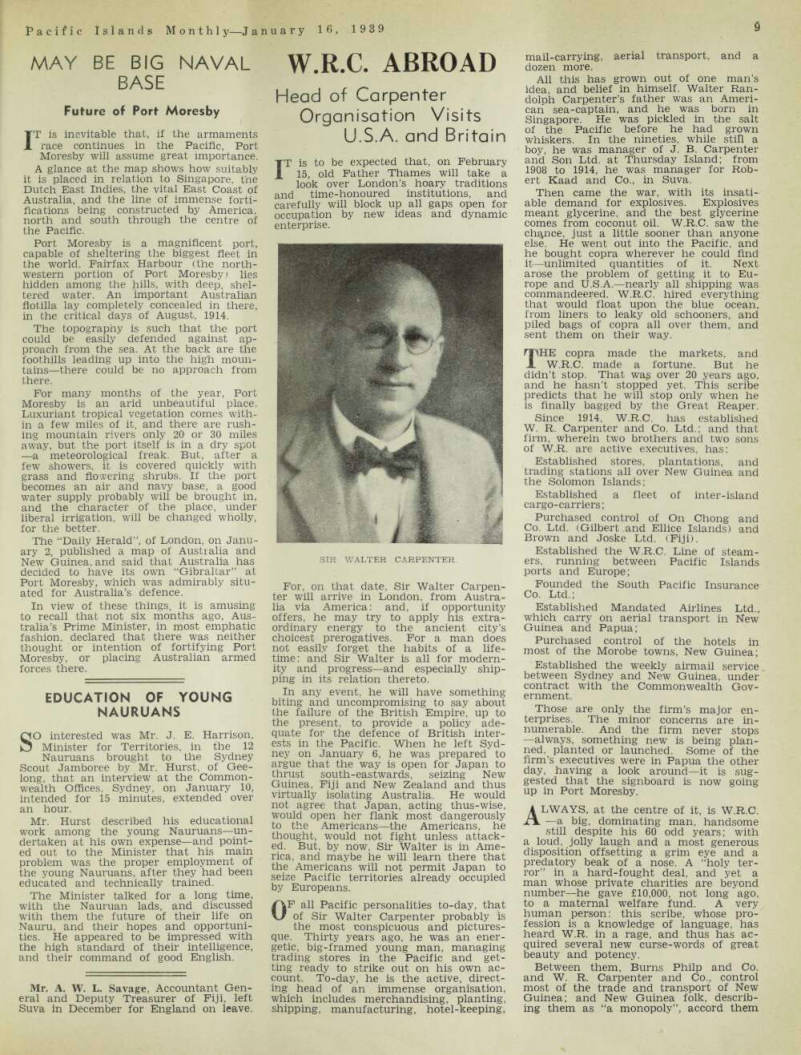
ALWAYS, at the centre of it, is W.R.C. —a big, dominating man, handsome still despite his 60 odd years; with a loud, jolly laugh and a most generous disposition offsetting a grim eye and a predatory beak of a nose. A “holy ter ror” in a hard-fought deal, and yet a man whose private charities are beyond number —he gave £lO,OOO, not long ago, to a maternal welfare fund. A very human person: this scribe, whose pro fession is a knowledge of language, has heard W.R. in a rage, and thus has ac quired several new curse-words of great beauty and potency.
Between them, Burns Philp and Co. and W. R. Carpenter and Co., control most of the trade and transport of New Guinea: and New Guinea folk, describ ing them as “a monopoly”, accord them
Sir Walter Carpenter.
neither love nor adulation. But, at least, we can appreciate the romantic and pic turesque character of the strong men who created those great organisations.
James Burns and his earlier associates are gone; but the creater of the younger firm, now on his way to greet Father Thames, is still very much alive and ac tive —and quite a few score of men, with a stake in the Pacific, await his next move with curiosity, and misgiving.—