Shrewd Comments
p. 10 · Read in the full issue
On N. Guinea
THE most readable and informative Pacific book received, lately, is “The Men and Birds of Paradise”, by A.
J. Marshall (published by Heinemann, London, for 11/6 Australian).
Mr. Marshall, a scientist (ornithology) with an unusual gift of writing, spent part of 1936-7 on the northern coast of New Guinea, between Madang and Hol landia; and every European in that re gion has a place in his pages. Even though un-named, one recognises a dozen well-known men. He has described New Guinea conditions and men just as he saw them, and their choicest stories are set down just as he heard them. He tells, without frills, and a good deal of humour, the story of his unpleasant overland journey from the Sepik to Humboldt Bay and back again.
Some extracts:— On recruiting of native labour:— “Only a few wise old lapuns realise that with the departure of the young men begins the cultural deterioration of the tribe. New standards would be in troduced on their return, new desires created; the old days and ways would rapidly slide into oblivion. The native is intensely imitative and acquisitive. He returns with a profound belief in the superiority of European life and meth ods—and usually with an umbrella, non descript clothing and his hair bleached white with hydrogen peroxide! No longer would a savage spend weeks painstakingly grinding a stone into an axe when he could get a better article —and knives, matches, beads as well merely by signing on with the next re cruiter who came along. All this is ex cellent for white enterprise, but ex tremely bad for the culture and ultimate welfare of the tribe. Individually, the natives do not suffer, for they are well fed and cared for while at work.
On the condition of the country:— “Unfortunately, people, and the Gov ernment, seem interested in little else but gold. The gold deposits cannot last for ever: now. then, is the logical time to establish other sources of future in come. Before the gold, the trade in the country was based on bird-feathers and copra. But the plume-trade collapsed and the bottom dropped out of the cop ra market for many tragic years. If the gold failed to-morrow (though, of course, it won’t for many years) copra and the doubtful prospect of oil would be the country’s only stand-by. In Ra baul there is an Agricultural Depart ment which is doing good work, con sidering that it is not very warmly en couraged. But if an intending settler goes to the Lands Department and asks for land, all he gets is a blank stare. Or so it was when I made the experiment in 1936. I was finally told that I should have to make an expensive trip to any district I liked, find suitable land, nego tiate personally with the natives who owned it; then, if they were willing to trade. I would be expected to make an application to the local official, paying one nominal deposit and heavy survey fees. The Government agent would then approach the kanakas, and satisfy him self that they were indeed willing to sell the land. But even if they were, he must always refuse the application if it is in any way harmful to the native —i.e., if the land is valuable for hunting or water supply. So the intending planter must begin all over again. This is not a good way to encourage settlers”.
On Mission activities in New Guinea:— “One wonders if it is worth while that good brains should be wasted and left to decay in a steaming wilderness with so much left undone in the ‘civilised’ world.
“In the Anglo-French Condominium of the New Hebrides, it is the missionary alone who is making the black man’s burden easier; but under the happy and humane administrations of New Guinea, as I have said, they are, I think, not strictly essential. These devout, intelli gent men could do more valuable work in civilisation. In London, Berlin, or any other European capital. But. taking the Western Pacific as a whole, and lumping together all the white men I know, then I must say with Stevenson: ‘Those who have a taste for hearing mis sions, Catholic or Protestant, decried, must seek their pleasure elsewhere than in my pages. . . With all their gross blots, with all their deficiency of can dour, of humour, and of common sense, the missionaries are still the best whites in the Pacific’ ”.
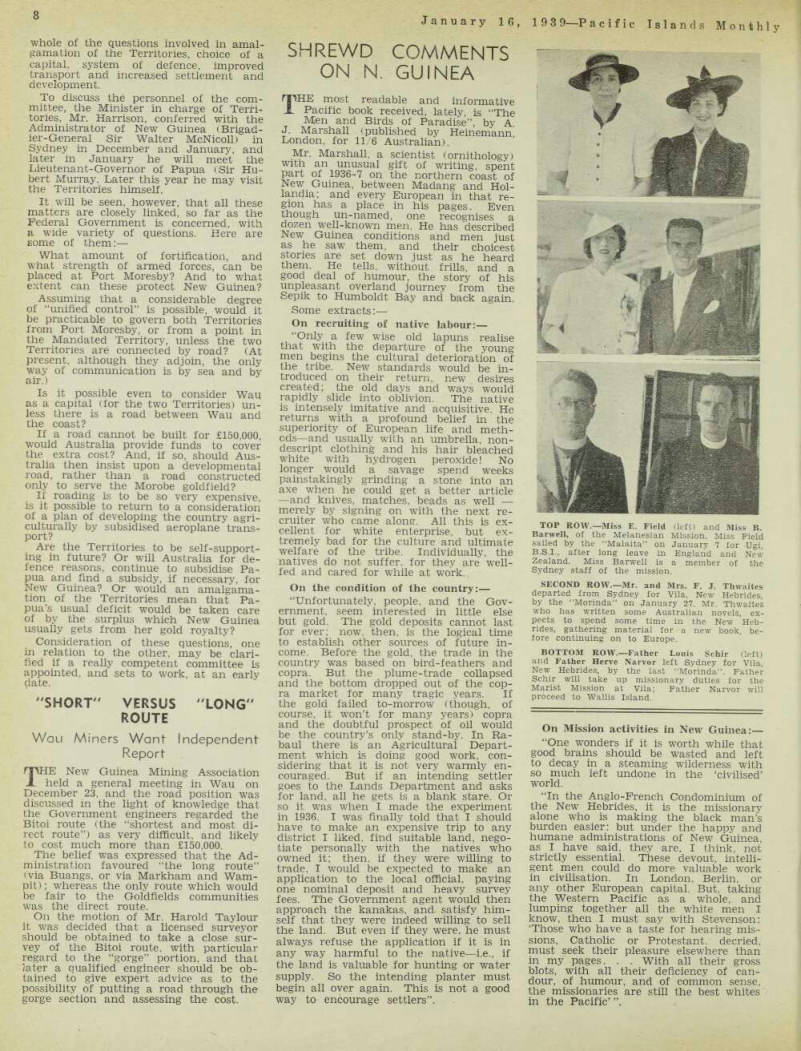
TOP ROW.—Miss E. Field (left) and Miss B.
Barwell, of the Melanesian Mission. Miss Field sailed by the “Malaita” on January 7 for Ugi, B.S.I. after long leave in England and New Zealand. Miss Barwell is a member of the Sydney staff of the mission.
SECOND ROW.—Mr. and Mrs. F. J. Thwaites departed from Sydney for Vila, New Hebrides, by the “Morinda” on January 27. Mr. Thwaites who has written some Australian novels, ex pects to spend some time in the New Heb rides, gathering material for a new book, be fore continuing on to Europe.
BOTTOM ROW.—Father Louis Schir (left) and Father Herve Narvor left Sydney for Vila, New Hebrides, by the last “Morinda”. Father Schir will take up missionary duties for the Marist Mission at Vila; Father Narvor will proceed to Wallis Island.