Christmas Is. —British Oh American?
pp. 13-14 · Read in the full issue
By Our Honolulu Corres pendent.
IN support of reports first published in the “P.1.M.” early in 1937, it seems that Christmas island, Brit ain’s mid-Pacific possession may be the next on America’s list of islands to be annexed, according to statements em anating from the Honolulu “annexation” office, which supervises the U.S. colonists upon Jarvis, Baker, Howland, Canton and Enderbury, the isles “annexed” since 1935 by America.
As a matter of fact, the local officials were surprised that Christmas was not “an nexed” before Canton and Enderbury were in March, 1938, because for long they have been gathering all the material they can about Christmas in obedience to a blanket order from Washing ton.
Christmas, 1,250 miles south of Honolulu, to-day is occupied commercially by a French copra company with headquarters in Tahiti, under lease from a British company.
Sovereignty of the island has oeen claimed by Great Brit ain many times.
H.M.S. “Leith”, of the New Zealand division of the Royal Navy, visited Christ mas in 1936, and a statement of British sovereignty was placed upon the island. In February, 1937, Mr. Oscar Barrack, a British radio op erator of Suva, was placed on Christmas, where permanent quarters were established.
Regular daily radio schedules are maintained by this British outpost with Suva and Ocean Island. In July, 1937, Mr.
Barrack was replaced by Mr.
William Cowie, also of Suva.
Sovereignty of Christmas has been discussed between Washington and London.
America bases her claim to Christmas on the grounds that it was “re-discovered” by an American whaler in 1857, after British subjects had occupied it. Later, a U.S. warship for mally announced American ownership; but, since then, British subjects again occu pied the island and established to-day’s copra plantations.
Of course, Captain James Cook “discovered” the tropic island on Christmas Day, 1777 —the very day that George
Washington and his army were complain ing about the lean, wintry conditions at historic Valley Forge.
Not much can be added to the volum inous records of Christmas. It is a skillet shaped island 40 miles long, 740,000 acres (200,000 of them arable) in area, 70,000 coconut palms, countless undulating dunes, billions of hermit crabs, swarms of wild cats that have multiplied from the many wrecks in the island’s famed Bay of Wrecks. The Tahitians employed in the copra industry to-day live in a couple of villages called London and Paris, at the entrance to the great lagoon that
is made to order for modern airboat pur poses. There are several landplane areas, too.
First aviation possibilities of Christ mas were expressed by the Australian aviator, Charles Ulm, who in 1934 dumped gasoline there in case he made an emer gency landing at Christmas on his ill fated attempt to fly from America to Aus tralia.
Besides Mr. Cowie, other white inhabi tants of Christmas are the plantation manager, Mr. Franta Jerabak, a Czecho slovakian, and his Austrian wife.
Significant fact about the American
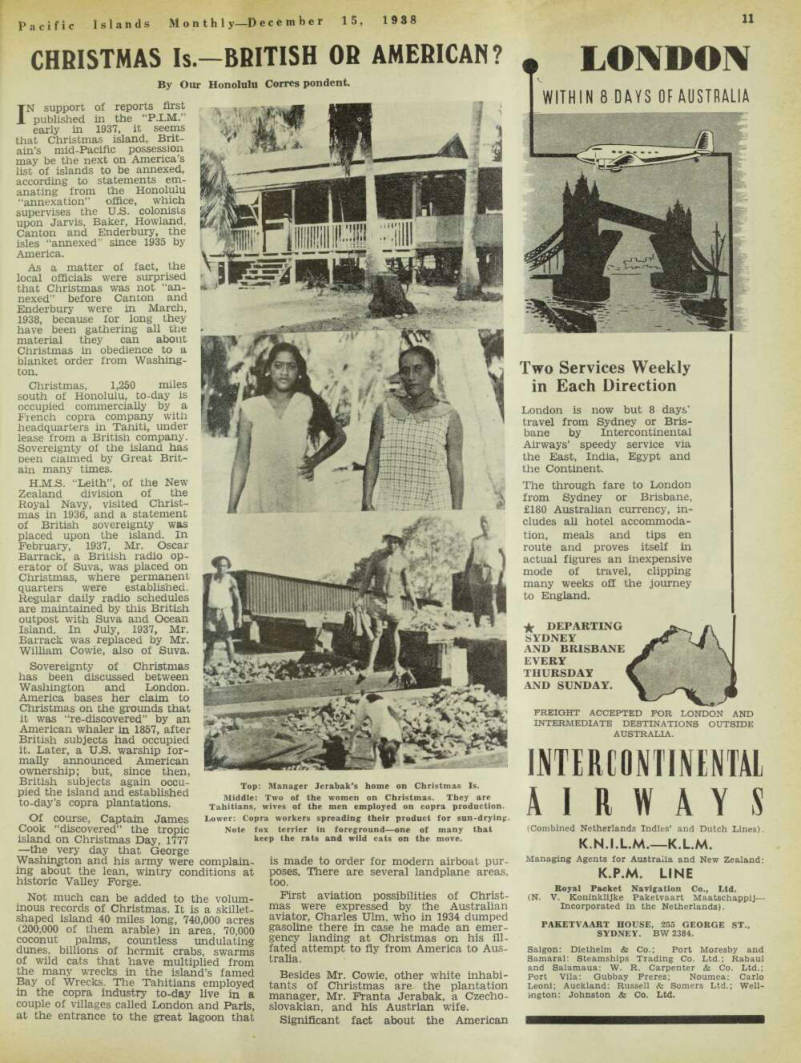
Top: Manager Jerabak’s home on Christmas Is.
Middle: Two of the women on Christmas. They are Tahitians, wives of the men employed on copra production.
Lower: Copra workers spreading their product for sun-drying.
Note fox terrier in foreground—one of many that keep the rats and wild cats on the move.
“annexation” of Pacific islands is that all the islands so far “annexed” were
generally recognised as belonging to Brit ain. This fact cannot be lost on Japan.
British Warship Busy In Central Pacific
(Published in Melbourne Herald on November 26.) Considerable speculation has been aroused concerning the visit to Fiji and other Pacific Islands by the New Zealand cruiser “Leander”, carrying Commodore H. E. Horan, chief of the New Zealand Naval Staff and Major-General J. E.
Duigan, chief of the General Staff.
It is an unusal period of the year for a warship to cruise in the Pacific, particu larly as it is believed that the “Leander’s” voyaging will take her into the hurri cane zone.
The names of the islands to be visited have been kept secret, but it is stated that Apia, and the cable station on Fan ning Island, will be included.
The cruiser arrived at Fiji on Novem ber 11. At the same time a senior Air Force officer arrived. The warship’s move ments and the date of her return to Auckland are unknown. The “Leander’s”
aeroplane has been very busy. It is re ported that work has been started on building an aerodrome in Fiji.
Proceeding from Fiji to an unstated destination, the “Leander” took a sur veyor, also a civil engineer. It is reported that they will be engaged in prelimmary work for the establishment of civil or military air bases at Christmas Island, or on other islands near the Equator.
The Fiji Government has chartered a motorship, it is believed for the purpose of transporting native labour to the is lands.
There is considerable speculation whether Fiji will eventually be used as a naval or Air Force outpost in connec tion with the scheme of Pacific defence.
Although it may be only a coincidence, Fiji’s new governor was previously Lieu tenant-Governor of Malta. He served as intelligence officer on the staff of Admiral Wemyss, was a political officer.
When H.M.S. “Leander” finally left Suva on November 7 she took with her Mr. C. Harlen, Staff Surveyor, of the Lands and Survey Department, and Mr.
R. B. Roberts, Junior Engineer, of the Public Works Department, together with a quantity of surveying equipment and supplies for several months. Their des tination, says “Fiji Herald”, has not been revealed.