"Aunt Selina" Of Norfolk
pp. 32-34 · Read in the full issue
Island
Last of the Pitcairn Ladies
OF the 194 Pitcairn Island inhabitants moved to Norfolk Island just over 80 years ago, only two are alive to-day —Mrs. Seymour Buffett (affectionately known by everyone on N.I. as “Aunt Selina”), aged 82, and Mr. Parkin Christian, 85. The following interesting account of a recent interview with Mrs.
Buffett appeared in a Sydney women’s journal recently:— ON June 8, 1856, the Pitcairners dis embarked from the “Morayshire”, the ship provided by the British Gov ernment to take them to N.I. Among the new arrivals there was a baby of a few months old in her mother’s arms, happily unconscious of all the bustle and excitement and trouble of landing. That baby, Marian Selina Buffett, and one other Parkin Christian, then a very young lad, alone survive of all those born on Pitcairn. They naturally have no recollection of their Pitcairn home, but they grew up in a Norfolk Island that does not exist to-day, and they re ceived first-hand accounts of the pre vious island home that their parents
had held so dear.
From the simplicity of housing on Pitcairn these people came to what to them must have seemed a magnificent city—hpuses, stores, churches, mills, plantations, well-made roads, and an ex cellent water mill and drainage system.
There is no other instance in modern
times where one society stepped straight into the habitation of another in this peaceful way. The first community, ex tremely simple, even primitive, having lived very close to Nature-the other, sophisticated, and having a settlement replete with all the comforts of that day perhaps more than the general comforts, because the governors of the settlement had at their disposal con vict labour to carry out advanced en gineering schemes which were beyond the means of most communities.
It was in this settlement that Marian Selina Buffett grew up, and to-day at 82 years of age she can tell of that Norfolk Island which is now in ruins.
She is Mrs. Seymour Buffett to-day, and in her home at Steele’s Point she gave us the kindly welcome that we had been led to expect from her. Upright, alert, she presided at her table, and as we drank tea she gradually unfolded the scroll of the years.
“I was just a bundle in my mother’s arms when we came”, she said. “But they always talked of Pitcairn in those days, so I feel as if I know it”.
“Tell us about when you were a child”, we begged.
“I would never stop”, she laughed. “Oh! but this was a fine place then. The houses were all lovely, and the gardens, beautiful. Every building was stately, even the prisons, and every house was beautifully furnished. We lived in King ston, and our farms were in the coun
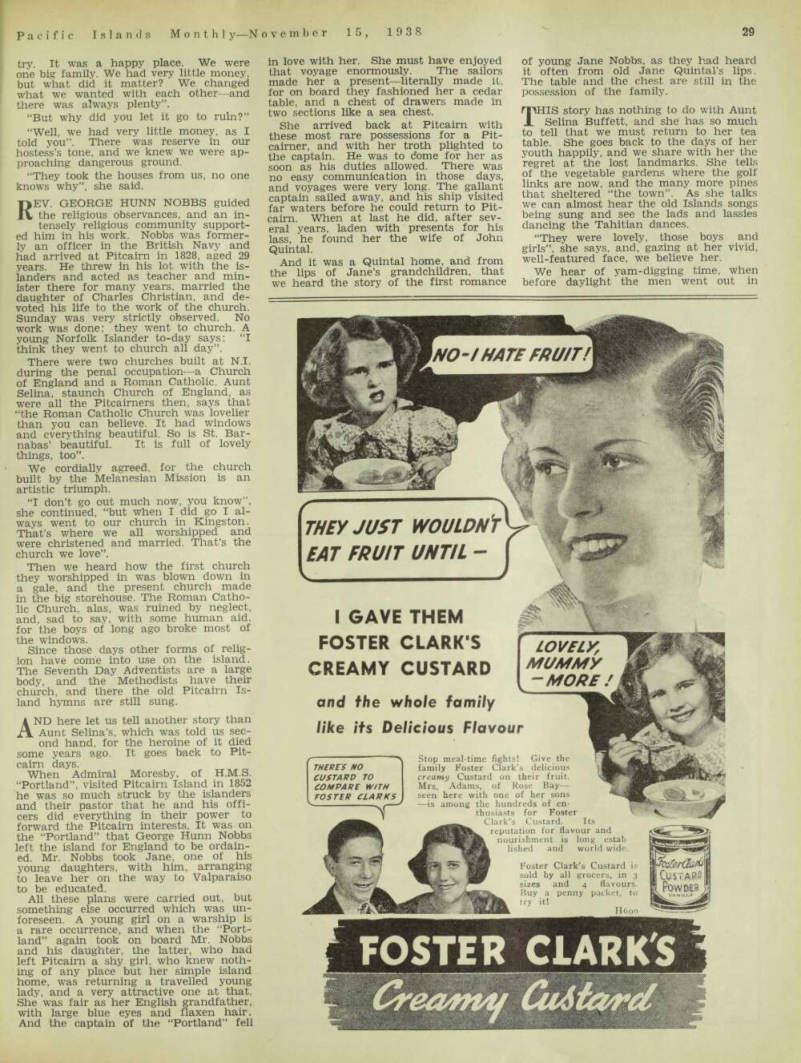
Mrs. Seymour Buffett (“Aunt Selina”) and Mr.
Parkin Christian—last of the Pitcairners, —Photo. “Australian Christian World”.
try. It was a happy place. We were one big family. We had very little money, but what did it matter? We changed what we wanted with each other—and there was always plenty”.
“But why did you let it go to ruin?”
“Well, we had very little money, as I told you”. There was reserve in our hostess’s tone, and we knew we were ap proaching dangerous ground.
“They took the houses from us, no one knows why”, she said.
Rev. George Hunn Nobbs Guided
the religious observances, and an in tensely religious community support ed him in his work. Nobbs was former ly an officer in the British Navy and had arrived at Pitcairn in 1828, aged 29 years. He threw in his lot with the is landers and acted as teacher and min ister there for many years, married the daughter of Charles Christian, and de voted his life to the work of the church.
Sunday was very strictly observed. No work was done; they went to church. A young Norfolk Islander to-day says: “I think they went to church all day”.
There were two churches built at N.I. during the penal occupation—a Church of England and a Roman Catholic. Aunt Selina, staunch Church of England, as were all the Pitcairners then, says that “the Roman Catholic Church was lovelier than you can believe. It had windows and everything beautiful. So is St. Bar nabas’ beautiful. It is full of lovely things, too”.
We cordially agreed, for the church built by the Melanesian Mission is an artistic triumph.
“I don’t go out much now, you know”, she continued, “but when I did go I al ways went to our church in Kingston.
That’s where we all worshipped and were christened and married. That’s the church we love”.
Then we heard how the first church they worshipped in was blown down in a gale, and the present church made in the big storehouse. The Roman Catho lic Church, alas, was ruined by neglect, and, sad to say, with some human aid. for the boys of long ago broke most of the windows.
Since those days other forms of relig ion have come into use on the island.
The Seventh Day Adventists are a large body, and the Methodists have their church, and there the old Pitcairn Is land hymns are- still sung.
AND here let us tell another story than Aunt Selina’s, which was told us sec ond hand, for the heroine of it died some years ago. It goes back to Pit cairn days.
When Admiral Moresby, of H.M.S.
“Portland”, visited Pitcairn Island in 1852 he was so much struck by the islanders and their pastor that he and his offi cers did everything in their power to forward the Pitcairn interests. It was on the “Portland” tljat George Hunn Nobbs left the island for England to be ordain ed. Mr. Nobbs took Jane, one of his young daughters, with him, arranging to leave her on the way to Valparaiso to be educated.
All these plans were carried out, but something else occurred which was un foreseen. A young girl on a warship is a rare occurrence, and when the “Port land” again took on board Mr. Nobbs and his daughter, the latter, who had left Pitcairn a shy girl, who knew noth ing of any place but her simple island home, was returning a travelled young lady, and a very attractive one at that.
She was fair as her English grandfather, with large blue eyes and flaxen hair.
And the captain of the “Portland” fell
in love with her. She must have enjoyed that voyage enormously. The sailors made her a present—literally made it. for on board they fashioned her a cedar table, and a chest of drawers made in two sections like a sea chest.
She arrived back at Pitcairn with these most rare possessions for a Pit cairner, and with her troth plighted to the captain. He was to dome for her as soon as his duties allowed. There was no easy communication in those days, and voyages were very long. The gallant captain sailed away, and his ship visited far waters before he could return to Pit cairn. When at last he did, after sev eral years, laden with presents for his lass, he found her the wife of John Quintal.
And it was a Quintal home, and from the lips of Jane’s grandchildren, that we heard the story of the first romance
of young Jane Nobbs, as they had heard it often from old Jane Quintal’s lips.
The table and the chest are still in the possession of the family.
THIS story has nothing to do with Aunt Selina Buffett, and she has so much to tell that we must return to her tea table. She goes back to the days of her youth happily, and we share with her the regret at the lost landmarks. She tells of the vegetable gardens where the golf links are now, and the many more pines that sheltered “the town”. As she talks we can almost hear the old Islands songs being sung and see the lads and lassies dancing the Tahitian dances.
“They were lovely, those boys and girls”, she says, and, gazing at her vivid, well-featured face, we believe her.
We hear of yam-digging time, when before daylight the men went out in
whaleboats and brought in loads of fish.
The women in the meantime made cook ing fires near the yam fields, and when the fish arrived they cooked it and pre pared a sumptuous feast. As well as the fish there were pork, black puddings, and savoury stews. The whole affair was a glorious picnic. In the evening they danced their graceful dances derived from their Tahitian foremothers with traces of their forefathers’ sailor dances inter mixed.
“Bounty” Day
“It was something like paradise then”, Aunt Selina says, and there was the sad ness of loss in her voice.
But she is too sturdy, this old lady of 82, to spend her time in regrets. There is some of the old fun and laughter in her voice as she tells of weddings and the wonderful celebrations which used to take place on “Bounty Day".
“They shouldn’t drop that”, she says severely. ‘ You keep up Anniversary Day in Syd ney, and ‘Bounty Day’ is the same here, and should be kept up”. We heartily agreed.
We told Aunt Selina that we had been to the school-house to see the wonderful model of the “Bounty” made by Mr. W.
Allen, and we also told her that the “Bounty” gun, which lies neglected in front of the courthouse, merits more shelter and care.
“Any museum in the world would like to have that”, we remarked.
“But they can’t have it; it’s ours”, she responded sturdily.
Which is quite true. It belongs to the Norfolk Islanders, once the Pitcairners, and before that the “Bounty” mutineers.
Perhaps, they will gather it, and the few other remaining “Bounty” treasures, and the old, almost unique, convict treasures, in a museum of their own some day.