Lae May Be Chosen
How Otherwise Explain Public Works Activity in N. Guinea?
AN extraordinary situation exists in regard to the selection of a new capi tal for New Guinea, and the con struction of a road to connect the Mo robe goldfield towns with the port of Salamaua.
Officially nothing has been done since Mr. Hughes, four months ago, rejected the Griffiths Committee’s recommenda tion of Lae, and then saw his own selec tion of Salamaua rejected by the Com monwealth Government.
Repeatedly, right up until he lost the administration of Pacific Territories, in the Cabinet re-shuffle at the beginning of November, he told frequent inquirers that the “search for a new capital was proceeding diligently”, and that the sur veys of four or five alternative routes for the proposed roads were nearing com pletion. He indicated, on October 18, that the Middle Bitoi route (practically direct from Salamaua to Wau) was fav oured.
But nothing has been done—officially.
The Administrator has gone away on four months’ leave, and Canberra, when asked questions, is merely evasive.
It was assumed by many that Canberra is stalling for time, being unwilling to undertake heavy expenditure in New Guinea until it could be sure that it would hold control of New Guinea. A more likely explanation is that Canberra finds itself embarrassed by the need for providing a large portion of the £500,000, which is the estimated cost of the new administrative establishment.
In Favour Of Wau
In these circumstances, there has been pressure in favour of the selection of
Wau. It is pointed out that, if the road is built between Wau and Salamaua (.the linance for which is being provided by me big companies in what is virtually a compulsory loan), the administrative es tablishment could be placed quickly and very much more cheaply at Wau, where a town system already is in existence, and has not to be carved out of the jungle.
But, in the meantime, there has been extraordinary and unexpected activity at Lae (the original choice of the Griffiths Committee).
Our correspondent at Lae reports that, since early October, there have been surveyors and chainmen, assisted by teams of native labourers, at work there. “Traverses”, he .says, “have been run everywhere”. He further reports:— The new capital design is like a spid er’s web, the headquarters being in the middle (for the flies to walk in!) and roads radiating from it. One may call it wheel-shaped.
Writing by airmail on November 10, he says:— “There are now six surveyors busy at Lae, each with a gang of boys.
“The construction of the Markham road (from Lae up the Markham) is now proceeding seriously, and all the ma terial is on the job for the necessary bridges. We now can drive five miles up this road, over temporary bridges.
“There will be a deviation of this road, about 5i miles out of Lae, towards the proposed bridge-head, over the Markham River (from which point, ac cording to the Griffiths plan, the road will run along the coast 18 miles to Salamaua).
“Some of the surveyors, in conversa tion, have praised the suitableness of this Lae area for the purpose of laying out a town.
“A representative of the Department of Forests is also here at present, look ing into the timber position”.
The foregoing indicates that, whatever Canberra may think and say, tne New Guinea administration is very much on the job, and is doing everything possible in the way of preparation. Once Can berra can make up its mind, no time will be lost in New Guinea.
Problem Of The Road
Probably, if Lae is favoured, the real problem is the route of the road. Can berra. undoubtedly, wants to get on with the development of New Guinea. If the road goes direct from Salamaua to Wau (and thus gives the goldfield cheaper transport), and the capital is at Lae, then communication with Central New Guinea will have to be either — (a) Along the proposed coastal road to Salamaua; then over the new direct mountain road to the Bulolo Valley; thence via the Watut, by a new road, to the Upper Markham —a circuitous and expensive arrangement, so far as Cen tral New Guinea is concerned. (b) By a new road to be built straight up the Markham Valley into Central New Guinea, ignoring the Lae-Salamaua and the Salamaua-Wau roads.
It is a headache for the authorities.
They may seek to compromise by adopt ing the Buangs route for the Wau-Sala maua road. It is longer than the Mid dle Bitoi route, and would be correspond ingly more expensive for freighting: but it would serve the need for a Lae-Cen tral New Guinea route, as well as pro viding road communication between the goldfield and Salamaua. The Wau miners, however, seem determined to demand the shortest and cheapest route
(Bitoi, or thereabouts): and the action of the New Guinea Administration in mop ping up about £400,000 of gold royalties, during the past ten years, instead of using the money for reading, as orig inally intended, gives the miners now a strong claim for special consideration.
Miss M. Hodge, of the Methodist Mis sion, Salamo, Papua, is now in Sydney on leave.
Lieut.-Colonel Neville Sneyd Bertie Clay died at his residence in Papara, Tahiti, on October 17, aged 74. The greater part of Colonel Clay’s military career was passed in India. When he retired, after distinguished service, he settled in Tahiti. He was greatly re spected and beloved by those who knew him intimately. His passing has taken from the British colony at Tahiti one of its most valued and esteemed mem bers.
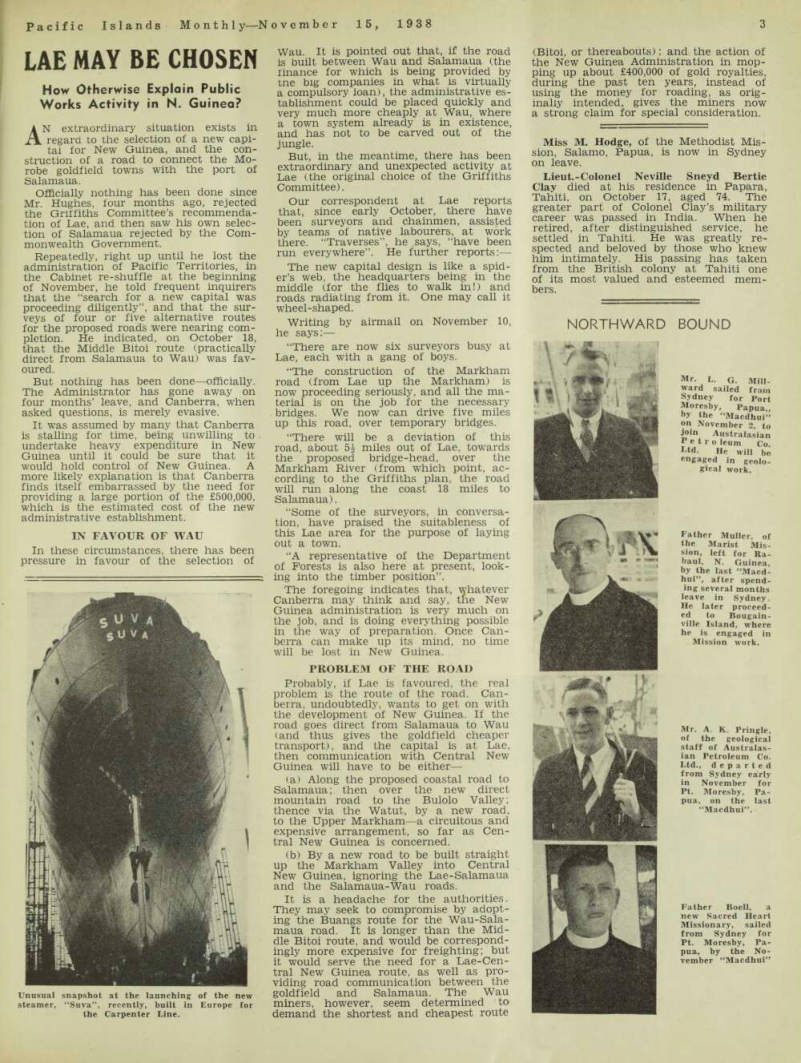
Unasual snapshot at the launching of the new steamer, “Suva”, recently, built in Europe for the Carpenter Line.