A Food
p. 37 · Read in the full issue
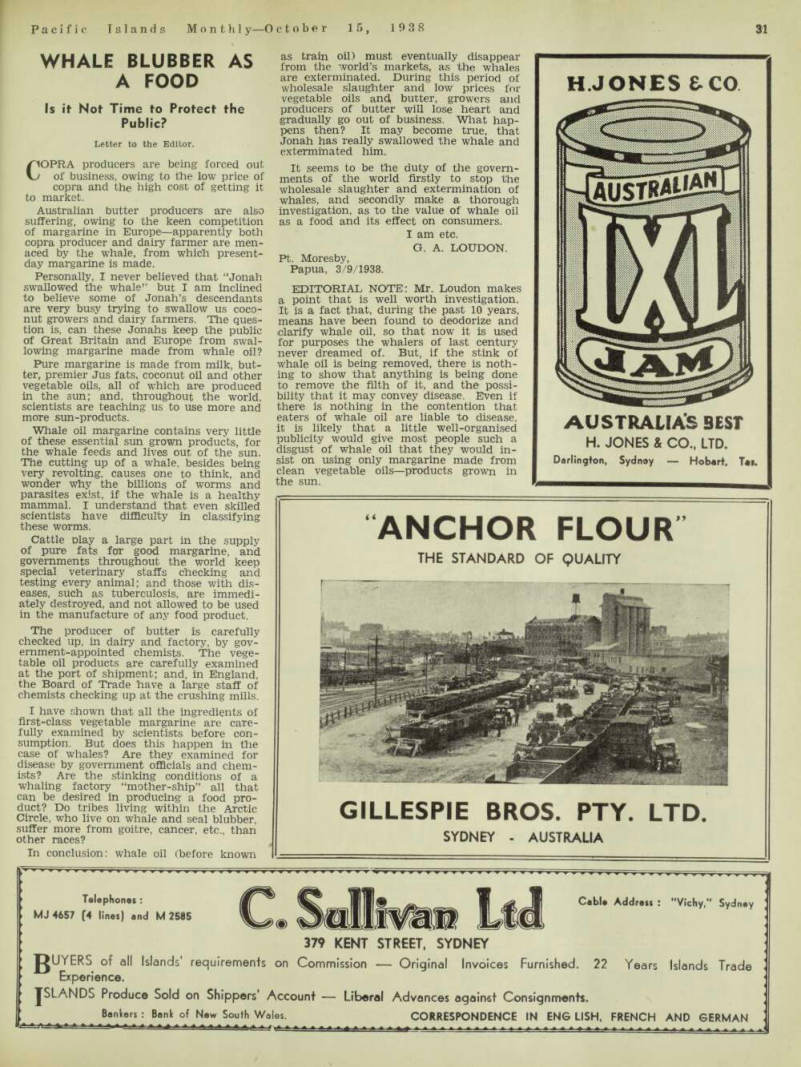
Whale Blubber As
Is it Not Time to Protect the Public?
Letter to the Editor.
COPRA producers are being forced out of business, owing to the low price of copra and the high cost of getting it to market.
Australian butter producers are also suffering, owing to the keen competition of margarine in Europe—apparently both copra producer and dairy farmer are men aced by the whale, from which present day margarine is made.
Personally, I never believed that “Jonah swallowed the whale” but I am inclined to believe some of Jonah’s descendants are very busy trying to swallow us coco nut growers and dairy farmers. The ques tion is, can these Jonahs keep the public of Great Britain and Europe from swal lowing margarine made from whale oil?
Pure margarine is made from milk, but ter, premier Jus fats, coconut oil and other vegetable oils, all of which are produced in the sun; and, throughout the world, scientists are teaching us to use more and more sun-products.
Whale oil margarine contains very little of these essential sun grown products, for the whale feeds and lives out of the sun.
The cutting up of a whale, besides being very revolting, causes one to think, and wonder why the billions of worms and parasites exist, if the whale is a healthy mammal. I understand that even skilled scientists have difficulty in classifying these worms.
Cattle play a large part in the supply of pure fats for good margarine, and governments throughout the world keep special veterinary staffs checking and testing every animal; and those with dis eases, such as tuberculosis, are immedi ately destroyed, and not allowed to be used in the manufacture of any food product.
The producer of butter is carefully checked up, in dairy and factory, by gov ernment-appointed chemists. The vege table oil products are carefully examined at the port of shipment; and, in England, the Board of Trade have a large staff of chemists checking up at the crushing mills.
I have shown that all the ingredients of first-class vegetable margarine are care fully examined by scientists before con sumption. But does this happen in the case of whales? Are they examined for disease by government officials and chem ists? Are the stinking conditions of a whaling factory “mother-ship” all that can be desired in producing a food pro duct? Do tribes living within the Arctic Circle, who live on whale and seal blubber, suffer more from goitre, cancer, etc., than other races?
In conclusion: whale oil (before known
as train oil) must eventually disappear from the world’s markets, as the whales are exterminated. During this period of wholesale slaughter and low prices for vegetable oils and, butter, growers and producers of butter will lose heart and gradually go out of business. What hap pens then? It may become true, that Jonah has really swallowed the whale and exterminated him.
It seems to be the duty of the govern ments of the world firstly to stop the wholesale slaughter and extermination of whales, and secondly make a thorough investigation, as to the value of whale oil as a food and its effect on consumers.
I am etc.
G. A. Loudon.
Pt. Moresby, Papua, 3/9/1938.
EDITORIAL NOTE: Mr. Loudon makes a point that is well worth investigation.
It is a fact that, during the past 10 years, means have been found to deodorize and clarify whale oil, so that now it is used for purposes the whalers of last century never dreamed of. But, if the stink of whale oil is being removed, there is noth ing to show that anything is being done to remove the filth of it, and the possi bility that it may convey disease. Even if there is nothing in the contention that eaters of whale oil are liable to disease, it is likely that a little well-organised publicity would give most people such a disgust of whale oil that they would in sist on using only margarine made from clean vegetable oils—products grown in the sun.