A Famous Light
p. 34 · Read in the full issue
Prom Our Own Correspondent.
, Papeete, Sept. 20.
r|\HE mariner sailing close in to Tahiti, J. along its northern shore after night * sees ou^ine d against the splendour of the stars, the towering twin peaks of and, at its base, a brilliant point of light. By this light he can correct his
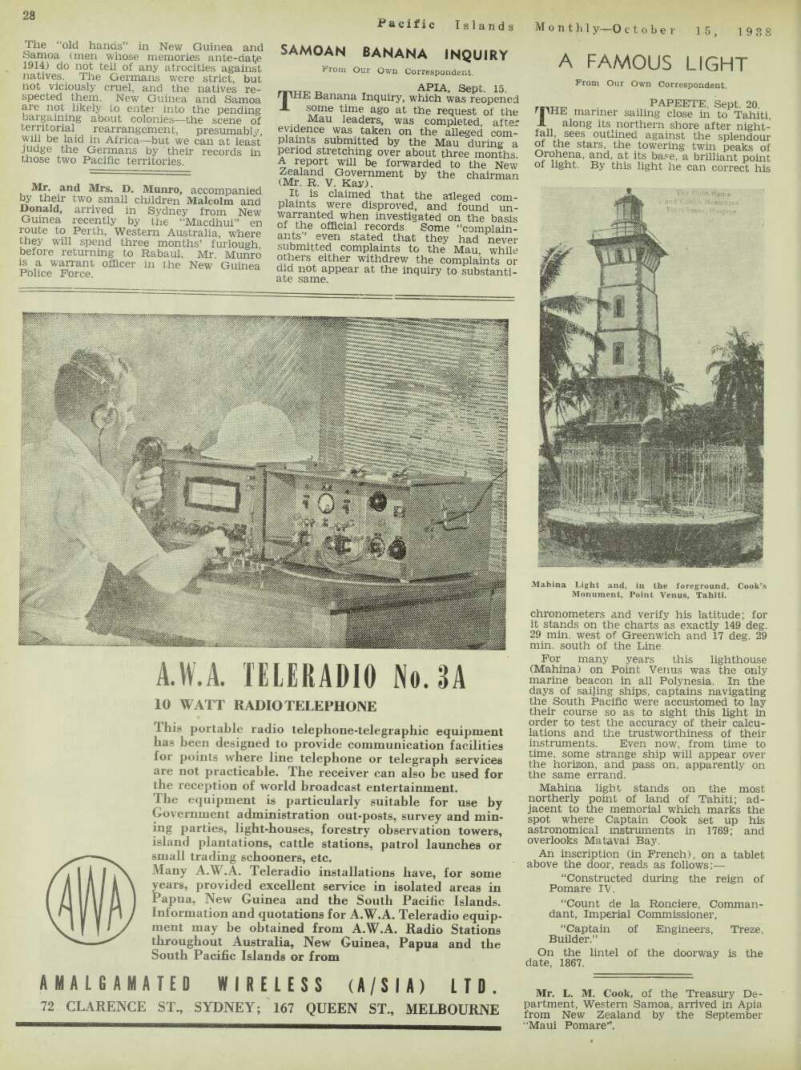
chronometers and verify his latitude; for it stands on the charts as exactly 149 deg. 29 min. west of Greenwich and 17 deg. 29 min. south of the Line For many years this lighthouse (Mahina) on Point Venus was the only marine beacon in all Polynesia. In the days of sailing ships, captains navigating the South Pacific were accustomed to lay their course so as to sight this light in order to test the accuracy of their calcu lations and the trustworthiness of their instruments. Even now, from time to time, some strange ship will appear over the horizon, and pass on, apparently on the same errand.
Mahina light stands on the most northerly point of land of Tahiti; ad jacent to the memorial which marks the spot where Captain Cook set up his astronomical instruments in 1769; and overlooks Matavai Bay.
An inscription (in French), on a tablet above the door, reads as follows: “Constructed during the reign of Pomare IV.
“Count de la Ronciere, Comman dant, Imperial Commissioner, “Captain of Engineers, Treze, Builder.”
On the lintel of the doorway is the date, 1867.
Mr. L, M. Cook, of the Treasury De partment, Western Samoa, arrived in Apia from New Zealand by the September “Maui Pomare”.
Mahina Light and, in the foreground, Cook’s Monument, Point Venus, Tahiti.