Dwight Long’S Adventures
pp. 24-27 · Read in the full issue


Under Arrest in Spain—Meets Tahitian in Madeira
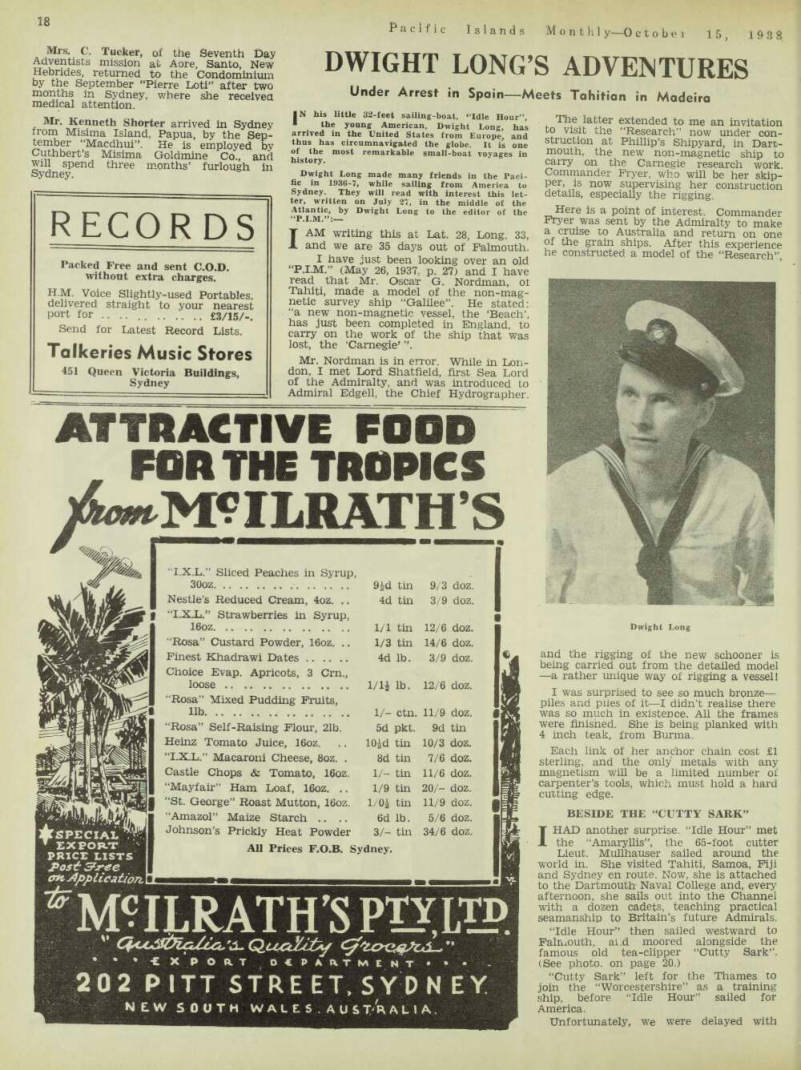
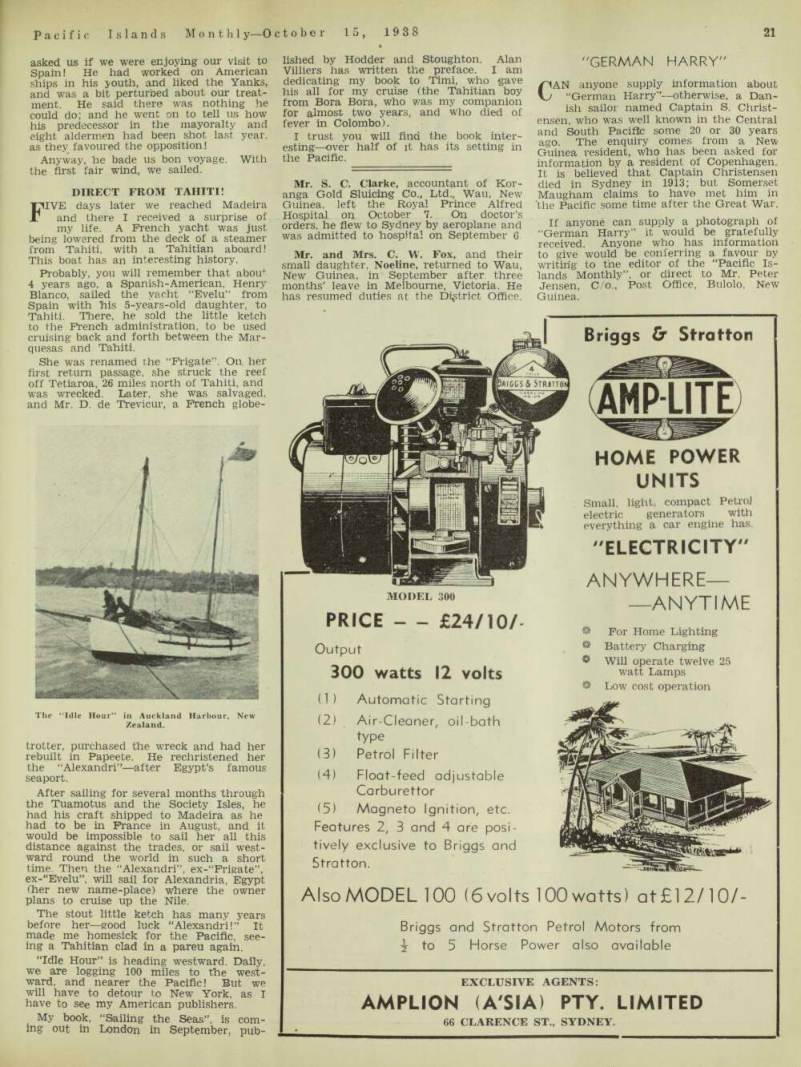
■ N his little 32-feet sailing-boat, “Idle Hour”, ■ the young American, Dwight Long, has arrived in the United States from Europe, and thus has circumnavigated the globe. It is one of the most remarkable small-boat voyages in history.
Dwight Long made many friends in the Paci fic in 1936-7, while sailing from America to Sydney. They will read with interest this let ter, written on July 27, in the middle of the Atlantic, by Dwight Long to the editor of the
‘‘P.I.M.”:—
I AM writing this at Lat. 28, Long. 33, and we are 35 days out of Falmouth.
I have just been looking over an old “P.1.M.” (May 26, 1937, p. 27) and I have read that Mr. Oscar G. Nordman, of Tahiti, made a model of the non-mag netic survey ship “Galilee”. He stated: “a new non-magnetic vessel, the ‘Beach’, has just been completed in England, to carry on the work of the ship that was lost, the ‘Carnegie’
Mr. Nordman is in error. While in Lon don, I met Lord Shatfield, first Sea Lord of the Admiralty, and was introduced to Admiral Edgell, the Chief Hydrographer.
The latter extended to me an invitation to visit the “Research” now under con struction at Phillip’s Shipyard, in Dart mouth, the new non-magnetic ship to carry on the Carnegie research work.
Commander Fryer, who will be her skip per, is now supervising her construction details, especially the rigging.
Ilere is a point of interest. Commander Fryer was sent by the Admiralty to make a cruise to Australia and return on one of the grain ships. After this experience he constructed a model of the “Research”.
and the rigging of the new schooner is being carried out from the detailed model —a rather unique way of rigging a vessel!
I was surprised to see so much bronze — piles and piles of it—l didn’t realise there was so much in existence. All the frames were finished. She is being planked with 4 inch teak, from Burma.
Each link of her anchor chain cost £1 sterling, and the only metals with any magnetism will be a limited number of carpenter’s tools, which must hold a hard cutting edge.
Beside The “Cutty Sark”
IHAD another surprise. “Idle Hour” met the “Amaryllis”, the 65-foot cutter Lieut. Mullhauser sailed around the world in. She visited Tahiti, Samoa, Fiji and Sydney en route. Now, she is attached to the Dartmouth Naval College and, every afternoon, she sails out into the Channel with a dozen cadets, teaching practical seamanship to Britain’s future Admirals.
“Idle Hour” then sailed westward to Falmouth, ai.d moored alongside the famous old tea-clipper “Cutty Sark”. (See photo, on page 20.) “Cutty Sark” left for the Thames to join the “Worcestershire” as a training ship, before “Idle Hour” sailed for America.
Unfortunately, we were delayed with
Dwight Long
many repairs, and did not get away with the north-west prevailing winds down the channel.
When we finally did get under way, we had head winds, and weTe two weeks beating into the Bay of Biscay. I de
neacuanas, and make more to windward
where the seas were not so high and steep. But no—we could find no lee, as the wind had veered north of west.
Under Arrest In Spain
THEN came the black night of July 2.
“Idle Hour” was hailed by a ship with no lights—one of Franco’s gun boats !
We were ordered into port. “Idle Hour” was searched from stem to stern. We were taken ashore as “prisoners of war”.
A detachment of armed soldiers awaited us on the jetty. Paraded, between Franco’s storm-troopers, with cocked
rifles, we were taken to an army truck and ordered aboard.
As we drove away, I wondered when I would see “Idle Hour” again? Finally,, we arrived at the village of Barcadero.
Here a telegram was despatched. We were taken to the marine police. “Idle Hour’s” crew were grilled.
I later learned that a small cutter, with a couple of Frenchmen, was suspected of trying to land and then make for Franco’s headquarters, in order to assassinate him.
We fitted the description admirably!
Another telephone call was made. A de bate ensued between a captain of the local police, an army corporal and the local constable—our fate was in the bal ance.
With Latin efficiency, they haggled for hours. We waited, and waited.
A decision was finally reached, when a telegram arrived.
Between armed guards my companion and I were paraded through the streets to the jetty. A boat was launched and we were taken to “Idle Hour” by water.
We were given instructions not to land, as soldiers were to be stationed on the beach, with instructions to prevent our landing—to shoot, if necessary!
We couldn’t sail, as the wind was dead against us. There we were, virtually prisoners of war, aboard the “Idle Hour’ over July 4. our Independence Day, with a firing squad stationed ashore to re ceive us!
Then came a sort of anti-climax. The mayor came in from a fishing trip, in his private launch. He boarded the “prisoner ship” and, ignorant of our predicament,
The “Idle Hour” lying beside the famous clipper “Cutty Sark”, in Falmouth, England.
asked us if we were enjoying our visit to Spain! He had worked on American ships in his youth, and liked the Yanks, and was a bit perturbed about our treat ment. He said there was nothing he could do; and he went on to tell us how his predecessor in the mayoralty and eight aldermen had been shot last year, as they favoured the opposition!
Anyway, he bade us bon voyage. With the first fair wind, we sailed.
Direct From Tahiti!
FIVE days later we reached Madeira and there I received a surprise of my life. A French yacht was just being lowered from the deck of a steamer from Tahiti, with a Tahitian aboard!
This boat has an interesting history.
Probably, you will remember that about 4 years ago, a Spanish-American, Henry Blanco, sailed the yacht “Evelu” from Spain with his 5-years-old daughter, to Tahiti. There, he sold the little ketch to the French administration, to be used cruising back and forth between the Mar quesas and Tahiti.
She was renamed the “Frigate”. On her first return passage, she struck the reef off Tetiaroa, 26 miles north of Tahiti, and was wrecked. Later, she was salvaged, and Mr. D. de Trevicur, a French globe-
trotter, purchased the wreck and had her rebuilt in Papeete. He rechristened her the “Alexandri”—after Egypt’s famous seaport.
After sailing for several months through the Tuamotus and the Society Isles, he had his craft shipped to Madeira as he had to be in Prance in August, and it would be impossible to sail her all this distance against the trades, or sail west ward round the world in such a short time. Then the “Alexandri”, ex-“ Frigate”, ex-“Evelu”, will sail for Alexandria. Egypt (her new name-place) where the owner plans to cruise up the Nile.
The stout little ketch has many years before her—good luck “Alexandri!” It made me homesick for the Pacific, see ing a Tahitian clad in a pareu again.
“Idle Hour” is heading westward. Daily, we are logging 100 miles to the west ward, and nearer the Pacific! But we will have to detour to New York, as I have to see my American publishers.
My book, “Sailing the Seas”, is com ing out in London in September, pub
lished by Hodder and Stoughton. Alan Villiers has written the preface. I am dedicating my book to Timi, who gave his all for my cruise (the Tahitian boy from Bora Bora, who was my companion for almost two years, and who died of fever in Colombo).
I trust you will find the book inter esting—over half of it has its setting in the Pacific.
Mr. S. C. Clarke, accountant of Kor anga Gold Sluicing Co., Ltd., Wau, New Guinea, left the Royal Prince Alfred Hospital on October 7. On doctor’s orders, he flew to Sydney by aeroplane and was admitted to hospital on September 6 Mr. and Mrs. C. W. Fox, and their small daughter, Noeline, returned to Wau, New Guinea, in September after three months’ leave in Melbourne, Victoria. He has resumed duties at the District Office.
The “Idle Hour” in Auckland Harbour, New Zealand.