Australia
p. 16 · Read in the full issue
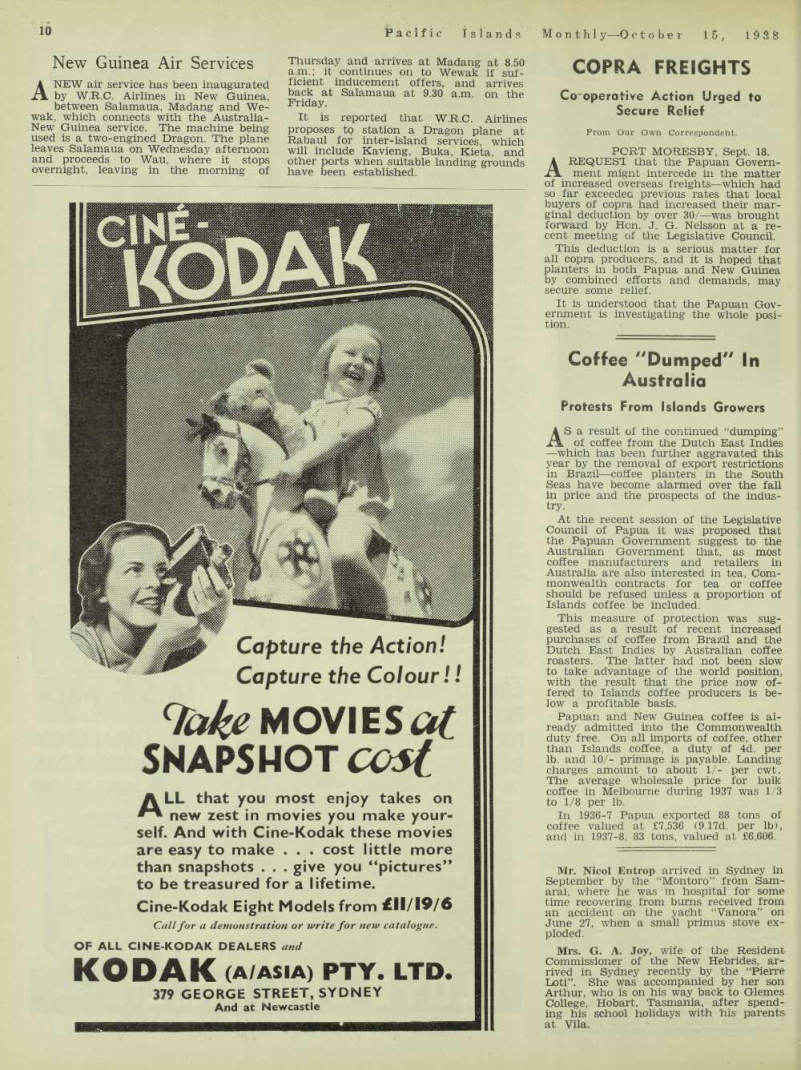
Coffee "Dumped" In Australia Protests From (stands Growers
AS a result of the continued “dumping” of coffee from the Dutch East Indies —which has been further aggravated this year by the removal of export restrictions in Brazil —coffee planters in the South Seas have become alarmed over the fall in price and the prospects of the indus try.
At the recent session of the Legislative Council of Papua it was proposed that the Papuan Government suggest to the Australian Government that, as most coffee manufacturers and retailers in Australia are also interested in tea, Com monwealth contracts for tea or coffee should be refused unless a proportion of Islands coffee be included.
This measure of protection was sug gested as a result of recent increased purchases of coffee from Brazil and the Dutch East Indies by Australian coffee roasters. The latter had not been slow to take advantage of the world position, with the result that the price now of fered to Islands coffee producers is be low a profitable basis.
Papuan and New Guinea coffee is al ready admitted into the Commonwealth duty free. On all imports of coffee, other than Islands coffee, a duty of 4d. per lb. and 10/- primage is payable. Landing charges amount to about 1/- per cwt.
The average wholesale price for bulk coffee in Melbourne during 1937 was 1/3 to 1/8 per lb.
In 1936-7 Papua exported 88 tons of coffee valued at £7,536 (9.17 d. per lb), and in 1937-8, 83 tons, valued at £6,606, Mr. Nicol Entrop arrived in Sydney in September by the “Montoro” from Sam arai, where he was in hospital for some time recovering from bums received from an accident on the yacht “Vanora” on June 27, when a small primus stove ex ploded.
Mrs. G. A. Joy, wife of the Resident Commissioner of the New Hebrides, ar rived in Sydney recently by the “Pierre Loti”. She was accompanied by her son Arthur, who is on his way back to Glemes College, Hobart, Tasmania, after spend ing his school holidays with his parents at Vila.