Tropicalities
p. 13 · Read in the full issue
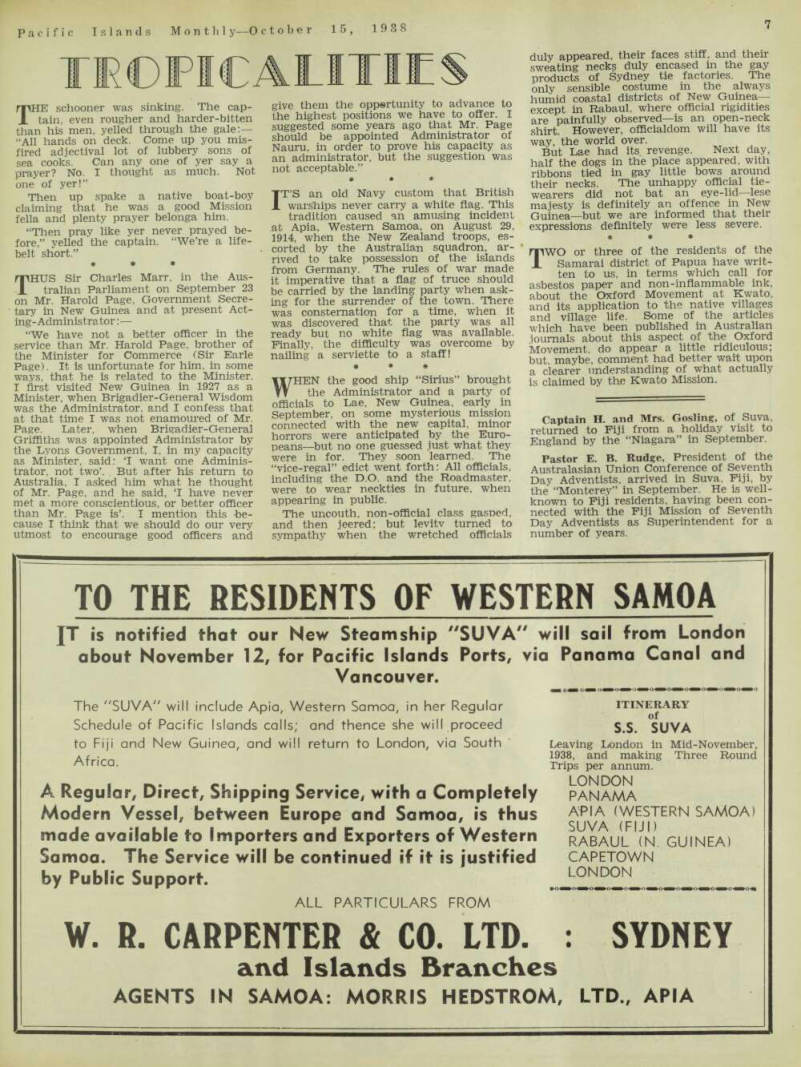
THE schooner was sinking. The cap tain, even rougher and harder-bitten than his men, yelled through the gale:— “All hands on deck. Come up you mis fired adjectival lot of lubbery sons of sea cooks. Can any one of yer say a prayer? No. I thought as much. Not one of yer!”
Then up spake a native boat-boy claiming that he was a good Mission fella and plenty prayer belonga him.
“Then pray like yer never prayed be fore,” yelled the captain. “We’re a life belt short.” ♦ ♦ ♦ THUS Sir Charles Marr, in the Aus tralian Parliament on September 23 on Mr. Harold Page, Government Secre tary in New Guinea and at present Act
ing-Administrator :
“We have not a better officer in the service than Mr. Harold Page, brother of the Minister for Commerce (Sir Earle Page). It is unfortunate for him, in some ways, that he is related to the Minister.
I first visited New Guinea in 1927 as a Minister, when Brigadier-General Wisdom was the Administrator, and I confess that at that time I was not enamoured of Mr.
Page. Later, when Brigadier-General Griffiths was appointed Administrator by the Lyons Government, I, in my capacity as Minister, said: T want one Adminis trator, not two’. But after his return to Australia, I asked him what he thought of Mr. Page, and he said, T have never met a more conscientious, or better officer than Mr. Page is’. I mention this be cause I think that we should do our very utmost to encourage good officers and
give them the opportunity to advance to the highest positions we have to offer. I suggested some years ago that Mr. Page should be appointed Administrator of Nauru, in order to prove his capacity as an administrator, but the suggestion was not acceptable.” * * * IT’S an old Navy custom that British warships never carry a white flag. This tradition caused an amusing incident at Apia, Western Samoa, on August 29, 1914, when the New Zealand troops, es corted by the Australian squadron, ar rived to take possession of the islands from Germany. The rules of war made it imperative that a flag of truce should be carried by the landing party when ask ing for the surrender of the town. There was consternation for a time, when it was discovered that the party was all ready but no white flag was available.
Finally, the difficulty was overcome by nailing a serviette to a staff! * * * WHEN the good ship “Sirius” brought the Administrator and a party of officials to Lae, New Guinea, early in September, on some mysterious mission connected with the new capital, minor horrors were anticipated by the Euro peans—but no one guessed just what they were in for. They soon learned. The “vice-regal” edict went forth: All officials, including the D.O. and the Roadmaster, were to wear neckties in future, when appearing in public.
The uncouth, non-official class gasned, and then jeered: but levitv turned to sympathy when the wretched officials
duly appeared, their faces stiff, and their sweating necks duly encased in the gay products of Sydney tie factories. The only sensible costume in the always humid coastal districts of New Guinea— except in Rabaul, where official rigidities are painfully observed—is an open-neck shirt. However, officialdom will have its way, the world over.
But Lae had its revenge. Next day, half the dogs in the place appeared, with ribbons tied in gay little bows around their necks. The unhappy official tie wearers did not bat an eye-lid—lese majesty is definitely an offence in New Guinea —but we are informed that their expressions definitely were less severe. ♦ * ♦ TWO or three of the residents of the Samarai district of Papua have writ ten to us, in terms which call for asbestos paper and non-inflammable ink, about the Oxford Movement at Kwato, and its application to the native villages and village life. Some of the articles which have been published in Australian journals about this aspect of the Oxford Movement, do appear a little ridiculous; but, maybe, comment had better wait upon a clearer understanding of what actually is claimed by the Kwato Mission.
Captain H. and Mrs. Gosling, of Suva, returned to Fiji from a holiday visit to England by the “Niagara” in September.
Pastor E. B. Rudge, President of the Australasian Union Conference of Seventh Day Adventists, arrived in Suva, Fiji, by the “Monterey” in September. He is well known to Fiji residents, having been con nected with the Fiji Mission of Seventh Day Adventists as Superintendent for a number of years.