Effect on Pacific of Agreement in Europe
pp. 5-6 · Read in the full issue
THE far-reaching changes in inter national relationships that occurred between September 15 and 30 will affect the Pacific Territories, politically and economically.
The threat of war in Western Europe has been removed completely—for the present, at any rate. This almost cer tainly will react upon the world’s stock exchanges and commodity markets; a re turn of confidence in the future will allow freer operation, and prices generally should rise.
But a factor, on the other side, lies in the armaments position. As the threat of war diminishes, expenditure on arma ments will decrease and, then, only inter national action of a new and drastic kind will prevent a slump.
Most people, now, can see that world recovery from the depression was aided enormously by the armaments race. The main cause of the depression still exists —namely, the inability of the world to adjust its financial and industrial systems (involving the whole economy of civilisa tion) to the rapid, sweeping changes that have occurred in production and distri bution in the last three decades.
The unit of the economic structure of civilisation is the amount of work which the average man must do per day to maintain himself and his dependants in comfort and security. Thirty years ago, that unit was eight hours; to-day, owing to inventions, co-ordination of effort quicker transport and communications, mass production, the unit is very much reduced. Nevertheless, the economic
structure still is harnessed to a working week of 44 or 48 hours. In 1929-33 we saw the world staggering to social col lapse because the whole of the world’s needs were over-supplied by 75 per cent, of workers, working on the old schedule, while 25 per cent, were unemployed and starving.
There is much befogged argument about all this. But the facts are perfectly clear to any man who can read intelligently and think clearly, and is old enough to remember pre-war conditions.
Out of the idiocies and inequalities of the Versailles Treaty there arose, inevit ably, a condition of international affairs which produced the dictatorships, and a mad race for rearmament. In 1930, Britain stubbornly was leading the nations to disarmament, the arts of peace and the League of Nations: and a world, almost completely under peacetime con ditions, found that it had no work for an alarmingly large proportion of its people.
Then the totalitarian States introduced a new era of military activity, and the League of Nations was paralysed. In 1933-1934, frantic rearmament provided a new or additional service for the com munity, work was provided for the un employed, and the depression disappeared.
Taxation was increased vastly, of course, so that rearmament might be financed; but the newly-employed now were able to buy food, clothing, shelter, etc., and those who paid the taxes found themselves, in the end, better off.
It is apparent that if millions of workers, throughout the world, are to be released from armament duties, some
other work must be found for them — that is, -some other communal service must be performed by them. They either must share the present non-armaments work, now being performed by the rest of the community (which means a world wide shortening of the working week, or appalling social and economic confusion) or some new service must be performed for the community, either as part of a general rise in the standard of living, or through the Governments providing such amenities as improved housing, cheap transport, free hospital service, etc.
It is a vast subject. Sufficient has been said to show the real danger of the Euro pean agreement. But there is no sign of disarmament yet: and therefore no need yet to worry, HITLER has said that, having secured Sudeten-land, Germany has no de sire for further territory in Europe; and European statesmen believe him. But, already, a clamour is arising for “the re turn of the German colonies ’. And so, almost immediately, we are facing the situation that had been foretold in many recent issues of the “P.1.M.” We insisted that the international tension could not last much longer; we anticipated an agreement and a “policy of appeasement’’; and we assumed that, as part of that policy, Britain and France would get ready to pass certain colonial territories over to Germany. It must work out that way, as the only alternative to war.
We always have taken the view that Germany does not want New Guinea; and, despite a recent London report to the contrary, we only can repeat that, in all the numerous communications we have had with European interests on the sub ject during the past eight years, we have
not one line of evidence that New Guinea enters into Hitler’s colonial plans or cal culations—unless for bargaining purposes only. Western Samoa never has been even mentioned.
It is likely that, in the early future, the incalculably shrewd propagandists of Germany will have much to say about the vast, undeveloped richness of New Guinea, its potential value to Germany, and Australia’s failure to do any more with this territory than allow certain in terests to provide facilities for the deve lopment of the Morobe goldfield. But that will be done, deliberately, to “put the wind up” Whitehall and Canberra.
Germany wants —and will have—a colonial Empire in Africa.
THE outstanding effect of the European agreement is its startling.diplomatic re-alignment of the nations. The France- Czech-Russian alliance (which had an “understanding” with the Little Entente, and to which Britain was more or less tied up) is gone. Britain, while retaining her close relationship with France, is reaching a friendly understanding with Germany and Italy.
This seems all to the good—but Wes tern European hopes depend absolutely upon a humbly-born person named Adolf Hitler. He is the mystery-man of the moment. If he plays the game with Mr.
Chamberlain, a Western European pact may do much to ensure the peace and progress of humanity. But, for a time — two or three years, maybe—we shall not know whether Hitler is a kind of mad man, or one of the greatest figures in history. Anglo-French opinion, at the moment, is friendly to the Germans and io Hitler; but we cannot yet forget how this man massacred the suspected anti- Nazis, on Jane 30, 1936, and how callously he broke his pledged word to Mussolini and to Schuschnigg last March, and seized Austria.
THE point that interests us, at the moment, is the apparent isolation of Japan. Until September 30, it seemed that the Anti-Comintern Pact signed by Germany, Italy and Japan bound those three Powers together in all kinds of in ternational trouble. On that black day of September 28, when war appeared un avoidable, British and French communi ties throughout the Pacific were very hur riedly preparing to meet raids by hostile Japanese. To-day, only two weeks later, international realignments are proceed ing in Europe in such a way as to sug gest that Japan is left out in the cold.
Not knowing the nature of the Anti- Comintern Pact, however, we really do not know how closely Germany and Italy are bound to Japan.
But, at the moment, it does appear as if Japan is isolated. If that is so, it is a matter of great importance to the Pacific territories. Japan’s military adventure in China has gone sadly awry. The cam paign has been enormously costly; the weaknesses of the Japanese military machine have become painfully apparent; and the invader’s cruelty to the Chinese, such as the “rape of Nanking”, has built up against her a volume of hatred that must have widespread reactions. But, presumably, Japan will extricate herself from China in due time, and turn south into the Pacific. If, as a result of the European re-alignment, she comes alone, and not as the ally of Germany, she can be taken care of. If there is to be ap peasement in Europe, however we may expect some serious effort by the Western Powers to solve Japan’s desperate prob lems of markets and colonies. So far as the Western Powers and Japan are concerned, there are only three courses possible—namely, remain everlastingly armed, and on guard; fight and exter minate the Japanese; help Japan to solve the problems created by “Europeanisation” of a too large and rapidly growing popu lation. * * * FNALLY, markets. It is thought that buyers, generally, seeing the threat of war removed, should hurry into the market to build up stocks before prices rise; and this should accelerate the rise.
But producers should not build their hopes too high. We can see nothing in the world situation to indicate any large increase in consumption—such as hap pened four or five years ago, when many millions of men returned to work and became free consumers of world goods.
Production during the past couple of years has been ample to take care of world demand. The building up of stocks may bring prices back to what they were nine months ago; but it would be foolish to expect a return of the conditions of early 1937.
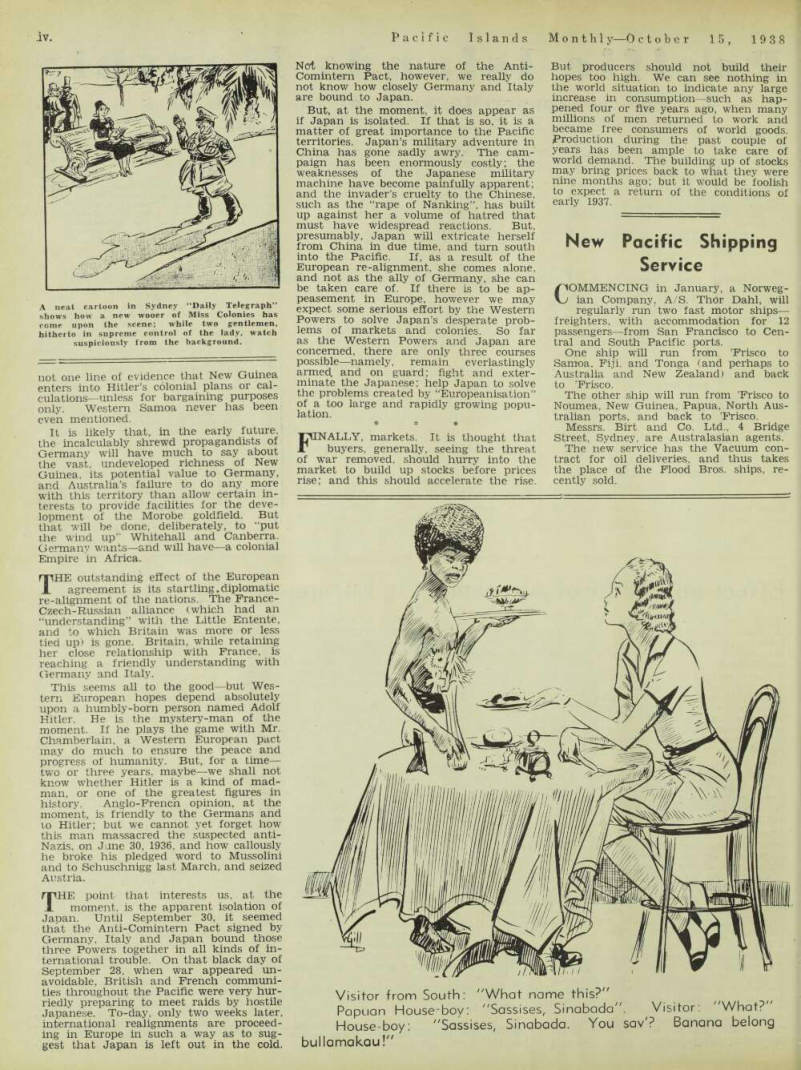
A neat cartoon in Sydney “Daily Telegraph” shows how a new wooer of Miss Colonies has come upon the scene; while two gentlemen, hitherto in supreme control of the lady, watch suspiciously from the background.