Notes On The Portraits
pp. 56-57 · Read in the full issue
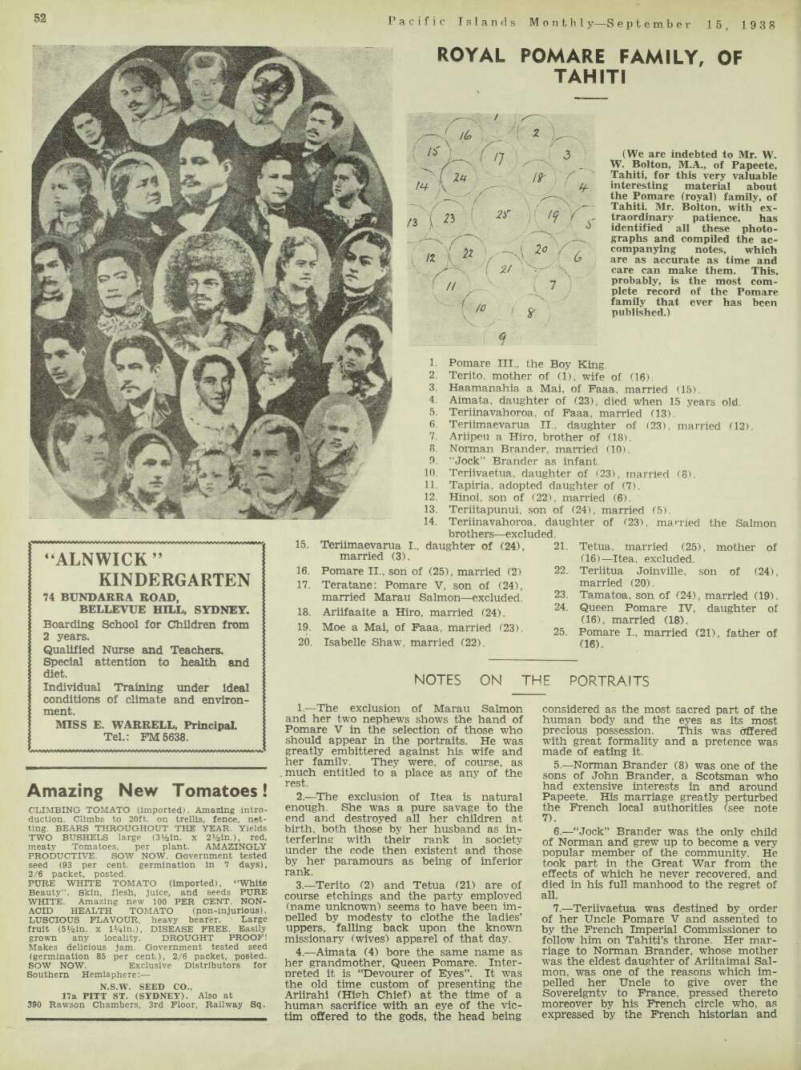
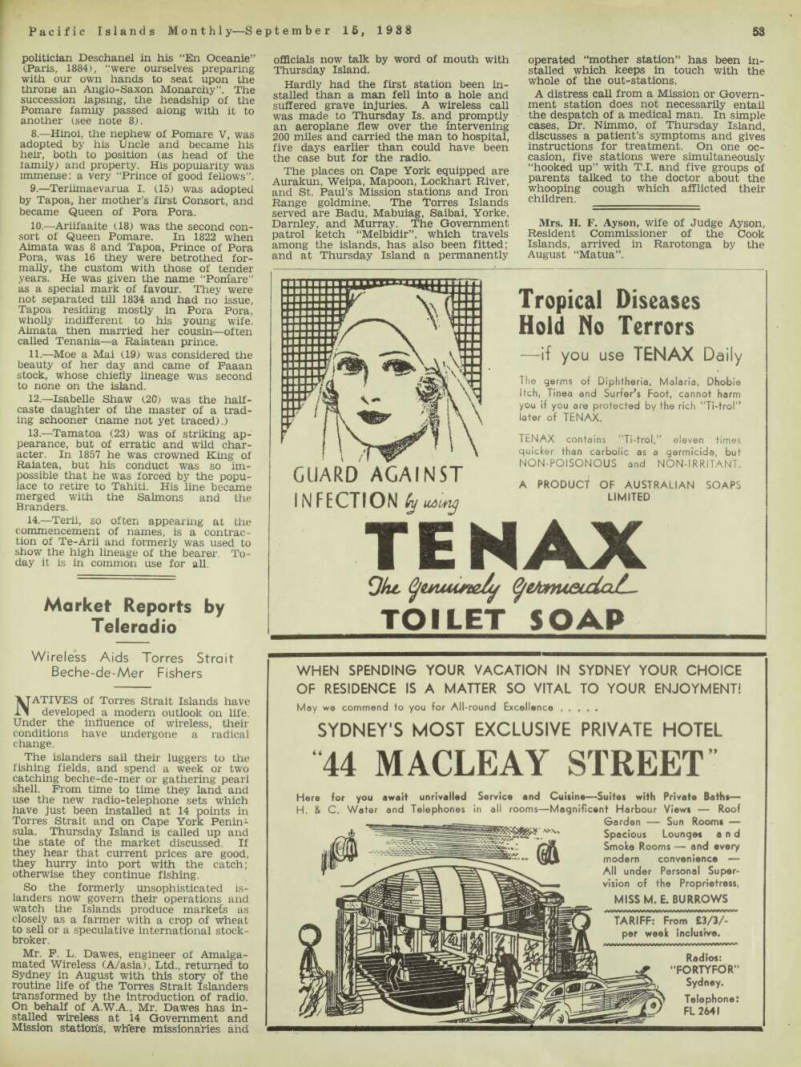
1. —The exclusion of Marau Salmon and her two nephews shows the hand of Pomare V in the selection of those who should appear in the portraits. He was greatly embittered against his wife and her family. They were, of course, as . much entitled to a place as any of the rest. 2. —The exclusion of Itea is natural enough. She was a pure savage to the end and destroyed all her children at birth, both those by her husband as in terfering with their rank in society under the code then existent and those by her paramours as being of inferior rank. 3. —Terito (2) and Tetua (21) are of course etchings and the party employed (name unknown) seems to have been im pelled by modesty to clothe the ladies’ uppers, falling back upon the known missionary (wives) apparel of that day. 4. —Aimata (4) bore the same name as her grandmother, Queen Pomare. Inter preted it is “Devourer of Eyes”. It was the old time custom of presenting the Ariirahi (High Chief) at the time of a human sacrifice with an eye of the vic tim offered to the gods, the head being
considered as the most sacred part of the human body and the eyes as its most precious possession. This was offered with great formality and a pretence was made of eating it. 5. —Norman Brander (8) was one of the sons of John Brander, a Scotsman who had extensive interests in and around Papeete. His marriage greatly perturbed the French local authorities (see note 7). 6. —“Jock” Brander was the only child of Norman and grew up to become a very popular member of the community. He took part in the Great War from the effects of which he never recovered, and died in his full manhood to the regret of all. 7. —Teriivaetua was destined by order of her Uncle Pomare V and assented to by the French Imperial Commissioner to follow him on Tahiti’s throne. Her mar riage to Norman Brander, whose mother was the eldest daughter of Ariitaimai Sal mon, was one of the reasons which im pelled her Uncle to give over the Sovereignty to France, pressed thereto moreover by his French circle who, as expressed by the French historian and
politician Deschanel in his “En Oceanic” (Paris, 1884), “were ourselves preparing with our own hands to seat upon the throne an Anglo-Saxon Monarchy”, The succession lapsing, the headship of the Pomare family passed along with it to another (see note 8). 8. —Hinoi, the nephew of Pomare V, was adopted by his Uncle and became his heir, both to position (as head of the lamily) and property. His popularity was immense: a very “Prince of good fellows”. 9. —Teriimaevarua I. (15) was adopted by Tapoa, her mother’s first Consort, and became Queen of Pora Pora. 10. —Ariifaaite (18) was the second con sort of Queen Pomare. In 1822 when Aimata was 8 and Tapoa, Prince of Pora Pora, was 16 they were betrothed for mally, the custom with those of tender years. He was given the name “Pomare” as a special mark of favour. They were not separated till 1834 and had no issue, Tapoa residing mostly in Pora Pora, wholly indifferent to his young wife.
Aimata then married her cousin—often called Tenania —a Raiatean prince. 11. —Moe a Mai (19) was considered the beauty of her day and came of Faaan stock, whose chiefly lineage was second to none on the island. 12. —lsabelle Shaw (20) was the half caste daughter of the master of a trad ing schooner (name not yet traced).) 13. Tamatoa (23) was of striking ap pearance, but of erratic and wild char acter. In 1857 he was crowned King of Raiatea, but his conduct was so im possible that he was forced by the popu lace to retire to Tahiti. His line became merged with the Salmons and the Branders. 14. —Terii, so often appearing at the commencement of names, is a contrac tion of Te-Arii and formerly was used to show the high lineage of the bearer. To day it is in common use for all.