What Is The Future Of Young Nauruans?
pp. 45-47 · Read in the full issue

THE experiment of providing Nauruan native bovs with a technical education at Geelong, Victoria, has now been in progress for two years, with marked success, and it seems destined to bring results that will benefit the
?hl e SS 8 '
are delighted with the opportunity that work as a sacred trust undertaken with m fqt p Pr nf m ?hTl5 and moral welfare of their people.
As pupils of the Geelong Junior Technical School and the Gordon Institute of Technology, these lads are regarded as normal students, with the tastes of the average Australian boy. One has been chosen as a school prefect, not from any desire to be hospitable, but on merit alone. Most of them play in their school football teams, and their skill has been sufficient to win for them honours in various fields of sport.
Their efficiency in school work is outstanding. Governed by the ordinary class methods employed with other pupils, they have made steady advancement,
and have shown that they have equal capacity with their Australian comrades in the branches of technical and com mercial education that they have under taken.
A reC ent exhibition of the boys’ work was viewed by the board of inspectors of technical schools, who spent consid erable time examining the various ex hlbits, which they described as being equal to anything they had seen in the schools of the State. Included among them was an excellent model of a tropi cal bungalow, built entirely from work intj drawings, first-class articles of fur niture. a complete window-frame and door of modern design, and inlaid boxes and other articles of rare workmanship, polished with the skill of the finished artisan, The sheet-metal work carried out by these boys was also remarkable for its finish, and every article made was first planned in working drawings. Samples of engineering, and very creditable art work were included in the things that
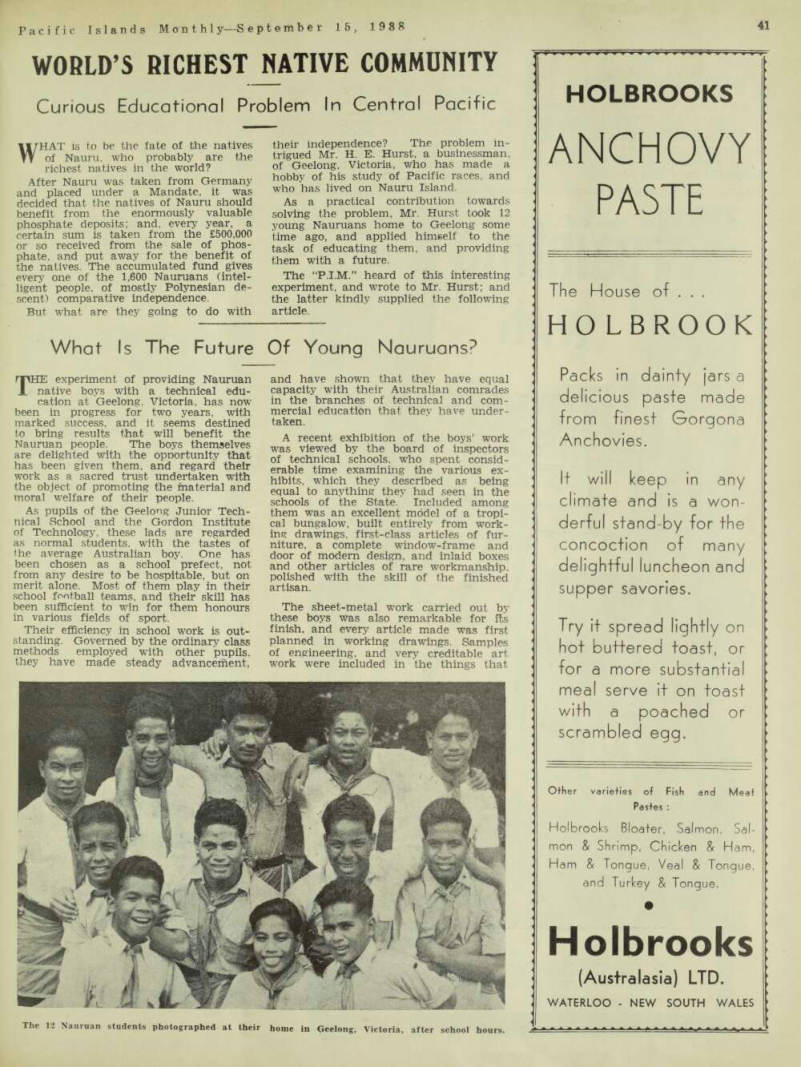
The 12 Nauruan students photographed at their home in Geelong, Victoria, after school hours.
the lads appear to have so completely mastered.
The experiment commenced two years ago, with seven Nauruan boys, five of whom are now filling positions of trust on their island with credit, and with no suggestion of being spoiled. In fact, they are setting a fine example to their fellow Nauruans, as tribute to their excellent character-training in Geelong.
I.t is impossible, in this short article, to describe fully the intricacies of the
whole experiment, which embraces a highly technical scheme of character development, j have sponsored the work at Geelong, an( j j have cons tructed suitable housing in S p ac i o us grounds at the rear of my h ome Here the boys live as close t 0 their own natural mode of life as is possible to do. They prepare their own mea i s i n a simple way, with food that will be obtainable on Nauru. They proceed to their school over a short,
well-defined route, in the company of a trusted European Scout. Outside this route is “out-of-bounds”, as is anything but the close precincts of their school.
On no account are they allowed to roam the streets or to move, excepting as a complete unit comprising all 12 boys.
They do not enter European homes, and never by any chance visit shops or en tertainments unless they are carefully guarded.
There are 12 boys in all, comprising two of the original seven, and 10 younger boys, who came to Geelong at the be ginning of this year. The older boys act as prefects, and they control the systems of working in an efficient manner.
Each boy will be trained to fill the requirements of the Administration of Nauru. All the five boys who completed their training last year are now usefully employed—two as wireless apprentices, one as a technical teacher, one as a works apprentice and one as a draftsman.
Two returned this year as prefects, and -one is now doing a splendid course of engineering, whilst the other is engaged in advanced wood-working and drafts manship. The remaining ten are at tending school in the ordinary way with the idea of determining for what they are best suited, and for which they will receive special instruction next year.
Crux Of The Problem
It should be remembered that there is no other territory quite like Nauru, where the enormously rich phosphate deposits are bringing wealth to a clever native people. As we have seen, educa tion there has reached the high standard which enables Nauruan boys to enter and more than hold their own in a large Australian school, and education is com pulsory for all boys and girls.
But what then? Comparatively few of the many products of Nauruan schools find employment, and it has been thought necessary to import Chinese and other Islanders to perform duties the Nauru ans should be able to accomplish. Long hours spent at school over the years rob them of inclination for their native arts and crafts, and life is without the pur pose that makes it worth while.
In any scheme of forced education, applied to the whole youth of a native community, it is inevitable that the critical time be reached when the boys and girls will be educated far in excess of their parents. The parent is reduced to a state of educational inferiority and becomes an object of pity in the eyes of the children. There is no parental control and no home discipline. As the natural restraint of custom and tradition has been destroyed, the moral fibre of the people is weakened.
This, it seems to me, is the stage of development reached at Nauru, and which presents a problem the Administration has yet to solve. An incentive to right thinking and right living has to be found, and the realisation of which finds its expression in the special character training now proceeding at Geelong.
Life in Nauru has always been a thing of ease. Day or night, through out the year, there is no need for any thing but the scantiest of clothing, and food there is in plenty for little or no exertion.
There was, however, some weak incen tive in the mere necessity to live. With the advent of easy money even that has passed away.
So it seems that the solution lies only in the possible provision of some nat ural motive for both physical and men tal exertion. The Geelong training aims
to provide such an incentive, by some form of recreational institution that will be controlled by the Nauruans and be so designed that all will desire to associate with it. So would be provided the re quired incentive; and, judging from re sults already achieved, it is more than a possibility.