Commodities
pp. 24-25 · Read in the full issue
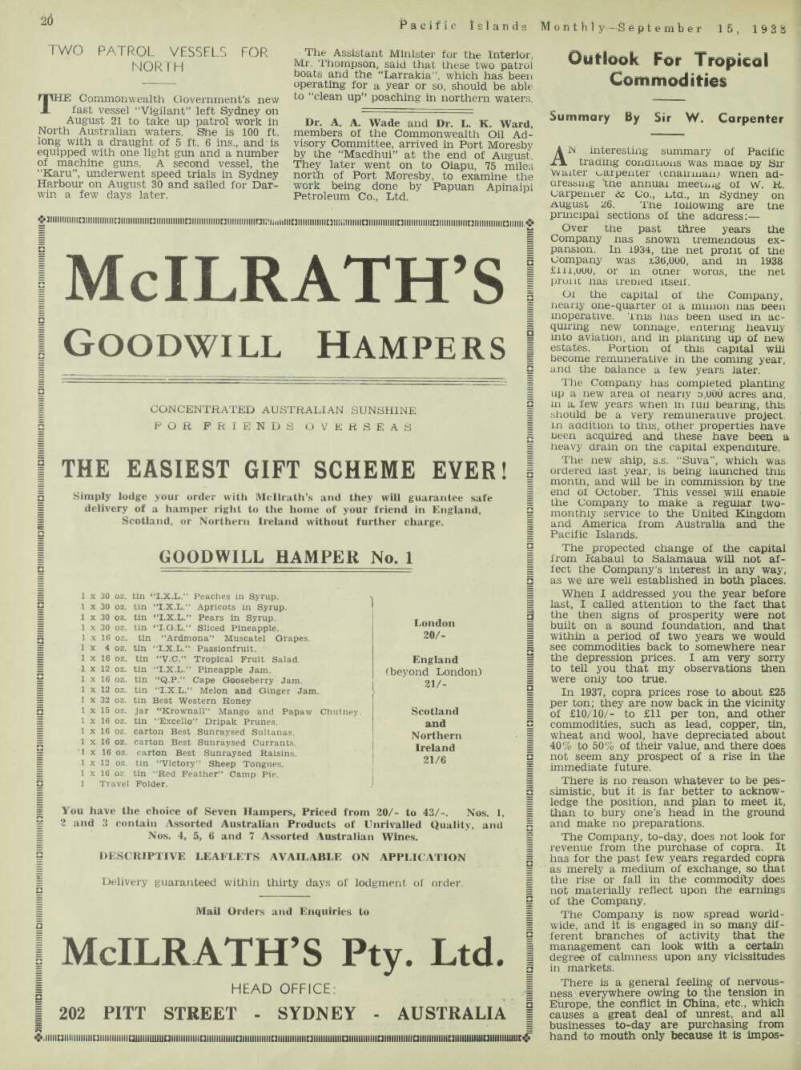

Outlook For Tropical Commodities Summary By Sir W. Carpenter
AN interesting summary of Pacific trading conditions was maae oy Sir Waiter oarpenter (cnamuanj wnen ad aressing 'tne annual meeting of W. H. carpenter & Co., ctd., m Sydney on August 26. xne foilowmg are tne principal sections of the address;— Over the past three years the Company nas snown tremendous ex pansion. In 1934, the net profit of the company was *38,000, and in 1938 £iii,uuo, or in otner woras, the net pront nas ire Died itsen .
Oi the capital of the Company, nearly one-quarter ol a minion nas Deen inoperative. Tms has been used in ac quiring new tonnage, entering heavuy into aviation, and in planting up of new estates. Portion of this capital will become remunerative in the coming year, and the balance a few years later.
The Company has completed planting up a new area ot nearly d,ouO acres ana, in a. few years when in mu bearing, this should be a very remunerative project, in addition to this, other properties have been acquired and these have been a heavy drain on the capital expenditure.
The new ship, s.s. “Suva”, which was ordered last year, is being launched this montn, and will be in commission by tne end of October. This vessel will enable the company to make a regular two monthiy service to the United Kingdom and America from Australia and the Pacific Islands.
The propected change of the capital from ftabaul to Salamaua will not af fect the Company’s interest in any way, as we are well established in both places.
When I addressed you the year before last, I called attention to the fact that the then signs of prosperity were not built on a sound foundation, and that within a period of two years we would see commodities back to somewhere near the depression prices. I am very sorry to tell you that my observations then were only too true.
In 1937, copra prices rose to about £25 per ton; they are now back in the vicinity of £lO/10/- to £ll per ton, and other commodities, such as lead, copper, tin, wheat and wool, have depreciated about 40% to 50% of their value, and there does not seem any prospect of a rise in the immediate future.
There is no reason whatever to be pes simistic, but it is far better to acknow ledge the position, and plan to meet it, than to bury one’s head in the ground and make no preparations.
The Company, to-day, does not look for revenue from the purchase of copra. It has for the past few years regarded copra as merely a medium of exchange, so that the rise or fall in the commodity does not materially reflect upon the earnings of the Company.
The Company is now spread world wide, and it is engaged in so many dif ferent branches of activity that the management can look with a certain degree of calmness upon any vicissitudes in markets.
There is a general feeling of nervous ness everywhere owing to the tension in Europe, the conflict in China, etc., which causes a great deal of unrest, and all businesses to-day are purchasing from hand to mouth only because it is impos
sible to apply the old method of supply and demand so as to form any opinion of prices to-day.
All countries are trying to build up their exports and restrict their imports.
This, to-day, is a physical impossibility, as no nation will make loans to any other, and the only way to sell the sur plus productions is to buy in value an equal quantity from other nations — always, of course, looking upon interest charges of debtor nations as an import.
The hoarding of money is useless, as it only restricts trade and does not benefit the one who hoards it. Whereas, the judicious use and spending of money gives employment, and assists everyone who is in employment to retain his position.