Hemisphere
pp. 17-18 · Read in the full issue
Highest Cross In The Southern
Placed By Catholic Missionaries On Top Of Mt. Albert Edward, in Papua, 13,213 Feet
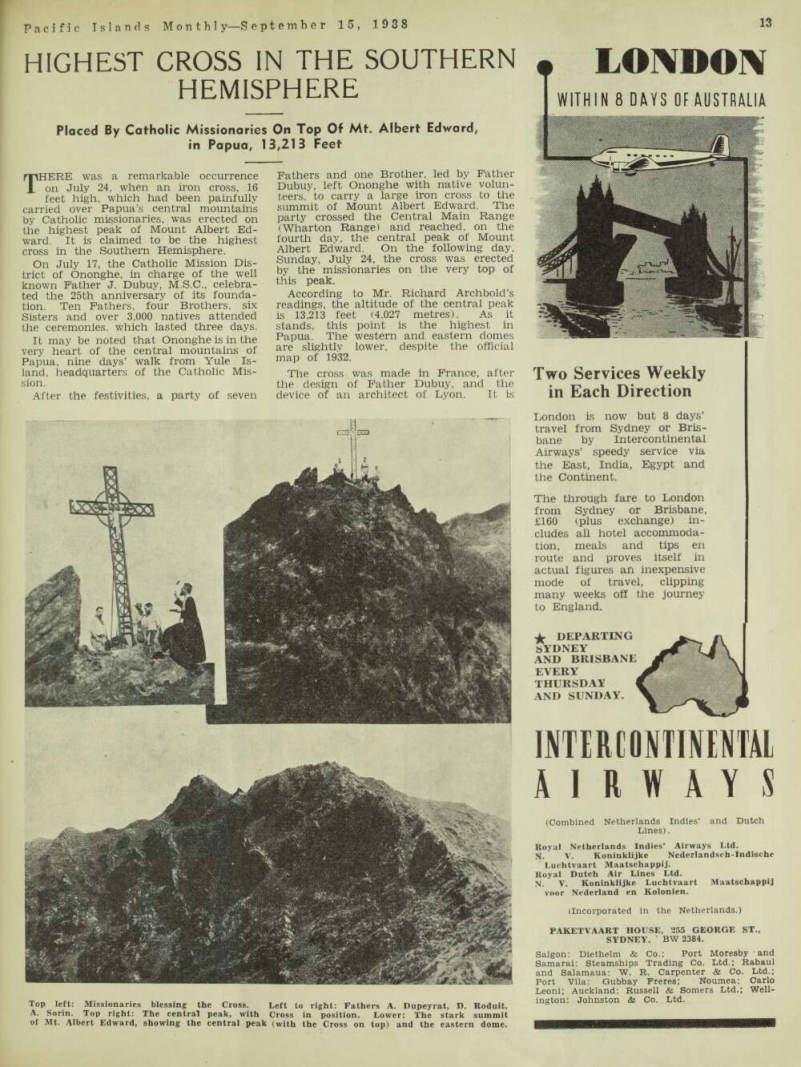
THERE was a remarkable occurrence on July 24, when an iron cross, 16 feet high, which had been painfully carried over Papua’s central mountains by Catholic missionaries, was erected on the highest peak of Mount Albert Ed ward. It is claimed to be the highest cross in the Southern Hemisphere.
On July 17, the Catholic Mission Dis trict of Ononghe, in charge of the well known Father J. Dubuy, M.S.C., celebra ted the 25th anniversary of its founda tion. Ten Fathers, four Brothers, six Sisters and over 3,000 natives attended the ceremonies, which lasted three days.
It may be noted that Ononghe is in the very heart of the central mountains of Papua, nine days’ walk from Yule Is land, headquarters of the Catholic Mis sion.
After the festivities, a party of seven
Fathers and one Brother, led by Father Dubuy, left Ononghe with native volun teers, to carry a large iron cross to the summit of Mount Albert Edward. The party crossed the Central Main Range (Wharton Range) and reached, on the fourth day, the central peak of Mount Albert Edward. On the following day, Sunday, July 24, the cross was erected by the missionaries on the very top of this peak.
According to Mr. Richard Archbold’s readings, the altitude of the central peak is 13,213 feet (4,027 metres). As it stands, this point is the highest in Papua. The western and eastern domes are slightly lower, despite the official map of 1932.
The cross was made in France, after the design of Father Dubuy, and the device of an architect of Lyon. It is
Top left: Missionaries blessing the Cross. Left to right: Fathers A. Dupeyrat, D. Roduit, A. Sorin. Top right: The central peak, with Cross in position. Lower: The stark summit of Mt. Albert Edward, showing the central peak (with the Cross on top) and the eastern dome.
composed of iron tubes and circles, which were adjusted and bolted together. It is 16 feet high, and one foot thick. Its weight is about 700 lbs. The foot of the cross is embedded two feet deep, m a block of concrete placed there by Father Dubuy and Brother Tiz on November 19- 22, 1937; 300 lbs. of cement were brought from Yule Island; 19 bags of sand, weighing 40 lbs. each, were brought from the Vangule River, near Ononghe; 20 tins of quartz, taken from the slopes of the central peak, were used in the building of this base A beautiful crucifix of white metal is attached to the cross.
After the erection, the cross was blessed by Rev. Father A. Sorin, V.G., in the name of His Excellency, Bishop de Boismenu, Vicar Apostle of Papua. The following day two Masses were celebrated at the foot of the cross by Rev. Fr.
A. Sorin, representing the Catholic Mis-
s ion, and by Rev. Father A. Dupeyrat, representing the missionaries of the Sacred Heart Order, which has supplied missionaries to the Papuan Mission since igBs.
A cavity was made in the block of ce ment as a receptacle for documents left by visitors to Mount Albert Edward. It is interesting to record their names:— D . l. Pullen and Jack Hides, Patrol Officers on May 15 1927 T ’ , . ’ „ * „ Ivan Champion and S. E. Smith, P. 0., on C. Healy, P. 0., from Kokoda, on Sep te™ ™ Middleton, on May 14, 1933.
The members of the American Mu seum of Natural History Expedition, R.
Archbold, L. G. Brass, A. L. Rand, on June 21, 1933; followed by G. J. Adam son on July 12.
On May 24, 1934, Fathers Garreau and Th. Cadoux.
M.S.C. Missionaries present at the erec tion of the iron cross were: Fathers A.
Sorin, Vicar General; A. Dupeyrat, Pro- Superior; J. Dubuy, Parish Priest, and A.
Bohn, with D. Roduit, in charge of Ononghe District; E. Pinget, Director of Bomana College; A. Benedetti, of Ma fulu District: Brother Camille Fridez.
Father Dubuy has been often on the summit of Mount Albert Edward. On June 26, 1936, he planted there a cross made of bush timber, which he replaced with a wooden cross of sawn timber in October, 1928. In December, 1933. he spent there one week, for his annual re ligious retreat, living alone under his tent on the slopes of the central peak.
During the day, shade temperature was around + 6 deg. Centigrade; one morn ing he found zero Centigrade, the water in his bucket being frozen a quarter of an inch thick.
It was impossible to find any remain ing traces of the visit of Mr. C. A.
W. Monckton who, whilst Resident Mag istrate at loma. was the first white man to climb Mount Albert Edward, in May, 1906.
The cross of Mount Albert Edward is the highest in the Southern Hemisphere and it is a cause of joy to all Christians that the secred Sign of the Salvation stands firmly, with outstretched arms over Papua.