Missionary
pp. 52-54 · Read in the full issue

Pioneer Lutheran
Death Of Rev. F. Oertel, Of The Markham Valley, T.N.G.
MEW Guinea missionaries nowadays are not called upon so often to undergo such hardships and dangers in opening stations in primitive areas as were the band of workers who, early this century, went boldly into the interior and pioneered the way. One of these tireless, un-
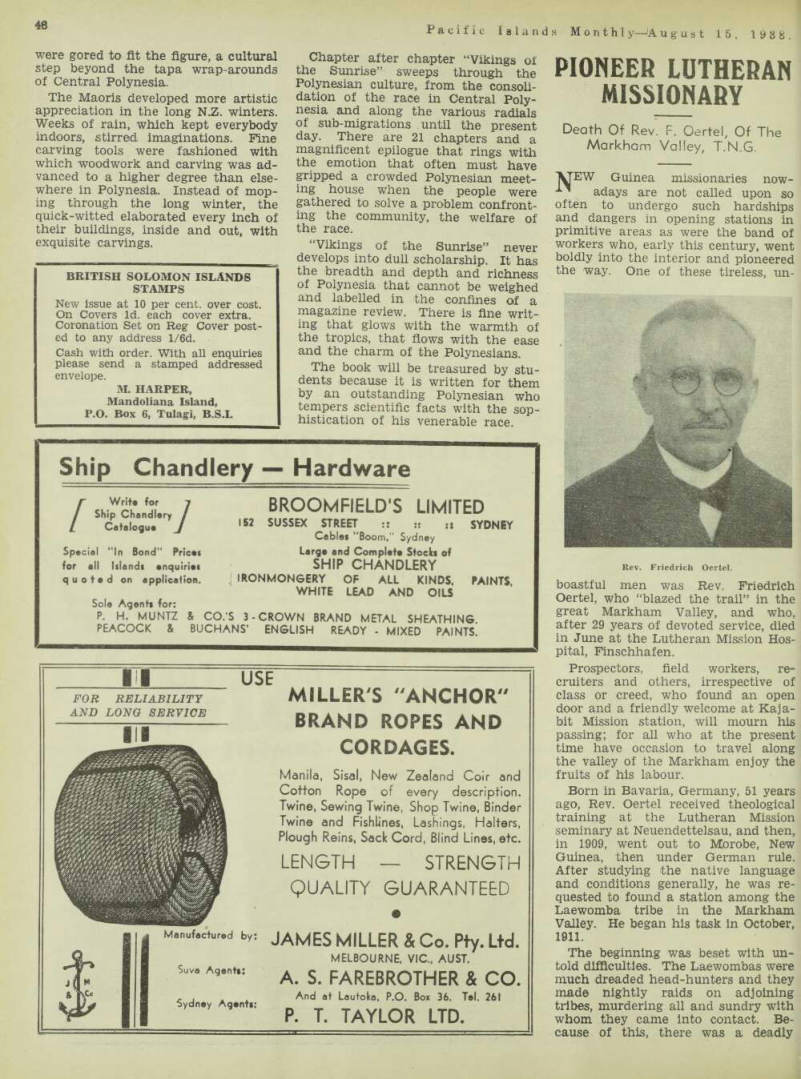
boastful men was Rev. Friedrich Oertel, who “blazed the trail” in the great Markham Valley, and who, after 29 years of devoted service, died in June at the Lutheran Mission Hos pital, Finschhafen.
Prospectors, field workers, re cruiters and others, irrespective of class or creed, who found an open door and a friendly welcome at Kaja bit Mission station, will mourn his passing; for all who at the present time have occasion to travel along the valley of the Markham enjoy the fruits of his labour.
Born in Bavaria, Germany, 51 years ago, Rev. Oertel received theological training at the Lutheran Mission seminary at Neuendettelsau, and then, in 1909, went out to Morobe, New Guinea, then under German rule.
After studying the native language and conditions generally, he was re quested to found a station among the Laewomba tribe in the Markham Valley. He began his task in October, 1911.
The beginning was beset with un told difficulties. The Laewombas were much dreaded head-hunters and they made nightly raids on adjoining tribes, murdering all and sundry with whom they came into contact. Be cause of this, there was a deadly
Rev. Friedrich Oertel.
enmity between these fierce warriors and all coastal tribes, the latter standing in great dread of the bush men.
A German scientific expedition which had tried to visit the Lae wombas had become lost in the track less forest and was forced to return, such was the nature of the country.
Undaunted, Mr. Oertel set to with remarkable fortitude and studied the language and methods of the Lae wombas. It was no easy matter to gain their friendship. During the
first few years they frequently planned an attack on the station, which consequently had to be under guard day and night. After a period of eight years, however, the Gospel message found its way into the hearts of the tribesmen—they gave up their war-like intentions and went along to receive religious instruction.
Having got over the initial diffi culties at Gabmazung station, Mr.
Oertel received a commission in 1918 to go further into the interior, along the Markham, and extend his work
to the numerically strong Azera tribe, Just as formerly there had been no roads leading from the coast to the Laewombas, there were no roads leading from there to the Azeras; none even into the regions where the Laewombas made their murderous raids. In those days anyone desiring to get to the Azeras had to wind his way through dense kunai grass con siderably above the average height of man, which grew on plains without any shady trees and where one was constantly exposed to the rays of the tropical sun. The founding of a mission station among the Azera tribe 20 years ago was a daring enter prise and entailed innumerable hard ships, but by unflagging energy and determination Mr. Oertel won through.
To travel from the coast to the Lae wombas was a day and a half’s jour ney; from there it took another three days to get into the heart of the Azera region. There were no paths of any kind and no methods of trans port. It was Mr. Oertel who “blazed the track” from Gabmazung to Kaja bit Mission station and even further on, to outstations, and it was he who for years kept this track in order.
The character of the Azeras dif fered from the Laewombas insofar that they were not as war-like, but on the other hand they were leth argic and, in many respects, careless and indifferent. It required no small amount of perseverance on Mr.
Oertel’s part before he saw any re sults of his labours and before the Azeras abandoned a number of their heathen practices. In the course of years, however, Mr. Oertel mastered the Azera language and gained a knowledge of their ways, which en abled him to win their complete con fidence.
With the opening up of the Morobe Goldfield after the discovery of rich gold, Azera became the hunting ground of recruiters, and hundreds of natives were taken to the gold fields under indenture, thereby up setting the system of the whole tribe.
That, on the whole, they met the new situation calmly was due largely to Mr. Oertel’s influence among them.
For some time Mr. Oertel had been suffering from indisposition and re cently was suddenly compelled to seek medical aid. He was taken to the Mission Hospital at Finschhafen, but it was soon evident that he had held out too long and all medical skill proved unavailing. He passed away on June 12.
Mrs. Oertel and two children are in Germany, having left New Guinea about a year ago owing to ill-health.
Mr. Oertel had planned to join them shortly and spend a well-earned fur lough in the Fatherland.—D.P.