Effect of Christianity
p. 34 · Read in the full issue
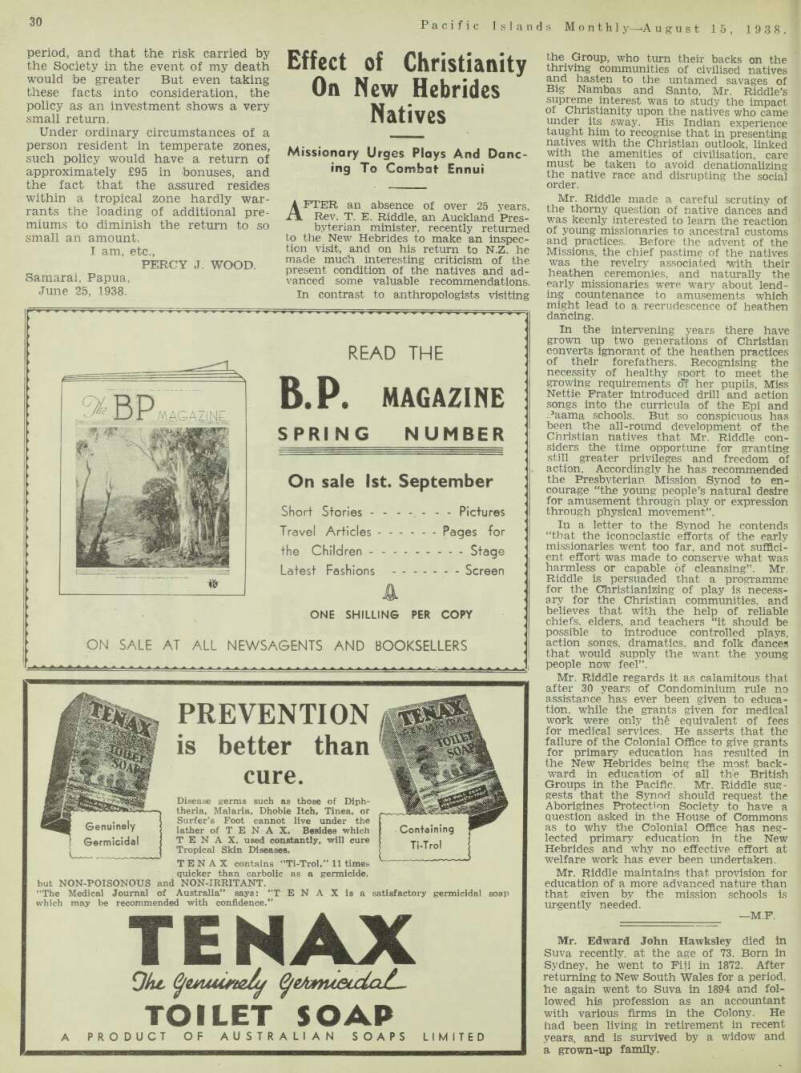
On New Hebrides Natives Missionary Urges Plays And Danc ing To Combat Ennui
AFTER an absence of over 25 years, Rev. T. E. Riddle, an Auckland Pres byterian minister, recently returned to the New Hebrides to make an inspec tion visit, and on his return to N.Z. he made much interesting criticism of the present condition of the natives and ad vanced some valuable recommendations.
In contrast to anthropologists visiting
the Group, who turn their backs on the thriving communities of civilised natives and hasten to the untamed savages of Big Nambas and Santo, Mr. Riddle’s supreme interest was to study the impact of Christianity upon the natives who came under its sway. His Indian experience taught him to recognise that in presenting natives with the Christian outlook, linked with the amenities of civilisation, care must be taken to avoid denationalizing the native race and disrupting the social order.
Mr. Riddle made a careful scrutiny of the thorny question of native dances and was keenly interested to learn the reaction of young missionaries to ancestral customs and practices. Before the advent of the Missions, the chief pastime of the natives was the revelry associated with their heathen ceremonies, and naturally the early missionaries were wary about lend ing countenance to amusements which might lead to a recrudescence of heathen dancing.
In the intervening years there have grown up two generations of Christian converts ignorant of the heathen practices of their forefathers. Recognising the necessity of healthy snort to meet the growing requirements of her pupils, Miss Nettie Prater introduced drill and action songs into the curricula of the Epi and ■ J aama schools. But so conspicuous has been the all-round development of the Christian natives that Mr. Riddle con siders the time opportune for granting still greater privileges and freedom of action. Accordingly he has recommended the Presbyterian Mission Synod to en courage “the young people’s natural desire for amusement through play or expression through physical movement”.
In a letter to the Synod he contends “that the iconoclastic efforts of the early missionaries went too far, and not suffici ent effort was made to conserve what was harmless or capable of cleansing”. Mr.
Riddle is persuaded that a programme for the Christianizing of play is necess ary for the Christian communities, and believes that with the help of reliable chiefs, elders, and teachers “it should be possible to introduce controlled plays, action songs, dramatics, and folk dances that would supply the want the young people now feel”.
Mr. Riddle regards it as calamitous that after 30 years of Condominium rule no assistance has ever been given to educa tion, while the grants given for medical work were only the equivalent of fees for medical services. He asserts that the failure of the Colonial Office to give grants for primary education has resulted in the New Hebrides being the most back ward in education of all the British Groups in the Pacific. Mr. Riddle sug gests that the Synod should request the Aborigines Protection Society to have a question asked in the House of Commons as to why the Colonial Office has neg lected primary education in the New Hebrides and why no effective effort at welfare work has ever been undertaken.
Mr. Riddle maintains that provision for education of a more advanced nature than that sdven by the mission schools is urgently needed.
M.F.
Mr. Edward John Hawksley died In Suva recently, at the age of 73. Born in Sydney, he went to Fiji in 1872. After returning to New South Wales for a period, he again went to Suva in 1894 and fol lowed his profession as an accountant with various firms in the Colony. He had been living in retirement in recent years, and is survived by a widow and a grown-up family.