American Operations At Midway Island
pp. 17-18 · Read in the full issue
New Central Pacific Base For U.S.A,
By John Williams
IMPORTANT of the self-denying clauses of the famous Washington Disarma ment Conference treaty of 1922, and of the treaty of London (which expired in December, 1936) were those which stipulated that the Powers would not disturb the status quo in the Pacific by fortifying certain of their islands. This, of course, reduced tension by the sim plicity of removing the competitive causes.
Now that the treaties have been jet tisoned. America is losing no time in pushing a plan which has been under consideration for many years.
It is a simple scheme. Midway Is land. a westerly atoll of the widespread
Hawaiian Islands group (now a station on Pan-American Airways North Pacific Service) is midway between California and China, and 1,400 miles westward of Honolulu. It has a 5 by 4 miles lagoon, with dredging possibilities that would convert it into a fine anchorage for small cruisers, destroyers, submarines and fly ing boats, and thus be a potent “spring board” for the U.S. naval patrol of the Western Pacific.
For many years, the U.S. navy has used Midway for “war games”. Flights of as many as 48 navy bombers (called airboats by the navy) have flown simul taneously from Pearl Harbour to Mid way since 1934, and conducted exten sive local “drill” flights.
Always such flights have been ac companied by aircraft tenders, which are glorified tugs. They are “pocket” aircraft mother-ships. They go ahead and “feel the way” for the aircraft, by preparing anchorages in the lagoons, re porting back by radio the weather and other conditions, and establishing the essential radio aids for the flights. The tenders are equipped for recovering dis abled aircraft from the sea, with big reserve stores of gasoline and oil for refuelling the ’planes, with repair facili
ties, and with reserve stocks of fresh and canned foods and drinking water.
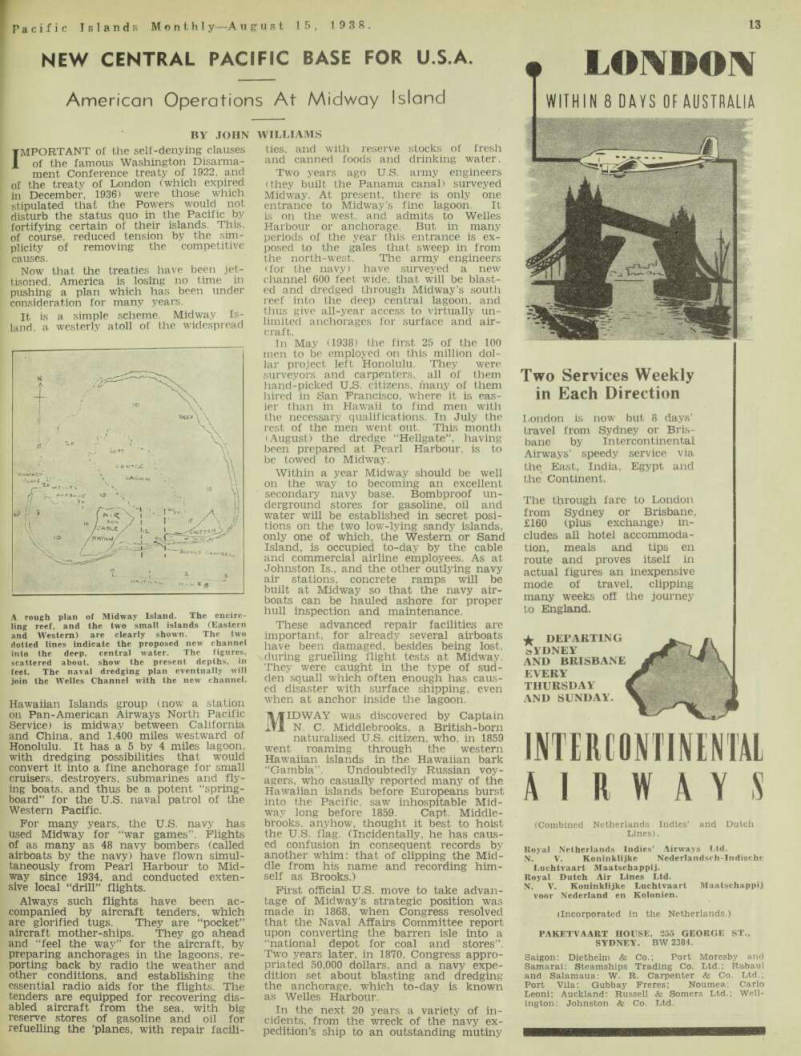
Two years ago U.S. army engineers (they built the Panama canal) surveyed Midway. At present, there is only one entrance to Midway's fine lagoon. It is on the west and admits to Welles Harbour or anchorage. But in many periods of the year this entrance is ex posed to the gales that sweep in from the north-west. The army engineers (for the navy) have surveyed a new channel 600 feet wide, that will be blast ed and dredged through Midway’s south reef into the deep central lagoon, and thus give all-year access to virtually un limited anchorages for surface and air craft.
In May (1938) the first 25 of the 100 men to be employed on this million dol lar project left Honolulu. They were surveyors and carpenters, all of them hand-picked U.S. citizens, many of them hired in San Francisco, where it is eas ier than in Hawaii to find men with the necessary qualifications. In July the rest of the men went out. This month (August) the dredge “Hellgate”. having been prepared at Pearl Harbour, is to be towed to Midway.
Within a year Midway should be well on the way to becoming an excellent secondary navy base. Bombproof un derground stores for gasoline, oil and water will be established in secret posi tions on the two low-lying sandy islands, only one of which, the Western or Sand Island, is occupied to-day by the cable and commercial airline employees. As at Johnston Is., and the other outlying navy air stations, concrete ramps will be built at Midway so that the navy air boats can be hauled ashore for proper hull inspection and maintenance.
These advanced repair facilities are important, for already several airboats have been damaged, besides being lost, during gruelling flight tests at Midway.
They were caught in the type of sud den squall which often enough has caus ed disaster with surface shipping, even when at anchor inside the lagoon.
MIDWAY was discovered by Captain N. C. Middlebrooks, a British-born naturalised U.S. citizen, who, in 1859 went roaming through the western Hawaiian islands in the Hawaiian bark “Gambia”. Undoubtedly Russian voy agers, who casually reported many of the Hawaiian islands before Europeans burst into the Pacific, saw inhospitable Mid way long before 1859, Capt. Middle brooks, anyhow, thought it best to hoist the U.S. flag. (Incidentally, he has caus ed confusion in consequent records by another whim: that of clipping the Mid dle from his name and recording him self as Brooks.) First official U.S. move to take advan tage of Midway’s strategic position was made in 1868, when Congress resolved that the Naval Affairs Committee report upon converting the barren isle into a “national depot for coal and stores”.
Two years later, in 1870, Congress appro priated 50,000 dollars, and a navy expe dition set about blasting and dredging the anchorage, which to-day is known as Welles Harbour.
In the next 20 years a variety of in cidents, from the wreck of the navy ex pedition’s ship to an outstanding mutiny
A rough plan of Midway Island. The encirc ling reef, and the two small islands (Eastern and Western) are clearly shown. The two dotted lines indicate the proposed new channel into the deep, central water. The figures, scattered about, show the present depths, in feet. The naval dredging plan eventually will join the Welles Channel with the new channel.
among another shipwrecked crew on Midway, caused unfavourable comment about Midway in Washmgton. There were several sea dramas at Midway; even a woman and her children were mvolved; and there was a startling mstance of fiendish revenge, man’s mhuinanity to man. .
A ft er Spanish-American war in 1903, President Roosevelt, placed Midway ler the jurisdiction of the navy. In 1904 he despatched a company of mannes. plus two six-pounders, to “defend’’ the cabie station which had been established at Midway.
J n . Midway was appointed an official U.S. weather observatory. First aerial consideration of Midway seems to have been made by the Americans, Messrs. William S. Brock and Edward F.
Schlee, who in 1927 proposed to fly from
Japan to America and use Midway as a wayside stop. The navy department then ridiculed the idea that a landplane could land and take off at Midway.
When the Midway scheme is comple ted, Uncle Sam will extend his strategic theory westward, again, to Wake Island and thus duplicate the Midway dredg ings and service facilities. Of course to day the facilities, already created at Mid way and Wake by Pan-American Air ways, would be taken over by the navy in the event of an emergency.
Methodically, base by base, Uncle Sam is getting into a better position along a strategic front. Midway is effec tively linked with the major scheme at Pearl Harbour by a series of anchorages for submarines, destroyers and airboats, notably at French Frigate Shoals and Pearl and Hermes Reef.