Von Luckner In
pp. 46-48 · Read in the full issue
Fiji
A Famous Incident of 1917
Count von Luckner has been re ceiving a good deal of hospitality and publicity in Australia lately; and, as his war exploits were of in terest to Fiji and French Oceania, it may be worth while to briefly re-tell the story of the “See Adler”.
The following is a summary of articles published recently in Sydney journals.
IT was in 1916 that Felix von Luckner, German naval officer, put out to sea in a camouflaged vessel named the “See Adler” to run the blockade of the Brit ish Fleet, reach the sea-tracks of trade, and raid commerce.
The story of Count von Luckner’s voyage down the Atlantic and into the Pacific has been told in a book by an American, Lowell Thomas; but it is so liberally embroidered by imagination as to be worthless as an historic document.
The “See Adler” sank many ships, but care was taken to preserve the lives of those aboard. These prisoners were either retained aboard the “See Adler”, or transferred to another ship, as oppor tunity offered. When the “See Adler” reached the Society Islands it still had on board the captain and crew of an American schooner, which the raider had bailed up on the high seas.
By that time Luckner had been out from Germany nearly nine months and his vessel needed cleaning. He made for lonely Mopiha Island, in the Tua-
motus, reached it in September, 1917, and cast anchor too near the reef. The captain of the American schooner warned von Luckner about the anchor age, but no notice was taken.
The “See Adler” remained at anchor until a gale came up, to show that the Yankee skipper’s advice had been sound. By then it was too late. The raider was a wreck, and Count von Luckner a castaway, with all hands.
Among the salvage was a motor-launch, “Cecile”, fitted with a modern diesel engine, capable of ten knots an hour, In this von Luckner, with Lieutenant Kerschiess and four of a crew, set out for the Fiji Group, due west, intending to capture a suitable vessel and use it as a raider in place of the “See Adler”.
Aboard the launch were a machine-gun, ammunition, and carbines, automatics, bombs and hand-grenades.
They broke their 2,600 miles journey at Rarotonga, but could see no ship there likely to interest them. They were weather-beaten, and suffering from scurvy, but they carried on grimly.
They reached the Fijis early in 1917, and, owing to squally weather, decided to shelter at Wakaya Island, about 12 miles due east of Levuka. There they went ashore to reconnoitre, pretending they were a week-ending party from a Norwegian ship in Suva.
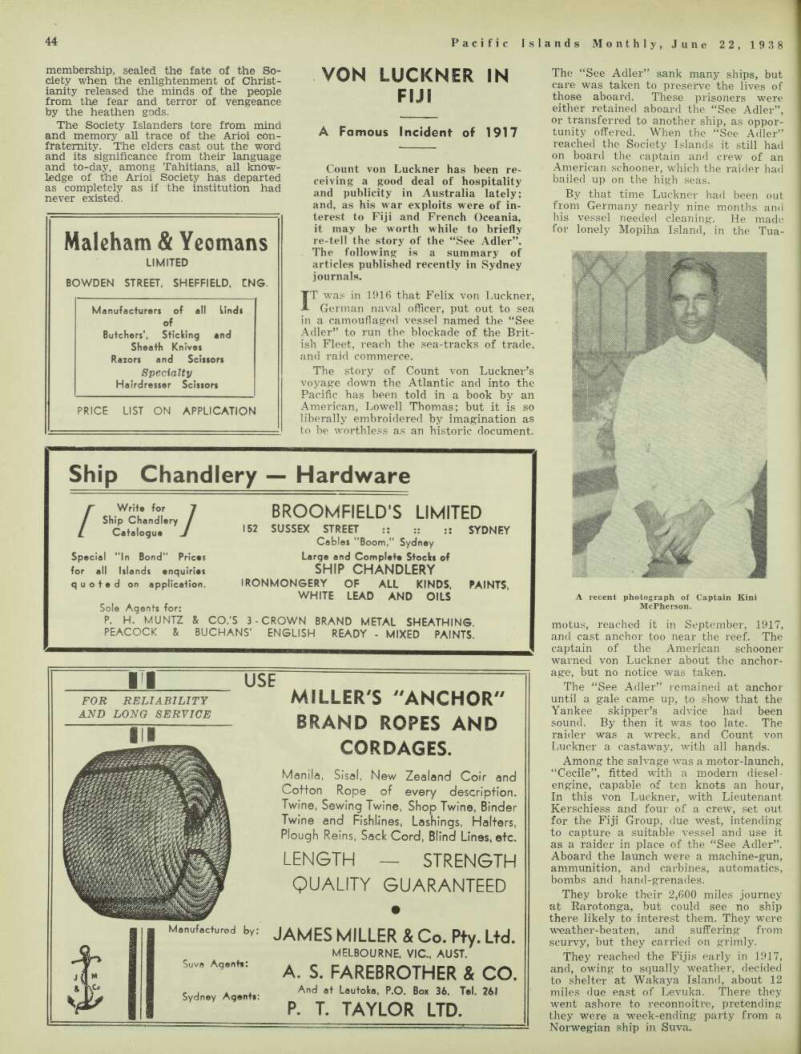
A recent photograph of Captain Kini McPherson.
A small cutter entered the harbour soon after, also for shelter. It belonged to Captain Kini McPherson, a half-caste, who, after conversation with the strangers, decided that they needed in vestigation. When he announced his intention of leaving Wakaya they tried to prevent him, but he pretended he had to get back to his plantation, round the coast, and they then let him go.
Captain McPherson sailed out on the course he had stated, but as soon as he was out of observation he went about and made for Levuka, where he reported to Sub-Inspector H. C. Hills, of the Fijian constabulary.
Hills had started life 33 years earlier in Britain, and in due time had been variously an officer in the P. and 0. ser vice, ranger in Canadian foothills, police officer in Natal, explorer in Portuguese East Africa, customs officer in New Zea land, and finally, on being ordered to the tropics by his doctor, he had taken the job of constabulary officer in Fiji.
Clearly he was reasonably equipped for dealing with a situation such as Captain Kini McPherson placed before him, provided he had the necessary temperament. Courage was needed, initiative, coolness, and a commanding manner.
Firearms, and possibly an armed guard, might have been considered an essential. Hills telephoned to Suva, the Administrative headquarters, was for bidden to arm his native police, and was given permission to take his ser
vice pistol only at his own risk. He set out in the cutter “Sunbeam”, and had to return owing to rough weather.
Meanwhile, the “Amra”, a small cattle-boat trading about the group, had steamed into Levuka. Sub-Inspector Hills got permission from Suva to use this instead of the cutter, and again set opt for Wakaya.
As soon as the “Amra” rounded the point leading into the bay at Wakaya, a boat was lowered. The strange motor launch' was already under way and heading for the open sea and for the “Gleaner A”, an auxiliary schooner which was just entering the bay. It would have been a useful and easy cap ture for von Luckner.
The boat from the “Amra” containing Hills, A. E. S. Howard, and a few Fijian policemen, pulled strongly on a con verging route, came closer to the motor launch, and Sub-Inspector Hills ordered it to stop.
The launch stopped, and the police boat ran alongside. Hills heard them speaking German to each other—a lan guage he recognised instantly. With his hand on his holster, which contained an empty revolver, he commanded: “You are all prisoners. You will surrendei as prisoners of war”.
One of the Germans instantly re plied: “I am Lieutenant Kerschiess, second in command of ‘See Adler’. I surrender”.
Two of the native police then jumped aboard the “Cecile” and clambered to
ward a German who was aft, while Hills commanded him to surrender. He replied: “My name is Count von Luck ner, commander of the ‘See Adler’. I surrender”.
Three of his crew then surrendered.
But there was another, the engineer, who still hesitated, defiantly. Hills ordered a Fijian policeman to leap aboard the •“Cecile” and arrest him. Von Luckner spoke urgently to him and he* sur rendered.
Von Luckner since has pointed out that the Englishmen were in uniform, while his party were in civilian clothes.
According to his code, if they had shot at uniformed linen, they could have been charged with murder, and the tak ing of life, in any event, was the one thing they were determined to avoid.
As they rowed toward the “Amra” von Luckner asked Hills if he were a naval officer, and when he learned he had been captured by a mere policeman he became almost as explosive as one of his own bombs, but with suppressed anger.
But when they got aboard the “Amra” and discovered that she had no guns, no arms of any sort, and only five bags of coal so that chase would have been impossible, the suppressed emotions of the Teutonic raiders ran through in credulity, chagrin, indignation, and finally burst into wrath. They had be lieved that the cattle-pens prominent on the “Amra’s” deck were camouflaged guns!
Copra exported from New Guinea In May was declared for Customs purposes to have an assessed value of £B/5/- per ton.