Pacific
Islands
Monthly
Vol. Viii. No. 11
June 22, 1938
[j ßegistered at the G.P.0., Sydney, for transmission hy post as a newspaper .]
8“
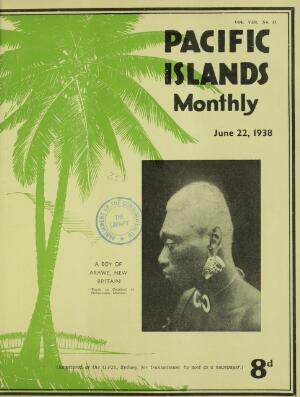
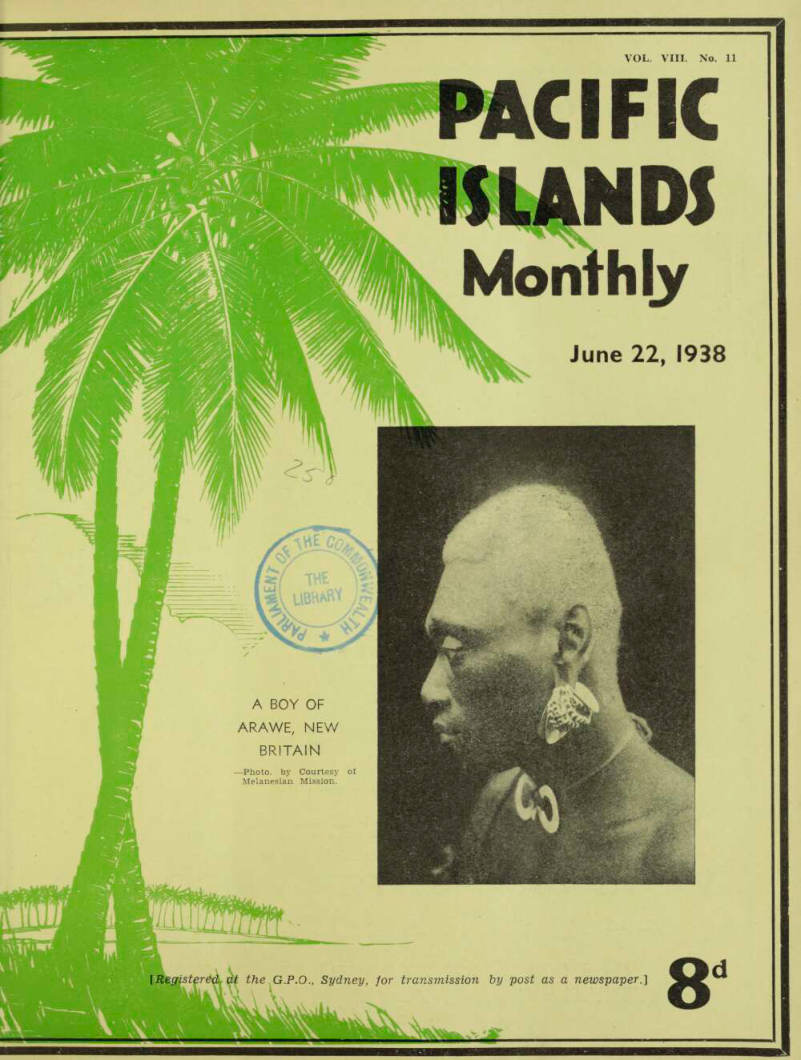
A Boy Of
Arawe, New
Britain
—Photo, by Courtesy of Melanesian Mission.
Advertisements & other items, p. 2 (1 item)
W. R. Carpenter & Co. Ltd.
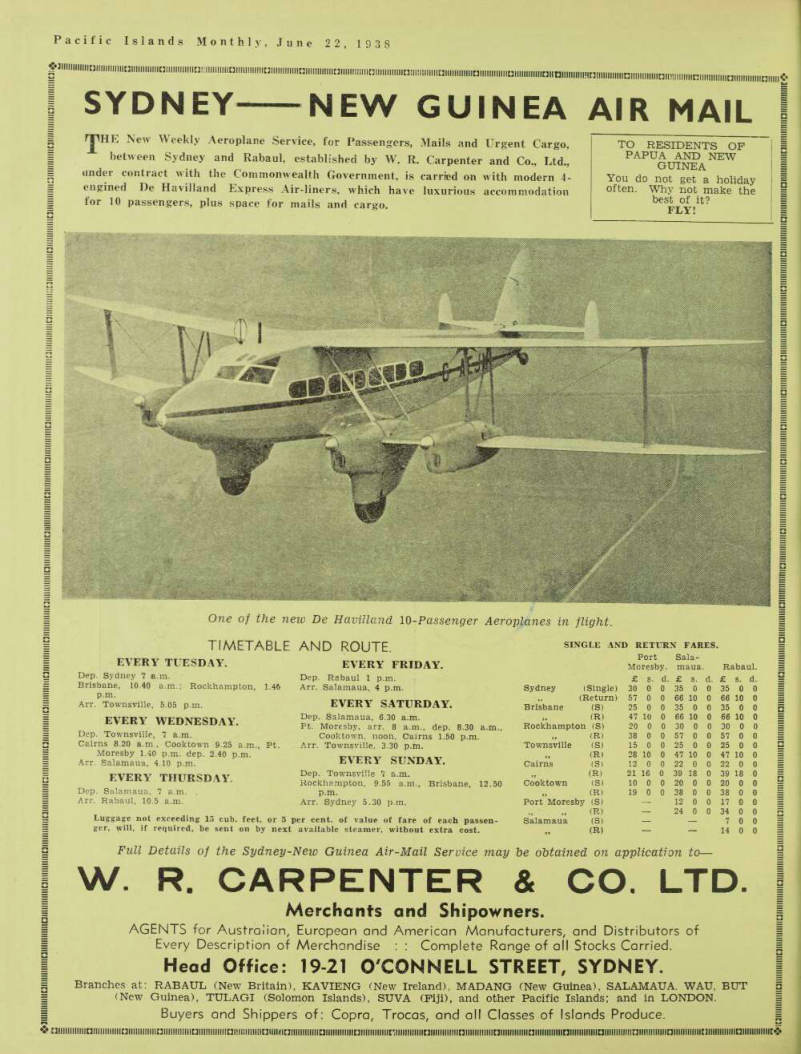
SYDNEY NEW GUINEA AIR MAIL
rjIHE New Weekly Aeroplane Service, for Passengers, Mails and Urgent Cargo, between Sydney and Rabaul, established by W. R. Carpenter and Co., Ltd., under contract with the Commonwealth Government, is carried on with modern 4engined De Havilland Express Air-liners, which have luxurious accommodation for 10 passengers, plus space for mails and cargo.
TO RESIDENTS OF
PAPUA AND NEW
GUINEA
You do not get a holiday often. Why not make the best of it?
FLY!
X * V#. p
I li
: - I I '.: : * V
watMSFnM!’***l
w ■ One of the new De Havilland 10-Passenger Aeroplanes in flight.
TIMETABLE AND ROUTE.
SINGLE AND RETURN FARES.
EVERY TUESDAY.
Dep. Sydney 7 a.m.
Brisbane, 10.40 a.m.; Rockhampton, p.m.
Arr. Townsville, 5.05 p.m.
EVERY WEDNESDAY.
Dep. Townsville, 7 a.m.
Cairns 8.20 a.m., Cooktown 9.25 a.m., Moresby 1.40 p.m. dep. 2.40 p.m.
Salamaua, 4.10 p.m.
EVERY THURSDAY.
Dep. Salamaua, 7 a.m. .
Arr. Rabaul, 10.5 a.m.
Pt.
Arr.
EVERY FRIDAY.
Dep. Rabaul 1 p.m.
Arr. Salamaua, 4 p.m.
EVERY SATURDAY.
Dep. Salamaua, 6.30 a.m.
Pt. Moresby, arr. 8 a.m., dep. 8.30 a.m.
Cooktown, noon, Cairns 1.50 p.m.
Arr. Townsville. 3.30 p.m.
EVERY SUNDAY.
Dep. Townsville 7 a.m.
Rockhampton, 9.55 a.m., p.m.
Arr. Sydney 5.30 p.m.
Brisbane, 12.50 Luggage not exceeding 15 cub. feet, or 5 per cent, of value of fare of each passenger, will, if required, be sent on by next available steamer, without extra cost.
Full Details of the Sydney-New Guinea Air-Mail Service may be obtained on application to —
W. R. CARPENTER & CO. LTD.
Merchants and Shipowners.
AGENTS for Australian, European and American Manufacturers, and Distributors of Every Description of Merchandise : : Complete Range of all Stocks Carried.
Head Office: 19-21 O'CONNELL STREET, SYDNEY,
Branches at: RABAUL (New Britain), KAVIENG (New Ireland), MADANG (New Guinea), SALAMAUA. WAU, BUT (New Guinea), TULAGI (Solomon Islands), SUVA (Fiji), and other Pacific Islands; and in LONDON.
Buyers and Shippers of: Copra, Trocas, and all Classes of Islands Produce.
Pacific Islands Travellers
Passengers Per “Macdhui” Which Ar
RIVED IN SYDNEY FROM PAPUA AND N.G.
ON MAY 26;—Messrs. Atkinson (2), Armia, Aye ling. Buchanan, Battich, Brewer, Butler, Brown, Benton, Carr, Darbyshire, Ellis, Gil bert, Graham. Gould, Hutchen, Humphries, Horne, Josch, Melville, Marshall, McLean, Mc- Villy, O’Malley, Page, Puff, Ryan, Robson, Rob ertson, Rutherford, Scott, Swanson, Spychiger, Sullivan, Studwick, Tait, Taylor, Watkilns.
Mesdames Armstrong, Benton, Edwards, Frame, Leigh, Maidment, McLean, Northam, Oxen bridge, Reece, Richardson, Shaw, Studwick, Watkins. Misses Michael, Tait.
Passengers Per “Swartenhondt”,
Which Sailed From Sydney For Port
MORESBY, PAPUA, ON MAY 26:—V. G. Smith, A. P. Tavener, G. I. Younger.
Passengers Per “Nellore” Which
Arrived In Sydney From Rabaul, N.G.,
ON MAY 26: —Messrs. Cooper, Dwyer, Prior, Morgan, Nosworthy, Perriman, Thompson.
Naulty, Watts, Lee. Mesdames Prior. Dwyer, Perriman, Rondahl. Miss Berge.
Passengers Per Airmail Liner Which
LEFT SYDNEY ON MAY 30 FOR SALAMAUA: M. A. Taylor; RABAUL: Rt. Hon. W. M.
Hughes, R. Corlett, A. Bachli, J. R. Halligan; PT. MORESBY to RABAUL; E. G. Betts.
Passengers Per “Macdhui” Which
Sailed From Sydney For Papua And
N.G. PORTS ON JUNE 1:--Messrs. Angel, Aber nethy, Andre, Alentorn, Barnes, Brewster, Bar ber, Broadhurst, Cardew, Clappison, Clarke, Chipper, Crago, Callaghan, Diddleton, Davies, Edwards, Fyffe, Gordon. Grant, Gillespie (2), Garvin, Harding. Hurl, Hanrahan, Henderson, Hopkins, Halliday, Havill, Inglis, Jewell, Joiner, Johnson, Kenyon, Kerr, de Latour, Lutz, Lib bessen, Laurence, Long, Murphy, Marlow, Mit chell. Miller (2), Ellrington, Marn, McLauchlin, Middleton, Nolan, Owers, Prosser, Parkin, Prat ten, Parer, Penglase, Poland, Pillard, Partridge, Rogers, Rankin, Reason, Skiller, Scott, Sellen.
Sinclair, Schmidt, Shaw. Smith, Sargeant, Tutty, Ternes, Tuophy, Wollard, Wilson, Weidmann.
Mesdames Budden, Brew, Broadhurst, Bollinger, Beckett, Clappison, Clarke, Carlson, Carr, Ed wards, Ecclestone, Grant, Gillespie, Goodwin, Hewill, Hopkins, Howard, Halliday, Hanrahan, Jewell, Luxmoore, Logan, Lee, Mann, Middleton, Maggs, Owers, Peters, Parer, Penglase, Rayner, Rogers, Rankin, Sellen, Schmidt, Tudor, Wil liams, Weidmann. Misses Brew, Beckett, Casey, Gillespie, Gallagher, Hogg, Highfield, Lee, Mathieson, Mumme, Menzie, Meldrum, Peters, Reeks, Schlenker, Walker, Willoughby.
Passengers Per “Malatta” Which
Arrived In Sydney Prom N.G. And
B. PORTS ON JUNE 3; —Messrs. Chadwick.
Bray, Bennetts, Colebrooke, Clarke (2), Codd, Cattell, Chalmers, Colson, Dethrldge, Davies, Fulton. Harbordt, Klngsmill, Surr, Thomas.
Wilton, Whitford, Wilson Mesdames Clarke, Tudberry, Bennetts, Codd, Chalmers, Christmas.
Driver, Harbordt, Kellett, Lanham, Maroney, Thomas, Thomson. Misses Golden, Brown, Cooper, Cohen, Christmas, Moore, Thomson.
Todd.
Passengers Per Airmail Liner Which
LEFT RABAUL ON JUNE 3 FOR: SALA MAUA: Rt. Hon. W. M. Hughes, A. Bachli.
J. R. Halligan; SYDNEY: O. M. Rondahl.
SALAMAUA to SYDNEY; A. J. Hoile, Mrs. E.
A. Day, A. M. Freeman. TPT. MORESBY to SYDNEY: W. S. Carey. PT. MORESBY to CAIRNS: E. A. James.
Passengers Per “Niagara” Which Ar
RIVED IN SYDNEY FROM SUVA, FIJI, ON JUNE 4:—F. N. Ashley, A. V. Bonamy, S. G.
Ellis, W. J. Hawthorne, W. T. Nicholson. N.
C. Robertson, M. Summers.
Passengers Per “Morinda” Which
Arrived In Sydney From Lord Howe,
Norfolk Is., And New Hebrides On
JUNE 6; —Messrs. Dunn, Lawson, Leaney, Rush, Craig, Humphery, Venard, Cooke. Jarvis, Lean (2), Le Cran, McCoy, Morgan, Nobbs, Simpson.
Anderson, Clarke, Gray, Harvie, Helsham, Henderson, Leathes. Mankey, Payne, Penson, Quinn, Stewart, Sweet, Thomas. Mesdames
(Continued On Page 80.)
Canney, Cooke, Douran, Menzies, Nobbs, Clarke, Dewar, Harvie, Helsham, Lawton, Thomas.
Misses Ahlston, Gregerson, Beadell, Belpett, Charlton, Davies, Helsham, Hines. Swain, Williamson
Passengers Per Airmail Liner Which
LEFT SYDNEY ON JUNE 7 FOR;— PT. MORES BY: R. S. Haines. Mrs. G. O. Higgins; SALA MAUA; C. L. B. Wilde; RABAUL; C. A. B. Pyne.
Passengers Per “Niagara” Which
SAILED FROM SYDNEY FOR SUVA ON JUNE 9:—Messrs. Allard, Browne, Barry (2), Bowden, Brooks (2), Bingham, Clark, Colohen, Dearman, Garrick, Griffiths (2), Gemmell-Smith, Hermes, Prentice, Seward, Snowsill, Ware, Bromley, Bradman, Harness, Moltzen, Peterson, Tarte, Turnbull, Williams. Mesdames Browne, Buxton, Bowden, Colohen, Garrick, Griffiths, Hallowes, Matthews, Ware, Yates, Bartley, Garrett, Har ness, Moltzen, Peterson, Williams, Blacklock.
Misses de Brancas, Lyons, Read (2), Webb, Ware (2), Bartley (2), Green, Peterson, Blacklock,
Passengers Per “Morinda” Which
Sailed From Sydney For Lord Howe
And Norfolk Is. On June 11;—Messrs.
Williams, Connolly, Street, Brown (2), McMinn, Keith, Thompson, Storey, Lucas, Heron (21, Tattle, Evans, Nicholls, Adams, Flanagan, Forestler, Rawson, Buffett (2), Kleiner, Randall, Emblen, Frame (2), Cope. Miller. Mesdames Williams, Brown (2), Street, Johnson, Waley, McMinn, Keith, Stopp, Martin, Pentreath, Bale, Worboys, Chapman, Ranken, Ryan, Tattle, Wilson. Misses West, McLean. Lyne, Cook, Gillespie, Austic, Dean-Smith, Parkinson, Beres ford.
Passengers Per “Malaita” Which
SAILED FROM SYDNEY FOR 8.5.1. AND N.G PORTS ON JUNE 11: Messrs. Robinson, Voss, Phillips, Cottrell-Dormer, Manning, Green, Tyrer, Ottawa, Braban, Mansfield, Webb, Clark, Ashley, Train, Stock, Salmond, Campbell, Alley, Seton, Bourne, Musgrave, Taylor. Voyce, Hughes.
Donnelley, Roenfelt. Bennett, Alexander. Mes dames Manning, Svensen, Tyrer, Train, Stock, Seton, Bourne, Voyce, Hand, Donnelley, Alex ander. Misses Shelton (3), G’over, Norman, Taylor, McLean, Munro, Appleton, Reine, Lud low, Jenkins, Davies, Cohen, Moore.
Passengers Per Airmail Liner Which
ARRIVED IN SYDNEY ON JUNE 12 FROM:— PT. MORESBY: Rt. Hon W. M. Hughes. A, Bachli, J. R. Halligan: SALAMAUA: J. Wright, G. W. Osborne; RABAUL: T. R. Walsh, E. Rob erts.
Passengers Per Airmail Liner Which
LEFT SYDNEY ON JUNE 14 FOR:—CAIRNS: F.
N. Ashley: RABAUL: I. H. Tait, B. B Perri man; BRISBANE to PT. MORESBY: A. R. Mul holland: SALAMAUA: B. Rossi.
Passengers Per “Nellore” Which
Sailed From Sydney For Rabaul, N.G.,
ON JUNE 15: —Messrs. Pines, McCheane, Wells, Pennefather, Henderson, Jackson, Hutchinson, Wilson (2), Hill, Sinclair. Mesdames Bell- Ferguson, Brain, Wells, Woodhill, Henderson, Jackson. Wilson, Hill, Little. Misses O’Reilly, Guaran, Tossol, Ponhow.
Mr. C. S. Israel, manager of Morris, Hedstrom, Ltd., at Lautoka, left Fiji by the last “Monterey” on furlough.
Advertisements & other items, p. 3 (1 item)
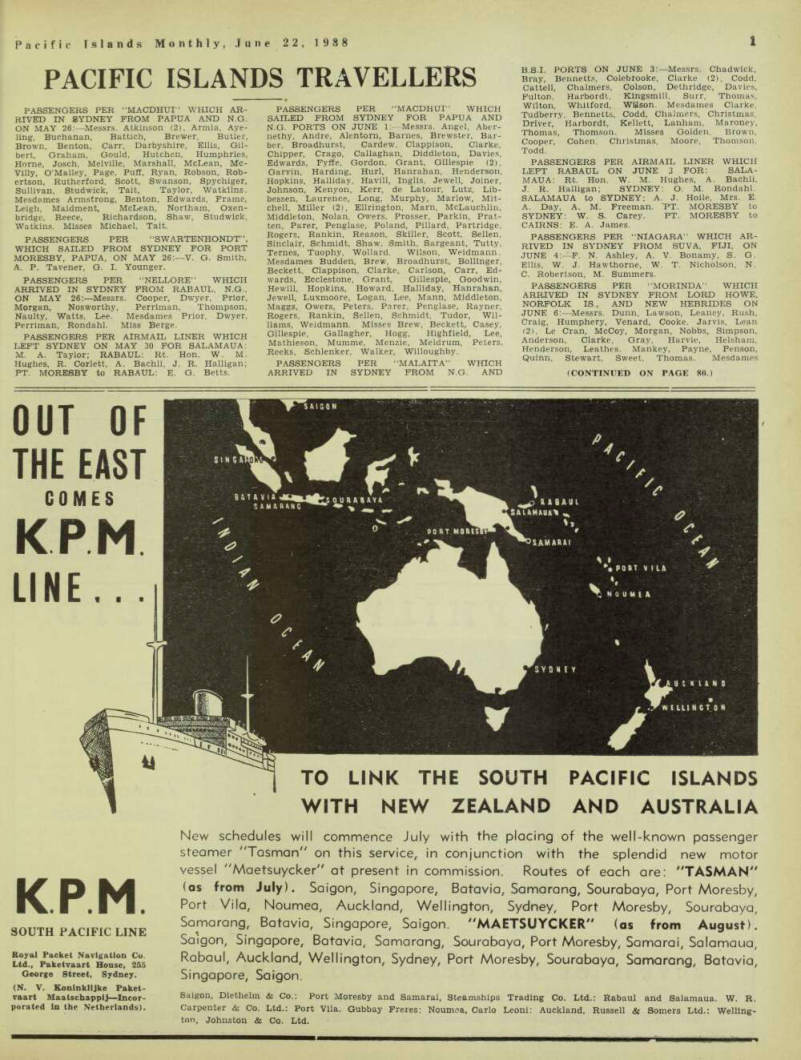
Out Of
THE EAST
COMES
KPM
LINE.. .
ii
TO LINK THE SOUTH PACIFIC ISLANDS
WITH NEW ZEALAND AND AUSTRALIA
KPM
SOUTH PACIFIC LINE
Royal Packet Navigation Co.
Ltd., Paketvaart House, 255 George Street, Sydney. (N. V. Koninklijke Paketvaart Maatschappij—lncorporated In the Netherlands).
New schedules will commence July with the placing of the well-known passenger steamer "Tasman" on this service, in conjunction with the splendid new motor vessel "Maetsuycker" at present in commission. Routes of each are: "TASMAN" (as from July). Saigon, Singapore, Batavia, Samarang, Sourabaya, Port Moresby, Port Vila, Noumea, Auckland, Wellington, Sydney, Port Moresby, Sourabaya, Samarang, Batavia, Singapore, Saigon. "MAETSUYCKER" (as from August).
Saigon, Singapore, Batavia, Samarang, Sourabaya, Port Moresby, Samarai, Salamaua, Rabaul, Auckland, Wellington, Sydney, Port Moresby, Sourabaya, Samarang, Batavia, Singapore, Saigon.
Saigon, Diethelm & Co.: Port Moresby and Samarai, Steamships Trading Co. Ltd.: Rabaul and Salamaua. W. R.
Carpenter & Co. Ltd.: Port Vila. Gubbay Freres: Noumea, Carlo Leoni: Auckland, Russell & Somers Ltd.: Wellington, Johnston & Co. Ltd.
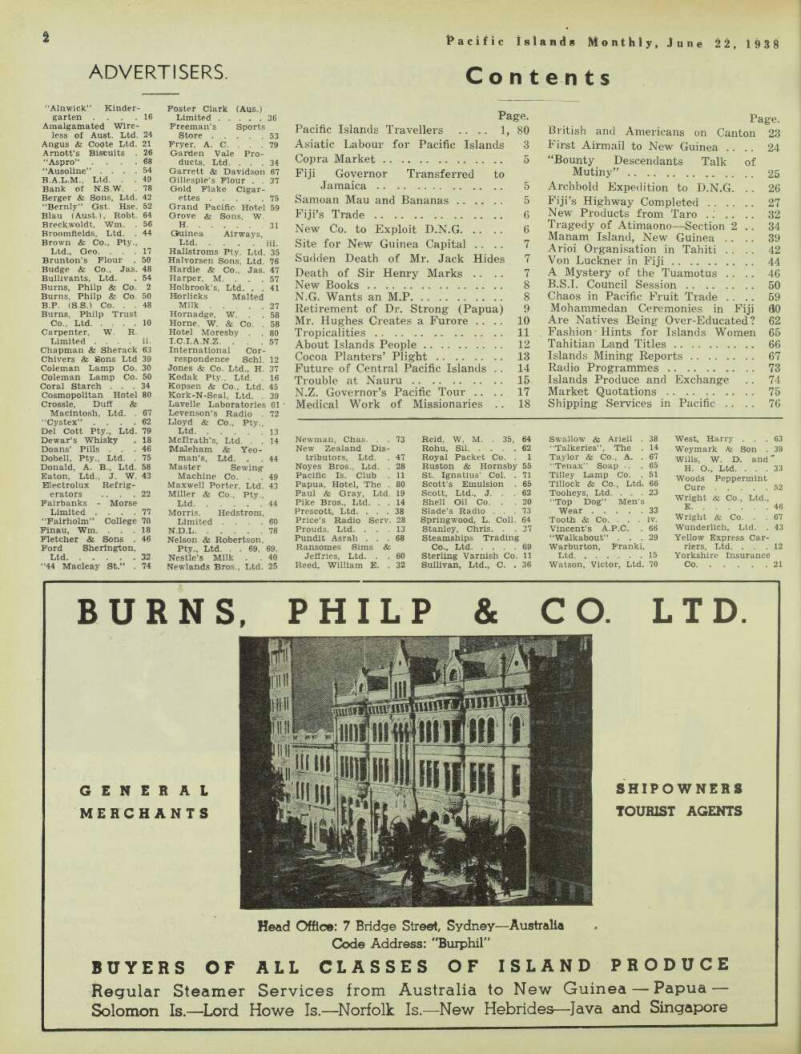
Advertisers.
“Alnwick” Kinder garten ... 16 Amalgamated Wire less of Aust. Ltd. 24 Angus & Coote Ltd. 21 Arnott’s Biscuits . 26 “Aspro” ... 68 “Ausollne” ... 54 8.A.L.M.. Ltd. . . 49 Bank of N.S.W. . 78 Berger & Sons, Ltd. 42 “Bernly” Gst. Hse. 52 Blau (Aust.), Robt. 64 Breckwoldt, Wm. . 56 Broomfields, Ltd. . 44 Brown & Co., Pty., Ltd., Geo. ... 17 Brunton’s Flour . 50 Budge & Co., Jas. 48 Bullivants, Ltd. . 54 Burns, Philp & Co. 2 Burns, Philp & Co. 50
B.P. (S.S.) Co. . . 48
Burns, Philp Trust Co.. Ltd 10 Carpenter, W. R.
Limited ... ii.
Chapman & Sherack 63 Chivers & Sons Ltd 39 Coleman Lamp Co. 30 Coleman Lamp Co. 50 Coral Starch ... 34 Cosmopolitan Hotel 80 Crossle, Duff & Macintosh, Ltd. . 67 “Cystex” ... 62 Del Cott Pty., Ltd. 79 Dewar’s Whisky . 18 Doans’ Pills ... 46 Dobell. Pty., Ltd. . 75 Donald, A. 8., Ltd. 58 Eaton. Ltd., J. W. 43 Electrolux Refrig erators .. . .22 Fairbanks - Morse Limited ... 77 “Fairholm” College 70 Pinau, Wm. ... 18 Fletcher & Sons . 46 Ford Sherlngton, Ltd 32 “44 Macleay St.” . 74
Foster Clark (Aus.) Limited 36 Freeman’s Sports Store 53 Fryer, A. C. . . .79 Garden Vale Pro ducts, Ltd. ... 34 Garrett & Davidson 67 Gillespie’s Flour . . 37 Gold Flake Cigar ettes 75 Grand Pacific Hotel 59 Grove & Sons, W.
H 31 Guinea Airways, Ltd iff, Hallstroms Pty. Ltd. 35 Halvorsen Sons, Ltd. 76 Hardie & Co., Jas. 47 Harper, M. . . .57 Holbrook's, Ltd. . . 41 Horlicks Malted Milk 27 Hornadge, W. . .58 Horne, W. & Co. . 58 Hotel Moresby . . 80
1.C.1.A.N.Z. ... 57
International Cor respondence Schl. 12 Jones & Co. Ltd., H. 37 Kodak Pty., Ltd. . 16 Kopsen & Co., Ltd. 45 Kork-N-Seal, Ltd. . 39 Lavelle Laboratories 61 Levenson’s Radio . 72 Lloyd & Co., Pty., Ltd 13 McHrath’s, Ltd. . . 14 IMaJeham & Yeo man’s, Ltd. , . 44 Master Sewing Machine Co. . . 49 Maxwell Porter, Ltd. 43 Miller & Co., Pty., Ltd 44 Morris. Hedstrom, Limited ... 60
N.D.L 78
Nelson & Robertson.
Pty., Ltd. . . 69, 69.
Nestle’s Milk . . 40 Newlands Bros , Ltd. 25
Newman, Chas. . . 73 New Zealand Dis tributors, Ltd. . 47 Noyes Bros., Ltd. . 28 Pacific Is. Club . 11 Papua, Hotel, The . 80 Paul & Gray, Ltd. 19 Pike Bros., Ltd. . . 14 Prescott, Ltd. ... 38 Price’s Radio Serv. 28 Prouds, Ltd. ... 13 Pundit Asrah ... 68 Ransomes Sims & Jeffries, Ltd. . . 60 Reed, William E. . 32
Reid, W. M. . 35, 64 Rohu, Sil 62 Royal Packet Co. . 1 Ruston & Hornsby 55 St. Ignatius’ Col. . 71 Scott’s Emulsion . 65 Scott, Ltd., J. . .62 Shell Oil Co. . . 20 Slade’s Radio ... 73 Springwood, L. Coll. 64 Stanley, Chris. . . 37 Steamships Trading Co., Ltd 69 Sterling Varnish Co. 11 Sullivan, Ltd., C. . 36
Swallow & Ariell . 38 “Talkeries”, The . 14 Taylor & Co., A. . 67 “Tenax” Soap .. .65 Tilley Lamp Co. . 51 Tillock & Co., Ltd, 66 Tooheys, Ltd. ... 23 “Top Dog” Men’s Wear 33 Tooth & Co. . . . iv.
Vincent’s A.P.C, . 66 “Walkabout” ... 29 Warburton, Franki, Ltd 15 Watson, Victor, Ltd. 70
West, Harry ... 63 Weymark & Son . 39 Wills, W. D. and"
H. 0., Ltd. ... 33 Woods Peppermint Cure 52 Wright & Co., Ltd., E 46 Wright & Co. . . 67 Wunderlich, Ltd. . 43 Yellow Express Car riers, Ltd. . . .12 Yorkshire Insurance Co 21
Contents
Page.
Pacific Islands Travellers ... 1, 80 Asiatic Labour for Pacific Islands 3 Copra Market 5 Fiji Governor Transferred to Jamaica 5 Samoan Mau and Bananas 5 Fiji’s Trade 6 New Co. to Exploit D.N.G 6 Site for New Guinea Capital ... 7 Sudden Death of Mr. Jack Hides 7 Death of Sir Henry Marks ... 7 New Books 8 N.G. Wants an M.P 8 Retirement of Dr. Strong (Papua) 9 Mr. Hughes Creates a Furore ... 10 Tropicalities 11 About Islands People 12 Cocoa Planters’ Plight 13 Future of Central Pacific Islands .. 14 Trouble at Nauru 15 N.Z. Governor’s Pacific Tour ... 17 Medical Work of Missionaries .. 18
Page.
British and Americans on Canton 23 First Airmail to New Guinea ... 24 “Bounty Descendants Talk of Mutiny” 25 Archbold Expedition to D.N.G. . . 26 Fiji’s Highway Completed 27 New Products from Taro ... 32 Tragedy of Atimaono—Section 2.. 34 Manam Island, New Guinea .. .. 39 Arioi Organisation in Tahiti ... 42 Von Luckner in Fiji 44 A Mystery of the Tuamotus ... 46 8.5.1, Council Session 50 Chaos in Pacific Fruit Trade ... 59 Mohammedan Ceremonies in Fiji 00 Are Natives Being Over-Educated? 62 Fashion Hints for Islands Women 65 Tahitian Land Titles 66 Islands Mining Reports 67 Radio Programmes 73 Islands Produce and Exchange .. 74 Market Quotations 75 Shipping Services in Pacific ... 76
Advertisements & other items, p. 4 (1 item)
Burns, Philp & Co. Ltd.
GENERAL
MERCHANTS
I Mi in m
III!
Ilf Hi
ill
II
SHIPOWNERS
TOURIST AGENTS
Head Office: 7 Bridge Street, Sydney—Australia Cod© Address: "Burphil"
BUYERS OF ALL CLASSES OF ISLAND PRODUCE Regular Steamer Services from Australia to New Guinea — Papua — Solomon Is.—Lord Howe Is.—Norfolk Is.—New Hebrides—Java and Singapore
Pacific Islands Monthly
The Newspaper-Magazine of the South Seas [Registered at the G.P.0., Sydney , for transmission by post as a newspaper. J
Published Once Each Month and Circulated in Australia and New Zealand and in the following Pacific Territories and Islands Groups:
Crown Colony of Fiji.
Australian Territory of Papua.
Mandated Territory (Australia) of New Guinea, Bismarck Archipelago and Northern Solomon Islands.
Mandated Territory (Japan) of Marshall, Caroline and Marianna Islands.
French Territory of New Caledonia.
British and French Condominium of New Hebrides.
American Territory of Eastern Samoa.
American Territory of Guam.
Mandated Territory of Nauru.
British Crown Colony of Gilbert and Ellice Islands.
Mandated Territory (New Zealand) of Samoa.
British Solomon Islands Protectorate.
British Protectorate of Tongan Islands.
New Zealand Territory of Cook Islands.
Australian Territory of Norfolk Island.
French Colony of Oceania (Tahiti, etc.).
American Territory of Hawaiian Islands.
Owned and Produced by Pacific Publications Pty. Ltd., Union House, 247 George Street, Sydney.
'TTI’T rpunxrr J Managing Director . 8W5037 IJCLEPHUNE 1 BuainesB and Editorial MA7IOI
P.O. Box 3408 R
Registered Address of Telegrams, Radiograms, and Cables: “Pacpub”, Sydney.
Contributions
Articles, Stories, and Photographs dealing with Pacific Islands subjects are invited and will be paid for on publication at usual rates.
Subscription Rates
Per Annum, within British Empire, Prepaid, Post Free 8/- Per Annum, elsewhere, prepaid, Post Free 10/- Single Copies Bd.
Editor and Publisher:
R. W. Robson, P.R.G.S.
Assisted by Selwyn Hughes.
Advertisements
Advertising Manager: L. W. Bailey.
Advertising Office and Printing-House: 29 Alberta St., Sydney.
Advertising rates furnished on application.
Colours, etc by Arrangement Process Blocks made at Advertiser’s expense when required. Screen, 100.
Changes of Advertising Copy should reach this Office by Bth of each month, otherwise previous advertisement may be repeated.
Agents
The following are authorised to receive sub scriptions for the Pacific Islands Monthly:— Islands Branches of Burns, Philp & Co. Ltd., and Burns Philp (South Sea) Co. Ltd.
Islands Branches of W. R. Carpenter & Co. Ltd.
All Branches of Morris, Hedstrom & Co. Ltd.
G. Thomas & Co., Rabaul, New Guinea.
T. A. Olsson, Wau, New Guinea.
Whitten Bros. Ltd., Samaral, Papua.
Steamships Trading Co., Papua. All Branches.
P. Costello, Suva, Fiji.
J. Muir Suva, Fiji.
N. C. Mackenzie-Hunt, Wainunu, Bua, Fiji.
All Branches and Representatives of W. H. Grove & Sons Ltd., Auckland, New Zealand.
Cook Islands Trading Co., Rarotonga, Cook Is.
A. C. Rowland, Papeete, Tahiti.
Representative in London: W. C HARVEY, Coronation Building 4 Lloyds Avenue, London, E.C.2. from whom may be obtained copies of Pacific Islands Monthly, Pacific Islands Year Book, advertising schedules, etc.
Vol. VIII. No. 11.
Sydney, June 22, 1938
Pfifo ( 8d - Pei Copy.
IT 1 ICC ( Prepaid: 8/- p.a.
Asiatic Labour For Pacific
Territories
AS the years pass, one can see a ** labour problem growing acute in the Pacific.
If European occupation of the vari ous Territories of the Central and South Pacific is to continue effec tively, some guarantee of an adequate labour supply must be given to the commercial interests concerned. In that connection, there always is danger of a clash between the em ployers, and the various folk who con sider it their duty to protect the in terests of the natives—the latter class including some utterly impractical idealists who believe that Europeans, without apology and without cere mony, should be thrown out of the Islands altogether. Writers of letters to the editor, published in this and recent issues, deal interestingly with certain aspects of this problem.
The fact of the matter is that a better labour supply already is needed by British interests in New Guinea, the Solomons, and Samoa, and to some extent in Fiji, and probably it will be needed soon in Papua. This
is a matter—especially in its relation ship to the possible use of indentured Asiatic labour—concerning which there should, long ago, have been con sultation between the Dominions con cerned and the British Government.
Instead, all the little bureaucrats paddle along, each in his own water tight compartment, and coldly ignore the similar problem of the men along side them.
The first principle of colonisation nowadays is that the native may not be enslaved. In any event, as an aboriginal landowner, he has certain inalienable rights, which give him economic independence. Yet, without an adequate labour supply, Europeans cannot make sufficient use of these islands to justify European occupa tion; and, if Europeans abandon them the Asiatics will come in—and that will be the end of the European nations in the West and South Pacific.
Every year, it is becoming more difficult to obtain a sufficient labour supply for New Guinea’s plantations, mines and commercial establishments.
This position became inevitable, from the time that the goldmines suddenly demanded from 7,000 to 10,000 native labourers. There are several reasons for it, and a dozen angles to each reason; but the net result is that the New Guinea natives, in an increasing degree, are unwilling to make labour contracts, and those who do are in creasingly difficult to handle.
The same thing is likely to happen in Papua. If an oil industry is estab lished there the labour position will become acute, so far as native sup plies are concerned.
The real solution was seen long ago, but always has been frowned upon officially. It is to employ a system of indentured Asiatic labour, similar to that used by the French in New Caledonia and the New Hebrides.
The well-meaning, but uninstructed and inexperienced Socialist Govern ment of New Zealand has removed most of the indentured Chinese labourers from Western Samoa, and has told the embarrassed planters there: “Use local labour, or get out!”
The issue, which apparently is too big to be seen by the gentlemen in little New Zealand, has application to the whole Pacific. If there is to be an effective and justifiable occupation of Samoa by Europeans there must be
an adequate labour supply. Samoans, holding ample food-producing lands on a communal basis, will not hire themselves as labourers to Europeans.
Exactly the same difficulty has been experienced in other Pacific ter ritories during the past decades. In almost every case, an attempt has been made to solve it by bringing in Asiatic labour (always on a system of strict indenture and periodical re patriation), and in almost every case the result has been deplorable. For one reason and another—too many and lengthy to examine here—the various indenture systems broke down, with the result that a Chinese com munity has become established in Tahiti, a Japanese community in Hawaii, an Indian community in Fiji, and a Chinese community in New Guinea. In the cases of Tahiti, Fiji and New Guinea, the implantation of Asiatics has not solved the labour problem; the Asiatics simply have be come traders, planters, and artisans, and will not hire themselves out as labourers. But the breakdown of the indenture system in those cases does not mean that it will not work. It has worked, and is working admirably to-day, in New Caledonia, where Javanese operate the chrome and nickel industries; in New Hebrides, where Tonkinese supply plantation labour; and in Nauru and Ocean Island, where Chinese work the phos phate deposits.
It is fair neither to European en terprise, to Government officials, to missionaries, nor to the Pacific Islands natives themselves, to expect that these territories shall be satisfactorily occupied by Europeans, with the assistance of the indigenous peoples only. The natives, through countless generations, have not known real labour—Mother Nature has provided abundantly for their simple needs.
Why should they be made to labour?
Or why, alternatively, should their lives be altered, and their needs be made more numerous and complex, so that they may be induced to labour?
Following this argument, one may say, Why not leave the natives alone in their Pacific islands, to work out their own destiny, under the guidance of missionaries and benevolent Gov ernment despots? Unfortunately, the day in which that idea might be seri ously discussed is past. In relation to the occupation and use of occupiable territories, there is a mighty stirring in the world. The fertile, undeve loped Pacific territories are directly affected. European countries must occupy and make proper use of the Pacific territories they hold, or they will lose them, with results calamitous to themselves. They dare not even hand over the territories to the natives whom they may have organised and
educated—the position in the Philip pines, where America now is trying to put the Philippines Independence Plan into reverse, is proof of that.
And so we come back to some plain questions, to which answers can easily be given:— Is it desirable that all Pacific ter ritories south of the Equator be held by Britain, France and other Euro peans? It is.
Can those territories be effectively occupied and held unless there is ade quate labour available for established industries and developmental works?
They cannot.
Is sufficient native labour avail able? There is not sufficient native labour available in any of the terri tories, but there is ample labour to be hired next door, in Asia.
But that indenture system, as al ready shown, is full of dangers, in an economic and racial sense. That is why there should be a clear under- * standing and a common policy be tween the various colonising interests concerned.
Mr. Eric Vine, well-known Fiji bar rister and solicitor, died at Raki Raki, Ra, on May 10. Born in London in 1889, Mr. Vine was admitted as a solicitor of the Supreme Court of England in 1911, He served through the war and went to Fiji in 1924, being admitted as a bar rister and solicitor of the Supreme Court in the same year. Mr. Vine practised in many districts on Viti Levu, finally establishing himself at Ra. He is sur vived by his widow.
"Touboda, one meat'e die pfinish!" (English is the official language of the Papuans.)
School Pupils Of
Over 30 Years
Awkward Situation In Samoa
From Our Own Correspondent.
APIA, June 2. fPHE mutual hates of local politics have A invaded even our education system, and it now appears likely that the Post- Primary School, opened recently by the Administration, to provide our young people with a link between the primary schools and the University, will be wrecked.
It was originally intended that the school should be available for boys and girls of European status, up to the age of 17 and it was also intended that the more intelligent Samoan children of school age should be admitted.
However the Mau and the Mau leaders got busy and protested to the New Zea land Government against the fixing of an age-limit for the school. The open ing of the school was postponed several times and, finally, the age limit was withdrawn. The result is that among a large number of native pupils admitted are a number of adult Samoans, some of them over 30 years of age, and some married. European parents, quite natur ally, have refused to send their young daughters to the school in these circum stances.
Mr. W. R. Humphries, Resident Mag istrate of Port Moresby, Papua, arrived in Sydney by the May “Macdhui” on long furlough. Mr. Humphries is be ing relieved by Mr. K. A. Woodward, who has been Resident Magistrate at Misima Island for the past year.
Copra
Market Overshadowed By Politics
ADVICES from London, dated early in June, and received by airmail, :hrow no light upon the immediate future of the copra market.
The more expert of the London copra lealers confess that the world market position has them baffled. Messrs.
Faure, for instance, say that they ex acted in April that by the end of May ;here would be a rise in copra prices, )ut nothing of the kind has materialised, ind for this they blame the very dis urbed, and at times critical, inter lational situation.
There is a concensus of opinion imong London market commentators hat, despite the readiness of the world generally to buy liberally of all com nodities, there will be no eager buying o long as there remains a daily danger •f an outbreak of war. All are agreed hat, so long as a major economic dis location is threatened, no person or in erest will invest more money than can •e helped in perishable goods.
The economic situation in the United Rates also remains chaotic and uncer ain, and this also tends definitely to lepress the world markets for all com aodities. It will have been noted that number of the largest manufacturers f motor cars in U.S.A. recently decided pon what is virtually a “three-months oliday”. There could be no greater vidence than this of the slowing-up of usiness, as a result of the timidity of be markets and the unwillingness of idividuals to invest money in any hing.
But, while the immediate outlook is epressing, it can be said that there is ttle likelihood of war in Europe. There re outcries and alarms, but even the ations under dictatorships realise that major war in Europe to-day would lean the end of European civilisation. 7e believe that when this fact is suf ciently appreciated—and its general cceptance may come at any time—the orld may quite easily swing into an ra of trading and prosperity, that will e almost without precedent in human ffairs.
Effect Of Oil Search In
Papua
HHE fall in the price of copra and other L commodities is not causing much nbarrassment in Papua.
“Things here are not by any means 3 depressed as they might be," says a ort Moresby merchant in a letter to the ditor, ‘“We have to thank the active aerations of the various companies hich are seeking for oil. I sincerely ape that their activities will continue >r at least another two years; for, by lat time, I think the world will have ;raightened out some of its compli itions, and our commodities will bo ale to keep us going comfortably ?ain."
Fiji's Governor
Unexpected Transfer to Jamaica
THERE was considerable surprise when it was announced on June 15 that Sir Arthur Richards, Governor of Fiji and High Commissioner for the Western Pacific, had been appointed Governor of Jamaica. Sir Arthur Richards was ap pointed to his present position at the end of 1936, and had really only settled down to his new duties, which he was discharging with every indication o+ strength, courage and vision.
Probably it was the display of those qualities which caused his early transfer.
There have been serious riots recently in
Jamaica, and it may be that the trouble is due to administrative weakness there.
One may suppose that the British Colonial Office looked about for some man of outstanding ability for appoint ment to a difficult situation, and Sir Arthur Richards evidently was the type of man required. It may be Jamaica’s gain—but definitely it is Fiji’s loss.
The men who are administering the outlying territories under the command of the High Commissioner for the Wes tern Pacific will regret this development.
As a rule, the Solomons, the Gilbert and Ellice Colony, Tonga and the New Hebrides complain bitterly that Suva, more often than not, ignores their existence and pigeonholes their variour representations; but, in Sir Arthur Richards, they had found a man who gave as much attention to the outlying territories as to Fiji itself.
Mr. V. Hunt has been appointed as sayed to Cuthbert’s Misima Gold Mines, Misima Is., Papua. Mr. Hunt was formerly connected with the Triton Gold Mining Co., Western Australia.
Dr. Peter H. Buck, director of the Bernice P. Bishop Museum at Honolulu, Hawaii, has been appointed visiting pro fessor of Polynesian ethnology to Yale University, U.S.A.
Sir Arthur Richards, with his small son, “snapped” on the liner in Sydney, in 1986, when he was en route to Suva to assume the Governorship.
Samoan Mau And
Bananas
Industry May Be Wrecked
From Our Own Correspondent.
APIA, June 2.
WITH the local cocoa price down to less than £22 per ton, and no profit at present in the cocoa industry, the banana export business has become the mainstay of our economic life. Re cently, 17,000 cases of bananas were shipped to New Zealand, and the de mand apparently is increasing, owing to the good quality of the fruit and the rigid inspection enforced.
It is, therefore, deplorable that the success of the banana industry should be threatened by a ceaseless and trouble some agitation against the Govern ment’s present hanana-oxport organi sation. The Man, for apparently per sonal and political reasons, is adopting all sorts of methods to make the organi sation difficult. It even went to the length of sending circulars to all native shippers of bananas and asking them to supply details of any complaints they might have against the present system of inspection. So far, the Government has flatly rejected the intrigues of the Mau, and the banana scheme is working admirably—but under a definite sense of uneasiness.
New Goldfields in New
Guinea Report of Sepik Discovery
NEWSPAPER reports, liberally head lined “Prospector is King of Wild Natives” in the Australian newspapers early in June, described how Mr. Mick Leahy, 36-years-old prospector and ex plorer, is “the only white man in the Wahgi region, on the Mount Hagen plateau, 8,000 feet up, in the centre of New Guinea”. It was stated that Mr.
Leahy has discovered gold close to the foot of Mount Hagen (13,000 feet) and employs over 200 Wahgi natives to work his claims.
It was stated in the same newspaper article that reports have been received in New Guinea of the discovery of a new goldfield near the headwaters of the Sepik River, close to the Dutch border.
It was said that the new discovery was of “considerable importance”, but no de tails are given. The report may be cor rect; but it has all the earmarks of flapper press sensationalism.
Mission Aeroplane
AN interesting development in mis sionary enterprise is seen in the establishment at Finschafen, New Guinea, headquarters of the Lutheran Mission, of an aeroplane, which is to be used in maintaining communication between the different Lutheran stations.
The plane, which is in charge of Pilot Garms and Mechanic Paul Rabe, has already made a number of flights be tween Finschafen and Lae.
Advertisements & other items, p. 7 (1 item)
5
acific Islands Monthly, June 22, 19 3 8
Fiji's Trade
Good Start for 1938
From Our Own Correspondent.
SUVA, June 2.
FIGURES published in the Fiji Royal Gazette concerning the trade of the Colony for the first quarter of 1938 dis close considerable increases over the corresponding quarter of 1937. Imports increased by £109,442 and exports by £110,325. Although imports showed such a high increase, duty paid amounted to £9,934 less.
Details were as follows:
Imports.
1937. 1938. £ £ Value . . .. 382,175 391,617 Duty 91.569 Wharfage 2,727 Tonnage Duty , 1,105 1,292
Exports.
1937. 1938. £ £ Sugar 139,098 Copra 81,775 Bananas .. .. 18,377 18,148 Molasses . . . . 3.427 4,658 Gold 121,871 Trochus 4,724 1,606 Other 43,270 23,932 Totals .. .. £280.763 £391.088
to Australia
N.Z. Trade Diverted to Australia
THERE has been some concern recently in Islands trading circles in New Zealand over the fact that much of the Fiji trade formerly enjoyed by the Dominion has been diverted to Aus tralia. Dealing with this decline, the Suva Chamber of Commerce states that the main factors responsible are the higher price of N.Z. manufactured goods and Australia’s advantage with shipping facilities.
There was a boom in New Zealand goods in 1931-32 as the result of a pre ferential tariff extended by Fiji when Australia shut out her bananas; but that concession was abandoned under the Ottawa Agreement and N.Z. goods went into Fiji on the same footing as Australian products. Under the prefer ential tariff the following goods were im ported from N.Z. in fairly large quan tities:—Biscuits, boots and shoes, bran, confectionery, fruits, jams, leather, milk, manures, pickles, paints and soaps. With the removal of the preference these are now imported from Australia.
Fiji imported goods from Aus tralia valued at £317,046 and from N.Z. goods valued at £100,255. In 1936 im ports from Australia were valued at £514,504. and from N.Z. £56,870. Fijian exports to Australia also increased from £50,098 in 1932 to £241,564 in 1936.
To some extent Australia supplies p-oods to Fiji which N.Z. cannot supply.
These include coal, wheat products and manufactured tobacco, which in 1936 were valued at £124,381. New Zealand also cannot supply the light varieties of beers and ales imported from Australia.
Pacific Travellers
Miss F. Mathieson, of the New Guinea Administrative staff, sailed for Rabaul by the June “Macdhui”, after furlough in Sydney.
Mr. Alec. Ottawa, sales representative of the Riverstone Meat Co. Pty. Ltd., whose frozen and tinned-meat products are. well-known in the Pacific Islands, sailed from Sydney by the “Malaita” for the Solomons on June 11, on one of his periodical visits to the Western Paci fic.
Sister Mary Reine, who has been en gaged in mission work for the Marist Mission for more than 15 years, sail ed by the June “Malaita” for Visale, B.S.I., after spending furlough in Sydney.
Mr. Arthur Jewell, M.L.C., left Sydney for Foil Moresby, Papua, by the “Macd hui” on June 1. Mr. and Mrs. Jewell have been spending a short holiday in Australia.
Death Of Sir George
Richardson
THE death occurred suddenly in Auck land on June 12, at the age of 70, of Major-General Sir George Richardson, who was Administrator of Western Samoa from 1923 to 1928 —a period of considerable political unrest in the Ter ritory.
Sir George Richardson was a man of brilliant parts. He began life as a humble private in the British army. He became a military instructor in New Zealand in 1891; was representing New Zealand at the War Office in London in 1914; and he was on the staff of the Royal Naval Division at Antwerp and Gallipoli and of the 12th Corps at Salonika. He was knighted in 1926.
New Guinea
New Co. For Dutch
Plans For Far-Reaching Development
THE determination of Holland to develop her own tropical terri tories, and so to forestall the Japanese in their insistent argument that they are entitled to enter undeveloped territories in the South Seas, is seen in the recent creation of the Netherlands New Guinea Company. It has been formed with far reaching, long-range plans for the deve lopment of Dutch New Guinea and the neighbouring districts in Papua, and some fifteen leading Dutch concerns in the East Indies, and probably British interests, are expected to take part.
The initial capital of 2,000,000 gulden (equal to £220,000 sterling) is being provided, and the company will have a governing body in Holland and a board of directors in Batavia, where Mr. E.
V, Van Dunne will be Managing Direc tor.
Full Government co-operation is as sured. The first task is exploration. A research company will exploit natural products of land and sea, and study the question of agriculture, testing out the cultivation of various staples.
Combating malaria and other diseases is regarded as most important. The possibility of white settlement in the upland areas is not being overlooked, though any decision will not be rushed.
Settlement of Javanese on any large scale is not expected for at least ten or 20 years. On the other hand, every ef fort will be made to develop the capa cities of the Papuans, though it is re cognised that steady constant work is strange to them.
Exploration of oil and gold possi bilities will be continued by the New Guinea Petroleum Co. and the Billiton Mining Co.
Advertisements & other items, p. 8 (1 item)
Look on the Front
of Your Wrapper!
The figures stamped there (if any) show the date when your subscription expires.
This date will appear on wrappers of three issues preceding expiration, thereby giving 3 months’ notice. If, at the end of that time, we have not been instructed to continue to send the journal to you, it will be discontinued.
Your subscription (8/- per annum, or 10/- in the case of countries outside the
British Empire—which includes postage)
may be sent direct, or may be paid to any of our agents (listed on page 3.)
POSTAGE RATES
The postage required for this issue is:— To Australia and New Zealand 2d To United Kingdom via All-sea routes ... 2d To United Kingdom via Prance 2d To other British Possessions 2d To U.S.A. and Foreign Countries 4d
PACIFIC PUBLICATIONS PTY. LTD.
Union House, 247 George St., Sydney.
Capital Site for New
Guinea Choice Believed To Be Between Two Plateaus On Mainland
SINCE his return from New Guinea, the Australian Minister (Mr.
Hughes) has given no indication of the locality he favours as the future capital of the Territory.
The matter will probably come before the Federal Cabinet on Tuesday, June 21, and an announcement then may be made.
All unofficial information suggests that the new site will be on the mainland, at a point that will assist in opening up the rich plateaus of the interior, and that the establishment of the capital there will form part of a vigorous policy
of road-building, calculated to connect both the Morobe goldfield and the agri cultural plateaus with suitable coastal ports.
Plans for financing the goldfields road have been under consideration. The Morobe interests resent the idea that they should be specially taxed. They point out that the Administration al ready takes from them at least £75,000 per annum in gold royalties, plus a huge sum in Customs duties, and this should be ample to finance a £250,000 road.
It is reported that a highway up the Markham Valley to the Ramu with a spur-road up the Wampit, into the Bulolo Valley, is contemplated; and that the final choice of a capital site will lie be tween (a) a plateau overlooking the Markham Valley, with access to Lae, Wau, and Salamaua, and (b) a plateau, about 1,100 feet high, overlooking the Ramu Rfver, with access to Madang, on the one side, and the Ramu-Benna Benna-Markham districts, on the other.
Hides
Death Of Jack
IT is announced, as we go to press, that Mr. Jack Hides, 31, famous for exploration achievements in Papua, died in a private hospital in Sydney on Sunday night, June 19.
Pneumonia is given officially as the cause of death. Actually,' the doctors had conquered the pneu monic condition, but Mr. Hides did not rally. He had never recovered from the mysterious form of beri beri disease he contracted, plus the incred’ble physical effort he made, when bringing David Lyall out from the centre of New Guinea to Daru in August-September, 1937. He spent some months in the mountains near Sydney, and had three or four spells in hospital, but he f?jipd to recover his former wiry strength, which had carried him through so many critical situations in Papua.
Sir Henry Marks
Dead
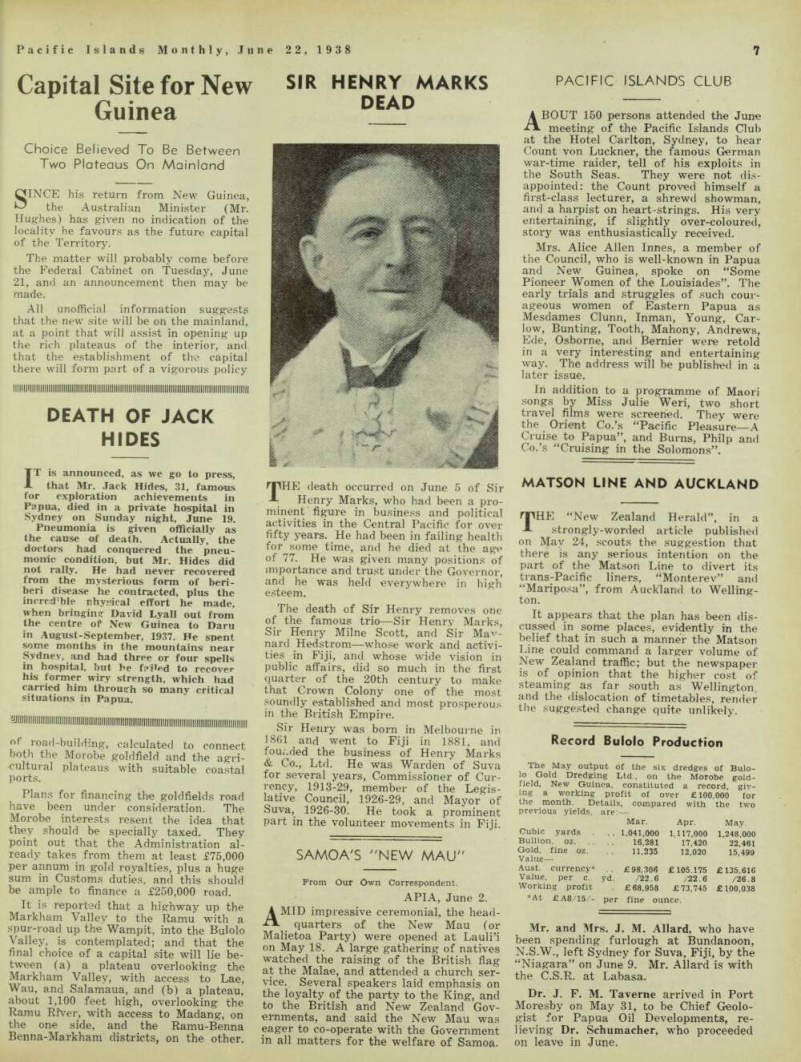
THE death occurred on June 5 of Sir Henry Miarks, who had been a pro minent figure in business and political activities in the Central Pacific for over fifty years. He had been in failing health for some time, and he died at the agv of 77. He was given many positions of importance and trust under the Governor, and he was held everywhere in high esteem.
The death of Sir Henry removes one of the famous trio—Sir Henry Marks, Sir Henry Milne Scott, and Sir May nard Hedstrom—whose work and activi ties in Fiji, and whose wide vision in public affairs, did so much in the first quarter of the 20th century to make that Crown Colony one of the most soundly established and most prosperous in the British Empire.
Sir Henry was born in Melbourne in 1861 and went to Fiji in 1881, and founded the business of Henry Marks & Co., Ltd. He was Warden of Suva for several years, Commissioner of Cur rency, 1913-29, member of the Legis lative Council, 1926-29, and Mayor of Suva, 1926-30. He took a prominent part in the volunteer movements in Fiji.
Samoa's "New Mau"
From Our Own Correspondent.
APIA, June 2.
AMID impressive ceremonial, the head quarters of the New Mau (or Malietoa Party) were opened at Lauli’i on May 18. A large gathering of natives watched the raising of the British flag at the Malae, and attended a church ser vice. Several speakers laid emphasis on the loyalty of the party to the King, and to the British and New Zealand Gov ernments, and said the New Mau was eager to co-operate with the Government in all matters for the welfare of Samoa.
Pacific Islands Club
ABOUT 150 persons attended the June meeting of the Pacific Islands Club at the Hotel Carlton, Sydney, to hear Count von Luckner, the famous German war-time raider, tell of his exploits in the South Seas. They were not dis appointed: the Count proved himself a first-class lecturer, a shrewd showman, and a harpist on heart-strings. His very entertaining, if slightly over-coloured, story was enthusiastically received.
Mrs. Alice Allen Innes, a member of the Council, who is well-known in Papua and New Guinea, spoke on “Some Pioneer Women of the Louisiades”. The early trials and struggles of such cour ageous women of Eastern Papua as Mesdames Clunn, Inman, Young, Car low, Bunting, Tooth, Mahony, Andrews, Ede, Osborne, and Bernier were retold in a very interesting and entertaining way. The address will be published in a later issue.
In addition to a programme of Maori songs by Miss Julie Weri, two short travel films were screened. They were the Orient Co.’s “Pacific Pleasure—A Cruise to Papua”, and Burns, Philp and Co.’s “Cruising in the Solomons”.
Matson Line And Auckland
THE “New Zealand Herald”, in a strongly-worded article published on May 24, scouts the suggestion that there is any serious intention on the part of the Matson Line to divert its trans-Pacific liners, “Monterev” and “Mariposa”, from Auckland to Welling ton.
It appears that the plan has been dis cussed in some places, evidently in the belief that in such a manner the Matson Line could command a larger volume of New Zealand traffic; but the newspaper is of opinion that the higher cost of steaming as far south as Wellington, and the dislocation of timetables, render the suggested change quite unlikely.
N.S.W., left Sydney for Suva, Fiji, by the
Record Bulolo Production
The May output of the six dredges of Bulo lo Gold Dredging Ltd., on the Morobe gold field, New Guinea, constituted a record, giv ing a working profit of over £lOO,OOO for the month. Details, compared with the two previous yields, are:—
Mr. and Mrs. J. M. Allard, who have been spending furlough at Bundanoon, N.S.W., left Sydney for Suva, Fiji, by the “Niagara” on June 9. Mr. Allard is with the C.S.R. at Labasa.
Dr. J. F. M. Taverne arrived in Port Moresby on May 31, to be Chief Geolo gist for Papua Oil Developments, re lieving Dr. Schumacher, who proceeded on leave in June.
Mar. Apr. May.
Cubic yards . .. 1.041.000 1,117,000 1,248.000 Bullion, oz 16,281 17.420 22,461 Gold, fine oz. . 11,235 12.020 15,499 Value— Aust. currency* £98.306 £105.175 £135.616 Value, per c. yd. /22.6 /22.6 /26.8 Working profit £68,958 £73,745 £100,038 *At £A8/15/- per fine ounce.
New Books
Angus & Robertson's List
WE have received a most interesting
budget of new books from Messrs.
Angus and Robertson, Ltd., well-known
publishers, of Sydney. This firm is
maintaining, in the books it produces, a
High standard of literary quality, plus
“reader interest”; and residents of the
Islands, requiring good reading matter,
may order any of the following without
hesitation.
ACTION AT AQUILA, by Hervey Allen (au thor of “Anthony Adverse”) is a fascinat ing description of a series of little-known events and localities connected with the Ame rican Civil War. strung together as the mili tary career of a colonel. There is no plot and only a few exciting incidents. Features are the portrayal of battle scenes with ex traordinary vividness, and read artistry in describing how the beautiful valleys of Penn sylvania and Virginia were racked by war. < 10/6>.
SWINGING INTO GOLF, by Ernest Jones and Innls Brown. Here Is an excellent man ual for use both of beginners and of those who have become set in their ways. It deals with primary rules, old habits and modern technique—and, moreover, it is eminently read able. (8/6).
THE VICTORIAN ERA—lts Strength and Weakness, by Professor Walter Murdoch. This volume contains two Macrossan Lectures, de livered in 1937. and every man and woman interested in comparisons betweens the cul tures of particular eras will read it with de light. Professor Murdoch is one of our most erudite and charming writers, and he has made available in these two lectures, in most attractive form, the results of a lifetime of reading. (2/-).
SAVAGES IN SERGE, by Jack Hides. This is the well-known young Papuan explorer’s third book. He has gained steadily in the technique of writing, and there will be many who will regard this as his most attractive work. “Savages in Serge”, of course, are the native Papuan policemen, who have accom panied him so loyally and staunchly in all his Papuan adventures, and for whom he has the deepest admiration and respect. The book was written on his last expedition up the Strickland River, and it is vivid with colour and incident. The young author, in a spec ial foreword, gives all the credit for the fine spirit and efficient condition of the Papuan Armed Constabulary to the present Governor.
Sir Hubert Murray. The book will be more fully reviewed in our next issue. (8/6).
JAPAN REACHES OUT, by Willard Price.
This book already has been referred to in this journal. We merely remind readers that if they want to understand the Pacific situ ation, in relation to present deeply significant events in Asia, they must read this volume —written and published since the Japanese at tack on China commenced. (10/6).
HARPOONS AHOY! by Will Lawson. This is a valuable contribution to South Pacific and Antarctic history. Mr. Lawson is a good historian, because he is always careful of his facts, and he has a vivid, dramatic style of story-telling. In the present case the setting down of the experiences of the late Captain McKillop, last of the old-time whalers —he has a job to his liking, and he has carried it out in admirable fashion. It is a dramatic and often exciting story of the great sperm whales —not the migratory crea tures which nowadays are hunted by small fleets of steamers, but huge and cunning fight ers, which frequent certain areas, seek their food on the bed of the ocean, and are cap able of sinking ships and swallowing men.
It is a readable book, which can be warmly recommended as an historical narrative and an exciting yarn. (7/6).
DEATH IN THE MORNING, by Harry Hodge.
Here we have an Australian thriller with a good mystery, quick action and plenty of exciting situations. The author flies high, by tying up his story to a diabolical scheme to wreck the administrative machinery of a na tion; but he gets away with it successfully,
and skilfully introduces romance and real humour to brighten his sinister tale. (4/6).
DERELICT, by Joseph Shaw. This is a thril ler of another kind, eminently readable and stirring. We have an ancient setting for the tale—a gallant young man finds himself alone on a water-logged ship with a beautiful red haired girl, her mother, a person of definitely villainous inclinations, and a giant wolf-hound; but the story moves swiftly, in an ingenious and unexpected fashion, and we are given a most attractive tale of adventure, romance and intrigue. (7/6).
THE AULD SINNER, by Cowan Harper.
Cowan Harper is the nom-de-plume of Pro fessor Angus, of St. Andrew’s College (Syd ney) who. as well as being a very notable ecclesiastic, is also a cultured and delightful writer, with an unusual sense of humour. This collection of stories, based on incidents among Scottish folk in a little village in Ulster, is sprinkled with humour, with hatred of the hypocritical and narrow mind, with philoso phical reflection, and with quaint and lively Incident; and the charming character of the tales is in no way lessened because they con tain much of the Scottish dialect. A delight ful book, cordially recommended. (3/6).
THE MAKING OF A SCIENTIST, by Ray mond L. Dltmaras. Everyone is aware that scientists know a great deal about natural phenomena which is of fascinating interest to common people, but that not one scientist in a thousand is able to tell us what he knows.
In this book, however, we have fifteen chap ters devoted to the work of a scientist in a score of, different fields—flies, snakes, frogs, monkeys, bears, bats. etc.—and in every case he gives us something new and interesting and startling. The mass, good in itself, is leavened with a vein of rich humour, and the whole book is at once entertaining and in structive. The text is illustrated with a couple of score of unusual photographs. (7/6).
Mr. Len Christoffersen, formerly of
Fiji, died recently at the age of 33 at
Reefton, New Zealand. He was for
many years in the Fiji Customs Depart
ment, being stationed as Suva and
Levuka. Later he worked at Tavua,
from the commencement of mining op
erations there, returning to New Zealand
last year.
M.P. Wanted
Suggestion From New Guinea
A Miners’ Association Was
formed recently in the Morobe sec tion of New Guinea, to carry on an agi tation for a road to the coast, for re duced charges for essential commodities, and for a general reduction of costs all round; and, as a result of an alleged “unsatisfactory” interview with the Minister (Mr. Hughes) on June 6, a meeting of residents of Rabaul formed the Rabaul Business People’s and Pro perty Owners’ Association, to take action to protect their interests, espec ially in regard to the plan for the re moval of the capital.
The “Rabaul Times” points out that, already, there are other bodies of this kind in New Guinea, and their chief function seems to be to make urgent ap peals of one kind and another to the Supreme Governmental authority in Australia.
The newspaper says that what is really needed is a representative of the Pacific territories in the Commonwealth Parliament, so that the requests and pleas of the various interests and classes in the territories will not fall continu ally on the deaf ears of departmental bureaucrats, as has been the case in the past.
Islands Travellers
Mr. and Mrs. Neville McLean arrived in Sydney from New Guinea by the “Macdhui” on May 26, on short furlough.
Mr. McLean is an employee of Green ward & Laws at Wau.
Dr. Alfred Metraux, who has been associated with the Bernice P. Bishop Museum at Honolulu, Hawaii, has been appointed a visiting professor at Yale University, U.S.A. Dr. Metraux, who recently achieved prominence for his studies of Polynesian ethnology on Easter Island, will proceed to Yale, dur ing' September where he will take his duties until the end of January, 1939.
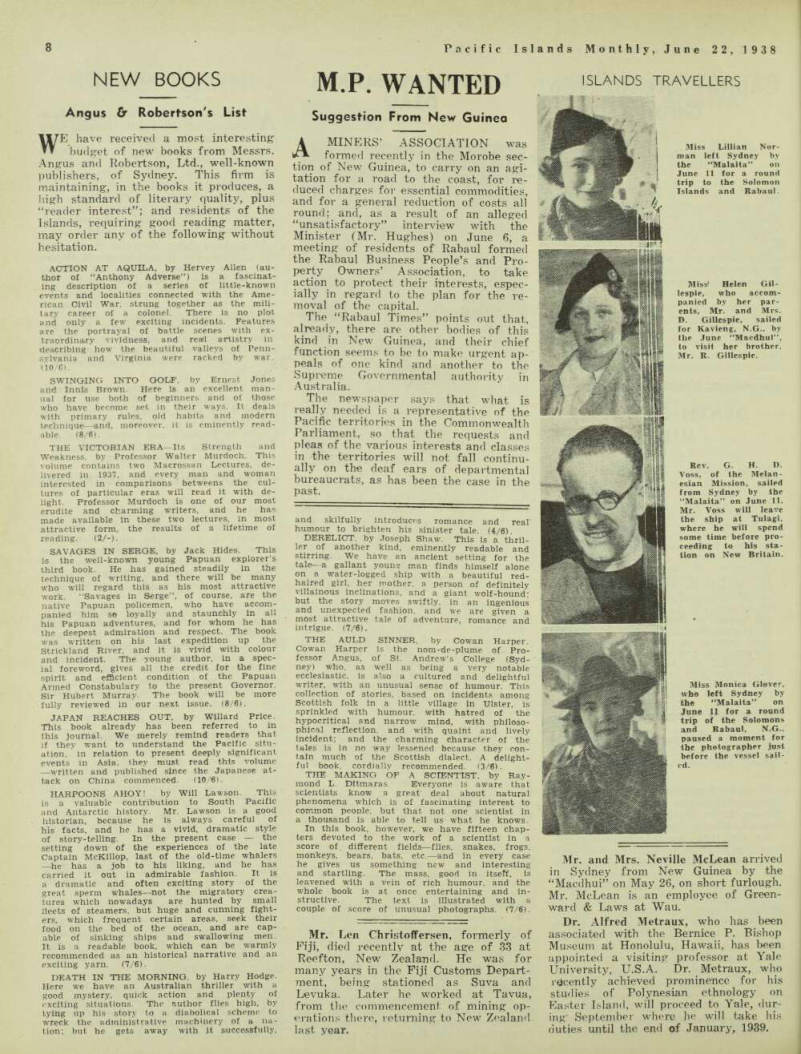
Miss Lillian Nor man left Sydney by the “Malaita” on June 11 for a round trip to the Solomon Islands and Rabaul.
Missl Helen Gil lespie, who accom panied by her par ents, Mr. and Mrs.
D. Gillespie, sailed for Kavieng, N.G.. by the June “Macdhui”, to visit her brother.
Mr. R. Gillespie.
Rev. G. H. D.
Voss, of the Melan esian Mission, sailed from Sydney by the “Malaita” on June 11.
Mr. Voss will leave the ship at Tulagi, where he will spend some time before pro ceeding to his sta tion on New Britain.
Miss Monica Glover, who left Sydney by the “Malaita” on June 11 for a round trip of the Solomons and Ranaul N.G.. paused a moment for the photographer just before the vessel sail ed.
Explain?
Will Somebody Please Explain?
By “Amel”
THROUGHOUT the Islands it is a well known fact that, where planters foregather, two topics of conversa tion hold the floor —namely, the perver sity of native labour, and the price of copra.
The vagaries of the latter are hard to understand. Before December, 1936, the price soared to £l4 and £l5 per ton, which meant comparative comfort for the planters. But this was too good to last. Steadily and relentlessly it fell again, until now it is £5/15/ per ton.
Can anyone give some good sound rea sons for this performance?
Various explanations, such as the European situation, the unstable condi tion of world affairs and the excess of substitutes lor copra products are dish ed up to us from time to time, but the unexplained fact remains that coconut and copra by-products are still being sold at precisely the same prices as when copra was £2O per ton.
It seems a trifle ridiculous, while cop ra fetches £5 15 per ton, desiccated co conut is sold at the rate of £ll2 per ten. And, as far as I know, margarine and cattle-food are maintaining their usual price levels.
A large amount of coconut oil prob ably goes into the manufacture of both household and toilet soaps. Consequent ly, according to the ruling price of cop ra, those commodities should be as cheap as dirt. But are they? Household soap, made in Suva, is indeed valuable stuff, being sold at approximately £47 per ton.
Why all the profit?
Perhaps coconut oil is one of the main ingredients of shaving soap? A 3oz. stick costs 1/9. Allow 9d for the bakelite con tainer, and figure out the rest for your self. All I can say is, the knowledge that they are lathering their faces with stuff worth about £597 per ton should cause men to weep tears of joy.
If the price of butter fluctuated to the same extent as the price of copra, dairy farmers would all go bankrupt and crazy in a week But it does not, so why can not the price of copra be the same? Why d9es not the low price of copra affect the high prices of the commodities manufac tured therefrom? Surely they should come down also!
It appears that the copra planters, as mere puppets of the powerful combines that rule world markets, can only sit tight, endeavour to evade the clutches of the merchants, hope for the best, and wonder whether, ultimately, their outlook will ever be any clearer than the mud it so closely resembles On May 30, a native of Mailu, Papua, was electrocuted, when he came in con tact with a wire fence which had become charged with current in an extraordinary
way. Water, overflowing from a gutter,
had reached an electric light switch.
This had destroyed the insulation, and the current had escaped to the iron walls and through an iron fence, to the wire.
The premises were properly wired, and there was the usual earth wire, and the galvanised iron fence was also partly buried in the earth; but the current took its course to the ground through the wire in the fence.
Retirement Of Dr.
W. M. Strong
Man Who Inaugurated Medical Training For Papuans
From Our Own Correspondent.
Port Moresby, June 10.
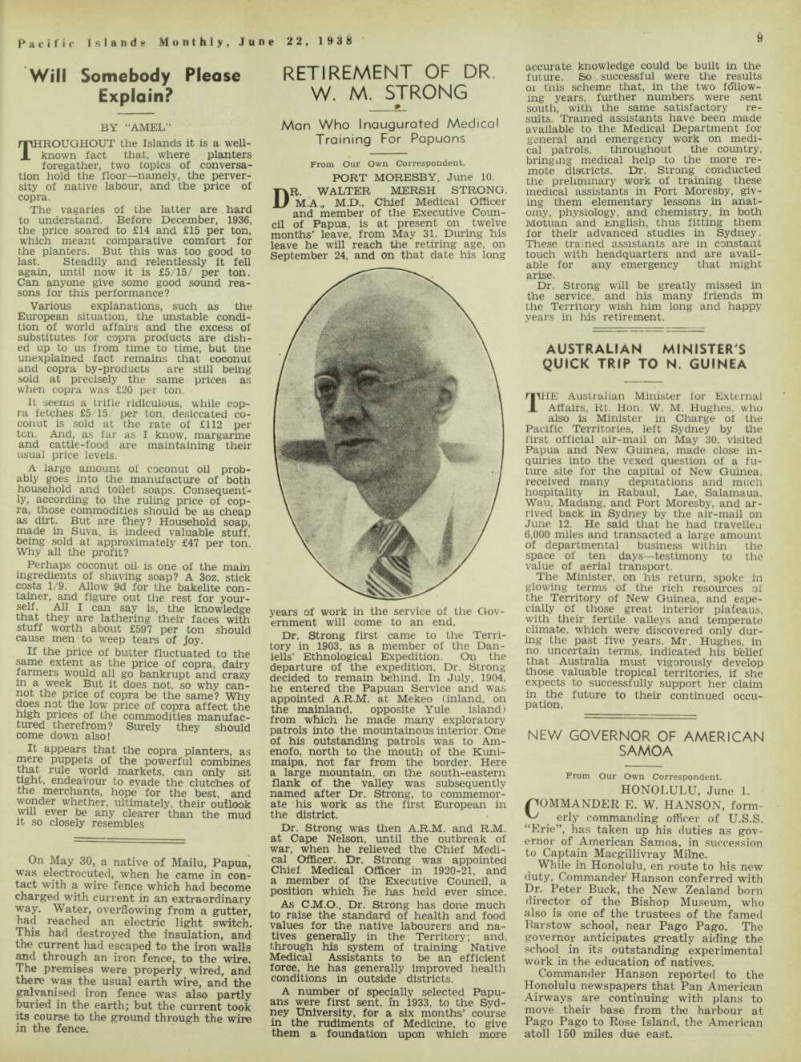
Dr. Walter Mersh Strong,
M.A M.D., Chief Medical Officer and member of the Executive Coun cil of Papua, is at present on twelve months’ leave, from May 31. During his leave he will reach the retiring age, on September 24, and on that date his long
years of work in the service of the Gov ernment will come to an end.
Dr. Strong first came to the Terri tory in 1903, as a member of the Dan iells’ Ethnological Expedition. On the departure of the expedition, Dr. Strong decided to remain behind. In July, 1904, he entered the Papuan Service and was appointed A.R.M. at Mekeo (inland, on the mainland, opposite Yule island) from which he made many exploratory patrols into the mountainous interior. One of his outstanding patrols was to Am enofo, north to the mouth of the Kuni maipa, not far from the border. Here a large mountain, on the south-eastern flank of the valley was subsequently named after Dr, Strong, to commemor ate his work as the first European in the district.
Dr. Strong was then A.R.M. and RM. at Cape Nelson, until the outbreak of war, when he relieved the Chief Medi cal Officer. Dr. Strong was appointed Chief Medical Officer in 1920-21, and a member of the Executive Council, a position which He has held ever since.
As CM.O., Dr. Strong has done much to raise the standard of health and food values for the native labourers and na tives generally in the Territory; and, through his system of training Native Medical Assistants to be an efficient force, he has generally improved health conditions in outside districts.
A number of specially selected Papu ans were first sent, In 1933, to the Syd ney University, for a six months’ course in the rudiments of Medicine, to give them a foundation upon which more
accurate knowledge could be built in the future. So successful were the results oi this scheme that, in the two follow ing years, further numbers were sent south, with the same satisfactory re sults. Trained assistants have been made available to the Medical Department for general and emergency work on medi cal patrols, throughout the country, bringing medical help to the more re mote districts. Dr. Strong conducted the preliminary work of training these medical assistants in Port Moresby, giv ing them elementary lessons in anat omy, physiology, and chemistry, in both Motuan and English, thus fitting them for their advanced studies in Sydney.
These trained assistants are in constant touch with headquarters and are avail able for any emergency that might arise.
Dr. Strong will be greatly missed in the service, and his many friends in the Territory wish him long and happy years in his retirement.
Australian Ministers
Quick Trip To N. Guinea
TITHE Australian Minister for External 1 Affairs, Rt. Hon. W. M. Hughes, who also is Minister in Charge of the Pacific Territories, left Sydney by the first official air-mail on May 30, visited Papua and New Guinea, made close in quiries into the vexed question of a fu ture site for the capital of New Guinea, received many deputations and much hospitality in Rabaul, Lae, Salamaua, Wau, Madang, and Port Moresby, and ar rived back in Sydney by the air-mail on June 12. He said that he had travellea 6,000 miles and transacted a large amount of departmental business within the space of ten days—testimony to the value of aerial transport.
The Minister, on his return, spoke in glowing terms of the rich resources of the Territory of New Guinea, and espe cially of those great interior plateaus, with their fertile valleys and temperate climate, which were discovered only dur ing the past five years. Mr. Hughes, in no uncertain terms, indicated his belief that Australia must vigorously develop those valuable tropical territories, if she expects to successfully support her claim in the future to their continued occu pation.
New Governor Of American
Samoa
Prom Our Own Correspondent.
Honolulu, June 1.
Commander E. W. Hanson, Form
erly commanding officer of U.S.S.
“Erie”, has taken up his duties as gov ernor of American Samoa, in succession to Captain Macgillivray Milne.
While in Honolulu, en route to his new duty, Commander Hanson conferred with Dr. Peter Buck, the New Zealand born director of the Bishop Museum, who also is one of the trustees of the famed Barstow school, near Pago Pago. The governor anticipates greatly aiding the school in its outstanding experimental work in the education of natives.
Commander Hanson reported to the Honolulu newspapers that Pan American Airways are continuing with plans to move their base from the harbour at Pago Pago to Rose Island, the American atoll 150 miles due east.
Hughes Speaks!
"All Hell Is Not Going To Take Our Mandate Away" is "Mis interpretation"
WHEN the Rt. Hon. W. M. Hughes Minister for External Affairs, reach ed Rabaul, on June 1, he made a statement about the future of the Man dated Territory which caused a general furore.
One must remember the circumstan ces and the historical background. Mr.
Hughes was Australia’s great, war-time Prime Minister, and it was he who, at Versailles in 1919, obtained the New Guinea Mandate for Australia. Recently, there has been much talk about the pos sibility of the return of New Guinea to Germany, to which Mr. Hughes could not have been indifferent; and, at Port Moresby, he found the German Consul- General in Australia, Dr. Asmis, engag ed in a leisurely and very friendly tour of Papua.
So, when he got to Rabaul, Mr. Hughes —to the delight of all people who like to find some backbone in their political leaders —just “let go”. At any rate, this was indicated by press reports.
There was a formal welcome to the Minister on the Rabaul aerodrome. Sir Walter McNicoll (Administrator) refer red to the fact that it was Mr. Hughes who was responsible for the control of the Territory by Australia, and therefore they were glad to greet him as a pass enger on the first official air-mail.
Mr. Hughes described, in his usual graphic and amusing way, some of the difficulties he had encountered 20 years ago in obtaining the Mandate for Aus tralia. Then, according to the “Rabaul Times” report, he proceeded as follows:
‘‘Well, anyway, we got our Mandate and on this rock we have built our church and all hell is not going to take ft away.
This Territory has a great future”, said Mr. Hughes in conclusion, “and what we have we shall hold. Some people down below ask what will happen if they took the Mandate away from us. I say; No thing would happen”.
This was the report that was radioed to Australian newspapers, and repeated in press reports throughout the world.
The declaration caused a merry stir in Canberra. Mischief-makers decided that Mr. Hughes had caused “most seri ous embarrassment” to the Australian Government; and some excited news papers even announced that his resigna tion from the Ministry had been called for.
The storm died down, after a day or two. There is reason to suppose that the Prime Minister asked Mr. Hughes what he said, and why he said it; and that Mr. Hughes replied that he would be back in Sydney on June 12 and he then would be available for discussions.
The majority of Australians thanked their gods that they had at least one leader who was not dominated by the “hush, hush” policy of Mr. Lyons.
Their pleasure was short-lived.
When Mr. Hughes arrived in Sydney on June 12 he repudiated the Rabaul re port of his speech, in this fashion:— “Apparently words that I used in re ferring to the mainland of Australia were applied to the Territory of New Guinea.
What I said in relation to the Territory of New Guinea was that the Mandate was given to us by the League of Na tions to govern the Territory in the in terests of the natives, whose country it was. I said that we had governed it in the best interests of the natives, and that all the powers of Hell had not prevailed against this”.
One is bound to say, with all respect to Mr. Hughes, that his repudiation and explanation are unconvincing. They do
not in any way fit into the structure of his Rabaul speech.
“S.Ivlh.” On W.M.H.
This was the view taken by “Sydney Morning Herald”, which dealt rather scathingly with the incident in a leading article on June 13:— “At least, if Mr. Hughes did not say this, the language does no injustice to his forcible and picturesque style. And if he did say it, or something very like it, it is still difficult to see what all the pother at Canberra is about. Granted that phrases uttered under the shadow of Matupi may sound a trifle tropical amid the chill conventionality of Can berra, the sentiment attributed to Mr.
Hughes is not likely to be repudiated by Australians generally; and the agitated and distressmgly obvious attempts to water them down may accentuate rather than correct any mischief that may have been done”.
The newspaper goes on to show that Mr. Hughes’s speech, as originally report ed, was quite consistent with two or three other official pronouncements on the same subject, in recent years. “What we had in 1936 we were determined to hold”, says “SJVL Herald”. “Are we less determined in 1938, or is it merely that our statesmen, with one impenitent ex ception, have grown more mealy-mouth ed .. . Whether Mr. Hughes said it or not, it is largely true that whoever holds New Guinea commands Australia.
Not territorial greed but the instinct of self-preservation bids us cling to the outer ring of our defences”.
And so we are back where we were.
The future of New Guinea, it would seem, remains upon the knees of the international high gods.
Future Of New Guinea And
Samoa
As a matter of fact, there need be no agitation about the future of New Guinea and Samoa, so far as Germany is con cerned. Germany wants territory: but, according to the best information avail able, the Pacific Islands are too small and too far away to be interesting. We have consistently expressed this opinion, and it is supported by a letter just re ceived from a German, in touch with German public opinion. “Germany does not want Samoa or New Guinea”, he says.
Major C. B. Joske, of Suva, who led the Fiji contingent to England to take part in the Coronation Ceremonies, arrived in New York on May 23 by the
“Queen Mary”, en route to Fiji.
Mrs. A. M. Logan and her two child ren left Sydney for Port Moresby, Papua, by the June “Macdhui”. Mrs.
Logan is the wife of the Inspector of
Constabulary in Papua.
Rev. and Mrs. R. Rankin passed
through Sydney early in June after
spending long furlough in England. Mr.
Rankin is engaged in mission work fo
the London Missionary Society at Faroa,
Papua.
Mr. R. A. Robinson, Burns, Philp .plantation inspector, left Sydney for Tulagi, 8.5.1., by the “Malaita” on June 11.
Mr. T. G. Gould, formerly in legal practice at Nadi, Fiji, has been appointed to a post in the Colonial Legal Service of Hong Kong. He left Suva by the May “Monterey”.
Advertisements & other items, p. 12 (1 item)
king tfout Will
HONESTY FIDELITY
Safeguard your interests. Ensure their protection and security. Avail yourself of the advantages to be derived from the appointment of this Company as your trustees, in preference to any one individual. Write to or call on any Branch of Burns, Philp & Company Limited, or Bums Philp (South Sea) Company, Limited, for the folder which fully explains these advantages.
Give careful consideration to the benefits to be gained by appointing as your Executors—
BURNS PHILP TRUST CO. LTD.
DIRECTORS
JAMES BURNS
ROBERT JOHN NOSWORTHY
LEWIS ARMSTRONG
JOSEPH MITCHELL
BURNS PHILP TRUST CO. LTD.
capital — eloaod II 7 BRIDGE STREET SYDNEY, N.S.W.
Tropiclities
WHEN Count von Luckner stood up to speak, at the Pacific Islands Club reception, in Sydney, on June 1, he waved a friendly hand to a man nearby. “There is my old friend Tommy Home”, he said. “He was my good host, in Suva, over 20 years ago”. Mr.
Horne waved back, with equal cordiality.
“Tell them about the Japanese cargo steamer, Count!” he replied. The Count said “Ja, ja!” and chuckled hugely, but did not tell the story.
Mr. Horne was “host” to the famous Count in 1917 —he was in charge of the guard of the Fiji Defence Force, which held the ex-raider a prisoner until he could be shipped to New Zealand. The guard liked their prisoner, however, and allowed him many privileges. He was permitted to go aboard a Japanese steamer, and returned, very mellow and happy, with a description of “ze best viskey I have tasted ever”. And aboard that casual Japanese cargo-carrier, to his amazement, he had been shown an excellent photograph of himself and the “See Adler”. The Count’s respect for the Japanese secret service was out spoken.
When the Count first met his guard he was a little critical. “You are not trained soldiers”, he said. “No—but we shoot straight!” replied Sergeant Horne, grimly. • * * WHEN a French sailor was charged in Suva last month with opium smuggling, it was found that no one around the Court could speak French, and an Indian who had lived in a French colony was brought in as interpreter.
This recalls another incident in Fiji. Six men were charged with some offence; and as they comprised a Fijian, a Chinese, a Samoan, and three Indians who spoke different dialects, no less than six differ ent interpreters were brought into action at once. • • • HE dashed up to the bar of the gold fields hotel and hollered: — “Gimme a double-header, quick, before the trouble starts”
The bartender did, and he drank it “Gimme another double-header —before the trouble starts”.
Bartender, puzzled, did, and asked:— “Before what trouble starts?”
He replied sadly: “It’s started now. I ain’t got any money”. * * • A CAPTION, “Oxford Group News- Miracles in Papua”, in the “Austra lian Christian World”, of June 3, caught our eye. It is stated there that, between 1927 and 1931, the Kwato Mis sion “had become conventional and static” and “the little community became ineffective and disunited”. Then Mr.
Cecil Abel remembered something he had learned of the Oxford Group Movement and, “for a whole day he examined him
self in a Quiet Time in the light of the Pour Absolutes”. As a result, he and his chief Papuan assistant began to prac tise the principles of the Movement; oth ers joined in; the Movement spread into the surrounding native villages; and, in the last seven years, sorcery, brutality and debauchery have been, to a large extent, driven out. Sorcerers even have gone and apologised to the families of persons they have killed!! ♦ * * TAKING native girl servants South on holidays with one sometimes provides very amusing incidents (writes a planter’s wife from Eastern Papua). On one of my rare visits to Sydney, I had occasion to go out, leaving the flat and the girl alone. I showed her how to lock the door and told her not to open it for anyone.
During the morning there was a rap on the back door. Sticking her kinkly head out of the window, the girl, in a scolding voice, asked, “Who you?”
“I am the ice man”, announced the caller.
“You no nice man, you bad man. You go away quick time”.
The girl stood her ground, and the butter was soft for dinner that evening! * * * A STORY told by Captain L. C. P.
Tudway (Commander of H.M.S.
“Leith”) at a luncheon given by the United Services Institute, Sydney: When honoured visitors call at Auki (Malaita, Solomon Islands) natives beat the water at a certain place, and a shark presents himself—a friendly, understanding fish.
“He puts in to shore, rises to the sur face, and exhibits himself”, said Cap tain Tudway. “He even turns over to be patted. The natives can handle him like a pup, even though his weight is
about 250 lb. The children bathe with him, and even get on his back”.
With a little bright company promot ing, Malaita’s shark should become more valuable than Guadalcanal’s gold.
Saving Rarotongan Babies
Prom Our Own Correspondent.
Rarotonga, May 24.
SINCE the inception of the Rarotonga Child Welfare Association in 1931 the infant death rate has been reduced from 130 per thousand to 68. Dr. Ellison states that there are now over 100 native vol untary nurses who are taking an active part in this work. Each settlement has its section whose duty it is to look after the infants from the time of birth until they are five years of age.
M.V. "Bulolo" Is Launched
The “Bulolo”, a modem motor liner, built for Burns, Philp and Co. Ltd., lor the Sydney-New Guinea service, was successfully launched on the Clyde on June 3 by Mrs. Mackintosh, wife of Mr.
A. M. Mackintosh, London manager and a director of Bums, Philp and Co. Ltd.
A description of the new vessel, which should be running in the Islands service, in place of the “Montoro”, before the end of the year, was published in the “P.1.M.” in April.
Advertisements & other items, pp. 13-14 (1 item)
iOTEj|f
THE PACIFIC ISLANDS CLUB
Visitors from the Islands to Sydney (or those interested in Islands affairs), are advised to communicate with the honorary secretary of the above Club, which has been formed to study the history, traditions, economics, and political developments of the Pacific Islands.
Next gathering: Tuesday, July 5, 8 p.m., at Hotel Carlton, Sydney. Mr. F. D.
McCarthy will speak on “An Australian Ethnologist in Malaya’’.
THE PACIFIC ISLANDS CLUB,
C/o Pacific Publications Pty. Ltd., Union House, George St.. Sydney.
iOTEj|f
mm
CREAM
Writ© for a Colour Card . . .
STERLING VARNISH CO.
Dries in halt an hour on plaster walls, ceilings, cement, fibro, wood and iron.
Also Excellent as an Undercoat for lacquers, paints and enamels.
II/- per gallon
HIGHLY DURABLE
Alexandria, N.S.W.
ADELAIDE
MELBOURNE
SYDNEY
TO BRISBANE
NEW GUINEA
DOOR TO DOOR
EXPRESS PARCEL DELIVERIES
by
AIR MAIL
Via— Rockhampton . . . Townsville Cairns . . . Cooktown Port Moresby . . . Salamaua Rabaul.
Rates on application to
YELLOW EXPRESS
CARRIERS LTD.
103 Murray St.. Pyrmont, Sydney Tel.: MW2551 in conjunction with
W. R. CARPENTER & CO., LTD.
The BIG
COGWHEEL
The Big Cogwheel that moves
the wheels of Commerce and
Industry in every civilised
Country in the World.
An I.C.S. Course is your BEST Chance. 0 'V * 7 r ¥ C
CORRESPONDENCE
iJ I ft &
The World's Greatest TECHNICAL COLLEGE 5
The Instruction is under constant revision and the ILLUSTRATION METHOD makes everything clear and practical. You can become an EXPERT in your own home.
Write for Free Advice - WE HAVE THE COURSE FOR YOU!
International Correspondence Schools
(A/asi«) Ply. Ltd.
140 Elizabeth Street, Sydney.
“Dear Sira—‘Please send me Free ‘Prospectus giving details of the Course marked X; Architect Mechanical Draftsman Building Contractor Concrete Engineer Concrete Contractor ( ar/renter and Joiner Furniture Maker Structural Engineer 4ir Conditioning Electric Illumination Civil Engineer Shire Engineer Shire Overseer Motor Engineer Motor Mechanic Motor Owner Electrical Engineer Electrical Mechanic Radio Engineer Radio Mechanlt __Aviation Radio Welding Engineering Aeronautical Engineer Aeroplane Designer Aero Fitter and Rigger Aero Ground Engineer Steam Engineer (Certif. I Diesel Engineer Refrigeration Engineer Mechanical Engineer , Cold Mining Coed Mining Metallurgy Analytical Chemist Navigator Plumber Textile ( All Branches) Textile Dyeing Agriculture Livestock Breeding Freach -Spanish-1 lalien (Phone Method) Accountancy Examinations General Bookkeeping Secretaritd (Aust. Inst.) Station Bookkeeping Personality in Selling „_Service Station Selling Management Salesmanship (General) Salesmanship (Name any Special Branch) Good English Advertising if in dote Dressing Show Card Writing Sign Painting Ticket Writing Commercial Art Caricaturing & Cartooning Poster Drawing Fashion Drawing Private Secretary Shorthand-Typing Business Letter R riling Radio Play R’riting Journalism Free Lance Journalism Short Story R riling __General Education Mathematics Matriculation Exam, Leaving Certificate Exam. lntermediate Exam.
Senior Public Exam. —Jsaifpr Public Exam.
Elec. Exam. (Name which) Motor Ex, (Name which) Police Entrance Exam.
Nurses * Entrance Exam, Dressmaking & Millinery Pattern Drafting Music Examinations Note.—Mark 1 Subject only.
Name Age
Address
Occupation
About Islands People
Mr. J. L. Lillecrappe, of the N.G. Ad ministration’s Agricultural Demonstra tion Plantation at Keravat, arrived in Australia in May on a hurried business visit to South Australia.
Captain G. Blum, formerly of the New Guinea inter-island steamer “Bremer haven” (now “Island Trader”), has taken over the command of the “Fri derun”, replacing Captain Rhinehart.
The latter vessel carries on a regular service between Hong Kong, New Guinea, and the Solomon Islands.
Father Puff, of the Devine Word Mis sion at Wewak, New Guinea, reached Sydney by the “Macdhui” on May 26 to spend his first holiday for nine years.
Rev. Sailor Gabey, of the Torres Strait Mission, has been appointed chap lain to the Mitchell River Mission, North Australia.
Mr. K. A. Stuart, 8.A., LL.B., form erly of New Zealand, has joined the legal firm of Chalmers and Rice, Lau toka, Fiji. He was admitted as a bar rister and solicitor of the Supreme Court
of Fiji by his Honor the Chief Justice, Mr. O. C. K. Corrie), in May.
Rev. J. F. Surr, a member of the ad ministrative staff of the Melanesian Mis sion at Tulagi, 8.5.1., passed through Sydney early in June en route to New Zealand, where he will spend short fur lough. Mr. Surr will return to Tulagi by the “Southern Cross” at the end of September.
Mr. N. B. Casey, Superintendent of Prisons in Fiji, accompanied by Mrs.
Casey, left Suva for England on leave by the last “Aorangi”.
Mr. J. Hinton, of the Bank of N.S.W. at Salamaua, New Guinea, sailed for Queensland on short furlough by the May “Macdhui”.
Mr. B. St. J. Fisher, Registrar General and Registrar of the Supreme Court of Fiji, and Mrs. Fisher are at present en route to England on leave.
Mr. Harry Horne, who is an employee of Bulolo Gold Dredging, Ltd., at Wau, New Guinea, recently arrived in Aus tralia by the “Macdhui” on short fur lough.
Miss E. Reeks passed through Sydney early in June en route to Papua, where she will be married to Rev. D. Taylor, Priest-in-Charge of the Australian Board of Missions station at Wanigela.
Mr. C. Page, store manager of W. R.
Carpenter & Co., Ltd., Kavieng, New Guinea, arrived in Sydney by the “Macdhui” at the end of May.
Rev. J. D. Bodger, Priest-in-Charge of Dogura, Papua, head station of the New Guinea Mission, is expected to visit Australia in August.
REV. F. H. DELBRIDGE, B.A., and his wife.
DR. DELBRIDGE, will sail from Sydney for Fiji by the “Mariposa” on June 24, with their two children. Mr. Delbridge has been ap pointed superintendent of the Ba Circuit by the Methodist Mission, and Dr. Delbridge will take charge of the Mission hospital for In dian women and children at Ba.
Photo, by courtesy “Mission Review”.
Moresby Gaol
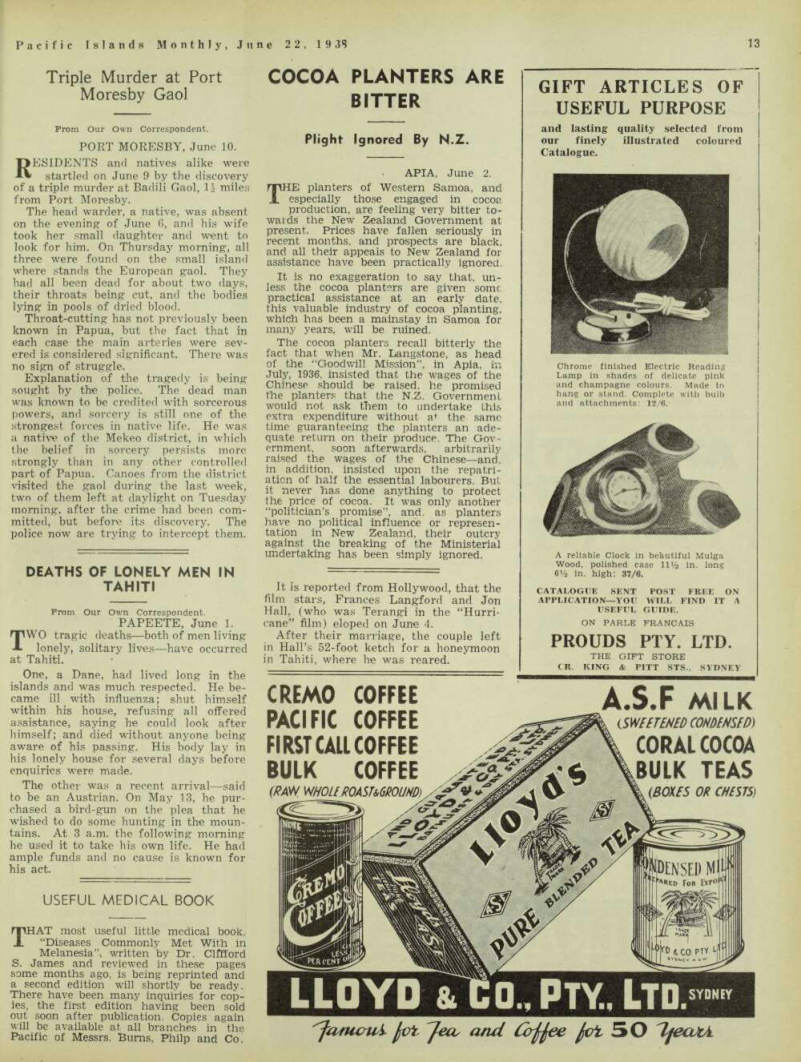
Triple Murder at Port Moresby Gaol
From Our Own Correspondent.
Port Moresby, June 10.
RESIDENTS and natives alike were startled on June 9 by the discovery of a triple murder at Badili Gaol, 11 mile.'! from Port Moresby.
The head warder, a native, was absent on the evening of June 6, and his wife took her small daughter and went to look for him. On Thursday morning, all three were found on the small island where stands the European gaol. They had all been dead for about two days, their throats being cut, and the bodies lying in pools of dried blood.
Throat-cutting has not previously been known in Papua, but the fact that in each case the main arteries were sev ered is considered significant. There was no sign of struggle.
Explanation of the tragedy is being sought by the police. The dead man w T as known to be credited with sorcerous powers, and sorcery is still one of the strongest forces in native life. He was a native of the Mekeo district, in which the belief in sorcery persists more strongly than in any other controlled part of Papua. Canoes from the district visited the gaol during the last week, two of them left at daylight on Tuesday morning, after the crime had been com mitted, but before its discovery. The police now are trying to intercept them.
Deaths Of Lonely Men In
Tahiti
From Our Own Correspondent.
Papeete, June 1.
TWO tragic deaths—both of men living lonely, solitary lives—have occurred at Tahiti.
One, a Dane, had lived long in the islands and was much respected. He be came ill with influenza; shut himself within his house, refusing all offered assistance, saying he could look after himself; and died without anyone being aware of his passing. His body lay in his lonely house for several days before enquiries were made.
The other was a recent arrival—said to be an Austrian. On May 13, he pur chased a bird-gun on the plea that he wished to do some hunting in the moun tains. At 3 a.m. the following morning he used it to take his own life. He had ample funds and no cause is known for his act.
Useful Medical Book
THAT most useful little medical book, “Diseases Commonly Met With in Melanesia”, written by Dr. Clifford S. James and reviewed in these pages some months ago, is being reprinted and a second edition will shortly be ready.
There have been many inquiries for cop ies, the first edition having been sold out soon after publication. Copies again will be available at all branches in the Pacific of Messrs. Bums, Philp and Co.
Cocoa Planters Are
Bitter
Plight Ignored By N.Z.
APIA, June 2.
THE planters of Western Samoa, and especially those engaged in cocoa production, are feeling very bitter to wards the New Zealand Government at present. Prices have fallen seriously in recent months, and prospects are black, and all their appeals to New Zealand for assistance have been practically ignored.
It is no exaggeration to say that, un less the cocoa planters are given some practical assistance at an early date, this valuable industry of cocoa planting, which has been a mainstay in Samoa for many years, will be ruined.
The cocoa planters recall bitterly the fact that when Mr. Langstone, as head of the “Goodwill Mission”, in Apia, in July, 1936, insisted that the wages of the Chinese should be raised, he promised the planters that the N.Z. Government would not ask them to undertake this extra expenditure without a* the same time guaranteeing the planters an ade quate return on their produce. The Gov ernment, soon afterwards, arbitrarily raised the wages of the Chinese—and. in addition, insisted upon the repatri ation of half the essential labourers. But it never has done anything to protect the price of cocoa. It was only another “politician’s promise”, and. as planters have no political influence or represen tation in New Zealand, their outcry against the breaking of the Ministerial undertaking has been simply ignored.
It is reported from Hollywood, that the film stars, Frances Langford and Jon Hall, (who was Terangi in the “Hurri cane” film) eloped on June 4.
After their marriage, the couple left in Hall’s 52-foot ketch for a honeymoon in Tahiti, where he was reared.
Mr. and Mrs. O. Colohen, of Labasa, Fiji, left Sydney for the Colony by the “Niagara” on June 9.
Advertisements & other items, pp. 15-16 (1 item)
Pty. Ltd
GIFT ARTICLES OF
USEFUL PURPOSE
and lasting quality selected from our finely illustrated coloured
Catalogue.
Chrome finished Electric Reading Lamp in shades of delicate pink and champagne colours. Made to hang or stand. Complete with bulb and attachments: 12/(5.
A reliable Clock in beautiful Mulga Wood, polished case lIV2 in. long 6Mi In. high: 37/6.
CATALOGUE SENT POST FREE ON
APPLICATION—YOU WILL FIND IT A
USEFUL GUIDE.
ON PARLE PRANCAIS
PROUDS PTY. LTD.
THE GIFT STORE
CR. KING & PITT STS.. SYDNEY
CREMO COFFEE
PACIFIC COFFEE
FIRST CAll COFFEE
BULK COFFEE
(MW WHOLE ROASTiOROUHD)
A.S.F MILK
(SWEETENEDCONDENSED)
CORAL COCOA
BULK TEAS
(BOXES OR CHESTS)
* & A Cr 0 O & V V
WNSED M
r A RED For Expo Ov 4\ & ILxx j Ji
>ir 0 &CO PTY. M 1
SVONEV hi« I
PTY. LTD
SYDNEY
'fanuniS fot Jew and toffee
Post or Partio your or msthcctions to
Ow PeprCSdOllati
llhM most yo until cor ancf cto&oor your order, or conduct you to our premises...
By Special Appointment
PIKE
BROTHERS LIMITED
Queen St. f Brisbane.
ATTRACTIVE POOD
FOR THE TROPICS
yU^M^ILRATH’S
"WM.
PRICE LISTS
Post &ree ok Application All Prices f.o.b. Sydney.
Fiyi™
• • • -EXPORT D -£ P A fV T M E N T • • •
202 PITT STREET.SYDNEY
NEW SOUTH WALES. AUSTRALIA.
Central Islands’
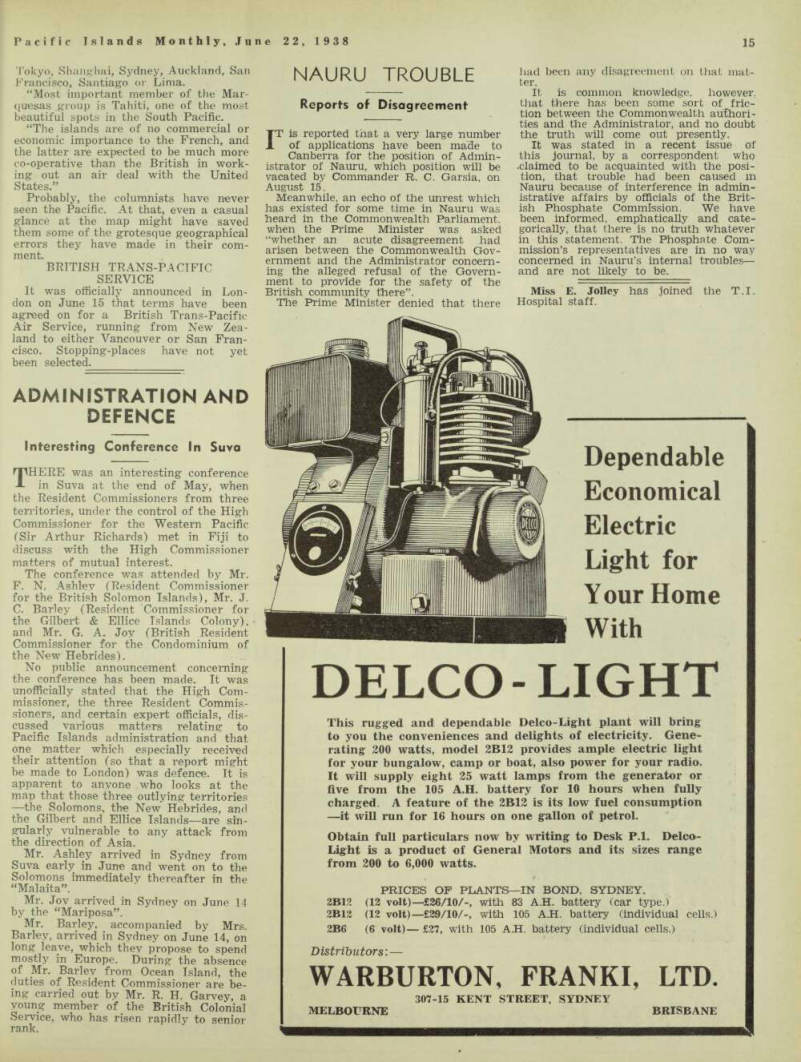
Future
Britain and U.S.A. Have "Share Control" Plan
MOVE and counter-move continue in the Central Pacific, as part of the friendly competition between Britain and the United States for the control of islands which, hitherto regarded as of little economic value, are now expected to become very desirable as possible bases for trans-Pacific aeroplane ser vices.
The more sensational and anti-British American newspapers—which, signi ficantly enough, are also the least re liable newspapers—continually publish silly stories about the existence of bad feeling between British and American officials in the Islands. These reports, however, are discounted by well-informed people. There is no doubt that, wherever the British and Americans meet, they are on perfectly friendly terms, and it is apparent, also, that there is some
kind of amicable understanding between London and Washington regarding the future of the islands. (See article on page 23.) It was reported with authority from London on June 10 that Britain and the United States have practically agreed that islands, whose title of ownership is in doubt, but which now have value as air bases, shall be run under a “share control system”.
The Resident Commissioner in the Gilbert and Ellice Islands recently was in conference in Suva with Sir Arthur Richards, High Commissioner for the Western Pacific; and it is worth noting that the following was contained in a news-despatch from London on June lli- Great Britain will shortly colonise the Phoenix Islands, including Canton and Enderbury, by transferring natives from the Gilbert and Ellice groups. This is disclosed in a memorandum which will be submitted to Parliament with the Colonial Office Estimates, in which the High Commissioner for the Western Pacific, Sir Arthur Richards, outlines the results of his examination of schemes to relieve the over-population of the Gilbert and Ellice Islands. Sir Arthur Richards says that the Phoenix Islands provide good prospects for colonisation, for which he will soon begin to transfer natives.
Funny Story About Marquesas.
Typical of the statements being made in the American press about certain Pacific islands is the following extract from a Washington journal:— “It is not supposed to be known, but an extremely important diplomatic deal with France is in the making when Ambassador Bill Bullitt gets back to Paris.
“It is a plan to use the vast network of the French Marquesas Islands in the South Pacific as American commercial airplane bases between Australia, South America and the United States.
“Whether this country will offer to buy some of the islands outright (pos sibly for cancellation of debts) or whether a leasing proposition will be worked out with the French, is not known. The negotiation still is in a nebulous state.
“All the State department actually wants is the right to establish regular landing bases in the French islands, al though the purchase of some of them might be feasible.
“The Marquesas Islands would be a sort of crossroads in mid-Pacific, where the air traveller would change planes for
Tokyo, Shanghai, Sydney, Auckland, San Francisco, Santiago or Lima.
“Most important member of the Mar quesas group is Tahiti, one of the most beautiful spots in the South Pacific.
“The islands are of no commercial or economic importance to the French, and the latter are expected to be much more co-operative than the British in work ing out an air deal with the United States.”
Probably, the columnists have never seen the Pacific. At that, even a casual glance at the map might have saved them some of the grotesque geographical errors they have made in their com ment.
British Trans-Pacific
Service
It was officially announced in Lon don on June 15 that terms have been agreed on for a British Trans-Pacific Air Service, running from New Zea land to either Vancouver or San Fran cisco. Stopping-places have not yet been selected.
Advertisements & other items, p. 16 (1 item)
Recor Ds
Packed Free and sent C.O.D. without extra charges.
H.M. Voice Slightly-used Portables, delivered straight to your nearest port for .. .. . . £3/15/-.
Send for Latest Record Lists.
Talkeries Music Stores
451 Queen Victoria Buildings, Sydney
Administration And
Defence
Interesting Conference In Suva
THERE was an interesting conference in Suva at the end of May, when the Resident Commissioners from three territories, under the control of the High Commissioner for the Western Pacific (Sir Arthur Richards) met in Fiji to discuss with the High Commissioner matters of mutual interest.
The conference was attended by Mr.
F. N. Ashley (Resident Commissioner for the British Solomon Islands), Mr. J.
C. Barley (Resident Commissioner for the Gilbert & Ellice Islands Colony), and Mr. G. A. Joy (British Resident Commissioner for the Condominium of the New Hebrides).
No public announcement concerning the conference has been made. It was unofficially stated that the High Com missioner, the three Resident Commis sioners, and certain expert officials, dis cussed various matters relating to Pacific Islands administration and that their attention (so that a report might be made to London) was defence. It is apparent to anyone who looks at the map that those three outlying territories —the Solomons, the New Hebrides, and the Gilbert and Ellice Islands—are sin gularly vulnerable to any attack from the direction of Asia.
Mr. Ashley arrived in Sydney from Suva early in June and went on to the Solomons immediately thereafter in the “Malaita”.
Mr. Jov arrived in Sydney on June 14 by the “Mariposa”.
Mr. Barley, accompanied by Mrs.
Barley, arrived in Sydney on June 14, on long leave, which they propose to spend mostly in Europe. During the absence of Mr. Bariev from Ocean Island, the duties of Resident Commissioner are be ing carried out by Mr. R. H. Garvey, a young member of the British Colonial Service, who has risen rapidly to senior rank.
Nauru Trouble
Reports of Disagreement
IT is reported that a very large number of applications have been made to Canberra for the position of Admin istrator of Nauru, which position will be vacated by Commander R. C. Garsia, on August 15.
Meanwhile, an echo of the unrest which has existed for some time in Nauru was heard in the Commonwealth Parliament, when the Prime Minister was asked “whether an acute disagreement had arisen between the Commonwealth Gov ernment and the Administrator concern ing the alleged refusal of the Govern ment to provide for the safety of the British community there”.
The Prime Minister denied that there
had been any disagreement on that mat ter.
It is common knowledge, however, that there has been some sort of fric tion between the Commonwealth authori ties and the Administrator, and no doubt the truth will come out presently.
It was stated in a recent issue of this journal, by a correspondent who .claimed to be acquainted with the posi tion, that trouble had been caused in Nauru because of interference in admin istrative affairs by officials of the Brit ish Phosphate Commission. We have been informed, emphatically and cate gorically, that there is no truth whatever in this statement. The Phosphate Com mission’s representatives are in no way concerned in Nauru’s internal troubles— and are not likely to be.
Miss E. Jolley has joined the T.I.
Hospital staff.
Advertisements & other items, p. 17 (1 item)
Delco-Light
Dependable
Economical
Electric
Light for
Your Home
With
DELCO-LIGHT
This rugged and dependable Delco-Light plant will bring to you the conveniences and delights of electricity. Generating 200 watts, model 2812 provides ample electric light for your bungalow, camp or boat, also power for your radio.
It will supply eight 25 watt lamps from the generator or five from the 105 A.H. battery for 10 hours when fully charged. A feature of the 2812 is its low fuel consumption —it will run for 16 hours on one gallon of petrol.
Obtain full particulars now by writing to Desk P.l. Delco- Light is a product of General Motors and its sizes range from 200 to 6,000 watts. ■ jf V •
PRICES OF PLANTS—IN BOND. SYDNEY.
2812 (12 volt)—£26/10/-, with 83 A.H. battery (car type.) 2812 (12 volt) —£29/10/-, with 105 A.H. battery (individual cells.) 286 (6 volt) — £27, with 105 AH. battery (individual cells.) Distributors :—
WARBURTON, FRANKI, LTD.
307-15 KENT STREET, SYDNEY
MELBOURNE BRISBANE
V
"My Tahiti"
Book By Robert Dean Frisbie
WHENEVER anew book about our Islands is placed in our hands, we open the covers wearily but hope fully.
Wearily, because of our memories of the romantic twaddle, the manufactur ed adventures and the nauseating stor ies of waterfront hetaira which make up the substance of the average travel ler’s book. Hopefully, because we are of a cheerful, optimistic order of mind, and hold the belief that over the next hill dwells a writer who will some day compose a book which will give the world a true conception of our Island life.
It was, therefore, with surprise and pleasure, that we perused the latest pub lication about our Island, “My Tahiti”, by Robert Dean Frisbie. This book pic tures accurately the life of the period —lB years ago—in the districts of Ta hiti.
The reviewer, in company with three or four companions, went frequently, in those times, to pass a delightful day with a friend whose home was within half a kilometre of Mr. Frisfre’s house on the shore of Vaiari. Tne house in which he dwelt, the men and women who were his friends, and the life they lived in common, are truly described by Mr. Frisbie.
The illustrations by Mr. W. Alister Macdonald are a delight. All the moun tains and valleys and beaches are in their right places, and the ensembles are as truly pictures of Tahiti as are the exquisite colours of the Island by that incomparable artist.
In common with all reviewers, we are constrained to temper our praise with a little criticism. Mr. Frisbie’s Tahitian is a bit shaky; but that is a small mat ter. Very few Europeans, indeed, are able to master the idioms of Polynesian dialects. Our serious criticism is direct ed at his chapter on the Reverend “Pierre”.
We are sorry that Mr. Frisbie has given his ear to detractors who are ene mies of the mission. He has done him self and his book a disservice by record ing gossip which has no basis in fact.
The reviewer was honoured with the in timate friendship of Monsieur “Pierre” during many years and, although no church member, was privileged to be his companion on many an expedition.
Mr. Frisbie should have remember that ancient Arabic saying: “The dogs bark; but the caravan moves on”.
Apart from this blemish, “My Tahiti” is a delightful book, and we recommend it to those who would know the charm of life in these Islands—as it existed
twenty years ago.-
A.C.R.
Sir Albert Ellis
Knighthood for Well-known Pacific Islander
MANY old hands in the Central Paci fic will derive real pleasure from the announcement that a knight hood has been conferred upon Mr. Albert Fuller Ellis. New Zealand Commissioner on the British. Phosphate Commission.
He is a well-known and popular resid ent of Auckland, and is an acknowledg ed authority on Central Pacific affairs.
His recent book, “Ocean Island and Nau ru”, is one of the most “readable” con tributions to the steadily-growing library of Pacific literature.
Mr. F. N. Ashley, Resident Commis sioner of the Solomon Islands, joined the June “Malaita” at Cairns for Tulagi, after furlough in Australia.
Mr. E. A. De Latour left Sydney for Port Moresby, Papua, by the “Macdhui” on June 1. Mr. De Latour, who was at one time manager of N.G. Goldfields, Ltd., flew from Port Moresby to Wau,
T.N.G.
Playmates—A snapshot in the Solomon Islands.
A. M. Andresen.
Advertisements & other items, p. 18 (1 item)
Kodak Catalogues
I $ I
Write for your copy NEW
KODAK AMATEUR BOOKLET. Describes and illustrates all the newest Kodaks including the new Retina 11.
CINE-KODAK AND KODASCOPE CATALOGUE
AND PRICE LIST. Contains full details of all the new models of Cine-Kodak and Kodascope, together •with many new accessories.
KODAK ACCESSORIES CATALOGUE. Covers the
requirements of the amateur photographer. A beautiful and comprehensive production. (In the press.) Fill in and post the coupon, mentioning the catalogue you desire.
I NAME
I ADDRESS
I
CATALOGUE REQUIRED ,
FtuM it •I in
KODAK FILM MAKES EVERY
CAMERA A BETTER CAMERA.
Kodak Film remains unchallenged on the market because it is the finest available. Made in Australia to suit tropical conditions.
There’s a Kodak grade to suit every requirement.
OF ALL KODAK DEALERS THROUGHOUT THE ISLANDS and KODAK (Aust.) Pty. Ltd. 37, sy G d°nTy st '
Central Pacific
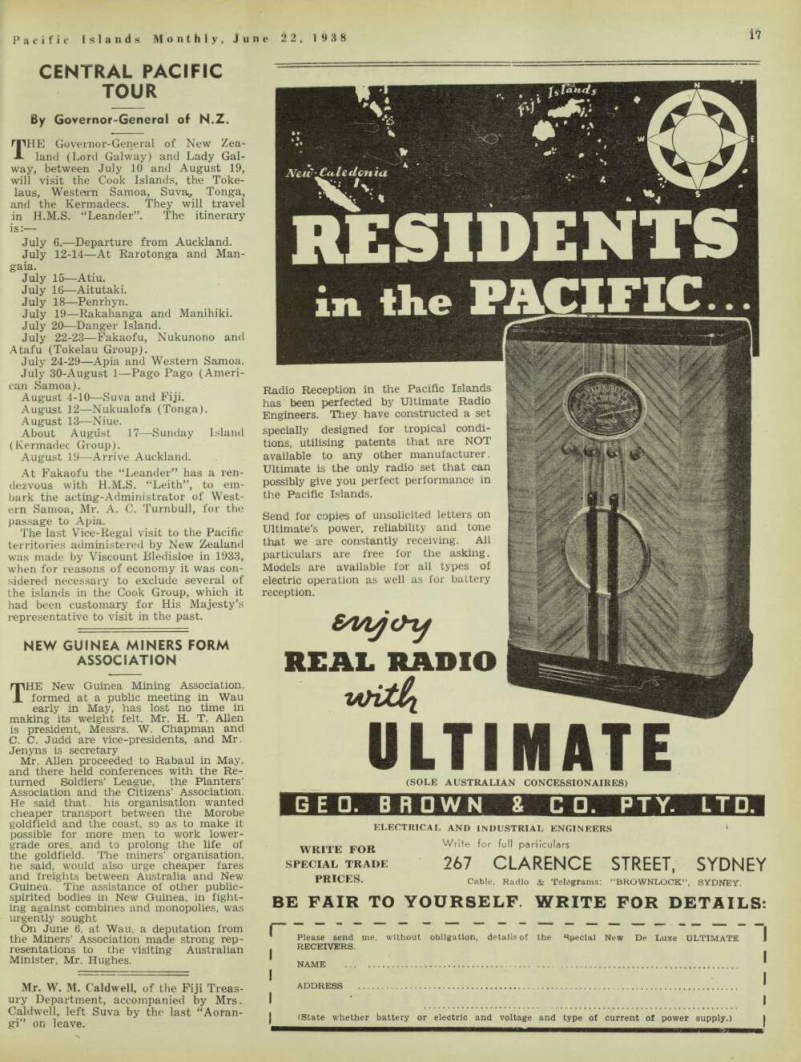
Tour
By Governor-General of N.Z.
THE Governor-General of New Zea land (Lord Galway) and Lady Gal way, between July 10 and August 19, will visit the Cook Islands, the Toke laus, Westeirn Samoa, Suva, Tonga, and the Kermadecs. They will travel in H.M.S. “Leander”. The itinerary is:— July 6. —Departure from Auckland.
July 12-14—At Rarotonga and Man gaia.
July 15—Atiu.
July 16—Aitutaki.
July 18 —Penrhyn.
July 19—Rakahanga and Manihiki.
July 20—Danger Island.
July 22-23 —Fakaofu, Nukunono and Atafu (Tokelau Group).
July 24-29—Apia and Western Samoa.
July 30-August I—Pago Pago (Ameri can Samoa).
August 4-10 —Suva and Fiji.
August 12 —Nukualofa (Tonga).
August 13 —Niue.
About August 17 —Sunday Island (Kermadec Group).
August 19—Arrive Auckland.
At Fakaofu the “Leander” has a ren dezvous with H.M.S. “Leith”, to em bark the acting-Administrator of West ern Samoa, Mr. A. C. Turnbull, for the passage to Apia.
The last Vice-Regal visit to the Pacific territories administered by New Zealand was made by Viscount Bledisloe in 1933, when for reasons of economy it was con sidered necessary to exclude several of the islands in the Cook Group, which it had been customary for His Majesty’s representative to visit in the past.
New Guinea Miners Form
Association
THE New Guinea Mining Association, formed at a public meeting in Wau early in May, has lost no time in making its weight felt. Mr. H. T. Allen is president, Messrs. W. Chapman and C. C. Judd are vice-presidents, and Mr.
Jenyns is secretary Mr. Allen proceeded to Rabaul in May, and there held conferences with the Re turned Soldiers’ League, th,e Planters’
Association and the Citizens’ Association.
He said that his organisation wanted cheaper transport between the Morobe goldfield and the coast, so as to make it possible for more men to work lower grade ores, and to prolong the life of the goldfield. The miners’ organisation, he said, would also urge cheaper fares and freights between Australia and New Guinea. The assistance of other public spirited bodies in New Guinea, in fight ing against combines and monopolies, was urgently sought On June 6, at Wau, a deputation from the Miners’ Association made strong rep resentations to the visiting Australian Minister, Mr. Hughes.
Mr. W. M. Caldwell, of the Fiji Treas
ury Department, accompanied by Mrs.
Caldwell, left Suva by the last “Aoran gi” on leave.
Mrs. Isabelle Williams, wife of Mr.
George Williams, of Poum, New Cale donia, died at Koumac in May, aged 57.
Mr. R. B. McVilley, deputy manager of Enterprise of New Guinea Gold and Petroleum Co., Ltd., arrived in Sydney from Salamaua by the “Macdhui” at the end of May.
Advertisements & other items, pp. 19-20 (1 item)
Ultimate
Radio Reception in the Pacific Islands has been perfected by Ultimate Radio Engineers. They have constructed a set specially designed for tropical conditions, utilising patents that are NOT available to any other manufacturer.
Ultimate is the only radio set that can possibly give you perfect performance in the Pacific Islands.
Send for copies of unsolicited letters on Ultimate’s power, reliability and tone that we are constantly receiving. All particulars are free for the asking.
Models are available for all types of electric operation as well as for battery reception.
ZVljOTj
REAL RADIO
Witix
ULTIMATE
(SOLE AUSTRALIAN CONCESSIONAIRES)
GEO. BROWN X C□. PTY. LTD
ELECTRICAL AND INDUSTRIAL ENGINEERS ‘
WRITE FOR Write for full particulars
special trade 267 CLARENCE STREET, SYDNEY
PRICES. Cable, Radio & Telegrams: “BROWNLOCK”, SYDNEY.
BE FAIR TO YOURSELF. WRITE FOR DETAILS: Please send me, without obligation, details of the Special New De Luxe ULTIMATE
RECEIVERS.
I
NAME 1
I
ADDRESS *
I • I (State whether battery or electric and voltage and type of current of power supply.) j
W. FINAU
International Stamp & Photo Service,
BOX 40, NUKUALOFA, TONGA IS., OCEANIA.
Photos of native life and scenes in Tonga; 5/-.
Tin-Can Mail cover franked with eight pretty Niuafoou mint; 4/6; same with 3 varieties: 1/6.
Registered, postmarked and despatched at Niuafoou (Tin-Can Island). m f Tongan mint of 15 all different: 16/6 postpaid.
The sea has a charm of its own, and so has DEWAR’S Whisky. As invigorating as the winds that blow from out of space, DEWAR’S, like a well-found ship, brings content; boundless and satisfying.
DEWARS
~?Ae SCOTCH WHISKY
Missionaries
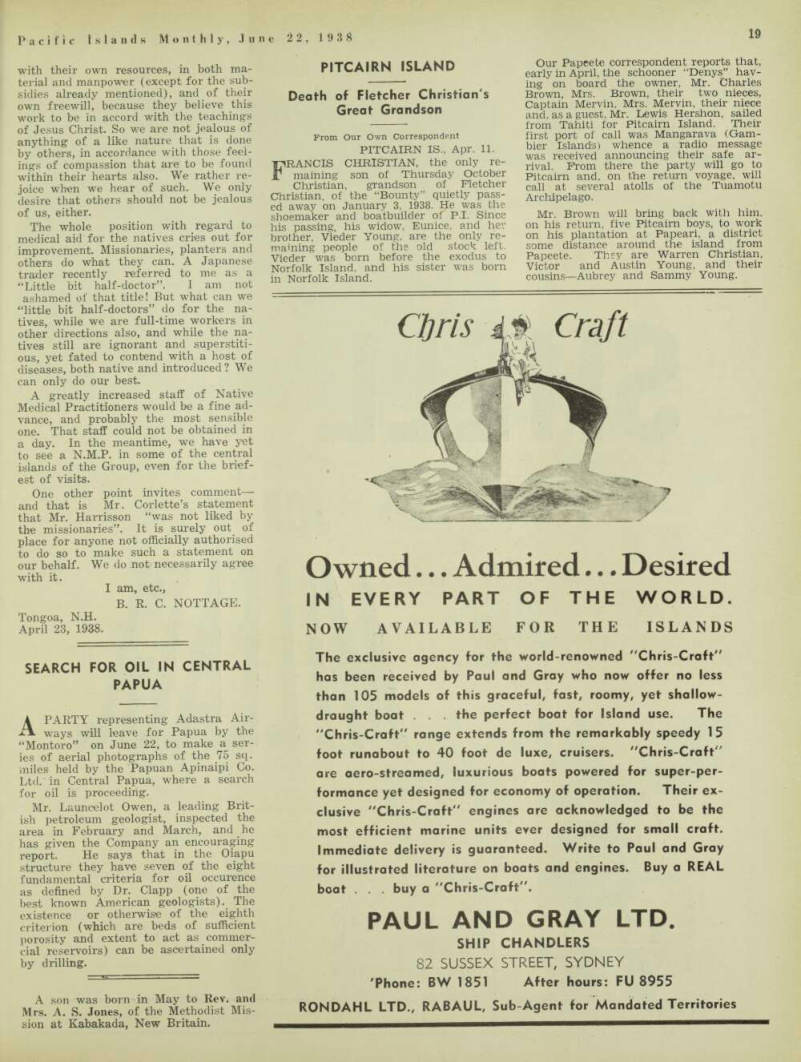
Medical Work Of
Little Official Help in New Hebrides
Letter to the Editor.
TN your issue of February, 1938, under A the heading “The Claims of T. H.
Harrisson”, there is a letter from E. H.
Corlette, of Bushman’s Bay, Malekula.
I am concerned only with the last few paragraphs, and with those only insofar as they state a misleading and in some points erroneous view of the medical work done by missionaries within the New Hebrides.
In his anxiety to prove Mr. Harrisson’s statements inaccurate, Mr. Corlette re fers to “the work of the much-maligned Condominium Government, which sup plies the materials with which the Mis sions inject the natives”, and also asks Mr. Harrisson to “count the number of times he saw missionaries using ars
phenamide injections, and how many times it was Rockefeller plus Condom- Mr. Corlette thus puts undue emphasis on the medical assistance given to the natives by the Condomin ium Government through the missionar ies. He says that the missionaries “would be the first to admit the truth”.
We would. But the Condominium Gov ernment’s part in the medical work of the missionaries begins and ends with small subsidies that are granted to Mis sion Hospitals.
It is simply not true that the Admin istration “supplies the materials”—this or any other kind—to the missionaries.
On the contrary, they decline to do so under any circumstances for the ordin ary missionary.
About two years ago, one Presbyter ian missionary obtained a supply of drugs for injections from a French Gov ernment Hospital, at a reasonable rate, but the British Resident Commissioner in Vila informed me that this was irre gular, and ought not to have happened!
It can be stated categorically that mis sionaries have no way of getting the drugs except such as are open to every other citizen within the Group at ex actly the same rates. I think that this has always been so.
It is true that the Rockefeller Insti tution did continue its own great cam paign by making supplies of the drug available at no cost in certain areas.
Malekula, I understand, is one of the islands that were not completely covered by their own representative, so that there, with the idea of giving all the na tives in the Group equal treatment, a Mission doctor (and perhaps others) later continued the work for the Rocke feller Institution with drugs supplied by them (possibly with the co-operation of the Administration).
When Mr. Corlette says that “many planters give medicine—including ars phenamides—free or at actual cost, and they have to pay for it out of their own pocket at full price”, he does by impli cation, but not in fact, make a compari son between planters and missionaries that is to the disparagement of the lat ter. But the latter also “pay for it out of their own pocket at full price”. When the cost price of N.A.B. was 3/- and up wards per dose missionaries, like plant ers, had to pay that price and get back what they could from the natives. Nat urally the natives at that time received far fewer injections than would have been good for them.
I think, too, that everyone would agree that the missionaries do, in fact, do a great deal more medical work than do planters. Taking the giving of in jections only as an example, there are very few planters who give hundreds of injections per year to the natives, as do most missionaries. Some missionaries have four-figure tallies for single years, in the ordinary course of their mission ary work. If desired, one could also make comparison between medical work done by the Administration and by mis sionaries, but that is unnecessary here.
I need only add that the medical work done by the Missions is done entirely
with their own resources, in both ma terial and manpower (except for the sub sidies already mentioned), and of their own freewill, because they believe this work to be in accord with the teachings of Jesus Christ. So we are not jealous of anything of a like nature that is done by others, in accordance with those feel ings of compassion that are to be found within their hearts also. We rather re joice when we hear of such. We only desire that others should not be jealous of us, either.
The whole position with regard to medical aid for the natives cries out for improvement. Missionaries, planters and others do what they can. A Japanese trader recently referred to me as a “Little bit half-doctor”. I am not ashamed of that title! But what can we “little bit half-doctors” do for the na tives, while we are full-time workers in other directions also, and while the na tives still are ignorant and superstiti ous, yet fated to contend with a host of diseases, both native and introduced ? We can only do our best.
A greatly increased staff of Native Medical Practitioners would be a fine ad vance, and probably the most sensible one. That staff could not be obtained in a day. In the meantime, we have yet to see a N.M.P. in some of the central islands of the Group, even for the brief est of visits.
One other point invites comment — and that is Mr. Corlette’s statement that Mr. Harrisson “was not liked by the missionaries”. It is surely out of place for anyone not officially authorised to do so to make such a statement on our behalf. We do not necessarily agree with it.
I am, etc.,
B. R. C. Nottage.
Tongoa, N.H.
April 23, 1938.
Search For Oil In Central
Papua
A PARTY representing Adastra Air ways will leave for Papua by the “Montoro” on June 22, to make a ser ies of aerial photographs of the 75 sq. miles held by the Papuan Apinaipi Co.
Ltd. in Central Papua, where a search for oil is proceeding.
Mr. Launcelot Owen, a leading Brit ish petroleum geologist, inspected the area in February and March, and he has given the Company an encouraging report. He says that in the Oiapu structure they have seven of the eight fundamental criteria for oil occurence as defined by Dr. Clapp (one of the best known American geologists). The existence or otherwise of the eighth criterion (which are beds of sufficient porosity and extent to act as commer cial reservoirs) can be ascertained only by drilling.
A son was born in May to Rev. and Mrs. A. S. Jones, of the Methodist Mis sion at Kabakada, New Britain.
Pitcairn Island
Death of Fletcher Christion's Great Grandson
From Our Own Correspondent
Pitcairn Is., Apr. 11.
Francis Christian, the only re maining son of Thursday October Christian, grandson of Fletcher Christian, of the “Bounty” quietly pass ed away on January 3. 1938. He was the shoemaker and boatbuilder of P.I. Since his passing, his widow, Eunice, and her brother, Vieder Young, are the only re maining people of the old stock left.
Vieder was born before the exodus to Norfolk Island, and his sister was born in Norfolk Island.
Our Papeete correspondent reports that, early in April, the schooner “Denys” hav ing on board the owner, Mr. Charles Brown, Mrs. Brown, their two nieces, Captain Mervin, Mrs. Mervin, their niece and. as a guest, Mr. Lewis Hershon, sailed from Tahiti for Pitcairn Island. Their first port of call was Mangarava (Gam bier Islands) whence a radio message wag received ann ouncing their safe ar rivai From there the party will go to Pitcairn and, on the return voyage, will call at several atolls of the Tuamotu Archipelago, Mr. Brown will bring back with him, on his return, five Pitcairn boys, to work on his plantation at Papeari, a district some distance around the island from Papeete. They are Warren Christian, Victor and Austin Young, and their cousins—Aubrey and Sammy Young.
Advertisements & other items, pp. 21-22 (1 item)
Chris 49 Craft
V * y r
Owned... Admired... Desired
IN EVERY PART OF THE WORLD.
NOW AVAILABLE FOR THE ISLANDS
The exclusive agency tor the world-renowned "Chris-Craft" has been received by Paul and Gray who now otter no less than 105 models ot this graceful, tost, roomy, yet shallowdraught boat . . . the perfect boat for Island use. The "Chris-Craft" range extends from the remarkably speedy 15 foot runabout to 40 foot de luxe, cruisers. "Chris-Craft" are aero-streamed, luxurious boats powered tor super-performance yet designed for economy of operation. Their exclusive "Chris-Craft" engines are acknowledged to be the most efficient marine units ever designed for small craft.
Immediate delivery is guaranteed. Write to Paul and Gray for illustrated literature on boats and engines. Buy a REAL boat . . buy a "Chris-Craft".
PAUL AND GRAY LTD.
SHIP CHANDLERS
82 SUSSEX STREET, SYDNEY
'Phone: BW 1851 After hours: FU 8955 RONDAHL LTD., RABAUL, Sub-Agent for Mandated Territories
31/BE-S
E 5 *
DuO
PX n \ QJ -O
German Consul-General In Papua
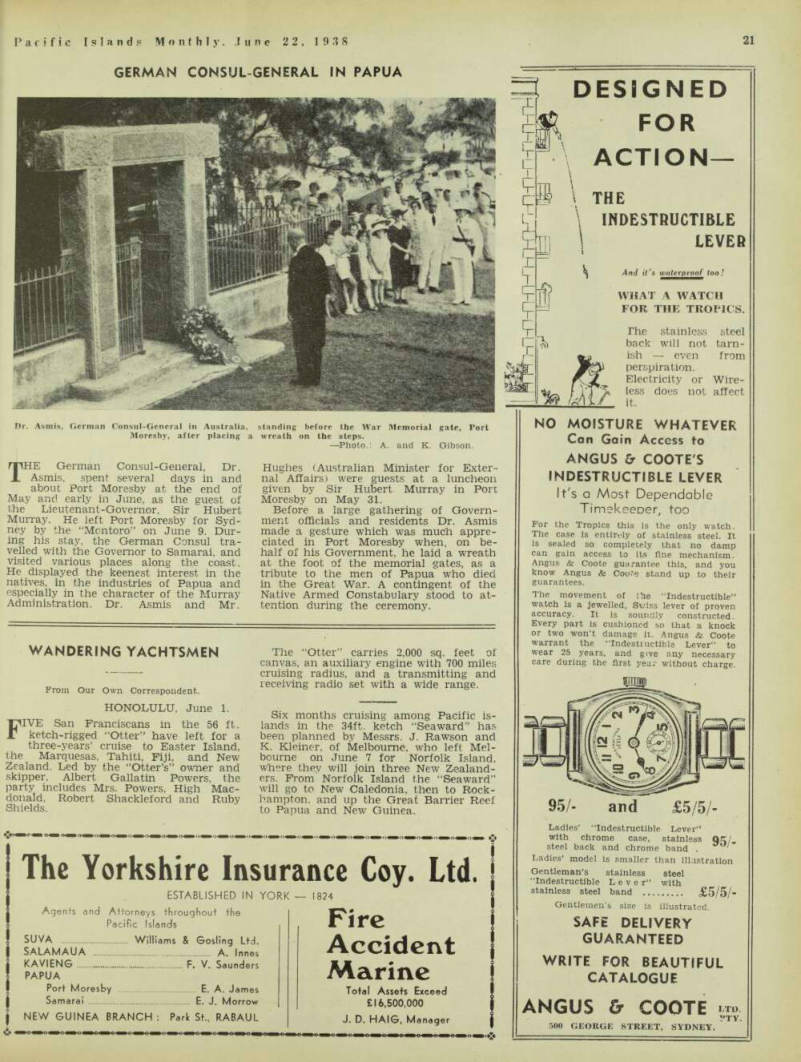
THE German Consul-General, Dr.
Asmis, spent several days in and about Port Moresby at the end of May and early in June, as the guest of the Lieutenant-Governor, Sir Hubert Murray. He left Port Moresby for Sydney by the “Montoro” on June 9. Dur- Ing his stay, the German Consul travelled with the Governor to Samarai, and visited various places along the coast.
He displayed the keenest interest in the natives, in the industries of Papua and especially in the character of the Murray Administration. Dr. Asmis and Mr.
Hughes (Australian Minister for Exter nal Affairs) were guests at a luncheon given by Sir Hubert Murray in Port Moresby on May 31.
Before a large gathering of Govern ment officials and residents Dr. Asmis made a gesture which was much appre dated in Port Moresby when, on be half of his Government, he laid a wreath at the foot of the memorial gates, as a tribute to the men of Papua who died in the Great War. A contingent of the Native Armed Constabulary stood to at tention during the ceremony.
Dr. Asmis, German Consul-General in Australia, standing before the War Memorial gate, Port Moresby, after placing a wreath on the steps. —Photo.: A. and K. Gibson.
Wandering Yachtsmen
From Our Own Correspondent.
Honolulu, June 1.
FIVE San Franciscans in the 56 ft. ketch-rigged “Otter” have left for a three-years’ cruise to Easter Island, the Marquesas, Tahiti, Fiji, and New Zealand. Led by the “Otter’s” owner and skipper. Albert Gallatin Powers, the party includes Mrs. Powers. High Mac donald, Robert Shackleford and Ruby Shields.
The “Otter - ’ carries 2,000 sq. feet of canvas, an auxiliary engine with 700 miles cruising radius, and a transmitting and receiving radio set with a wide range.
Six months cruising among Pacific is lands in the 34ft. ketch “Seaward” has been planned by Messrs. J. Rawson and K. Kleiner, of Melbourne, who left Mel bourne on June 7 for Norfolk Island, where they will join three New Zealand ers. From Norfolk Island the “Seaward” will go to New Caledonia, then to Rock hampton. and up the Great Earner Reef to Papua and New Guinea.
Advertisements & other items, pp. 23-24 (1 item)
The Yorkshire Insurance Coy. Ltd.
m JZ r r Hf
DESIGNED
FOR
ACTION—
\ THE
INDESTRUCTIBLE
LEVER
And it’s waterproof too !
WHAT A WATCH
FOR THE TROPICS.
The stainless steel back will not tarnish even from
perspiration.
Electricity or Wireless does not affect it.
NO MOISTURE WHATEVER
Can Gain Access to
ANGUS COOTE'S
INDESTRUCTIBLE LEVER
It's a Most Dependable
Timekeeper, too
For the Tropics this Is the only watch.
The case is entirely of stainless steel. It is sealed so completely that no damp can gain access to its fine mechanism.
Angus & Coote guarantee this, and you know Angus & Coo*e stand up to their guarantees.
The movement of the “Indestructible” watch is a jewelled, Swiss lever of proven accuracy. It is soundly constructed.
Every part is cushioned so that a knock or two won’t damage it. Angus & Coote warrant the “Indestructible Lever” to wear 25 years, and give any necessary care during the first year without charge.
CM
95/- and £5/5/-
Ladles’ “Indestructible Lever” with chrome case, stainless Qni steel back and chrome band .
Ladies’ model is smaller than Illustration Gentleman’s stainless steel “Indestructible Lever” with stainless steel band <£s/5/- Gentlemen’s size is illustrated.
SAFE DELIVERY
GUARANTEED
WRITE FOR BEAUTIFUL
CATALOGUE
ANGUS & COOTE ™
?TY.
500 GEORGE STREET, SYDNEY.
The Yorkshire Insurance Coy. Ltd.
ESTABLISHED IN YORK 1824
Agents and Attorneys throughout the Pacific Islands SUVA Williams & Gosling Ltd.
SALAMAUA A. Innes
KAVIENG F. V. Saunders
PAPUA
Port Moresby E. A. James Samara! E. J. Morrow NEW GUINEA BRANCH : Park St., RABAUL
Fire
Accident
Marine
Total Assets Exceed £16,500,000 J. D. HAIG, Manager
Modern Refrigeration for the South Sea Islands
The ELECTROLUX kerosene OPERATED
REFRIGERATOR
MARVEL
OF
MODERN
SCIENCE
...i M
THE
MIRACLE
OF
ICE
FROM
HEAT
THE ELECTROLUX OFFERS economical, modern and completely efficient refrigeration for
ISLANDS' HOMES.
FREEZES CONTINUOUSLY WHILE SMALL LAMP BURNS
Freezing controlled by simply regulating height of flame. Uses only \ gallon of kerosene per week.
MOTORLESS ... NO PARTS TO GET OUT OF ORDER.
MODEL L 22
Capacity 2.2 cubic feet.
MODEL L3B
(as Illustrated) Capacity 4 cubic feet. guaranteed for two years Write to your bocal Distributor for prices and full details.
MODEL LKSS
Capacity 5.5 cubic feet.
Obtainable from . .
W. R. Carpenter & Company Ltd. —Sydney and following New Gainea Branches : Rabaul, Salamaua, Wau, Kavieng, Madang, But and Wewak.
Representation in Papua and New Hebrides.
W. R. Carpenter & Coy. (Solomon Is.) Pty. Ltd.—Tulagi, British Solomon Islands.
On Chong & Company Pty. Ltd.—Butaritari, Gilbert & Ellice Islands.
Friendly Relations
British and Americans On Canton Is.
Prom Our Own Correspondent.
Honolulu, June 1.
DISCUSSIONS between London and Washington re the occupation and sovereignty of Canton Island in the British Phoenix Group are expected to proceed for a long time before even a basis of agreement can be announced, ac cording to an announcement by the “New York Times”.
On April 18, U.S. state, navy and in sular officials conferred with President Roosevelt about Canton but without any definite decisions being reached. Offi cials included Mr. Ernest H. Gruening. chief of the territories division, which controls the American “annexationists” on Canton and Enderbury.
After the “annexation” of Canton by the American party in March, the U.S. press naturally made a feature of the British party’s offer of iced beer to the Americans (as reported in April “P.1.M.”), but the good-humoured hu man-interest stories annoyed the “ca reer” officials in Honolulu, who conduct a sort of quartermaster’s office for the supervision of the isles. They wrote to Mr. Gruening and regretted the headlin ing of the beer incident.
However, Mr. Gruening replied prompt ly:— “. . . .1 canhot agree with you that the ‘beer publicity’ will be misunderstood by the public. My instructions to the Canton colonists requested that the friendliest relations possible be encour aged with the Britishers, and that in cludes beer drinking, poker, and bridge playing, and anything else that the friendly Britishers care to suggest. I am anxious that the utmost goodwill obtain at Canton, . . .”.
Meanwhile, everything possible is being done by the British side. Captains “Mic key” Hill, of the “Aorangi”. and “Bill”
Martin, of the “Niagara”, call at Canton every time they pass the isle on their run to Vancouver.
Canton in this way seems destined to become the feature that the “Tin Can” island mail used to be with trans-Paci fic liners.
Cable For Transport Over
Mountains
Plan To Connect Wau With N.G. Coast
IMPORTANT interests in Wau continue to attack the problem of cheap trans port between the Morobe tableland and the coast.
It is reported that one plan, support ed by Wau funds and Wau enterprise, is to build an aerial cable between Wau and Salamaua. running over the moun tains and the steep gorges which sep arate the two places. It is calculated that such a cable system could be oper ated by using seven stations, in the 50 miles or so between Wau and Salamaua It is claimed, also, thaf this method of transport would compete on reasonable terms with the aeroplane companies in the freighting of cargoes.
Plea For Motor Road
Deputations representing the Morobe Chamber of Mines, the New Guinea Mi llers’ Association and other bodies, when they interviewed the Minister for Ex ternal Affairs, Mr. Hughes, on June 6, urged the view that the only way to prolong the life of the Morobe goldfield is to construct a trafficable road between Wau and Salamaua, and so reduce trans port costs as to render payable the large areas of low grade ore in the Wau and Edie Creek districts.
The speakers urged upon Mr. Hughes the need to build 50 miles of road to allow motor vehicles to run between Wau and the coast. They said that such a road would reduce the transport costs from £25 per ton (which they claimed was the present rate for air transport) to £5 per ton.
Fire On Fiji Copra
Plantation
From Our Own Correspondent.
Suva, May 27.
FIRE in the early hours of the morning of May 9 on the Salialevu copra plantation of the Coubrough Estate, Taveuni, caused damage estimated at between £2,000 and £3,000.
The outbreak destroyed the No. 2 kiln, a copra shed with a large quantity of copra, a garage, and a lorry. The drier was a steam one and as the boilers had not been in use for 24 hours prior to the outbreak the origin of the fire is a mystery. It is understood that incen diarism is suspected, and a police officer has gone from Suva to investigate.
Advertisements & other items, p. 25 (1 item)
Tooheys
PAH PORT
TO
HEALTH
A V m &
Tooheys
Oatmeal Stout
HERE/ TOEE
Government £30,000
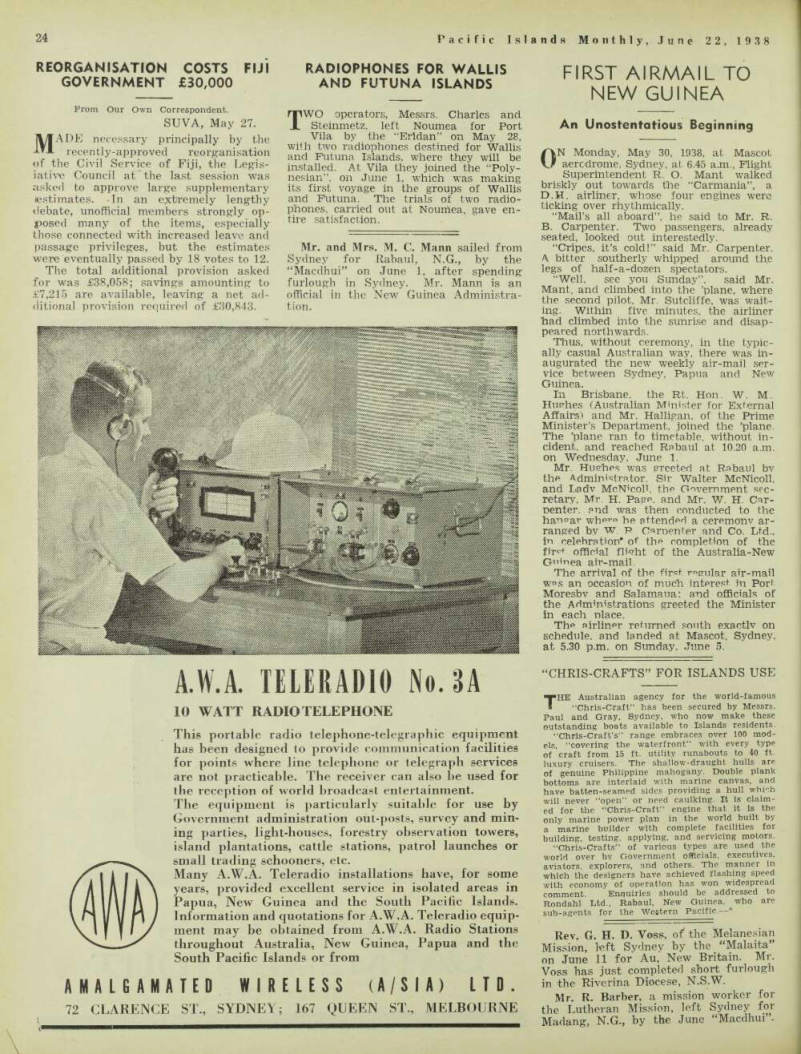
Reorganisation Costs Fiji
From Our Own Correspondent.
Suva, May 27.
MADE necessary principally by the recently-approved reorganisation of the Civil Service of Fiji, the Legis lative Council at the last session was asked to approve large supplementary iestimates. In an extremely lengthy debate, unofficial members strongly op posed many of the items, especially those connected with increased leave and passage privileges, but the estimates were eventually passed by 18 votes to 12.
The total additional provision asked for was £38,058; savings amounting to £7,215 are available, leaving a net ad ditional provision required of £30,843.
Radiophones For Wallis
And Futuna Islands
TWO operators, Messrs. Charles and Steinmetz, left Noumea for Port Vila by the “Eridan” on May 28, with two radiophones destined for Wallis and Futuna Islands, where th,ey will be installed. At Vila they joined the “Poly nesian”. on June 1, which was making its first voyage in the groups of Wallis and Futuna. The trials of two radio phones. carried out at Noumea, gave en tire satisfaction.
Mr. and Mrs. M. C. Mann sailed from
Sydney for Rabaul, N.G., by the
“Macdhui” on June 1, after spending furlough in Sydney. Mr. Mann is an official in the New Guinea Administra tion.
First Airmail To
New Guinea
An Unostentatious Beginning
ON Monday, May 30, 1938, at Mascot aerodrome, Sydney, at 6.45 a.m., Flight Superintendent R. O. Mant walked briskly out towards the “Carmania”, a D.H. airliner, whose four engines were ticking over rhythmically.
“Mail’s all aboard”, he said to Mr. R.
B. Carpenter. Two passengers, already seated, looked out interestedly.
“Gripes, it’s cold!” said Mr. Carpenter.
A. bitter southerly whipped around th,e legs of half-a-dozen spectators.
“Well, see you Sunday”, said Mr.
Mant, and climbed into the ’plane, where the second pilot. Mr. Sutcliffe, was wait ing. Within five minutes, the airliner had climbed into the sunrise and disap peared northwards.
Thus, without ceremony, in the typic ally casual Australian way, there was in augurated the new weekly air-mail ser vice between Sydney, Papua and New Guinea.
In Brisbane, the Rt. Hon. W. M.
Huehes (Australian Minister for External Affairs) and Mr. Halligan, of the Prime Minister’s Department, joined the ’plane.
The ’plane ran to timetable, without in cident. and reached Rebaul at 10.20 a.m. on Wednesday, June 1.
Mr. Huehes was greeted at Rabaul bv the Administrator. Sir Walter McNicoll, and Ladv McN’coh. the Government sec retary, Mr. H. Page, and Mr. W. H. Car penter. and was then conducted to the hangar wh^ 0 he attended a ceremonv ar ranged by w, p Carpenter and Co. Ltd., in celebration* of the completion of the firs* official flieht of the Australia-New Gninea air-mail.
The arrival of the first regular air-mail was an occasion of much interest in Port Moresby and Salamaua; and officials of the Administrations greeted the Minister in each place.
The airliner returned south exactly on schedule, and landed at Mascot, Sydney, at 5.30 p.m. on Sunday, June 3.
Voss has just completed short furlough
“Chris-Crafts” For Islands Use
THE Australian agency for the world-famous “Chris-Craft” has been secured by Messrs.
Paul and Gray, Sydney, who now make these outstanding boats available to Islands residents.
“Chris-Craft’s” range embraces over 100 mod els, “covering the waterfront” with every type of craft from 15 ft. utility runabouts to 40 ft. luxury cruisers. The shallow-draught hulls are of genuine Philippine mahogany. Double plank bottoms are interlaid with marine canvas, and have batten-seamed sides providing a hull which will never “open” or need caulking. It is claim ed for the “Chris-Craft” engine that it is the only marine power plan in the world built by a marine builder with complete facilities for building, testing, applying, and servicing motors.
“Chris-Crafts” of various types are used the world over bv Government officials, executives, aviators, explorers, and others. The manner in which the designers have achieved flashing speed with economy of operation has won widespread comment. Enquiries should be addressed to Rondahl Ltd., Rabaul, New Guinea, who are sub-agents for the Western Pacific.—* Rev. G. H. D. Voss, of the Melanesian
Mission, left Sydney by the “Malaita”
on June 11 for Au, New Britain. Mr.
Voss has just completed short furlough
in the Riverina Diocese, N.S.W.
Mr. R. Barber, a mission worker for
the Lutheran Mission, left Sydney for
Madang, N.G., by the June “Macdhui -
Advertisements & other items, p. 26 (1 item)
A.W.A. Teleradio N«.3A
i
10 WATT RADIOTELEPHONE
m This portable radio telephone-telegraphic equipment has been designed to provide communication facilities for points where line telephone or telegraph services are not practicable. The receiver can also he used for the reception of world broadcast entertainment.
The equipment is particularly suitable for use by Government administration out-posts, survey and mining parties, light-houses, forestry observation towers, island plantations, cattle stations, patrol launches or small trading schooners, etc.
Many A.W.A. Teleradio installations have, for some years, provided excellent service in isolated areas in Papua, New Guinea and the South Pacific Islands.
Information and quotations for A.W.A. Teleradio equipment may be obtained from A.W.A. Radio Stations throughout Australia, New Guinea, Papua and the South Pacific Islands or from
AMALGAMATED WIRELESS (A/SIA) LTD.
72 CLARENCE ST., SYDNEY; 167 QUEEN ST., MELBOURNE
“Bounty Descendants Talk Of
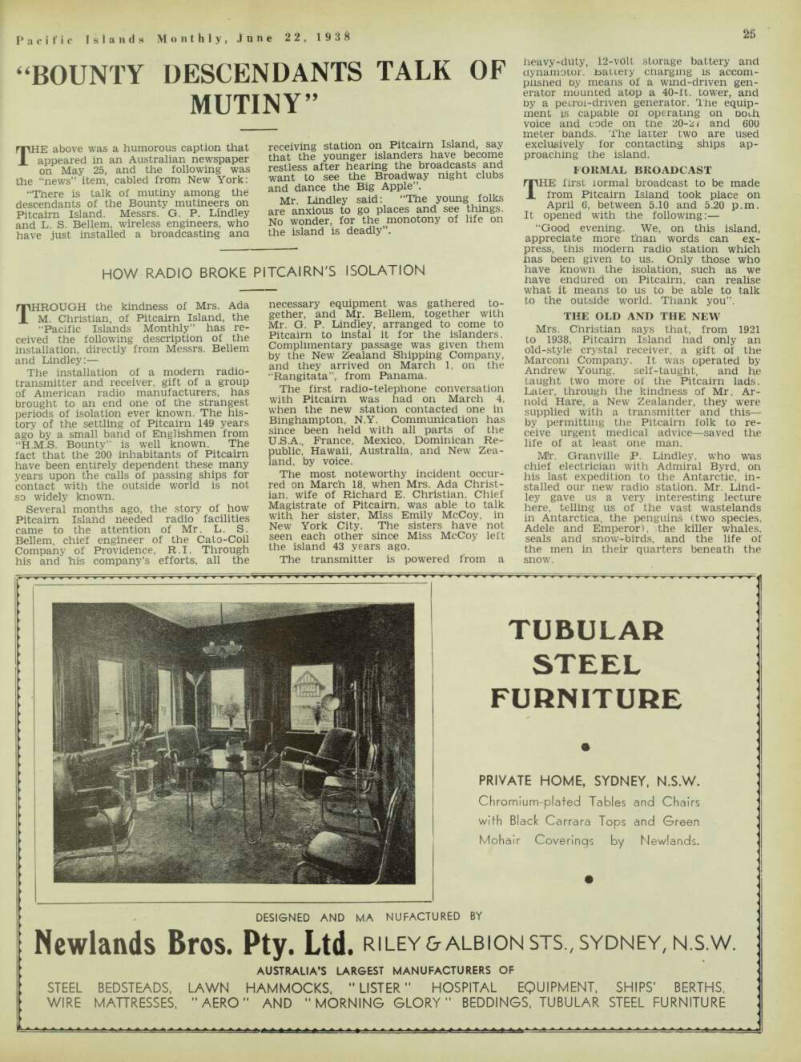
Mutiny”
THE above was a humorous caption that appeared in an Australian newspaper on May 25, and the following was the “news” item, cabled from New York: “There is talk of mutiny among thei descendants of the Bounty mutineers on Pitcairn Island. Messrs. G. P. Lindley and L. S. Bellem, wireless engineers, who have just installed a broadcasting ana
receiving station on Pitcairn Island, say that the younger islanders have become restless after hearing the broadcasts and want to see the Broadway night clubs and dance the Big Apple”.
Mr Lindley said: “The young folks are anxious to go places and see things.
No wonder, for the monotony of life on the island is deadly”.
How Radio Broke Pitcairn's Isolation
THROUGH the kindness of Mrs. Ada M. Christian, of Pitcairn Island, the “Pacific Islands Monthly” has re ceived the following description of the installation, directly from Messrs. Bellem
and Lindley:—
The installation of a modern radio transmitter and receiver, gift of a group of American radio manufacturers, has brought to an end one of the strangest periods of isolation ever known. Th,e his tory of th,e settling of Pitcairn 149 years ago by a small band of Englishmen from “H.M.S. Bounty” is well known. The fact that the 200 inhabitants of Pitcairn have been entirely dependent these many years upon the calls of passing ships for contact with the outside world is not so widely known.
Several months ago, the story of how Pitcairn Island needed radio facilities came to the attention of Mr. L. S.
Bellem, chief engineer of the Cato-Coil Company of Providence, R.I. Through his and his company’s efforts, all the
necessary equipment was gathered to gether, and Mr. Bellem, together with Mr. G. P. Lindley, arranged to come to Pitcairn to insfal it for the islanders.
Complimentary passage was given them by the New Zealand Shipping Company, and they arrived on March 1, on the “Rangitata”, from Panama.
The first radio-telephone conversation with Pitcairn was had on March 4, when the new station contacted one in Binghampton, N.Y. Communication has since been held with all parts of the U.S.A., France, Mexico, Dominican Re public. Hawaii, Australia, and New Zea land, by voice.
The most noteworthy incident occur red on March 18, when Mrs. Ada Christ ian, wife of Richard E. Christian, Chief Magistrate of Pitcairn, was able to talk with, her sister, Miss Emily McCoy, in New York City. The sisters have not seen each other since Miss McCoy left the island 43 years ago.
The transmitter is powered from a
heavy-duty, 12-volt storage battery and dynamotor. charging is accom plished oy means of a wmd-driven gen erator mounted atop a 40-ft. tower, and by a pecroi-driven generator. The equip ment is capable oi operating on Doth, voice and code on the 20- 21 and 600 meter bands. Th,e latter two are used exclusively for contacting ships ap proaching the island.
Formal Broadcast
THE first lormal broadcast to be made from Pitcairn Island took place on April 6, between 5.10 and 5.20 p.m.
It opened with the following:— “Good evening. We, on this island, appreciate more than words can ex press, this modern radio station which has been given to us. Only those who have known the isolation, such as we have endured on Pitcairn, can realise what it means to us to be able to talk to the outside world. Thank you”.
The Old And The New
Mrs. Christian says that, from 1921 to 1938, Pitcairn Island had only an old-style crystal receiver, a gift of the Marconi Company. It was operated by Andrew Young. self-taught, and h,e taught two more of the Pitcairn lads.
Later, through the kindness of Mr. Ar nold Hare, a New Zealander, they were supplied with a transmitter and this — by permitting the Pitcairn folk to re ceive urgent medical advice —saved the life of at least one man.
Mr. Granville P. Lindley, who was chief electrician with Admiral Byrd, on his last expedition to the Antarctic, in stalled our new radio station. Mr. Lind ley gave us a very interesting lecture here, telling us of the vast wastelands in Antarctica, the penguins (two species, Adele and Emperor), the killer whales, seals and snow-birds, and the life of the men in their quarters beneath the snow.
Advertisements & other items, p. 27 (1 item)
Newlands Bros. Pty. Ltd. riley&albionsts. # Sydney, n.s.w.
f
TUBULAR
STEEL
FURNITURE
PRIVATE HOME, SYDNEY, N.S.W.
Chromium-plated Tables and Chairs with Black Carrara Tops and Green Mohair Coverings by Newlands.
DESIGNED AND MA NUFACTURED BY
Newlands Bros. Pty. Ltd. riley&albionsts. Sydney, n.s.w.
AUSTRALIA’S LARGEST MANUFACTURERS OF
STEEL BEDSTEADS, LAWN HAMMOCKS. "LISTER" HOSPITAL EQUIPMENT, SHIPS' BERTHS, WIRE MATTRESSES, "AERO" AND " MORNING GLORY" BEDDINGS, TUBULAR STEEL FURNITURE
Colony For Tired
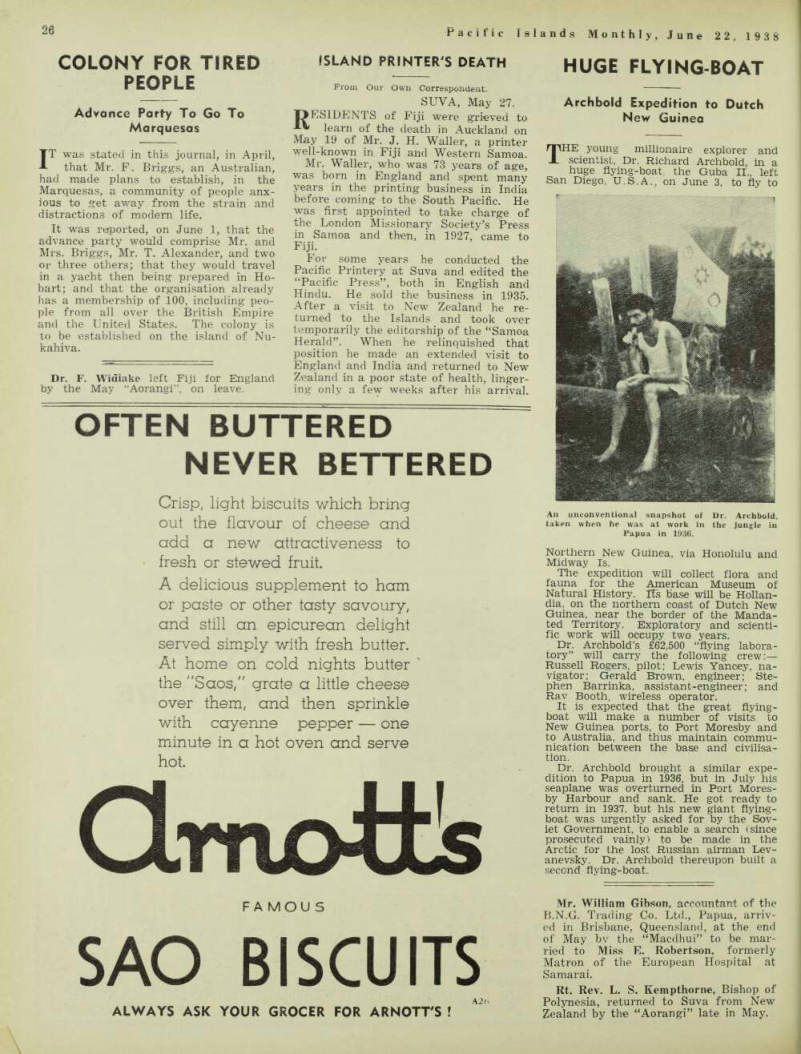
People
Advance Party To Go To Marquesas
IT was stated in this journal, in April, that Mr. F. Briggs, an Australian, had made plans to establish, in the Marquesas, a community of people anx ious to get away from the strain and distractions of modem life.
It was reported, on June 1, that the advance party would comprise Mr. and Mrs. Briggs, Mr. T. Alexander, and two or three others; that they would travel in a yacht then being prepared in Ho bart; and that the organisation already has a membership of 100, including peo ple from all over the British Empire and the United States. The colony is to be established on the island of Nu kahiva.
Dr. F. Widiake left Fiji for England by the May “Aorangi”, on leave.
Island Printer's Death
Prom Our Own Correspondent.
Suva, May 27.
T3ESIDENTS of Fiji were grieved to -■-% learn of the death in Auckland on May 19 of Mr. J. H. Waller, a printer well-known in Fiji and Western Samoa.
Mr. Waller, who was 73 years of age, was born in England and spent many years in the printing business in India before coming to the South Pacific. He was first appointed to take charge of the London Missionary Society’s Press in Samoa and then, in 1927, came to Fiji.
For some years he conducted the Pacific Printery at Suva and edited the “Pacific Press”, both in English and Hindu. He sold the business in 1935.
After a visit to New Zealand he re turned to the Islands and took over temporarily the editorship of the “Samoa Herald”. When he relinquished that position he made an extended visit to England and India and returned to New Zealand in a poor state of health, linger ing only a few weeks after his arrival.
Huge Flying-Boat
Archbold Expedition to Dutch New Guinea
THE young millionaire explorer and scientist, Dr. Richard Archbold, in a huge flying-boat ; the Guba 11., left San Diego, U.S.A., on June 3, to fly to
Northern New Guinea, via Honolulu and Midway Is.
The expedition will collect flora and fauna for the American Museum of Natural History. ITs base will be Hollan dia, on the northern coast of Dutch New Guinea, near the border of the Manda ted Territory. Exploratory and scienti fic work will occupy two years.
Dr. Archbold’s £62,500 “flying labora tory” will carry the following crew:— Russell Rogers, pilot; Lewis Yancey, na vigator; Gerald Brown, engineer; Ste phen Barrinka, assistant-engineer; and Rav Booth, wireless operator.
It is expected that the great flying boat will make a number of visits to New Guinea ports, to Port Moresby and to Australia, and thus maintain commu nication between the base and civilisa tion.
Dr. Archbold brought a similar expe dition to Papua in 1936, but in July his seaplane was overturned in Port Mores by Harbour and sank. He got ready to return in 1937, but his new giant flying boat was urgently asked for by the Sov iet Government, to enable a search (since prosecuted vainly) to be made in the Arctic for the lost Russian airman Lev anevsky. Dr. Archbold thereupon built a second flying-boat.
Mr. William Gibson, accountant of the B.N.G. Trading Co. Ltd., Papua, arriv ed in Brisbane, Queensland, at the end of May by the “Macdhui” to be mar ried to Miss E. Robertson, formerly Matron of the European Hospital at Samarai.
Rt. Rev. L. S. Kempthorne, Bishop of Polynesia, returned to Suva from New Zealand by the “Aorangi” late in May.
An unconventional snapshot of Dr. Archbold, taken when he was at work in the jungle in Papua in 1936.
Advertisements & other items, p. 28 (1 item)
CLmott!s
OFTEN BUTTERED
NEVER BETTERED
Crisp, light biscuits which bring out the flavour of cheese and add a new attractiveness to fresh or stewed fruit.
A delicious supplement to ham or paste or other tasty savoury, and still an epicurean delight served simply with fresh butter.
At home on cold nights butter ' the "Sacs," grate a little cheese over them, and then sprinkle with cayenne pepper one minute in a hot oven and serve hot.
CLmott!s
FAMOUS
SAO BISCUITS
A 2(.
ALWAYS ASK YOUR GROCER FOR ARNOTT'S !
Fiji's Highway
Completed
New Road Around Viti Levu Pro vides Fascinating 2-Days' Drive For Tourists
117ITH the completion in the middle of Yt May of the Suva-Sigatoka Road the main island of Viti Levu, upon which Suva is situated, is circled by a fine highway (says the “New Zealand Her ald”).
Less than 10 years ago road communi cation east of Suva was limited to a road between Suva and Naduruloulou, a dis tance of about 17 miles. From that point to the northern and western sides of the island bush tracks were the only means of lar. communication, and all traffic to the ..her side of the island was by sea.
Having linked up the northern road and the east coast, a start was made with the Suva-Sigatoka section, a dis tance of 86 miles, on the west coast.
With this work completed it is now pos sible to leave Suva and drive around the island in comfort in two days.
Increase in Motor Vehicles Th,e effect of this road programme up on motor traffic, and upon the number of people moving from place to place, is very marked. Motor buses have increas ed from 151 in 1927 to 775 at the end of 1937, and private cars have also in creased considerably.
Upon the native and Indian population the provision of roads has had the ef fect of developing their travel sense, and natives and Indians who previously had no intention or desire of visiting the capi tal or oth,er parts of the island now travel frequently from village to village, or from one district to another.
The tourist trade will benefit consid erably by the completion of the road, particularly in the Sigatoka district, where beach cottages and native huts have been erected and furnished for the convenience of visitors.
The country traversed by the 300-mile road includes mountain, bush and river scenery and, in the Sigatoka district, typical Islands beach scenes.
Natives Appreciate Motor ’Buses.
In the northern districts, of which Lau toka and Ba are the two main centres, sugar-cane dominates the landscape and this industry is reflected in the popu lation, which is mostly Indian, and in the general activities of the district, all of which centre around this industry.
Where natives and Indians previously were compelled to walk from district to district along bush tracks on journeys that often took them several days, they now sit by the roadside awaiting the first ’bus that comes along, and in this very convenient manner travel with their goods and produce along the road from village to village.
In some instances the road runs through the centre of what a few years ago were remote villages, and the intro duction of the motor ’bus and its easy form of travel has wrought a big change in the outlook and lives of many of the native people.
Mr. T. A. Carr, of New Guinea Gold
fields Ltd., reached Sydney by the
“Macdhui” from T.N.G. on May 26.
Advertisements & other items, p. 29 (1 item)
Guards Against Night-Starvation
31^ T ; Tennis again
Betty? I simply
haven't the energy I even wake tired.
I was the same until the Doctor put me on Horlicks — now I feel
splendid
jL / Betty is always ready for a game, even when the weather is most trying. Her boundless energy makes her the envy of other women, and a popular partner on the courts.
There was a time when Betty, too, was listless—was 100 fagged out to he bothered about anything. Betty’s Doctor described the condition as Night Starvation, and put her on Horlicks—a cupful every night at bedtime.
Horlicks is the ideal food drink. It quickly recharges the system with vital energy —so that you wake refreshed—able and eager for the demands of the day.
If you are feeling weary and without sufficient energy to enjoy work or play—try Horlicks. You’ll enjoy the delicious flavour of Horlicks, and he delighted with the fresh vitality which follows its regular use.
Ost He CL c >o'° Hi °u s ' a °f Oc tJ Qfifj J f*c w . il Pp Try Hitrlicks cold — it’s delicious. (14s os. size costs 3/- in all main totvns throughout the British Pacific Islands.) 11115
GUARDS AGAINST NIGHT-STARVATION
Australian Warships To
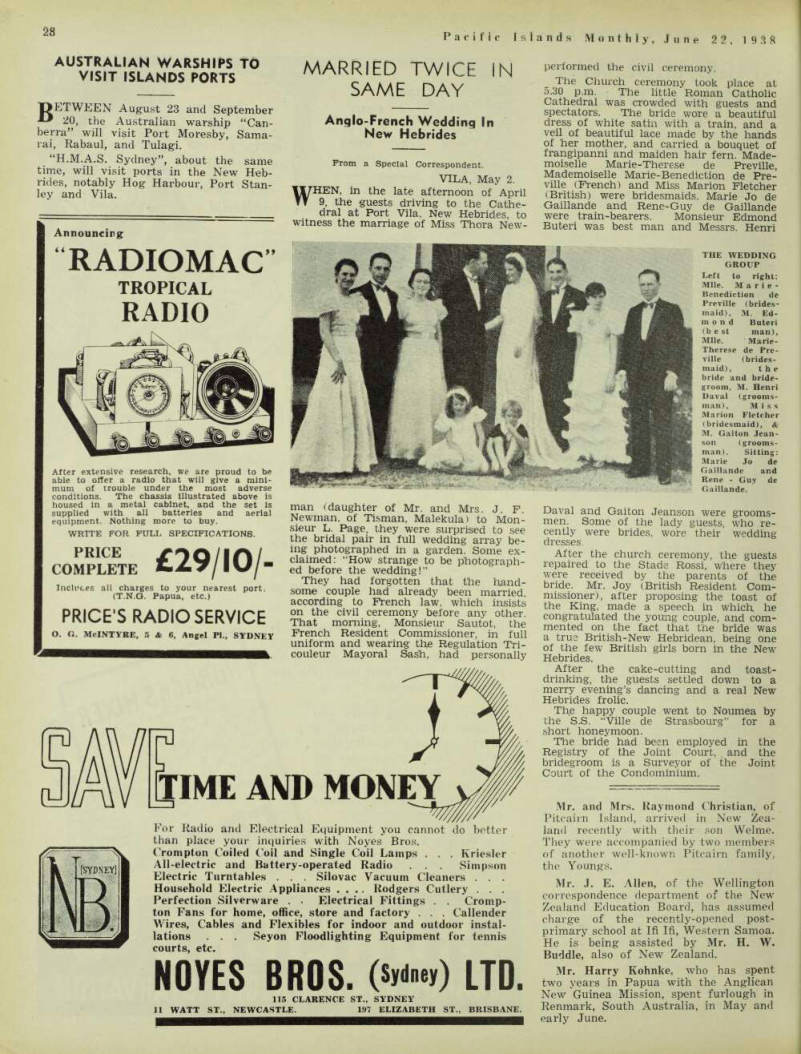
Visit Islands Ports
T>ETWEEN August 23 and September ** the Australian warship “Can berra” will visit Port Moresby, Sama rai, Rabaul, and Tulagi.
“H.M.A.S. Sydney”, about the same time, will visit ports in the New Heb rides, notably Hog Harbour, Port Stan ley and Vila.
Same Day
Married Twice In
Anglo-french Wedding In New Hebrides
Prom a Special Correspondent.
Vila Mav 9
WHPN- in thp iQi-p of/a ' -1 o m th6 f la j te - fter J loo^ l of A P nl hV ,^ 16 4. g D os + s .Cathe .. dra Zw P° r t Vila, New Hebrides, to witness the marriage of Miss Thora New-
man (daughter of Mr. and Mrs. J. F Newman, of Tisman, Malekula) to Mon sieur L. Page, they were surprised to see the bridal pair in full wedding array be ing photographed in a garden. Some ex claimed: “How strange to be photograph ed before the wedding!”
They had forgotten that the hand some couple had already been married, according to French law. which insists on the civil ceremony before any other.
That morning, Monsieur Sautot, the French Resident Commissioner, in full uniform and wearing the Regulation Tri couleur Mayoral Sash, had personally
performed the civil ceremony.
The Church ceremony took, place at 5.30 p.m. The little Roman Catholic Cathedral was crowded with guests and spectators. The bride wore a beautiful dress of white satin with a train, and a veil of beautiful lace made by the hands of her mother, and carried a bouquet of frangipanni and maiden hair fern. Made moiselle Marie-Therese de Preville, Mademoiselle Marie-Benediction de Pre ville (French) and Miss Marion Fletcher (British) were bridesmaids. Marie Jo de Gaillande and Rene-Guy de Gaillande were train-bearers. Monsieur Edmond Buteri was best man and Messrs. Henri
Daval and Gaiton Jeanson were grooms men. Some of the lady guests, who re cently were brides, wore their wedding dresses, After the church ceremony, the guests repaired to the Stade Rossi, where they were received by the parents of the bride. Mr. Joy (British Resident Com missioner), after proposing the toast of the King, made a speech in which he congratulated the young couple, and com mented on the fact that the bride was a true British-New Hebridean, being one of the few British girls born in the New Hebrides.
After the cake-cutting and toast drinking, the guests settled down to a merry evening’s dancing and a real New Hebrides frolic.
Th,e happy couple went to Noumea by the S.S. “Ville de Strasbourg” for a short honeymoon.
The bride had been employed in the Registry of the Joint Court, . and the bridegroom is a Surveyor of the Joint Court of the Condominium.
Mr. and Mrs. Raymond Christian, of Pitcairn Island, arrived in New Zea land recently with their son Welme.
They were accompanied by two members of another well-known Pitcairn family, the Youngs.
Mr. J. E. Allen, of the Wellington correspondence department of the New Zealand Education Board, has assumed charge of the recently-opened post primary school at Ifi Ifi, Western Samoa.
He is being assisted by Mr. H. W.
Buddie, also of New Zealand.
Mr. Harry Kohnke, who has spent two years in Papua with the Anglican New Guinea Mission, spent furlough in Renmark, South Australia, in May and early June.
The Wedding
Group
Left to right: Mile. Marie- Benediction de Preville (brides maid), M. Ed mond Buteri (best man), Mile. Marie- Therese de Pre ville (brides maid), the bride and bride groom, M. Henri Daval (grooms man), Miss Marion Fletcher (bridesmaid), & M. Gaiton Jean son (grooms man). Sitting: Marie Jo de Gaillande and Rene - Guy de Gaillande.
Advertisements & other items, pp. 30-31 (2 items)
Noyes Bros. (***) Ltd.
Announcing
“RADIOMAC”
TROPICAL
RADIO
f After extensive research, we are proud to be able to offer a radio that will give a minimum of trouble under the most adverse conditions. The chassis Illustrated above is housed in a metal cabinet, and the set is supplied with all batteries and aerial equipment. Nothing more to buy.
WRITE FOR PULL SPECIFICATIONS.
PRICE £90/10/-
COMPLETE / * V// “
Induces all charges to your nearest port. (T.N.G. Papua, etc.)
PRICE’S RADIO SERVICE
O. G. McINTYRE, 5 & 6, Angel PL, SYDNEY
For Radio and Electrical Equipment you cannot do better than place your inquiries with Noyes Bros.
Crompton Coiled Coil and Single Coil Lamps . . . Kriesler All-electric and Battery-operated Radio . . . Simpson Electric Turntables . . . Silovac Vacuum Cleaners . . .
Household Electric Appliances ... Rodgers Cutlery . . .
Perfection Silverware . Electrical Fittings . . Crompton Fans for home, office, store and factory . . . Callender Wires, Cables and Flexibles for indoor and outdoor installations . . . Seyon Floodlighting Equipment for tennis
NOYES BROS. (***) LTD.
115 CLARENCE ST., SYDNEY
11 WATT ST., NEWCASTLE. 197 ELIZABETH ST., BRISBANE.
Interesting !
WA
EACH
MONTH
ONE
SHILLING
GEOGRAPHIC MAGAZINE
Unusual Articles Featuring—
AUSTRALIA...
NEW ZEALAND...
SOUTH SEA ISLANDS
and Travelogues of
THE WORLD AT LARGE
ILLUSTRATED WITH STRIKING PHOTOGRAPHS
A SPECIAL 8-page Camera Section features outstanding Australian, New Zealand and South Sea Island photographic studies each month.
WALKABOUT for reading that is
Interesting !
Entertaining
Educational
ANNUAL SUBSCRIPTION
Pacific Islands.. 14/- Australasia ... 12/as r Aaivi [ygpci rrsvKyan
WALKABOUT
FLINDERS ST. RAILWAY BLDG., MELBOURNE, C.
or from Pacific Publications Pty. Ltd.
247 GEORGE STREET, SYDNEY,
and their representatives in the Pacific Islands.
Tuamotus

Poison Fish Of
Deadly To-day—And Good Food To-morrow
From Our Own Correspondent.
Papeete, May 10.
A VO YAGER among the atoj.ls of the Tuamotu Group has need to be wary of the fish he brings to his table.
Certain species of fish taken in the lagoon and about the reefs of one is land will be perfectly wholesome. The same species, taken at another atoll, will be violently poisonous. Again, cer tain fish from one part of a lagoon will be harmless, while the same species caught in another part of the same lagoon will be deadly.
Some fish are poisonous at certain seasons and wholesome at other seasons.
Very rarely, a species which has never been poisonous will suddenly develop toxins which threaten the life of those who eat the flesh.
This, has happened recently to the taihi—a fish highly esteemed for its delicious flavour.
The expedition, which left aboard the “Denvs” for Pitcairn Island, late in March, and returned to Papeete on April 30, had a perilous experience with this fish. On the outward voyage, the “Denys” called at Fakahina, where taihi abound. All on board partook
generously of this fish, and suffered no harm.' Five weeks later, the “Denys” again called at Fakahina, and the voyagers ate generously of taihi. That night all were very ill indeed. Happily a native tahua, skilled in the knowledge of anti dotes against these poisons, was at hand to rescue them.
This is the first time within the mem ory of man that the taihi has been poisonous.
The most dangerous fish in this re spect is the ha’amea. No one has any knowledge of the time or season when it may be wholesome or deadly poison ous. Its flesh is so delicious that natives
will often take the chance of eating it, while knowing the peril should the fish be poisonous. There is no indication of taste in this or any other fish, to warn the eater of his danger. Should the ha’amea be poisonous, those who have eaten it will have descended to the very gates of death within a few hours. If medical help is not at hand they die. The toxin appears to attack and destroy the tissues of the kidneys.
There are many theories, but no know ledge, to account for these extraordin ary transmutations. Until someone learned in toxicology and in the food sources of fish in these waters shall have studied the problem it will remain a mystery.
Some Tongan
Leaders
From left to right; Prince Tugi, Pre mier of Tonga: Rev.
J. S. Faubula, L.Th., of the Meth odist Mission, and his wife, Asinate; and Rev. John Havea, of Tubou College. -Photo.: Miss M. Rogers.
Advertisements & other items, p. 32 (1 item)
Coleman
i I
TABLE LAMPS
FULFIL THE FAMILY DEMANDS
Big Full Brilliance.—3oo Candle Power.
Big Safety Factor. Can’t spill fuel.
Big in Convenience. Lights Instantly.
Big Savings.—Costs Halfpenny per hour.
For the LOUNGE DINING-ROOM
VERANDAH.
COLEMAN LAMPS Beautifully modern in design. Founts in rich Coppertone Lacquer Finish. Equipped with Parchment Shades in delightful tonings. Protected with Patent Fuel and Air Control Valves.
COLEMAN INSTANT LIGHTING LAMPS burn any Clear Clean Benzine, and are equipped with Built-in Pumps.
COLEMAN KEROSENE LAMPS will also burn benzine. All Lamps equipped with Automatic Self-Cleaning Generators, No Island Breezes or Heavy Draughts can affect Coleman Lamps. They just continue to shine.
Take Your "Coleman" Anywhere
Obtainable from COLEMAN LAMP & STOVE Co.. TORONTO. CANADA, and Messrs.
Burns Philp & Co. Ltd.. W. R. Carpenter & Co. Ltd.. Morris Hedstrom Ltd., Steamships Trading Co. Ltd,, Whitten Bros. Ltd., or Coleman Qutck-Lite Co., 500 Kent St., Sydney.
Illustrating Insect Proof Attachments completely safeguarding Mantles.
Genuine Clear Glass P y rex- Globe of highest q u a 1 Ity.
Parchment shade removed.
Notes Made In Wau
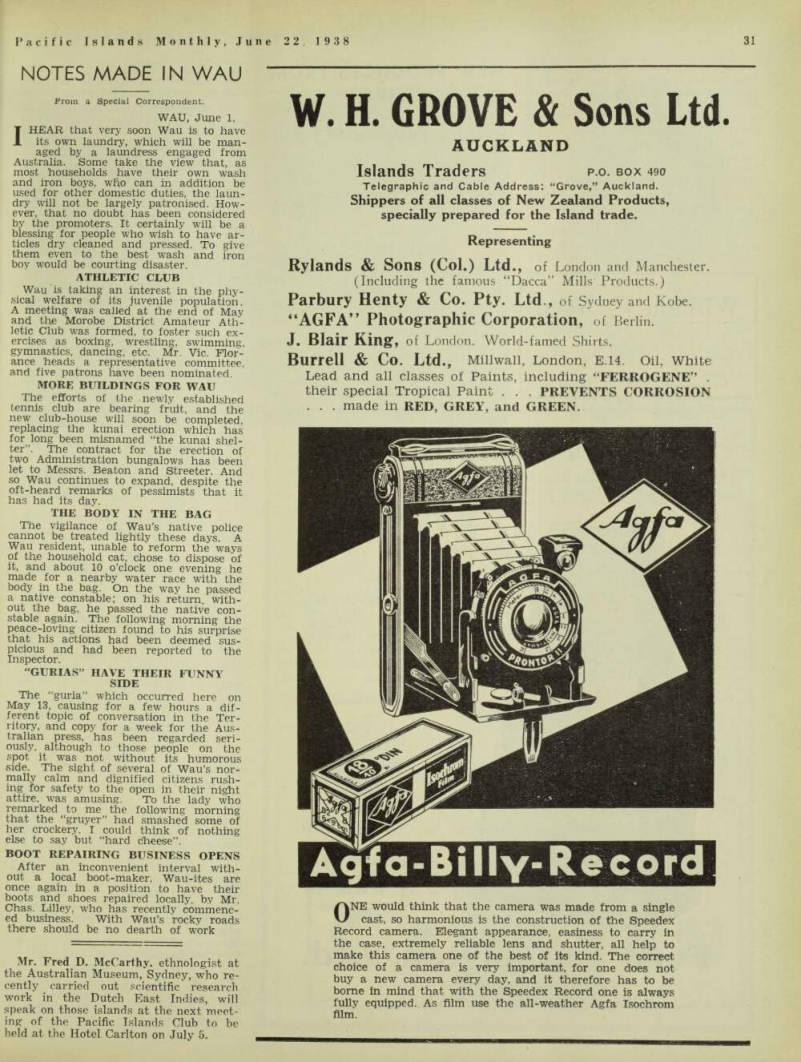
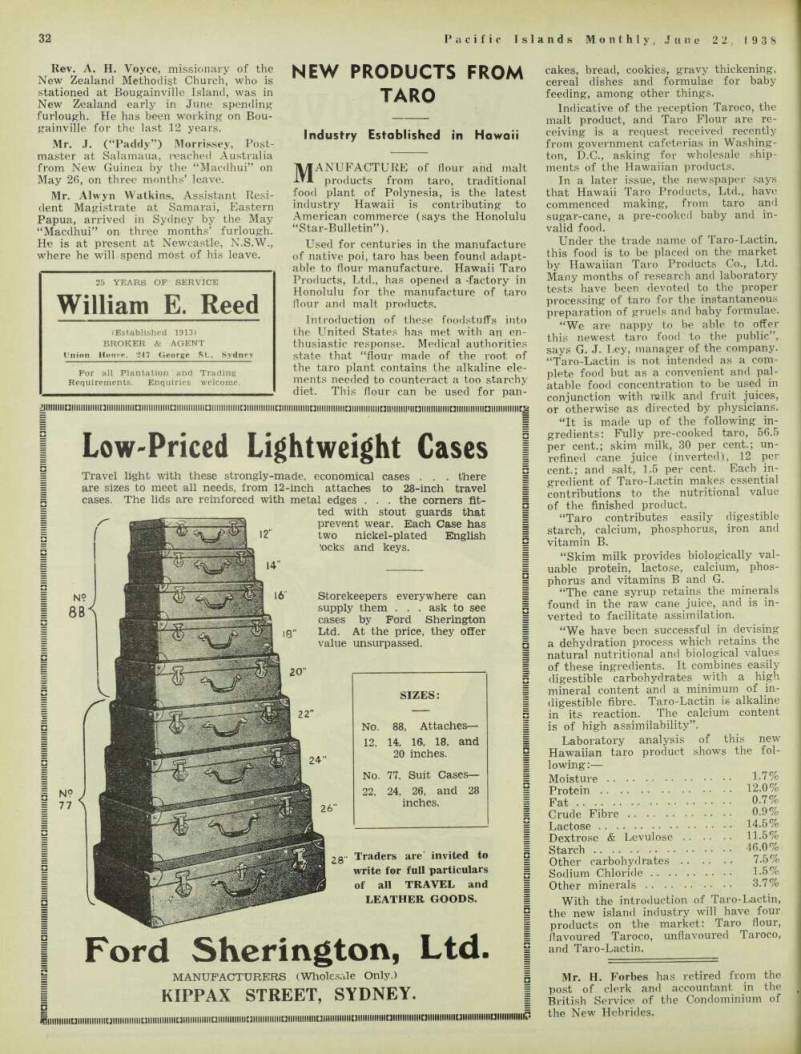
From a Special Correspondent.
WAU, June 1.
I HEAR that very soon Wau is to have its own laundry, which will be man aged by a laundress engaged from Australia. Some take the view that, as most households have their own wash and iron boys, wh,o can in addition be used for other domestic duties, the laun dry will not be largely patronised. How ever, that no doubt has been considered by the promoters. It certainly will be a blessing for people who wish to have ar ticles dry cleaned and pressed. To give them even to the best wash and iron boy would be courting disaster.
Athletic Club
Wau is taking an interest in the phy sical welfare of its juvenile population.
A meeting was called at the end of May and th,e Morobe District Amateur Ath letic Club was formed, to foster such ex ercises as boxing, wrestling, swimming, gymnastics, dancing, etc. Mr. Vic. Flor ance heads a representative committee, and five patrons have been nominated.
More Buildings For Wau
The efforts of the newly established tennis club are bearing fruit, and the new club-house will soon be completed, replacing the kunai erection which has for long been misnamed “the kunai shel ter”. The contract for the erection of two Administration bungalows has been let to Messrs. Beaton and Streeter. And so Wau continues to expand, despite the oft-heard remarks of pessimists that it has had its day.
The Body In The Bag
The vigilance of Wau’s native police cannot be treated lightly these days. A Wau resident, unable to reform the ways of the household cat, chose to dispose of it, and about 10 o’clock one evening he made for a nearby water race with the body in the bag. On the way he passed a native constable; on his return, with out the bag, he passed the native con stable again. The following morning the peace-loving citizen found to his surprise that his actions had been deemed sus picious and had been reported to the Inspector.
“Gurias” Have Their Funny
Side
The “guria” which occurred here on May 13, causing for a few hours a dif ferent topic of conversation in the Ter ritory, and copy for a week for the Aus tralian press, has been regarded seri ously, although to those people on the spot it was not without its humorous side. The sight of several of Wau’s nor mally calm and dignified citizens rush ing for safety to the open in their night attire, was amusing. To the lady who remarked to me the following morning that the “gruyer” had smashed some of her crockery, I could think of nothing else to say but “hard cheese”.
Boot Repairing Business Opens
After an inconvenient interval with out a local boot-maker. Wau-ites are once again in a position to have their boots and shoes repaired locally, by Mr.
Chas. Lilley, who has recently commenc ed business. With Wau’s rocky roads there should be no dearth of work Mr. Fred D. McCarthy, ethnologist at the Australian Museum, Sydney, who re cently carried out scientific research work in the Dutch East Indies, will speak on those islands at the next meet ing of the Pacific Islands Club to be held at the Hotel Carlton on July 5.
Rev. A. H. Voyce, missionary of the New Zealand Methodist Church, who is stationed at Bougainville Island, was in New Zealand early in June spending furlough. He has been working on Bou gainville for the last 12 years.
Mr. J. (“Paddy”) Morrissey, Post master at Salamaua, reached Australia from New Guinea by the “Macdhui” on May 26, on three months’ leave.
Mr. Alwyn Watkins, Assistant Resi dent Magistrate at Samarai, Eastern Papua, arrived in Sydney by the May “Macdhui” on three months’ furlough.
He is at present at Newcastle, N.S.W., where he will spend most of his leave.
Advertisements & other items, pp. 33-34 (1 item)
W. H. GROVE & Sons Ltd.
AUCKLAND
Islands Traders p.o. box 490 Telegraphic and Cable Address: “Grove,” Auckland.
Shippers of all classes of New Zealand Products, specially prepared for the Island trade.
Representing Rylands & Sons (Col.) Ltd of London and Manchester. (Including the famous “Dacca” Mills Products.) Parbury Henty & Co. Pty. Ltd., of Sydney and Kobe.
“AGFA” Photographic Corporation, of Berlin.
J. Blair King, of London. World-famed Shirts.
Burrell & Co. Ltd., Millwall, London, E. 14. Oil, White Lead and all classes of Paints, including “FERROGENE” . their special Tropical Paint . . . PREVENTS CORROSION . . . made in RED, GREY, and GREEN.
CM I 0> @1 ONE would think that the camera was made from a single cast, so harmonious is the construction of the Speedex Record camera. Elegant appearance, easiness to carry in the case, extremely reliable lens and shutter, all help to make this camera one of the best of its kind. The correct choice of a camera is very important, for one does not buy a new camera every day, and it therefore has to be borne in mind that with the Speedex Record one is always fully equipped. As film use the all-weather Agfa Isochrom film.
25 YEARS OF SERVICE
William E. Reed
(Established 1913)
BROKER & AGENT
Union House. 247 George St.. Sydney For all Plantation and Trading Requirements. Enquiries welcome.
Low-Priced Lightweight Cases
Travel light with these strongly-made, economical cases . . . there are sizes to meet all needs, from 12-inch attaches to 28-inch travel cases. The lids are reinforced with metal edges . . . the comers fitted with stout guards that prevent wear. Each Case has two nickel-plated English locks and keys. 12 N9 8B< |Q" 20 r 22 24' N9 77 Storekeepers everywhere can supply them . . . ask to see cases by Ford Sherington Ltd. At the price, they offer value unsurpassed.
SIZES:
No. 88, Attaches— 12, 14, 16, 18, and 20 inches.
No. 77, Suit Cases— 22, 24, 26, and 28 inches.
Traders are invited to write for full particulars of all TRAVEL and
LEATHER GOODS.
Ford Sherington, Ltd.
MANUFACTURERS (Wholesale Only.)
KIPPAX STREET, SYDNEY.
New Products From
Taro
Industry Established in Hawaii
Manufacture of flour and malt products from taro, traditional food plant of Polynesia, is the latest industry Hawaii is contributing to American commerce (says the Honolulu “Star-Bulletin”).
Used for centuries in the manufacture of native poi, taro has been found adapt able to flour manufacture. Hawaii Taro Products, Ltd., has opened a 'factory in Honolulu for the manufacture of taro flour and malt products.
Introduction of these foodstuffs into the United States has met with an en thusiastic response. Medical authorities state that “flour made of the root of the taro plant contains the alkaline ele ments needed to counteract a too starchy diet. This flour can be used for pan
cakes, bread, cookies, gravy thickening, cereal dishes and formulae for baby feeding, among other things.
Indicative of the reception Taroco, the malt product, and Taro Flour are re ceiving is a request received recently from government cafeterias in Washing ton, D.C., asking for wholesale ship ments of the Hawaiian products.
In a later issue, the newspaper says that Hawaii Taro Products, Ltd., have commenced making, from taro and sugar-cane, a pre-cooked baby and in valid food.
Under the trade name of Taro-Lactin. this food is to be placed on the market by Hawaiian Taro Products Co., Ltd.
Many months of research and laboratory tests have been devoted to the proper processing of taro for the instantaneous preparation of gruels and baby formulae.
“We are happy to be able to offer this newest taro food to the public”, says G. J. Ley, manager of the company.
“Taro-Lactin is not intended as a com plete food but as a convenient and pal atable food concentration to be used in conjunction with milk and fruit juices, or otherwise as directed by physicians.
“It is made up of the following in gredients: Fully pre-cooked taro, 56.5 per cent.; skim milk, 30 per cent.; un refined cane juice (inverted), 12 per cent.; and salt, 1.5 per cent. Each in gredient of Taro-Lactin makes essential contributions to the nutritional value of the finished product.
“Taro contributes easily digestible starch, calcium, phosphorus, iron and vitamin B.
“Skim milk provides biologically val uable protein, lactose, calcium, phos phorus and vitamins B and G.
“The cane syrup retains the minerals found in the raw cane juice, and is in verted to facilitate assimilation.
“We have been successful in devising a dehydration process which retains the natural nutritional and biological values of these ingredients. It combines easily digestible carbohydrates with a high mineral content and a minimum of in digestible fibre. Taro-Lactin is alkaline in its reaction. The calcium content is of high assimilability”.
Laboratory analysis of this new Hawaiian taro product shows the fol lowing:— Moisture 1.7% Protein 12.0% Fat 0.7% Crude Fibre 0.9% Lactose 14.5% Dextrose & Levulose 11.5% Starch 46.0% Other carbohydrates 7.5% Sodium Chloride 1.5% Other minerals 3.7% With the introduction of Taro-Lactin, the new island industry will have four products on the market: Taro flour, flavoured Taroco, unflavoured Taroco, and Taro-Lactin.
Mr. H. Forbes has retired from the post of clerk and accountant in the British Service of the Condominium of the New Hebrides.
To Revive The Cook Is. Orange Industry
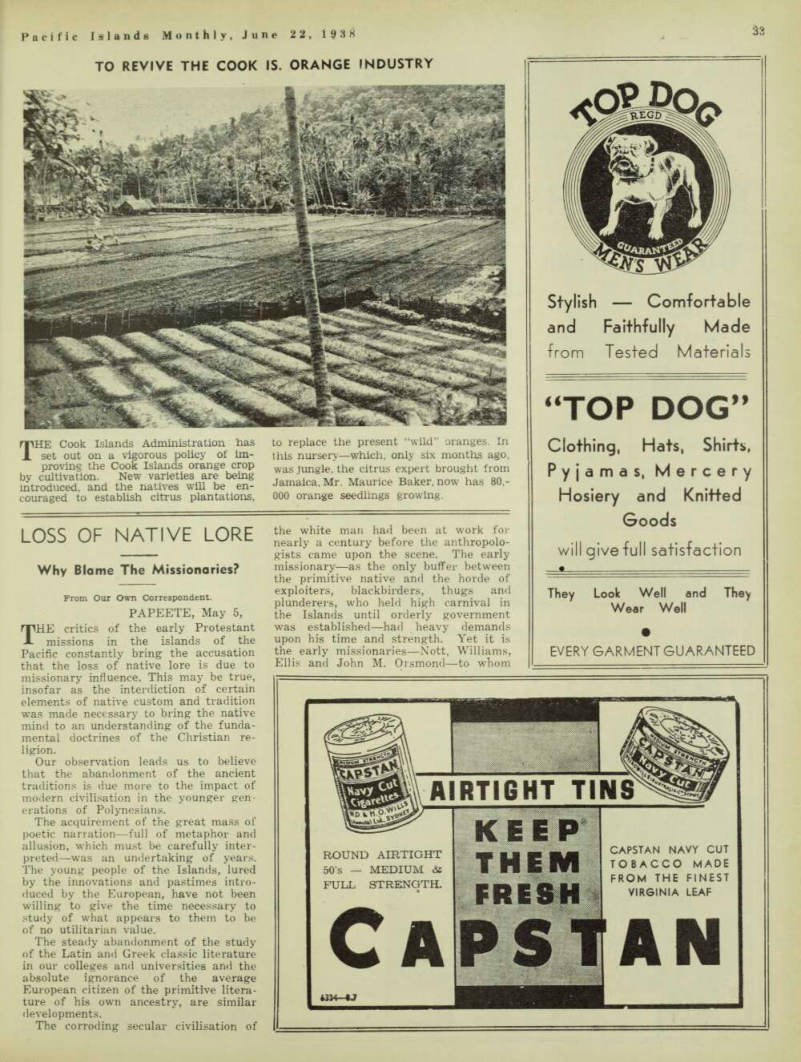
THE Cook Islands Administration has set out on a vigorous policy of im proving the Cook Islands orange crop by cultivation. New varieties are being introduced, and the natives will be en couraged to establish citrus plantations,
to replace the present “wild” oranges. In this nursery—which, only six months ago, was the citrus expert brought from Jamaica,Mr. Maurice Baker,now has 80,- 000 orange seedlings growing.
Loss Of Native Lore
Why Blame The Missionaries?
Prom Our Own Correspondent.
Papeete, May 5,
THE critics of the early Protestant missions in the islands of the Pacific constantly bring the accusation that the loss of native lore is due to missionary influence. This may be true, insofar as the interdiction of certain elements of native custom and tradition was made necessary to bring the native mind to an understanding of the funda mental doctrines of the Christian re ligion.
Our observation leads us to believe that the abandonment of the ancient traditions is due more to the impact of modern civilisation in the younger gen erations of Polynesians.
The acquirement of the great mass of poetic narration—full of metaphor and allusion, which must be carefully inter preted—was an undertaking of years.
The young people of the Islands, lured by the innovations and pastimes intro duced by the European, have not been willing to give the time necessary to study of what appears to them to be of no utilitarian value.
The steady abandonment of the study of the Latin and Greek classic literature in our colleges and universities and the absolute ignorance of the average European citizen of the primitive litera ture of his own ancestry, are similar developments.
The corroding secular civilisation of
the white man had been at work for nearly a century before the anthropolo gists came upon the scene. The early missionary—as the only buffer between the primitive native and the horde of exploiters, blackbirders, thugs and plunderers, who held high carnival in the Islands until orderly government was established—had heavy demands upon his time and strength. Yet it is the early missionaries—Nott, Williams, Ellis and John M. Orsmond—to whom
we are indebted for our knowledge of the customs, ritual, traditions and early history of the Society Islands.
The ethnologists and anthropologists were asleep while the harvest was wait ing to be garnered. They should cen sure themselves—not the missionaries.
Advertisements & other items, pp. 35-36 (1 item)
Keep 1
K ' K* I
Stylish Comfortable
and Faithfully Made from Tested Materials
“TOP DOG”
Clothing, Hats, Shirts, Pyjamas, Mercery Hosiery and Knitted Goods will give full satisfaction They Look Well and They Wear Well
EVERY GARMENT GUARANTEED
UK m p d
AIRTIGHT TINS
KEEP 1
s» vs 2S ?c7
ROUND AIRTIGHT
50 s MEDIUM &
FULL STRENGTH.
Ca
THEM
CAPSTAN NAVY CUT
TOBACCO MADE
FROM THE FINEST
VIRGINIA LEAF
4334-4 J
FRE
PURE RICE
STARCH
Always ask for . . .
CORAL’ BRAND
100% PURE
Noted for Its
QUALITY
and
WHITENESS
Goes Farthest and gives Lasting Finish
WILL NOT
STICK TO
IRON
Obtainable from Leading Island Stores Manufactured by
AUSTRALIAN RICE LTD.
Sydney, N.S.W.
CORAL BRAND
RICE STARCH
t Australia’s Choicest Products: Brussels Sprout* White Turnips Sweet Corn Tomato Puree Tomato Sauce Tomato Soup Tutti Fruit Sauce (Worcestershire flavor) Beetroot Spinach Cabbage Carrot* Parsnip* Celery Green Peas French Beans Cauliflower k ■ * r: n sa J Always . . . make sure you have at hand an ample Reserve of these Delicious . .
Garden
Vale
Ready-toserve Vegetables
Tragedy Of Atimaono
Story of the Rise and Fall of a Tahitian Cotton Enterprise
Section 2.
(From the MS. of J. L. Young, written at Merami, Warren, N.S.W., about 1928, and edited by W. W. Bolton, M.A.)
Comte de la Ronciere.
THE career of Comte de la Ronciere as Governor of Tahiti was so much, af fected by the affairs of the planta tion of Atimaono, and vice versa, that an explanation is in order. There can be no doubt that his administration from 1863 to 1869 was dictated by a sincere desire for the betterment of the popu lation, He caused roads and bridges to be constructed, educational facilities to be extended, an agricultural bank to be founded, and in many other directions favoured progress.
But all this, notwithstanding, there ac cumulated against him strong opposition and even hatred, alike on the part of certain functionaries, the laxity and even dishonesty of whose methods he con demned, and of certain civilians. These latter included not only some of the mer chants of Papeete whose interests clash ed with those of Stewart, but the Pro testant Mission party, who disliked the latter’s mode of life.
Then, again, the Governor had earned
the ill-will of the Catholic Mission by certain action which had been forced on him immediately after his arrival at Papeete, in carrying on an enquiry insti tuted by his predecessor as Governor. His enemies watched for their opportunity, and it came to them in an extraordinary manner in 1869.
James Stewart, the brother of William Stewart, who carried on at Papeete a small mercantile business and who also had a store at Atimaono, managed by one William Keane, having decided to quit Tahiti, sold the contents of the afore said store to Keane, who paid him with an order payable six months after date, drawn by William Stewart on his Auck land agents—the amount was francs 92,- 200. This was really a loan made by William Stewart to Keane to enable him to pay James Stewart and thus facilitate the sale of the store by the latter to Keane.
William Stewart had lent to James Stewart a few weeks before, francs 25,= 000, by an order on his Auckland agents, which order James Stewart had sent to Auckland for collection.
James Stewart then sued his brother William for francs 100,000 composed as follows: Francs 92,000, plus francs 25,000 francs 117,000, less francs 17,000, which James Stewart owed to the plantation— francs 100,000.
In vain, William Stewart pointed out that neither of these notes was due. The judge in the Lower Court gave a verdict in favour of James Stewart, which, on appeal to the Higher Court was confirm ed, and immediate execution of judgment was ordered, and the plantation of Ati maono was seized by the sheriff.
The Governor came to the rescue by instructing the Agricultural Bank (Caisse Agricole) to purchase cotton from the plantation to the value of francs 100,000, and this enabled William Stewart to pay the amount of the unjust judgment.
Both the judges—one a local lawyer and one a functionary—owed their ap pointment to the Governor —no judges from France being available at the time.
Both were personal enemies of Stewart— and, sub rosa, of the Governor and their action against Stewart was dictated as much by feeling against the Governor as against him.
James Stewart with francs 100,000 in his pocket, left Tahiti for Honolulu, leav ing behind him debts to the amount of francs 60,000, and no books of account. (Incidentally, it was reported that not long afterwards he died in gaol abroad, under sentence for fraud).
The Governor removed the two judges and banished ona (the functionary) to Moorea Island, 12 miles away, but at his request allowed him to return soon after wards. The functionary and others of his friends denounced the Governor to the Government at Paris, who ordered the functionary to be reinstated to his post, and recalled the Governor in March, 1869. He, however, remained until Aug ust, 1869, as the newly appointed Gov
emor—on account of illness did not come to Tahiti as expected.
Meantime, the aforesaid functionary conspired with his friends against the Governor, suborned certain interpreters and others to make false statements and to steal certain private documents from his office and, indeed, went so far as to begin to arrange for his seizure and de
portation.
The functionary, however, was prose cuted and finally sentenced to one year’s imprisonment and was sent to San Fran cisco en route to Paris. But the Min ister of Marine telegraphed to the French Consul at San Francisco to send him back to Tahiti.
The Comte de la Ronciere had one good friend, Mr. Louis Jacolliot, a judge at Tahiti who, on his arrival from Paris in March, 1869, was opposed to the Gover nor on account of his removal of the two judges, but who on examination of the affair decided that the Governor was righ,t in interfering with the abuse of justice. He returned to Paris in August, 1869, and took up the defence of the ex- Governor with enthusiasm, as appears from his pamphlet “La Verite sur Tahiti”, Paris, October, 1869 —but without avail.
The influences against the Comte were too great. Even an old scandal of the year 1833, though, long since declared false, was raked up against him, and he went into oblivion. His sympathy with and support of William Stewart’s enter prise was one of the proximate causes of his downfall, hence this extended men tion of him.
Stewart In Sydney ONE of the episodes of Stewart’s ad venturous career was the follow ing:— In 1858, h,e was a wine and spirit mer chant at Sydney, his brother James be ing a Customs House Agent at the same place. In that year, these two conspired with three Customs House officers to avoid payment of duties on 300 cases and casks of wines and spirits, and a quan tity of tobacco, by obtaining certificates of export of the above mentioned articles out of Bond to New Caledonia on the schooner yacht, the “Louisa”, of 78 tons register. The vessel left, ostensibly for Noumea, on September 2, 1858. But it was soon ascertained that the goods had never been placed on board; they were traced to various hotels in Sydney and suburbs.
The “Louisa” returned to Sydney on October 7, but left the same day, after the Stewarts had visited her. She went to Hobart, thence to Jervis Bay, near Sydney, where William Stewart joined her; thence to Lord Howe Island, where the schooner “Martha” was met, having James Stewart, his wife and family aboard, who transhipped to the “Louisa”, which left for an unknown destination.
The “Louisa” was seen again in July, 1860, when Captain Anderson, of the “Marla” met her at Norfolk Island, un der the name of “Mary Ann”, Captain Wilson in command. The name “Louisa” was distinctly visible under the new paint.
It has been stated, since the death of William Stewart, that the “Louisa” pro ceeded from Lord Howe Island to a South American port, calling at Bora Bora Is land on her return towards New Zea land where, during 1859 and 1860, arms and ammunition were supplied from her to the Maori warriors.
The account of the Sydney episode was published in the “South Austra lian”, of July, 1917, under the heading “The Notorious Louisa”, written by a member of the Australian Historical So ciety.
Life of Stewart ... . . 11TILLIAM STEWART was bom m the ? ▼ north of Ireland in 1825, of Scotch Presbyterian ancestors. He was tall, fully six feet in height, of a striking presence, with a long black beard and black hair (.but partly bald) and with piercing dark eyes, widely opened and set well apart. He was well educated, speaking Prench, some Spanish and Portuguese, and some Hindustani. He had been in the army in India as a young man and, subsequently, in the wine business in Spain and Portugal. He was a man of the world, a good judge of wines and
liquors, but rarely drank to excess; he played cards but had the reputation of gambling in moderation. He was a charm ing host and companionable with those but masterful and arrogant wit b those who opposed his wishes. He was a strict disciplinarian, but was con sidered by his employees to be always j Us t. He was generous as he proved on many occasions, but could drive hard bar gains in business matters, He died in his house at Atimaono on September 24, 1873, at the age of 48, his death, which was said to be due to nver disease, being undoubtedly hasten ed by chagrin. He died in penury, all
that he had having gone to keep the plantation going. While not actually un der arrest, he was forbidden to leave his residence without permission, he having been declared insolvent.
All those to whom he had extended hospitality and given largesse deserted him. Almost his only consistent visitor, while on his death bed, was a lady who was a descendant of one of the old Mis sionary families. She, and his wife, to whom he had been only recently mar ried, attended to his last moments. He was buried, almost without cere mony and with a very meagre attend ance of mourners, at Mataiea, be tween the main road and the sea, nearly 47 kilometres from Papeete. Several years afterwards, his bones were removed by his widow to the burial plot of her family.
Many years after his death, an in credible story became current, to the ef fect that he did not die in 1873, but es caped from Tahiti in a vessel. But this was only a reflection of the glamour which was associated with Stewart’s ca reer at Tahiti in the minds of those who remembered his outstanding personality.
The writer did not arrive at Tahiti un til some time after Stewart’s death, but was always keenly interested in the de tails of the rise and fall of the Ati maono enterprise, and had many conver sations with those who were closely con nected with Stewart in business, and as
employees, etc.
Thus, when the writer subsequently be came owner of one-fifth of the Atimaono Estate, there fell into his hands maps, plans and documents relating to the his tory of the same, and he obtained access to numerous letters, etc., all of which en abled him to reconstruct in a measure the romance of Atimaono and of William Stewart.
There is no intention to paint him as other than he was. During part of his career he was apparently what is called an adventurer, with but little scruples of honesty, but it is not on record that during his residence at Tahiti he was ever justifiably accused of dishonesty.
Whatever his faults—and they were many —he was certainly sincere in his belief in, and devotion to the Atimaono enter prise. He carried the burden on his own shoulders —almost every man’s hand was against him. He failed through no fault of his own, and his end was pathetic.
In a world in which are so many weak lings it is refreshing to meet a strong man, an organiser and administrator, even with all his faults of omission and com mission. It would be easy to point a moral by Stewart’s career, but let us leave him saying with the Spaniard: “Que sea su juez Dios” (Let God be his Judge).
Advertisements & other items, pp. 37-38 (1 item)
Hallstrom
W. M. REID
EXPORT AGENT
offers you a buying service based on • Saving of Shipping Cost . . . Attention to Detail • Contact with First - Class Suppliers
WHOSE GOODS CAN BE SAFELY RECOMMENDED
Send your enquiries to W. M, REID for . . .
"VAT 69" WHISKY—by W, SANDERSON & SON, Leith, Scotland. A fine old Scotch Liqueur Whisky without a rival.
"EMU BRAND" ROPES—by O. PENDERGAST & CO. LTD., who are featuring special Islands' Quality Ropes—Cheap and Reliable.
"CLYDE" LAWN MOWERS —By CLYDE ENGINEERING CO. LTD. The widest advertised and best known ball-bearing Lawn Mowers, Sheffield steel blades.
"SNOW DROP" ICE CREAM CONES—by ZUTTION SNOWDROP PRODUCTS LTD.
A sales help tor every ice cream vendor. Always fresh. Pink and white.
STOTT & UNDERWOOD PTY. LTD. for the NEW UNDERWOOD—and also for well known brands of Reconditioned Typewriters.
"VIGOR FOODS"'—Vegetables, etc. Dehydrated and not compressed Remain fresh without refrigerator. No loss of vitamins. No preservatives.
SADDLES. HARNESSES. CANVAS & LEATHER GOODS—by J. P. TALTY LTD, Finest quality materials, and first-class workmanship guaranteed.
For any other requirements in Food, Hardware. Clothing, etc., communicate with . . .
W. M. REID, " Reid House," 75 King Street, Sydney
Hallstrom
KEROSENE OPERATED ...
REFRIGERATORS
ANNOUNCE NEW EXPORT POLICY
AND THE BEST REFRIGERATOR VALUE EVER OFFERED To enable us to obtain Full Advantage from the enormous Output Capacity of the new Hallstrom Manufacturing Plant, covering 20 acres and including the finest machinery of its type in Australia, we have decided on a policy of More Sales at Lower Prices We now offer the Model as illustrated at £5l-10-0 F. 0.8. Sydney.
This ever popular Hallstrom model has, over a number of years, stood all tests under all conditions, and may be ordered direct from the factory, or is obtainable, at the new price, from all branches of Burns, Philp & Co. Ltd. and W. R. Carpenter & Co. Ltd.
HALLSIROMS PTY. LTD., Willoughby, Sydney ■- -
'i
WHEN SHALL I ASK
DAD TO BUY ME
nTHAT FROCK?
"> vc V -
AFTER DINNER
THIS NEW SWEET
IS MADE WITH
i H FOSTER CLARKS
CUSTARD. HELL
ENJOY IT.
THANKS TO
A DELICIOUS SWEET
It was one of Elizabeth Craig’s Custard recipes that made Dad generous. Being made with Foster Clark’s creamy Custard, all Elizabeth Craig’s dishes are wholesome and economical, as well as delici ous. Only the purest ingredients are used in Foster Clark’s Custard Avoid cheap imitations 0/ Write for Elizabeth Craig’s FREE Recipe Book to Foster Clark (Aust.) Ltd-.
Department R. 8..
Redfern, N.S.W.
Enclose id. stamp for postage.
V756A
Foster Clark's
creamij CUSTARD SERVE IT WITH ALL FRUIT. FOR ADDED
FLAVOUR AND NOURISHMENT
Addenda By W. W. Bolton
TO complete the story, now first given to the general public through the publication of Mr. J. L. Young’s manuscript, it may be of interest to men tion various additional facts which in the main are to be found in the obscure and now rare weekly newspaper of Papeete in its issues of that day. “The Messager de
Tahiti” came to an end in 1880. It Is strange that this news-sheet should have escaped the attention of the author of the MS., who lived for years in the town.
The following items deal with many aspects of the life of a remarkable man, a born organiser who was known locally as “Big William”, not alone for his fine physique but that, for Tahitians, all he did was on a colossal scale, stupendous.
An Official Visit MENTION has been made of an offi cial visit.
There was another visit paid by a large party of guests a year later, who in their report, express their astonish ment at all they saw and at the bound less and overwhelming hospitality of their host during many days. They dwell on “this vast Estate”: “the astounding suc cess after only four years”, and at seeing “an establishment on so vast a scale functioning with such calm, such order, full proof of superb direction”.
They seem to have been specially at tracted by the Chinamen’s Village: “a small town, two clubs where they dance, and a theatre for their plays. Always keen to make his workers happy, he per mits each Chinese who behaves himself well a house where he can live alone. It is his home. This favour is highly prized, the number of separate dwellings grows yearly”. Prom Taharini Valley the labourers were allowed to cut timber to make rafts on which to disport them selves in the lagoon.
Their host won th,eir hearts for they thus conclude: “Calumniators before taking up the pen should go and see for themselves, taking note of the work, and they would certainly blush at the very idea of wronging an establishment which does hpnour to him who created it”.
Stewart was given the honour of a spe cial visit by the Duke of Edinburgh in 1869, amid all the pressing engagements of the Prince, who must needs see the amazing estate. Later on. we come across an advertisement inviting cargo for his vessel “The Prince Alfred”: he re turned the visit in the only way he could.
The Countess de la Ronciere THE cordial friendship between the Roncieres and Stewart gave free play to the evilminded, It crushed the woman; she could stand no more.
An official notice appears reading that the Countess had left Tahiti “in a poor state of health” and quite “unable to bid adieu to her friends”: and the Imperial Judge Jocolliot reports that before a year was out she died at her residence in Paris, demanding an enquiry by the Gov ernment to kill the calumny, but which was bluntly denied her. The Roncieres’ enemies were strong at Home.
The departure of the Count himself, did not, as the MS. shows, end the bit ter hounding of Stewart. There were still nigh fours years more for him.
Once only does he appear to have hit
back, but here again he lost out. He had been summoned to attend the Court (for a case not named) and had replied by letter refusing either to attend or be rep resented. In December, 1870, the matter was brought to the attention of the Su perior Court, when the charge was made that “the said Stewart refuses to acknow ledge in the said functionaries and mag istrates the powers they claim, and pro tests their decisions and th,eir judgments”.
He was fined and the costs were his to pay. 111-will of Catholic Mission THE ill-will of the Catholic Mission to wards the Count —which reacted upon Stewart—was the result of his report sent home as to the iniquitous and in human conduct of Father Laval and his assistants at Mangareva (Gambier Is lands). The French Parliament took up the matter and demanded the banish ment of Laval from the Gambier Group, which was duly carried out, the man be ing retired to Papeete where he died in 1880.
The tract of land which Stewart ac quired was owned in the main by the Vai-raa-to people and those allied to them through marriage. Throughout 1864 and 1865 there are to be seen in the lit tle newspaper of Papeete long lists of those giving the required legal notice of their purpose to sell to Stewart, and among them appear the names of Royalty, two sons of Queen Pomare —Ariiaue and Tamatoa —both wishing to have “a finger in the pie” of ready cash. Not only the land was pur chased but all the cattle browsing on the plots: they would help keep down the verdure and fed his army of labourers.
There appears later on, a portion of the Annual Report for 1867 of the Company, issued from London, giving two items: “Land costs 750,000 francs”: “Improve ments 1,671,415 francs”. Stewart appears on the Board of Directors but not Soares who was appointed later, acting at first only as general manager.
Introduction of Chinese SINCE the introduction of Chinese to Tahiti by Stewart, they have increas ed and multiplied till to some they appear as a menace to the community.
Be that as it may, there are many who are the direct descendants of these pion eers. There are still Gilbert Islanders resident in Tahiti under the name of the Arurai, after Hope Island, in that group, from whence their progenitors mostly came.
Stewart’s Misfortunes THE statement made as to the dissat isfaction of some as to the price Stewart had paid them for their land —in fact, that they had been duped— lends strength to the local belief that they placed a curse upon the estate. And the seouel may well be said to sunport th,at belief, not alone in the case of Stew art himself, but that every subsequent attempt, to this day, to revive the area has ended in disastrous failure.
The years 1870 to 1873, which latter year saw Stewart’s end, had been far more cruel years for him than the brief summary nf the MS. colour to.
Herewith : the blows, as the little news paper reports them: Owen and Graham (Stewart’s bankers in Auckland) seek to recover and send up J. E. Brown in 1870 as their Attor ney. J. E. Brown was a New Zealander, by profession a book-keeper, who went later to the Marauesas to act in that capacity for Captain Hart (once Commo dore of Stewart’s fleet) who had cotton interests there. Stewart sees his hereto
fore unencumbered creation plastered with a mortgage “dated May 10, 1871”. His undisputed supremacy becomes a tem porary managership “for our account”, cn September 22, 1872.
Next, this is taken from him, and J.
E. Brown appointed on January 31, 1873.
His full rule is restored, Owen and Gra ham “having renounced th,e mortgage” on March 28, 1873. It was but a flash in the pan, for the shareholders step in.
“By a Writ of Ref ere, Mr. John Ed ward Brown acting in the name of and as Attorney for the Tahiti Cotton and Coffee Plantation Ltd., has been placed in charge of the administration of the said Company’s Estates in place and in stead of Mr. William Stewart”.—June 17, 1873. He now is wholly out of it.
Then came the final blow—the order of the Court declaring him, personally, a bankrupt was rendered on Septemb3r 23, and on the 24th he died of a violent haemorrhage.
The following obituary notice appeared in the issue of the local sheet for Sep tember 26: — “Mr. William Stewart succumbed on the evening of the day before yesterday, to the onslaught of a prolonged and cruel illness. He was the first European to introduce the culture of cotton to the colony, the development of which is a source of prosperity and riches to the country: and throughout the course of his management he attempted by every means possible to encourage both com merce and agriculture on Tahiti. Such are the rights of Mr. Stewart to th,e regrets of both the European and native
a . n u w , ith , such regrets will not be lacking .
Where He Is Buried A S Wh8 a t e lie the remains of Mr.
SX William Stewart to-day, there is need for correction of the MS. His first was Mataiea > Jut near his residence at Atimaono. When the es-
tate had been liquidated, and the land opened for sale to the public in 1875 his widow removed his bones to the property however, to the ‘^plot” R where a he? a fathjer and mother were placed in a four-square mausoleum (still standing, but now empty) but across the highway dividing the property: “between the main road and
the sea”, which lies but a short distance away.
William Stewart’s widow was one of the several daughters of Andrew Gibson, a highly esteemed English merchant in Papeete, and his Tahitian wife, Moehauti a Pupa. Stewart held him in the high est regard, for when he died (February, 1569) and his body was taken to the family property of his wife at Mataiea for burial, his friend had his small army of employees* line both sides of the high way as the cortege passed the estate.
Years later, when the Pupa property was sold, Gibson’s body and that of his wife were removed to Papeete’s picturesque cemetery “Pauranie”, where his epitaph reads in both native and English:—“A good name is better than great riches”.
“Moaroa” Tragedy WHILST the MS. account of the tragedy of the “Moaroa” is largely in accurate. owing to its being gather ed together piecemeal, its opening para graph is valuable as giving the reason for Lattin’s presence as a “passenger” aboard, as also is its concluding para graph as giving the fate of the natives, both of which items were unknown to the second mate, and so completes the story.
Authorship of MS, THERE is considerable difference of opinion as to the authorship of the MS.
Those who claim it as the work of W.
J. Stuart, who was employed by William Stewart as a highly efficient engineer, are met with certain statements in the major latter half which could not possibly have come from his pen, e.g. (1) The owner ship by the writer of one-fifth of the es tate which is recorded under the name of J. L. Young: (2) The arrival of the writer on Tahiti, years after—not before —the death, of Stewart. The best solution would appear to be that W. J. Stuart wrote as far as the first mention of Wil liam Stewart’s death: and J. L. Young, securing the MS. from his aged friend, who ended his days in Papeete, added the remainder, striking off a limited num ber of typed copies for his particular friends with “attached photograph” of the man whom he, like others, had never seen.
Advertisements & other items, pp. 38-40 (1 item)
Telephones :
MJ 4657 (4 lines) and M 2585 Cable Address : "Vichy," Sydney
379 KENT STREET, SYDNEY
JgUYERS of all Islands' requirements on Commission — Original Invoices Furnished. 22 Years Islands Trade Experience.
JSLANDS Produce Sold on Shippers' Account — Liberal Advances against Consignments.
Bankers : Bank of New South Wales. - CORRESPONDENCE IN ENG LISH, FRENCH AND GERMAN
H.JONES &C0
AUSTRALIA’S BEST
H. JONES & CO., LTD.
Darlington, Sydney — Hobart. Ta»,
For— Fresh Fruit, Vegetables, and Produce Islands Residents can rely on the old-established Shipping Providers:
rfO**
& Island Agents Only Address: 421 Sussex Street, SYDNEY All Orders Promptly Attended
NELSON & ROBERTSON PTY. LTD.
ANCHOR FLOUR
THE STANDARD OF QUALITY
m i
GILLESPIE BROS. PTY. LTD
SYDNEY - AUSTRALIA
PRESCOTT L T J? luyTI u yTn x e s^ qt-q sole wholesale fbi^
PINEAPPLE BACON s HANS
DAISV BRAND BUTTER
LEA& PERRINS’ H.P.Sauce
LEA & PERRINS’ H.P.Sauce
and Most other Super-Quality Lines of the Trade
Swallow & Ariell's
WORLD RENOWN ED
CANTERBURY
CARES
FRUIT
PLAIN
SEED
PLUM
ALMOND
ITER
ifi
PRESERVED
; GINGER
SULTANA
CHERRY
RIPE
GENOA
Each Cake is Enclosed, by special process, in air-tight tin, and is warranted to keep its condition tor a considerable period.
Japanese Ships
Port Charges "Too High" For Japanese Ships
A COMPLAINT that port charges in New Zealand were too high was made by Mr. N. Nomura, Sydney repres entative of the Osaka Shosen Kalsha shipping line when he paid a visit to Wellington in May. The Co. runs a regular monthly service between Japan and N.Z., via New Guinea and New Caledonia.
“Sometimes port charges are much higher than the freight charges we obtain”, he said, “and on top of that we have the cost of discharging and loading. We would like to see port charges reduced to the amount of the freight charges if we do not obtain much cargo in a port. If, however, we load so much cargo that freight charges are higher than the port charges, then th,e standard rates could be charged”.
He instanced the loading of guano at Noumea or Walpole Island (New Cale donia) for N.Z. importers to show the disadvantage of high port charges. These cargoes were usually required at Wan ganui and New Plymouth, but the port charges there rendered it unprofitable to proceed direct unless sufficient induce ment for loading cargo could be obtained.
Manam Is.
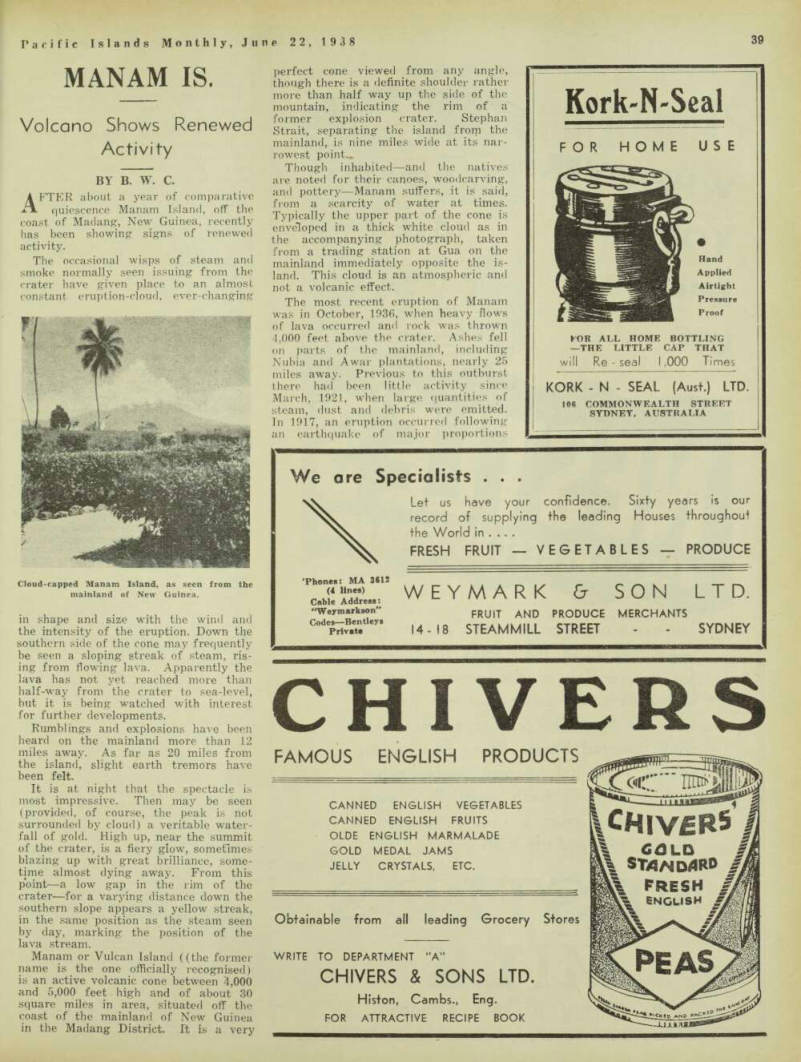
Volcano Shows Renewed Activity
By B. W. C.
A FTER about a year of comparative xX quiescence Manam Island, off the coast of Madang, New Guinea, recently has been showing signs of renewed activity.
The occasional wisps of steam and smoke normally seen issuing from the crater have given place to an almost constant eruption-cloud, ever-changing
in shape and size with the wind and the intensity of the eruption. Down the southern side of the cone may frequently be seen a sloping streak of steam, ris ing from flowing lava. Apparently the lava has not yet reached more than half-way from the crater to sea-level, but it is being watched with interest for further developments.
Rumblings and explosions have been heard on the mainland more than 12 miles away. As far as 20 miles from the island, slight earth tremors have been felt.
It is at night that the spectacle is most impressive. Then may be seen (provided, of course, the peak is not surrounded by cloud) a veritable water fall of gold. High up, near the summit of the crater, is a fiery glow, sometimes blazing up with great brilliance, some time almost dying away. From this point—a low gap in the rim of the crater —for a varying distance down the southern slope appears a yellow streak, in the same position as the steam seen by day, marking the position of the lava stream.
Manam or Vulcan Island ((the former name is the one officially recognised) is an active volcanic cone between 4,000 and 5,000 feet high and of about 30 square miles in area, situated off the coast of the mainland of New Guinea in the Madang District, ft is a very
perfect cone viewed from any angle, though there is a definite shoulder rather more than half way up the side of the mountain, indicating the rim of a former explosion crater. Stephan Strait, separating the island from the mainland, is nine miles wide at its nar rowest point.,.
Though inhabited—and the natives are noted for their canoes, woodcarving, and pottery—Manam suffers, it is said, from a scarcity of water at times.
Typically the upper part of the cone is enveloped in a thick white cloud as in the accompanying photograph, taken from a trading station at Gua on the mainland immediately opposite the is land. This cloud is an atmospheric and not a volcanic effect.
The most recent eruption of Manam was in October, 1936, when heavy flows of lava occurred and rock was thrown 4,000 feet above the crater. Ashes fell on parts of the mainland, including Nubia and A war plantations, nearly 25 miles away. Previous to this outburst there had been little activity since March, 1921, when large quantities of steam, dust and debris were emitted.
In 1917, an eruption occurred following an earthquake of major proportions
Cloud-capped Manam Island, as seen from the mainland of New Guinea.
locally, and blocks of rock were hurled thousands of feet into the air.
It was on August 11, 1919, however, that the most violent of recent eruptions took place. On this occasion greyish brown volcanic dust was blown as far as Marienberg, a Catholic mission sta tion on the Sepik River and 70 miles away. Red-hot lava poured down the mountain side and reached the sea, causing it to boil and send up thick clouds of vapour. At night it was pos sible, so it is reported, to read by the light of the reflection of the lava on the clouds at a distance of 10 miles from the volcano. Native gardens and houses were destroyed, and leaves had to be spread on the track for several days afterwards to protect the feet of the natives from the great heat of the fallen ash.
No wonder there are no plantations on Manam, although its soil is rich and fertile! Europeans prefer the quieter sister-island about 100 miles to the south-east—Karkar. There, at Karkar, situated on the thick dark volcanic soil, are some of the most prosperous plan tations of the district.
Advertisements & other items, pp. 41-42 (1 item)
Chi Vers
Kork-N-Seal
FOR HOME USE
Hand Applied Airtight Pressure Proof
KOR ALL HOME BOTTLING
—THE LITTLE CAP THAT
Re - seal 1,000 Times
KORK - N - SEAL (Aust.) LTD.
10(5 COMMONWEALTH STREET
SYDNEY, AUSTRALIA
a
CHI VERS
FAMOUS ENGLISH PRODUCTS
CANNED ENGLISH VEGETABLES
CANNED ENGLISH FRUITS
OLDE ENGLISH MARMALADE
GOLD MEDAL JAMS
JELLY CRYSTALS, ETC.
Obtainable from all leading Grocery Stores
WRITE TO DEPARTMENT "A"
CHIVERS & SONS LTD.
Histon, Cambs., Eng.
FOR ATTRACTIVE RECIPE BOOK
\CH1V£RS
CO S LD
FRESH
ENGLISH
PEAS
h m $ Ntp ■XU h
V/HEHEVER
YOU USE
kAOK
sweete ned con© J 18*
y NEST BRAND
«»g<J to* Harh ;;.
Condensed
SYDNEY
Si
CHtWtSt
For every occasion on which you use milk —whether it's for the kiddies, for cooking, for tea, coffee or cocoa —use Nestle's Milk—the safest and purest milk you can buy. Nestle's Milk is rich country milk taken from selected herds. Being hermetically sealed, it cannot become contaminated, and it remains fresh indefinitely while unopened. Order a regular supply of Nestle's Milk and use it always.
NESTLES
FULL CREAM
MILK
Its Quality is Your Safeguard
New Caledonia Is
Busy
Demand for Chrome and Nickel
A WELL-KNOWN business man, writing to tbe editor from Noumea on May 26. said that New Caledonia is busy and prosnerous. World arma ment has created a orreat demand for New Caledonia’s metals.
“The shipments of various ores— i.e.. Chrome and Nickel—are going on apace, and there are rumors that the Mine ‘Chairin’ mav be taken over by an Australian svndicate. It is also pos sible that the Nickel Company may ex tend, whilst the Japanese are most active in their efforts to develon the iron ore deposits. which are to be found all over the island.
“So far. Chrome Alluvials do not annear to have any material ready for shipment; it is to be hoped they will soon have their plant in full working: order.
“The Refrigerator Comnany anpears to he nearing its successful completion, and there appears to be ouite a definite feeling: that such is a real necessity here”.
"Tiarf Taporo " May Fly
The Tricolour
Prom Our Own Corresnondent.
Rarotonga, May 16.
the “Tiare Taporo” arrived from Tahiti rpcentlv. Cant,am Ben son relinauished bis command and returned to New Zealand hv tbe “Matua".
His niace has been taken by Canta.in Cambridee. who is well-known in N.Z. shinnine cireles. He was at on* time in command of the brivantine “Ysabel”.
It is rumoured that in about three months’ time th,e “Tiare” will return to Tahiti to make her headquarters there and sail under the French flag.
Highest Jobs For
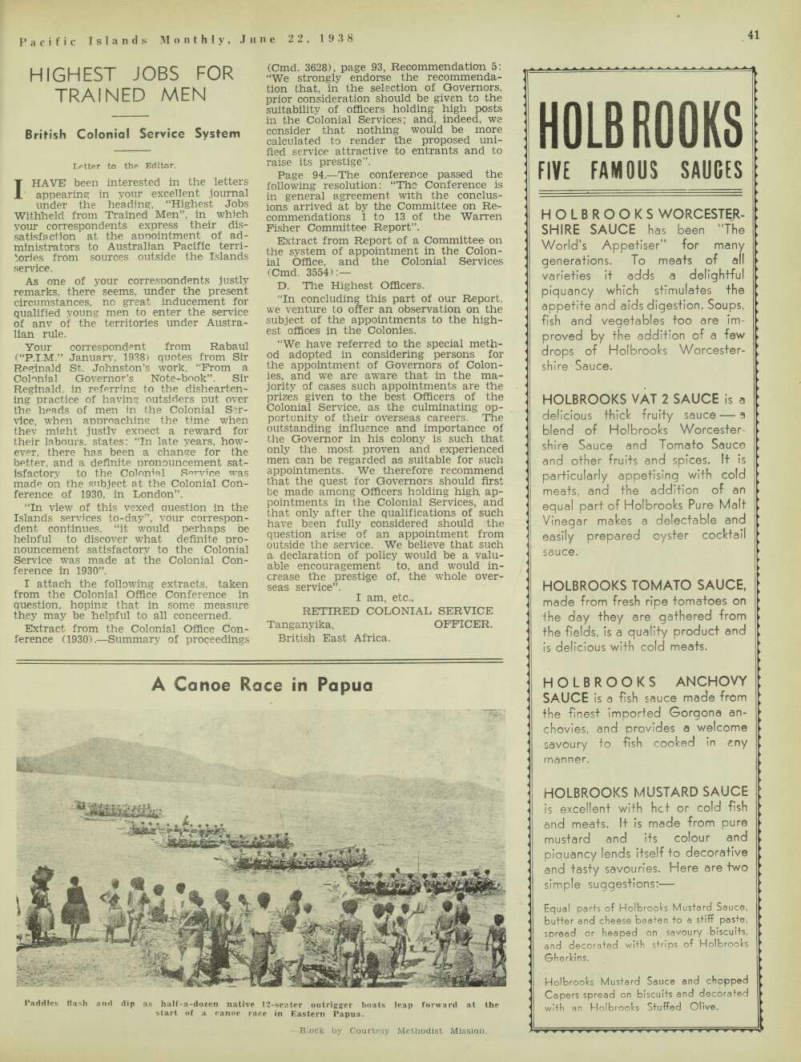
Trained Men
British Colonial Service System
Letter to the Editor.
I HAVE been interested in the letters appearing in your excellent journal under the heading, “Highest Jobs Withheld from Trained Men”, in which your correspondents express their dis satisfaction at the annointment of ad ministrators to Australian Pacific terri tories from sources outside the Islands service.
As one of your corresnondents justly remarks, there seems, under the present circumstances, no great inducement for qualified young men to enter the service of anv of the territories under Austra lian rule.
Your correspondent from Rabaul (“P.1.M.” Januarv, 1938) quotes from Sir Reginald St. Johnston’s work, “From a Colonial Governor’s Note-book”. Sir Reginald, in referring to the dishearten ing practice of having outsiders nut over the heads of men in the Colonial Ser vice, when annroaching the time when thev might justlv exnect a reward for their labours, states: “In late years, how ever, there has been a change for the better, and a definite nronouncement sat isfactory to the Colonial Service was made on the subject at the Colonial Con ference of 1930, in London”.
“In view of this vexed question in the Islands services to-day”, vour correspon dent continues, “it would perhaps be helnful to discover what definite pro nouncement satisfactory to the Colonial Service was made at the Colonial Con ference in 1930”.
I attach the following extracts, taken from the Colonial Office Conference in question, hoping that in some measure they may be helpful to all concerned.
Extract from the Colonial Office Con ference (1930). —Summary of proceedings
(Cmd. 3628), page 93, Recommendation 5: “We strongly endorse the recommenda tion that, in the selection of Governors, prior consideration should be given to the suitability of officers holding high posts in the Colonial Services; and, indeed, we consider that nothing would be more calculated to render the proposed uni fied service attractive to entrants and to raise its prestige”.
Page 94. —The conference passed the following resolution: “The Conference is in general agreement with the conclus ions arrived at by the Committee on Re commendations 1 to 13 of the Warren Fisher Committee Report”.
Extract from Report of a Committee on the system of appointment in the Colon ial Office, and the Colonial Services (Cmd. 3554): D. The Highest Officers.
“In concluding this part of our Report, we venture to offer an observation on the subject of the appointments to the high est offices in the Colonies.
“We have referred to the special meth od adopted in considering persons for the appointment of Governors of Colon ies, and we are aware that in the ma jority of cases such appointments are the prizes given to the best Officers of the Colonial Service, as the culminating op portunity of their overseas careers. The outstanding influence and importance of the Governor in his colony is such that only the most proven and experienced men can be regarded as suitable for such appointments. We therefore recommend that the quest for Governors should first be made among Officers holding high ap pointments in the Colonial Services, and that only after the qualifications of such have been fully considered should the question arise of an appointment from outside the service. We believe that such a declaration of policy would be a valu able encouragement to, and would in crease the prestige of, the whole over seas service”.
I am, etc.,
Retired Colonial Service
Tanganyika,
Officer.
British East Africa.
Advertisements & other items, p. 43 (2 items)
A Canoe Race in Papua
Paddles flash and dip as half-a-dozen native 12-seater outrigger boats leap forward at the start of a canoe race in Eastern Papua. -Block by Courtesy Methodist Mission.
Holbrooks
FIVE FAMOUS SAUCES
HOLBROOKS WORCESTER-
SHIRE SAUCE has been "The World's Appetiser" for many generations. To meats of all varieties it adds a delightful piquancy which stimulates the appetite and aids digestion. Soups, fish and vegetables too are improved by the addition of a few drops of Holbrooks Worcestershire Sauce.
HOLBROOKS VAT 2 SAUCE is a
delicious thick fruity sauce a blend of Holbrooks Worcestershire Sauce and Tomato Sauce and other fruits and spices. It is particularly appetising with cold meats, and the addition of an equal part of Holbrooks Pure Malt Vinegar makes a delectable and
easily prepared oyster cocktail
sauce.
HOLBROOKS TOMATO SAUCE,
made from fresh ripe tomatoes on
ihe day they are gathered from
the fields, is a quality product and is delicious with cold meats.
HOLBROOKS ANCHOVY
SAUCE is a fish sauce made from the finest imported Gorgona anchovies, and provides a welcome savoury to fish cooked in any manner.
HOLBROOKS MUSTARD SAUCE
is excellent with hct or cold fish and meats. It is made from pure mustard and its colour and piquancy lends Itself to decorative and tasty savouries. Here are two simple suggestions! — Equal parts of Holbrooks Mustard Sauce, butter and cheese beaten to a stiff paste, spread or heaped on savoury biscuits, and decorated with strips of Holbrooks Gherkins.
Holbrooks Mustard Sauce and chopped Capers spread on biscuits and decorated with an Holbrooks Stuffed Olive.
Beautifying Wau
From Our Own Correspondent WAU, May 17. mHE Administration engineering staff A at "Wau have been busy putting down footpaths around the business area of Wau. They have definitely made an improvement and, even though at the moment are looking very rough, are far superior to the 4 ft.-high grass that has
been growing unchecked on them until recently.
With care and attention to the couch grass which has been planted along the sides of the walk, Wau will have an ex cellent appearance. It seems a pity that some one does not start a tree planting scheme for our streets—anyone who saw the wonderful trees in Rabaul before the eruption can never forget them. Our cli mate, here in Wau, lends itself to many kinds of trees which could not be grown elsewhere in the Territory.
The Notorious
Arioi
History of a Strange Tahiti Organisation
From Our Own Correspondent.
Papeete, May 5.
THE swaying dance called “Te Ori”, and the ancient “Paoa” (a combined dance and chant)—witnessed at na tive celebrations of Bastile Day and other great occasions—are all that remain, in memory or in practice, of that gay, joy ous, boisterous, mysterious, formidable, wicked institution—the Arioi Society.
Externally, the Arioi were companies of comedians and dancers, established in several principal islands of the Society Archipelago, who travelled from district to district and. at stated times, from is land to island, to stage their exhibitions.
Internally, the Society was an hier archy; its higher grades composed of seers, and wise men, and persons of con sequence. whose doctrines were rooted deeply in the cult of Oro. and who, in their persons, because of their rank in the institution, were affiliated with the gods themselves.
In each principal district on the larger islands, the Society was under the rule of a Grand Master, who assumed the hereditary name of his predecessors in that office. Henry, in ‘Ancient Tahiti”, gives an interesting description of the or ganisation.
There were eight orders of those initi ated into the Arioi mysteries, and they were distinguished by dress and by tat tooing. The highest order, who presided over the rest—a man for the men and a woman for the women—were called Arioi Maro TJra (Arioi of the red loin girdle).
The red girdle worn by either sex was made of paper mulberry, and was dyed with red and yellow to resemble the royal feather girdle.
They anointed themselves with sweet oil and wore flowers and leaves of sweet odor.
The men of the second order. Haro tea, wore over their cloth girdle another girdle of shredded ti leaves. Over their wrappers the women of this order wore girdles of ti leaves, garlands and wreaths.
The third order, Taputu, wore shredded opuhi leaves, in the same manner as the Harotea wore ti leaves.
The fourth order, Otiore, used as their decoration a soft yellow creeper, Tainoa, instead of shredded leaves.
The fifth order. Hua, wore over their girdle another of the A’a Ha’ari (fibrous covering of the young coconut leaf) and head-dresses of yellow coconut leaves.
The sixth order, Atoro, decked them selves in bright yellow Pe’i leaves.
The seventh order, Ohe-Mara, had as decorations the Maiuu Tafai (club moss).
The eighth order, Tara-Tutu, wore bright flowers and a cap of red and yel low Barringtonia leaves.
Novices were called Poo (flappers).
In applying for membership the candi dates, who were always people unencum bered with children, were supposed to be inspired, and brought themselves to no tice in the midst of some public exposi tion by appearing in a frenzied state, ar rayed in gay colours, a profusion of frag rant flowers and anointed with strongly perfumed oil.
Then, and until the exhibition ended, they displayed their skill in dancing among th,e performers. If approved, they
went through the novices’ initiation, which was to pledge themselves not to suffer their offspring to live, if any came to them, and to obey absolutely the orders of their Arioi chief or chieftainess, as the case for man or woman might be.
Their novitiate lasted two or three years, or until they became accomplished in recitals of historic events, in music, dancing, and acting (chiefly in panto mime form).
When the novices were considered ac complished enough to be admitted into the Society, an assembly of Arioi was convened at the Marae of Oro for the purpose of receiving them.
The Poo were first privately invested with a loin girdle of white breadfruit tree bark, dyed with wide red bars, and with a fringed cape dyed to match the girdle. They were then solemnly dedi cated to Oro-i-Te-Tea-Moe, to whom was presented a sacred pig wrapped in Arioi cloth of bright colours.
Finally, after being anointed with per fumed oil in honour of Romatane (the god who received those destined to enter the Paradise, Rohutu-No’ano’a » upon whose stone image they placed garlands of flowers. They were led forth by their chiefs and chieftainesses and introduced to the assembly by new names, by which they were ever afterwards known to the Society.
The members of the various orders were gradually promoted to the higher grades, according to their merits, by the Society itself. But to the king was re served the right to bestow the highest, or order of the red girdle, when such a dig nitary was required in the community.
As to their exhibitions, there is a vari ety of opinion. Ellis, who apparently writes from hearsay, speaks of things which “were abominable, unutterable”.
Yet the Padres of the Spanish Expedi tion to Tahiti in 1775, who witnessed Arioi performances at the Court of the Arii, Vehiatua, at Tautira, record in their diary the following: “As a finish, after a noisy Heyba (Heiva) of drums, they act ed (on this occasion) a farce represent ing one of the heathen whose wife was jealous. The function lasted an hour and a half, and was very amusing, because the clown played his part with great clev erness. When, from time to time, the music of the drums was sounded, the ac tors, placed in a row and in that wise bending well forward towards the ground, kept time to the measure by swaying their bodies and limbs without moving from their places; all following the lead of the clowm, who was stationed in front of them. They are extraordinarily quick in their motions, and move the different parts of their bodies with wonderful agil ity and ease, throwing themselves into a variety of contortions and making frightfu grimaces the while.
“Women also take part in the dances and interludes, very modestly dressed.
They resemble Spanish women, and are not behind the men in agility of body”. (“Quest and Occupation of Tahiti—l 772- 1776—Corney”).
Immense houses were erected in every principal district for the accommodation of the Arioi assemblies. That at Matavai, on Tahiti, is described by Captain Wallis: “The house measured 327 feet long and 42 feet wide, 30 feet high along the cen tre, and 12 feet along the eaves”.
“The amusement generally took place at night, when the great Arioi house was illuminated with fires and candlenut tap ers. On a high platform, erected at one end of the house, were placed high stools as seats for the chief Arioi of both sexes.
In the centre of the building were the
comedians, over whom presided the Arloi- Hi’o-Niao (master of ceremonies).
“The royal family had their seats of honour, and within the building, and out side upon the grass, were the spectators.
Even the crickets, it is said, cried with joy on these occasions.
“In th,eir plays the actors flattered or ridiculed with impunity people and even priests, from the greatest to the least, and they often did much good in thus caus ing faults to be corrected”. (“Ancient Tahiti—Henry).
To those who know the deep affection with which Tahjtians regard their child ren —whether they be of their own blood or adopted, as is so generally the custom —it is wellnigh impossible to believe that infanticide was formerly practised in the islands.
Many years ago, Tati, chief of Papara —who was a learned scholar in Polynes ian lore told the writer that human sacrifice and infanticide did not exist in ancient Polynesia; but were initiated in comparatively recent times, by that later invasion of warrior Polynesians who im posed the bloodthirsty rites of the war god, Oro. upon the people of the con quered islands. This has been confirmed bv later research,.
The inexorable law of Arioi, requiring the slaughter of all children born to its
membership, sealed the fate of the So ciety when the enlightenment of Christ ianity released the minds of the people from th,e fear and terror of vengeance by the heathen gods.
The Society Islanders tore from mind and memory all trace of the Arioi con fraternity. The elders cast out the word and its significance from their language and to-day, among Tahitians, all know ledge of the Arioi Society has departed as completely as if the institution had never existed.
Advertisements & other items, pp. 44-46 (2 items)
painting
with
means 'm painting to STAY painted . %
Paint
w D) Creeps on JCeep m
(PRE PARE'd)
AGENTS THROUGHOUT THE ISLANDS.
Wunderlich
Timber, Joinery
ETC.
PREPARED BUILDINGS ready for erection a speciality.
SHIP AND BOAT BUILDING.
TIMBERS specially catered for.
FIBROLITE, PLYWOODS. GALVANISED
IRON.
CONSIGNMENTS shipped
by RETURN STEAMERS
to the Islands.
John W. Eaton
PTY. LTD.
WEST CRESCENT STREET
NORTH SYDNEY
TELEPHONES: X 5051 (5 lines)
BITUMENOID ROOFING
MADE IN AUSTRALIA
Bltumenoid Roofings, Dampcourse and Insulating Pelts are made from the world’s best raw materials. Warranted to stand the most rigid tests.
BITUMENOID THE BEST
Roofing, 1,2, 3-ply; Flooring, Waterproof Materials: Saturated Pelt; Resilient Road Jointing: Natural Asphalt Dampcourse; 2 and 3-ply Dampcourse; 1-2 lb. Lead-core Dampcourse: Roofing Cement: Asphalt Paints; Roofing Compound.
SAMPLES AND PRICE LISTS ON APPLICATION.
MAXWELL PORTER & SON LTD.
ESTABLISHED 1888. BUILDERS’ SUPPLIES.
107 REDFERN ST.. REDFERN, SYDNEY. N.S.W. Phone: M 3157. Cables Bitumenoid.
ff Obtain a copy before you build.
It contains designs and plans—in colour—of Homes that can be inexpensively built with
WUNDERLICH DURABESTOS,
the indestructible asbestos-cement building sheeting. Write to
WUNDERLICH LIMITED
G.P.0.. Box 474 aa. SYDNEY
FOR TROPICAL BUILDINGS, SPECIFY
WUNDERLICH
DURABESTOS
ASBESTOS CEMENT BUILDING SHEETS
Maleham & Yeomans
LIMITED
BOWDEN STREET, SHEFFIELD, CNS.
Manufacturers of all kinds of Butchers', Sticking and Sheath Knives Razors and Scissors Specialty Hairdresser Scissors
PRICE LIST ON APPLICATION
Ship Chandlery Hardware
[ Write for Ship Chandlery Catalogue y
BROOMFIELD'S LIMITED
152 SUSSEX STREET :: :: :: SYDNEY Cables "Boom," Sydney Special "In Bond" Prices Large and Complete Stocks of for all Islands enquiries SHIP CHANDLERY quoted on application, IRONMONGERY OF ALL KINDS, PAINTS,
WHITE LEAD AND OILS
Sole Agents for: P. H. MUNTZ & CO.'S 3-CROWN BRAND METAL SHEATHING.
PEACOCK & BUCHANS' ENGLISH READY - MIXED PAINTS.
II
USE
FOR RELIABILITY
AND LONG SERVICE
Manufactured by: Suva Agent*: Sydney Agent*:
MILLER'S "ANCHOR"
BRAND ROPES AND
CORDAGES.
Manila, Sisal, New Zealand Coir and Cotton Rope of every description.
Twine, Sewing Twine, Shop Twine, Binder Twine and Fishlines, Lashings, Halters, Plough Reins, Sack Cord, Blind Lines, etc.
LENGTH STRENGTH
QUALITY GUARANTEED
JAMES MILLER & Co. Pty. Ltd.
MELBOURNE. VIC., AUST.
A. S. FAREBROTHER & CO.
And at Lautolca, P.O. Box 36. Tel. 261
P. T. TAYLOR LTD.
Von Luckner In
Fiji
A Famous Incident of 1917
Count von Luckner has been re ceiving a good deal of hospitality and publicity in Australia lately; and, as his war exploits were of in terest to Fiji and French Oceania, it may be worth while to briefly re-tell the story of the “See Adler”.
The following is a summary of articles published recently in Sydney journals.
IT was in 1916 that Felix von Luckner, German naval officer, put out to sea in a camouflaged vessel named the “See Adler” to run the blockade of the Brit ish Fleet, reach the sea-tracks of trade, and raid commerce.
The story of Count von Luckner’s voyage down the Atlantic and into the Pacific has been told in a book by an American, Lowell Thomas; but it is so liberally embroidered by imagination as to be worthless as an historic document.
The “See Adler” sank many ships, but care was taken to preserve the lives of those aboard. These prisoners were either retained aboard the “See Adler”, or transferred to another ship, as oppor tunity offered. When the “See Adler” reached the Society Islands it still had on board the captain and crew of an American schooner, which the raider had bailed up on the high seas.
By that time Luckner had been out from Germany nearly nine months and his vessel needed cleaning. He made for lonely Mopiha Island, in the Tua-
motus, reached it in September, 1917, and cast anchor too near the reef. The captain of the American schooner warned von Luckner about the anchor age, but no notice was taken.
The “See Adler” remained at anchor until a gale came up, to show that the Yankee skipper’s advice had been sound. By then it was too late. The raider was a wreck, and Count von Luckner a castaway, with all hands.
Among the salvage was a motor-launch, “Cecile”, fitted with a modern diesel engine, capable of ten knots an hour, In this von Luckner, with Lieutenant Kerschiess and four of a crew, set out for the Fiji Group, due west, intending to capture a suitable vessel and use it as a raider in place of the “See Adler”.
Aboard the launch were a machine-gun, ammunition, and carbines, automatics, bombs and hand-grenades.
They broke their 2,600 miles journey at Rarotonga, but could see no ship there likely to interest them. They were weather-beaten, and suffering from scurvy, but they carried on grimly.
They reached the Fijis early in 1917, and, owing to squally weather, decided to shelter at Wakaya Island, about 12 miles due east of Levuka. There they went ashore to reconnoitre, pretending they were a week-ending party from a Norwegian ship in Suva.
A recent photograph of Captain Kini McPherson.
A small cutter entered the harbour soon after, also for shelter. It belonged to Captain Kini McPherson, a half-caste, who, after conversation with the strangers, decided that they needed in vestigation. When he announced his intention of leaving Wakaya they tried to prevent him, but he pretended he had to get back to his plantation, round the coast, and they then let him go.
Captain McPherson sailed out on the course he had stated, but as soon as he was out of observation he went about and made for Levuka, where he reported to Sub-Inspector H. C. Hills, of the Fijian constabulary.
Hills had started life 33 years earlier in Britain, and in due time had been variously an officer in the P. and 0. ser vice, ranger in Canadian foothills, police officer in Natal, explorer in Portuguese East Africa, customs officer in New Zea land, and finally, on being ordered to the tropics by his doctor, he had taken the job of constabulary officer in Fiji.
Clearly he was reasonably equipped for dealing with a situation such as Captain Kini McPherson placed before him, provided he had the necessary temperament. Courage was needed, initiative, coolness, and a commanding manner.
Firearms, and possibly an armed guard, might have been considered an essential. Hills telephoned to Suva, the Administrative headquarters, was for bidden to arm his native police, and was given permission to take his ser
vice pistol only at his own risk. He set out in the cutter “Sunbeam”, and had to return owing to rough weather.
Meanwhile, the “Amra”, a small cattle-boat trading about the group, had steamed into Levuka. Sub-Inspector Hills got permission from Suva to use this instead of the cutter, and again set opt for Wakaya.
As soon as the “Amra” rounded the point leading into the bay at Wakaya, a boat was lowered. The strange motor launch' was already under way and heading for the open sea and for the “Gleaner A”, an auxiliary schooner which was just entering the bay. It would have been a useful and easy cap ture for von Luckner.
The boat from the “Amra” containing Hills, A. E. S. Howard, and a few Fijian policemen, pulled strongly on a con verging route, came closer to the motor launch, and Sub-Inspector Hills ordered it to stop.
The launch stopped, and the police boat ran alongside. Hills heard them speaking German to each other—a lan guage he recognised instantly. With his hand on his holster, which contained an empty revolver, he commanded: “You are all prisoners. You will surrendei as prisoners of war”.
One of the Germans instantly re plied: “I am Lieutenant Kerschiess, second in command of ‘See Adler’. I surrender”.
Two of the native police then jumped aboard the “Cecile” and clambered to
ward a German who was aft, while Hills commanded him to surrender. He replied: “My name is Count von Luck ner, commander of the ‘See Adler’. I surrender”.
Three of his crew then surrendered.
But there was another, the engineer, who still hesitated, defiantly. Hills ordered a Fijian policeman to leap aboard the •“Cecile” and arrest him. Von Luckner spoke urgently to him and he* sur rendered.
Von Luckner since has pointed out that the Englishmen were in uniform, while his party were in civilian clothes.
According to his code, if they had shot at uniformed linen, they could have been charged with murder, and the tak ing of life, in any event, was the one thing they were determined to avoid.
As they rowed toward the “Amra” von Luckner asked Hills if he were a naval officer, and when he learned he had been captured by a mere policeman he became almost as explosive as one of his own bombs, but with suppressed anger.
But when they got aboard the “Amra” and discovered that she had no guns, no arms of any sort, and only five bags of coal so that chase would have been impossible, the suppressed emotions of the Teutonic raiders ran through in credulity, chagrin, indignation, and finally burst into wrath. They had be lieved that the cattle-pens prominent on the “Amra’s” deck were camouflaged guns!
Copra exported from New Guinea In May was declared for Customs purposes to have an assessed value of £B/5/- per ton.
Advertisements & other items, pp. 47-48 (1 item)
W. KOPSEN & Co. Pty. Ltd.
TILLEY LAMPS
BURN KEROSENE
with a light of 300 c.p.
Storm Proof, Insect Proof and Fool Proof. British made. New type mantle which is supported top and bottom, and will not shake off. Made of brass and will not corrode. There are 11 different models of Lamps suitable for every purpose.
Complete range of Lamps and Spare Parts available.
Send for Catalogue.
SHIPCHANDLERS AND HARDWARE MERCHANTS
We have large and complete stocks of Shipchandlery and Mining Gear. Boat fittings of all descriptions manufactured in our own marine foundry.
We are manufacturers of the well known "Pioneer” brand Ash Oars and Tool Handles.
Write for free catalogue of any line which may interest you.
AGENTS OR DISTRIBUTORS FOR ... .
SKARSTEN MANUFACTURING CO.
SKARSTEN SCRAPERS
AKTIEBOLAGET PENTAVERKEN
PENTA MARINE ENGINES
TILLEY LAMP CO.
TILLEY LAMPS
COLTHURST & HARDING LTD.
PAINTS. OILS AND VARNISHES
R. HAYWARD & CO. LTD.
HAYWARD’S CANVAS
A. JEFFREY & CO.
JEFFREY’S SEAMFLEX AND GLUES
KOCKUMS
TYFON WHISTLES FOR AIR. Etc.
PENTA MARINE ENGINES
e
3-100 Horsepower, 1-6 Cylinders
FOR KEROSENE, PETROL OR HEAVY OIL
PENTA have just produced a modern 4 and a modern 6 both with electric starter, generator, etc., and dashboard.
These models are particularly robust and compact and are a real marine job.
PENTA ENGINES are precision built, and will last the life of the boat.
Write for catalogue of all models and special export prices.
Cables: "Kopsen." Sydney, 7Q CLARENCE STREET SYDNEY Phone :BW 1114 (3 lines)
FLUSH OUT
15 MILES OF
KIDNEY TUBES
Win Back Pep . . . Vigor . . . Vim Medical authorities agree that your kidneys contain 15 MILES of tiny tubes or filters which help to purify the blood and keep you healthy.
If you have trouble with too frequent bladder passages with scanty amount causing burning and discomfort, the 15 MILES of kidney tubes need flushing out. This danger signal may be the beginning of nagging backaches, leg pains, loss of pep and energy, getting up nights, lumbago, swollen feet and ankles, puffiness under the eyes, rheumatic pains and dizziness.
If kidneys don’t empty 3 pints a day and get rid of more than 3 pounds of waste matter, your body will take up these poisons causing serious trouble. Don’t wait. Ask your chemist for DOAN’S BACKACHE KID- NEY PILLS . . . used successfully the world over by millions of people. They give quick relief and will help to flush out the 15 MILES of kidney tubes. Get DOAN’S BACKACHE KIDNEY PILLS at your chemist.
Woven Wire for all Industry \
COPRA DRYING TRAYS. FLOORS, Etc.
FRUIT DRYING TRAYS. MINING SCREENS
Heavy Mosquito Gauze in Phosphor Bronze and other Metals Impervious to Salt Sea Air WIRE DOOR MATS AND GENERAL WIRE WORKS
E. WRIGHT & CO. LTD.
Office and Work*: 148-162 Cleveland Street. Sydney, N.S.W.
Telegraphic Address: “ Wrightmake,” Chippendale f, 3r £ |SV^
Over Thirty Years Ago
The first Younger Stove was exported to the Pacific Islands. Ruggedly strong in construction, highly efficient and economical in fuel, has made them the most popular stove in the South Seas.
The Illustration shows a Younger Single Stove. Special stoves, with cast Iron ovens for Island requirements made to order.
Writ© us for quotations for special sizes and catalogue of double and single oven stoves. •
G. Fletcher & Son
50 OXFORD STREET, SYDNEY
r
A Mystery Of The Tuamotus
Whence Came the Wooden Cross on Anaa?
From Our Own Correspondent.
Papeete, May 21.
THE island of Anaa (or Chain Island) —the first atoll of the Tuamotu Archipelago encountered when sailing east from Tahiti—has an interesting history.
The substance of that history, in con densed form, is found in the Journal of Senior Lieutenant Don Thomas Gayan gos, of the frigate “Santa Maria Magda lena” (alias “Aguila”), commanded by Captain Don Domingo Boenechea, and in the comprehensive footnote by the translator, Doctor Bolton Glanvill Cor ney.
“On the 2nd of November (1774) at 8| in the morning we sighted the isle of San Quintin (Haraki) right ahead, 5 leagues distant; and we passed to the nor’ard of it, one league off. We pro ceeded on our course at six o’clock in’ the afternoon under easy sail in order that, when day should break, we might be to windward of the island to Todos
Santos (Anaa), which, in fact, was sighted away to the south’ard and west’ard at about ten o’clock in the forenoon. We thereupon stood towards it until near enough to conveniently send in’a boat as enjoined by our in structions; but we -were not then able to do this, as the weather had set in squally during the day. Having cleared up, however, the boat was got into the water, armed, and placed under my orders.
“When we had got within about a boat’s length of the reef that fringes it all around, more than a hundred or a hundred and fifty Indians came for ward, armed with spears and slings, ranged closely together and droning a sort of chant, as if a prayer, and made signs to us to land. Not being' able to do so, however, because of the heavy surf that was breaking on the reef, I directed the Indian Pautu, after he had made them some signs of recognition, to jump into the water and get into communication with them, so as to ex plain to them who we were; but scarcely had he set about this, when they attacked us with a volley of stones from their slings, and we were compelled to discharge some muskets into the air to secure our retreat ...
“1 then proceeded farther on, coast ing along the island ...
“Just then we caught sight of a wooden cross, standing on a sandy beach on the inner side of the reef, near the skirt of a wood. It was of moderate size, regular in all its propor tions, and showed signs of having been erected there a long time ago”.
The footnote by Doctor Corney fol lows: — “A particular interest attaches to this passage about a cross, in relation to the one that was erected by the mem bers of Quiros’ expedition on the 11th of February, 1606, at the island they named La Conversion de San Pablo, identified by Sir Clements Markham and the late Admiral Sir William Whar ton as this very atoll of Anaa. In ‘The Voyages of Pedro Fernandez de Quiros (Hakluyt Society, Second Series, vols.
XIV and XV)’ Gonzalez de Leza says that it was ‘a very high well-made cross’.
“Belmonte Bermudez says the spot was in a ‘palm grove’ (adjoining a Marae); and Torquemada observes that the landing party ‘arrived at a place which was near the beach, and on the verge of a small clump of palms and other trees’, that they ‘entered the thick wood, some of our people cutting away the branches with their swords until they came near the other bay of still water (the lagoon) which is on the other side of the island’ and that on finding the Marae ‘they desired to plant the royal insignia where the dweller in darkness was worshipped ... so with
Christian fervour they began to cut down a tree with wood-knives, of which they formed a cross, and set it up in the place with great joy’, etc.
“The analogy of these records with the story related by Gayangos is too striking to be passed over without criti cism; yet it is scarcely conceivable that a cross, constructed on the spur of the moment out of green timber, with only wood-cutters’ knives (and perhaps cut lasses) for tools, without copper nails, presumably, or augurs for boring tre nail holes, should survive the ravages of time and cyclones for 168 years— even supposing that the natives, the sanctity of whose Marae was thus flouted, did not interfere with it ... .
“On the whole, I am not disposed to believe that the cross Gayangos stumbled upon so opportunely at the only spot he touched at on the whole island, in 1774, was the same that Quiros’ men set up in 1606; but, if the former was really a cross, designed as such and made by hands, the questions naturally arise ‘Who put it there? When? And with what object?’
“The only records we have of Anaa, after Quiros’ discovery of it, but prior to this visit, are Captain Cook’s, who sighted it, without communicating, in April 1769, and again in August, 1773; and Boenechea’s, who coasted along the S. and W. sides of it without effecting any landing, in 1772.
“Tupaia, however, alleged that a white man’s ship had once been wrecked there (Bibl. No. 41, p. 517 —John Rein hold Forster).
“This question must therefore, it would seem, remain one of the many mysteries of the Pacific—like ‘the half of a cedar pole, which had been worked on the coast of Nicaragua or Peru’ that Gonzalez de Leza says they found at the same island on the day when they set up their cross; and the ‘gold ring with an emerald’ that Belmonte Ber mudez saw the old Anaa ‘woman who appeared to be a hundred years of age’ wearing ‘on one of her fingers’ but who ‘did not care for one of brass that they offered her’ in exchange”. (From Bibl.
No. 41—Observations made during a Voyage Round the World, of Physical Geography, Natural History and Ethic Philosophy, by John Reinhold Forster, L.L.D., F.R.S., London, 1778.)
Grapefruit From Samoa
Prom Our Own Correspondent.
Apia, May 12.
EXPERIMENTS are being made in the cultivation of grapefruit and the op ening of a market for it in New Zea land. Citrus fruits thrive in Samoa.
Mr. A. R. Cobcroft recently sent a trial shipment to N.Z., and if it is successful it will be followed by consignments from other planters. The New Zealand Re paration Estates have a considerable area under citrus fruits.
A shipment of 10 pure-bred Zebu bulls and 40 heifers recently arrived in Fiji from Texas, U.S.A., for the Colonial Sugar Refining Co. Ltd.
Farewell Evening To Cook
Islands Chieftain
NEARLY 200 guests, including Raro tongans, Samoans, Tongans, Maoris, and Europeans, attended a social evening at Symondsville, New Zealand, on May 17 to bid farewell to Makea Tini rau, paramount chief of the Cook Islands, prior to his departure by the “Matua” for Avarua, after a two months’ health visit to the Dominion. In the official party was Judge H. F. Ayson, formerly Resident Commissioner in the Cook Is. were various musical and dance
items by Islands performers, including a song of welcome (Ono Mai ra e taku Ariki) by Rarotongans in native costume.
The guest of honour, in a speech inter preted by Mr. Tiakana Potatai, said he would like to see the Rarotongans in New Zealand co-operate and form a Polynesian Club in Auckland, to welcome and assist any native who comes from the South Seas.
The Administration of New Guinea recently let a contract for the erection and completion of an administrative of fice and bungalow at Buin, Bougain ville, to Ah Ying. The amount was £1,275.
Advertisements & other items, p. 49 (1 item)
Fibrolite
SPECIFY
STARLINE
BRAND
"5t
STARLINE
CHINESE LACQUER
For all Indoor and Outdoor Decoration
1/- fin covers 18 sq. feet
"STARLINE" CHINESE LACQUER : Is guaranteed to withstand the severe elements to which paint is subjected In the Tropics, including Salt Water, Heat and Rain, etc., and will not lose its gloss or permanence.
To give some idea of the covering capacity, one gallon will cover over 1200 sq. ft. 42 colours to choose from . . . Dries in a few hours.
Won’t chip or crack.
MADE IN ENGLAND
Write to us for Colour Chart and full particulars regarding attractive sole agency for territories still vacant. f For Rf. Tonga and Samoa, Messrs. MORRIS HEDSTROM LTD.
AGENTS: j, p or j anc j Coolc Islands, Messrs. A. B. DONALD LTD.
Factory Representative for all Islands and New Zealand : NEW ZEALAND DISTRIBUTORS LTD., Box 530, AUCKLAND, N.Z.
BUILD WITH
Fibrolite
ASBESTOS CEMENT SHEETS
By using this Economical, Fire Retardant and White Ant Proof building material for External and Internal Walls and Ceilings, you can build a comfortable and durable Bungalow Home—AT LOW COSTI Supplied in big, sturdy building sheets in 44 handy stock sizes. "FIBROLITE" is easily and quickly erected. No waste.
Less labour. No painting.
For full information, write for illustrated "Fibrolite" Booklet F.6—FREE AND POST FREE!
JAMES HARDIE &COY. LTD.
ASBESTOS HOUSE, YORK ST., SYDNEY, N.S.W.
(Box 3935 V., G.P.0., Sydney)
Islands Missionaries For
Madras Conference
A WORLD meeting of the Interna tional Missionary Council is to be held this year at Madras, India, from December 13 to 20. Among the mis sionaries in the Pacific Islands who have been nominated to represent the South Seas are: Rev. W. Flierl, Lutheran Mis sion, New Guinea; Rev. H. J. E. Short, London Missionary Society, Papua; Mr.
Wilson Inia, Methodist Mission, Fiji; Pastor Jupeli, Gilbert Islands.
Mr. Charles Arthur Banks, managing director of Placer Development Ltd., has received the gold medal of the Mining and Metallurgical Society of America for “the application of aerial transpor tation to development in i emote mining regions”. This refers to the Mandated Territory of New Guinea.
Clipperton
Desolate Island Has Strategic Value
A READER asked recently if anyone knew anything about Clipperton Is land. Mr. P. J. D. Milne, of East Cam berwell, Melbourne, kindly has for warded the following, which is a clipping from the “News Chronicle”, London, of November 7, 1932: “Mexico City, Wednesday.—A deso late coral island in the Pacific, 670 miles from the coast of Mexico, and only two miles in circumference, may raise a fine point regarding the inter pretation of the Monroe Doctrine.
“Clipperton Island was discovered by Spanish sailors, annexed later by France, and seized by a Mexican garri son in 1897. It is destitute of vegeta tion, and its only inhabitants are Mexi
can soldiers. Yet both France and Mexico coveted its possession. Trouble was avoided by arbitration. The ques tion was submitted to King Victor Em manuel of Italy, who in February, 1930, gave his verdict. The island was to be handed over to France.
“Now, nearly two years later, Mexico is about to make preparations for the surrender of her ‘colonial possession’.
Senor Antonio Valadex Ramirez, Presi dent of the Mexican Senate’s Foreign Affairs Committee, says it will go on record that Mexico is not recognising the Monroe Doctrine, when the Senate discusses the fate of Clipperton Island”.
The Monroe Doctrine, announced by President Monroe in his message to the United States Congress on December 2, 1823, had as its principle to prevent European interference or future colon isation in America.
Clipperton Island received its name from a notorious English pirate, John Clipperton, who often sought refuge there.
John Clipperton, in 1704, was mate to a well-known buccaneer, William Dampier. • The pair quarrelled in the Gulf of Nicoya, and Clipperton, with 21 mutineers, seized a barque and sailed away on new adventures. They roamed the Pacific and were accumstomed to find sanctuary on the little island off the Mexican coast.
The construction of the Panama Canal has given the island some strategic im portance, lying as it does near tfie route from Central America to China and Japan.
Rev. E. R. Fenn, of the London Mis sionary Society, Metoreia, Papua, has been transferred to Aird Hill to take charge of the mission station there in place of Rev. C. Steley, who has re turned to Australia owing to the ill health of his wife.
Miss Peggy Brew, of Vaucluse, sailed from Sydney by the “Macdhui” on June 1 for New Guinea, where she was to be married to Mr. Robert Gillespie, of Ka vieng. Misses Helen Gillespie and Jean ette Menzies accompanied her to act as bridesmaids at the wedding.
Advertisements & other items, pp. 50-51 (2 items)
Burns Philp
(SOUTH SEA) CO. LTD.
Inc. in Fiji SUVA Island Traders and Shipowners Also Branches at: x Code Address: "Burnsouth."
Fiji: Levuka, Lautoka, Labasa, Ba, Sigatoka, Rofuma.
Tonga: Nukualofa, Haapai, Vavau.
Samoa: Apia, Pago Pago (American Samoa).
Solomons: Makambo, Gizo, Faisi.
New Hebrides: Vila.
Gilberts: Tarawa.
Norfolk Is. Niue. Wallis Is. Futuna Is.
ss ■ ‘3
JAMES BUDGE LTD
REFRIGERATION . ..
BUDGE" Automatic or Manually-controlled Refrigeration and Ice-making Plants, with or without insulated Cabinets or Rooms, ranging from 4 cubic feet to 1000 cubic feet or larger, using ammonia in the large and sulphur dioxide (SO2) in the small units.
Where electricity is not available, crude oil engines may be utilised for driving the larger plants and petrol engines for driving the smaller machines. The accompanying illustration is of a petrol engine driven SO2 unit. Enquirers please state power available (if any), size of cabinet and amount of ice required per day.
JAMES BUDGE LIMITED
REFRIGERATION AND GENERAL ENGINEERS
McEvoy and Harley Streets
ALEXANDRIA SYDNEY
Established 1890
ENGINEERING WORKSHOPS
ALL CLASSES OF MACHINES MADE AND RECONDITIONED
Anzac Day In Cook Islands
The decorated War Memorial at Rarotonga, Cook Islands, on Anzac Day, April 25.
Native Labour And
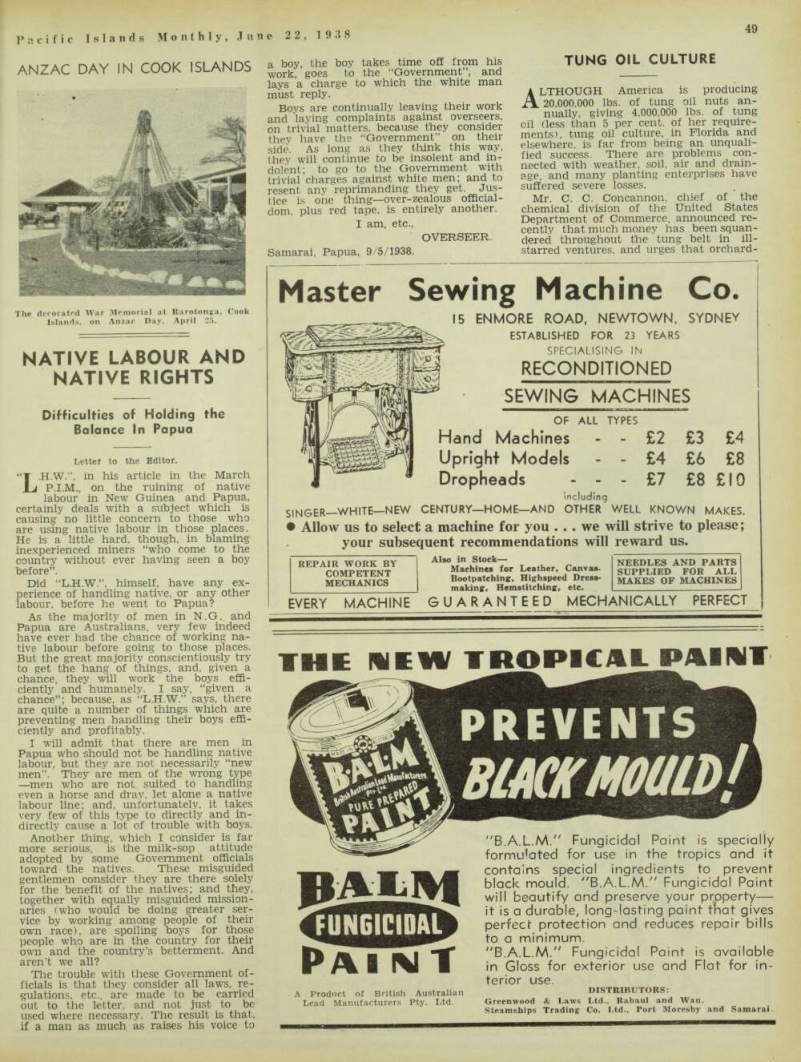
Native Rights
Difficulties of Holding the Balance In Papua
Letter to the Editor.
“T H.W.”, in his article in the March 1 1 P.1.M., on the ruining of native labour in New Guinea and Papua, certainly deals with a subject which is causing no little concern to those who are using native labour in those places.
He is a little hard, though, in blaming inexperienced miners “who come to the country without ever having seen a boy before”.
Did “L.H.W.”, himself, have any ex perience of handling native, or any other labour, before he went to Papua?
As the majority of men in N.G. and Papua are Australians, very few indeed have ever had the chance of working na tive labour before going to those places.
But the great majority conscientiously try to get the hang of things, and, given a chance, they will work the boys effi ciently and humanely. I say, “given a chance”; because, as “L.H.W.” says, there are quite a number of things which are preventing men handling their boys effi ciently and profitably.
I will admit that there are men in Papua who should not be handling native labour, but they are not necessarily “new men”. They are men of the wrong type —men who are not suited to handling even a horse and dray, let alone a native labour line; and, unfortunately, it takes very few of this type to directly and in directly cause a lot of trouble with boys.
Another thing, which I consider is far more serious, is the milk-sop attitude adopted by some Government officials toward the natives. These misguided gentlemen consider they are there solely for the benefit of the natives; and they, together with equally misguided mission aries (who would be doing greater ser vice by working among people of their own race), are spoiling boys for those people who are in the country for their own and the country’s betterment. And aren’t we all?
The trouble with these Government of ficials is that they consider all laws, re gulations, etc., are made to be carried out to the letter, and not just to be used where necessary. The result is that, if a man as much as raises his voice to
a boy, the boy takes time off from his work, goes to the “Government”, and lays a charge to which the white man must reply.
Boys are continually leaving their work and laying complaints against overseers, on trivial matters, because they consider they have the “Government” on their side. As long as they think this way, thev will continue to be insolent and in dolent; to go to the Government with trivial charges against white men; and to resent any reprimanding they get. Jus tice is one thing—over-zealous official dom, plus red tape, is entirely another.
I am, etc.,
Overseer.
Samarai, Papua, 9/5/1938.
Advertisements & other items, pp. 51-52 (2 items)
A of tu^ 8 0 t^g
TUNG OIL CULTURE
ALTHOUGH America is producing
snercent of her Require? oiL (less than 5 per cent, or ner require ments), tung oil culture, in .fioriaa ana elsewhere, is far from being an unquali fied success. There are problems con nected with weather, soil, air and dram age, and many planting enterprises have suffered severe losses. .
Mr. C. C. Concannon, chief of the chemical division of the United States Department of Commerce, announced re cently that much money has been squan dered throughout the tung belt in ill starred ventures, and urges that orchard
ists and prospective investors inform themselves thoroughly concerning the prospects for profits before investing time and money in tung groves. Acreage con tinues to be planted in places not suited to tung trees, according to present accepted ideas, and all too frequently groves which might otherwise thrive, fail from lack of care, according to the Commerce Depart ment specialist. He pointed out that the fundamental requirements of climate and soil are now generally known, and that increasing attention is being given to the problem with the view to safeguarding future developments.
Dr. W. M. Strong, Chief Medical Officer in Papua, is at present on 12 months’ leave.
Mrs. Donovan, wife of Mr. John Dono van, manager for Messrs. Burns Philp (S.S.) Co., Ltd., at Tarawa in the Gilbert and Ellice Group, is in Australia spend ing a year’s holiday.
Balm
Master Sewing Machine Co.
■o
15 ENMORE ROAD, NEWTOWN, SYDNEY
ESTABLISHED FOR 23 YEARS
SPECIALISING IN
RECONDITIONED
SEWING MACHINES
OF ALL TYPES
Hand Machines
Upright Models
Dropheads
£2 £4 £7 £3 £4 £6 £8 £8 £lO including
OTHER WELL
SIN GER WHITE —NEW CENTURY—HOME—AND OTHER WELL KNOWN MAKES. • Allow us to select a machine for you ... we will strive to please; your subsequent recommendations will reward us.
REPAIR WORK BY
COMPETENT
MECHANICS
Y MACHINE
Also in Stock— Machines for Leather, Canvas- Bootpatching. Highspeed Dressmaking, Hemstitching, etc.
GUARANTEED MECHANICALLY
NEEDLES AND PARTS
SUPPLIED FOR ALL
MAKES OF MACHINES
PERFECT
THE NEW TROPICAL PAINT
BALM
FUNGICIDAL
PaiimT
A Product of British Australian Lead Manufacturers Pty. Ltd.
"8.A.L.M." Fungicidal Paint is specially formulated for use in the tropics and it contains special ingredients to prevent black mould. "8.A.L.M." Fungicidal Paint will beautify and preserve your property— it is a durable, long-lasting paint that gives perfect protection and reduces repair bills to a minimum.
"8.A.L.M." Fungicidal Paint is available in Gloss for exterior use and Flat for interior use.
DISTRIBUTORS:
Greenwood & Laws Ltd., Rabaul and Wan.
Steamships Trading Co. Ltd., Port Moresby and Samarai
READ THE
B.P. MAGAZINE
WINTER NUMBER
On Sale Ist. June Short Stories Pictures Travel Articles Pages for the Children Stage Latest Fashions Screen A
ONE SHILLING PER COPY
ON SALE AT ALL NEWSAGENTS AND BOOKSELLERS BP
PRODUCING UNIFORM GOOD RESULTS SINCE 1868
ALWAYS ASK FOR IT
Solomon Islands
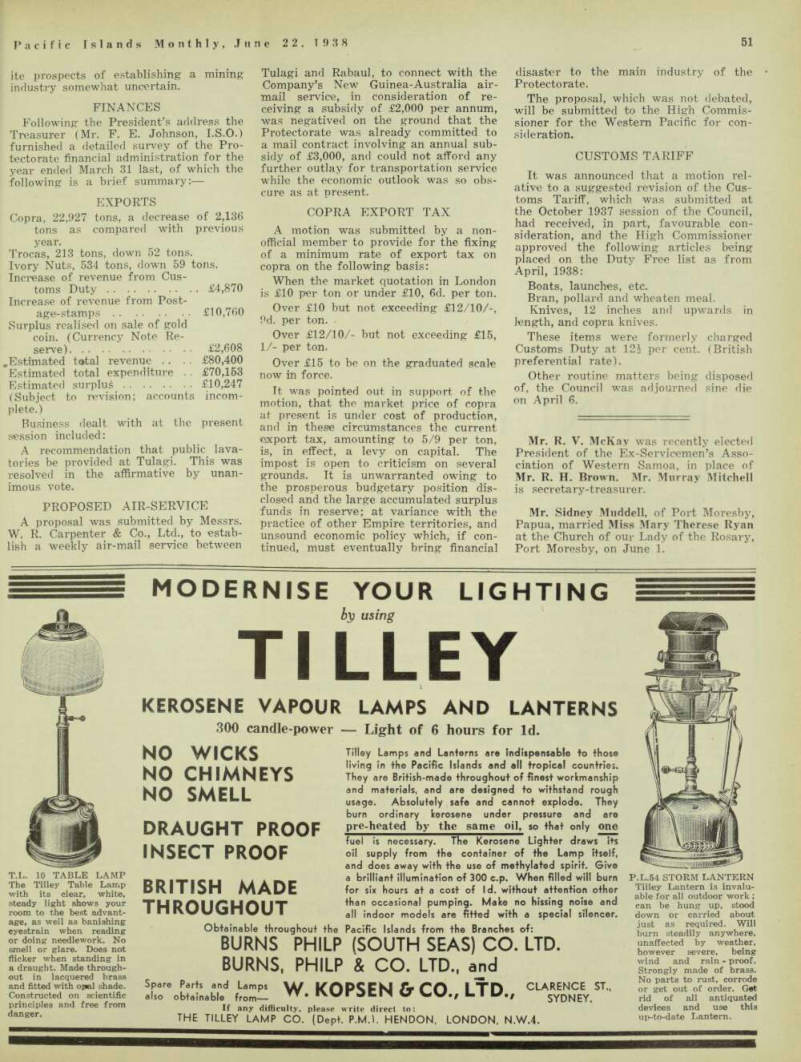
Council
Wide Range of Subjects
fpHE Solomon Islands Protectorate Advisory Council commenced its first session of the year at Tulagi on Monday, April 4.
The Resident Commissioner (Mr. F.
N. Ashley, C.M.G.) presided, and mem bers present were, Official: Mr. F. E.
Johnson, 1.5.0. (Treasurer and Col lector of Customs); Mr. S. G. C. Knibbs (Commissioner of Lands); Dr. H. B.
Hetherington (Senior Medical Officer).
Non-official: Mr. D. Mackinnon, Right Rev. W. H. Baddeley (Bishop of Mel anesia), Mr. J. C. M. Scott. The fourth non-official member, Mr. C. E Hart, was unable to take his seat owing to
an injured knee, but his colleagues were in daily conference with him at the Government Hospital, where he was be ing treated, and he was permitted to submit a motion through a fellow member in council.
The President, in a comprehensive and informative address, referred to the fall in prices of copra and other ex portable products, the result of which, he said, would affect the public revenue.
Leprosy
His Honour dealt at some length with the incidence of leprosy in the Protect orate, and gave particulars obtained re cently as a result of the reconnaissance survey carried out by the visiting Lepro logist, Dr. J. Ross Innes. The total number of natives examined by Dr. Ross Tnnes was 21.615, of whom 221 (1.02 per cent.) were found to be afflicted with leprosy.
Taking the Protectorate as a whole, the number of lepers is estimated at 000.
Expert opinion is that the total inci dence of leprosy in the Solomons is moderate; that there exists no present danger of an explosive outbreak, and that about half of all cases may be taken as infectious, with perhaps one quarter curable.
Phenomenal Sale Of Stamps
The phenomenal demand for the Cor onation commemorative postage-stamps brought the Protectorate an unexpect edly large financial windfall. Although the issue was restricted to three de nominations costing SH. for the set, the total sales from May until the issue was withdrawn on December 31, 1937, amounted to nearly £12,000.
A new pictorial issue, consisting of twelve denominations, to take the place of all stamps at present in use, will, it is expected, be on sale towards the end of this year.
Radio-Telephones
The process of linking up Government out-stations by wireless is progressing, if slowly. Radio-telephonic communi cation between Tulagi and Auki (Mal aita) is functioning satisfactorily, and has proved both the efficiency of the sets employed and the advantages con ferred by an inter-island wireless service.
The next installation will be made at Gizo, within a few months.
The cost of the three beacon-lights, with towers and bases, erected in Tulagi harbour, amounted to £2,567.
Solomons Goldfield
The goldfields on Guadalcanal, His Honour said, “have not proved, so far, the wedge of Ophir that we all hoped.”
The present position, he added, is that a company called the Guadalcanal Sluicing and Dredging Co., Ltd., has been floated with a capital of £200,000, and is carry ing out prospecting in the river flats.
Other prospecting licenses have been issued, and a new find of gold is re ported, but many difficulties and obstruc tions encountered appear to leave defin
ite prospects of establishing a mining industry somewhat uncertain.
Finances
Following the President’s address the Treasurer (Mr. F. E. Johnson, 1.5.0.) furnished a detailed survey of the Pro tectorate financial administration for the year ended March 31 l&st, of which the following is a brief summary:—
Exports
Copra, 22,927 tons, a decrease of 2,136 tons as compared with previous year.
Trocas, 213 tons, down 52 tons.
Ivory Nuts, 534 tons, down 59 tons.
Increase of revenue from Cus toms Duty £4,870 Increase of revenue from Post ageustamps £10,760 Surplus realised on sale of gold coin. (Currency Note Re serve) £2,608 .Estimated total revenue .. £80,400 Estimated total expenditure £70,153 Estimated surplus £10,247 (Subject to revision; accounts incom plete.) Business dealt with at the present session included: A recommendation that public lava tories be provided at Tulagi. This was resolved in the affirmative by unan imous vote.
Proposed Air-Service
A proposal was submitted by Messrs.
W. R. Carpenter & Co., Ltd., to estab lish a weekly air-mail service between
Tulagi and Rabaul, to connect with the Company’s New Guinea-Australia air mail service, in consideration of re ceiving a subsidy of £2,000 per annum, was negatived on the ground that the Protectorate was already committed to a mail contract involving an annual sub sidy of £3,000, and could not afford any further outlay for transportation service while the economic outlook was so obs cure as at present.
Copra Export Tax
A motion was submitted by a non official member to provide for the fixing of a minimum rate of export tax on copra on the following basis: When the market quotation in London is £lO per ton or under £lO, 6d. per ton.
Over £lO but not exceeding £l2/10/-, 9d. per ton.
Over £l2/10/- but not exceeding £l5, 1/- per ton.
Over £l5 to be on the graduated scale now in force.
It was pointed out in support of the motion, that the market price of copra at present is under cost of production, and in these circumstances the current export tax, amounting to 5/9 per ton, is, in effect, a levy on capital. The impost is open to criticism on several grounds. It is unwarranted owing to the prosperous budgetary position dis closed and the large accumulated surplus funds in reserve; at variance with the practice of other Empire territories, and unsound economic policy which, if con tinued, must eventually bring financial
disaster to the main industry of the Protectorate.
The proposal, which was not debated, will be submitted to the High Commis sioner for the Western Pacific for con sideration.
Customs Tariff
It was announced that a motion rel ative to a suggested revision of the Cus toms Tariff, which was submitted at the October 1937 session of the Council, had received, in part, favourable con sideration, and the High Commissioner approved the following articles being placed on the Duty Free list as from April, 1938: Boats, launches, etc.
Bran, pollard and wheaten meal.
Knives, 12 inches and upwards in length, and copra knives.
These items were formerly charged Customs Duty at 12i per cent. (British preferential rate).
Other routine matters being disposed of, the Council was adjourned sine die on April 6.
Mr. R. V. McKay was recently elected President of the Ex-Servicemen’s Asso ciation of Western Samoa, in place of Mr. R. H. Brown. Mr, Murray Mitchell is secretary-treasurer.
Mr. Sidney Muddell, of Port Moresby, Papua, married Miss Mary Therese Ryan at the Church of our Lady of the Rosary, Port Moresby, on June 1.
Advertisements & other items, p. 53 (1 item)
Tilley
T.L. 10 TABLE LAMP
The Tilley Table Lamp with its clear, white, steady light shows your room to the best advantage, as well as banishing eyestrain when reading or doing needlework. No smell or glare. Does not flicker when standing in a draught. Made throughout in lacquered brass and fitted with opal shade.
Constructed on scientific principles and free from danger.
MODERNISE YOUR LIGHTING
h\) using
TILLEY
KEROSENE VAPOUR LAMPS AND LANTERNS
300 candle-power Light of 6 hours for Id.
Tilley Lamps and Lanterns are indispensable to those living in the Pacific Islands and all tropical countries.
They are British-made throughout of finest workmanship and materials, and are designed to withstand rough usage. Absolutely safe and cannot explode. They burn ordinary kerosene under pressure and are pre-heated by the same oil, so that only one fuel is necessary. The Kerosene Lighter draws i+s oil supply from the container of the Lamp itself, and does away with the use of methylated spirit. Give a brilliant illumination of 300 c.p. When filled will burn for six hours at a cost of Id. without attention other than occasional pumping. Make no hissing noise and all indoor models are fitted with a special silencer.
Obtainable throughout the Pacific Islands from the Branches of:
BURNS PHILP (SOUTH SEAS) CO. LTD.
BURNS, PHILP & CO. LTD., and
Spare Parts and Lamps U/ KOPSFN &CO LTD CLARENCE ST., also obtainable from— " * DC IN CJ vU., L I U, f SYDNEY.
If any difficulty, please write direct to: THE TILLEY LAMP CO. (Dept. P.M.I, HENDON. LONDON, N.W.4.
NO WICKS
NO CHIMNEYS
NO SMELL
DRAUGHT PROOF
INSECT PROOF
BRITISH MADE
THROUGHOUT
<St 4
P.L.54 STORM LANTERN
Tilley Lantern is invaluable for all outdoor work ; can be hung up, stood down or carried about just as required. Will burn steadily anywhere, unaffected by weather, however severe, being wind and rain - proof.
Strongly made of brass.
No parts to rust, corrode or get out of order. Get rid of all antiquated devices and use this up-to-date Lantern.
Quail For Tonga
A SOMEWHAT unusual request was dealt with by the council of the Otago Acclimatisation Society (New Zea land), when a letter was received from the Department of Internal Affairs in quiring into the possibility of obtaining two dozen quail for liberation in Tonga.
The letter explained that Prince Tugi, Premier of Tonga, was anxious to ac climatise quail in the Group, and efforts to obtain them in the north of New Zealand had failed. As the Department offered to issue the necessary warrant for the trapping .of the birds, it was agreed to supply them at once.
Mf. J. Cummings, of the merchandise staff of Messrs. Burns, Philp and Co., Ltd., Salamaua, New Guinea, arrived in
Sydney recently on short furlough.
Burns, Philp & Co.
Review of Year's Operations
SALES of merchandise by Bums, Philp and Company Limited, during the year ended March 31 increased by £596,447 to £5.189.863, a record. Expenses also increased, the percentage of “obliga tory expenditure” to gross profit rising from 52.90 for 1936-37 to 55.247.
At the annual meeting on May 18 the chairman, Mr. James Burns, said the in crease in working expenses, salaries, and wages, costs of general management, in spection and taxation, was £107,495. Pro vision for depreciation, bad debts and losses rose by £23,969, although bad and doubtful debts written off represented only 0.447 per cent, of aggregate sales. Gross profit rose by £145,973. An increase in
insurance values and rates would cost the Company about £ll,OOO a year more on the present fleet.
Mr. Burns said that every year the Pacific was becoming more important, not only to Australia, but to the outside world. In his opinion the Company’s work in the Islands over the past fifty years had been of great benefit to the Commonwealth. He hoped that the Commonwealth Government would never try to enforce an undistributed profits tax. It was necessary to put more money into the South Sea trade each year to keep pace with foreign competition, and to enable a fair profit ratio on the orig inal capital to be maintained.
“This undistributed profit tax plan was tried in America”, said the chairman, “and when passing through there last year I heard more adverse criticism of this than of any other move of President Roosevelt. The United States Congress has lately repealed this measure, the reason given being that it retarded eco nomic recovery”.
Mr. Burns said taxation loomed larger every year, and became more intricate, so a staff of experts had t 6 be kept to deal with. it. If the National Health In surance Bill became law, all this work would become materially increased.
The Company and Burns Philp (South Sea) Ltd. had had a crop of misfortunes during the year. There was the fire on the “Macdhui”, the fires in the Rabaul store, Penney’s store in Brisbane, and the copra store in Apia. There was also the loss of the “Makoa” and the stranding of the “Neptuna”. Some of the losses had been covered by insurance, but they all tended to dislocate trade.
Two small motor vessels for the Islands trade, ordered last financial year, had been completed and delivered. The fleet had been written down substantia 11 v while profits would permit, and especially in view of the big addition to the shipping property figures which would take place when the new motor vessel “Bulolo” was delivered in a few months. It cost more to make a profit these days than it did a few years ago The contract price for the “Montoro”. built in 1911, was £A.73,880. The “Bulolo”. although a lit tle larger, would cost well over £A.500.00n Overtime rates instituted were a heavy burden in running Australian ships against outsiders, and if it were not for the subsidy granted by the Federal Gov ernment the Company could not exist in competition with foreign vessels.
The chairman said that trade during 1937-38 had been particularly good, but the outlook at present, owing to the low prices of most primary products, was un certain. The Company’s shipping trade was likelv to suffer as wool and wheat in Australia would probably bring much less than last year, and all Islands pro duce, such as copra, pearl shell, cocoa, ivory nuts and rubber was depressed.
The situation in Europe and elsewhere was the cause of a lot of trouble.
The balance sheet showed that profits had been made as follows:
The Bay Loo Co. Ltd., of Rabaul, was recently awarded two constructional con tracts by the New Guinea. Administra tion —namely, the erection of native la bour quarters at Wewak for £995, and the erection of native labour quarters at An goram for £690.
Gross Net earnings. profits. £ £ 1935 .. . . .. 792,841 211,006 1936 . . .. . .. 860,119 216.980 1937 . . 965,978 226.065 1938 .. .. . . 1.111.950 272,710
Advertisements & other items, pp. 54-55 (2 items)
'I . JTike km
NOW OPEN.
SYDNEY'S NEW AND FINEST GUEST HOUSE
<< DCDMI \7” Springfield Avenue,
DLKINL I Potts Point
Situated in delightful locality ... 4 mins, from City.
MODERN BUILDING OF 4 STORIES, WITH ELEVATORS. AND INCORPORATING THE LATEST INNOVATIONS DESIGNED FOR THE
COMFORT AND CONVENIENCE OF DISCERNING GUESTS.
100 RICHLY FURNISHED ROOMS . . . MANY .WITH PRIVATE SHOWERS HOT AND COLD WATER AND TELEPHONES ALL ROOMS
BILLIARDS AND ROOF GARDEN
CUISINE UNDER DIRECTION OF FIRST-CLASS CHEF.
TARIFF : From 3 gns. p.w. inclusive.
Proprietor: F. J. BERNE Telephone: FL2771 (3 lines)
'I . JTike km
Q now and then Common sense will tell you when.
Duty done should rest attain, Strain relaxed from hand and brain.
Take life easy till you’re well, When the pangs of cold compel.
Add relief to warmth and rest — Woods’ Great Peppermint Cure is best.
Woods’ Great Peppermint Cure, For Bronchial Coughs, Colds. Influenza.
Rrccmans
For Quality Goods at Low Prices
ESTABLISHED SINCE 1905
165-167 Castlereagh St., Sydney, N.S.W.
Sporting Goods.
GOLF SETS.
“J. A. Kirkwood’’ Hickory Shaft Matched Golf Sets; special rustless heads made in Scotland, including mid-iron, mashie, putter and brassie-driver, in leather mounted waterproof canvas bag 42/6.
“J. A. Kirkwood” Steel Shaft Matched Golf Sets; latest heavy ridged back design, rustless heads made in Scotland, including midiron, mashie, putter and brassie-driver, in leather mounted waterproof canvas bag. 69/6.
All well-known makes of Golf Equipment and Sporting Goods of every description always in stock. Enquiries invited for particulars of goods in which you are interested.
Camping Equipment.
TARPAULIN SPECIALS!
Waterproof Tarpaulins, made from superior quality canvas and duck. All tarpaulins are less seam measurements. Special sizes made to order. lOoz. duck, 6xB, 13/6; 8 x 10, 19/6; 10 x 12, 24/6; 12 x 16, 31/6; 12 x 18, 39/-. 15oz. Duck, 6 x.B, 18/6; 8 x 10, 24/6; 10 X 12, 33/6; 12 x 16, 47/6; 12 x 18, 52/-; 14 x 18, 60/-.
“Birkmyre”, green or khaki, 6xB, 25/-; 8 x 10, 37/6; 10 x 12, 57/6; 12 x 16, 86/-; 12 X 18, 94/-; 14 x 18, 102/6. 12 x 8 Lean-to Auto. Tents, 15 oz, duck roof, 10 oz, duck walls, with poles, ropes, pegs, bags, etc £2/19/6.
All Camping Equipment made to order.
Send your order now.
Saddlery.
We specialise in High-grade Saddles made of best quality materials throughout. Strong guaranteed trees and first class workmanship.
All metal work guaranteed Solid Brass.
Strong High-grade Saddles in Stock, Kemp or Poley styles. Strong guaranteed trees, narrow grip, firm pads, best quality flaps and skirts mounted with leathers, girth, and 3bar N.P. irons £3/19/6.
High-grade Station Saddles, in Kemp or Poley styles, deep comfortable kip seat, narrow grip, wide leather facings at back, strong firm pads, extra long kip flaps and skirts, mounted with leathers, girth, and 3bar N.P. irons £4/19/6.
Very Fine High-grade Super Station Stock Saddles, built on strongly plated, guaranteed trees, deep comfortable hogskin seat, with 4Va in. dip, narrow, grip, wide leather facings at back, very firm 5V 2 in. strong capped pads, raised thigh pads, extended leather points, extra long flaps and skirts made of long wearing flexible kip, mounted with bevelled leathers, girth, and 4-bar N.P. irons £6/19/6.
SPECIAL SADDLES MADE TO ORDER.
Jewellery Specials.
Gent’s Modern Shape “Starlex” Chrome Wrist Watches; Jewelled lever movement, luminous dial, leather strap 19/6.
Men’s Latest Square-shaped “York” Lever Wrist Watches; 15 jewelled movement, Chrome Link Band 39/6.
Gent’s Chrome 7-Jewelled Lever Watches, on leather band 29/6.
Men’s 10-year Guaranteed Gold-filled Wrist Watches; 15 Jewels, 5 adjustments, very latest smart shapes 45/-.
Gent’s Solid Gold-filled Wrist Watches, modern shapes, 15 Jewelled movement, luminous dial, leather band, complete with presentation case 55/-.
“Fenchurch” Solid gold-filled Gent’s Wrist Watches, latest square shape, 15 Jewelled, shock-absorber movement, latest modern dial, Rolled-gold Link Band, complete with presentation case £4/15/-.
Lady’s Chrome Wrist Watches, latest miniature shapes, on chrome link band . 39/6.
Lady’s 9ct. Gold Wrist Watches, ultra smart shapes, 17 Jewelled movement, 5 adjustments, 44 hr. time-keepers’ 59/6.
Lady’s Solid Chrome Wrist Watches, brilliant studded bezel, dainty baguette shapes, complete with double-rope moire wristband, with presentation case 75/-.
Chrom. STOP WATCHES, Swiss made, 1-5 or 1.10 second, “Floretta” Levers, Guaranteed accurate racing Time Pieces 27/6.
Postage Paid on all Jewellery Orders.
Powerful Field Glasses.
Extra-powerful Field Glasses, centre focus, complete in case 21/-.
High-power Field Glasses, centre focus, special knuckle Joint 35/-.
“Lumiere” Paris, High-power, Field Glasses, centre focus, with case and strap ... 35/-.
Extra High-power, Marine Glasses, day and night use, centre focus 45/-.
High-power Super Dreadnought Marine Glasses, extra wide optics, with case, 50/-.
High-power “Loren” Field Glasses, centre focus, 4 X 36 wide vision, complete with leather strap and case 59/6.
“Audemalr”, 8 x 30 Prismatic Field Glasses, extra-wide optics, central and Individual focus, complete with strap and case, £6/10/- Carl Zeiss Field Glasses, 6 x magnification; slightly used, with case £6/19/6.
Carl Zeiss Field Glasses, 8 x 30 magnification, wide vision, slightly used .. .. £ll/15/-.
“Goerz” Field Glasses, 6 x 24, individual focus, slightly used, with case .. .. £6/15/-.
Postage Paid on all Field Glass Orders.
Sewing Machines.
“Pinnock” Hand Sewing Machines, torpedo shuttle, slightly used, perfect order .. 75/-.
“Rowley’’ Hand Sewing Machines, torpedo shuttle, slightly used, perfect order .. 65/-.
Musical Instruments.
Ukeleles: Complete with set of strings, Free Tutor 10/6.
Steel Guitars, beautiful tone, Free Tutor, 85/- “Harmony” Guitars, beautiful tone, nicely finished, Free Tutor £3/19/6 “Harmony” Guitars, professional model, pearl position dots, beautiful finish and tone.
With Free Tutor £6/6/-.
Guitar Cases, 19/6. Set of Picks, Steels, 4/6 per set.
Cameras.
Vest Pocket Cameras, slightly used .. 17/6. 1A Kodak Folding Cameras, double lens, slightly used 27/6.
Agfa “Speedex” Folding Cameras, 16 photos. built-in filter 37/6.
Agfa “Record” Folding Cameras, P 7.7 anastigmat lens 57/6.
Voigtlander “Brilliant” Cameras, F 7.7 Voigtor lens £2/18/-.
“Welta Trio” Cameras, 4.5 lens, compur shutter, 1 sec. to l/250th £6/6/-.
“Leica” Cameras, 3.5 lens, 5 c.m. focus and appropriate viewfinder, focal, plane shutter, l/20th to l/500th secs. ... £22/17/6.
Postage Paid on all Camera Orders.
Typewriter Bargains.
Slightly used.
Corona, 3-Bank, Portable Typewriters, in case, perfect order £5/19/6.
Corona, 4-Bank, Portable Typewriters, in case, perfect order £B/15/-.
Remington 4-Bank Portable Typewriters, in case, perfect order £B/15/-.
Bicycles.
Good Strong Bicycles, slightly used, fixed or free wheel, with brake, in good order 45/-.
Gent’s Roadster Bicycle, free wheel, rlectric dynamo and lamp, handbrake, good tyres and tubes, slightly used .. .. £3/15/-.
“Speedwell” Bicycle, Club-racer, brazed on back stays, free wheel, tapered frame, handbrake, slightly used £4/19/6 Brand-new Gent’s “Oxford” Special Roadster Bicycle. Equipment: Brake, lamp, tools, free wheel £5/19/6.
Gent’s Brand-new Oxford” Club-racer Bicycle, fully tapered frame and forks, brazedon seat stays. Equipment; “Pitz” H/bars, side-pull brake, doubl-sided hub, Endrlck rims, “Dunlop” black and white tyres, speedo. Complete Cycle £B/19/6.
Lady’s brand new “Oxford” Special Cycle, fitted with free wheel, dress nets, chain guard, mud guards, spring top saddle and handbrake. All English fittings throughout A variety of colors. At the amazing price of . £6/19.6.
WE STOCK EVERYTHING. WRITE FOR
YOUR REQUIREMENTS. GOODS FOR-
WARDED V.P.P. OR SIGHTDRAFT.
SERVICE AND SATISFACTION GUAR-
ANTEED. PLEASE ADD FREIGHT. ALL
PACKING FREE.
FREEMANS
FOR PROMPT SERVICE
and
HONEST VALUE.
165-167 Castlereagh Street, SYDNEY, New South Wales.
Opium Smuggling
Big Haul From French Boat In Suva
From Our Own Correspondent.
Suva, May 25.
CUSTOMS officials in Suva on May 16 made a valuable haul of opium from the Messagenes Maritimes vessel “Eridan” during ner visit to Suva to take on oil fuel, while en route from Mar seilles via Papeete to Vila and Noumea.
The amount secured was 184 lbs. The authorities said that the local retail value was rumoured to be £2/10/ oz. giving the haul a total value of £730.
The first lot taken was when a Cus toms officer apprehended a member of the crew, Horace Malfathi, coming ashore. A search revealed that he had 54 lbs. on his person in three parcels, one strapped in the small of his back and the other two round his calves. In the Police Court he pleaded guilty to a charge of importing opium and was fined £l5O, default being fixed at six months’ imprisonment. The fine was paid.
Later the same day, another man al leged to be acting in a suspicious man ner in the town was arrested and search ed, but was found to have nothing con cealed on him. He was taken back to the ship and a search made of the re frigerating space where he was employ ed disclosed two tins containing a total of 13 lbs. of opium. This man, the shjp’s
freezer, Jean Poli, and the butcher, Syl vestre Orsmi, were arrested, the latter because the opium was actually found In the butchery.
To enable the ship to get away as soon as possible the Police Court sat at night, both men pleading not guilty. Af ter a somewhat lengthy trial, hampered by difficulties of interpretation, the Mag istrate declared that there was a doubt as to whether the defendants were actu ally in possession of and responsible for the opium, as it had been proved that it was possible for other members of the crew to have had access to the butchery.
They were given the benefit of the doubt and were discharged, the opium being confiscated and destroyed.
Mrs. M. Wilson, acting matron of the Methodist Mission’s Hospital at Ba, Fiji, reached Sydney from Suva by the May “Monterey”, on furlough.
Mr. Les. Clout, an officer of the N.G.
Administration, who has been carrying out regular inspections of RabauTs vol canoes, had a narrow escape recently.
Taking temperature readings in Vulcan Island crater, he was traversing a por tion of the floor when the thin crust gave way beneath him and one leg was plunged into scalding mud. Fortunate ly he was able -to crawl to firmer ground without the rest of his body breaking through the surface crust.
He spent five weeks in Namanula Hos pital recovering from the bums.
Centre of Oil-Search
Activities Daru, in Western Papua, Assumes New Importance
From Our Own Correspondent.
Ft. Moresby, May 18.
DARU, the tnnd largest European sec clement in r-apua, wmen lies on a sman island a nine irom tne main land to tne west oi the mouth of tne .fiy River, is Decoming increasingly ousy, due to the vigorous search lor oil oy companies, wmcn use it as their head quarters. Almost daily vessels and sea planes arrive there from either Port Moresby or Thursday Island, or from the different prospecting camps scattered over the large areas oeing investigated.
On April 22, the 60 tons vessel “Casi ano ’, owned by Islands Exploration Co., together with two small speed launches capable of 18 knots, arrived from Thurs day Island. They were followed by the “Bon Accord” on April 25; the same day the “Prorero” called in from Kikori.
The “Milga” put in an appearance on April 27 with a batch of raw recruits from Lake Murray, the first to be re cruited from the district. They appear ed to be as fine a type of native as any working in the territory and were for the Papua Oil Development Co., which has a prospecting camp on Lake Murray.
On May 2 and 3, the “Milga” from Kikori and the “Aramia” from Thurs day Island helped to swell the ever-in creasing traffic in Daru waters.
On April 27, Dr. Jenkins, of the P.O.D. Co., added to the interest of the settlement by giving a cocktail party to celebrate the opening of his new surgery and residence, and many residents were present.
37 Japanese Pearlers
Drowned
THIRTY - SEVEN Japanese pearlers bound for Australia, were drowned when a disastrous hurricane swept the Philippines, in April.
Two luggers were lost. Five new lug gers were dismasted, and numerous lug gers in Palau Harbour, in the Pelew Group, were damaged. A Japanese de stroyer was sent out to search for the missing luggers, but could find no trace of them.
Mr. H. R. Craigie, Government Printer in Fiji, was a passenger for England by the “Aorangi” from Suva on May 20.
Advertisements & other items, p. 56 (1 item)
Usoline
IT ATTRACTS THEY EAT IT THEY DIE n*o
NEVER
KNOWN
TO FAIL !
V COCKROACH
\ DESTROYER
IT’S A PASTE!
AUSOLINE CO.
314 CROWN STREET, SYDNEY
(Established 1919)
PRICES:
lib. 5/- . . . 3lbs. 10/- Postage Extra.
Remit Cash with Order.
Obtainable also from Islands stores of:
BURNS, PHILP & Co. Ltd.
W. R. CARPENTER & Co. Ltd.
rQ>i <
BULLIVANTS’ WIRE ropes
I THE WORLD'S STANDARD
LARGEST STOCKS IN AUSTRALASIA FOR ALL PURPOSES I Also Blocks, Hooks, Shackles, Thimbles, Strand, Seizing, Aircraft Cord, etc.
I u Pmmpt Attention! Efficient Service!! Complete Satisfaction???
BULLIVANTS' Australian Co. Pty., Ltd.
T . Incorporated In Victoria. Telegrams: j-ictLcio. Sydney.
Box 1298 J, G.P.O. 331 KENT STREET, SYDNEY.
“Bullivants, Ltd.”
A New Industry At Wau, New Guinea
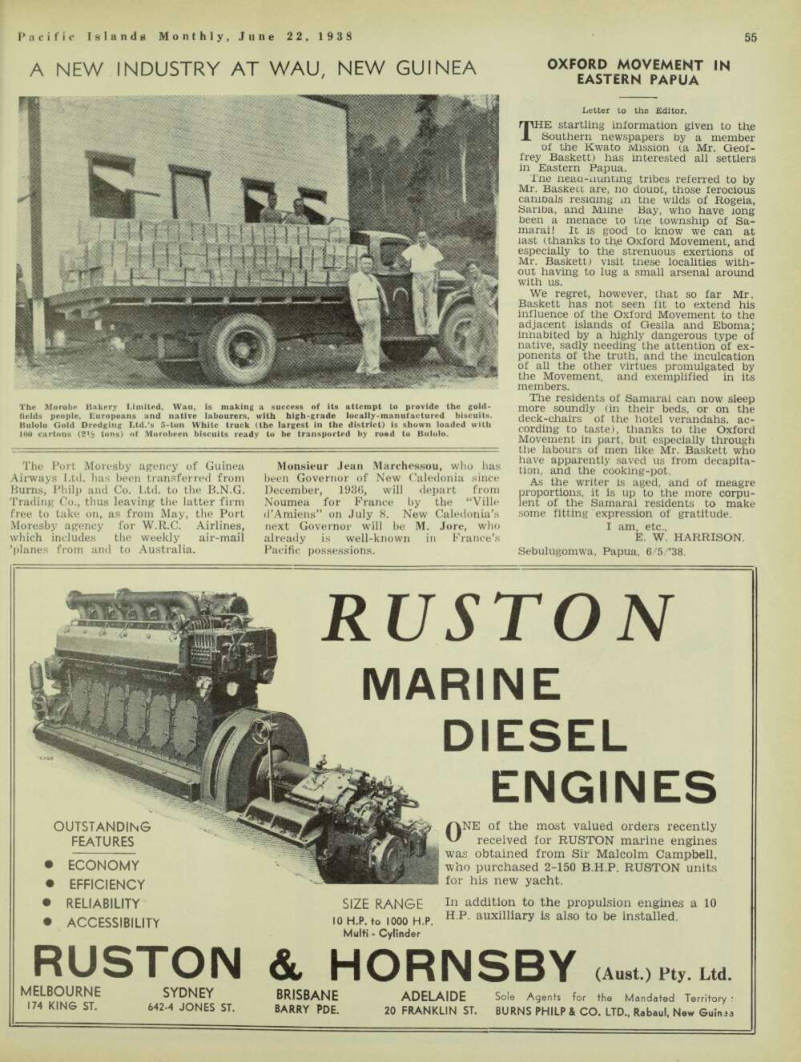
The Port Moresby agency of Guinea Airways Ltd. has been transferred from Bums, Philp and Co. Ltd. to the B.N.G.
Trading Co., thus leaving the latter firm free to take on, as from May, the Port Moresby agency for W.R.C. Airlines, which includes the weekly air-mail ’planes from and to Australia.
Monsieur Jean Marchessou, who has been Governor of New Caledonia since December, 1936, will depart from Noumea for France by the “Ville d’Amiens” on July 8. New Caledonia’s next Governor will be M. Jore, who already is well-known in France’s Pacific possessions.
The Morobe Bakery Limited, Wau, is making a success of its attempt to provide the gold fields people, Europeans and native labourers, with high-grade locally-manufactured biscuits.
Bulolo Gold Dredging Ltd.’s 5-ton White truck (the largest in the district) is shown loaded with 100 cartons tons) of Morobeen biscuits ready to be transported by road to Bulolo.
Oxford Movement In
Eastern Papua
Letter to the Editor.
THE startling information given to th,e Southern newspapers by a member of the Kwato Mission (a Mr. Geof frey Baskett) has interested all settlers in Eastern Papua.
The neaa-huntmg tribes referred to by Mr. Baskett are, no doubt, those ferocious canibals residing in the wilds of Rogeia, Sariba, and Mime Bay, who have long been a menace to the township of Sa marai! It is good to know we can at last (thanks to th,e Oxford Movement, and especially to th,e strenuous exertions of Mr. Baskett) visit these localities with out having to lug a small arsenal around with us.
We regret, however, that so far Mr.
Baskett has not seen lit to extend his influence of the Oxford Movement to the adjacent islands of Gesila and Eboma; inhabited by a highly dangerous type of native, sadly needing the attention of ex ponents of the truth, and the inculcation of all the other virtues promulgated by the Movement, and exemplified in its members.
The residents of Samarai can now sleep more soundly (in their beds, or on the deck-chairs of the hotel verandahs, ac cording to taste), thanks to the Oxford Movement in part, but especially through the labours of men like Mr. Baskett who have apparently saved us from decapita tion, and the cooking-pot.
As the writer is aged, and of meagre proportions, it is up to the more corpu lent of the Samarai residents to make some fitting expression of gratitude.
I am, etc.,
E. W. Harrison.
Sebulugomwa, Papua, 6/5/*3B.
Advertisements & other items, pp. 57-58 (1 item)
Ruston
Vt
OUTSTANDING
FEATURES
• ECONOMY
• EFFICIENCY
• RELIABILITY
• ACCESSIBILITY
RUSTON
MARINE
DIESEL
ENGINES
ONE of the most valued orders recently received for RUSTON marine engines was obtained from Sir Malcolm Campbell, who purchased 2-150 B.H.P. RUSTON units for his new yacht.
SIZE RANGE In addition to the propulsion engines alO 10 h.P. to 1000 HP H p auxilliar y is also to be installed.
Multi - Cylinder
RUSTON & HORNSBY
(Aust.) Pty. Ltd.
MELBOURNE
174 KING ST.
SYDNEY BRISBANE ADELAIDE Sole Agents for the Mandated Territory : 642-4 JONES ST. BARRY PDE. 20 FRANKLIN ST. BURNS PHILP & CO. LTD., Rtbaul. Now Suinaa
WM. BRECKWOLDT & CO.,
SOUTH SEA MERCHANTS
POSTAL ADDRESSES:—
NEW GUINEA:—P.O. Box 89, Rabaul, TAHITI:—P.O. Box 60, Papeete.
FIJI:—P.O. Box 111, Suva. SAMOA:—P.O. Box 124, Apia.
TRADE MARK
BREWO
AGENTS FOR...
VESTA
SEWING MACHINES
♦ B A E R ASPIRIN . . . ATEBRIN . . . YATREN PYRAMIDON . . . PLASMOCHIN . . .
MITIGAL . . .HELMITOL . . . NEOSAL- VARSAN . . . ETC., ETC. . . .
"PETROMAX"-
HURRICANE LANTERNS, LAMPS AND
ACCESSORIES
"FROWO"-
HURRICANE LANTERNS, No. 45, 55, 65,
25, 85, Etc.
"TIGER BRAND"-
CORRUGATED AND FLAT GALVANISED
IRON.
"TAIFUN"-
BICYCLES AND ACCESSORIES.
"TELEFUNKEN"-
RADIO SETS.
A TRIAL- \ »
MAKE
APPLY
TO-DAY.
SWEDISH Axes and Hatchets . . . Bicycles . . .
Sewing Machines . . .
Knives . . . Razor Blades . . . Lavalavas . . . Toothpaste. also all kinds of
GERMAN, BRITISH
and
CONTINENTAL
GOODS.
BLANKETS
ARARA"-
GAS STOVES
ANCRE"-
CAST IRON SAUCEPANS.
TWO LIONS"-
COPRA KNIVES, BUTCHERS' KNIVES
BECK'S-
"KEY BRAND" GERMAN LAGER.
BIRKO
"POLISSE" and "POLO" RAZOR BLADES.
LOHSE,
URALT LAVENDER.
"TORPEDO" "BIJOU" and "ERICA
TYPEWRITERS.
Pineapple Production In Fiji
THE chairman of directors of the Col onial Sugar Refining Co. Ltd. inform ed the annual meeting of sharehold ers on May 24 that the severe hurri cane in Fiji last February caused some damage to the Company’s pineapple plantations and spoiled the flowering in the most affected areas. A small crop, however, would be harvested and canned in June and July. The canning factory was practically completed. It would be capable of handling the crops in pros pect for the next few years, and it had been designed in a way which would sim plify further additions as the industry developed.
South African Yacht At
Rarotonga
Rarotonga, May 24.
A STRANGE sail was sighted one day last week, and the “Pai ori aere” (the ship that has got nothing else to do but go from place to place) was soon alongside the Avarua wharf.
She was the “Land’s End”, captained by retired marine-engineer Jeffrey, from Durban, South Africa, and has a crew of four. They left Durban last Septem ber. on a trip round the world, their route being via the Atlantic Ocean, Panama Canal, Society Islands. Their next port of call is Auckland, N.Z.
Coward Comedy Staged At
Wau
WAU, May 21.
WAU people enjoyed two perform ances of Noel Coward’s “Hay Fever”, presented by the local Dramatic Society early in the month. The shows were a real credit to every one concerned— acting, stage appointments, and lighting effects were excellent.
The cast was: Sorel Bliss (Nance Beck), Simon Bliss (Frank Hood), Clara (Betty Linn), Judith Bliss (Winifred Jenner), David Bliss (Major Berkeley Ayris), Sandy Tyrell (George Granfelt), Myra Arundel Corfe), Richard Greatham (Kenneth McGregor), Jackie Coryton (Daphne Beck).
Scientist Going To Rotuma
Honolulu, June 2.
ONE of the few remaining “blind spots” in the field of Pacific botanical re search will be thoroughly covered during June, July and August by Dr.
Harold St. John, professor of botany at the University of Hawaii and botanist for the Bishop Museum of Honolulu.
Dr. St. John made a valuable collec tion of Fiji plants for the museum last year: this time he also will gather zoo logical specimens. He has chosen Rotu ma. of the Fiji group, because it is iso lated and unexplored from a botanical or zoological viewpoint. It is said to be one of the hottest, wettest and most tropical of the Pacific’s thousands of isles.
A grant from the Carnegie Corpor ation has made this projected expedi tion possible.
Cocoa Culture Near Lae,
New Guinea
Old Markham Road In Use
AFTER years of exasperating delay, some roads are being built in the fertile Lae-Markham River district of New Guinea by the Administration.
The old Markham Road—built by Ad ministrator Wisdom and allowed to fall into disrepair—has been reconditioned, under the direction of Mr. Hoffman, and probably it will be used a good deal in the near future. Allotments have been taken up along this road, not far out from Lae. and a start has been made on a number of the blocks with a view to the production of cocoa.
Right Rev. W. H. Baddeley, M.A., D. 5.0., M.C., Bishop of Melanesia, will shortly visit Sydney on matters con nected with his Diocese He will then proceed to N.Z. in August, to join the mission vessel “Southern Cross” on its return voyage to Tulagi, 8.5.1., in
September.
£5,000 Fruit Payout
From Our Own Correspondent.
Rarotonga, May 24.
THERE has been an atmosphere of prosperity this fortnight, since the Government paid the growers for their April shipment of oranges and bananas.
It has been many years since there has been so much ready cash on the beach, and all stores report greatly increased turnover. As this May shipment will br the same as the last, there will be an other orgy of spending when Cashiei Jones pays out.
Advertisements & other items, p. 59 (1 item)
Icianz
BRITISH SOLOMON ISLANDS
STAMPS
New issue at 10 per cent, over cost.
On Covers Id. each cover extra.
Coronation Set on Reg Cover posted to any address l/6d.
Cash with order. With all enquiries please send a stamped addressed envelope.
M. HARPER.
Mandoliana Island.
P.O. Bex 6, Tulagi, 8.5.1.
RF2-8 m "M <t 13
CA RTmOCn
m 12 M * 4- ?n s*l
ICIANZ
The New Brass Case
.22 RIM FIRES
With Dry Lubricated Bullets ICIANZ "Imperials" have achieved instantaneous success—proving themselves to be THE cartridge keen shooters demand.
Higher velocity, flatter trajectory and greater hitting power combine in assuring greater shooting accuracy, with maximum life ensured for the barrel, by reason of their non-rusting and non-erosive components.
OBTAINABLE EVERYWHERE
2 2 SHORT - LONG - LONG RIFLE - SOLID* HOLLOW POINT
Checking the Wild Dog Menace in
Viti Levu
AMONG the new Bills presented at the last meeting of the Fiji Legis lative Council was one entitled The Dogs (Amendment) Bill 1938, to deal with the menace of wild dogs on the main island of Viti Levu.
For some years, wild dogs have done much damage among poultry and live stock. The Government, therefore, con sidered it desirable to take measures to destroy unregistered dogs at large, and the Bill makes the necessary pro visions. Public notice will be given of the methods of destruction, the place, and the time when they will be carried out, so that owners of valuable and pet dogs may take steps to safeguard them.
On two other Fiji islands, Taveuni and Vanua Levu, dogs are highly prized, to keep down wild pigs which are a great nuisance to plantation owners. In those places, unless trained dogs are kept, the pigs root up young coconut trees and vegetable patches as soon as they are planted.
Morris, Hedstrom, Ltd.
Profit Higher
A NET profit of £82,098 (being an increase of £11,714 over the pre vious year) is shown in the accounts of Morris, Hedstrom, Liimited, Suva, for the year ended March 31.
The dividend was increased to 6 per cent, from 51 per cent, and in addi tion a bonus of 2h per cent, on ord inary shares was given in commemor ation of the 70th anniversary of the foundation of the firm.
Results for the past three years are as follows:
Total assets have risen by £43,017 to £1,067,831.
In his report, Sir Maynard Hed strom, managing director, stated: “The increase in the profit earned is due to generally favourable conditions. The production of sugar for the year ended December 31 was slightly less than that for the previous year; also, there was a slight fall in the production of copra. Expenditure in the mining areas continues to stimulate general busi ness.
“Although prospects for the current year are reasonably good, the directors do not anticipate that it will be pos sible to achieve as good results during this period as have been obtained dur ing the period just ended.
“The financial position is very sound.
Cash on hand and at bankers has in creased by over £37,000, and, while debts and liabilities show an apparent increase of about £3,600, this does not represent any actual increase in out side liabilities”.
1936. 1937. 1938. £ £ £ Brought forward 40,425 54,764 62,073 Net profit 53,512 70,384 82,098 93,937 125,148 144,171 To reserve — — 20,000 Dividends— Pref., 6 p.c. 13,152 13,152 13,152 Ord., p.c. 5 52 6 Amount .. 26,021 29,923 31,224 Bonus, 2 h p.c. . — — 13,010 Pension fund . — — 5,000 Carried forward 54,764 62,073 61,785
Need A New Lawn Mower?
IN 1832 the first British lawn mower was manufactured by Ransomes, Sims & Jef ries Ltd., Ipswich, England, and for 106 years the Company has been perfecting its products ' until to-day they are in constant use all over the world. The Company has just issued its 1938 Lawn Mower Catalogue which is packed full of first-class illustrations showing the div erse range of grass-cutting implements now turned out at Ipswich.
There are mowers of every conceivable type —from the ordinary hand cutter to the giant “Septuple” gang units with a cutting width of 16 ft. and a cutting capacity of 10 acres per hour for keeping aerodromes and golf links in trim. Also illustrated are garden and bowling green rollers, labour-saving lawn sweepers, edge cutters, bullock mowers, etc.
Advertisements & other items, p. 60 (1 item)
Your Tropical Rit
WANTED
Regular supplies of Used Pacific Island stamps. All Coronations, Jubilees, Airmails and ordinary issues wanted. Best prices paid. Submit stamps or details to:
W. HORNADGE,
Catherine Hill Bay, N.S.W., Australia.
Your Tropical Rit
When you visit the Pacific Islands, whether on Business or Pleasure, you need Special Equipment Light Suits of Correct Style, which fit well and launder easily; Tunic Shirts Silk Shirts, Light Underwear, White Shoes, etc.
WALTER HORNE & CO. LTD., established in 1885, specialise in this Service. Skilled Tailors make your Suits from First-class material within 24 hours. Complete equipment can be supplied from our Large Stocks at Reasonable. Moderate Prices.
BUY FROM THE FIRM WHICH UNDERSTANDS YOUR NEEDS AND
DRESSES YOU CORRECTLY
WALTER HORNE & CO. LTD., carry a Full Range Drapery of all kinds; also Frocks, Millinery, Foundations and Lingerie, Hosiery, Shoes and Sandals, Ribbons and Laces, Household Drapery, of M Men resident in any of the Pacific Territories can he supplied with Suitable Clothes.
Ladies' Hairdressing and Manicuring
Write to us and Describe your Requirements.
WALTER HORNE & CO. LTD
Drapers and Men's Wear Specialists
SUVA. FIJI
A. B. DONALD LTD.
AUCKLAND
ISLAND TRADERS :: GENERAL MERCHANTS
P. O. Box 1509 Cables and Telegrams: "Kingdom," Auckland Branches at Rarotonga and throughout the Cook Islands At Papeete and throughout the Society, Marquesas and Paumotu Islands trading as " ETABLISSEMENTS DONALD. TAHITI "
At Fiji; Trading as "Dominion Fruit C 0.," Suva
Central Pacific
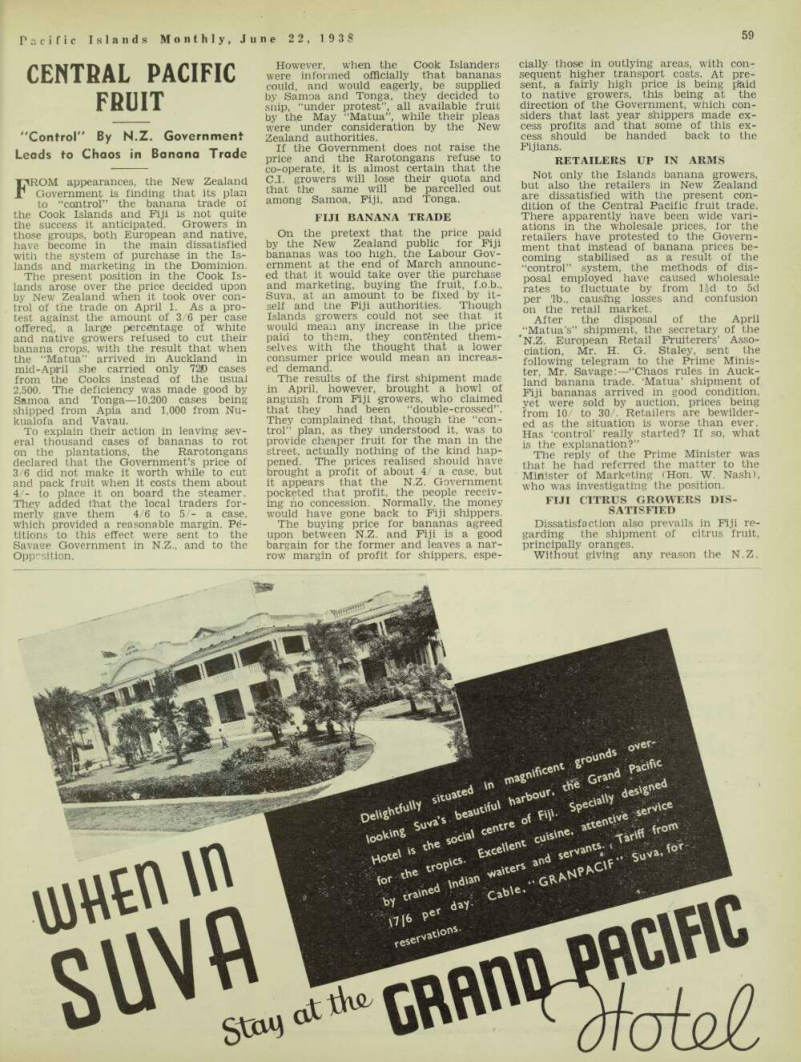
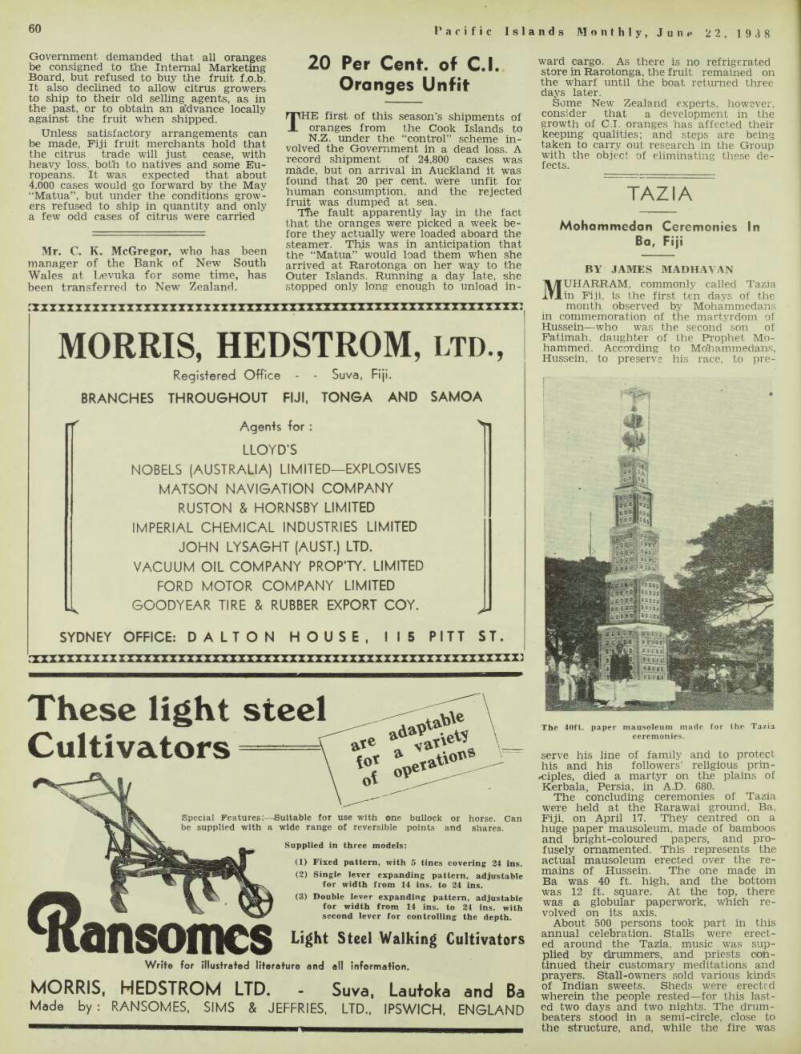
Fruit
"Control" By N.Z. Government Leads to Chaos in Banana Trade
FROM appearances, the New Zealand Government is finding that its plan to “control” the banana trade of the Cook Islands and Fiji is not quite the success it anticipated. Growers in those groups, both European and native, have become in the main dissatisfied with the system of purchase in the Is lands and marketing in the Dominion.
The present position in the Cook Is lands arose over the price decided upon by New Zealand when it took over con trol of the trade on April 1. As a pro test against the amount of 3/6 per case offered, a large percentage of white and native growers refused to cut their banana crops, with the result that when the “Matua” arrived in Auckland in mid-April she carried only 725) cases from the Cooks instead of the usual 2,500. The deficiency was made good by Samoa and Tonga—lo,2oo cases being shipped from Apia and 1,000 from Nu kualofa and Vavau.
To explain their action in leaving sev eral thousand cases of bananas to rot on the plantations, the Rarotongans declared that the Government’s price of 3/6 did not make it worth while to cut and pack fruit when it costs them about 4/- to place it on board the steamer.
Th,ey added that the local traders for merly gave them 4/6 to 5/- a case, which provided a reasonable margin. Pe titions to this effect were sent to the Savaae Government in N.Z., and to the Opposition.
However, when the Cook Islanders were informed officially that bananas could, and would eagerly, be supplied by Samoa and Tonga, they decided to snip, “under protest”, all available fruit by the May “Matua”, while their pleas were under consideration by the New Zealand authorities.
If the Government does not raise the price and the Rarotongans refuse to co-operate, it is almost certain that the C.I. growers will lose their quota and that the same will be parcelled out among Samoa, Fiji, and Tonga.
Fiji Banana Trade
On the pretext that the price paid by the New Zealand public for Fiji bananas was too high, the Labour Gov ernment at the end of March announc ed that it would take over the purchase and marketing, buying the fruit, f.0.b., Suva, at an amount to be fixed by it self and the Fiji authorities. Though Islands growers could not see that it would mean any increase in the price paid to them, they contented them selves with the thought that a lower consumer price would mean an increas ed demand.
The results of the first shipment made in April, however, brought a howl of anguish from Fiji growers, who claimed that they had been “double-crossed”.
They complained that, though the “con trol” plan, as they understood it. was to provide cheaper fruit for the man in the street, actually nothing of the kind hap pened. The prices realised should have brought a profit of about 4/ a case, but it appears that the N.Z. Government pocketed that profit, the people receiv ing ho concession. Normally, the money would have gone back to Fiji shippers.
The buying price for bananas agreed upon between N.Z. and Fiji is a good bargain for the former and leaves a nar row margin of profit for shippers, espe
dally those in outlying areas, with con sequent higher transport costs. At pre sent, a fairly high price is being joaid to native growers, this being at the direction of the Government, which con siders that last year shippers made ex cess profits and that some of this ex cess should be handed back to the Fijians.
Retailers Up In Arms
Not only the Islands banana growers, but also the retailers in New Zealand are dissatisfied with the present con dition of the Central Pacific fruit trade.
There apparently nave been wide vari ations in the wholesale prices, for the retailers have protested to the Govern ment that instead of banana prices be coming stabilised as a result of the “control” system, the methods of dis posal employed have caused wholesale rates to fluctuate by from Ud to 5d per lb., causihg loss'es and confusion on the retail market.
After th,e disposal of the April “Matua’s” shipment, the secretary of the ’N.Z. European Retail Fruiterers’ Asso ciation, Mr, H. G. Staley, sent the following telegram to the Prime Minis ter, Mr. Savage:—“Chaos rules in Auck land banana trade. ‘Matua’ shipment of Fiji bananas arrived in good condition, yet were sold by auction, prices being from 10/ to 30/. Retailers are bewilder ed as the situation is worse than ever.
Has ‘control’ really started? If so, what is the explanation?”
The reply of the Prime Minister was that he had referred the matter to the Minister of Marketing (Hon. W. Nash), who was investigating the position.
Fiji Citrus Growers Dis
Satisfied
Dissatisfaction also prevails in Fiji re garding the shipment of citrus fruit, principally oranges.
Without giving any reason the N.Z.
Government demanded that all oranges be consigned to the Internal Marketing Board, but refused to buy the fruit f.o.b.
It also declined to allow citrus growers to ship to their old selling agents, as in the past, or to obtain an Advance locally against the fruit when shipped.
Unless satisfactory arrangements can be made, Fiji fruit merchants hold that the citrus trade will just cease, with heavy loss, both to natives and some Eu ropeans. It was expected that about 4.000 cases would go forward by the May “Matua”, but under the conditions grow ers refused to ship in quantity and only a few odd cases of citrus were carried Mr. C. K. McGregor, who has been manager of the Bank of New South Wales at Levuka for some time, has been transferred to New Zealand.
Advertisements & other items, pp. 61-62 (1 item)
%
0$ AT** g
MORRIS, HEDSTROM, ltd.,
Registered Office - - Suva, Fiji.
BRANCHES THROUGHOUT FIJI, TONGA AND SAMOA
T” Agents for: \
LLOYD'S
NOBELS (AUSTRALIA) LIMITED—EXPLOSIVES
MATSON NAVIGATION COMPANY
RUSTON & HORNSBY LIMITED
IMPERIAL CHEMICAL INDUSTRIES LIMITED
JOHN LYSAGHT (AUST.) LTD.
VACUUM OIL COMPANY PROP'TY. LIMITED
FORD MOTOR COMPANY LIMITED
GOODYEAR TIRE & RUBBER EXPORT COY. j.
SYDNEY OFFICE: DALTON HOUSE, 115 PITT ST.
These light steel
Cultivators
aAa *atS*
at® oP e ol
taU^ 8
Special Features:—Suitable for use with one bullock or horse. Can be supplied with a wide range of reversible points and shares.
Supplied in three models: (1) Fixed pattern, with 5 tines covering 24 ins. (2) Single lever expanding pattern, adjustable for width from 14 ins. to 24 ins. (3) Double lever expanding pattern, adjustable for width from 14 ins. to 24 ins. with second lever for controlling the depth.
nsomcs Light Steel Walking Cultivators
Writ© for illustrated literature and all information.
MORRIS, HEDSTROM LTD. - Suva, Lautoka and Ba Made by : RANSOMES, SIMS & JEFFRIES, LTD., IPSWICH, ENGLAND
Oranges Unfit
20 Per Cent, of C.l.
THE first of this season’s shipments of oranges from the Cook Islands to N.Z. under the “control” scheme in volved the Government in a dead loss. A record shipment of 24,800 cases was mkde, but on arrival in Auckland it was found that 20 per cent, were unfit for human consumption, and the rejected fruit was dumped at sea.
The fault apparently lay in the fact that the oranges were picked a week be fore they actually were loaded aboard the steamer. Thjs was in anticipation that the “Matua” would load them when she arrived at Rarotonga on her way to the Outer Islands. Running a day late, she stopped only long enough to unload in
ward cargo. As there is no refrigerated store in Rarotonga, the fruit remained on the wharf until the boat returned three days later.
Some New Zealand experts, however, consider that a development in the growth of C.I. oranges has affected their keeping qualities; and steps are being taken to carry out research in the Group with the object of eliminating th.ese de fects.
Tazia
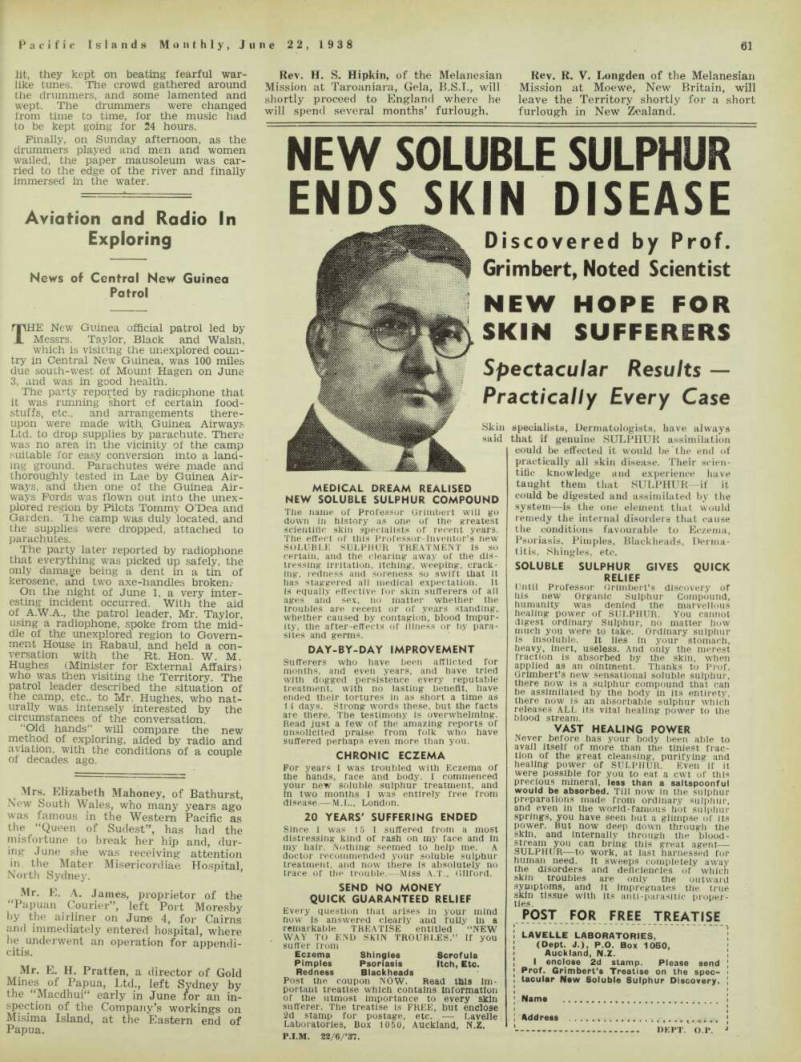
Mohommedon Ceremonies In Ba, Fiji
By James Madhavan
MUHARRAM, commonly called Tazia in Fiji, is the first ten days of the month, observed by Mohammedans in commemoration of the martyrdom of Hussein—who was the second son of Fatimah, daughter of the Prophet Mo hammed. According to Mohammedans, Hussein, to preserve his race, to pre-
serve his line of family and to protect his and his followers’ religious prin ciples, died a martyr on the plains of Kerbala, Persia, in A.D. 680.
The concluding ceremonies of Tazia were held at the Rarawai ground, Ba, Fiji, on April 17. They centred on a huge paper mausoleum, made of bamboos and bright-coloured papers, and pro fusely ornamented. This represents the actual mausoleum erected over the re mains of Hussein. The one made in Ba was 40 ft. high, and the bottom was 12 ft. square. At the top, there was a globular paperwork, which re volved on its axis.
About 500 persons took part in this annual celebration. Stalls were erect ed around the Tazia, music was sup plied by drummers, and priests con tinued their customary meditations and prayers. Stall-owners sold various kinds of Indian sweets. Sheds were erected wherein the people rested—for this last ed two days and two nights. The drum beaters stood in a semi-circle, close to the structure, and, while the fire was
The 40 ft. paper mausoleum made for the Tazia ceremonies.
lit, they kept on beating fearful war like tunes. The crowd gathered around the drummers, and some lamented and wept. The drummers were changed from time to time, for the music had to be kept going for 24 hours.
Finally, on Sunday afternoon, as the drummers played and men and women wailed, tffe paper mausoleum was car ried to the edge of the river and finally immersed in the water.
Exploring
Aviation and Radio In Exploring News of Central New Guinea Patrol
THE New Guinea official patrol led by Messrs. Taylor, Black and Walsh, which is visiting the unexplored coun try in Central New Guinea, was 100 miles due south-west of Mount Hagen on June 3, and was in good health.
The party reported by radiophone that it was running short cf certain food stuffs, etc., and arrangements there upon were made with, Guinea Airways Ltd. to drop supplies by parachute. There was no area in the vicinity of the camp suitable for easy conversion into a land ing ground. Parachutes were made and thoroughly tested in Lae by Guinea Air ways, and then one of the Guinea Air ways Fords was flown out into the unex plored region by Pilots Tommy O’Dea and Garden. The camp was duly located, and the supplies were dropped, attached to parachutes.
The party later reported by radiophone that everything was picked up safely, the only damage being a dent in a tin of kerosene, and two axe-handles broken.
On the night of June 1, a very inter esting incident occurred. With the aid of A.W.A., the patrol leader, Mr. Taylor, using a radiophone, spoke from the mid dle of th,e unexplored region to Govern ment House in Rabaul, and held a con versation with the Rt. Hon. W. M Hughes (Minister for External Affairs) who was then visiting the Territory. The patrol leader described the situation of the camp, etc., to Mr. Hughes, who nat urally was intensely interested by the circumstances of the conversation.
“Old hands” will compare the new method of exploring, aided by radio and aviation, with the conditions of a couple of decades ago.
Mrs. Elizabeth Mahoney, of Bathurst, New South Wales, who many years ago was famous in the Western Pacific as the “Queen of Sudest”, has had the misfortune to break her hip and, dur ing June she was receiving attention in the Mater Misericordiae Hospital.
North Sydney.
Mr. E. A. James, proprietor of the “Papuan Courier”, left Port Moresby by the airliner on June 4, for Cairns and immediately entered hospital, where he underwent an operation for appendi citis.
Mr. E. H. Pratten, a director of Gold Mines of Papua, Ltd., left Sydney by the “Macdhui“ early in June for an in spection of the Company’s workings on Misima Island, at the Eastern end of
Papua.
Rev. H. S. Hipkin, of the Melanesian Mission at Taroaniara, Gela, 8.5.1., will shortly proceed to England where he will spend several months’ furlough.
Rev. R. V. Longden of the Melanesian Mission at Moewe, New Britain, will leave the Territory shortly for a short furlough in New Zealand.
Rev. W. L. I. Linggood, accompanied by his wife and their two childre/n arrived in Rabaul, New Britain, by the “Nankin” on May 24 on their way back to the Methodist Mission station at Raluana after doing several months’ deputation work- in Australia.
Mr. J. Trotter, manager in Fiji for Messrs. Burns, Philp (South Sea) Co.
Ltd., made a quick business trip to New Zealand and return during May.
Advertisements & other items, pp. 63-64 (1 item)
New Soluble Sulphur
ENDS SKIN DISEASE
MEDICAL DREAM REALISED
NEW SOLUBLE SULPHUR COMPOUND
The name of Professor Orimbert will go down In history as one of the greatest scientific skin specialists of recent years.
The effect of this Professor-Inventor’s new
SOLUBLE SULPHUR TREATMENT Is so
certain, and the clearing away of the distressing irritation, itching, weeping, cracking, redness and soreness so swift that it has staggered all medical expectation. It is equally effective for skin sufferers of all ages and sex, no matter whether the troubles are recent or of years standing, whether caused by contagion, blood Impurity, the after-effects of illness or by parasites and germs.
DAY-BY-DAY IMPROVEMENT
Sufferers who have been afflicted for months, and even years, and have tried with dogged persistence every reputable treatment, with no lasting benefit, have ended their tortures in as short a time as 14 days. Strong words these, but the facts are there. The testimony is overwhelming.
Read just a few of the amazing reports of unsolicited praise from folk who have suffered perhaps even more than you.
CHRONIC ECZEMA
For years I was troubled with Eczema of the hands, face and body. I commenced your new soluble sulphur treatment, and In two months I was entirely free from disease.—M.L., London.
20 YEARS' SUFFERING ENDED
Since 1 was 15 I suffered from a most distressing kind of rash on my face and In my hair. Nothing seemed to help me. A doctor recommended your soluble sulphur treatment, and now there Is absolutely no trace of the trouble. —Miss A.T., Gilford.
SEND NO MONEY
QUICK GUARANTEED RELIEF
Discovered by Prof.
Grimbert, Noted Scientist
NEW HOPE FOR
SKIN SUFFERERS
Spectacular Results
Practically Every Case
Skin specialists, Dermatologists, have always
said that if genuine SULPHUR assimilation could be effected it would be the end of practically all skin disease. Their scientific knowledge and experience have taught them that SULPHUR—if it could be digested and assimilated by the system—is the one element that would remedy the internal disorders that cause the conditions favourable to Eczema,
Psoriasis, Pimples, Blackheads, Derma-
titis, Shingles, etc.
SOLUBLE SULPHUR GIVES QUICK
RELIEF
Until Professor Grlmbert’s discovery of his new Organic Sulphur Compound, humanity was denied the marvellous healing power of SULPHUR. You cannot digest ordinary Sulphur, no matter how much you were to take. Ordinary sulphur is insoluble. It lies in your stomach, heavy, inert, useless. And only the merest fraction is absorbed by the skin, when applied as an ointment. Thanks to Prof.
Grlmbert’s new sensational soluble sulphur, there now is a sulphur compound that can be assimilated by the body in its entirety, there now is an absorbable sulphur which releases ALL its vital healing power to the blood stream.
VAST HEALING POWER
Never before has your body been able to avail Itself of more than the tiniest fraction of the great cleansing, purifying and healing power of SULPHUR. Even if it were possible for you to eat a cwt of this precious mineral, less than a saltspoonful would be absorbed. Till now in the sulphur preparations made from ordinary sulphur, and even in the world-famous hot sulphur springs, you have seen but a glimpse of its power. But now deep down through the skin, and internally through the bloodstream you can bring this great agent— SULPHUR—to work, at last harnessed for human need. It sweeps completely away the disorders and deficiencies of which skin troubles are only the outward symptoms, and it Impregnates the time skin tissue with Its anti-parasitic properties.
Every question that arises in your mind now is answered clearly and fully In a remarkable TREATISE entitled “NEW WAY TO END SKIN TROUBLES.” If you suffer from Eczema Shingles Scrofula Pimples Psoriasis Itch, Etc.
Redness Blackheads Post the coupon NOW. Read this Important treatise which contains Information of the utmost importance to every skin sufferer. The treatise is FREE, but enclose 2d stamp for postage, etc. Lavelle Laboratories, Box 1050, Auckland. N.Z.
P.I.M. 28/6/’S7.
POST FOR FREE TREATISE
LAVELLE LABORATORIES,
(Dept. J.), P.O. Box 1050, Auckland, N.Z.
I enclose 2d stamp. Please send Prof. Grimbert’s Treatise on the spectacular New Soluble Sulphur Discovery.
Name Address
DEPT. OP.
Help Kidneys
Don’t Take Drastic Drugs
Your kidneys have nine million tiny tube* or filters which are endangered by neglect or drastic, irritating drugs. Beware ! If Kidney trouble or Bladder weakness makes you suffer from Getting Up Nights, Leg Pains, Nervousness, Dizainese, Stiffness, Rheumatism, Lumbago, Circles Under Eyes, Swollen Ankles, Neuralgia, Burning, Itching, Smarting, Acidity or Loss of Vigour, don’t delay.
Try the Doctor’s new discovery called Cystex (Sias-tex). Soothes, tones, cleans, and heals sick kidneys. Starts work in 15 minutes. Brings new health, youth and vitality in 48 hours. Cystex costs little and is guaranteed to end your troubles la 8 days or money back. Price 4/-, all Stores and Chemists. SCHAFFER k CO., 186 Clareaos Street, Sydney.
Firearm Repairs: “OUR HANDS MAKE GOOD ARMS”. Firearms sent C.O.D.
JUST ARRIVED
New Shipment of Harrington & Richardson Single Barrel 12 Gauge Guns. 36in. Barrel, Full Choke, chambered 2 3 / 4 in. Cartridges. Heavy reinforced Breech. An excellent gun for Long Range Shot. Price: Bft/-. 30in. and 32in. Barrel, ordinary model, full c hoke, and 2 3 / 4 in. Cartridges, also 410 Bore Gun. Price: 60/-.
For Rifle Reloaders. —New Shipment of Dupont, Nos. 3031, 17V2, 1204, and 80. Hecules No. 2400, and Sharpshooter Powder. All sell at 2ft/- per lb.
The Latest Book for Amateur Rifle Reloaders. —Earl Naramors Hand loaders Manual; 27/6.
Everything for the reloader. The greatest book yet published.
New List of Second-hand Guns now available.
Write for Firearm Catalogue (60ft illustrations). Fishing Catalogue (40ft illustrations).
SIL ROHU For Quality Firearms and Fishing Tackle 143 ELIZABETH STREET, SYDNEY. (Near Market Street.) 'Phone: ma.<s4o.
Scott’s “Renown” Brand Rope,
Cordage and
Binder
Twine
Cable Address; Ropeyard, Sydney - I
of Every
Description
MANUFACTURED AT
MASCOT, N.S.W.
J. SCOTT
PTY. LTD.
Head Office and Siore:
163 CLARENCE STREET.
SYDNEY
N.S.W.
Over-Educated?
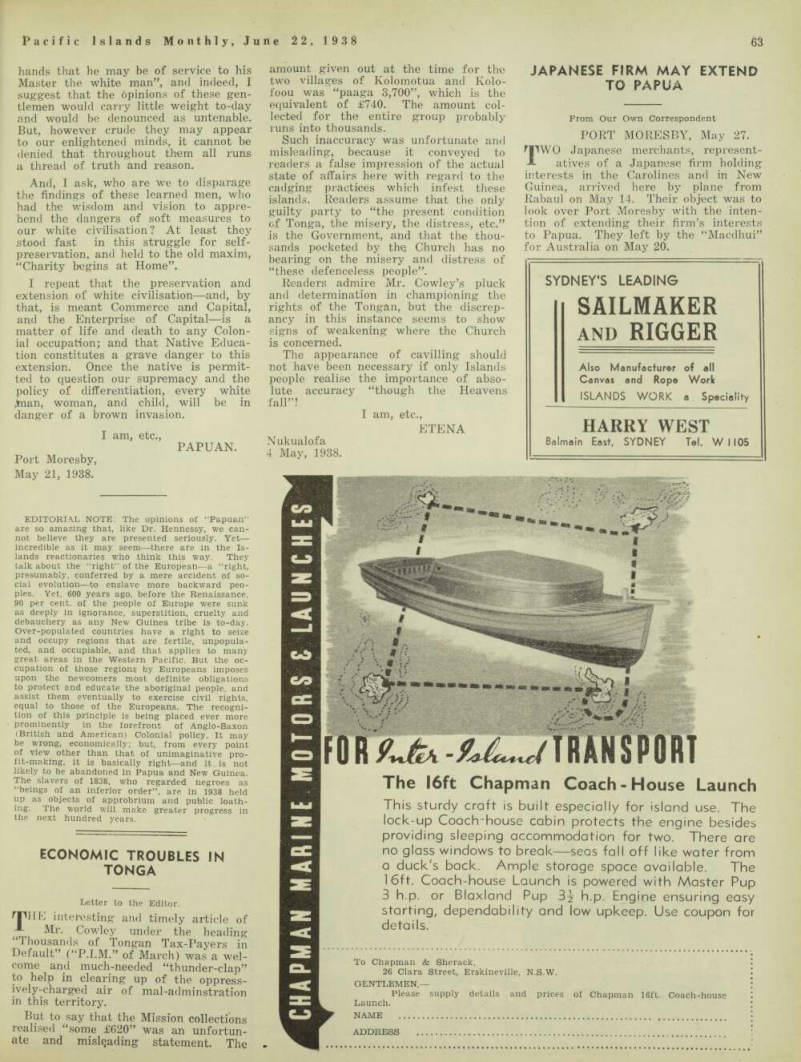
Are Natives Being
Reply to Dr. Hennessy
Letter to the Editor.
IMAY overlook Dr. James Hennessy’s discourteous and violent reference to myself in his explosive retort in the April number of the “P.1.M.” to my let ter of December, on the matter of na tive education, but 1 cannot ignore his uninformed denial of the decision of the U.S.A. Courts in the Dred Scott case, that a blackman has “no rights which a whiteman is bound to respect”.
This decision, as stated in my letter, Dr. Hennessy declares to be false. There fore I venture to draw attention to the following facts: The Missouri Compromise of 1820 allowed slavery in some States, but not in others. Dred Scott was a slave who had been taken into a State which did not allow slavery. He made ap plication to the Court, asking for a
declaration that he was a free man, but his application was refused on the ground that negroes had always been regarded as “beings of an inferior or der—so far inferior that they had no rights which a white man was bound to respect”. (This is a quotation from the judgment of Chief Justice Tansey).
A slave, it was held, is property, and the Court was bound to respect the right to property. So Dred Scott was sent back to the master to whom he belonged. This was in 1856-7. Dr.
Hennessy could have found this out for himself.
My main reason for referring to this decision was to point out how far we have travelled to-day along the road of tolerance in our relations with the primitive savage, and of the advisab ility—or, I should say, the urgent need —of calling a halt to educational schemes, if we are not to destroy for ever the balance of brown and white relationship, and the usefulness of a labour supply, which I stated before is the very life-blood of our economic system in the Pacific.
“Civilisation of the mind and the spirit” is a very beautiful theory for tlhose to work upon in secure posi tions, and a pretty picture could be drawn of happy and contented natives, reading and writing and working at complicated mathematical problems, while smiling missionaries, anthropolo gists, and Government officials stand around waving little flags. But—and there always is a but—where would the harassed settlers and planters stand in this happy throng? One might well answer, nowhere. •It is imperative that the activities ■of these well-meaning sentimentalists should be curbed. We have travelled far since Aristotle’s time, as I said pre viously, when the idea of the unity of the human race was considered ridicu lous; and since Dr. Josey concluded, in his “Race and National Solidarity”, that as man is the first among the creatures, and is therefore allowed to feed upon the animals of the field, the European is the first among human beings, and has the right to impose his will upon the lower races. We have, Dr. Josey thinks, made a mistake in educating these lower races and in admitting them to a share in our science and our know ledge; we should have done better, he considers, if we had kept them in com plete ignorance, for in that case they would have more readily recognised their true position.
Dr. Josey was anticipated by an other well-known authority, Nicolaus Engelhard, for Engelhard almost exactly the same when he points out the advantage “de maintenir le Javan ais dans cet abrutissement si avanta geux pour nous”, which prevents him from realising his strength and from recognising how much better off he would be without the white men.
These sentiments we naturally regard with wonder to-day, and even shocked wonder, on reading that Charles Car roll regarded the negro as a beast “created with articulate speech and
hands that he may be of service to his Master the white man”, and indeed, I suggest that the opinions of these gen tlemen would carry little weight to-day and would be denounced as untenable.
But, however crude they may appear to our enlightened minds, it cannot be denied that throughout them all runs a thread of truth and reason.
And, I ask, who are we to disparage the findings of these learned men, who had the wisdom and vision to appre hend the dangers of soft measures to our white civilisation ? At least they stood fast in this struggle for self preservation, and held to the old maxim, “Charity begins at Home”.
I repeat that the preservation and extension of white civilisation—and, by that, is meant Commerce and Capital, and the Enterprise of Capital—is a matter of life and death to any Colon ial occupation; and that Native Educa tion constitutes a grave danger to this extension. Once the native is permit ted to question our supremacy and the policy of differentiation, every white ,*nan, woman, and child, will be in danger of a brown invasion.
I am, etc.,
Papuan.
Port Moresby, May 21, 1938.
EDITORIAL NOTE: The opinions of “Papuan” are so amazing that, like Dr. Hennessy, we can not believe they are presented seriously. Yet— incredible as it may seem—there are in the Is lands reactionaries who think this way. They talk about the “right” of the European—a “right, presumably, conferred by a mere accident of so cial evolution—to enslave more backward peo ples. Yet, 600 years ago, before the Renaissance, 90 per cent, of the people of Europe were sunk as deeply in ignorance, superstition, cruelty and debauchery as any New Guinea tribe is to-day.
Over-populated countries have a right to seize and occupy regions that are fertile, unpopula ted, and occupiable, and that applies to many great areas in the Western Pacific. But the oc cupation of those regions by Europeans imposes upon the newcomers most definite obligations to protect and educate the aboriginal people, and assist them eventually to exercise civil rights, equal to those of the Europeans. The recogni tion of this principle is being placed ever more prominently in the forefront of Anglo-Saxon (British and American) Colonial policy. It may be wrong, economically; but, from every point of view other than that of unimaginative pro fit-making, it is basically it is not likely to be abandoned in Papua and New Guinea.
The slavers of 1838, who regarded negroes as “beings of an inferior order”, are in 1938 held up as objects of approbrium and public loath ing. The world will make greater progress in the next hundred years.
Economic Troubles In
Tonga
Letter to the Editor.
THE interesting and timely article of Mr. Cowley under the heading “Thousands of Tongan Tax-Payers in Default” (“P.1.M.” of March) was a wel come and much-needed “thunder-clap” to help in clearing up of the oppress ively-charged air of mal-adminstration in this territory.
But to say that the Mission collections realised “some £620” was an unfortun ate and misleading statement. The
amount given out at the time for the two villages of Kolomotua and Kolo foou was “paaga 3,700”, which is the equivalent of £740. The amount col lected for the entire group probably runs into thousands.
Such inaccuracy was unfortunate and misleading, because it conveyed to readers a false impression of the actual state of affairs here with regard to the cadging practices which infest these islands. Readers assume that the only guilty party to “the present condition of Tonga, the misery, the distress, etc.” is the Government, and that the thou sands pocketed by the Church has no bearing on the misery and distress of “these defenceless people”.
Readers admire Mr. Cowley’s pluck and determination in championing the rights of the Tongan, but the discrep ancy in this instance seems to show signs of weakening where the Church is concerned.
The appearance of cavilling should not have been necessary if only Islands people realise the importance of abso lute accuracy “though the Heavens fall”!
I am, etc.,
Etena
Nukualofa 4 May, 1938.
Japanese Firm May Extend
To Papua
From Our Own Correspondent
Port Moresby, May 27.
TWO Japanese merchants, represent atives of a Japanese firm holding interests in the Carolines and in New Guinea, arrived here by plane from Rabaul on May 14. Their object was to look over Port Moresby with the inten tion of extending their firm’s interests to Papua. They left by the “Macdhui” for Australia on May 20.
Advertisements & other items, pp. 65-66 (1 item)
Nsport
SYDNEY'S LEADING
SAILMAKER
AND RIGGER
Also Manufacturer of all Canvas and Rope Work ISLANDS WORK a Speciality
HARRY WEST
Balmain East, SYDNEY Tel. W 1105
I f
9*% teA -9x£c4*
The 16ft
NSPORT
Chapman Coach-House Launch
This sturdy craft is built especially for island use. The lock-up Coach-house cabin protects the engine besides providing sleeping accommodation for two. There are no glass windows to break—seas fall off like water from a duck's back. Ample storage space available. The 16ft. Coach-house Launch is powered with Master Pup 3 h.p. or Blaxland Pup 3-J h.p. Engine ensuring easy starting, dependability and low upkeep. Use coupon for details.
To Chapman & Sherack, 26 Clara Street, Erskineville, N.S.W.
GENTLEMEN,—
Please supply details and prices of Chapman 16ft. Coach-house Launch.
NAME
ADDRESS
From £3
C.I.F. Sydney
M 3.
W. M. REID t b o r, y n ou g Direct from the Up-To-Date Factory of Haid & Neu, at Karlsruhe, Baden.
Germany, precision built sewing MACHINES with a reputation maintained during "77 YEARS” for supreme workmanship and materials.
A patented hardening process guarantees smooth action and a long life free of repairs.
Needles, Bobbins, eto., can be 5 YEARS interchan sed with other well r known sewing machines, guarantee Information, Parts, Patterns and all dress materials are obtainable from the agent . . .
W. M. REID, “Reid House,” 75 King Street, Sydney, G.P.O. Box No. 137 CC.
/ $ r:
When dancing
or at the theatre don’t forget now and then to dab a few drops of ~4711 n Genuine Eau de Cologne on temples and forehead; it will refresh, invigorate, revive.
DE u, * •siocum mm
Genuine
i Eau de
Cologne
The Philippines
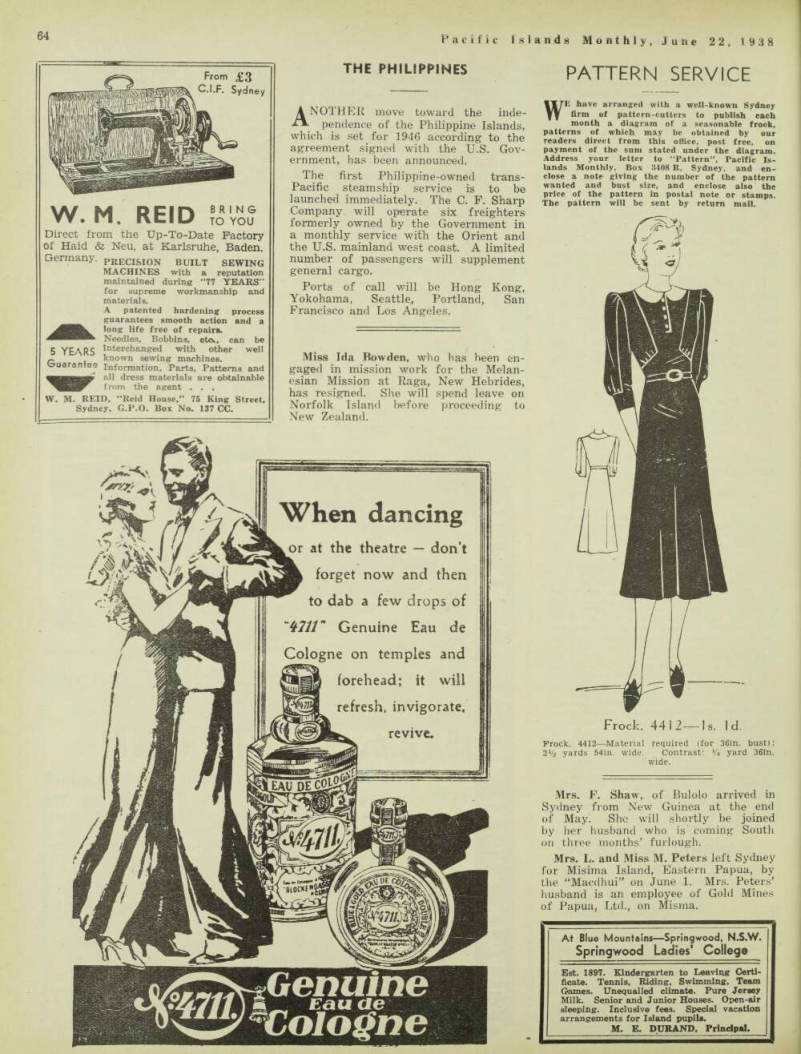
ANOTHER move toward the inde pendence of the Philippine Islands, which is set for 1946 according to the agreement signed with the U.S. Gov ernment, has been announced.
The first Philippine-owned trans pacific steamship service is to be launched immediately. The C. F. Sharp Company will operate six freighters formerly owned by the Government in a monthly service with the Orient and the U.S. mainland west coast. A limited number of passengers will supplement general cargo.
Ports of call will be Hong Kong, Yokohama, Seattle, Portland, San Francisco and Los Angeles.
Miss Ida Bowden, who has been en gaged in mission work for the Melan esian Mission at Raga, New Hebrides, has resigned. She will spend leave on Norfolk Island before proceeding to New Zealand.
Pattern Service
WE have arranged with a well-known Sydney firm of pattern-cutters to publish each month a diagram of a seasonable frock, patterns of which may be obtained by our readers direct from this office, post free, on payment of the sum stated under the diagram.
Address your letter to “Pattern”, Pacific Is lands Monthly, Box 3408 R, Sydney, and en close a note giving the number of the pattern wanted and bust size, and enclose also the price of the pattern in postal note or stamps.
The pattern will be sent by return mail.
Mrs. F. Shaw, of Bulolo arrived in Sydney from New Guinea at the end of May. She will shortly be joined by her husband who is coming South on three months’ furlough.
Mrs. L. and Miss M. Peters left Sydney for Misima Island, Eastern Papua, by the “Macdhui” on June 1. Mrs. Peters’ husband is an employee of Gold Mines of Papua, Ltd., on Misma.
Frock. 4412—Is. Id.
Frock, 4412 —Material required (for 36in. bust): 2½ yards 54in. wide. Contrast; ¼ yard 36in. wide.
Advertisements & other items, p. 66 (1 item)
Springwood Ladies' College
At Blue Mountains—Springwood, N.S.W.
Est. 1897. Kindergarten to Leaving Certificate. Tennis, Riding, Swimming. Team Games. Unequalled climate. Pure Jersey Milk. Senior and Junior Houses. Open-air sleeping. Inclusive fees. Special vacation arrangements for Island pupils.
M. E. DURAND. Principal.
GLOVES are definitely interesting.

Fashion Hints for Islands Women
By Therese.
THERE are no rules to break in the Fashion world this season—provided that full consideration is given to line and colour you may take any lib erty you like. Sail forth in a picture frock or go all Greek and classical in sylph-like frocks; or if neither appeals to your mood the swing skirt may still be worn with success and here and there also one sees the bouffant skirt tip tot ed in front.
Don’t tie yourself down to type because of some preconceived delusion. Try any thing and alter the style of hair-dress ing to suit the type of frock and the result will be delightfully surprising.
All the Greek and Second Empire de signs are modernised to meet the de mands of the time and they gain attrac tion in process. Evening clothes still glitter—pailettes, rhinestones, diamante, all do their share towards making fes tive hours a success. If these fail in their appeal two, three and even four colour combinations will lift you to the heights.
A gown of striking simplicity is of heavy white crepe with a bolero jacket and a big cat’s whisker bow of black se quins. The skirt has that lovely slim line to the hips and the fulness is ob tained by subtle cut.
Evening, wraps are exciting. Envelop ing capes worn in swashbuckling style, cavalier capes with a dashing air, coats that reach to the hem of the gown are all delightful. A slender knee length coat of lame with billowing sleeves is so lovely that it must be seen to be be lieved.
THE accent is on accessories, whether for day or evening, especially flow ers, real or artificial. Wear them tuck ed in your hair, or as a corsage posv. or huge clusters of them thrust at the waist. Flower-trimmed evening caps are the last wnrd in chic when worn at a jaunty anele.
Belts are important and give brilliant touches of colour or glitter to evening gowns and to a lesser degree on day clothes. A brown suede belt twinkles with gold stars and is worn with a day frock of the same shade of brown. Col oured rhinestones of all sizes and shapes adorn the belt that encircles the waist of a black frock. Gold kid, whether plain or jewel trimmed, finds much favour.
All sorts of clothes are zipped up with lightning fasteners. These are really de lightful and offer a wide choice. They are in gold and silver, and are adorned with multi-coloured rhinestones; happily they can also be procured in colours to match any dress. Sometimes they are the only note of contrast in a toilette and quaint little ornaments are attach ed to their tag ends. Buttons and buck les are endlessly amusing. They run the gauntlet of all things real and unreal that designers can utilise for our pleas ure and as if realising the tremendous rivalry of the zipp fastener add consid erable charm to their utility.
Dressmaker jewellery claims a tremen dously important place in Fashion’s scheme of things, and there are some really lovely things showing in this type of accessory. Gold is. of course, extreme ly popular and is the natural accompa niment to black and is worn for both day and evening. A little, well chosen rather than a lot is definitely the rule for dressmaker jewellery.
GLOVES are definitely interesting.
They come in all colours and in all materials—kid, suede, fabric—and in dozens of different designs. Coloured gloves worn with contrasting frocks in dark shades are very attractive.
For suits, liberty with colour may be taken and a hat, blouse, and bag of vel vet worn with a suit, makes it particu larly distinctive. Ultramarine erloves and scarf with a brown suit leave little to be
desired, and the more daring crimson with silver-birch green is really charming.
SIGNS in the Fashion sky point to blouses and skirts, and the odd jac ket adds the formal touch when ne cessary. Nothing could be nicer than this fashion, for lots of blouses give you greater scope for ingenious colour com binations than almost anything else.
The gilet type of blouse is a favourite, and this is readily understood. A white pique model buttons up the front and the
encrusted plastron is worked with tucks terminating in a stand up collar.
Waistcoats are a close relation to blouses and they are extremely chic, made in striped linens and plain piques.
They have added virtue in that they have a happy knack of pepping up tired suits.
Cottons are happy mediums for any type of blouse whether it be tailored or softly feminine. There are sturdy cot tons for tailored types and really lovely plain, checked and figured cottons for softer occasions.
Mrs. E. Stopp left Sydney for Nor folk Island, by the “Morinda” on June 11.
She is the wifei of the Government Secretary of N.I.
Advertisements & other items, pp. 67-68 (1 item)
Tenax
WHY SOME
CHILDREN THRIVE
IN WINTER AND
OTHERS DON'T
* Most children are given cod liver oil as a winter tonic. But why do some children get real benefit from their cod liver oil , whilst
others get little benefit?
NOWADAYS practically every careful mother gives her children a cod liver oil tonic in winter, to build their systems and so keep them safe from colds and epidemics.
Why is it then, that some children really thrive on their cod liver oil and become strong, sturdy and proof against illness — whilst other children seem to get no good out of their cod liver oil, and become pale, easily tired and often ill ?
A famous Medical Research Body has discovered the answer: the good your child gets out of cod liver oil depends upon how well he can digest it.
“ When cod liver oil is given in the form of Scott’s Emulsion,” says this Research Body, “children can wholly digest the oil, and get all the body-building protective goodness they need.”
FOUR GOOD REASONS WHY YOUR
CHILD'S COD LIVER OIL TONIC
MUST BE SCOTT'S EMULSION
I Ordinary cod liver oil and cod liver oil mixtures are difficult for some children to take. 2 Scott’s Emulsion is the most digestible form of cod liver oil. Soon after taking a spoonful, every drop has gone to strengthen the child’s whole body, particularly the chest and lungs. 3 Scott’s Emulsion stimulates your child’s digestive juices. Thus it ensures that the body gets more nourishment out of food. 4. Scott’s Emulsion also contains hypophosphites of lime and soda, to help still further in building up your child’s bones and teeth.
Next time you are buying a cod liver oil tonic for your children remember that only Scott’s Emulsion has all these advantages.
K
VkV
m :r
GUARD AGAINST
INFECTION Sjj Miwj
Tropical Diseases
Hold No Terrors
= :E —if you use TENAX Daily The germs of Diphtheria, Malaria, Dhobie Itch, Tinea and Surfer’s Foot, cannot harm you if you are protected by the rich "Ti-trol” later of TENAX, TENAX contains "Ti-trol," eleven times quicker than carbolic as a germicide, but
NON-POISCNOUS and NON-IRRITANT.
A PRODUCT OF AUSTRALIAN SOAPS
LIMITED
TENAX
0/u. S/etotueukdi.
TOILET SOAP
PAINS
MASTER
POWDERS &
TABLETS
1/6 AND 2/6.
SINGLES 2d.ea.
STOPS SAFELY
HEADACHE
FLU & COLDS
RHEUMATISM
NEURALGIA
SCIATICA
NEURITIS
LUMBAGO
AND ALL NERVE AND
MUSCULAR PAINS
Over the past 20 years thousands of men and women have proved Vincent’s A.P.C, to be the most effective remedy for relieving all pain. That is why there are more Vincent’s A.P.C.
Powders and Tablets sold in Australia to-day than all other similar preparations.
If you suffer from Headache, Rheumatism, Heat Exhaustion, Nervous Irritability, Sleeplessness, or any nerve or muscular pain, get a packet of Vincent’s A.P.C. Powders or Tablets and take them as directed. Take Vincent’s A.P.C. also to relieve Feverishness and reduce temperature. You will be more than satisfied at the speedy, effective relief Vincent’s A.P.C. brings. Vincent’s A.P.C. can be taken with perfect safety, as it does not affect the heart orleave any after-effects.
FOR SAFETY'S SAKE, SAY — "VINCENT'S A. P. C."
DELICIOUS, TASTY FOODS
For ISLAND MEALS
AUNT MARY’S COOKERY
BOOK.
There's no finer book for every home . . . 212 pages, lavishly Illustrated In colour, and over 400 recipes and useful hints make it a book that every housewife will want. Send only one shilling and twopence to
TELLOCK & CO. PTY. LTD.,
Sydney N.S.W., and get your copy of this great book NOW.
JUST TRY any of AUNT MARY'S Pure Food Products, and you will be back for more . . . delicious in themselves or with innumerable dishes.
AUNT MARY'S BAKING POWDER
AUNT MARY'S TOMATO SAUCE
AUNT MARY'S SPAGHETTI IN TOMATO
SAUCE
AUNT MARY'S BAKED BEANS IN TOMATO
SAUCE
AUNT MARY'S CANNED VEGETABLES
Green Peas, Cauliflower, Celery, etc.
RANEE CURRY POWDER
BLOSSOM HONEY — In Attractive Jars Or any of the large variety of Pure Food Products specially packed for Tropical conditions, in Tillock’s Hermetically Sealed 1-lb. tins. All goods are procurable from your local stores.
TILLOCK & CO. PTY. LTD., SYDNEY
Land Titles!
What Happens To An Unwary Buyer In Tahiti
Prom Our Own Correspondent.
Papeete, June 1.
LAND tenure in French Oceania is a weird and bewildering problem.
Under native law, the ownership of land descended to the Matahiapo, or eld est child—somewhat after the manner of the entail of property in English prac tice—who was obligated to care for the needs of the younger children and their
families in the distribution of the pro ducts from the estate.
European law changed all that, and de creed that inheritance should pass to each child in equal measure. After the lapse of several generations, with own ership vested in numerous direct descen dants, collateral heirs, cousins germane, minor children, step-children, adopted children and every other possible rela tionship, a situation has developed which regularly congests the court calendars and has raised our legal profession to the state of plutocracy.
The phrase “caveat emptor” should be, but often is not, shouted into the ear of the unwary buyer of native land.
We have a friend who once blithely bought a tract of land, as a residence site, in one of the districts of Tahiti.
Now, years ago—after long and bitter ex perience with human contumacy we had abandoned the giving of advice to anyone on any subject. In this case, however, the information had come to our ears that the vendor of the parcel of land was merely a caretaker on the property, whose ownership was vested in a one-twentieth share.
We warned our friend: “Do not lay the foundation of your house or mend a fence or cut a blade of grass until you have cleared your title beyond all question”.
“My title is already clear”, replied our friend. “Monsieur So-and-So, who knows all things about natives and lands, has assured me that it is so”.
“Very well”, we rejoined. “You will have a quiet and pleasant season of peace and tranquility, until your house is fin ished, your fence built, and your land well planted. Then, one day, an old na tive whom you have never seen before, will ooze into your place. His face will express the nadir of desolation. He will rub his hands, shake his head, and mur mur, “Mea Rahi Peapea” (there is great trouble). Finally, he will reach under the waistband of his Pareu and produce a paper which is a registered copy of the true title deed, and that title deed will show the real owners of this property”.
“Ha” laughed our friend. “Do you know more about land than Monsieur So and-So?”
Time passed. Our friend built his house, erected his fences and planted lavishly his land.
Then one day he came to see us.
“Truly”, he said, “A prophet is not without honour save in his own coun try. If what you told me had been writ ten down and rehearsed, the scene could not have been more perfectly acted than it has been. An old scoundrel, whom I had never seen before, oozed into my place last week. His face expressed the nadir of desolation. He rubbed his hands, shook his head and murmured, ‘Mea Rahi Peapea’. Then he reached under the waistband of his pareu and produced a registered title deed. I am in for it, and I deserve it because I would not listen to advice”.
Such has been the experience of many a buyer of land in these Islands.
Land titles are so involved that the only safe procedure is to purchase land that has been put up at auction.
Rev. and Mrs. W. G. Wiedemann left
Sydney for Rabaul, N.G., by the
“Macdhui” on June 1. Mr. Wiedemann who has been on furlough in Sydney will resume his duties as mission worker for the Melanesian Mission at
Sag Sag, New Britain.
Pacific Mining
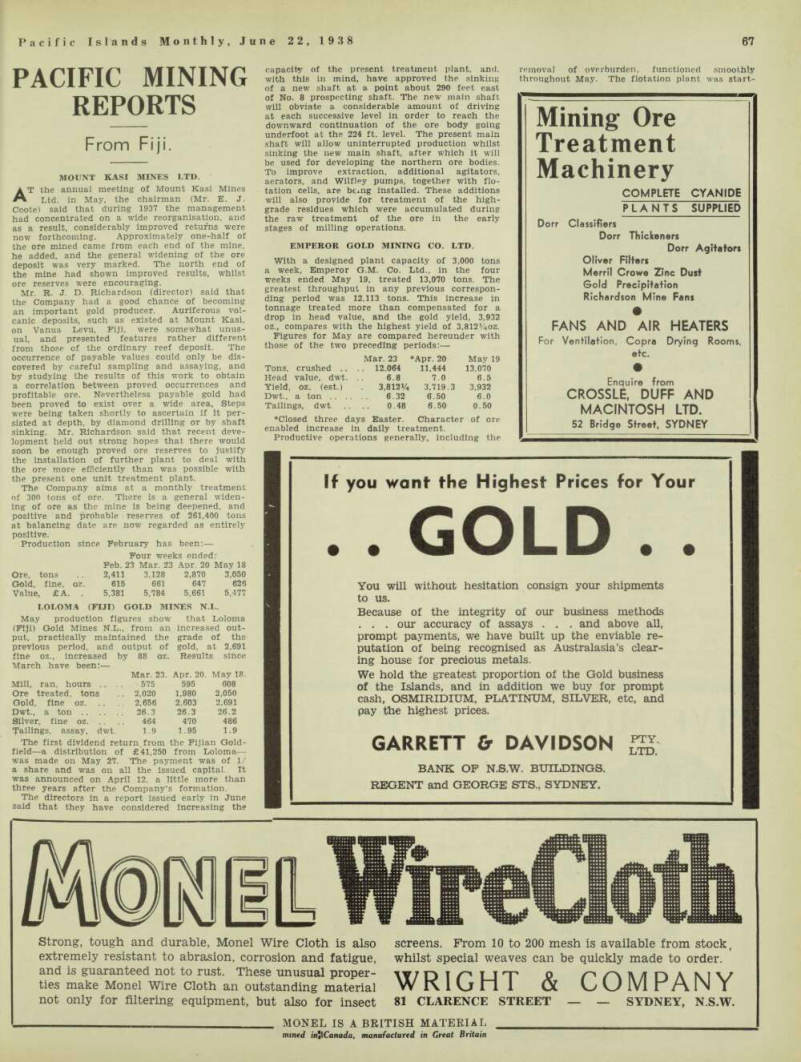
Reports
From Fiji.
Mount Kasi Mines Ltd.
AT the annual meeting of Mount Kasi Mines Ltd. in May, the chairman (Mr. E. J.
Coote) said that during 1937 the management had concentrated on a wide reorganisation, and as a result, considerably improved returns were now forthcoming. Approximately one-half of the ore mined came from each end of the mine, he added, and the general widening of the ore deposit was very marked. The north end of the mine had shown improved results, whilst ore reserves were encouraging.
Mr. R. J. D. Richardson (director) said that the Company had a good chance of becoming an important gold producer. Auriferous vol canic deposits, such as existed at Mount Kasi, on Vanua Levu, Fiji, were somewhat unus ual, and presented features rather different from those of the ordinary reef deposit. The occurrence of payable values could only be dis covered by careful sampling and assaying, and by studying the results of this work to obtain a correlation between proved occurrences and profitable ore. Nevertheless payable gold had been proved to exist over a wide area, Steps were being taken shortly to ascertain if it per sisted at depth, by diamond drilling or by shaft sinking. Mr. Richardson said that recent deve lopment held out strong hopes that there would soon be enough proved ore reserves to Justify the Installation of further plant to deal with the ore more efficiently than was possible with the present one unit treatment plant.
The Company aims at a monthly treatment of 300 tons of ore. There is a general widen ing of ore as the mine is being deepened, and positive and probable reserves of 261,400 tons at balancing date are now regarded as entirely positive.
Production since February has been;—
Loloma (Fiji) Gold Mines N.L.
May production figures show that Loloma (Fiji) Gold Mines N.L., from an increased out put, practically maintained the grade of the previous period, and output of gold, at 2,691 fine oz., increased by 88 oz. Results since March have been:—
The first dividend return from the Fijian Gold field—a distribution of £41,250 from Loloma— was made on May 27. The payment was of 1/ a share and was on all the Issued capital. It was announced on April 12, a little more than three years after the Company’s formation.
The directors In a report issued early in June said that they have considered increasing the
capacity of the present treatment plant, and, with this in mind, have approved the sinking of a new shaft at a point about 290 feet east of No. 8 prospecting shaft. The new main shaft will obviate a considerable amount of driving at each successive level in order to reach the downward continuation of the ore body going underfoot at the 224 ft. level. The present main shaft will allow uninterrupted production whilst sinking the new main shaft, after which it will be used for developing the northern ore bodies.
To improve extraction, additional agitators, aerators, and Wilfley pumps, together with flo tation cells, are bemg installed. These additions will also provide for treatment of the high grade residues which were accumulated during the raw treatment of the ore in the early stages of milling operations.
Emperor Gold Mining Co. Ltd.
With a designed plant capacity of 3,000 tons a week, Emperor G.M. Co. Ltd., in the four weeks ended May 19, treated 13,070 tons. The greatest throughput in any previous correspon ding period was 12,113 tons. This increase in tonnage treated more than compensated for a drop in head value, and the gold yield, 3,932 oz., compares with the highest yield of 3,812V 4 0z.
Figures for May are compared hereunder with those of the two preceding periods:—
removal of overburden, functioned smoothly throughout May. The flotation plant was start
Mar. 23 *Apr. 20 May 19 Tons, crushed .. . . 12.064 11,444 13,070 Head value, dwt. .. 6.8 7.0 6.5 Yield, oz. (est.) 3,812 V 4 3,719.3 3,932 Dwt., a ton 6.32 6.50 6.0 Tailings, dwt 0.48 6.50 0.50 •Closed three days Easter. Character of ore enabled increase in dally treatment.
Productive operations generally, including the
Pour weeks ended: Feb. 23 Mar. 23 Apr. 20 May 18 Ore. tons 2,411 3,128 2,870 3,050 Gold, fine, oz. 615 661 647 626 Value. £ A. . 5,381 5,784 5,661 5,477
Mar. 23.
Apr. 20.
May 18.
Mill, ran, hours .. .. 575 595 608 Ore treated, tons . 2,020 1,980 2,050 Gold, fine oz. 2,656 2,603 2,691 Dwt., a ton 26.3 26.3 26.2 Silver, fine oz. 464 470 486 Tailings, assay, dwt. 1.9 1.95 1.9
ed up on the 23rd of the month.
The Co. reports that since the acquisition of the Koroere area, work has been confined to prospecting.
Kasi Developments Ltd.
The chairman of Kasi Development Ltd., Fiji, stated at the end of May that although the leases have been abandoned, Mt. Kasi Mines has secured over 100 acres abutting that Com pany’s area. If it is proved at depth, share holders in Kasi Developments will participate in the profits.
Advertisements & other items, pp. 69-70 (1 item)
Mining Ore
Treatment
Machinery
COMPLETE CYANIDE
PLANTS SUPPLIED
Dorr Classifiers Dorr Thickeners Dorr Agitators Oliver Filters Merril Crowe Zinc Dust Gold Precipitation Richardson Mine Fans •
FANS AND AIR HEATERS
For Ventilation, Copra Drying Rooms, etc. • Enquire from
CROSSLE, DUFF AND
MACINTOSH LTD.
52 Bridge Street, SYDNEY
If you want the Highest Prices for Your
. . GOLD . .
You will without hesitation consign your shipments to us.
Because of the integrity of our business methods . . . our accuracy of assays . . . and above all, prompt payments, we have built up the enviable reputation of being recognised as Australasia’s clearing house for precious metals.
We hold the greatest proportion of the Gold business of the Islands, and in addition we buy for prompt
cash, OSMIRIDIUM, PLATINUM, SILVER, etc, and
pay the highest prices.
GARRETT & DAVIDSON
BANK OF N.S.W. BUILDINGS.
REGENT and GEORGE STS., SYDNEY.
Jh c w c; w screens. From 10 to 200 mesh is available from stock, whilst special weaves can be quickly made to order.
Strong, tough and durable, Monel Wire Cloth is also extremely resistant to abrasion, corrosion and fatigue, and is guaranteed not to rust. These unusual proper- ty/nI r* II T"* JP C\ UDA\ ] \7 ties make Monel Wire Cloth an outstanding material WKIVJ il 1 Cx IVI li\lN Y not only for filtering equipment, but also for insect 81 CLARENCE STREET SYDNEY, N.S.W.
MONEL IS A BRITISH MATERIAL
mined in*\Canada, manufactured in Great Britain
ASTROLOGER
ADVISES
Woman Shares £lOOO
“I wrote to Pundit Asrah and he gave me some advice and also said that my lucky day should be Tuesday, so I sent for a share in a lottery on a Tuesday. It brought me a share of £l,OOO prize”. •"PViic io nr’hof Eort_ logy, gives days and numbers which should be lucky. This is what he did for Mrs. Woods —and. heeding th,e advice, she acted on the information and shared a £l.OOO prize.
Readers who would like similar advice are invited to clip this paragraph and send it, with a postal note for 1/- and a stamped, addressed envelope, and the date and year of their birth, to Pundit Asrah, Desk P.M., Box 586 E, G.P.0., Hobart.
By return mail they will receive advice as to the days that should be lucky. They will also be given ten simple rules on “How to be Lucky”.
These rules were given to Mrs.
Woods and followed by her before she shared the £l,OOO prize.
This is a money-back offer, and anyone who is not satisfied can have their money refunded.
Mrs. W. T. Woods birth, this famous astrologer, from his study of astro-
FIVE MINUTES RELIEF
There is nothing indefinite about " ASPRO."
Its service is QUICK safe, effective, and definite. It gives you relief in 5 to 10 minutes, and then goes on to dispel or dissolve the cause of the pain, allowing Nature to effect the desired relief. Furthermore, you get no harmful after effects from " ASPRO," as it is speedily eliminated from the system a few hours after being taken. It neither dopes, deadens,
nor drugs.
ASPRO'
DOES NOT HARM THE HEART
From New Guinea
Enterprise Of N.G. Gold And
Petroleum
THE general manager of Enterprise of New Guinea Gold and Petroleum Development N.L. reports that in the fortnight ended June 1 sluicing and elevating continued as usual at the Surprise Creek mine. Two faces showed a slight improvement in values.
At the Edie mine underground development work proceeded on three shifts. The new drain age adit passed through the main western lode at 853 ft. from the portal. The adit was ad vanced 102 ft., and timbered throughout during May. The lode is 3ft. 6in. wide, and consists of white friable quartz carrying sulphides. This is a major development, the general manager states, and will be followed up as rapidly as existing conditions permit.
The old drainage adit, 100 ft. above the horiz on of the new drainage adit, has cut the main western and the hanging wall lodes. The former shows a width of Bft,, and assays sdwt. B.6gr. gold and 4oz. 3dwt. 14.4 gr. silver a ton. The hanging-wall lode assays Bdwt. 19.2 gr. gold and 4oz. 13dwt. silver a ton over a width of 2ft.
Production of unrefined retorted alluvial gold from all sources in May was 370 z. 17dwt. from 2,565 cubic yds. wash and 1,872 cubic yds. over burden.
Sunshine Gold Development N.L.
Sunshine Gold Development Ltd. has declared a dividend of 6d. per share, payable on June 30. The previous dividend of 6d. per share was paid on February 28.
The Co.’s quarterly report is as follows:
During April and May sluicing was hamper ed through temporary staff shortage, and re
moval of an ancient landslide intrusion cover ing a limited section of the auriferous gravels being worked.
In May the Watut River tailings wall was blown further out. During this operation 8,400 cubic yds. tailings were blown up. This permits the area of the sluicing paddock to be extend ed in a north-westerly direction from No. 3 elevator site.
N.G. Goldfields Ltd.
For the third month in succession New Guinea Goldfields Ltd. incurred an operating loss on the Edie Creek mill. The management report ed it was expected that operations would re turn to normal during May. Production figures for the last three months are compared in the following table:—
Sandy Creek Gold Sluicing Ltd.
The mine manager of Sandy Creek Gold Sluicing Ltd. reported on June 2 that May production compared with the three previous months as follows:—
Cub. yd. Hours. Oz. Gold.
March 12,000 517 519.75 ) 502 352.25 23.400 May ' 423 335.23 35,400 1,442 1,180.252 Previous quarter 52,300 1,451 1,084.3
Feb.
Mar.
April.
Alluvial— Pine gold, oz. 1914 1,163 959 Fine silver, oz. 665 847 684 Golden Ridges Mill — Fine gold, oz. .. 601 x50 Fine silver, oz. 671 x55 Edie Creek Mill— Fine gold, oz. .. 652 758 744 Silver, oz 2,936 2,845 2,528 Operating Profit— Edie Creek Mill . *£1,214 ‘£1,427 *£1,206 Alluvial £2,383 £4,286 £2,880 Golden Ridges Mill £3.532 £411 tReduced production due to a pump breakdown. ‘Operating loss. xFrom clean up of plant.
Feb. Mar.
Apr.
May.
Cubic yards .. 18.441 17,2GO 18,790 20,119 Gold, oz. 258 338 212 446 Per cub. yd. 2/1 y 4 2/10V2 1 /8V2 3/4 Working cost 1/5 1/1 1/4 1/4
Bulolo
Gold Deposits
Ltd.
The following yields have been reported by Bulolo Gold Deposits Ltd.. New Guinea:— Five weeks Mar. 11, Apr. 28, ended to to Mar. 10. Apr. 27.
June 3.
Hours ,. . . 545 825 725 Morobe Alluvials— Cubic yards . . . 4,720 8.500 7,000 Gold, oz. . .. 120 130 130 Morobe Deposits- Hours ... 470 850 420 Cubic yards . . . 2,500 4,000 3,000 Gold, oz. .. . ... 35 50 35
From Papua
Mandated Alluvials
MANDATED ALLUVIALS, NX., has been ad vised from the Chillagoe Smelters that the contents of the first shipment of matte from the mine near Port Moresby, Papua, was 114 oz. gold, 3360 z. silver, and five tons cop per. Mecnanlcal adjustments caused suspen sion of the plant for a short period. The sec ond consignment of matte, which is of a high er grade, has been prepared for shipment.
There have been no metallurgic difficulties.
Borneo Options N.L.
Borneo Options N.L. has decided to exer cise its options over the manganese lease at Kapa Kapa and its gold lease at Astralobe goldfield, Papua. The Company has also ac quired a red oxide lease at Rigo, Papua. Ar rangements are being made to develop these leases at an early date and to dispose of the large tonnage of ore at grass.
Gold Mines Of Papua Ltd.
During May, Gold Mines of Papua, Ltd. treated 1,600 tons of ore, and recovered bul lion and concentrates valued at £1,630. The treatment difficulties experienced are being overcome, and the labour position is gradu allv improving.
Comparison of production shows: — April. May.
Gold £930 £1,630 Crushed, tons 1,375 1,600
Papuan Apinaipi Petroleum Co. Ltd.
Mr. L. Owen, British petroleum geologist, has submitted to the directors of Papuan Api nalpl Petroleum Co. Ltd., of Sydney, a re port of the Aplnaipi dome and surrounding
country, Papua. Mr. Owen advises that the permit area held by the Company contains a number of structures favourable to the col lection and conservation of petroleum, and the greater part of the area justifies the expense of detailed geological investigation. The work accomplished up to the present by the vari ous geologists who have examined the area is almost entirely of a pioneer nature. The whole area is underlaid at varying depths by a mudstone series of strata which is known to be petroliferous in other parts of Papua, although proof of its commercial value is lacking, as none of the drilling so far accom plished has reached the horizon where com mercial oil might be expected to occur. In spite of this incomplete knowledge of the area the Oiapu structure is so excellent that drill ing is justified to a depth of 5,000 ft.
Cuthbert’S Misima Gold Mines Ltd.
Directors of Cuthbert’s Misima Gold Mines Ltd., Misima Island, have declared an interim dividend of 1/ a share, payable June 25.
Transfer books closed on June 17. In 1937, the Company made four distributions, each of 6d a share, equivalent to 20 per cent. The divid end of 1/ to be paid on June 25 is the first declared this year, and will require £15,000.
This will bring the aggregate disbursements to £67,500
Quartz Mountain (Papua) Ltd.
Quartz Mountain (Papua) Ltd., a Dunedin N.Z., gold company which has a considerable area on Mlsima Island. Eastern Papua, after a long period of inactivity, has made a new move. The chairman of directors (Mr. J.
W. Thomson) was in Sydney in June. The recently-appointed engineer-manager (Mr. Don aldson) has taken charge at Misima. and has commenced investigations preparatory to car rying out a new development policy. Neces sary white labour, has been engaged, and min ers left by the “Macdhui” on June 1 to com plete present requirements. By the same ves sel Mr. D. P. Scott, M.A.I.M.M. (who is the Company’s consulting metallurgist and man aging director of Quartz Investments Ltd.), also left Sydney on a visit to Mlsima.
Recent comparative production figures are: Mar. Apr. May.
Treated, tons 2.805 2,656 2,568 Bullion, oz 2,814 2,496 2,397 Gold, fine oz 845 764 738 Silver, fine oz 1,550 1.503 1,537 Estimated value (gold at £A8 OZ. 1 .. . £6,833 £6,184 £6,000 Per ton 48/9 46/7 46/9
Gold Shares.
Quotations for Islands Gold Shares.
Mr. J. M. Hedstrom arrived in Aus tralia by the May “Monterey” from Fiji.
Mr. L. J. O’Malley, A.R.M., who to gether with Mr. Jack Hides carried out important explorations in Central Papua some time ago, arrived in Sydney by the “Macdhui” on May 26, on furlough.
Fiji.
Mid-Jan. Mid-Apr. Mid-June.
Emperor Mines ... bl3/2 bl2/5 bl2/4 Koroere ... s3/ bl/6 Loloma bl7/ b23/6 b21/9 Mt. Kasi b4/ll b3/ll b3/10 Vatu Kasia sl/9 sl/2 s2/
New Guinea.
Bulolo Deposits .. bl/1 >/ 2 blOd b8«/ 2 d Bulolo G.D b £ 6/3/ b£2 b£6/10/ Enterprise ot N.G bl5/ b£ 1/7/6 b £ 1/2/6 Guinea Gold bl2/6 bl2/10 bl3/4 N.G.G., Ltd bl/6 bl/4 bl/5 Oil Search .. b6/7 b6/l b6/3 Placer Dev b£3/14/6 b£ 3/11/6 b3/15/6 Sandy Ck bl/6 bl/4 bl/5 Sunshine Gold bll/6 bll/8 bll/3
Papua.
Cuthbert’s b20/6 bl9/ bl8/6 G.M. of Papua blO/2 b7/ll b8/ Mandated All. ... b2/ bl/7 b2/3 Oriomo Exp. b3/5 b2/3 b3/10 Papuan Apinaipi b6/ Yodda Gold Co — b6d b6d
N.G Public Service
AT the end of May the following staff move ments in the New Guinea Public Service were announced by the Government Secretary, Rabaul:—
Permanent Staff Transfers
Public Health Dept.:—P. J. Giles, Medical Assistant, Salamaua to Rabaul.
District Services. Dept.:—C. H. Maclean, Clerk, Kavieng to Madang; J. I. Merry lees, D. 0., Rabaul to Kieta; H. A. Gregory, A.D.0., Kieta to Rabaul; W. M. Marshall, Clerk, Ra baul to Salamaua.
Lauds Dept.:—P. M. Swanson, Chainman, Salamaua to Rabaul.
Agriculture Dept.:—G. F. H. Gee, Inspector, Manus to Rabaul.
Customs Dept.:—P. E. R. Coe, Clerk, Sala maua to Rabaul.
Temporary Engagements.
District Service Dept.:—V. M. I. Gordon to be Storeman.
Lands Dept.:—G. D. Cowdery and J. Ban nigan to be Chainmen.
Agriculture Dept.:—Mrs. D. J. Beaton to be Typlste.
Public Works Dept.:—N. C. Momsen and S Bryan to be Roadmasters.
Mr. A. W. Brooks left Sydney for Suva, Fiji by the “Niagara” on June 9. An
employee of the Colonial Sugar Refining
Co., at Rarawai, he has been on three
months’ leave.
Advertisements & other items, p. 71 (1 item)
Pumpmobil
LIGHT AND PORTABLE
MOTOR PUMP
' Complete Plant’s weight, 140 lbs. Capacity up to 12,000 gallons per hour.
All heads from 10 to 115 feet.
Fuel consumption, gallon per hour.
Pressure 551 b. square inch.
Especially suitable prospecting and all Sluicing Requirements.
NELSON & ROBERTSON PTY. LTD
12 SPRING STREET SYDNEY
STEAMSHIPS TRADING COMPANY LTD.
PORT MORESBY PAPUA SAMARA)
Chairman and Managing Director: A. S. FITCH.
Shipowners, Wholesale and Retail Merchants and Traders; Shipping, Customs and Insurance Agents; Copra and Rubber Plantation Owners.
MAIL CONTRACTORS TO COMMONWEALTH AND PAPUAN GOVERNMENTS.
AGENCIES:—At Port Moresby: Coral Sea Insurance Co.; Phoenix Insurance Co.; Delta Sawmills, Ltd.; Acme Bakery Co.; Vacuum Oil Co. Pty. Ltd. At Samara!: Coral Sea Insurance Co. ; Delta Sawmills, Ltd.; Bankers and Traders’
Insurance Co. ; National Mutual Life Insurance Co.; Kularo Shipyards; Mamai Plantations.
BRANCHES;—In Papua; Hanuabada, Sivitoi, Aroma, Koki, Hula, Ela Beach, Duga Duga, Yule Island.
SYDNEY: NELSON & ROBERTSON PTY. LTD., 12 Spring St. ; Melbourne. 396 Flinders Lane; London, E. Whiteaway & Co.. 7 Chiswell Street. Finsbury, London.
Cable Address; ‘‘STEAMSHIPS.” Code- Bentley’s.
SKANDIA
FULL DIESEL ENGINES
MARINE AND STATIONARY
INSTANTANEOUS STARTING
SWEDISH MANUFACTURE
Guaranteed low consumption Fuel and Lubricating oil.
Simplest and most economical of aJI diesels.
Owners write in terms of highest praise.
Particulars:
NELSON & ROBERTSON PTY. LTD.
12 Spring Street, Sydney
Adventures Of Girl Flyer
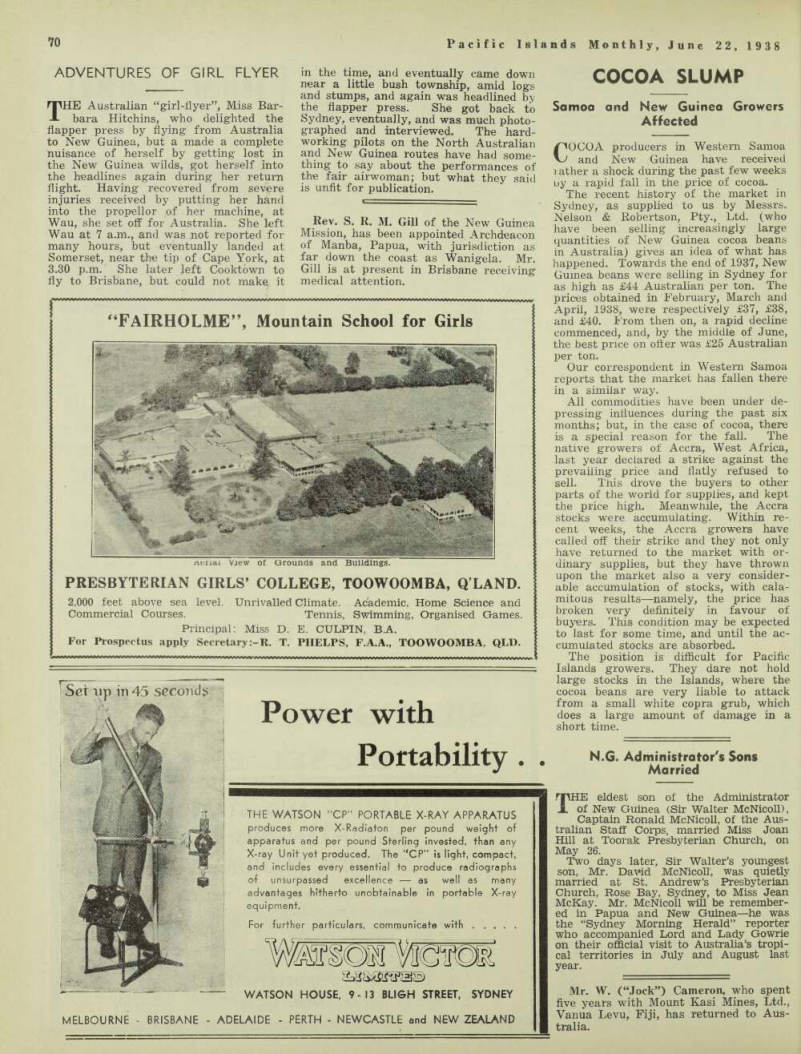
THE Australian “girl-flyer”, Miss Bar bara Hitchins, who delighted the flapper press by flying from Australia to New Guinea, but a made a complete nuisance of herself by getting lost in the New Guinea wilds, got herself into the headlines again during her return flight. Having recovered from severe injuries received by putting her hand into the propellor of her machine, at Wau, she set off for Australia. She left Wau at 7 a.m., and was not reported for many hours, but eventually landed at Somerset, near the tip of Cape York, at 3.30 p.m. She later left Cooktbwn to fly to Brisbane, but could not make it
in the time, and eventually came down near a little bush township, amid logs and stumps, and again was headlined by the flapper press. She got back to Sydney, eventually, and was much photo graphed and interviewed. The hard working pilots on the North Australian and New Guinea routes have had some thing to say about the performances of the fair airwoman; but what they said is unfit for publication.
Rev. S. R. M. Gill of the New Guinea Mission, has been appointed Archdeacon of Manba, Papua, with jurisdiction as far down the coast as Wanigela. Mr.
Gill is at present in Brisbane receiving medical attention.
Cocoa Slump
Samoa and New Guinea Growers Affected
COCOA producers in Western Samoa and New Guinea have received rather a shock during the past few weeks uy a rapid fall in the price of cocoa.
The recent history of the market in Sydney, as supplied to us by Messrs.
Nelson & Robertson, Pty., Ltd. (who have been selling increasingly large quantities of New Guinea cocoa beans in Australia) gives an idea of what has happened. Towards the end of 1937, New Guinea beans were selling in Sydney for as high as £44 Australian per ton. The prices obtained in February, March and April, 1938, were respectively £37, £3B, and £4O. From then on, a rapid decline commenced, and, by the middle of June, the best price on off er was £25 Australian per ton.
Our correspondent in Western Samoa reports that the market has fallen there in a similar way.
All commodities have been under de pressing influences during the past six months; but, in the case of cocoa, there is a special reason for the fall. The native growers of Accra, West Africa, last year declared a strike against the prevailing price and flatly refused to sell. This drove the buyers to other parts of the world for supplies, and kept the price high. Meanwhile, the Accra stocks were accumulating. Within re cent weeks, the Accra growers have called off their strike and they not only have returned to the market with or dinary supplies, but they have thrown upon the market also a very consider able accumulation of stocks, with cala mitous results —namely, the price has broken very definitely in favour of buyers. This condition may be expected to last for some time, and until the ac cumulated stocks are absorbed.
The position is difficult for Pacific Islands growers. They dare not hold large stocks in the Islands, where the cocoa beans are very liable to attack from a small white copra grub, which does a large amount of damage in a short time.
N.G. Administrator's Sons
Married
THE eldest son of the Administrator of New Guinea (Sir Walter McNicoll), Captain Ronald McNicoll, of the Aus tralian Staff Corps, married Miss Joan Hill at Toorak Presbyterian Church, on May 26.
Two days later, Sir Walter’s youngest son, Mr. David McNicoll, was quietly married at St. Andrew’s Presbyterian Church, Rose Bay, Sydney, to Miss Jean McKay. Mr. McNicoll will be remember ed in Papua and New Guinea —he was the “Sydney Morning Herald” reporter who accompanied Lord and Lady Gowrie on their official visit to Australia’s tropi cal territories in July and August last year.
Mr. W. (“Jock”) Cameron, who spent five years with Mount Kasi Mines, Ltd., Vanua Levu, Fiji, has returned to Aus tralia.
Advertisements & other items, p. 72 (1 item)
Power with
“FAIRHOLME”, Mountain School for Girls
- V X JX- '-r; i ■ Aenai View of Grounds and Buildings.
PRESBYTERIAN GIRLS’ COLLEGE, TOOWOOMBA, Q LAND.
2,000 feet above sea level. Unrivalled Climate. Academic, Home Science and Commercial Courses. Tennis, Swimming, Organised Games.
Principal: Miss D. E. CULPIN, B.A.
For Prospectus apply Secretary:-R. T. PHELPS, F.A.A., TOOWOOMBA, QLD.
Set up in 45 second^ m * V f »
Power with
Portability . .
THE WATSON "CP" PORTABLE X-RAY APPARATUS
produces more X-Radiaton per pound weight of apparatus and per pound Sterling invested, than any X-ray Unit yet produced. The U CP" is light, compact, and includes every essential to produce radiographs of unsurpassed excellence —as well as many advantages hitherto unobtainable in portable X-ray equipment.
For further particulars, communicate with SaSßaEPa©
WATSON HOUSE. 9-13 BLIGH STREET. SYDNEY
MELBOURNE - BRISBANE - ADELAIDE - PERTH - NEWCASTLE and NEW ZEALAND
Writs Against Papuan
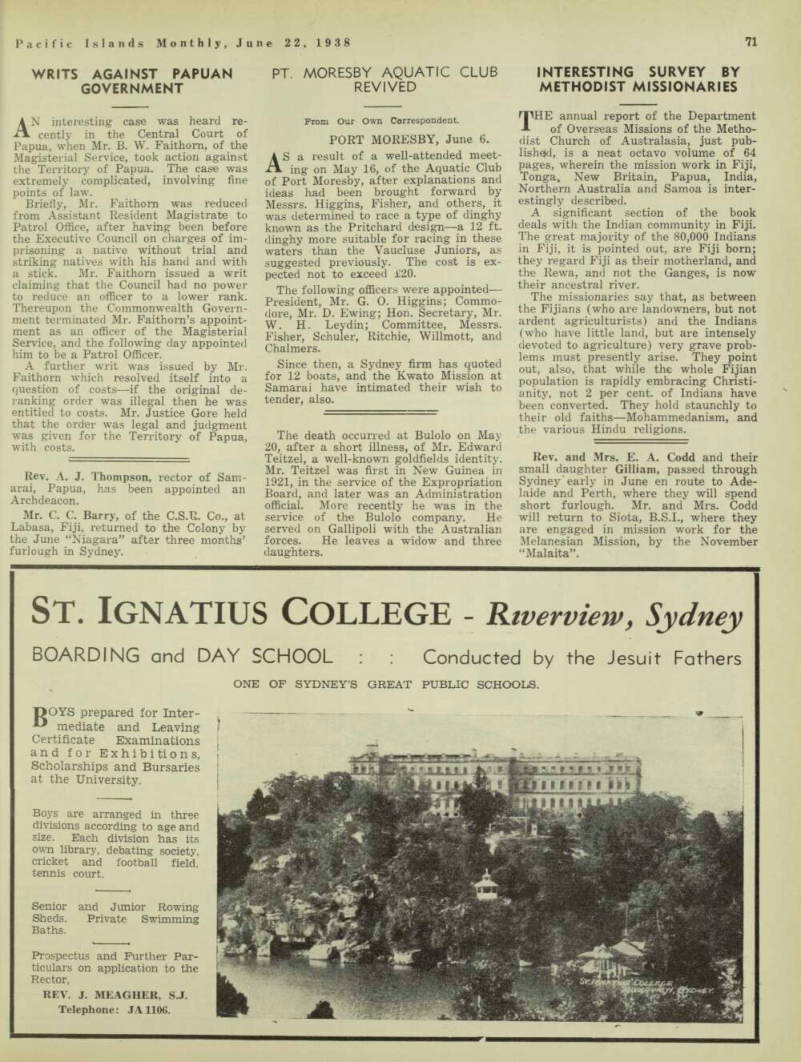
Government
AN interesting case was heard re cently in the Central Court of Papua, when Mr. B. W. Faithom, of the Magisterial Service, took action against the Territory of Papua. The case was extremely complicated, involving fine points of law.
Briefly, Mr. Faithom was reduced from Assistant Resident Magistrate to Patrol Office, after having been before the Executive Council on charges of im prisoning a native without trial and striking natives with his hand and with a stick. Mr. Faithom issued a writ claiming that the Council had no power to reduce an officer to a lower rank.
Thereupon the Commonwealth Govern ment terminated Mr. Faithom’s appoint ment as an officer of the Magisterial Service, and the following day appointed him to be a Patrol Officer.
A further writ was issued by Mr.
Faithom which resolved itself into a question of costs —if the original de ranking order was illegal then he was entitled to costs. Mr. Justice Gore held that the order was legal and judgment was given for the Territory of Papua, with costs.
Rev. A. J. Thompson, rector of Sam arai, Papua, has been appointed an Archdeacon.
Mr. C. C. Barry, of the C.S.R. Co., at Labasa, Fiji, returned to the Colony by the June “Niagara” after three months’ furlough in Sydney.
Pt. Moresby Aquatic Club
Revived
Prom Our Own Correspondent.
Port Moresby, June 6.
AS a result of a well-attended meet ing on May 16, of the Aquatic Club of Port Moresby, after explanations and ideas had been brought forward by Messrs. Higgins, Fisher, and others, it was determined to race a type of dinghy known as the Pritchard design—a 12 ft. dinghy more suitable for racing in these waters than the Vaucluse Juniors, as suggested previously. The cost is ex pected not to exceed £2O.
The following officers were appointed— President, Mr. G. O. Higgins; Commo dore, Mr. D. Ewing; Hon. Secretary, Mr, W. H. Leydin; Committee, Messrs.
Fisher, Schuler, Ritchie, Willmott, and Chalmers.
Since then, a Sydney firm has quoted for 12 boats, and the Kwato Mission at Samarai have intimated their wish to tender, also.
The death occurred at Bulolo on May 20, after a short illness, of Mr. Edward Teitzel, a well-known goldfields identity.
Mr. Teitzel was first in New Guinea in 1921, in the service of the Expropriation Board, and later was an Administration official. More recently he was in the service of the Bulolo company. He served on Gallipoli with the Australian forces. He leaves a widow and three daughters.
Interesting Survey By
Methodist Missionaries
THE annual report of the Department of Overseas Missions of the Metho dist Church of Australasia, just pub lished, is a neat octavo volume of 64 pages, wherein the mission work in Fiji, Tonga* New Britain, Papua, India, Northern Australia and Samoa is inter estingly described.
A significant section of the book deals with the Indian community in Fiji.
The great majority of the 80,000 Indians in Fiji, it is pointed out, are Fiji bom; they regard Fiji as their motherland, and the Rewa, and not the Ganges, is now their ancestral river.
The missionaries say that, as between the Fijians (who are landowners, but not ardent agriculturists) and the Indians (who have little land, but are intensely devoted to agriculture) very grave prob lems must presently arise. They point out, also, that while the whole Fijian population is rapidly embracing Christi anity, not 2 per cent, of Indians have been converted. They hold staunchly to their old faiths—Mohammedanism, and the various Hindu religions.
Rev. and Mrs. E. A. Codd and their small daughter Gilliam, passed through Sydney'early in June en route to Ade laide and Perth, where they will spend short furlough. Mr. and Mrs. Codd will return to Siota, 8.5.1., where they are engaged in mission work for the Melanesian Mission, by the November “Malaita”.
Advertisements & other items, pp. 73-74 (1 item)
St. Ignatius College - Rwerview, Sydney
BOARDING and DAY SCHOOL Conducted by the Jesuit Fathers
ONE OF SYDNEY’S GREAT PUBLIC SCHOOLS.
T>OYS prepared for Intermediate and Leaving Certificate Examinations and for Exhibitions, Scholarships and Bursaries at the University.
Boys are arranged in three divisions according to age and size. Each division has its own library, debating society, cricket and football field, tennis court.
Senior and Junior Rowing Sheds. Private Swimming Baths.
Prospectus and Further Particulars on application to the Rector,
REV. J. MEAGHER, S.J.
Telephone: JA 1106. szst 111 y
“Totem”, the newest and most thrilling Race Game for Home, parties, clubs, hotels, billiardrooms, etc.. 21/-. Write for leaflet Electric Dry shavers for 240
A.C. D.C. El-
ectric supply. Write for full list.
“VICO” 75/.
Special price to traders. Write for prices. “Packard” 90/.
“Schick” £5/5/.
All Bakelite R o u 1 e tte Wheels British 25/-.
Cloths 4/8, 9/6, 12/6, 15/.
Other types of Novelties 35/, 38/6, 48/6, 65/, 75/, up to £l2/10/. Write for fullest particulars. Small Roulette glass tops with betting sheets, 3/6. In Wooden Types 12/6. w English Cosmocord Gramo Radio Electric Motor complete with turntable and Pick-up: £9/10/-.
Ready to hook-up to your Radio. 240 A.C. Write for Lists.
Mantel Model Electric 240 volt A.C. Electric Radios in cabinets as illustrated £9/10/-, with 12 months guarantee. Floor Models, £l2/10/. Mantel Cabinets only 25/.
BULGIN
Aerial Lightning Switch.
British Best.
Highest Grade Electric Solder Iron, 15/.
Heavy Duty Type, 22/6.
“Goldstone” Jun i o r Electric Solder Irons, British, 4/6.
With Flex and 2-pin Plug.
Electric Motor Boats. Beautiful Wooden Models with Electric Motor and Battery Complete: 25/-, 35/-.
Metal Electric Boats: 9/11, 12/6, 14/6.
Steam Boats, All MetaJ: 12/15, 15/6, 18/6,
man-o-iupß"
RUBBER CLOD
PERIQL
4o sTßonos & (00 FT High tone buzzer for Morse Code Vlr Work as illustrated 3/6 other 2/6, 3/9 7/6. Morse Keys 12/6 & 19/6. £ Eliminoise’
Aerial Kit, carcaa for J Bhor ‘ Sms® or dual SsglssA A « rial p yrex type Insulators, transposi ti o n blocks and 200 ft. aerial wire, 22/6. Eliminates unwanted aerial and hideous electrical noises from your dual-wave or short-wave set. % ROLETTE. You back your fancy in the numbers and colors of three balls. The game ejects 3 colored balls. 55/. For homes, hotels clubs, etc. Complete with betting sheet and instructions. Send for Leaflet.
Gramophone Pick-up Heads. Suits all Sets. Pit all Standard Tone Arms 10/6, 12/6, 15/6, 19/6. Send for full list.
We have the best price for all types of Radio Valves. Just trust us with your order and mention the offer of at least 20 per cent, off xll List Prices.
Pickup ‘ Heads, fit all standard Gramo phone tone ental 10/6, 12/6.
English Cosmocord 11/6, 19/6.
English “Goldring” 16/6, 18/6, 19/6, with selfcontained Volume Control 21/ and 25/- with separate voluim control. 7/9 Beautiful Novelty Cigarette Cases. Up jump the cigarettes as you want them. Other Cigarette Novelty Cases; 3/9, 4/6, 5/6.
X Poker Card Dart Game for family or Club use. Complete with darts: 12/6. Dart Boards: 3/6, 8/6. 9/6, 10/6, up to 39/6. Darts, 3/ dozen.
Competition Darts: 1/6, 2/- each.
Build or buy assembled Lakes 1-valve All-wave Battery-operated Radio. Plug in coils for all wave lengths. Coils ready made. Easiway charts, 6d. Free with kit.
Parts 40/1, Valve 12/, Battery 11/9, Phones 30/, complete and built £5.
We Stock all kinds of Rubber Knee Boots and Rubber Rain Coats. Wet Weather Wants, etc. n Buy assembled or build the Air Patrol 2 - valve Battery - operated Radio for all short-wave stations and broadcasts. Easy to operate, change over switch. All parts £4/1/6, Valves 28/9, Batteries £2/15/9, Phones 30/-, Speaker 21/3.
The set assembled and complete, £l2/14/9. Easiway Charts 6d.
G r a phoscope 8/6. With it you can draw anything from any copy.
Fo cussing Torches, 1,500 ft., 5-cell. 6/6 “Cosmocord” British 240 Volt AO Electric Gramophone Motor and all turntable fittings, 39/6.
Valves: we guarantee a cheaper price for any replacement. Just send along your order.
Batteryless Hand Holding Microphone for speech or music, 45/- value for 22/6. eov/ mo 0 0 As illustrated with long lead fitted. Splendid Reproducer.
Excel lent English Mic r o p h o ne, Table Model, with selfcontained pre - amplifier unit in Base- 39/6.
These Microphones suit all sets. The leads plug into the Pickup terminals of the set.
Write for full illustrated list of the finest range of micro phones available. m Forehead Electric Battery Operated Torches for Campers Bush Workers, Miners, Bands men, Doctors, Soldiers, etc. 10/6 complete.
“Radio Moderne”. The Greatest Battery Operated Dual Wave Radio Made. No idle boast. A real and established fact. “Radio Moderne” is specially designed for the Island trade £22/10/. Send for the latest illustrated leaflet.
COSMOCOBD'
25' utA “Like a Flash” British make Gramophone Pickups comple Richards, just arrived 25/- “Cosmocord” 25/- "Cosmocord” De Luxe 32/6 “Cosmocord” high definition SB/6 "Cosmocord” Super de Luxe 45/- Amplion (English) 28/6 B.T.H. Crystal Type 75/-.
Write for Full List.
Petrel Irons for Laundry Work; 49/6, 59/C, Roulette Wheels, Glass Top: 3/6. All Bakeilite Beautiful English Model 25/-, ,Send for full list of Novelties. Joy Buzzer .Hand Shakers 3/3; Walking Match Box 2/3; 'Wobbling Match Box 1/6. (Headphones. Lissen 19/6; B.T.H. & S.T.C.
'’3o/-. Others 10/6. 6ft. ’Phone Cords 1/6 ’Phones Pads 1/9.
Miniature Table Model Electric Super Het.
Radios: £l2/10/ Value—NOW £B/10/. 12 months’ guarantee.
Write for Punch Board Leaflets
LEVENSON'S RADIO
Write fer
Pin-Game,
Totem and Odds and Evens Leaflets
GAMES, NOVELTIES AND HOBBIES
226 PITT STREET, SYDNEY
Manufacturers, Importers, and Exporters.
Branches: Radio Cheapside, 240 a Pitt St.
N.S.W.. AUSTRALIA v
Cable address: “Leveradioh.” Goods forwarded V.P.P. or Sight Draft. Satisfaction and Service Guaranteed. We can supply by mail all General Merchandise at a Better Price. Quotations with pleasure.
Please add freight and packing. Write for full list of interesting leaflets of Games, Hobbies, Novelties, and Electrical Goods.
Australian Short Wave
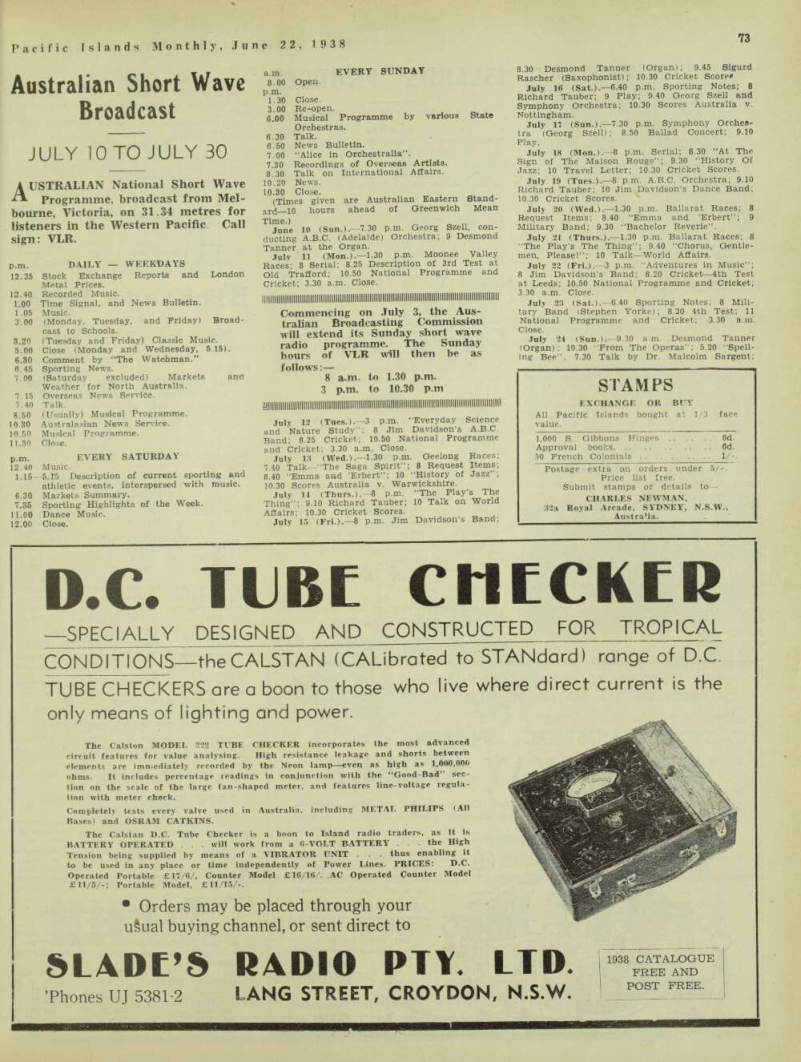
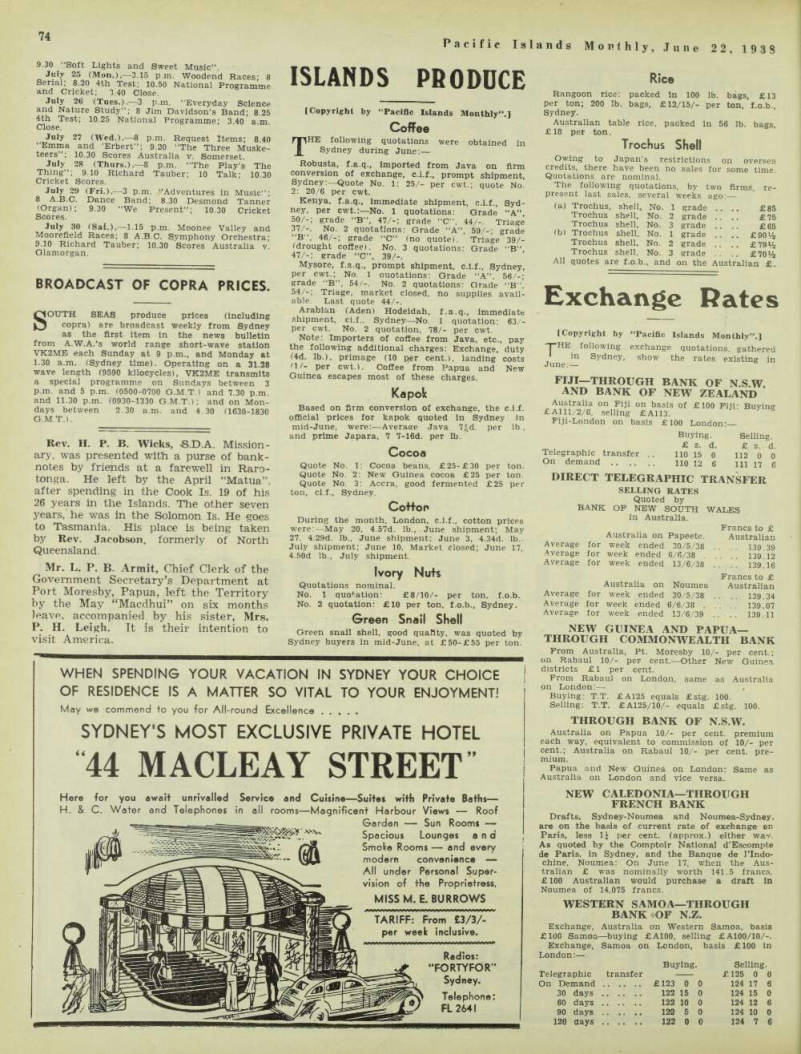
Broadcast
July 10 To July 30
AUSTRALIAN National Short Wave
Programme, broadcast from Mel
bourne, Victoria, on 31.34 metres for
listeners in the Western Pacific. Call
sign: VLR.
P.M. Daily Weekdays
12.25 Stock Exchange Reports and London Metal Prices. 12.40 Recorded Music. 1.00 Time Signal, and News Bulletin. 1.05 Music. 3.00 (Monday, Tuesday, and Friday) Broad cast to Schools. 3.20 (Tuesday and Friday) Classic Music. 5.00 Close (Monday and Wednesday, 5.15). 6.30 Comment by “The Watchman." 6.45 Sporting News. 7.00 (Saturday excluded) Markets and Weather for North Australia. 7.15 Overseas News Service. 7,40 Talk. 8.50 (Usually) Musical Programme. 10.30 Australasian News Service. 10.50 Musical Programme. 11.30 Close.
P.M. Every Saturday
12.40 Music. 1.16—5.15 Description of current sporting and athletic events, interspersed with music. 6.30 Markets Summary. 7.35 Sporting Highlights of the Week. 11,00 Dance Music. 12.00 Close.
а. Every Sunday
8.00 Open, p.m. 1.30 Close. 3.00 Re-open. б. Musical Programme by various State Orchestras. 6.30 Talk. 6.50 News Bulletin. 7.00 “Alice in Orchestralia”. 7.30 Recordings of Overseas Artists. 8.30 Talk on International Affairs. 10.20 News. 10.30 Close. (Times given are Australian Eastern Stand ard— 10 hours ahead of Greenwich Mean Time.) a „ June 10 (5un.).—7.30 p.m. Georg Szell, con ducting A.B.C. (Adelaide) Orchestra; 9 Desmond Tanner at the Organ. juiv 11 (M0n.).—1.30 p.m. Moonee Valley Races; 8 Serial; 8.25 Description of 3rd Test at Old Trafford; 10.50 National Programme and Cricket; 3.30 a.m. Close.
July 12 (Tues.).—3 p.m. “Everyday Science and Nature Study”: 8 Jim Davidson’s A.B.C Band; 8.25 Cricket; 10.50 National Programme and Cricket; 3.30 a.m. Close.
July 13 (Wed.).—l3o p.m. Geelong Races; 7.40 Talk “The Saga Spirit”: 8 Request Items; 8.40 “Emma and ’Erbert”; 10 “History of Jazz’ ; 10.30 Scores Australia v. Warwickshire.
July 14 (Thurs.).—B p.m. “The Play’s The Thing”; 9.10 Richard Tauber; 10 Talk on World Affairs: 10.30 Cricket Scores.
July 15 (Fri.). —8 p.m. Jim Davidson’s Band;
Commencing on July 3, the Aus tralian Broadcasting Commission will extend its Sunday short wave radio programme. The Sunday hours of VLR will then be as follows: — 8 a.m. to 1.30 p.m. 3 p.m. to 10.30 p.m
8.30 Desmond Tanner (Organ); 9.45 Sigurd Rascher (Saxophonist); 10.30 Cricket Score* July 16 (Sat.). —6.40 p.m. Sporting Notes; 8 Richard Tauber; 9 Play; 9.40 Georg Szell and Symphony Orchestra: 10.30 Scores Australia v.
Nottingham.
July 17 (Sun.). —7.30 p.m. Symphony Orches tra (Georg Szell); 8.50 Ballad Concert; 9.10 Play.
July 18 (Mon.).—B p.m. Serial; 8.30 “At The Sign of The Maison Rouge”; 9.30 “History Of Jazz; 10 Travel Letter; 10.30 Cricket Scores.
July 19 (Tues.). —8 p.m. A.B.C. Orchestra; 9.10 Richard Tauber; 10 Jim Davidson’s Dance Band; 10.30 Cricket Scores.
July 20 (Wed.).—1.30 p.m. Ballarat Races; 8 Request Items; 8.40 “Emma and ’Erbert”; 9 Military Band; 9.30 “Bachelor Reverie”.
July 21 (Thurs.). —1.30 p.m. Ballarat Races; 8 “The Play’s The Thing”; 9.40 “Chorus, Gentle men, Please!”; 10 Talk —World Affairs.
July 22 (Fri.). —3 p.m. “Adventures in Music”; 8 Jim Davidson’s Band; 8.20 Cricket—4th Test at Leeds: 10.50 National Programme and Cricket, 3.30 a.m. Close.
July 23 (Sat.). —6.40 Sporting Notes; 8 Mili tary Band (Stephen Yorke); 8.20 4th Test; 11 National Programme and Cricket; 3.30 a.m.
Close.
July 24 (5un.).—9.30 a.m. Desmond Tanner (Organ): 10.30 “From The Operas’ ; 5.20 “Spell ing Bee”. 7.30 Talk by Dr. Malcolm Sargent:
9.30 “Soft Lights and Sweet Music”.
July 25 (M0n.).—3.15 p.m. Woodend Races; 8 Serial; 8.20 4th Test; 10.50 National Programme and Cricket: 3.40 Close.
July 26 (Tues.). —3 p.m. “Everyday Science and Nature Study”; 8 Jim Davidson’s Band; 8.25 4th Test; 10.25 National Programme; 3.40 a.m.
Close.
July 27 (Wed.).—B p.m. Request Items; 8.40 “Emma and ’Erbert”; 9.20 “The Three Muske teers”; 10.30 Scores Australia v. Somerset.
July 28 (Thurs.). —8 p.m. “The Play’s The Thing”; 9.10 Richard Tauber; 10 Talk; 10.30 Cricket Scores.
July 29 (Fri,). —3 p.m. “Adventures in Music”; 8 A.B.C. Dance Band; 8.30 Desmond Tanner (Organ); 9.30 “We Present”; 10.30 Cricket Scores.
July 30 (Sat.). —1.15 p.m. Moonee Valley and Moorefleld Races; 8 A.B.C. Symphony Orchestra; 9.10 Richard Tauber; 10.30 Scores Australia v.
Glamorgan.
Advertisements & other items, p. 75 (1 item)
D.C. Tube Checker
STAMPS
EXCHANGE OR BUY
All Pacific Islands bought at 1/3 face value. 1,000 S. Gibbons Hinges 6d.
Approval books 6d. 50 French Colonials . . !/-■ Postage extra on orders under 5/-.
Price list free.
Submit stamps or details to —
CHARLES NEWMAN,
32a Royal Arcade, SYDNEY, N.S.W., Australia.
D.C. TUBE CHECKER
—SPEC I ALLY DESIGNED AND CONSTRUCTED FOR TROPICAL CONDITIONS—theCALSTAN (CALibroted to STANdard) range of D.C.
TUBE CHECKERS are a boon to those who live
only means of lighting and power.
The Calston MODEL 222 TUBE CHECKER incorporates the most advanced circuit features for value analysing. High resistance leakage and shorts between elements are immediately recorded by the Neon lamp—even as high as 1,000,000 ohms. It includes percentage readings in conjunction with the “Good-Bad” section on the scale of the large fan-shaped meter, ami features line-voltage regulation with meter check.
Completely tests every valve used in Australia, including METAL PHILIPS (All Bases) and OSRAM CATKINS.
The Calstan D.C. Tube Checker is a boon to Island radio traders, as It is BATTERY OPERATED . will work from a 6-VOLT BATTERY the High Tension being supplied by means of a VIBRATOR UNIT . . thus enabling it to be used in any place or time independently of Power Lines. PRICES: D.C.
Operated Portable £l7/6/, Counter Model £l6/16/. AC Operated Counter Model £ll/5/-; Portable Model, £ll/15/-. • Orders may be placed through your uSual buying channel, or sent direct to
where direct current is the
SLADE’S RADIO PTY. LTD.
Phones UJ 53812 LANG STREET, CROYDON, N.S.W.
1938 CATALOGUE
FREE AND
POST FREE.
Broadcast Of Copra Prices.
SOUTH SEAS produce prices (including copra) are broadcast weekly from Sydney as the first item in the news bulletin from A.W.A.’s world range short-wave station VK2ME each Sunday at 9 p.m., and Monday at 1.30 a.m. (Sydney time). Operating on a 31.28 wave length (9590 kilocycles), VK2ME transmits a special programme on Sundays between 3 p.m. and 5 p.m. (0500-0700 G.M.T.) and 7.30 p.m. and 11.30 p.m. (0930-1330 G.M.T.); and on Mon days between 2.30 a.m. and 4.30 (1630-1830
G.M.T.).
Rev. H. P. B. Wicks, -S.D.A. Mission ary, was presented with a purse of bank notes by friends at a farewell in Raro tonga. He left by the April “Matua”. after spending in the Cook Is. 19 of his 26 years in the Islands. The other seven years, he was in the Solomon Is. He goes to Tasmania. His place is being taken by Rev. Jacobson, formerly of North Queensland.
Mr. L. P. B. Armit, Chief Clerk of the
Government Secretary’s Department at
Port Moresby, Papua, left the Territory
by the May “Macdhui” on six months
leave, accompanied by his sister, Mrs.
P. H. Leigh. It is their intention to visit America.
Islands Produce
[Copyright by “Pacific Islands Monthly”.]
Coffee
THE following quotations were obtained in Sydney during June;— Robusta, f.a.q., imported from Java on firm conversion of exchange, c.i.f., prompt shipment, Sydney:—Quote No. 1: 25/- per cwt.; quote No. 2: 20/6 per cwt.
Kenya, f.a.q., immediate shipment, c.i.f., Syd ney, per cwt.:—No. 1 quotations: Grade “A”, 50/-; grade “B”, 47/-; grade “C”, 44/-. Triage 37/-. No. 2 quotations: Grade “A”, 59/-; grade “B”, 46/-; grade “C” (no quote). Triage 39/- (drought coffee). No. 3 quotations: Grade “B” 47/-; grade “C”, 39/-.
Mysore, f.a.q., prompt shipment, c.i.f., Sydney, per cwt.; No. 1 Quotations: Grade “A”, 56/-; grade “B”, 54/-. No. 2 quotations: Grade “B”. 54/-; Triage, market closed, no supplies avail able. Last quote 44/-.
Arabian (Aden) Hodeidah, f.a.q., immediate shipment, ci.f., Sydney—No. I quotation: 63/per cwt. No. 2 quotation, 78/- per cwt.
Note: Importers of coffee from Java, etc., pay the following additional charges: Exchange, duty (4d. lb.), primage (10 per cent.), landing costs <l/- per cwt.). Coffee from Papua and New Guinea escapes most of these charges.
Kapok
Based on firm conversion of exchange, the c.i.f. official prices for kapok quoted in Sydney in mid-June, were:—Average Java per lb., and prime Japara, 7 7-16 d. per lb.
Cocoa
Quote No. 1: Cocoa beans, £25-£3O per ton.
Quote No. 2: New Guinea cocoa £25 per ton.
Quote No. 3: Accra, good fermented £25 per ton, ci.f., Sydney.
Cotton
During the month, London, c.i.f., cotton prices were:—May 20, 4.57 d. lb., June shipment; May 27, 4.29 d. lb., June shipment; June 3,4.34 d. lb..
July shipment; June 10, Market closed; June 17, 4.50 d lb., July shipment.
Ivory Nuts
Quotations nominal.
No. 1 quotation: £B/10/- per ton. f.o.b.
No. 2 quotation; £lO per ton, f.0.b., Sydney.
Green Snail Shell
Green snail shell, good quality, was quoted by Sydney buyers in mid-June, at £5O-£55 per ton.
Rice
Rangoon rice: packed In 100 lb. bags, £l3 per ton; 200 lb. bags, £l2/15/- per ton, f.0.b., Sydney.
Australian table rice, packed in 56 lb. bags, £lB per ton.
Trochus Shell
Owing to Japan’s restrictions on oversea credits, there have been no sales for some time.
Quotations are nominal.
The following quotations, by two firms, re present last sales, several weeks ago:— (a) Trochus, shell, No. 1 grade .. .. £B5 Trochus shell. No. 2 grade .. .. £75 Trochus shell. No. 3 grade .. .. £65 lb) Trochus shell. No. 1 grade .. .. £9o^ Trochus shell. No. 2 grade .. .. £79V 2 Trochus shell. No. 3 grade .. .. £7OV2 All quotes are f.0.b., and on the Australian £.
Exchange Pates
(Copyright by “Pacific Islands Monthly”.] T" HE following exchange quotations, gathered in Sydney, show the rates existing in June:—
Fiji—Through Bank Of N.S.W
And Bank Of New Zealand
Australia on Fiji on basis of £lOO Fiji- Buving £ Alll/2/6, selling £AII3. Y g Fiji-London on basis £lOO London:—
Direct Telegraphic Transfer
Selling Rates
Quoted by
Bank Op New South Wales
in Australia.
New Guinea And Papua
Through Commonwealth Bank
From Australia, Pt. Moresby 10/- per cent.; on Rabaul 10/- per cent. —Other New Guinea districts £ 1 per cent.
From Rabaul on London, same as Australia on London:— Buying: T.T. £AI2S equals £stg. 100.
Selling; T.T. £AI2S/10/- equals £stg. 100.
Through Bank Of N.S.W.
Australia on Papua 10/- per cent, premium each way, equivalent to commission of 10/- per cent.; Australia on Rabaul 10/- per cent, pre mium.
Papua and New Guinea on London; Same as Australia on London and vice versa.
New Caledonia—Through
French Bank
Drafts, Sydney-Noumea and Noumea-Sydney. are on the basis of current rate of exchange on Paris, less 1J per cent, (approx.) either wav.
As quoted by the Comptoir National d’Escompte de Paris, in Sydney, and the Banque de I’lndo chine, Noumea: On June 17, when the Aus tralian £ was nominally worth 141.5 francs, £lOO Australian would purchase a draft in Noumea of 14,075 francs.
Western Samoa—Through
Bank Of N.Z.
Exchange, Australia on Western Samoa, basis £lOO Samoa —buying £AIOO, selling £AIOO/10/-.
Exchange, Samoa on London, basis £lOO in London:—
Buying. Selling. m , £ s. d. £ s. d.
Telegraphic transfer .. no 15 0 112 o 0 On demand 110 12 6 111 17 6
Average for Australia on Papeete, week ended 30/5/38 Francs to £ Australian . .. 139.39 Average for week ended 6/6/38 . . . .. 139.12 Average for week ended 13/6/38 . .. 139.16 Average for Australia on week ended Noumea 30/5/38 Francs to £ Australian . . .. 139.34 Average for week ended 6/6/38 . . . .. 139.07 Average for week ended 13/6/39 . . .. 139.11
Buying. Selling.
Telegraphic transfer £125 0 0 On Demand £123 0 0 124 17 6 30 days 122 15 0 124 15 0 60 days 122 10 0 124 12 6 90 days 122 5 0 124 10 0 120 days 122 0 0 124 7 6
Advertisements & other items, p. 76 (1 item)
44 Macleay Street
WHEN SPENDING YOUR VACATION IN SYDNEY YOUR CHOICE OF RESIDENCE IS A MAHER SO VITAL TO YOUR ENJOYMENT!
May we commend to you for All-round Excellence
SYDNEY'S MOST EXCLUSIVE PRIVATE HOTEL
44 MACLEAY STREET
Here for you await unrivalled H. & C. Water and Telephones Service and J 0 7 4) Cuisine—Suites with Private Baths— Magnificent Harbour Views Roof Garden Sun Rooms Spacious Lounges and Smoke Rooms and every modern convenience All under Personal Supervision of the Proprietress,
MISS M. E. BURROWS
per week inclusive.
Radios;
TORTYFOR"
Sydney.
Telephone: FL 2641
Market Quotations
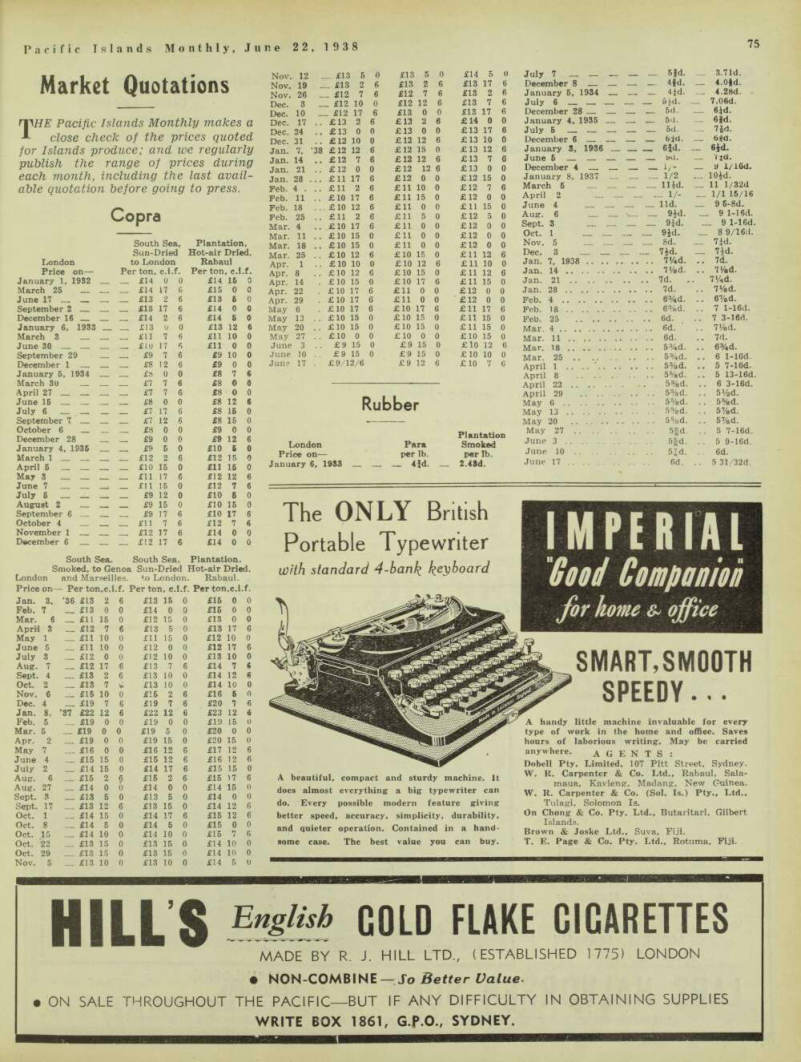
riMIE Pacific Islands Monthly makes a A close check of the prices quoted for Islands produce; and we regularly publish the range of prices during each month, including the last avail able quotation before going to press.
Copra
South Sea.
Plantation, Sun-Dried Hot-air Dried, London to London Rabaul Price on — Per ton. c.i.f.
Per ton. c.i.f.
January 1, 1932 , £14 0 0 £14 15 0 March 25 £14 17 G £15 0 0 June 17 £13 2 6 £13 5 0 September 2 £13 17 6 £14 0 0 December 16 £14 2 6 £14 5 0 January 6, 1933 £13 0 0 £13 12 6 March 3 £11 7 6 £11 10 0 June 30 £10 17 6 £11 0 0 September 29 £9 7 6 £9 10 0 December 1 £8 12 6 £9 0 0 January 5, 1934 £8 0 0 £8 7 6 March 30 £7 7 6 £8 0 0 April 27 £7 7 6 £8 0 0 June 15 — £8 0 0 £8 12 6 July 6 — ,, — , £7 17 6 £8 16 0 September 7 £7 12 6 £8 16 0 October 6 . £8 0 0 £9 0 0 December 28 £9 0 0 £9 12 6 January 4, 1936 £9 6 0 £10 6 0 March 1 £12 2 6 £12 16 0 April 5 £10 15 0 £11 16 0 May 3 — £11 17 6 £12 12 6 June 7 £11 15 0 £12 7 6 July 5 — £9 12 0 £10 6 0 August 2 £9 16 0 £10 16 0 September 6 £9 17 6 £10 17 6 October 4 £11 7 6 £12 7 6 November 1 , £12 17 6 £14 0 0 December 6 — — — £12 17 6 £14 0 0 South Sea.
South Sea.
Plantation.
Smoked, to Genoa , Sun-Dried Hot-air Dried, London and Marseilles. to London.
Rabaul.
Price on— Per ton,c.i.f. Per ton, c. i.f. Per ton.c.i.f.
Jan. 3. ’36 £13 2 6 £13 15 0 £15 0 0 Feb. 7 £13 0 0 £14 0 0 £15 0 0 Mar. 6 £11 16 0 £12 15 0 £13 0 0 April 3 £12 7 6 £13 5 0 £13 17 G May 1 £11 10 0 £11 15 0 £12 10 0 June 5 £11 10 0 £12 0 0 £12 17 6 July 3 £12 0 0 £12 10 0 £13 10 0 Aug. 7 — £12 17 6 £13 7 6 £14 7 6 Sept. 4 £13 2 6 £13 10 0 £14 12 6 Oct. 2 £13 7 w £13 10 0 £14 10 0 Nov. 6 £16 10 0 £15 2 6 £16 6 0 Dec. 4 £19 7 6 £19 7 6 £20 7 6 Jan. 8. ’37 £22 12 6 £22 12 6 £23 12 6 Feb. 5 £19 0 0 £19 0 0 £19 15 0 Mar. 5 £19 0 0 £19 5 0 £20 0 0 Apr, 2 £19 0 0 £19 15 0 £20 15 0 May 7 £16 0 0 £16 12 6 £17 12 6 June 4 £15 15 0 £15 12 6 £16 12 6 July 2 £14 15 0 £14 17 6 £15 15 0 Aug. 6 £15 2 6 £15 2 6 £15 17 6 Aug. 27 £14 0 0 £14 0 0 £14 15 0 Sept. 3 £13 6 0 £13 6 0 £14 0 0 Sept. 17 £13 12 6 £13 15 0 £14 12 6 Oct. 1 £14 15 0 £14 17 6 £15 12 6 Oct. 8 £14 5 0 £14 5 0 £15 0 0 Oct. 15 £14 10 0 £14 10 0 £15 7 6 Oct. 22 £13 15 0 £13 15 0 £14 10 0 Oct. 29 £13 15 0 £13 15 0 £14 10 0 Nov. 5 £13 10 0 £13 10 0 £14 5 0
July 7 5 id. 3.71d.
December 8 — 4 id. 4.0|d.
January 5, 1934 — — 4ld. 4.2Hd.
July 6 — . 6£d. 7.06d.
December 28 — — 6(1. fiid.
January 4, 1935 6<1. fifd.
July 6 — Bd. 7|d.
December 6 . . . bid. filld.
January 3, 1936 6 }d. fiid.
June B — »u.
U d.
December 4 1/- 9 1/1 fid.
January 8, 1937 1/2 10id.
March 5 ... iiid. 11 l/32d April 2 ... i/- 1/1 16/16 June 4 lld. 9 5-8d, Aug. 6 9*d. , 9 1-1fid.
Sept. 3 ... 9Jd. ... 9 l-16d.
Oct. 1 ... 9Jd. 8 9/16d.
Nov, 5 8d. 7id.
Dec. 3 7*d. 7id.
Jan. 7, 1938 .. . 7‘/ 4 d. ., 7d.
Jan. 14 .. 7y 8 d. .. 7y 8 d.
Jan. 21 .. . . .. 7d. . . 7*/ 4 d.
Jan. 28 .. .. .. 7d. .. 7V 8 d.
Feb. 4 .. 6%d. .. 6 7 /ad.
Feb. 18 .. 6 3 /«d. 7 l-16d.
Feb. 25 6d. 7 3-16d.
Mar. 4 .. . 6d. 7y 8 d.
Mar. 11 .. 6d. . . 7d.
Mar. 18 .. 5 3 / 4 d. . . 6%d.
Mar. 25 ., 5 3 / 4 d. . , 6 l-16d.
April 1 .. 5 5 /ad. , , 5 7-16d.
April 8 5 5 /sd. 5 13-16d.
April 22 ,. . 5%d. . , 6 3-16d.
April 29 5%d. sy 2 d.
May 6 .. 5y 8 d. sy 8 d.
May 13 .. 5 5 / 8 d. 5 7 / 8 d.
May 20 5 5 /«d. 5 7 /ad.
May 27 . 5|d. 5 7-16d.
June 3 .. 5gd. 5 9-16d.
June 10 5^d. fid.
June 17 .. fid. 5 31/32d.
Nov. 12 £13 5 0 £13 5 0 £14 5 0 Nov. 19 £13 2 6 £13 2 6 £13 17 6 Nov. 26 £12 7 6 £12 7 6 £13 2 6 Dec. 3 £12 10 0 £12 12 6 £18 7 6 Dec. 10 £12 17 6 £13 0 0 £13 17 6 Dec. 17 .. £13 2 6 £13 2 6 £14 0 0 Dec. 24 .. £13 0 0 £13 0 0 £13 17 6 Dec. 31 .. £12 10 0 £12 12 6 £13 10 0 Jan. 7. ’38 £12 12 6 £12 15 0 £13 12 6 Jan. 14 .. £12 7 6 £12 12 6 £13 7 6 Jan. 21 .. £12 0 0 £12 12 6 £13 0 0 Jan. 28 ... £11 17 6 £12 0 0 £12 15 0 Feb. 4 . .. £11 2 6 £11 10 0 £12 7 6 Feb. 11 .. £10 17 6 £11 15 0 £12 0 0 Feb. 18 .. £10 12 6 £11 0 0 £11 15 0 Feb. 25 .. £11 2 6 £11 5 0 £12 5 0 Mar. 4 .. £10 17 6 £11 0 0 £12 0 0 Mar. 11 .. £10 15 0 £11 0 0 £12 0 0 Mar. 18 .. £10 15 0 £11 0 0 £12 0 0 Mar. 25 . . £10 12 6 £10 15 0 £11 12 6 Apr. 1 .. £10 10 0 £10 12 6 £11 10 0 Apr. 8 .. £10 12 6 £10 15 0 £11 12 6 Apr. 14 . £10 15 0 £10 17 6 £11 15 0 Apr. 22 . £10 17 6 £11 0 0 £12 0 0 Apr. 29 . £10 17 6 £11 0 0 £12 0 0 May 6 . £10 17 6 £10 17 6 £11 17 6 May 13 .. £10 15 0 £10 15 0 £11 15 0 May 20 .. £10 15 0 £10 15 0 £11 15 0 May 27 .. £10 0 0 £10 0 0 £10 15 0 June 3 £9 15 0 £9 15 0 £10 12 6 June 10 £9 15 0 £9 15 0 £10 10 0 June 17 £9/12/6 £9 12 6 £10 7 6
Rubber
Plantation London Para Smoked Price on— per lb. per lb.
January 6, 1983 - - - 4Jd. 2.48d.
Advertisements & other items, p. 77 (1 item)
Imperial
The ONLY British
Portable Typewriter
with standard 4-hank keyboard
m A beautiful, compact and sturdy machine. It does almost everything a big typewriter can do. Every possible modern feature giving better speed, accuracy, simplicity, durability, and quieter operation. Contained in a handsome case. The best value you can buy.
IMPERIAL
Hood Companion
for home fa office
SMART,SMOOTH
SPEEDY.,.
A handy little machine invaluable for every type of work in the home and office. Saves hours of laborious writing. May be carried anywhere. AGENTS: Dobell Pty. Limited, 107 Pitt Street, Sydney.
W. R. Carpenter & Co. Ltd., Rabaul, Salamaua, Kavieng, Madang, New Guinea.
W. R. Carpenter & Co. (Sol. Is.) Pty., Ltd., Tulagi, Solomon Is.
On Chong & Co. Pty. Ltd., Butaritari, Gilbert Islands.
Brown & Joske Ltd., Suva, Fiji, T. E. Page & Co. Pty. Ltd., Rotuma, Fiji.
HILLS English GOLD FLAKE CIGARETTES
MADE BY R. J. HILL LTD., (ESTABLISHED 1775) LONDON • NON-COMBINE — So Better Va • ON SALE THROUGHOUT THE PACIFIC—BUT IF ANY DIFFICULTY IN OBTAINING SUPPLIES
WRITE BOX 1861, G.P.0., SYDNEY.
Shipping Services in the Pacific
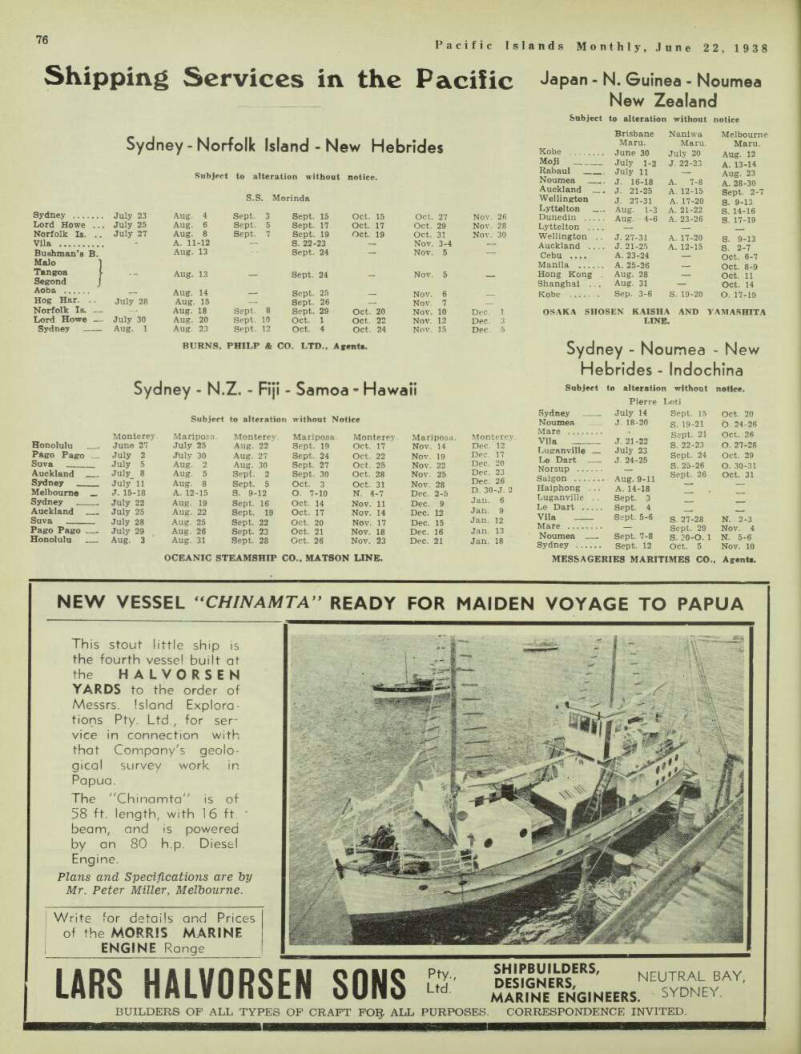
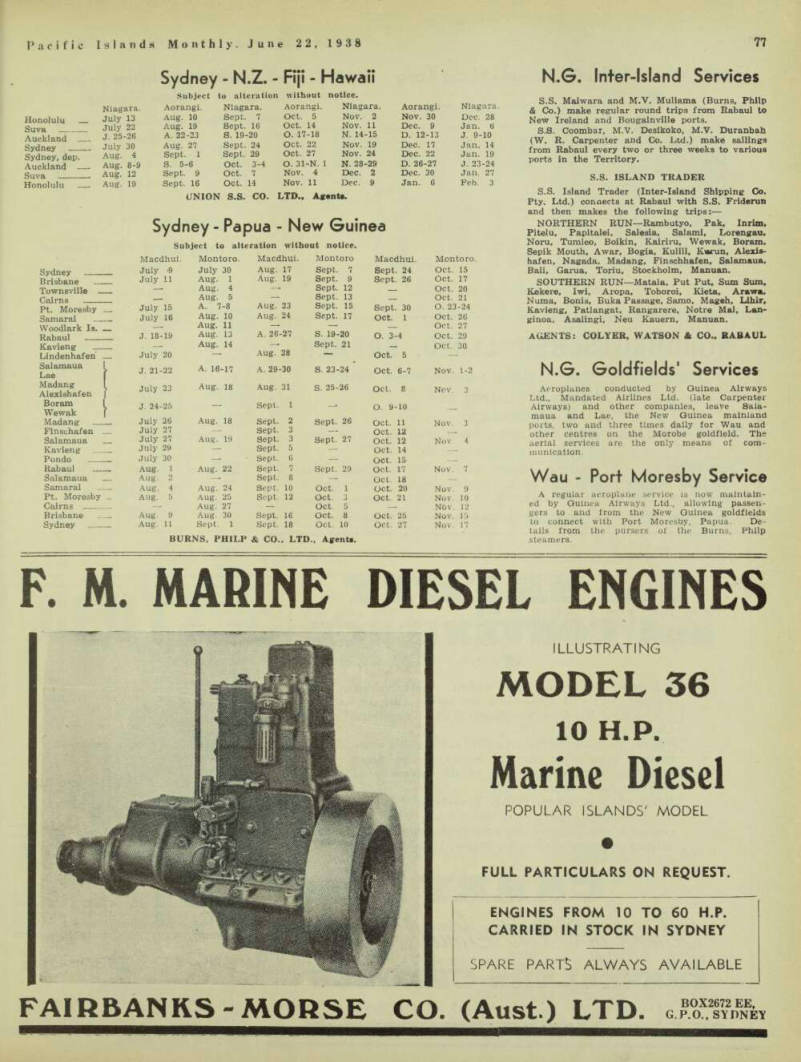
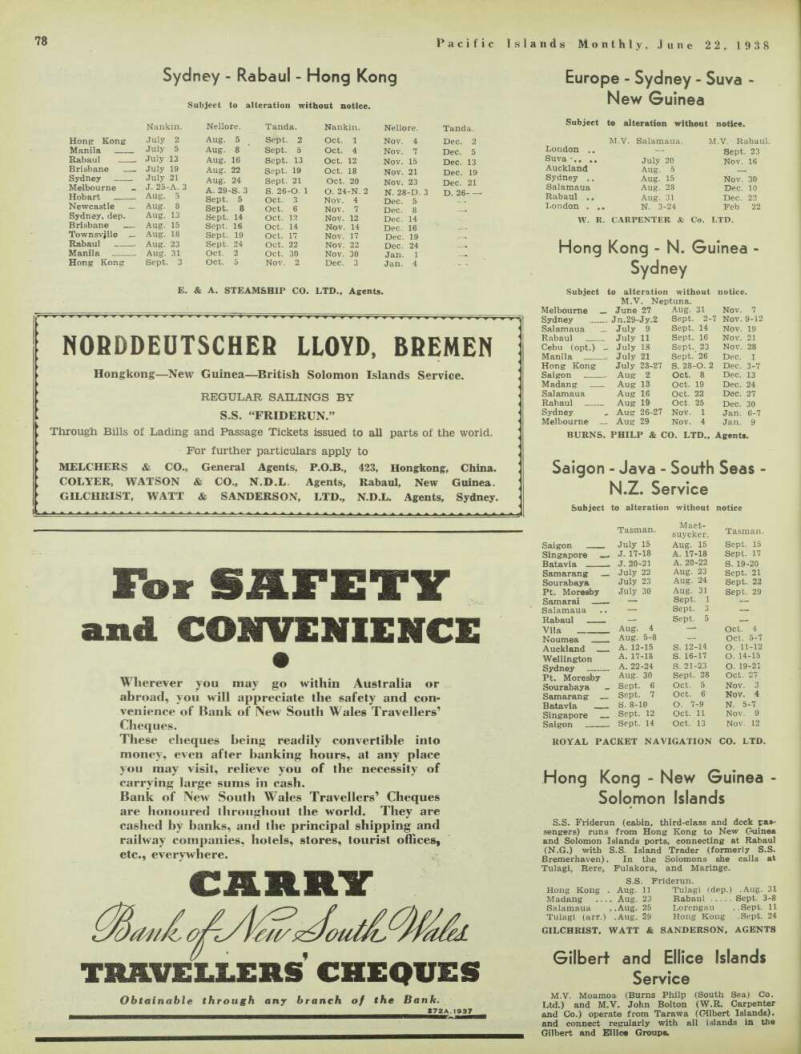
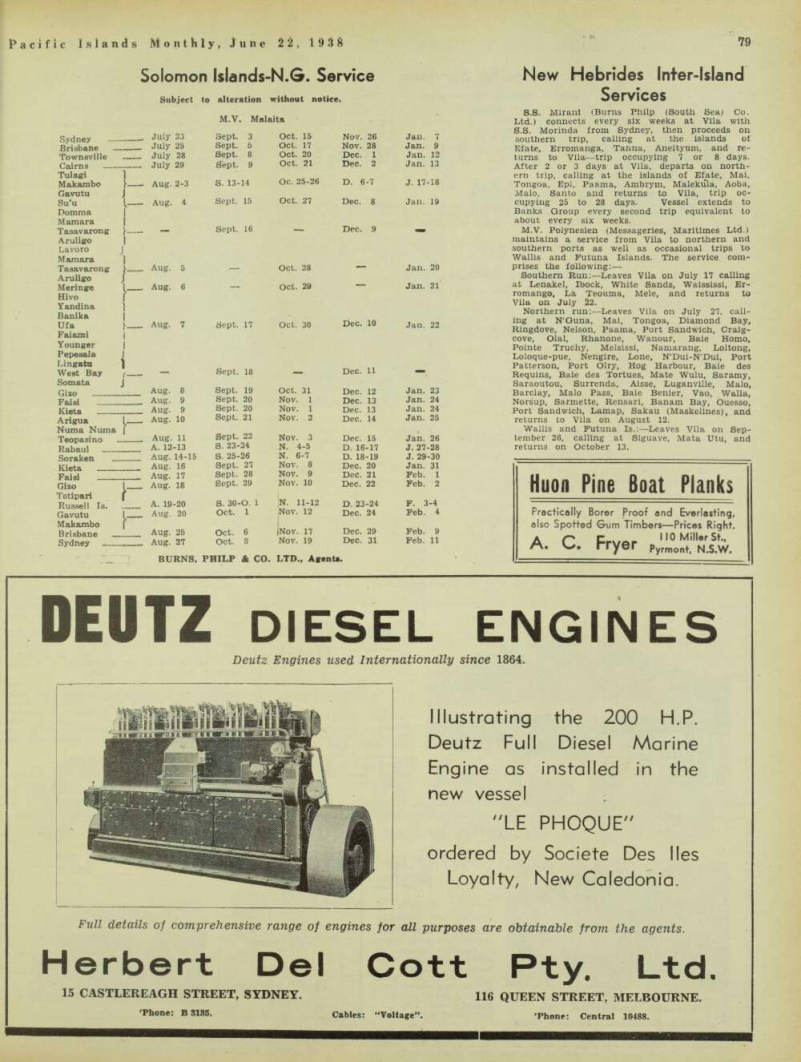
Sydney-Norfolk Island - New Hebrides
Sydney - N.Z. - Fiji - Samoa * Hawaii
Japan - N. Guinea - Noumea New Zealand
Sydney - Noumea - New Hebrides - Indochina
Subject to alteration without notice.
S.S. Morinda Sydney July 23 Aug. 4 Sept. 3 Sept. 15 Oct. 15 Oct. 27 Nov. 26 Lord Howe ...
July 25 Aug. 6 Sept. 5 Sept. 17 Oct. 17 Oct. 29 Nov. 28 Norfolk Is. ..
July 27 Aug. 8 Sept. 7 Sept. 19 Oct. 19 Oct. 31 Nov. 30 Vila - A. 11-12 — S. 22-23 — Nov. 3-4 Bushman’s B.
Malo ]
Aug. 13 Sept. 24 — Nov. 5
Tangoa f
Segond — Aug. 13 — Sept. 24 - Nov. 5 - Aoba — Aug. 14 — Sept. 25 Nov. 6 Hog Har. . .
July 28 Aug. 15 — Sept. 26 — Nov. 7 Norfolk Is. — Aug. 18 Sept. 8 Sept. 29 Oct. 20 Nov. 10 Dec. 1 Lord Howe — July 30 Aug. 20 Sept. 10 Oct. 1 Oct. 22 Nov. 12 Dec. 3 Sydney Aug. 1 Aug. 23 Sept. 12 Oct. 4
Burns, Ph1Lp & Co. Ltd.,
Oct. 24 A gents.
Nov. 15 Dec 5
Subject to alteration without Notice Monterey Mariposa Monterey.
Mariposa.
Monterey.
Mariposa.
Monterey.
Honolulu June 27 July 25 Aug. 22 Sept. 19 Oct. 17 Nov. 14 Dec. 12 Pago Pago July 2 JHily 30 Aug. 27 Sept. 24 Oct. 22 Nov. 19 Dec. 17 Suva July 5 Aug. 2 Aug. 30 Sept. 27 Oct. 25 Nov. 22 Dec. 20 Auckland July 8 Aug. 5 Sept. 2 Sept. 30 Oct. 28 Nov. 25 Dec. 23 Sydney July 11 Aug. 8 Sept. 5 Oct. 3 Oct. 31 Nov. 28 Dec. 26 Melbourne J. 15-18 A. 12-15 S. 9-12 O. 7-10 N. 4-7 Dec. 2-5 D. 30 - J. 2 Sydney July 22 Aug. 19 Sept. 16 Oct. 14 Nov. 11 Dec. 9 Jan. 6 Auckland July 25 Aug. 22 Sept. 19 Oct. 17 Nov. 14 Dec. 12 Jan. 9 Suva July 28 Aug. 25 Sept. 22 Oct. 20 Nov. 17 Dec. 15 Jan. 12 Pago Pago July 29 Aug. 26 Sept. 23 Oct. 21 Nov. 18 Dec. 16 Jan. 13 Honolulu Aug. 3 Aug. 31 Sept. 28 Oct. 26 Nov. 23 Dec. 21 Jan. 18
Oceanic Steamship Co., Matson Line.
Subject to alteration without notice Brisbane Naniwa Melbourne Maru.
Maru.
Maru.
Kobe June 30 July 20 Aug. 12 Moji July 1-2 J. 22-23 A, 13-14 Rabaul July 11 — Aug. 23 Noumea J. 16-18 A. 7-8 A. 28-30 Auckland J. 21-25 A. 12-15 Sept. 2-7 Wellington J. 27-31 A. 17-20 S. 9-13 Lyttelton Aug. 1-3 A. 21-22 S. 14-16 Dunedin Aug. 4-6 A. 23-26 S. 17-19 Lyttelton — Wellington ..
J. 27-31 A. 17-20 S. 9-13 Auckland J. 21-25 A. 12-15 S. 2-7 Cebu ...
A. 23-24 — Oct. 6-7 Manila A. 25-26 — Oct. 8-9 Hong Kong .
Aug. 28 — Oct. 11 Shanghai .. .
Aug. 31 — Oct. 14 Kobe Sep. 3-6 S. 19-20 O. 17-19
Osaka Shosen Ka1Sha And
Line.
Yamashita
Subject to alteration Pierre I .lOti notice.
Sydney July 14 Sept. 15 Oct. 20 Noumea J. 18-20 S. 19-21 0. 24-26 Mare - Sept. 21 S. 22-23 Sept. 24 Oct. 26 Vila J. 21-22 O. 27-28 Oct. 29 Lugnnville Le Dart July 23 J. 24-25 Norsup Saigon Aug. 9-11 S. 25-26 Sept. 26 O. 30-31 Oct. 31 Haiphong . ..
A. 14-18 Luganville ..
Sept. 3 Le Dart Sept. 4 Vila Sept. 5-6 S. 27-28 N. 2-3 Mare — Sept. 29 Nov. 4 Noumea Sept. 7-8 S. 20-0. 1 N. 5-6 Sydney Sept. 12 Oct. 5 Nov. 10
Messageries Maritimes Co.
, Agent*.
Sydney - N.Z. - Fiji - Hawaii
Sydney - Papua - New Guinea
N.G. Inter-Island Services
5.5. Maiwara and M.V. Muliama (Burns, Philp & Co.) make regular round trips from Rabaul to New Ireland and Bougainville ports. 5.5. Coombar, M.V. Deslkoko, M.V. Duranbah (W. R. Carpenter and Co. Ltd.) make sailings from Rabaul every two or three weeks to various ports in the Territory.
S.S. Island Trader
5.5. Island Trader (Inter-Island Shipping Co.
Pty. Ltd.) connects at Rabaul with S.S. Friderun and then makes the following trips:— NORTHERN RUN—Rambutyo, Pak, Inrim.
Pitelu, Papitalei, Salesia, Salami, Lorengau.
Noru, Tumleo, Boikin, Kairiru, Wewak, Boram.
Sepik Mouth, Awar, Bogia, Kulili, Korun, Alexis hafen, Nagada, Madang, Finschhafen, Salamaua, Bali, Garua, Toriu, Stockholm, Manuan.
SOUTHERN RUN—Matala, Put Put. Sum Sum, Kekere, Iwi, Aropa, Toboroi, Kieta, Arawa.
Numa, Bonis, Buka Passage, Samo, Mageh, Lihir, Kavieng, Patlangat, Rangarere, Notre Mai, Lan ginoa, Asalingi, Neu Kauern. Manuan.
Agents: Colyer, Watson & Co.. Rabaul
N.G. Goldfields' Services
Aeroplanes conducted by Guinea Airways Ltd,, Mandated Airlines Ltd. (late Carpenter Airways) and other companies, leave Sala maua and Lae, the New Guinea mainland ports, two and three times daily for Wau and other centres on the Morobe goldfield. The aerial services are the only means of com munication.
Wau - Port Moresby Service
A regular aeroplane service is now maintain ed by Guinea Airways Ltd., allowing passen gers to and from the New Guinea goldfields to connect with Port Moresby. Papua. De tails from the pursers of the Burns, Philp steamers.
Subject to alteration without notice.
Niagara. Aorangi. Niagara. Aorangi. Niagara. Aorangi. Niagara.
Honolulu July 13 Aug. 10 Sept. 7 Oct. 5 Nov. 2 Nov. 30 Dec. 28 Suva July 22 Aug. 19 Sept. 16 Oct. 14 Nov. 11 Dec. 9 Jan. 6 Auckland H J- 25-26 A. 22-23 S. 19-20 O. 17-18 N. 14-15 D. 12-13 J. 9-10 Sydney " July 30 Aug. 27 Sept. 24 Oct. 22 Nov. 19 Dec. 17 Jan. 14 Sydney dep * Aug. 4 Sept. 1 Sept. 29 Oct. 27 Nov. 24 Dec. 22 Jan. 19 Auckland ' Aug. 8-9 S. 5-6 Oct. 3-4 O. 31-N. 1 N. 28-29 D. 26-27 J. 23-24 Qmro Auer. 12 Sept. 9 Oct. 7 Nov. 4 Dec. 2 Dec. 30 Jan. 27 Honolulu Aug. 19 Sept. 16 Oct. 14 Nov. 11 Dec. 9 Jan. 6 Feb. 3
Union S.S. Co. Ltd., Agent*.
Subject to alteration without notice.
Macdhul.
Montoro.
Macdhui.
Montoro Macdhui.
Montoro.
Sydney July -9 July 30 Aug. 17 Sept. 7 Sept. 24 Oct. 15 Brisbane July 11 Aug. 1 Aug. 19 Sept. 9 Sept. 26 Oct. 17 Townsville — Aug. 4 —* Sept. 12 — Oct. 20 dairnR Aug. 5 — Sept. 13 — Oct. 21 Pt. Moresby .
July 15 A. 7-8 Aug. 23 Sept. 15 Sept. 30 O. 23 -24 Samarai July 16 Aug. 10 Aug. 24 Sept. 17 Oct. 1 Oct. 26 Woodlark Is. . —.
Aug. 11 —■ —• — Oct. 27 J. 18-19 Aug. 13 A. 26-27 S. 19-20 O. 3-4 Oct. 29 Kavieng — — Aug. 14 — Sept. 21 Oct. 30 Lindenhafen .
July 20 — Aug. 28 — Oct. 5 Salamaua I Lae r J. 21-22 A. 16-17 A. 29-30 S. 23-24 Oct. 6-7 Nov. 1-2 Madang
Alexishafen
July 23 Aug. 18 Aug. 31 S. 25-26 Oct. 8 Nov. 3
Boram
J. 24-25 — Sept. 1 O. 9-10 Wewak f Madang — July 26 Aug. 18 Sept. 2 Sept. 26 Oct. 11 Nov. 3 FInschafen July 27 — Sept. 3 — Oct. 12 Salamaua July 27 Aug. 19 Sept. 3 Sept. 27 Oct. 12 Nov 4 Kavieng July 29 — Sept. 5 — Oct. 14 Pondo July 30 Sept. 6 OCt. 15 Oct. 17 Rabaul Aug. 1 Aug. 22 Sept. 7 Sept. 29 Nov. 7 Salamaua Aug. 2 — Sept. 8 — Oct. 18 Samarai ...
Aug. 4 Aug. 24 Sept. 10 Oct. 1 Oct. 20 Nov. 9 Pt. Moresby Aug. 5 Aug. 25 Sept. 12 Oct. 3 Oct. 21 Nov 10 Cairns — — Aug. 27 — Oct. 5 — .
Nbv 12 Brisbane Aug. 9 Aug. 30 Sept. 16 Oct. 8 OCt. 25 Nov. 15 Sydney Aug. 11 Sept. 1 Sept. 18 Oct. 10 Oct. 27 Nov. 17
Burns. Ph1Lp & Co.. Ltd.. Agent*.
Sydney - Rabaul - Hong Kong
Europe - Sydney - Suva - New Guinea
Hong Kong - N. Guinea - Sydney
Saigon - Java - South Seas - N.Z. Service
Hong Kong - New Guinea -
Solomon Islands
S.S. Friderun (cabin, third-class and deck pas sengers) runs from Hong Kong to New Guinea and Solomon Islands ports, connecting at Rabaul (N.G.) with S.S. Island Trader (formerly S.S.
Bremerhaven). In the Solomons she calls at Tulagl, Here, Fulakora, and Maringe.
Gilbert and Ellice Islands
Service
M.V. Moamoa (Burns Philp (South Sea) Co.
Ltd.) and M.V. John Bolton (W.R. Carpenter and Co.) operate from Tarawa (Gilbert Islands), and connect regularly with all islands in the Gilbert and Ellice Groups.
Subject to alteration without notice.
Nankin.
Nellore.
Tanda.
Nankin.
Nellore.
Tanda.
Hong Kong Manila Rabaul Brisbane .
Sydney Melbourne Hobart July 2 July 5 July 13 July 19 July 21 J. 25-A. 3 Aug. 5 Aug. 5 Aug. 8 Aug. 16 Aug. 22 Aug. 24 A. 29-S. 3 Sept. 5 Sept. 8 Sept. 14 Sept. 16 Sept. 19 Sept. 24 Oct. 2 Oct. 5 Sept. 2 Sept. 5 Sept. 13 Sept. 19 Sept. 21 S. 26-0. 1 Oct. 1 Oct. 4 Oct. 12 Oct. 18 Oct. 20 O. 24-N. 2 Nov. 4 Nov. 7 Nov. 12 Nov. 14 Nov. 17 Nov. 22 Nov. 30 Dec. 3 Nov. 4 Nov. 7 Nov. 15 Nov. 21 Nov. 23 N. 28-D. 3 Dec. 2 Dec. 5 Dec. 13 Dec. 19 Dec. 21 D.26- — Newcastle Sydney, dep.
Brisbane Townsville Rabaul Aug. 8 Aug. 13 Aug. 15 Aug. 18 Aug. 23 Aug. 31 Sept. 3 Oct. 3 Oct. 6 Oct. 12 Oct. 14 Oct. 17 Oct. 22 Oct. 30 Nov. 2 Dec. 5 Dec. 8 Dec. 14 Dec. 16 Dec. 19 - Manila Hong Kong Jan. 1 Jan. 4 - E.
& A. Steamship Co.
LTD., Agents
Subject to alteration without notice.
M.V. Salamaua. M.V. Rabaul.
London .. — Sept. 23 Suva-,. ,, j u ly 20 Nov. 16 Auckland Aug. 5 Sydney .. Aug. 15 Nov. 30 Salamaua Aug. 28 Dec. 10 Rabaul .. Aug. 31 Dec. 22 London ... N. 3-24 Feta 22
W. R. Carpenter & Co. Ltd.
Subject to alteration without M.V. Neptuna. notice Melbourne — June 27 Aug. 31 Nov. 7 Sydney Jn.29-Jy.2 Sept. 2-7 Nov. 9-12 Salamaua July 9 Sept. 14 Nov. 19 Rabaul July 11 Sept. 16 Nov. 21 Cebu (opt.) - July 18 Sept.. 23 Nov. 28 Manila July 21 Sept. 26 Dec.
I Hong Kong July 23-27 S.28-0. 2 1 Dec. 3-7 Saigon Aug 2 Oct. 8 Dec. 13 Madang Aug 13 Oct. 19 Dec. 24 Salamaua Aug 16 Oct. 22 Dec. 27 Rabaul Aug 19 Oct. 25 Dec. 30 Sydney Aug 26-27 Nov. 1 Jan. 6-7 Melbourne Aug 29 Nov. 4 Jan. 9
Burns,
Philp & Co. Ltd.,
Agents.
Subject to alteration without notice Saigon Singapore — Batavia - Tasman.
July 15 J. 17-18 J. 20-21 Maetsuycker.
Aug. 15 A. 17-18 A. 20-22 Tasman.
Sept. 15 Sept. 17 S. 19-20 Samarang Sourabaya Pt. Moresby Samarai .
Salamaua Rabaul Vila July 22 July 23 July 30 Aug. 4 Aug. 23 Aug. 24 Aug. 31 Sept. 1 Sept. 3 Sept. 5 Sept. 21 Sept. 22 Sept. 29 Oct. 4 Noumea Auckland — Wellington Sydney Aug. 5-8 A. 12-15 A. 17-18 A. 22-24 S. 12-14 S. 16-17 S. 21-23 Oct. 5-7 O. 11-12 O. 14-15 O. 19-21 Pt. Moresby Sourabaya Samarang — Batavia Singapore — Saigon Aug. 30 Sept. 6 Sept. 7 S. 8-10 Sept. 12 Sept. 14 Sept. 28 Oct. 5 Oct. 6 O. 7-9 Oct. 11 Oct. 13 Oct. 27 Nov. 3
Nov. 4
N. 5-7 Nov. 9 Nov. 12
Royal Packet Navigation
Co. Ltd.
S.S. Priderun.
Hong Kong . Aug. 11 Tulagi (dep.) .Aug. 31 Madang . Aug. 23 Rabaul Sept. 3-8 Salamaua . .Aug. 25 Lorengau ..Sept. 11 Tulagi (arr.) .Aug. 29 Hong Kong .Sept. 24
Gilchrist,
Watt &
Sanderson,
Agents
Solomon Islands-N.G. Service
New Hebrides Inter-Island
Services
S.S. Mirani (Burns Philp (South Sea) Co.
Ltd.) connects every six weeks at Vila with S.S. Morinda from Sydney, then proceeds on southern trip, calling at the islands of Efate, Erromanga, Tanna, Aneityum, and re turns to Vila —trip occupying 7 or 8 days.
After 2 or 3 days at Vila, departs on north ern trip, calling at the islands of Efate, Mai, Tongoa, Epi, Paama, Ambrym, Malekula, Aoba, Malo, Santo and returns to Vila, trip oc cupying 25 to 28 days. Vessel extends to Banks Group every second trip equivalent to about every six weeks.
M.V. Polynesien (Messageries, Maritimes Ltd.) maintains a service from Vila to northern and southern ports as well as occasional trips to Wallis and Futuna Islands. The service com prises the following:—• Southern Run; —Leaves Vila on July 17 calling at Lenakel, Ibock, White Sands, Walssissi, Er romango. La Teouma, Mele, and returns to Vila on July 22.
Northern run:—Leaves Vila on July 27, call ing at N’Guna, Mai, Tongoa, Diamond Bay, Ringdove, Nelson, Paama, Port Sandwich, Craig cove, Olal, Rhanone, Wanour, Baie Homo.
Pointe Truchy, Melsissi, Namarang, Loltong, Loloque-pue, Nengire, Lone, N’Dui-N’Dui, Port Patterson, Port Olry, Hog Harbour, Baie des Requins, Baie des Tortues, Mate Wulu, Saramy, Saraoutou, Surrenda, Alsse, Luganville, Malo, Barclay, Malo Pass, Baie Benier, Vao, Walla, Norsup, Sarmette, Rensari, Banam Bay, Ouesso, Port Sandwich, Lamap, Sakau (Maskelines), and returns to Vila on August 12.
Wallis and Futuna Is.;—Leaves Vila on Sep tember 26, calling at Siguave, Mata Utu, and returns on October 13.
Subject to alteration without notice.
M.V. Malaita • July 23 Sept. 3 Oct. 15 Nov. 26 Jau. 7 July 25 Sept. 5 Oct. 17 Nov. 28 Jan. 9 Townsville — July 28 July 29 Aug. 2-3 Aug. 4 Aug. 5 Aug. 6 Aug. 7 Aug. 8 Sept. 8 Sept. 9 S. 13-14 Sept. 15 Sept. 16 Sept. 17 Sept. 18 Sept. 19 Oct. 20 Oct. 21 Dec. 1 Dec. 2 Jan.
Jan. 12 13 Tulagi Makambo Gavutu Su’u Domxna Mamara Tasavarong Aruligo Lavoro Mamara Tasavarong Aruligo Meringe Hivo Yandina Banika Ufa Faiami Younger Pepesala Lingatu West Bay Somata Gizo u \ 1 i — 1 J 1 1r i~ I j J Oc. 25-26 Oct. 27 Oct. 28 Oct. 29 Oct. 30 Oct. 31 D. 6-7 Dec. 8 Dec. 9 Dec. 10 Dec. 11 Dec. 12 J. 17- Jan.
Jan.
Jan.
Jan.
Jan. -18 19 20 21 22 23 Faisi Aug. 9 Sept. 20 Nov. 1 Dec. 13 Jan. 24 Kieta Aug. 9 Sept. 20 Nov. 1 Dec. 13 Jan. 24 Arigua Numa Numa Teopasino Rabaul Aug. 10 Aug. 11 Sept. 21 Sept. 22 Nov. 2 Nov. 3 Dec. 14 Dec. 15 Jan.
Jan. 25 26 A. 12-13 S. 23-24 N. 4-5 D. 16-17 J. 27 -28 Soraken Aug. 14-15 S. 25-26 N. 6-7 D. 18-19 J. 29 -30 Kieta Aug. 16 Sept. 27 Nov. 8 Dec. 20 Jan. 31 Faisi Aug. 17 Sept. 28 Nov. 9 Dec. 21 Feb. 1 Gizo Tetipari Russell Is.
Gavutu Makambo Brisbane F Aug. 18 A. 19-20 Aug. 20 Aug. 25 Sept. 29 S. 30-0. 1 Oct. 1 Oct. 6 Nov. 10 N. 11-12 Nov. 12
|nov. 17
Dec. 22 D. 23-24 Dec. 24 Dec. 29 Feb. 2 F. 3-4 Feb. 4 Feb. 9 Sydney Aug. 27 Oct. 8 Nov. 19 Dec. 31 Feb. 11 — i
Burns.
Philp & Co
. LTD., Agents.
Central Pacific Services
The cargo steamer Tolten will depart from Sydney on July 7 (approx.) for Suva, Lautoka, Apia, Papeete, and N. American ports. She will carry mail and general cargo and a limited number of passengers. The next Union cargo vessel will leave Sydney for Fiji and French Oceania at the end of August.
Union Steam Ship Co. Ltd.
No Zealand - Samoa - Niue
Subject to alteration without notice.
The New Zealand Government’s steamer Maui Pomare (1,159 tons) is the only direct con nection between N.Z., the Mandated Territory of Western Samoa and Niue Island. The vessel, which carries mails, passengers, and cargo, is controlled by the Department of External Af fairs at Wellington, where application should be made concerning freights, berths, etc.
Sydney - Noumea - Tahiti
Subject to alteration without notice.
Mails and passengers from Sydney for Tahiti may connect with Messageries Maritimes liners at Noumea, per Pierre Loti (see Sydney-Noumea-New Hebrides service). The M.M. liners run between Marseilles and Noumea, via Panama Canal.
Subject to alteration without notice.
Auckland June 30 July 14 M.V. Matua Aug. 11 Aug. 25 Sept. 8 Sept. 22 Cook Is — July 18 Aug. 15 Sept. 12 Outer Cooks —• J. 19-20 A. 16-17 .
S. 13-14 Cook Is — July 21 Aug. 18 — Sept. 15 Nukualofa July 3-4 — A. 28-29 S. 25-26 Apia July 5-6 —■ — A. 30-31 — S. 27-28 Suva July 9 — — Sept. 3 Oct. 1 Auckland July 13 July 27 Aug. 24 Sept. 7 Sept. 21 Oct. 5
M.V.
Maui Pomare Wellington July 12 Aug. 9 Sept. 6 Oct. 4 Nov. 1 Nov. 22 Apia J. 19-21 A. 16-18 S. 13-15 O.11-13 N. 8-10 N.29-D. 1 Niue July 23 Aug. 20 Sept. 17 Oct. 15 Nov. 12 Dec. 3 Lyttelton — Aug. 1 Aug. 29 Sept. 26 O.24-25 Nov. 21 Dec. 12 Wellington Aug. 2 Aug. 30 Sept. 27 Oct. 26 Nov. 22 Dec. 13
C. Ramel. Strasbourg Eridan. D’Amiens Papeete J- 31-A. 1 g. 14-15 O. 22-23 Dec. 4-5 Raiatea (opt.) — Sept. 16 Oct. 24 Vila . Aug. 10 Sept. 26 Nov. 2 Deo. 14 Noumea A. 12-18 S. 28-0 6 N. 4-12 D. 16-23 Vila Aug. 21 Oct. 9 Nov. 15 Dec. 26 Raiatea Aug. 28 Oct. 18 Nov. 22 Jan, 2 Papeete ... A. 29-31 O. 19-21 N. 23-25 J. 3-5
Messageries Mar1Times Co. Ltd.. Agents.
Advertisements & other items, pp. 78-84 (2 items)
Lars Halvorsen Sons
NEW VESSEL “ CHINAMTA ”READY FOR MAIDEN VOYAGE TO PAPUA This stout little ship is the fourth vessel built at
the HALVORSEN
YARDS to the order of Messrs. Island Explorations Pty. Ltd , for service in connection with that Company's geological survey work in Papua.
The "Chinamta" is of 58 ft. length, with 16 ft * beam, and is powered by an 80 h.p. Diesel Engine.
Plans and Specifications are by Mr. Peter Miller, Melbourne.
Write for details and Prices
of the MORRIS MARINE
ENGINE Range 9
LARS HALVORSEN SONS
Pty., Ltd.
SHIPBUILDERS,
DESIGNERS, wnMFV
MARINE ENGINEERS. SYDNE,
NEUTRAL BAY,
BUILDERS OF ALL TYPES OF CRAFT FOR ALL PURPOSES. CORRESPONDENCE INVITED.
F. M. MARINE DIESEL ENGINES
m.
ILLUSTRATING
MODEL 36
XO H.P.
Marine Diesel
POPULAR ISLANDS' MODEL
FULL PARTICULARS ON REQUEST.
ENGINES FROM 10 TO 60 H.P.
CARRIED IN STOCK IN SYDNEY
SPARE PARTS ALWAYS AVAILABLE
FAIRBANKS - MORSE
CO. (Aust.) LTD. G. P.O X2 S\^) E NE\
NORDDEUTSCHER LLOYD, BREMEN
Hongkong—New Guinea—British Solomon Islands Service.
REGULAR SAILINGS BY
S.S. “FRIDERUN.”
Through Bills of Lading and Passage Tickets issued to all parts of the world.
For further particulars apply to MELCHERS & CO., General Agents, P. 0.8., 423, Hongkong, China.
COLYER, WATSON & CO., N.D.L. Agents, Rabaul, New Guinea.
GILCHRIST, WATT & SANDERSON, LTD., N.D.L. Agents, Sydney.
For SAFETY
and CONVENIENCE
Wherever you may go within Australia or abroad, you will appreciate the safety and convenience of Bank of New South Wales Travellers’
Cheques.
These cheques being readily convertible into money, even after hanking hours, at any place you may visit, relieve you of the necessity of carrying large sums in cash.
Bank of New South Wales Travellers’ Cheques are honoured throughout the world. They are cashed by banks, and the principal shipping and railway companies, hotels, stores, tourist offices, etc., everywhere.
cjiMior
douiJtffyfaded.
TRAVELLERS CHEQUES
Obtainable through any branch of the Bank. 572A.1937
Huon Pine Boat Planks
Practically Borer Proof and Everlasting, also Spotted Gum Timbers—Prices Right.
A r C PWflr 1 10 Miller St., A. Fryer p yrmont( n.s.w.
DEUTZ DIESEL ENGINES
Deutz Engines used Internationally since 1864. m Illustrating the 200 H.P.
Deutz Full Diesel Marine Engine as installed in the new vessel
"IE PHOQUE"
ordered by Societe Des lies Loyalty, New Caledonia.
Full details of comprehensive range of engines for all purposes are obtainable from the agents.
Herbert Del Cott Pty. Ltd
15 CASTLEREAGH STREET, SYDNEY.
'Phone: B 3135.
Cables: “Voltage".
116 QUEEN STREET, MELBOURNE.
'Phone; Central 10488.
LICENSEE:
Cosmopolitan
SAIAA9A\ Hotel
First-class Accommodation for Tourists and Travellers Ballroom ; Electric Light; Billiards ; Freezing - works ; Cold Store. Best brands of Wines, Spirits, Ales.
MODERATE TARIFF
Fishing Trips and Launch Excursions arranged
WHERE TO STAY IN PORT MORESBY
am
Licensee: Papua Hotel, Ltd.
First-class Accommodation. Parties Arranged.
The PAPUA
HOTEL
Catering specially for
Tourists and Travellers.
Situated on high ground overlooking both coasts, its Spacious Lounges are always Cool and Comfortable. Tariff: Per day, 16/-; per week. £6/6/-; per month, £l4 ; bed and breakfast. 10/-: bedroom only, 7/6.
Cars meet ail Steamers.
Hotel Moresby
NEAR THE
WHARF
COMFORTABLE
ACCOMMODATION
ONLY THE BEST
BRANDS OF
WINES. SPIRITS
AND BEERS
IN STOCK
LICENSEE:
Hotel Moresby
Ltd.
" 'I Published by Pacific Publications Pty., Ltd., Union House, 247 George Street, Sydney. (Telephone: BW 5037). Wholly set up and printed in Australia by the Sydney and Melbourne Publishing Co., Pty., Ltd., 29 Alberta St., Sydney. (Telephone; MA7101).
What Aerial Transport has done for
war The above photograph shows how aerial transport is assisting in the establishment of a pastoral industry on the Morobe tableland in New Guinea. These dairy cows have just been unloaded from the Guinea Airways’ freight-carrying aeroplanes after being transported from the coast for a dairy farmer near Wau.
New Guinea
SINCE 1927, when the develop-
ment of the Morobe Goldfield
—Photo.: Thos. A. Olsson.
commenced, the European
population of the Territory has
been trebled. The new industry
has increased the Empire's
gold production by nearly
£2,000,000 per annum, and has
added enormously to the trade
GUINEA AIRWAYS, LIMITED
were established in 1927; and they have grown as the figures show until they are to-day the largest freight-carrying service in the world.
turnover of New Guinea.
Only Aerial Transport makes this possible.
There is no road between the Goldfields and the coast. Aeroplanes, running on Regular Schedules, without difficulty or delay, carry in Dredges, Crushing Mills, Cyaniding Plants, Motor Vehicles, Hydro- Electric Machinery, thousands of passengers, and every kind of goods needed by a large and growing European community.
GUINEA AIRWAYS, LIMITED, operate regular air services in New Guinea and Papua; they use over fifty Aerodromes and Landing-grounds in the two Territories.
Australian Services:—SYDNEY-ADELAIDE: Direct Service. Flying time, \\'z hours. Daily except Sundays.
ADELAIDE-DARWIN: Weekly, leaves Adelaide every Friday, arrives Darwin Saturday, leaves Monday.
LIMITED
LAE-SALAMAUA
Head Office: Austral Chambers, Currie Street, Adelaide, S.A., New Guinea Office: Lae, Mandated Territory of New Guinea.
BRANCH OFFICES AND AGENTS AT WAU
SALAMAUA—PORT MORESBY AND SYDNEY.
When two long thirsts equal one long bottle!
"What's yours?"
"Resch's Pilsener ; N "So's mine."
When you ask for Pilsener insist on the long bottle.
RESCH'S
PILSENER
80
PACIFIC IS. TRAVELLERS
(CONTINUED FROM PAGE 1.)
Pacific Islands Monthly, June 22, 1938