Manam Is.
pp. 41-42 · Read in the full issue

Volcano Shows Renewed Activity
By B. W. C.
A FTER about a year of comparative xX quiescence Manam Island, off the coast of Madang, New Guinea, recently has been showing signs of renewed activity.
The occasional wisps of steam and smoke normally seen issuing from the crater have given place to an almost constant eruption-cloud, ever-changing
in shape and size with the wind and the intensity of the eruption. Down the southern side of the cone may frequently be seen a sloping streak of steam, ris ing from flowing lava. Apparently the lava has not yet reached more than half-way from the crater to sea-level, but it is being watched with interest for further developments.
Rumblings and explosions have been heard on the mainland more than 12 miles away. As far as 20 miles from the island, slight earth tremors have been felt.
It is at night that the spectacle is most impressive. Then may be seen (provided, of course, the peak is not surrounded by cloud) a veritable water fall of gold. High up, near the summit of the crater, is a fiery glow, sometimes blazing up with great brilliance, some time almost dying away. From this point—a low gap in the rim of the crater —for a varying distance down the southern slope appears a yellow streak, in the same position as the steam seen by day, marking the position of the lava stream.
Manam or Vulcan Island ((the former name is the one officially recognised) is an active volcanic cone between 4,000 and 5,000 feet high and of about 30 square miles in area, situated off the coast of the mainland of New Guinea in the Madang District, ft is a very
perfect cone viewed from any angle, though there is a definite shoulder rather more than half way up the side of the mountain, indicating the rim of a former explosion crater. Stephan Strait, separating the island from the mainland, is nine miles wide at its nar rowest point.,.
Though inhabited—and the natives are noted for their canoes, woodcarving, and pottery—Manam suffers, it is said, from a scarcity of water at times.
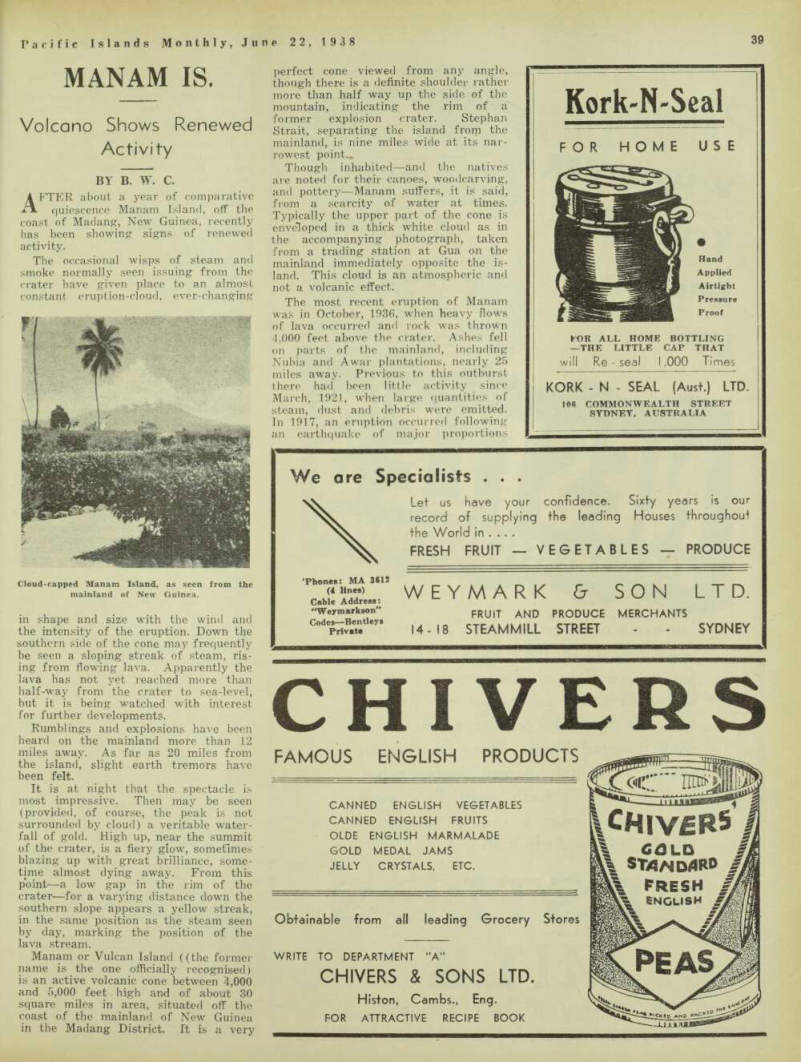
Typically the upper part of the cone is enveloped in a thick white cloud as in the accompanying photograph, taken from a trading station at Gua on the mainland immediately opposite the is land. This cloud is an atmospheric and not a volcanic effect.
The most recent eruption of Manam was in October, 1936, when heavy flows of lava occurred and rock was thrown 4,000 feet above the crater. Ashes fell on parts of the mainland, including Nubia and A war plantations, nearly 25 miles away. Previous to this outburst there had been little activity since March, 1921, when large quantities of steam, dust and debris were emitted.
In 1917, an eruption occurred following an earthquake of major proportions
Cloud-capped Manam Island, as seen from the mainland of New Guinea.
locally, and blocks of rock were hurled thousands of feet into the air.
It was on August 11, 1919, however, that the most violent of recent eruptions took place. On this occasion greyish brown volcanic dust was blown as far as Marienberg, a Catholic mission sta tion on the Sepik River and 70 miles away. Red-hot lava poured down the mountain side and reached the sea, causing it to boil and send up thick clouds of vapour. At night it was pos sible, so it is reported, to read by the light of the reflection of the lava on the clouds at a distance of 10 miles from the volcano. Native gardens and houses were destroyed, and leaves had to be spread on the track for several days afterwards to protect the feet of the natives from the great heat of the fallen ash.
No wonder there are no plantations on Manam, although its soil is rich and fertile! Europeans prefer the quieter sister-island about 100 miles to the south-east—Karkar. There, at Karkar, situated on the thick dark volcanic soil, are some of the most prosperous plan tations of the district.