How Radio Broke Pitcairn's Isolation
p. 27 · Read in the full issue
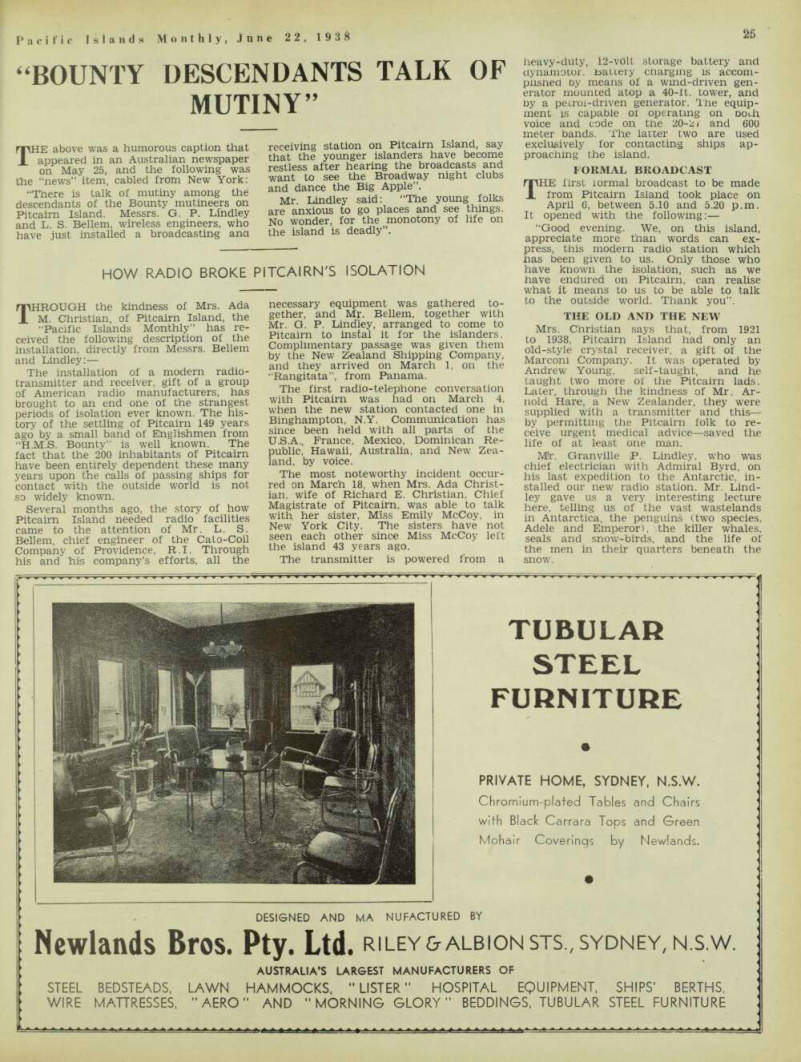
THROUGH the kindness of Mrs. Ada M. Christian, of Pitcairn Island, the “Pacific Islands Monthly” has re ceived the following description of the installation, directly from Messrs. Bellem
and Lindley:—
The installation of a modern radio transmitter and receiver, gift of a group of American radio manufacturers, has brought to an end one of the strangest periods of isolation ever known. Th,e his tory of th,e settling of Pitcairn 149 years ago by a small band of Englishmen from “H.M.S. Bounty” is well known. The fact that the 200 inhabitants of Pitcairn have been entirely dependent these many years upon the calls of passing ships for contact with the outside world is not so widely known.
Several months ago, the story of how Pitcairn Island needed radio facilities came to the attention of Mr. L. S.
Bellem, chief engineer of the Cato-Coil Company of Providence, R.I. Through his and his company’s efforts, all the
necessary equipment was gathered to gether, and Mr. Bellem, together with Mr. G. P. Lindley, arranged to come to Pitcairn to insfal it for the islanders.
Complimentary passage was given them by the New Zealand Shipping Company, and they arrived on March 1, on the “Rangitata”, from Panama.
The first radio-telephone conversation with Pitcairn was had on March 4, when the new station contacted one in Binghampton, N.Y. Communication has since been held with all parts of the U.S.A., France, Mexico, Dominican Re public. Hawaii, Australia, and New Zea land, by voice.
The most noteworthy incident occur red on March 18, when Mrs. Ada Christ ian, wife of Richard E. Christian, Chief Magistrate of Pitcairn, was able to talk with, her sister, Miss Emily McCoy, in New York City. The sisters have not seen each other since Miss McCoy left the island 43 years ago.
The transmitter is powered from a
heavy-duty, 12-volt storage battery and dynamotor. charging is accom plished oy means of a wmd-driven gen erator mounted atop a 40-ft. tower, and by a pecroi-driven generator. The equip ment is capable oi operating on Doth, voice and code on the 20- 21 and 600 meter bands. Th,e latter two are used exclusively for contacting ships ap proaching the island.
Formal Broadcast
THE first lormal broadcast to be made from Pitcairn Island took place on April 6, between 5.10 and 5.20 p.m.
It opened with the following:— “Good evening. We, on this island, appreciate more than words can ex press, this modern radio station which has been given to us. Only those who have known the isolation, such as we have endured on Pitcairn, can realise what it means to us to be able to talk to the outside world. Thank you”.
The Old And The New
Mrs. Christian says that, from 1921 to 1938, Pitcairn Island had only an old-style crystal receiver, a gift of the Marconi Company. It was operated by Andrew Young. self-taught, and h,e taught two more of the Pitcairn lads.
Later, through the kindness of Mr. Ar nold Hare, a New Zealander, they were supplied with a transmitter and this — by permitting the Pitcairn folk to re ceive urgent medical advice —saved the life of at least one man.
Mr. Granville P. Lindley, who was chief electrician with Admiral Byrd, on his last expedition to the Antarctic, in stalled our new radio station. Mr. Lind ley gave us a very interesting lecture here, telling us of the vast wastelands in Antarctica, the penguins (two species, Adele and Emperor), the killer whales, seals and snow-birds, and the life of the men in their quarters beneath the snow.