Retirement Of Dr.
p. 11 · Read in the full issue
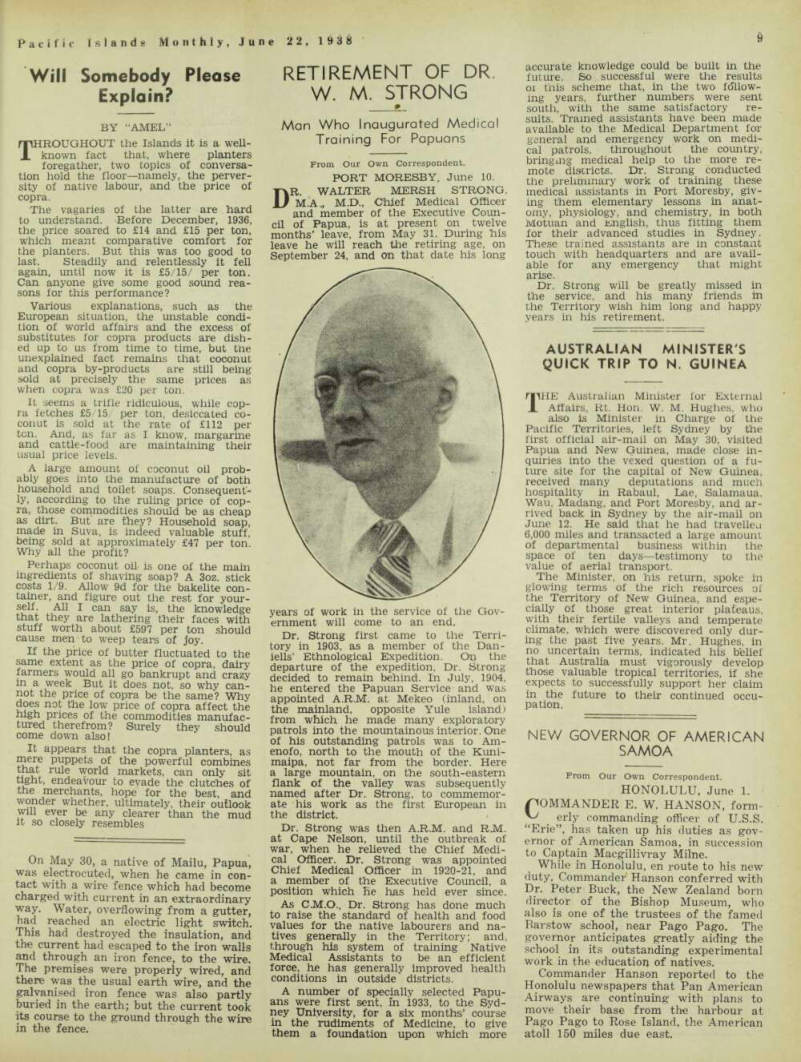
W. M. Strong
Man Who Inaugurated Medical Training For Papuans
From Our Own Correspondent.
Port Moresby, June 10.
Dr. Walter Mersh Strong,
M.A M.D., Chief Medical Officer and member of the Executive Coun cil of Papua, is at present on twelve months’ leave, from May 31. During his leave he will reach the retiring age, on September 24, and on that date his long
years of work in the service of the Gov ernment will come to an end.
Dr. Strong first came to the Terri tory in 1903, as a member of the Dan iells’ Ethnological Expedition. On the departure of the expedition, Dr. Strong decided to remain behind. In July, 1904, he entered the Papuan Service and was appointed A.R.M. at Mekeo (inland, on the mainland, opposite Yule island) from which he made many exploratory patrols into the mountainous interior. One of his outstanding patrols was to Am enofo, north to the mouth of the Kuni maipa, not far from the border. Here a large mountain, on the south-eastern flank of the valley was subsequently named after Dr, Strong, to commemor ate his work as the first European in the district.
Dr. Strong was then A.R.M. and RM. at Cape Nelson, until the outbreak of war, when he relieved the Chief Medi cal Officer. Dr. Strong was appointed Chief Medical Officer in 1920-21, and a member of the Executive Council, a position which He has held ever since.
As CM.O., Dr. Strong has done much to raise the standard of health and food values for the native labourers and na tives generally in the Territory; and, through his system of training Native Medical Assistants to be an efficient force, he has generally improved health conditions in outside districts.
A number of specially selected Papu ans were first sent, In 1933, to the Syd ney University, for a six months’ course in the rudiments of Medicine, to give them a foundation upon which more
accurate knowledge could be built in the future. So successful were the results oi this scheme that, in the two follow ing years, further numbers were sent south, with the same satisfactory re sults. Trained assistants have been made available to the Medical Department for general and emergency work on medi cal patrols, throughout the country, bringing medical help to the more re mote districts. Dr. Strong conducted the preliminary work of training these medical assistants in Port Moresby, giv ing them elementary lessons in anat omy, physiology, and chemistry, in both Motuan and English, thus fitting them for their advanced studies in Sydney.
These trained assistants are in constant touch with headquarters and are avail able for any emergency that might arise.
Dr. Strong will be greatly missed in the service, and his many friends in the Territory wish him long and happy years in his retirement.