Asiatic Labour For Pacific
pp. 5-6 · Read in the full issue
Territories
AS the years pass, one can see a ** labour problem growing acute in the Pacific.
If European occupation of the vari ous Territories of the Central and South Pacific is to continue effec tively, some guarantee of an adequate labour supply must be given to the commercial interests concerned. In that connection, there always is danger of a clash between the em ployers, and the various folk who con sider it their duty to protect the in terests of the natives—the latter class including some utterly impractical idealists who believe that Europeans, without apology and without cere mony, should be thrown out of the Islands altogether. Writers of letters to the editor, published in this and recent issues, deal interestingly with certain aspects of this problem.
The fact of the matter is that a better labour supply already is needed by British interests in New Guinea, the Solomons, and Samoa, and to some extent in Fiji, and probably it will be needed soon in Papua. This
is a matter—especially in its relation ship to the possible use of indentured Asiatic labour—concerning which there should, long ago, have been con sultation between the Dominions con cerned and the British Government.
Instead, all the little bureaucrats paddle along, each in his own water tight compartment, and coldly ignore the similar problem of the men along side them.
The first principle of colonisation nowadays is that the native may not be enslaved. In any event, as an aboriginal landowner, he has certain inalienable rights, which give him economic independence. Yet, without an adequate labour supply, Europeans cannot make sufficient use of these islands to justify European occupa tion; and, if Europeans abandon them the Asiatics will come in—and that will be the end of the European nations in the West and South Pacific.
Every year, it is becoming more difficult to obtain a sufficient labour supply for New Guinea’s plantations, mines and commercial establishments.
This position became inevitable, from the time that the goldmines suddenly demanded from 7,000 to 10,000 native labourers. There are several reasons for it, and a dozen angles to each reason; but the net result is that the New Guinea natives, in an increasing degree, are unwilling to make labour contracts, and those who do are in creasingly difficult to handle.
The same thing is likely to happen in Papua. If an oil industry is estab lished there the labour position will become acute, so far as native sup plies are concerned.
The real solution was seen long ago, but always has been frowned upon officially. It is to employ a system of indentured Asiatic labour, similar to that used by the French in New Caledonia and the New Hebrides.
The well-meaning, but uninstructed and inexperienced Socialist Govern ment of New Zealand has removed most of the indentured Chinese labourers from Western Samoa, and has told the embarrassed planters there: “Use local labour, or get out!”
The issue, which apparently is too big to be seen by the gentlemen in little New Zealand, has application to the whole Pacific. If there is to be an effective and justifiable occupation of Samoa by Europeans there must be
an adequate labour supply. Samoans, holding ample food-producing lands on a communal basis, will not hire themselves as labourers to Europeans.
Exactly the same difficulty has been experienced in other Pacific ter ritories during the past decades. In almost every case, an attempt has been made to solve it by bringing in Asiatic labour (always on a system of strict indenture and periodical re patriation), and in almost every case the result has been deplorable. For one reason and another—too many and lengthy to examine here—the various indenture systems broke down, with the result that a Chinese com munity has become established in Tahiti, a Japanese community in Hawaii, an Indian community in Fiji, and a Chinese community in New Guinea. In the cases of Tahiti, Fiji and New Guinea, the implantation of Asiatics has not solved the labour problem; the Asiatics simply have be come traders, planters, and artisans, and will not hire themselves out as labourers. But the breakdown of the indenture system in those cases does not mean that it will not work. It has worked, and is working admirably to-day, in New Caledonia, where Javanese operate the chrome and nickel industries; in New Hebrides, where Tonkinese supply plantation labour; and in Nauru and Ocean Island, where Chinese work the phos phate deposits.
It is fair neither to European en terprise, to Government officials, to missionaries, nor to the Pacific Islands natives themselves, to expect that these territories shall be satisfactorily occupied by Europeans, with the assistance of the indigenous peoples only. The natives, through countless generations, have not known real labour—Mother Nature has provided abundantly for their simple needs.
Why should they be made to labour?
Or why, alternatively, should their lives be altered, and their needs be made more numerous and complex, so that they may be induced to labour?
Following this argument, one may say, Why not leave the natives alone in their Pacific islands, to work out their own destiny, under the guidance of missionaries and benevolent Gov ernment despots? Unfortunately, the day in which that idea might be seri ously discussed is past. In relation to the occupation and use of occupiable territories, there is a mighty stirring in the world. The fertile, undeve loped Pacific territories are directly affected. European countries must occupy and make proper use of the Pacific territories they hold, or they will lose them, with results calamitous to themselves. They dare not even hand over the territories to the natives whom they may have organised and
educated—the position in the Philip pines, where America now is trying to put the Philippines Independence Plan into reverse, is proof of that.
And so we come back to some plain questions, to which answers can easily be given:— Is it desirable that all Pacific ter ritories south of the Equator be held by Britain, France and other Euro peans? It is.
Can those territories be effectively occupied and held unless there is ade quate labour available for established industries and developmental works?
They cannot.
Is sufficient native labour avail able? There is not sufficient native labour available in any of the terri tories, but there is ample labour to be hired next door, in Asia.
But that indenture system, as al ready shown, is full of dangers, in an economic and racial sense. That is why there should be a clear under- * standing and a common policy be tween the various colonising interests concerned.
Mr. Eric Vine, well-known Fiji bar rister and solicitor, died at Raki Raki, Ra, on May 10. Born in London in 1889, Mr. Vine was admitted as a solicitor of the Supreme Court of England in 1911, He served through the war and went to Fiji in 1924, being admitted as a bar rister and solicitor of the Supreme Court in the same year. Mr. Vine practised in many districts on Viti Levu, finally establishing himself at Ra. He is sur vived by his widow.
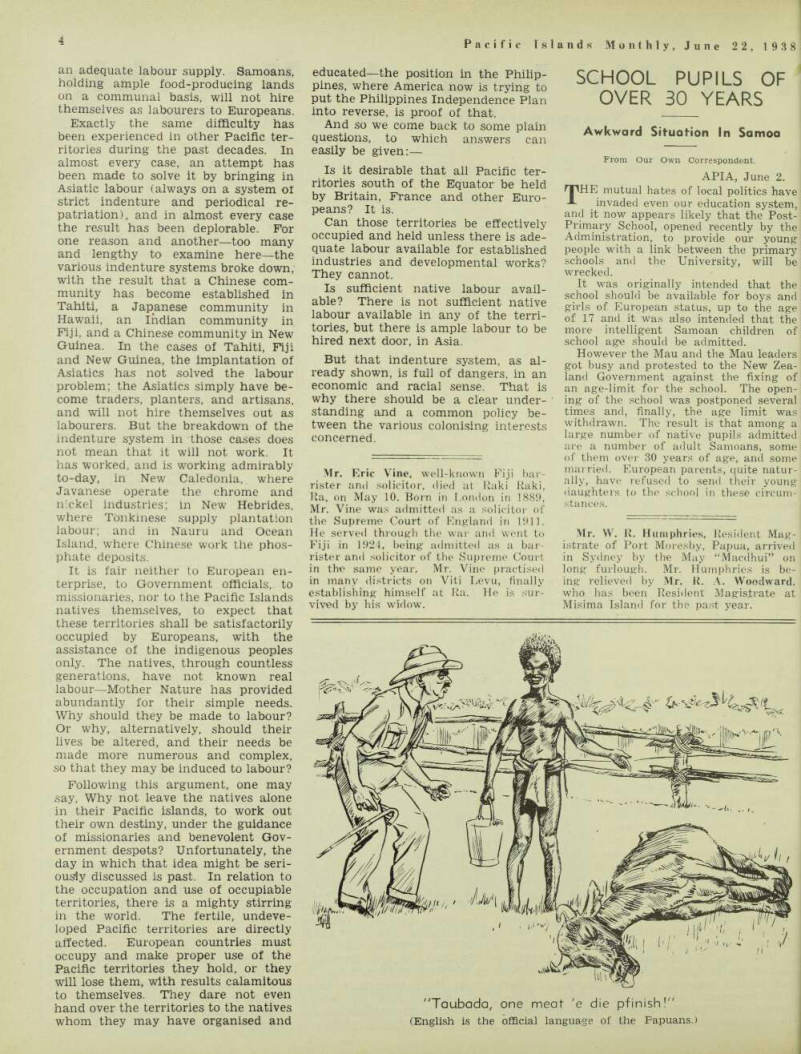
"Touboda, one meat'e die pfinish!" (English is the official language of the Papuans.)