Cinchona Trees.
p. 65 · Read in the full issue
Success At New Guinea Experimental Station May Affect Dutch Quinine Monopoly.
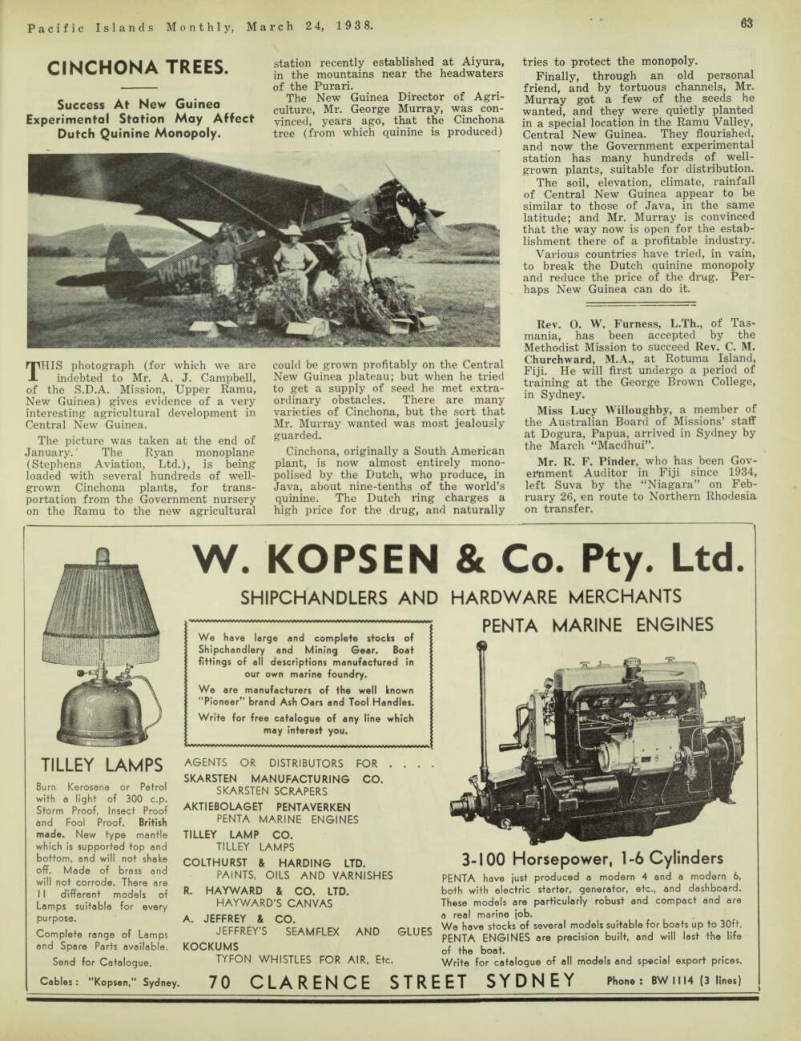
THIS photograph (for which we are indebted to Mr. A. J. Campbell, of the S.D.A. Mission, Upper Ramu, New Guinea) gives evidence of a very interesting agricultural development in Central New Guinea.
The picture was taken at the end of January. The Ryan monoplane (Stephens Aviation, Ltd.), is being loaded with several hundreds of wellgrown Cinchona plants, for transportation from the Government nursery on the Ramu to the new agricultural
station recently established at Aiyura, in the mountains near the headwaters of the Purari.
The New Guinea Director of Agriculture, Mr. George Murray, was convinced, years ago, that the Cinchona tree (from which quinine is produced)
could be grown profitably on the Central New Guinea plateau; but when he tried to get a supply of seed he met extraordinary obstacles. There are many varieties of Cinchona, but the sort that Mr. Murray wanted was most jealously guarded.
Cinchona, originally a South American plant, is now almost entirely monopolised by the Dutch, who produce, in Java, about nine-tenths of the world’s quinine. The Dutch ring charges a high price for the drug, and naturally
tries to protect the monopoly.
Finally, through an old personal friend, and by tortuous channels, Mr.
Murray got a few of the seeds he wanted, and they were quietly planted in a special location in the Ramu Valley, Central New Guinea. They flourished, and now the Government experimental station has many hundreds of wellgrown plants, suitable for distribution.
The soil, elevation, climate, rainfall of Central New Guinea appear to be similar to those of Java, in the same latitude; and Mr. Murray is convinced that the way now is open for the establishment there of a profitable industry.
Various countries have tried, in vain, to break the Dutch quinine monopoly and reduce the price of the drug. Perhaps New Guinea can do it.
Rev. O. W. Furness, L.Th., of Tas mania, has been accepted by the Methodist Mission to succeed Rev. C. M.
Churchward, M.A., at Rotuma Island, Fiji. He will first undergo a period of training at the George Brown College, in Sydney.
Miss Lucy Willoughby, a member of the Australian Board of Missions’ staff at Dogura, Papua, arrived in Sydney by the March “Macdhui”.
Mr. R. F. Pinder, who has been Gov ernment Auditor in Fiji since 1934, left Suva by the “Niagara” on Feb ruary 26, en route to Northern Rhodesia on transfer.