The "Mystery Stone"
pp. 46-47 · Read in the full issue
Of Tahiti.
By W. W. Bolton, M.A.
A SHORT hour’s stroll from Papeete’s market-place, up the Tipaerui Valley with finally a rocky ascent on its south-western side, a mountain stream is met with which has gouged out for itself a narrow but deep course to the sea.
When the heavy rains descend, the stream becomes a torrent eating into the high banks and in places overflowing.
Here, leaning slantingly against its western bank, there is, and has been so far as native memory goes back, a petro glyph stone (or boulder) marked with mystic carving. There is no other large similar stone thus marked upon the island of Tahiti. Who placed it, if not Nature, where it stands and who wrought it are mysteries which white folk and natives —though they have their usual “tradi tion”—have long sought to know.
Scientists have studied it and have been forced to leave the mystery unsolv ed. both as to its antiquity and real in terpretation. As to Tahitian lore there on. Mr. A. K. Richer many years back secured the following explanation from Monsieur Buillard on whose family pro perty it stands, all of whom regard it with veneration and have refused all offers to part with it, either into the care of the local Museum, much less to Museums in far-off countries that have sought its purchase. There it is and there it is to remain, lest ill-fortune follow its re moval (unless Authority steps in).
The rock was carved in memory of Tetaurii Vahine (Tetaurii’s wife) and her twin children, so the Tahitian story goes.
Tetaurii, defeated, took refuge in Tipaerui Valley. His wife there gave birth to twins and soon after all three died. They were buried on the land of Oteoteroa close to the brook: and a spirit in the form of a monster eel gives them constant protec tion. If one touches the rock, milk will flow along the grooves and the offender will die.
Mr. Kenneth P. Emory, of the Bishop Museum staff, Hawaii, on one of his sev eral visits to Tahiti, a dozen years ago, visited and carefully examined the stone and contributed a long and valuable arti cle thereon to the Societe des Etudes Oceaniennes, which appeared in the Bul letin (No. XI.) of the Society issued in February, 1926, from which the following excerpts are taken with, the hope of not only giving this remarkable Memorial of the Past a wider publicity, but also of bringing it to the notice of those among the readers of the “P.1.M.” who are qualified by their scientific training to do so, to try their hand as others have done in solving the weird carving.
Mr. Emory after quoting the above “tradition” adds: “There is the sinuous line which may represent an eel over the left head of the ‘twins’. It is so obscure I doubt if it would be noticed unless one gave the carving very careful study.
Therefore I doubt if the eel element would be included in a story made-up to-day to Jlt the carving. Yet the carving is so highly conventional and symbolic that I feel sure it had more meaning, if not an other meaning”.
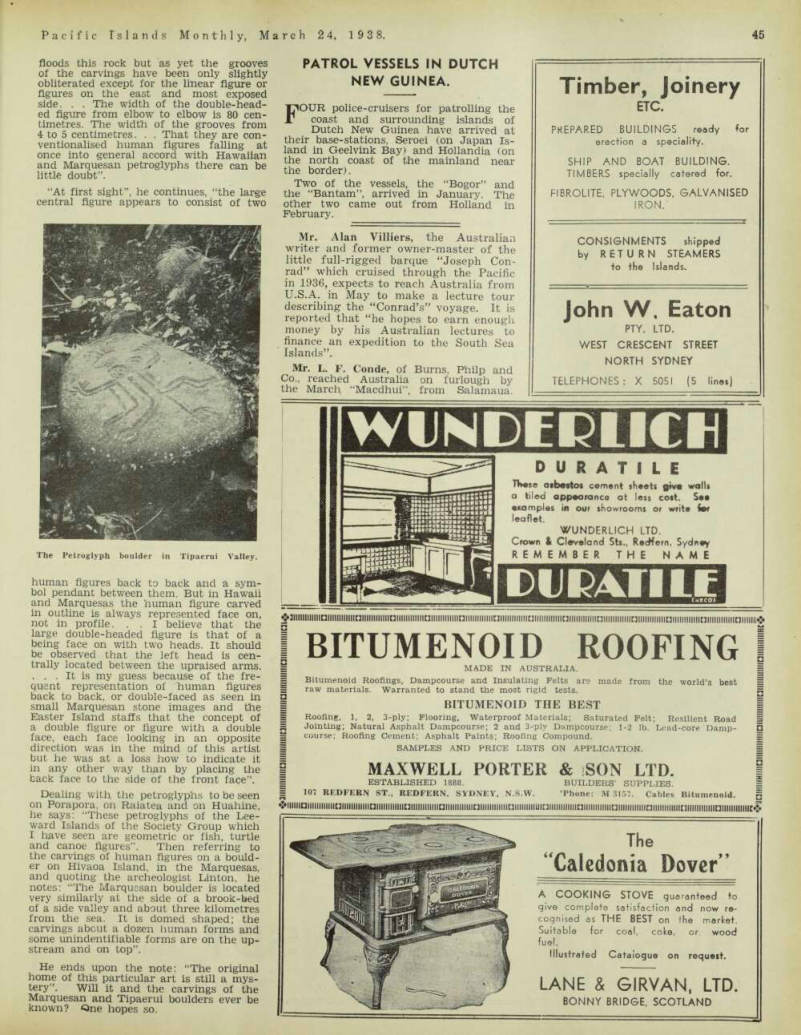
In a description of the stone he writes: “The boulder presents a flat, smooth, water-worn surface 181 centimetres long and 119 centimetres vide which is almost entirely filled by the most conspicuous carving. During heavy rains the brook
floods this rock but as yet the grooves of the carvings have been only slightly obliterated except for the linear figure or figures on the east and most exposed side. . . The width of the double-head ed figure from elbow to elbow is 80 cen timetres. The width of the grooves from 4 to 5 centimetres. . . That they are con ventionalised human figures falling at once into general accord with Hawaiian and Marquesan petroglyphs there can be little doubt”.
“At first sight”, he continues, “the large central figure appears to consist of two
human figures back to back and a sym bol pendant between them. But in Hawaii and Marquesas the human figure carved in outline is always represented face on, not in profile... I believe that the large double-headed figure is that of a being face on with two heads. It should be observed that th,e left head is cen trally located between the upraised arms. . . . It is my guess because of the fre quent representation of human figures back to back, or double-faced as seen in small Marquesan stone images and the Easter Island staffs that the concept of a double figure or figure with a double face, each face looking in an opposite direction was in the mind of this artist but he was at a loss how to indicate it in any other way by placing the back face to the side of the front face”.
Dealing with, the petroglyphs to be seen on Porapora, on Raiatea and on Huahine, he says: “These petroglyphs of the Lee ward Islands of the Society Group which I have seen are geometric or fish, turtle and canoe figures”. Then referring to the carvings of human figures on a bould er on Hivaoa Island, in the Marquesas, and quoting the archeologist Linton, he notes: “The Marquesan boulder is located very similarly at the side of a brook-bed of a side valley and about three kilometres from the sea. It is domed shaped; the carvings about a dozen human forms and some unindentifiable forms are on the up stream and on top”.
He ends upon the note: “The original home of this particular art is still a mys tery”. Will it and the carvings of the Marquesan and Tipaerui boulders ever be known? Qne hopes so.
The Petroglyph boulder in Tipaerui Valley.