By Bishop.
p. 28 · Read in the full issue
Mission Spheres Of
Influence.
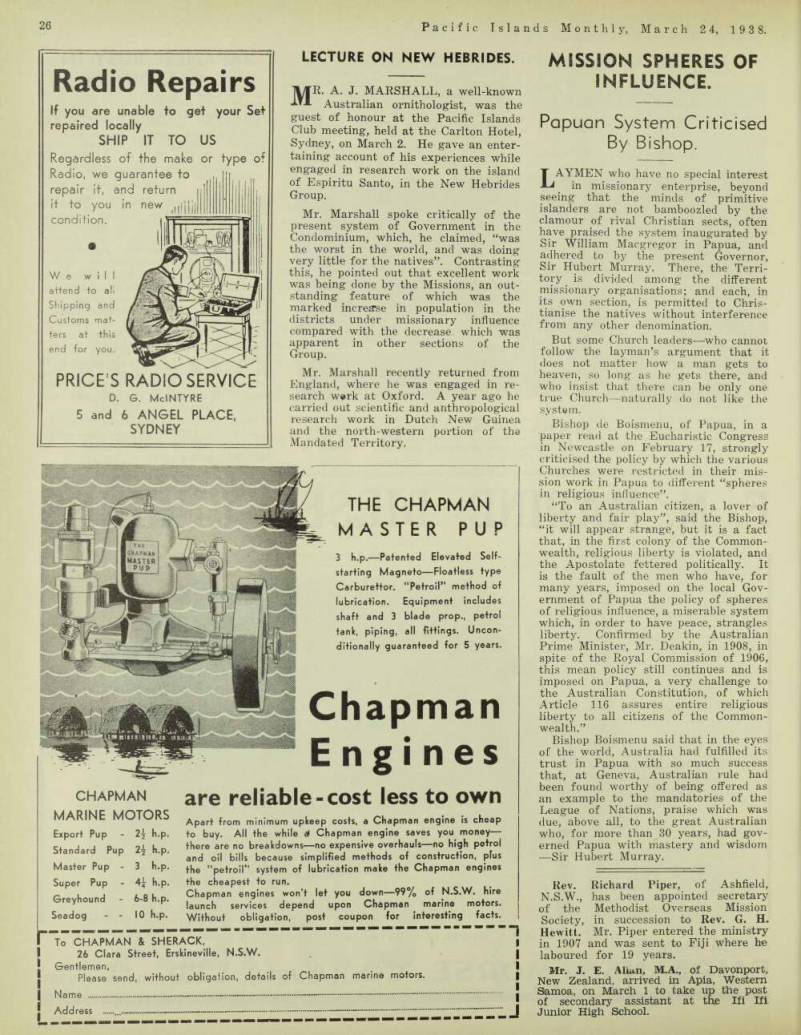
Papuan System Criticised By Bishop.
LAYMEN who have no special interest
in missionary enterprise, beyond
seeing that the minds of primitive islanders are not bamboozled by the clamour of rival Christian sects, often have praised the system inaugurated by Sir William Macgregor in Papua, and adhered to by the present Governor, Sir Hubert Murray. There, the Terri tory is divided among the different missionary organisations; and each, in its own section, is permitted to Chris tianise the natives without interference from any other denomination.
But some Church leaders—who cannot follow the layman’s argument that it does not matter how a man gets to heaven, so long as he gets there, and who insist that there can be only one true Church—naturally do not like the system.
Bishop de Boismenu, of Papua, in a paper read at the Eucharistic Congress in Newcastle on February 17, strongly criticised the policy by which the various Churches were restricted in their mis sion work in Papua to different “spheres in religious influence”.
“To an Australian citizen, a lover of liberty and fair play”, said the Bishop, “it will appear strange, but it is a fact that, in the first colony of the Common wealth, religious liberty is violated, and the Apostolate fettered politically. It is the fault of the men who have, for many years, imposed on the local Gov ernment of Papua the policy of spheres of religious influence, a miserable system which, in order to have peace, strangles liberty. Confirmed by the Australian Prime Minister, Mr. Deakin, in 1908, in spite of the Royal Commission of 1906, this mean policy still continues and is imposed on Papua, a very challenge to the Australian Constitution, of which Article 116 assures entire religious liberty to all citizens of the Common wealth.”
Bishop Boismenu said that in the eyes of the world, Australia had fulfilled its trust in Papua with so much success that, at Geneva, Australian rule had been found worthy of being offered as an example to the mandatories of the League of Nations, praise which was due, above all, to the great Australian who, for more than 30 years, had gov erned Papua with mastery and wisdom —Sir Hubert Murray.
Rev. Richard Piper, of Ashfield, N.S.W., has been appointed secretary of the Methodist Overseas Mission Society, in succession to Rev. G. H.
Hewitt. Mr. Piper entered the ministry in 1907 and was sent to Fiji where he laboured for 19 years.
Mr. J. E. Allitn, M.A., of Davenport, New Zealand, arrived in Apia, Western Samoa, on March 1 to take up the post of secondary assistant at the Ifi If I Junior High School.