Islands Life Pictured On Stamps.
pp. 43-44 · Read in the full issue
By Kenneth Allen.
THE Pacific Islands are inhabited by picturesque peoples. Each isle has its peculiar native customs and characteristics.
One particular class of non-travelling persons may “see” these islanders, and study their customs and typical dress.
They are the philatelists, or stamp col lectors. Throughout the territories there are issued innumerable postage stamps,
illustrating Islands folk and their associa tions.
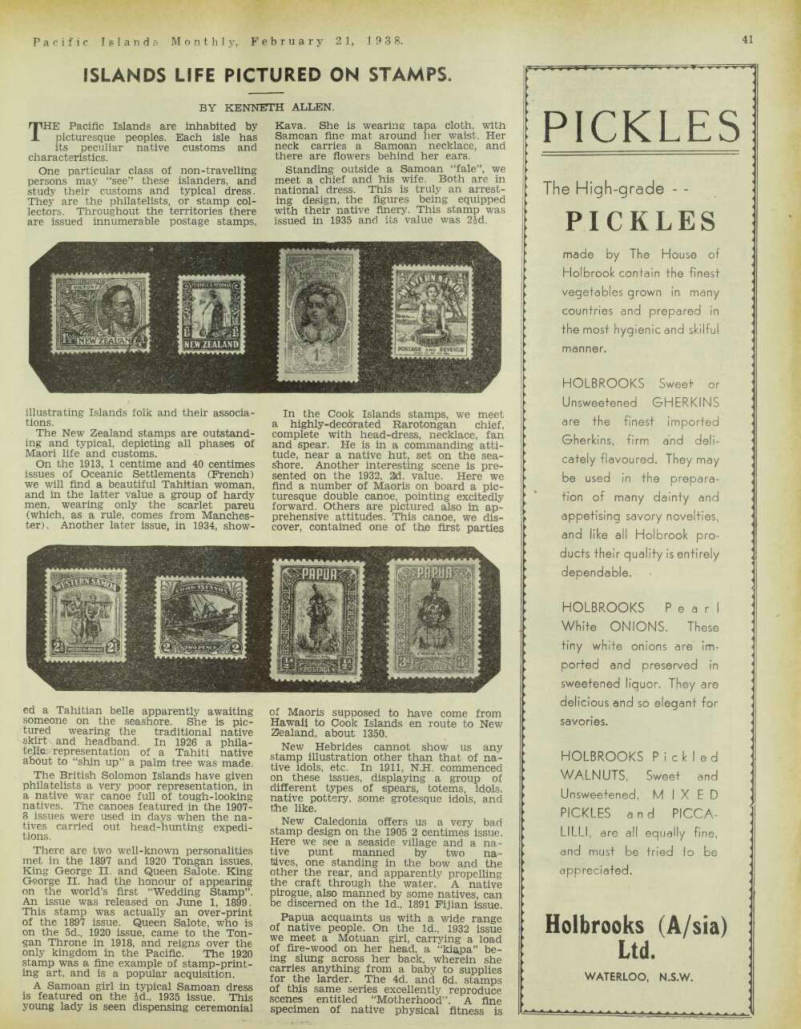
The New Zealand stamps are outstand ing and typical, depicting all phases of Maori life and customs.
On the 1913, 1 centime and 40 centimes issues of Oceanic Settlements (French) we will find a beautiful Tahitian woman, and in the latter value a group of hardy men, wearing only the scarlet pareu (which, as a rule, comes from Manches ter). Another later issue, in 1934, show-
ed a Tahitian belle apparently awaiting someone on the seashore. She is pic tured wearing the traditional native skirt and headband. In 1926 a philarepresentation of a Tahiti native about to “shin up” a palm tree was made.
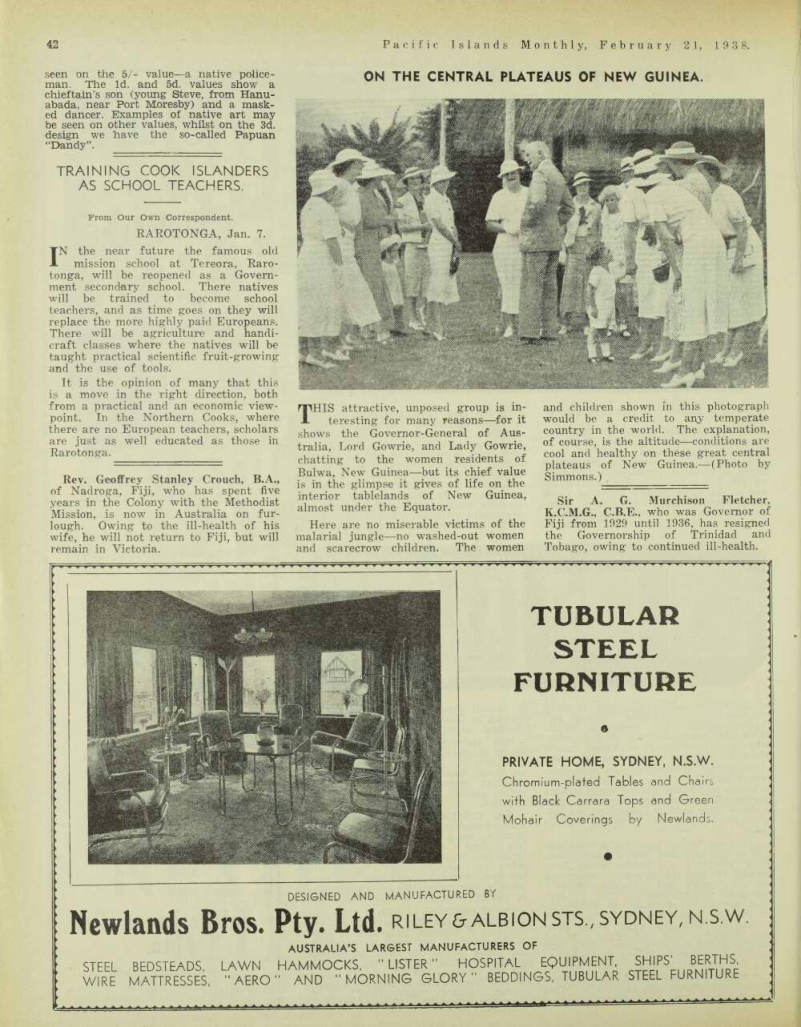
The British Solomon Islands have given philatelists a very poor representation, in a native war canoe full of tough-looking natives. The canoes featured in the 1907- 8 issues were used in days when the na tives carried out head-hunting expedi tions.
There are two well-known personalities met in the 1897 and 1920 Tongan issues, King George 11. and Queen Salote. King George 11. had the honour of appearing on the world’s first “Wedding Stamp”.
An issue was released on June 1, 1899.
This stamp was actually an over-print of the 1897 issue. Queen Salote, who is on the 5d., 1920 issue, came to the Ton gan Throne in 1918, and reigns over the only kingdom in the Pacific. The 1920 stamp was a fine example of stamp-print ing art, and is a popular acquisition.
A Samoan girl in typical Samoan dress is featured on the Id.. 1935 issue. This young lady is seen dispensing ceremonial
Kava. She is wearing tapa cloth, with Samoan fine mat around her waist. Her neck carries a Samoan necklace, and there are flowers behind her ears.
Standing outside a Samoan “fale”, we meet a chief and his wife. Both are in national dress. This is truly an arrest ing design, the figures being equipped with their native finery. This stamp was issued in 1935 and its value was 2ld.
In the Cook Islands stamps, we meet a highly-decorated Rarotongan chief, complete with head-dress, necklace, fan and spear. He is in a commanding atti tude, near a native hut, set on the sea shore. Another interesting scene is pre sented on the 1932, 2d. value. Here we find a number of Maoris on board a pic turesque double canoe, pointing excitedly forward. Others are pictured also in ap prehensive attitudes. This canoe, we dis cover, contained one of the first parties
of Maoris supposed to have come from Hawaii to Cook Islands en route to New Zealand, about 1350.
New Hebrides cannot show us any stamp illustration other than that of na tive idols, etc. In 1911, N.H. commenced on these issues, displaying a group of different types of spears, totems, idols, native pottery, some grotesque idols, and the like.
New Caledonia offers us a very bad stamp design on the 1905 2 centimes issue.
Here we see a seaside village and a na tive punt manned by two na tives, one standing in the bow and the other the rear, and apparently propelling the craft through the water. A native pirogue, also manned by some natives, can be discerned on the Id., 1891 Fijian issue.
Papua acquaints us with a wide range of native people. On the Id., 1932 issue we meet a Motuan girl, carrying a load of fire-wood on her head, a “kiapa” be ing slung across her back, wherein she carries anything from a baby to supplies for the larder. The 4d. and 6d. stamps of this same series excellently reproduce scenes entitled “Motherhood”. A fine specimen of native physical fitness is
seen on the 5/- value —a native police man. The Id. and sd. values show a chieftain’s son (young Steve, from Hanu abada, near Port Moresby) and a mask ed dancer. Examples of native art may be seen on other values, whilst on the 3d. design we have the so-called Papuan “Dandy”.