Islands By The Way.
pp. 27-30 · Read in the full issue
Fascinating History of Torres Strait.
BY DR. G. H. VERNON, OF DARU, PAPUA.
ALL little islands have their little mysteries.
The more distant and isolated they are, the more they seem to exercise a fascination over men of imaginative and adventurous spirit.
The islands of Torres Strait are no ex ception and each one has some special natural feature, some tale to tell, or some historical association that distin guishes it from its neighbours. In these changing times it is worth while record ing, before it is too late, some of the stories that have gathered round the little lost specks of land between Aus tralia and New Guinea.
There is the making of many books in Torres Strait, and the pity of it is that with the passing of the years and the advent of the modern cut-and-dried form of civilisation, so much of the rich ly-endowed past will be lost for want of record. The old hands have all but
gone and, for the most part, they were men of action rather than writing. But what a mass of material lay in the mem ories of those who have passed away!
Look back over the centuries and dwell for a moment on the pageant of Torres Strait—on Torres himself battling against adverse winds through unknown shoals and reefs; on the Malays, who came from afar since time immemorial to collect beche de mer; on the Chinese of an an even earlier date, who are supposed to have sailed down to Warrior Reef for the same purpose; on the scenes of those fierce battles of old be tween the tribes, where even to-day the skulls of the slain may be unearthed; on the massacre of white seamen on Darn ley Island; on the “Ocean Post Office” on Booby Island, where the rare passing ships of early Victorian days left letters for one another. Few parts of our southern land can compare in historical
interest with these desolate wind-swept isles and seas.
There are still seas on the globe that rarely see a ship, and are almost as empty and lonely to-day as they were a thousand years ago; yet, thanks to new enterprises on adjoining coasts, they suddenly find themselves “On th,e Map”, blossoming into trade routes of growing importance.
The northern part of Torres Strait has always been a side track, neglected by
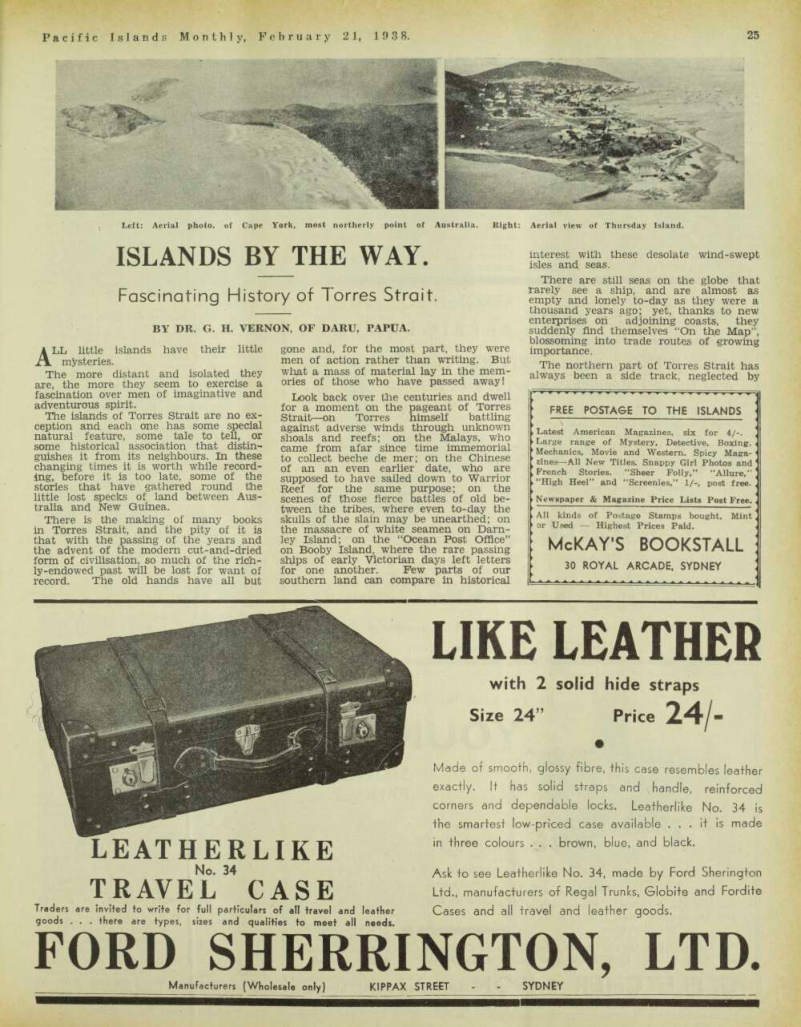
Left: Aerial photo. of Cape York, most northerly point of Australia.
Right: Aerial view of Thursday Island.
the world’s shipping, but to-day it is a changing sea. It is true that for more than half a century the pearling luggers on Thursday Island have sailed its waters in the course of their lawful, and sometimes unlawful, business; but a new class of vessel and a new class of seamen has now appeared, and the future seems to point to a new era in the long history of Torres Strait.
If oil is found over the water from Northern Australia, among the swamps of Western New Guinea—and the search is being feverishly carried out from Daru, the small and hithertp unknown island that fronts the Strait on the north—this shallow sea between two Continents will become a recognised steamer track, where the ships of many nations will come for fuel. Now that so many white men are crossing the Strait,
most of them probably in absolute ig norance of the romance of its past, it may be of interest to recall that these northern waters have played a great part in the drama of Australian exploration, Civilisation came to Torres Strait not as the result of trade, nor in the hopes of opening up new areas for the expan sion of British emigration in the Anti podes, but as the result of a long roll of misfortune and tragedies that beset the intrepid navigators who pioneered the Cape York route. Navigation here has always been, and always will be difficult, but in the earlier years of last century a worse fate than drowning often await ed ship-wrecked mariners in these island studded waters. Escaping from the dan gers of the sea, they fell victim far too often to the savagery of the natives ashore.
Many are the tales of women cast aways who were forced into captivity, and even marriage with their captors, on mainland or island; and even more nu merous the record of sailors who were killed and eaten. Captains of vessels had dangers both afloat and ashore to face, and it became intolerable that a route to India and China of growing import ance should be dominated by bands of nomadic cannibals. Torres Strait had to be cleaned up, BOTH the Home and Queensland Gov ernments were concerned at the in creasing calamities, and in the early sixties the Jar dine Brothers were ap pointed to form a settlement in the vic inity of Cape York for the express pur pose of establishing a depot where ship wrecked sailors might make for safety, and of maintaining order among the vari ous tribes. Thus originated the first permanent occupation of the British in these waters.
The arrival of th,e Jardines, who set tled at famous Somerset, overlooking one of the curving bays of Albany Pass, coincided with the first attempts at pearl ing in Torres Strait; and even had their station not been established at that time, a gradual development ashore must have taken place. Thereafter, matters began to improve, and pearling grew into an important industry that has lasted until the present day.
Torres Strait, however, had been re corded in history long before the advent of the Jardines, and the names of many of our most famous sea-going explorers had already been written there. Cook had passed through Endeavour Strait and raised the Union Jack on Posses sion Island. Bligh, set adrift by mutin eers, had spent a night on Wednesday Island. Flinders had anchored in Horn Island Bight; King, in the leaky “Mer maid”, had made a survey of some of the passages; and many less known though no less courageous navigators had added bit by bit to the knowledge of Torres Strait. An impressive record for one little portion of Australia! Is it any wonder that these are household names on Thursday Island or that those who live there have a well-developed sense of history and feel themselves to be as sociated with some of the most interest ing phases of exploration in the South ern Continent?
THOSE who expect to find a tropical paradise in Torres Strait will be disappointed, for the islands are rocky and arid, covered with long grass and sparse timber, and one looks in vain for the palm-enclosed lagoons and all the rich and ordered beauty of a South Sea Island of fiction, or indeed of fact. But the ocean gap between Australia and New Guinea has an austere beauty of its own, and an undeniable attraction for those who know it, though its skies are not universally blue nor its waters well behaved. Those who live amid the some what meagre amenities of civilised life on Thursday Island have always the feeling of being on the verge of a re gion rich in romance and history.
And, quite apart from the recorded history of Torres Strait, who among us who have dwelt there has not his own store of unrecorded history, of a life rich in incident and adventure and hu man contacts, in a setting of stormy waters and battles with the sea? There are many reasons why those who voy age among the islands feel a heart grip at the very mention of their name, many reasons why these forlorn surroundings have grown into our lives and come to be a part of our very selves.
No one could have lived in Torres Strait and escaped its spell.
There is romance, too, beneath the waves in Torres Strait, romance that is dead and turned to tragedy and decay.
Wrecks have been so frequent that they have slipped out of memory and, on be ing rediscovered, have remained unid entified. Treasure ships, coal ships, and ships.in ballast, famous passenger liners and insignificant windjammers have all paid toll to the perils of the Strait; and, if the sea gave up its dead, what a mot ley crowd would be gathered together.
Men of the Strait, both white and col oured, have always been accustomed to sailing in small boats, and some of their voyages have been nothing short of epics of heroism which in other parts of the world would not have passed unhon oured in history.
But in Torres Strait they are the com
monplaces of existence.
“TSLANDS by the Way” there are in 1 plenty between Thursday Island and Daru. Let us single out a few that every voyager comes to know, for each has something worthy of notice.
Naghir, the precipitous island that rises so picturesquely to windward on the first beat out of Thursday Island, is al most unique in situation, from the sum mit of its peak you can on a clear day see both Australia and New Guinea with the naked eye. Cape York and the in ter-twining hills of the mainland lie westward, and, far to the north where the almost similar peak of Dauan shows on the horizon, a long low violet tinted smudge marks the mainland of New Guinea.
It was here that Frank Jardine, the
pioneer administrator, formed his pearl ing station; and in the old homestead there one of the most gracious and hon oured ladies of Thursday Island first saw the light. Adventure came early for her, for when she was only a few days old she was rescued from her first home just before it was burnt to the ground.
On Coconut, farther east, we used, in the days that are gone, to come ashore at night just to hear the Chief of the Island spin yarns of the early days. The Coconut Islanders were always an adven turing, not to say freebooting crowd, who dominated the folk around them. It was intriguing to listen to Olandi’s sly com ments on the valour (?) of the Turituri people, on the New Guinea mainland, who locked themselves in their village at night when half a dozen Coconut Island ers arrived with yells to rob their palms, and saddening to think that raiding part ies in these fettered days cannot func tion in New Guinea without a permit to land.
Coconut Islanders were always having sea adventures of the most thrilling de scription; one of them capsized his dinghy and, for five days, kept himself alive on a log, drifting to and fro on the tide within sight of unattainable islands, be fore he was rescued.
Yam Island was a sort of South Sea international market, where Papuans and Islanders traded under a more or less perpetual truce. Here, men who were bitter enemies elsewhere, met to ex change marine products for commodities of the jungle, and it is quite conceivable that th,e adventurous lakatois of Hanua bada, near Moresby, made Yam a term inal port in their annual westward trad ing cruise with home-made cooking-pots.
From the top of Dauan’s 800 ft. peak, mentioned in de Prado’s account of the voyage of Torres, there is an amazing
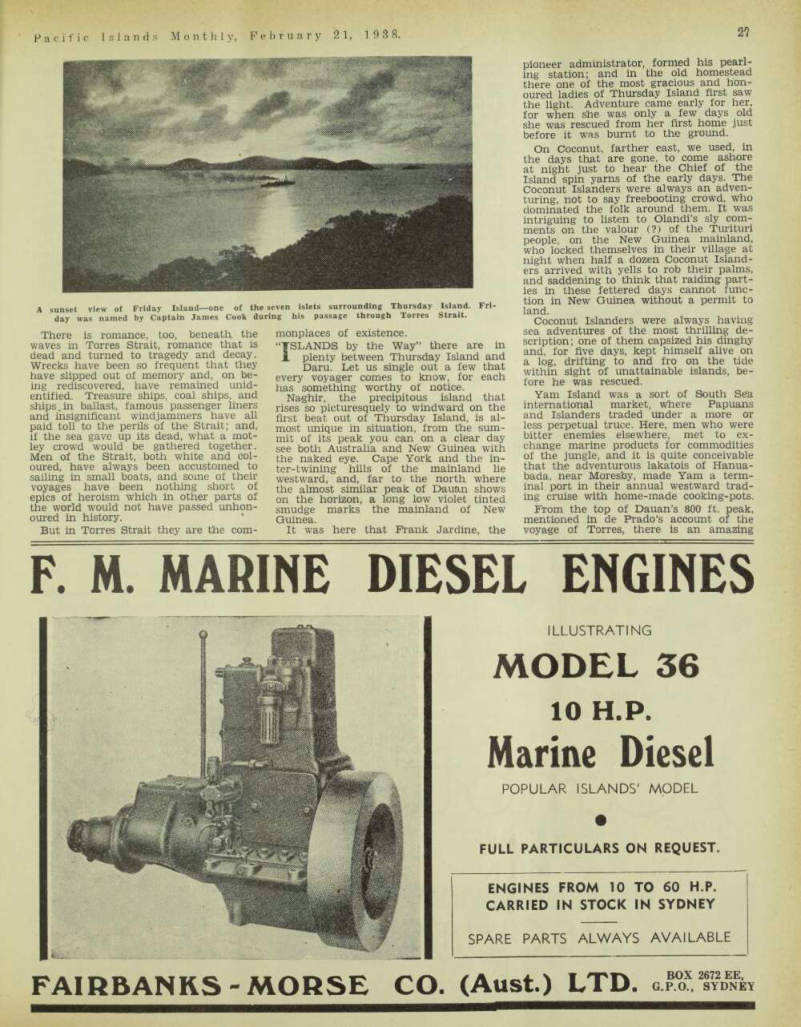
A sunset view of Friday Island—one of the seven islets surrounding Thursday Island. Fri day was named by Captain James Cook during his passage through Torres Strait.
view over the hinterland of Western Papua, which only an aerial photo, could equal. The land of New Guinea here lies spread out like a map on the ground, a vast expanse of plain and swamp, crossed by winding creeks and rivers that gradually fades without change or rise of altitude into the haze of infinity, the flattest, most water-logged land on earth.
It is of interest to note that the gran ite of both Naghir and Dauan is the same as that found in Southern Tas mania—a reminder that these remote is lands are sunken peaks of the Great Dividing Range of Australia.
Next to Dauan is the saucer-shaped is land of Saibai, obviously formed from New Guinea mud and nowhere higher
than ten feet above sea level. Though Torres must have sighted it in his voy age in 1606, Saibai’s contribution to his tory is of recent date. It was in 1916 that a strange vessel approached Saibai in the dusk and signalled the shore. Natives at once set sail for Thursday Is. to re port this visitor, which was supposed to be the famous German raider “Wolf”. Thursday Island rose to the oc casion nobly; a very small launch man ned by a very few riflemen, sailed away into the blue to challenge the enemy, while the rest of the war-time garrison waited with what patience they could for the “Wolf” to be towed into harbour. The launch did not find the “Wolf”—or per haps, we should say that the “Wolf” did not find the launch, or another laurel might have been added to the renown of the British Naval Reserve—but the in tention and, above all; the courage need ed to carry out a duty that must have led to capture or death were proof that Thursday Island’s heart was in the right place.
And here we leave our “Islands by the Way” in the hopes that enough has been culled from their store of history and human endeavour to deepen interest in the subject.