Rossel Island Financiers.
pp. 20-21 · Read in the full issue
Primitive Bill-Brokers of Complicated Monetary System in Papua.
By Mollie Lett.
IN far-away Rossel Island, the most remote and eastern of the Louisiade Group, South-Eastern Papua, where the mountain-tops are forever shrouded in clouds and misty rain, and the legends of the gloomy inhabitants point to some mysterious and long past invasion, a curious currency exists, consisting of shell money, of two kinds, known as the nDap and the nKo. They are used as real coins, and for no other purpose.
The inhabitants assert that these coins were made in the dim past, by their su preme deity, Wanajo, a snake god, who created their island from the coral beds and reefs, and who still lives as a snake on the heights of Mt. Rossel, a thickly wooded mountain some 3,000 feet in height, known to the natives as Ngwo.
The shell discs, or coins, are worn down, indicating great age, and the shell from which they are made does not now exist
on the island. Any additions that have been made to their number from time to time are looked upon as imitations, and therefore have little value.
The nDap coins, of which there are 22 values, each with separate names, are made from a species of Spondylus shell, ground down and polished, and perforated in one corner. Their value is regulated according to colour, which ranges from creamy yellow to orange and red. Each value is related to the other by the rate of interest and the length of time for which a loan is made, and not, as with other money, as simple multiples of the lowest value.
There are 16 values of nKo, and each consists of a set of 10 discs, roughly shaped and perforated, and strung to gether. They apparently were made long ago from a giant clam. The values of these sets are regulated by the size of the discs, and, as with the nDap, are re lated to one another by the conditions of loans.
The system has many complications, every article of commerce and every por tion of labour having a set price regula ted by custom. As the number of coins is limited, it is often necessary for a na tive requiring a particular coin to be for ced to borrow, even though he possesses others of a higher value. There is a con stant demand for particular coins to meet various situations and, in conse quence, many of the more wealthy na tives devote themselves to the business of financing obligations, at a profit.
These are professional financiers and bill-brokers, known as Ndeb, who, by borrowing at a lower rate and discounting at a higher, acquire substantial wealth.
Many have been known to become chiefs by their accumulated possessions. These men often resort to magic in order to con fuse the issue while transacting nego tiations, thus acting on the minds of their clients to their own advantage.
Chiefs and the ruling class alone han dle the highest coins of both nDap and nKo, though a commoner must repay his debts to chiefs in these values. These he must borrow, and only with security, so it can be seen that a wily and acquisi tive chief can do much, with his capital.
A great deal of ceremony, feasting and dancing is connected with transactions in volving the payments of the highest val ues of nDap, from No. 18 to 22, the first bride price being No. 18, Tyomundi. Be fore European occupation and, later, un til the practice was condemned, both No. 21 and 22, Pwojuma and Kwojuma, were payments made to murderers for vic tims or sacrifices for the mortuary feasts, held on the death of chiefs. Some chiefs were known to have had three and even four victims at their burial, mostly young boys or girls, or men without influence.
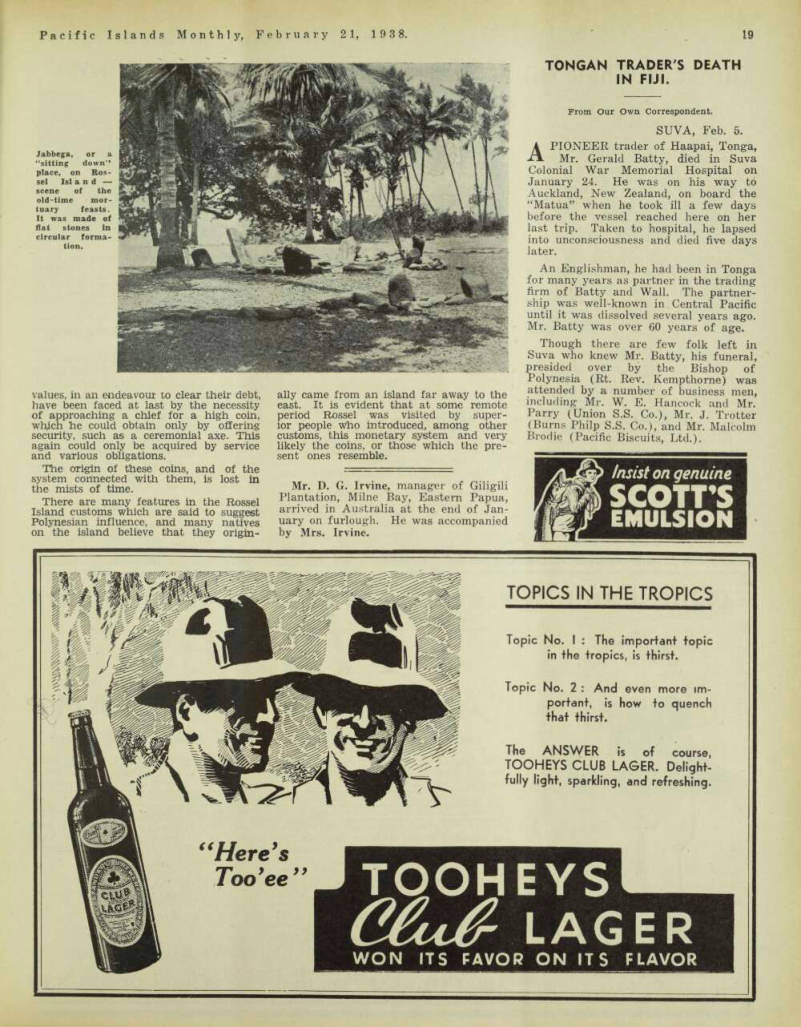
These were killed and eaten at the “sit ting down places”, known as Jabbega, made of flat stones in more or less cir cular formation, still to be seen on the island.
It can be realised that many natives have at times involved themselves in fin ancial difficulties, as the amount of in terest depended on the anticipated time of a loan. Some, compelled to borrow and borrow again, in higher and yet higher
values, in an endeavour to clear their debt, have been faced at last by the necessity of approaching a chief for a high coin, which he could obtain only by offering security, such as a ceremonial axe. This again could only be acquired by service and various obligations.
The origin of these coins, and of the system connected with them, is lost in the mists of time.
There are many features in the Rossel Island customs which are said to suggest Polynesian influence, and many natives on the island believe that they origin
ally came from an island far away to the east. It is evident that at some remote period Rossel was visited by super ior people who introduced, among other customs, this monetary system and very likely the coins, or those which the pre sent ones resemble.
Mr. D. G. Irvine, manager of Giligili
Plantation, Milne Bay, Eastern Papua,
arrived in Australia at the end of Jan uary on furlough. He was accompanied by Mrs. Irvine.
Jabbega, or a “sitting down" place, on Ros sel Islandscene of the old-time mor tuary feasts.
It was made of flat stones in circular forma tion.