Life On Makogai, The Leper Island.
pp. 63-64 · Read in the full issue

By James Madahan.
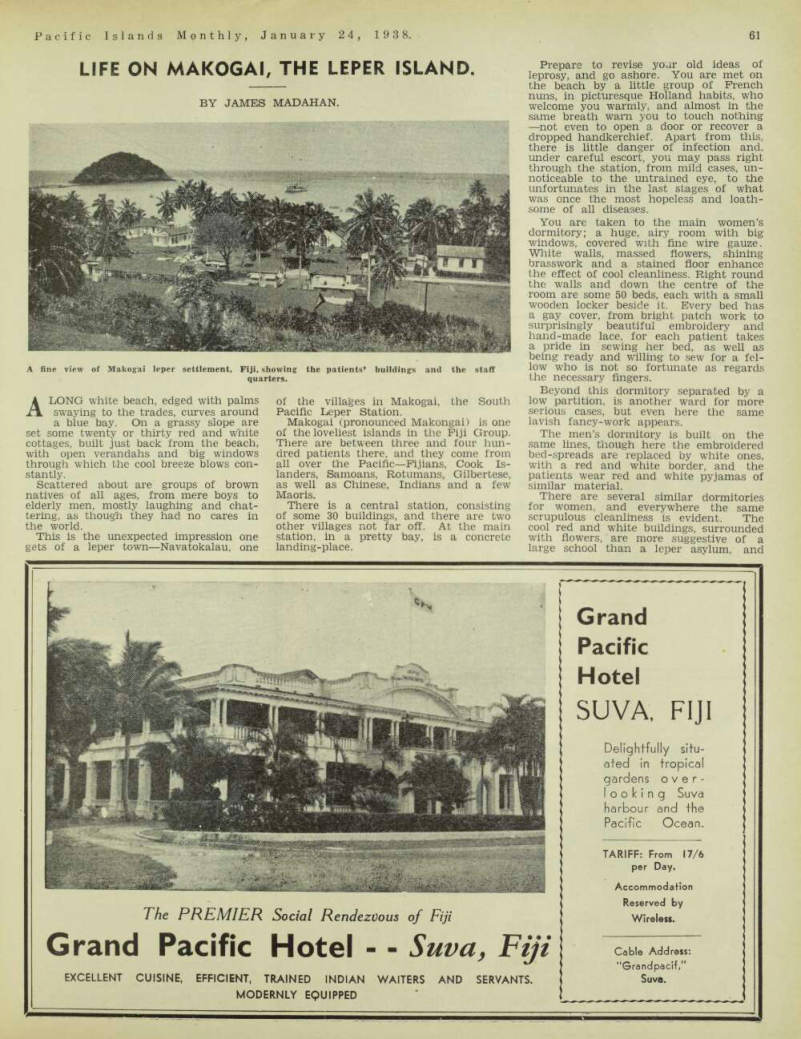
ALONG white beach, edged with palms swaying to the trades, curves around a blue bay. On a grassy slope are set some twenty or thirty red and white cottages, built just back from the beach, with open verandahs and big windows through which the cool breeze blows constantly.
Scattered about are groups of brown natives of all ages, from mere boys to elderly men, mostly laughing and chattering, as though they had no cares in the world.
This is the unexpected impression one gets of a leper town—Navatokalau, one
of the villages in Makogai, the South Pacific Leper Station.
Makogai (pronounced Makongai) is one of the loveliest islands in the Fiji Group.
There are between three and four hun dred patients there, and they come from all over the Pacific—Fijians, Cook Is landers, Samoans, Rotumans, Gilbertese, as well as Chinese, Indians and a few Maoris.
There is a central station, consisting of some 30 buildings, and there are two other villages not far off. At the main station, in a pretty bay, is a concrete landing-place.
Prepare to revise your old ideas of leprosy, and go ashore. You are met on the beach by a little group of French nuns, in picturesque Holland habits, who welcome you warmly, and almost in the same breath warn you to touch nothing —not even to open a door or recover a dropped handkerchief. Apart from this, there is little danger of infection and, under careful escort, you may pass right through the station, from mild cases, un noticeable to the untrained eye, to the unfortunates in the last stages of what was once the most hopeless and loath some of all diseases.
You are taken to the main women’s dormitory; a huge, airy room with big windows, covered with fine wire gauze.
White walls, massed flowers, shining brasswork and a stained floor enhance the effect of cool cleanliness. Right round the walls and down the centre of the room are some 50 beds, each with a small wooden locker beside it. Every bed has a gay cover, from bright patch work to surprisingly beautiful embroidery and hand-made lace, for each patient takes a pride in sewing her bed, as well as being ready and willing to sew for a fel low who is not so fortunate as regards the necessary fingers.
Beyond this dormitory separated by a low partition, is another ward for more serious cases, but even here the same lavish fancy-work appears.
The men’s dormitory is built on the same lines, though here the embroidered bed-spreads are replaced by white ones, with a red and white border, and the patients wear red and white pyjamas of similar material.
There are several similar dormitories for women, and everywhere the same scrupulous cleanliness is evident. The cool red and white buildings, surrounded with flowers, are more suggestive of a large school than a leper asylum, and
A fine view of Makogai leper settlement, Fiji, showing the patients’ buildings and the staff quarters.
when one remembers the uncleanliness of the average leper, and contrasts it with the attention given tq each one of these unfortunates, irrespective of colour, race, creed or sect, one appreciates the work of the sisters at Makogai.
There is nothing repulsive seen. Of course, there are many missing limbs, but all the wounds are either quite healed over or carefully dressed and bandaged.
Indeed, many of the people are quite healed and give no sign whatever, save a slight puffiness around eyes, that they are leprous.
There are three small houses, a little apart from the rest, where are the most serious cases. The sight of these old folks, mostly blind, all maimed and practically helpless, and yet clinging desperately to what is left of life, is very pitiful. But just speak a few words in their own language, and see their faces light up and hear their cheerful greetings to the strangers.
These hopeless cases are a very small minority; for, if taken in the early stages, and even later, leprosy now is by no means incurable. Here is an example. An Indian woman, in an advanced state of leprosy, was discovered in a native vil lage and sent to Makogai. Three months after her arrival she gave birth to a child, perfectly healthy and strong. The child was kept under observation for two years, and then was sent to her father, Each year, fifteen to twenty patients leave Makogai, cured. One who left some years ago was a Sister of Mercy from the Gilbert Islands, who contracted leprosy while working among the sick. After sev eral years at Makogai, she was cured and returned to her work in the Gilberts, One cannot speak too highly of the work the sisters are doing at Makogai. A little band of ten nuns, several of them quite young, have given up their lives to the care of the lepers. They spend hours tering the various Chaulmoogra oil pre
parations, yet they are never too tired or busy to trace off an embroidery pat tern for one woman, or admire the new dress of another, or comfort yet another because her daughter is not coming to see her by the next “Pioneer” (a Gov ernment boat which twice a year brings relations to visit the patients). They always are cheerful, whether the work to be done is assisting the doctor in charge with an operation, or working the small cinema which is one of the patients’ de lights.
Leprosy, once an incurable disease, the very name of which made one shudder, is being cured with modern methods of treatment. A few years ago, a man who developed leprosy was as one accursed, an outcast from his village and from the community, untouchable and helpless.
Now he is escorted to Makogai, to live with his fellow lepers, to be treated medi cally by the doctors and to be carefully nursed back to health by the devoted nuns.