Guam Island
pp. 43-44 · Read in the full issue
Now Officially in the Marianas Group.
ISLANDS scattered over the broad ex panses of the Pacific draw a measure of their standing and status, histon cally and politically, from the groups to which they belong. Islands groups, be they well known, such as the Hawaiian, Samoan or Marshall, or little-known such as Tongatabu or the Isles Tuamotu, all possess this power. Many an age-old controversy has raged among geograph
ers, cartographers, historians, and foreign department officials as to whether a par ticular island belonged to one group or to another.
It was the final outcome of these ar guments which recently led to a change in the sign above the boat dock in Apra Harbor, Guam Island, which greets pas sengers as they step ashore from Pan American Airways trans-Pacific clippers and which read: “GUAM, L. 1., Lat. 13 deg. 27 ft. N., Long. 144 deg. 39 ft. E.”.
Out came the “L” in the name and in went an “M”, changing Guam’s island group destination from Ladrones to Marianas. Action was taken after refer ence of the question involved to mem bers of the Congress of Guam.
(Continued Overleaf.)
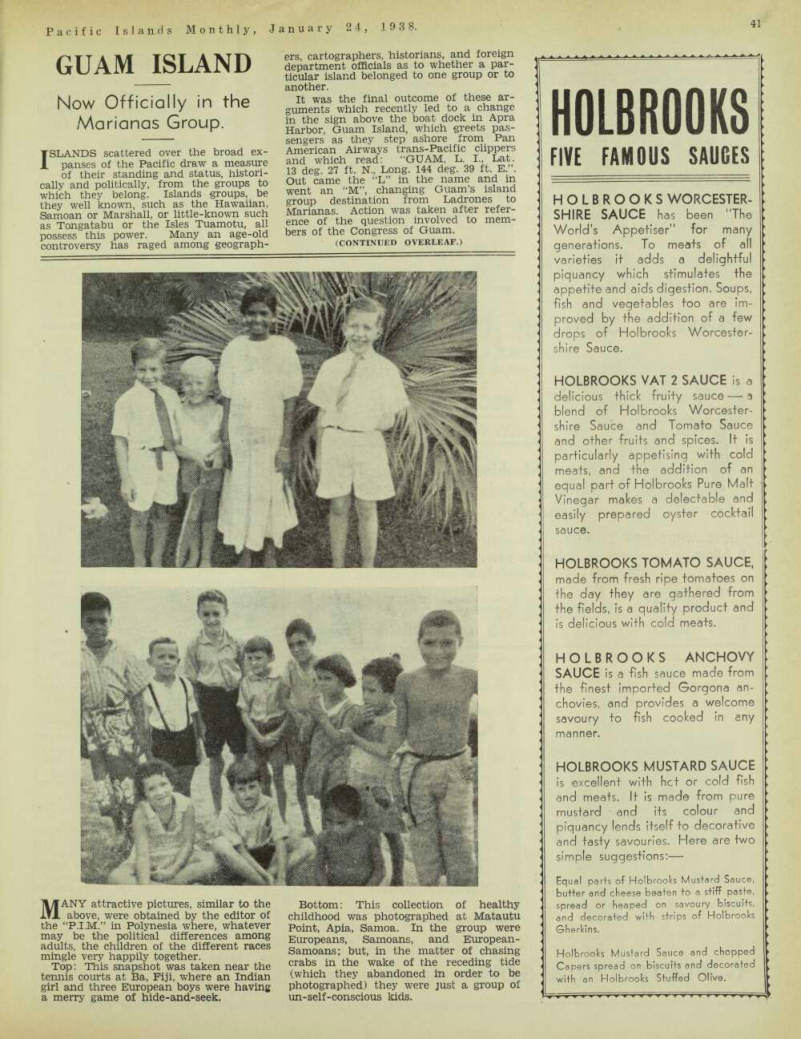
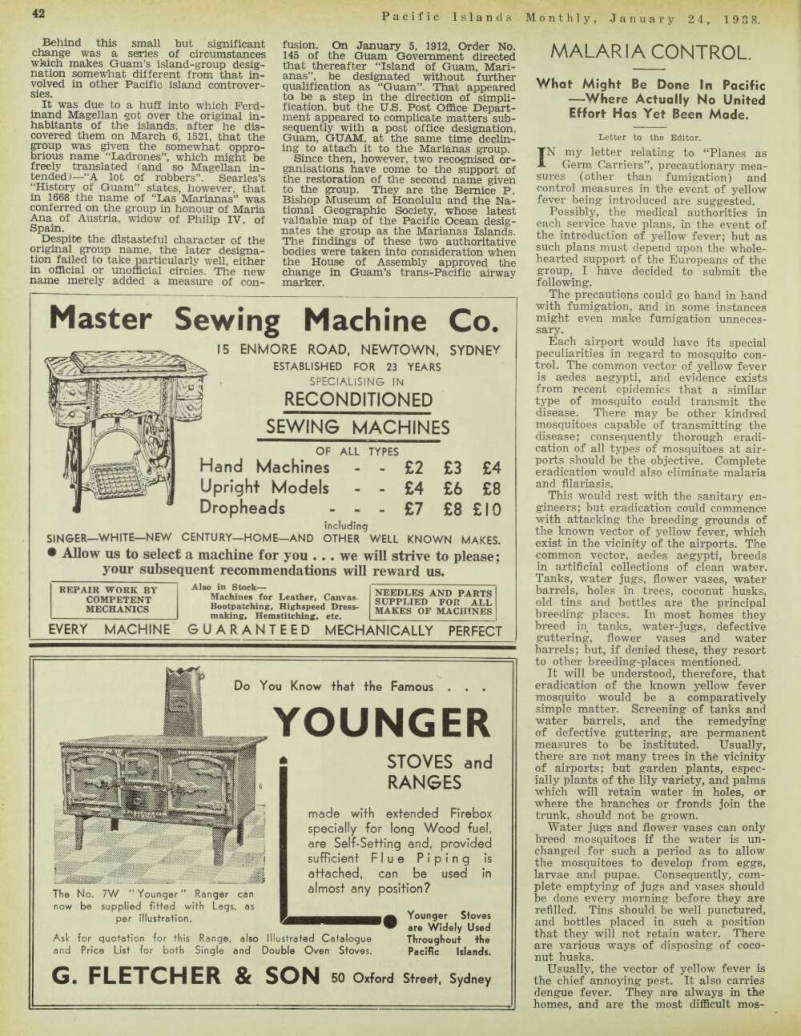
MANY attractive pictures, similar to the above, were obtained by the editor of the “P.I.M.” in Polynesia where, whatever may be the political differences among adults, the children of the different races mingle very happily together.
Top: This snapshot was taken near the tennis courts at Ba, Fiji, where an Indian girl and three European boys were having a merry game of hide-and-seek.
Bottom: This collection of healthy childhood was photographed at Matautu Point, Apia, Samoa. In the group were Europeans, Samoans, and European- Samoans; but, in the matter of chasing crabs in the wake of the receding tide (which they abandoned in order to be photographed) they were just a group of un-self-conscious kids.
Behind this small but significant change was a series of circumstances wmch makes Guam’s island-group designation somewhat different from that involved m other Pacific island controversie t s .* It was due to a huff into which Ferdmand Magellan got over the original inhabitants of the islands, after he discovered them on March 6, 1521, that the group was given the somewhat opprobnous name “Ladrones”, which might be freely translated (and so Magellan intended)—“A lot of robbers”. Searles’s History of Guam” states, however, that m 1668 the name of “Las Marianas” was conferred on the group in honour of Maria Ana of Austria, widow of Philip IV. of s P^ m - .. ..
Despite the distasteful character of the original group name, the later designanon failed to take particularly well, either m official or unofficial circles. The new name merely added a measure of con-
fusion. On January 5, 1912 Order No 145 of the Guam Government directed that thereafter “Island of Guam, Mari anas”, be designated without further qualification as “Guam”. That appeared to be a step in the direction of simpli fication, but the U.S. Post Office Depart ment appeared to complicate matters sub sequently with a post office designation, Guam, GUAM, at the same time declin ing to attach it to the Marianas group, Since then, however, two recognised or ganisations have come to the support of the restoration of the second name given to the group. They are the Bernice P.
Bishop Museum of Honolulu and the Na tional Geographic Society, whose latest valuable map of the Pacific Ocean desig nates the group as the Marianas Islands.
The findings of these two authoritative bodies were taken into consideration when the House of Assembly approved the change in Guam’s trans-Pacific airway marker.