How a Maritime Mystery was Solved on Vanikoro.
pp. 38-41 · Read in the full issue
By Captain A. Middenway, F.R.G.S.
ONE hundred and fifty years ago to day, on Saturday, January 26, 1788, as Jean Francois, Comte de La Perouse, in command of the two frigates “Bous sole” and “Astrolabe”, anchored in Botany Bay, New South Wales, the English ships under the command of Governor Phillip, already at anchor, got under sail and left for Port Jackson.
An officer from the English frigate “Cyrus” was sent on board the “Bous sole” by Captain Hunter to congratulate the French navigators on their arrival.
The compliment was returned by an officer from La Perouse’s staff, and despatches were handed to Governor Phillip, to be forwarded to France.
The two French frigates left Botany Bay a few days later; and, until May 13, 1826, thirty-eight years later, their fate was unknown.
IN 1812 or 1813, Captain Dillon, then an officer on the Calcutta ship “Hunter”, trading between Bengal and the Fiji Islands, when passing the island of Tikopia, put ashore Martin Bushart, Bushart’s Fijian wife and a Lascar named Joe. This was done at Bushart’s request, owing to his wife’s pregnancy.
On May 13, 1826, when passing from Valparaiso and New Zealand to Bengal, Dillon again sighted Tikopia. Several canoes pulled out from the island to his ship, and one had Bushart on board, and another the Lascar.
Dillon discovered that the Lascar had disposed of a sword to the armourer of his vessel. This aroused his curiosity and, on making enquiries, he learned that eleven years earlier Bushart had seen, in the possession of the natives, several iron bolts, chain plates, etc. At the time, Bushart thought they had come from a vessel that had been wrecked in the vicinity of the island; but, some two years later, he discovered that the articles, together with a sword guard, had been brought by canoe from Vanikoro, where two large ships similar to the “Hunter” had been wrecked.
The Lascar confirmed Bushart’s state ment, and added that on a visit to Vanikoro he had conversed with two old men from the wrecked vessels. Even tually, the sword was identified with La Perouse and, on January 6, 1827, Cap tain Dillon made preparation for a trip to Vanikoro in the “Research”, with the object of further investigation.
On September 13, 1827, Dillon arrived
at Vanikoro and anchored inside the eastern point of Bailey’s Bay. He came into contact with natives from the east coast of the island and from them re ceived details of the wrecks.
The natives stated that the survivors settled at Peu and there built a small vessel, which left the island to seek assistance.
Owing to conflicting statements in Dillon’s report, the number of men left behind is indefinite, but I think it is quite probable that, as stated in one portion of his report, “as many as could get room departed and the remainder remained behind”. Accommodation would hardly have necessitated the ex clusion of two only, particularly as the destination of the ship would have been Botany Bay, the nearest known in habited land.
However, it has been established that at least two of the survivors remained on Vanikoro, one of these an officer and the other his servant. These two were seen by the Lascar some 32 years after
the departure of the two frigates from Botany Bay. The natives reported that the servant died in 1824, three years be fore Dillon’s visit, and that six months later the officer accompanied a native chief who was compelled to flee from the island.
After spending 25 days on the coast of the island, Captain Dillon left on October 8, 1827.
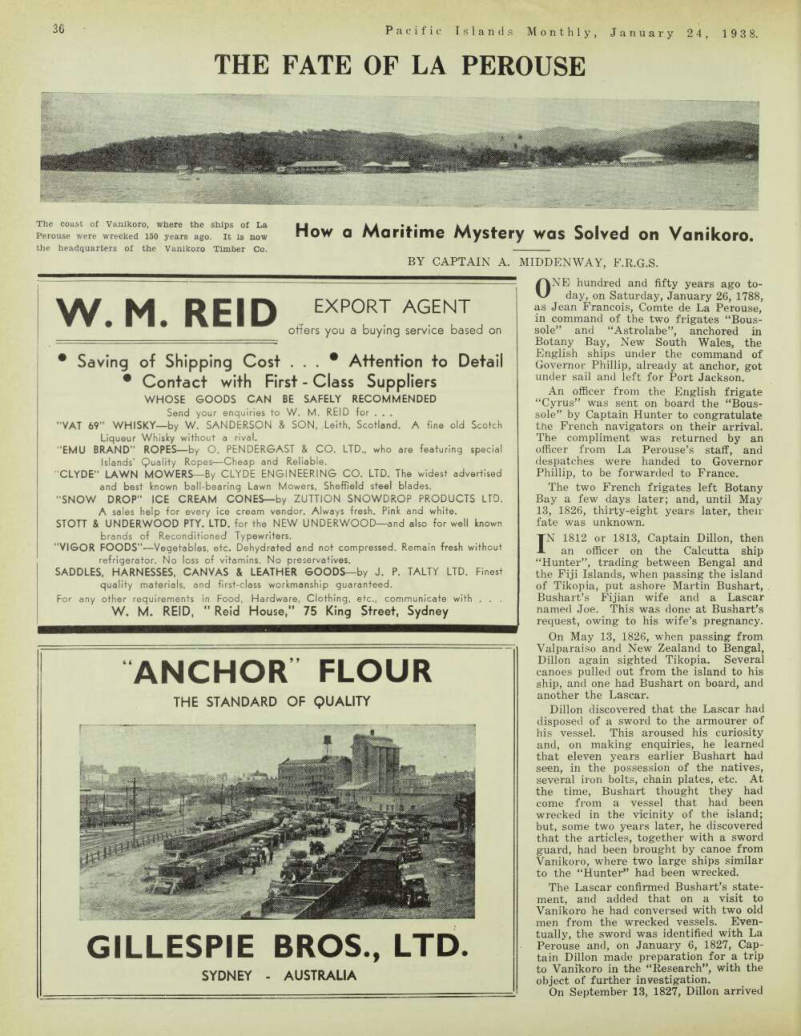
THE island of Vanikoro is approxi mately ten miles in length, from the extreme eastern to the extreme western points, and about seven miles in width. It rises to a height of 3,031 feet, is thickly timbered,, and is prac tically surrounded by reef, with a main entrance opposite Peu. Other breaks in the reef are on the northern and eastern sides, while a mile or so north of Peu is an irregular break known as Wreck Passage, where the ships of La Perouse were wrecked.
On January 10, 1921, as Government representative, with a party of timber
experts, I left Tulagi, the headquarters of the British Solomon Islands Protec torate Government, in the schooner “Vella Lavella”, for Vanikoro; but, owing to adverse weather conditions, did not reach that island until January 19, when we anchored in Peu Bay.
During eleven days spent on the island, I visited every village and settle ment, and a census taken revealed a population of between 180 and 190 natives. Captain Dillon’s estimate of 1,000, in 1827, and larger figures given at later dates, were purely estimates; though the natives told me that at one time the population was very much larger, and attributed the depletion to a “big sickness” which lasted for some time. This was evidently a particularly severe epidemic and, as the natives stated that it was not introduced by foreigners, it possibly had a malarial basis.
The natives I saw on my visit were of very poor physique, and unhealthy, malaria and elephantiasis being pre valent.
On questioning the natives with re gard to La Perouse and his crews, I found that although they were in pos session of a quantity of old iron, bolt^,
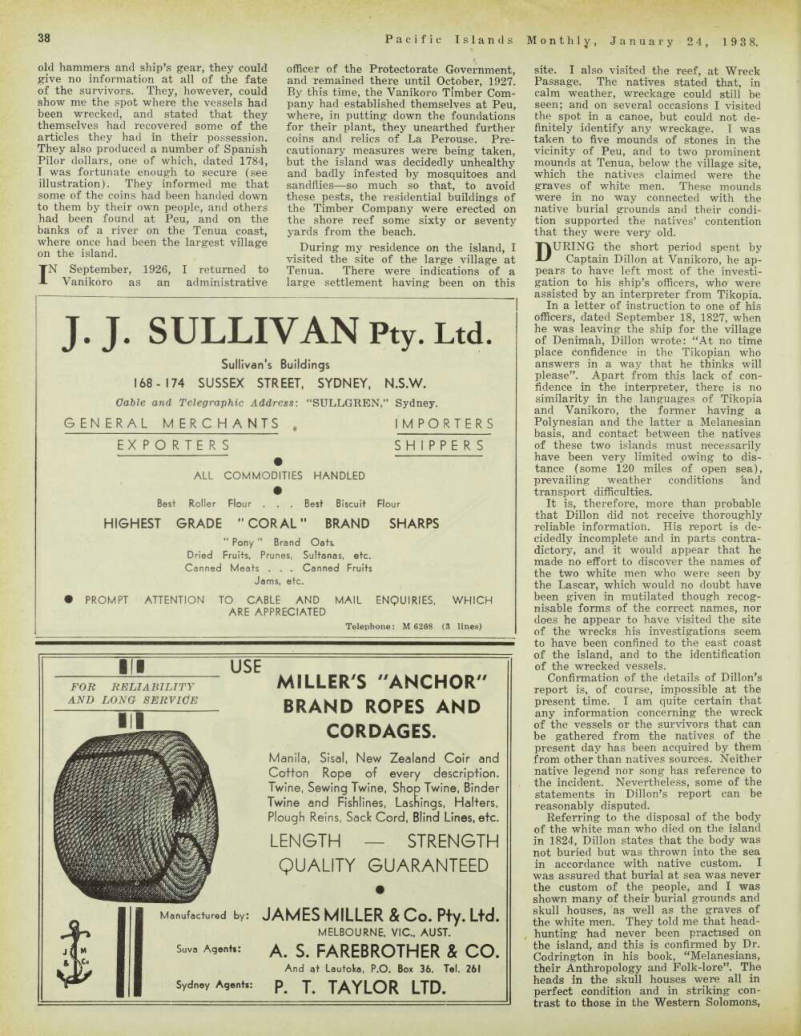
Photograph (exact size) of both sides of the Spanish dollar found on Vanikoro.
old hammers and ship’s gear, they could give no information at all of the fate of the survivors. They, however, could show me the spot where the vessels had been wrecked, and stated that they themselves had recovered some of the articles they had in their possession.
They also produced a number of Spanish Pilor dollars, one of which, dated 1784, I was fortunate enough to secure (see illustration). They informed me that some of the coins had been handed down to them by their own people, and others had been found at Peu, and on the banks of a river on the Tenua coast, b6en the larg6St VUlage IN September, 1926, I returned to Vanikoro as an administrative
officer of the Protectorate Government, and remained there until October, 1927.
By this time, the Vanikoro Timber Corn pany had established themselves at Peu, where, in putting down the foundations for their plant, they unearthed further coins and relics of La Perouse. Pre cautionary measures were being taken, but the island was decidedly unhealthy and badly infested by mosquitoes and sandflies—so much so that, to avoid these pests, the residential buildings of the Timber Company were erected on the shore reef some sixty or seventy yards from the beach.
During my residence on the island, I visited the site of the large village at Tenua. There were indications of a large settlement having been on this
site. I also visited the reef, at Wreck Passage. The natives stated that, in calm weather, wreckage could still be seen; and on several occasions I visited the spot in a canoe, but could not de finitely identify any wreckage. I was taken to five mounds of stones in the vicinity of Peu, and to two prominent mounds at Tenua, below the village site, which the natives claimed were the graves of white men. These mounds were in no way connected with the native burial grounds and their condi tion supported the natives’ contention that they were very old.
DURING the short period spent by Captain Dillon at Vanikoro, he ap pears to have left most of the investi gation to his ship’s officers, who were assisted by an interpreter from Tikopia.
In a letter of instruction to one of his officers, dated September 18, 1827, when he was leaving the ship for the village of Denimah, Dillon wrote: “At no time place confidence in the Tikopian who answers in a way that he thinks will please”. Apart from this lack of con fidence in the interpreter, there is no similarity in the languages of Tikopia and Vanikoro, the former having a Polynesian and the latter a Melanesian basis, and contact between the natives of these two islands must necessarily have been very limited owing to dis tance (some 120 miles of open sea), prevailing weather conditions and transport difficulties.
It is, therefore, more than probable that Dillon did not receive thoroughly reliable information. His report is de cidedly incomplete and in parts contra dictory, and it would appear that he made no effort to discover the names of the two white men who were seen by the Lascar, which would no doubt have been given in mutilated though recog nisable forms of the correct names, nor does he appear to have visited the site of the wrecks his investigations seem to have been confined to the east coast of the island, and to the identification of the wrecked vessels.
Confirmation of the details of Dillon’s report is, of course, impossible at the present time. I am quite certain that any information concerning the wreck of the vessels or the survivors that can be gathered from the natives of the present day has been acquired by them from other than natives sources. Neither native legend nor song has reference to the incident. Nevertheless, some of the statements in Dillon’s report can be reasonably disputed.
Referring to the disposal of the body of the white man who died on the island in 1824, Dillon states that the body was not buried but was thrown into the sea in accordance with native custom. I was assured that burial at sea was never the custom of the people, and I was shown many of their burial grounds and skull houses, as well as the graves of the white men. They told me that head hunting had never been practised on the island, and this is confirmed by Dr.
Codrington in his book, “Melanesians, their Anthropology and Folk-lore”. The heads in the skull houses were all in perfect condition and in striking con trast to those in the Western Solomons,
where many bore testimony of having been trophies of the hunt, and their statement that the heads preserved were those of deceased persons of rank and were kept as memorials of affection is undoubtedly correct.
In addition, I was informed that it had always been the practice to bury personal effects with the body, as is done in other parts of Melanesia, and that in this way many coins and relics of the wrecks had been disposed of.
Again, that the officer who remained behind after the departure of the locally constructed vessel left the island in the company of a native chief, who was com pelled to flee for safety, is also improb able. There is no record of inter-tribal strife on the island, and apparently there has always been one paramount chief. The size of the island would hardly permit of other conditions. The two white men apparently lived at Tenua, which was the headquarters of the paramount chief, and, not only is it unlikely that this chief would be com pelled to flee for safety, but there is no record of the incident on Vanikoro, or on any of the adjacent islands. It is more than probable that the departure of the white man was a story, con cocted by the natives, superstitious where death is concerned, to avoid ques tionings or complications, and Dillon appears to have accepted it without confirmation.
It is unfortunate that Dillon did not make any effort to identify the two sur vivors who were seen by the Lascar and who were on the island to within three years of his arrival, but that La Perouse could have been one of them is most improbable.
La Perouse was born on the 23rd August, 1741, and with the unusual and trying conditions under which he would have been compelled to live on Vanikoro, it is unlikely that he was alive in 1824 at the ripe old age of 83 years. There is, of course, the possibility that he left for Botany Bay with the party in search of assistance, but the fact that so many of his personal belongings, including his sword, were in the hands of the natives would suggest that he either did not reach the shore, or, having done so, died in a comparatively short time.
The two survivors Seen by the Lascar in approximately 1820 evidently died on the island and were buried there, pos sibly in the graves at Tenua.
Dillon does not appear to have in terested himself in the whereabouts of the ships’ records. Whether these were taken away or remained in the custody of the officer in charge of the shore party would, to an extent, depend on the seniority of the officer. If by any chance they remained on Vanikoro they would have been of no interest to the natives, and in all probability, in ac cordance with native custom, would have been buried with the last survivor.
While recognising the value of Cap tain Dillon]s report, it is to be regretted that the investigation was not more thorough, and one views those two mounds of stones at Tenua with rever ence and with an excusable speculative curiosity.