Taro Bread.
p. 27 · Read in the full issue
Why Should Not New Hawaii Industry Spread to South Seas?
From Our Own Correspondent.
Honolulu, Dec. 7.
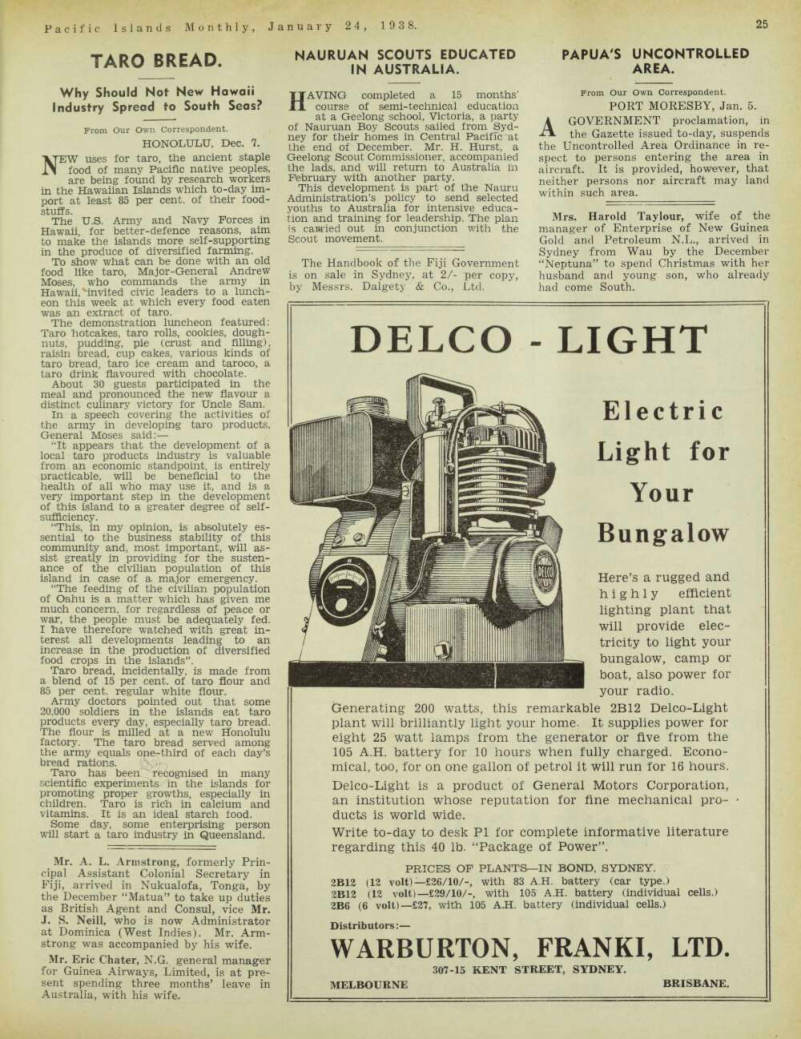
NEW uses for taro, the ancient staple food of many Pacific native peoples, are being found by research workers in the Hawaiian Islands which to-day im port at least 85 per cent, of their food stuffs.
The U.S. Army and Navy Forces in Hawaii, for better-defence reasons, aim to make the islands more self-supporting in the produce of diversified farming.
To show what can be done with an old food like taro, Major-General Andrew Moses, who commands the army in Hawaii,'invited civic leaders to a lunch eon this week at which every food eaten was an extract of taro.
The demonstration luncheon featured: Taro hotcakes, taro rolls, cookies, dough nuts, pudding, pie (crust and filling), raisin bread, cup cakes, various kinds of taro bread, taro ice cream and taroco, a taro drink flavoured with chocolate.
About 30 guests participated in the meal and pronounced the new flavour a distinct culinary victory for Uncle Sam.
In a speech covering the activities of the army in developing taro products, General Moses said: — “It appears that the development of a local taro products industry is valuable from an economic standpoint, is entirely practicable, will be beneficial to the health of all who may use it, and is a very important step in the development of this island to a greater degree of self sufficiency.
“This, in my opinion, is absolutely es sential to the business stability of this community and, most important, will as sist greatly in providing for the susten ance of the civilian population of this island in case of a major emergency.
“The feeding of the civilian population of Oahu is a matter which has given me much concern, for regardless of peace or war, the people must be adequately fed.
I have therefore watched with great in terest all developments leading to an increase in the production of diversified food crops in the islands”.
Taro bread, incidentally, is made from a blend of 15 per cent, of taro flour and 85 per cent, regular white flour.
Army doctors pointed out that some 20,000 soldiers in the islands eat taro products every day, especially taro bread.
The flour is milled at a new Honolulu factory. The taro bread served among the army equals one-third of each day’s bread rations.
Taro has been recognised in many scientific experiments in the islands for promoting proper growths, especially in children. Taro is rich in calcium and vitamins. It is an ideal starch food.
Some day, some enterprising person will start a taro industry in Queensland.
Mr. A. L. Armstrong, formerly Prin cipal Assistant Colonial Secretary in
Fiji, arrived in Nukualofa, Tonga, by
the December “Matua” to take up duties as British Agent and Consul, vice Mr.
J. S. Neill, who is now Administrator at Dominica (West Indies). Mr. Arm strong was accompanied by his wife.
Mr. Eric Chater, N.G. general manager for Guinea Airways, Limited, is at pre sent spending three months’ leave in Australia, with his wife.