Air Disaster
pp. 9-10 · Read in the full issue
P.A.A. Flying-Boat and Crew Lost Near Samoa
'T'BE destruction of Pan-American Air ways 19-tons flying-boat “Samoa Clipper,” off the coast of American Samoa, on January 11 (Eastern time) has seriously dislocated arrangements that had been made for the inauguration of the air-mail service between the United States and New Zealand. The project is not abandoned, of course—it probably will take shape during the current year.
It was stated in this journal, in Decem ber, that an American flying-boat was expected to leave Honolulu about Decem ber 20 on a survey flight to Auckland; but that, owing to the refusal of the U.S. Government to provide a mail sub sidy, there was some uncertainty about the actual date of commencing a regular service.
On December 23, the Sikorsky S-428 flying-boat “Samoa Clipper” (formerly the “Hong Kong Clipper”), lefj Honolulu for N.Z. in charge of Captain Edwin C.
Musick, who had flown 1,500,000 miles in the service of Pan-American Airways and was regarded as their No. 1 pilot. The flying-boat proceeded via Kingman Reef and Pago Pago (American Samoa) to Auckland, without incident, arriving there on December 26.
An interesting feature of the visit was the arrival in Auckland at the same time of Imperial Airways flying-boat “Centaurus”; and the two great machines lay in Auckland Harbour together for a day or two.
On January 1, carrying 3751 b. of air mail and 81bs. of express freight, the “Samoa Clipper” left Auckland and flew back to Hawaii. The trip was made without incident.
There was still some uncertainty re garding the date of the commence ment of a regular service; but it was reported, apparently with authority, that a fortnightly service between Honolulu and Auckland, connecting at Hawaii with the North Pacific service of P.A.A. for San Francisco, would be commenced early in the New Year, carrying mails and cargo. It was thought that pas senger traffic would have to await the introduction to the service of the huge Boeing flying boats now being built.
On January 10, Captain Musick left again for Auckland in the “Samoa Clipper.” The previous flight had been essentially a survey flight; but on this
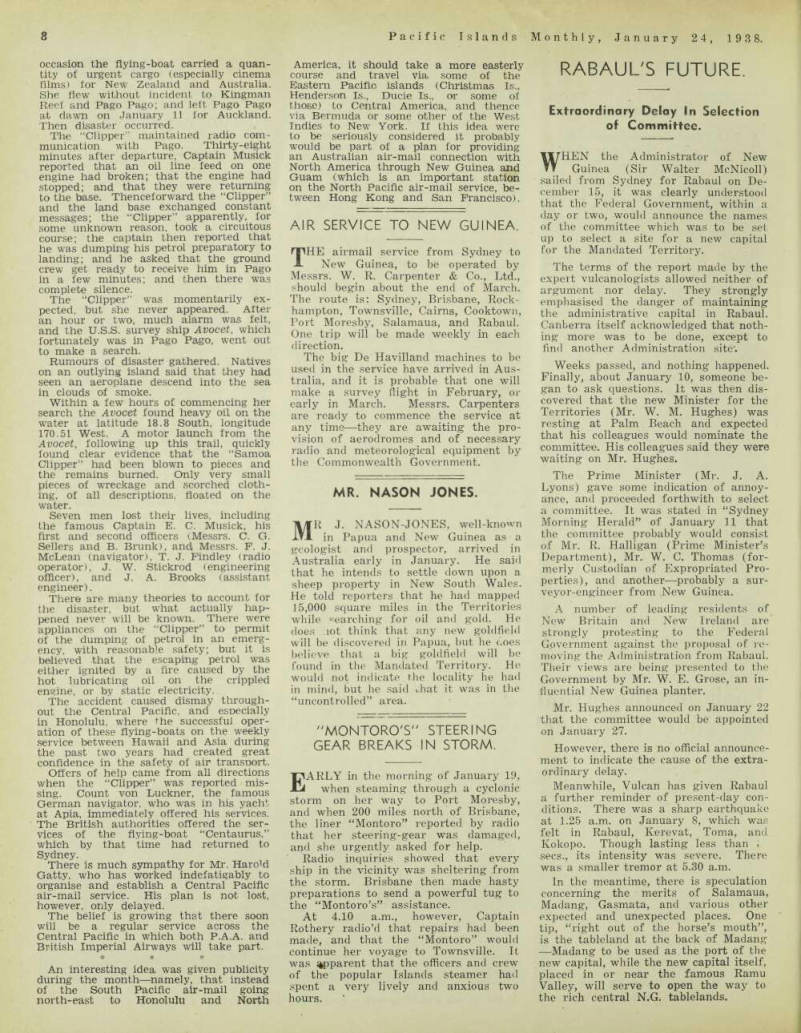
The “Samoa Clipper” moored in Pago Pago (American Samoa), on a previous survey flight.
occasion the flying-boat carried a quan tity of urgent cargo (especially cinema films) for New Zealand and Australia.
She flew without incident to Kingman Reef and Pago Pago; and left Pago Pago at dawn on January 11 for Auckland.
Then disaster occurred.
The “Clipper" maintained radio com munication with Pago. Thirty-eight minutes after departure, Captain Musick reported that an oil line feed on one engine had broken; that the engine had stopped; and that they were returning to the base. Thenceforward the “Clipper” and the land base exchanged constant messages; the “Clipper” apparently, for some unknown reason, took a circuitous course; the captain then reported that he was dumping his petrol preparatory to landing; and he asked that the ground crew get ready to receive him in Pago in a few minutes; and then there was complete silence.
The “Clipper” was momentarily ex pected, but she never appeared. After an hour or two, much alarm was felt, and the U.S.S. survey ship Avocet, which fortunately was in Pago Pago, went out to make a search.
Rumours of disaster gathered. Natives on an outlying island said that they had seen an aeroplane descend into the sea in clouds of smoke.
Within a few hours of commencing her search the Avocet found heavy oil on the water at latitude 18.8 South, longitude 170.51 West. A motor launch from the Avocet, following up this trail, quickly found clear evidence that the “Samoa Clipper” had been blown to pieces and the remains burned. Only very small pieces of wreckage and scorched cloth ing, of all descriptions, floated on the water.
Seven men lost their lives, including the famous Captain E. C. Musick, his first and second officers (Messrs. C. G.
Sellers and B. Brunk), and Messrs. F. J.
McLean (navigator), T. J. Findley (radio operator), J. W. Stickrod (engineering officer), and J. A. Brooks (assistant engineer).
There are many theories to account for the disaster, but what actually hap pened never will be known. There were appliances on the “Clipper” to permit of the dumping of petrol in an emerg ency, with reasonable safety; but it is believed that the escaping petrol was either ignited by a fire caused by the hot lubricating oil on the crippled engine, or by static electricity.
The accident caused dismay through out the Central Pacific, and especially in Honolulu, where the successful oper ation of these flying-boats on the weekly service between Hawaii and Asia during the past two years had created great confidence in the safety of air transoort.
Offers of help came from all directions when the “Clipper” was reported mis sing. Count von Luckner, the famous German navigator, who was in his yacht at Apia, immediately offered his services.
The British authorities offered the ser vices of the flying-boat “Centaurus,” which by that time had returned to Sydney.
There is much sympathy for Mr. Harold Gatty, who has worked indefatigably to organise and establish a Central Pacific air-mail service. His plan is not lost, however, only delayed.
The belief is growing that there soon will be a regular service across the Central Pacific in which both P.A.A. and British Imperial Airways will take part. * * * An interesting idea was given publicity during the month —namely, that instead of the South Pacific air-mail going north-east to Honolulu and North
America, it should take a more easterly course and travel via some of the Eastern Pacific islands (Christmas Is., Henderson Is., Ducie Is., or some of those) to Central America, and thence via Bermuda or some other of the West Indies to New York. If this idea were to be seriously considered it probably would be part of a plan for providing an Australian air-mail connection with North America through New Guinea and Guam (which is an important station on the North Pacific air-mail service, be tween Hong Kong and San Francisco).