“Sit 3 Sydney* for
Unknown Heart Of New Guinea
Source of the Sepik and the Fly
A 7 AST , r ® giori of extensive valley sysc lymg an , average height of 5,000 feet, surrounded by high mountains, and very numerously inhabited by many tribes of clean-skinned healthy intelligent, friendly natives is how Mr W Korn describes the of New Guinea —a huge and practically unmapped area lying around the intersection of the boundaries of Dutch New Guinea,, Papua and the Mandated Territory of New Guinea. Mr. Kom, in 1936-7, spent many months in this region, as a mem- IS WUllamS S ° ld proSpeCt - T P ' .
In a saucer-like depression among the ranges, just within the borders of the
Mandated Territory, Mr. Korn and his companions found a small stream which they proved to be the actual souree of th P SL a / ■, f e Sepik River. A few miles awa ?’ south wards, there was another small stream, which is the beginning of th , e . dually mighty Fly River. They estimated that from that point the Sepik flows 850 miles north to the Pacific, and Fl y some 600 or 700 miles south to the Gulf of Papua, Mr Kom aftpr lpnfi + hv fnrimia-b in
“Sit 3 Sydney* for
Guinea, in January. He knew Wau in other days—he it J was who “pegged”
Golden Ridges about 1927.
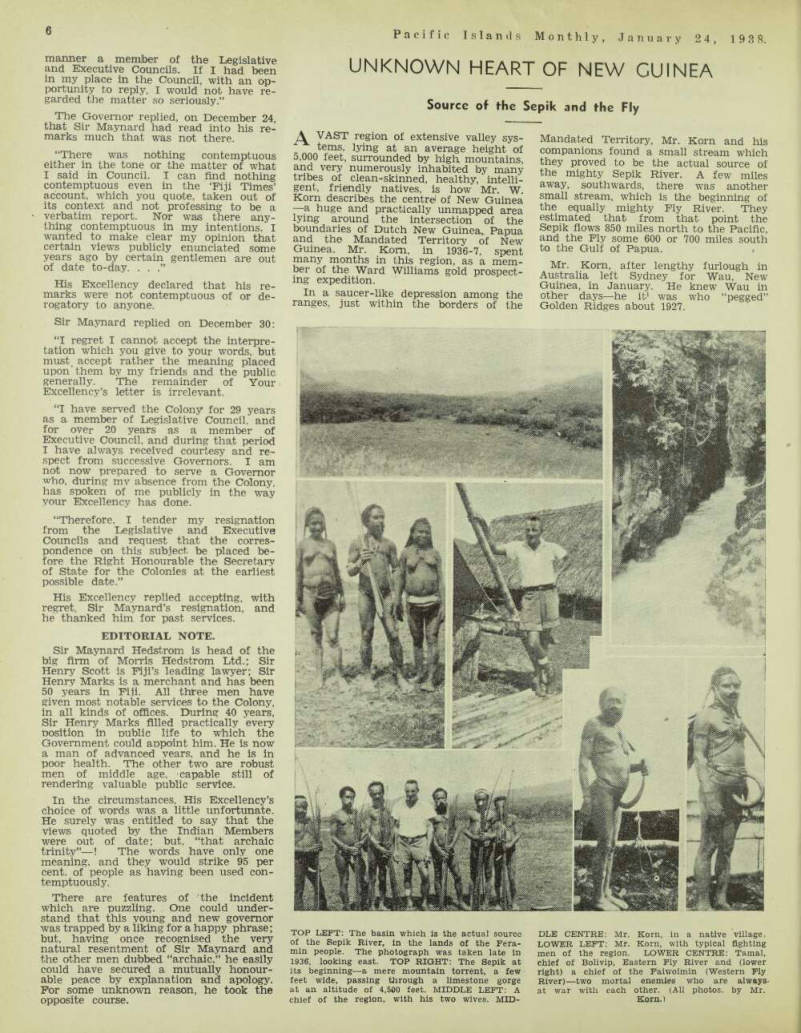
TOP LEFT: The basin which is the actual source of the Sepik River, in the lands of the Fera min people. The photograph was taken late in 1936, looking east. TOP RIGHT: The Sepik at its beginning—a mere mountain torrent, a few feet wide, passing through a limestone gorge at an altitude of 4,500 feet. MIDDLE LEFT: A chief of the region, with his two wives. MID-
DLE CENTRE: Mr. Korn, in a native village.
LOWER LEFT: Mr. Korn, with typical fighting men of the region. LOWER CENTRE: Tamal, chief of Bolivip, Eastern Ply River and (lower right) a chief of the Faiwoimin (Western Ply River) —two mortal enemies who are always at war with each other. (All photos, by Mr.
Korn.)