Official and Non-official Considerans
pp. 5-6 · Read in the full issue
IN this issue there are reports from three different territories in the Pacific, each indicating some difference of opinion between the official and non- P s ’ One correspondent, writing about Papua, has complained that, while the territory urgently needs funds for the construction of certain public works— a water supply for Port Moresby especiaHy is referred to—the Government has allotted some thousands of pounds of public money for the support of the nnhlic servants’ snnerannnation fund public servants superannuation fund.
Another report says that there is some feeling among residents of the Solomon Islands because the Government there has ear-marked something over £2,000 for the “re-organisation of the public service”—although what is intended has not been disclosed. It is clear, however, that residents object on principle to plans under which public moneys may be used for the benefit of public servants, unless equal consideratmn is given to the needs of planters and traders.
The unfortunate incident in the Legislative Council of Fiji, which has
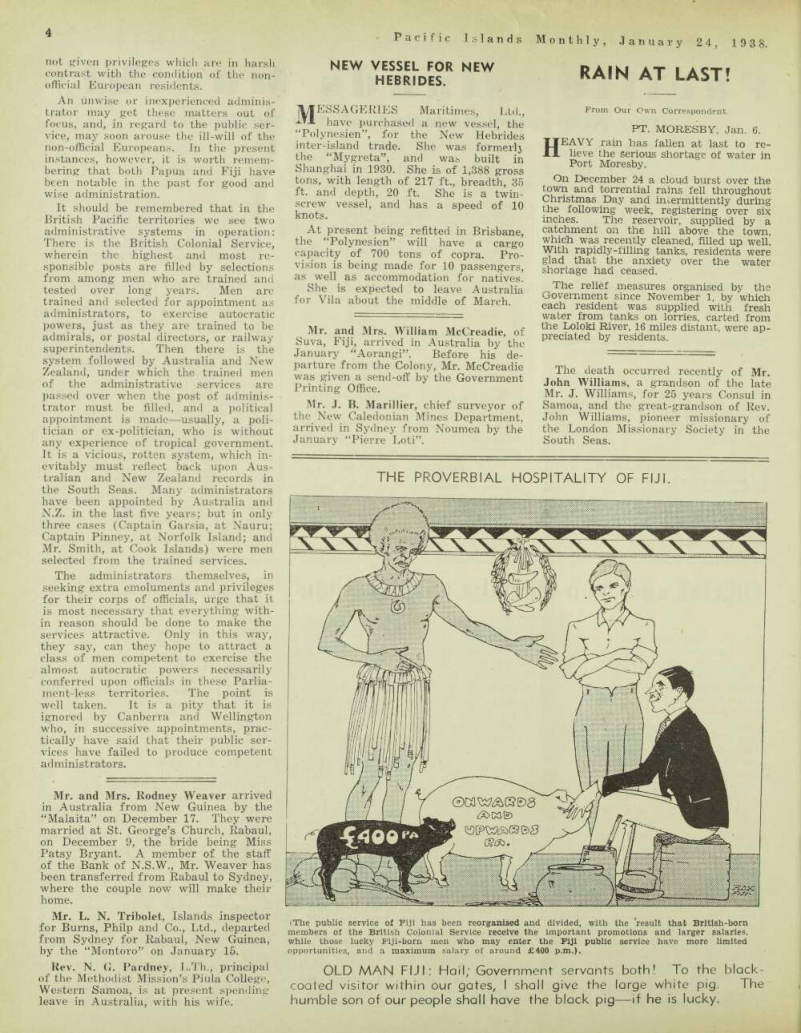
led to the resignation of Sir Maynard Hedstrom, had its origin in a con troversy based upon the same thing— namely, the determination of the Governor to provide, out of public funds, certain privileges (free quarters) for public servants. There has been criticism of this plan in Fiji, and some interesting argument has been produced on each side.
These and other incidents suggest that the time is coming when the rights and privileges of officials who govern Pacific territories will need more care ful consideration and clearer definition.
Public servants in the territories are in a position very different from that of Officials in countries where the public funds are directly controlled by elected Parliaments. If it is felt in an Austra lian State, for example, that civil ser vants are being given emoluments and powers in excess of what they are en titled to, the electors have the right, at regular intervals, of throwing out of office a Government which they think has permitted improprieties. In the territories there is no such remedy— petty bureaucrats may create an auto cracy of an outrageous kind, and quite a long time will elapse before the pro
tests of the oppressed classes can reach the Government in Europe, or Aus tralasia, or America, which is re sponsible for the administration.
Most of the Pacific territories main tain “Legislative Councils”. These are only advisory bodies—in every case, without exception, the “official mem bers”, who are the heads of Govern ment departments or nominees of the administrator, out-number and out-vote the non-official members (who may be either nominated or elected). The non official members in these various councils have the opportunity of protesting against the acts of officialdom—and they frequently do so protest—but the proceedings are dominated entirely *by the official members, who almost in variably vote en bloc, in accordance with the wish of the administrator.
It is clear, therefore, that the suc cess or failure of the system, and the future of the individual territories, de pends very much upon the quality of the particular administrator. Where he is a man of strong character, sound experience, clear vision and tactful undertaking, we usually have an ef ficient administration, which guards the natives during their critical change over from primitive to European con ditions, and guides the growth and development of the territory along sound lines. He will be especially care ful in seeing that the civil servants are
not given privileges which are in harsh contrast with the condition of the non official European residents.
An unwise or inexperienced adminis trator may get these matters out of focus, and, in regard to the public ser vice, may soon arouse the ill-will of the non-official Europeans. In the present instances, however, it is worth remem bering that both Papua and Fiji have been notable in the past for good and wise administration.
It should be remembered that in the British Pacific territories we see two administrative systems in operation: There is the British Colonial Service, wherein the highest and most re sponsible posts are filled by selections from among men who are trained and tested over long years. Men are trained and selected for appointment as administrators, to exercise autocratic powers, just as they are trained to be admirals, or postal directors, or railway superintendents. Then there is the system followed by Australia and New Zealand, under which the trained men of the administrative services are passed over when the post of adminis trator must be filled, and a political appointment is made—usually, a poli tician or ex-politician, who is without any experience of tropical government.
It is a vicious, rotten system, which in evitably must reflect back upon Aus tralian and New Zealand records in the South Seas. Many administrators have been appointed by Australia and N.Z. in the last five years; but in only three cases (Captain Garsia, at Nauru; Captain Pinney, at Norfolk Island; and Mr. Smith, at Cook Islands) were men selected from the trained services.
The administrators themselves, in seeking extra emoluments and privileges for their corps of officials, urge that it is most necessary that everything with in reason should be done to make the services attractive. Only in this way, they say, can they hope to attract a class of men competent to exercise the almost autocratic powers necessarily conferred upon officials in these Parlia ment-less territories. The point is well taken. It is a pity that it is ignored by Canberra and Wellington who, in successive appointments, prac tically have said that their public ser vices have failed to produce competent administrators.
Mr. and Mrs. Rodney Weaver arrived in Australia from New Guinea by the “Malaita” on December 17. They were married at St. George’s Church, Rabaul, on December 9, the bride being Miss Patsy Bryant. A member of the staff of the Bank of N.S.W., Mr. Weaver has been transferred from Rabaul to Sydney, where the couple now will make their home.
Mr. L. N. Tribolet, Islands inspector for Burns, Philp and Co., Ltd., departed from Sydney for Rabaul, New Guinea, by the “Montoro” on January 15.
Rev. N. G. Pardney, L.Th., principal of the Methodist Mission’s Piula College, Western Samoa, is at present spending leave in Australia, with his wife.