Anth Ropophagology
p. 56 · Read in the full issue
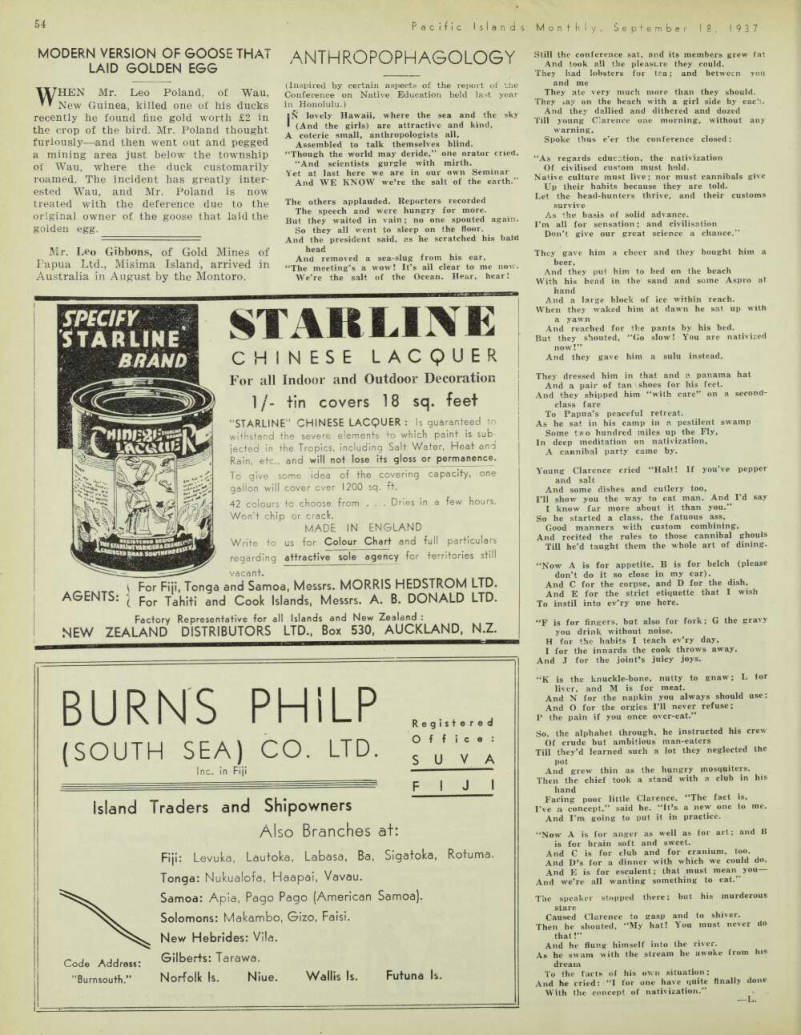
(Inspired by certain aspects of the report of the Conference on Native Education held last year in Honolulu.) IN lovely Hawaii, where the sea and the sky (And the girls) are attractive and kind, A coterie small, anthropologists all.
Assembled to talk themselves blind.
“Though the world may deride,” one orator cried, “And scientists gurgle with mirth.
Yet at last here we are in our own Seminar And WE KNOW we’re the salt of the earth.”
The others applauded. Reporters recorded The speech and were hungry for more.
But they w r aited in vain; no one spouted again, So they all went to sleep on the floor.
And the president said, as he scratched his bald head And removed a sea-slug from his ear, “The meeting’s a wow! It’s all clear to me now.
We’re the salt of the Ocean. Hear, hear!
Still the conference sat, and its members grew fat And took all the pleasure they could.
They had lobsters for tea; and between you and me They ate very much more than they should.
They »ay on the beach with a girl side by each.
And they dallied and dithered and dozed Till young Clarence one morning, without any warning.
Spoke thus e’er the conference closed; “As regards education, the nativization Of civilised custom must hold.
Native culture must live; nor must cannibals give Up their habits because they are told.
Let the head-hunters thrive, and their customs survive As the basis of solid advance.
I’m all for sensation; and civilisation Don’t give our great science a chance.’’
They gave him a cheer and they bought him a beer.
And they put him to bed on the beach With his head in the sand and some Aspro at hand And a large block of ice within reach.
When they waked him at dawn he sat up with a yawn And reached for the pants by his bed.
But they shouted, “Go slow! You are nativized now!’’
And they gave him a sulu instead.
They dressed him in that and a panama hat And a pair of tan shoes for his feet.
And they shipped him “with care’’ on a second class fare To Papua’s peaceful retreat.
As he sat in his camp in a pestilent swamp Some two hundred miles up the Fly, In deep meditation on nativization, A cannibal party came by.
Young Clarence cried “Halt! If you’ve pepper and salt And some dishes and cutlery too, I’ll show you the way to eat man. And I’d say I know far more about it than you.”
So he started a class, the fatuous ass.
Good manners with custom combining.
And recited the rules to those cannibal ghouls Till he’d taught them the whole art of dining.
“Now A is for appetite. B is for belch (please don’t do it so close in my ear).
And C for the corpse, and D for the dish.
And E for the strict etiquette that I wish To instil into ev’ry one here.
“F is for fingers, but also for fork; G the gravy you drink without noise.
H for the habits I teach ev’ry day, I for the innards the cook throws away.
And J for the joint’s juicy joys.
“K is the knuckle-bone, nutty to gnaw; L for liver, and M is for meat.
And N for the napkin you always should use; And O for the orgies I’ll never refuse; P the pain if you once over-eat.”
So, the alphabet through, he instructed his crew' Of crude but ambitious man-eaters Till they’d learned such a lot they neglected the pot And grew thin as the hungry mosquiters.
Then the chief took a stand with a club in his hand Facing poor little Clarence. “The fact is, I’ve a concept,” said he. “It’s a new one to me, And I’m going to put it in practice.
“Now A is for anger as well as for art; and B is for brain soft and sweet.
And C is for club and for cranium, too.
And D’s for a dinner with which we could do.
And E is for esculent; that must mean you— And we’re all wanting something to eat.”
The speaker stopped there; but his murderous stare Caused Clarence to gasp and to shiver.
Then he shouted, “My hat! You must never do that!”
And he flung himself into the river.
As he swam with the stream he awoke from his dream To the facts of his own situation; And he cried: “I for one have quite finally done With the concept of nativization.”