Pacific
Islands
Monthly
Vol. VIII. No. 2.
September 18, 1937
M t^l6 P’**'®-’ Sydney, f or transmission hy post as a newspaper .]
8
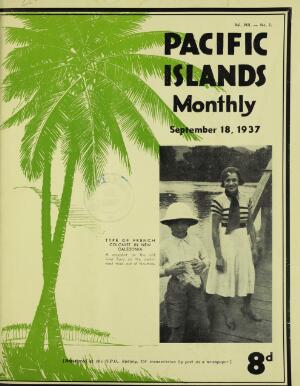
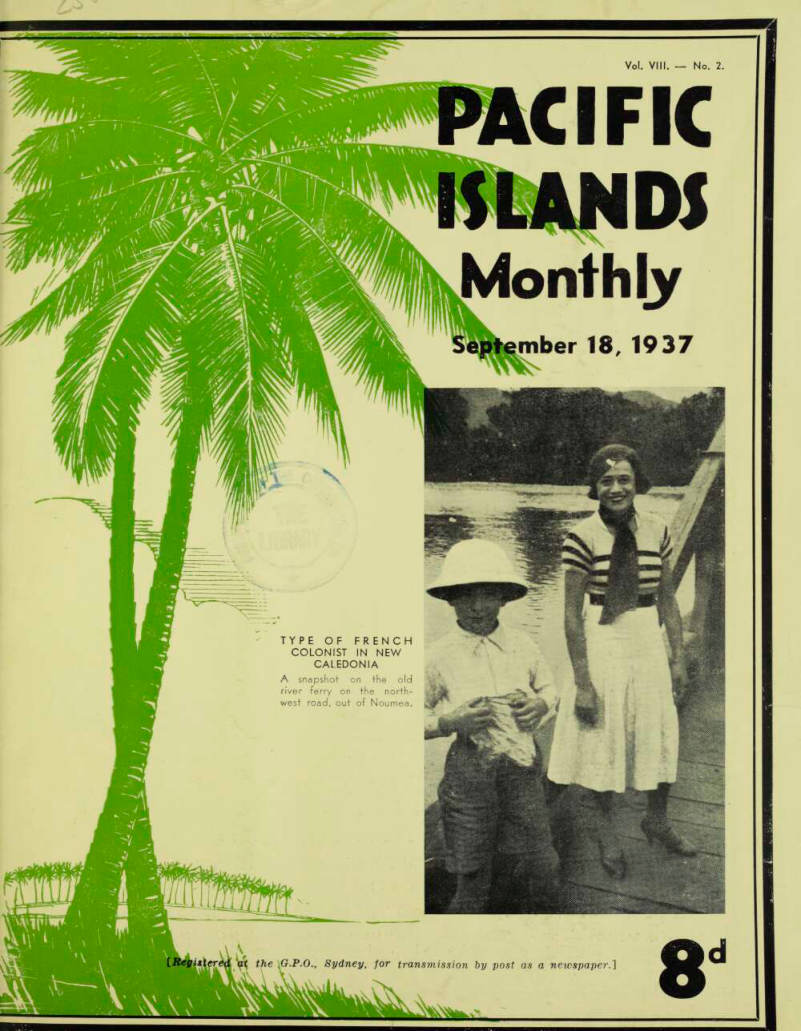
Type Of French
Colonist In New
Caledonia
A snapshot on the old river ferry on the north west road, out of Noumea.
Advertisements & other items, p. 2 (1 item)
Progress!
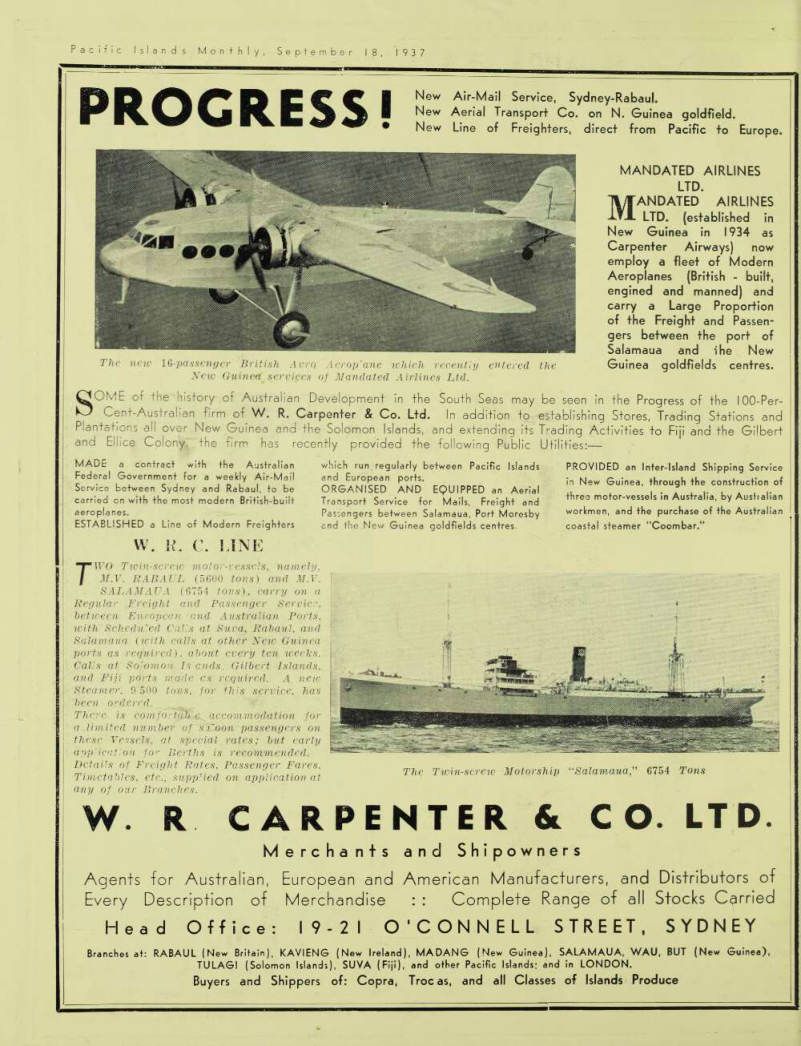
■« fc m \ The new 16-passenger British Avro Aerop'ane which recently entered the New Guinea services of Mandated Airlines Ltd.
New Air-Mail Service, Sydney-Rabaul.
New Aerial Transport Co. on N. Guinea goldfield.
New Line of Freighters, direct from Pacific to Europe.
MANDATED AIRLINES
LTD.
Mandated airlines
LTD. (established in New Guinea in 1934 as
Carpenter Airways) now
employ a fleet of Modern
Aeroplanes (British - built,
engined and manned) and
carry a Large Proportion
of the Freight and Passengers between the port of Salamaua and ihe New Guinea goldfields centres.
SOME of the history of Australian Development in the South Seas may be seen in the Progress of the 100-Per- Cent-Australian firm of W. R. Carpenter & Co. Ltd. In addition to establishing Stores, Trading Stations and Plantations all over New Guinea and the Solomon Islands, and extending its Trading Activities to Fiji and the Gilbert and Ellice Colony, the firm has recently provided the following Public Utilities:— MADE a contract with the Australian Federal Government for a weekly Air-Mail Service between Sydney and Rabaul, to be carried on with the most modern British-built aeroplanes.
ESTABLISHED a Line of Modern Freighters
W. K, C. LINE
TWO Twin-screw motor-vessels, namely.
M.V. RABAUL (5600 tons) and M.V.
SALAMAUA (6754 tons), carry on a Regular Freight and Passenger Service, between European and Australian Ports. with Scheduled Calls at Suva, Rabaul, and Salamaua (with calls at other New Guinea ports as required), about every ten weeks.
Calls at So'omoii I s'ends , Gilbert Islands, and Fiji ports made as required. A new Steamer. 9 500 tons, for this service, has been ordered.
There is comfortable accommodation for a limited number of ST.oon passengers on these Vessels, at special rates; but early app'ieatlon fo t% Berths is recommended.
Details of Freight Rates, Passenger Fares.
Timetables, etc., supplied on application at any of our Branches. which run regularly between Pacific Islands and European ports.
ORGANISED AND EQUIPPED an Aerial
Transport Service for Mails, Freight and Passengers between Salamaua, Port Moresby end the New Guinea goldfields centres PROVIDED an Inter-Island Shipping Service in New Guinea, through the construction of three motor-vessels in Australia, by Australian workmen, and the purchase of the Australian coastal steamer "Coombar."
The Twin-screw Motorship “Salamaua” 6754 Tons
W. R CARPENTER & CO. LTD.
Merchants and Shipowners
Agents for Australian, European and American Manufacturers, and Distributors of Every Description of Merchandise : : Complete Range of all Stocks Carried
Head Office: 19-21 O'CONNELL STREET, SYDNEY
Branches at: RABAUL (New Britain), KAVIENG (New Ireland), MADANG (New Guinea), SALAMAUA. WAU, BUT (New Guinea), TULAGI (Solomon Islands), SUVA (Fiji), and other Pacific Islands; and in LONDON.
Buyers and Shippers of: Copra, Trocas, and all Classes of Islands Produce
Pacific Islands Travellers
Passengers Per Macdhui Which
Sailed From Sydney For New Guinea
AND PAPUA ON AUGUST 28: Messrs. Arthur, Anthony, Briggs, Beazley, Beila, Bowman, Bunt ing, Chisholm, Cahill. Collins, Clegg, Costa (2), Clark, Kennedy-Duffy, Downs, Davies, Ffrost, Flatt, Forbes, Faulkner. Fry, Gunter, Gordon, Greer, Garvie, Greenwood, Hall (2), Kruttschnitt, Lawrence, Moore, McEwan, Mudge, Moore, Mc- Millan, McCulloch, Ongley, Shelton-O’Reilly.
O’Loan, Olander, Percy, Phelps, Plumb, Paynter, Quintrell (2), Rossi. Radford, Reddington, Shorter, Schuch, Stokie, Slaviero, Spagnola, Stevenson, Turner, Vernon, Wall, Webb, Walstab, Walshe. Mesdames Anthony, Bowring, Buston, Broughton, Bunting, Briggs, Cahill, Challis, Collins, Clark, Cromie, Doyle, Ditton, Day, Greer, Hall, Heinicke, Haycroft, Haviland, Hill, Kruttschnitt, Lawrence, Lee, Nettleship, Nor moyle, Phelps, Percy, Parer (2), Russell, Ryan, Richardson, Swanson, Schroder, Teitzel, Walstab.
Misses Ayton, Battersby, Christopher, Duggan, Edwards, Frewin, Blake, Greave, Gascoigne, Hobson, Heath, Luttrell, McGregor, Russell, Taylor, Schroeder, Sudlow, White. Sisters M.
Paul, Jules, Aloyse, Clare.
Passengers Per Niagara Which Ar
RIVED IN SYDNEY FROM SUVA. FIJI. ON
AUGUST 28: J. R. Baker, Mrs. F. Buch, G.
Buch, Mrs. V. Fickendey, W. Goodman, J. J.
Griffiths, Mr. and Mrs. H. A. Gribben, Miss Gribben, C. J. Magee, J. Marrows, Mrs. M.
Newman, Mrs. M. Van Gelderen, B. J.
Anderson, Mrs. A. B. Anderson, H. Baird, Mrs. , D. C. Baird. Masters E. and E. Baird, Miss L.
Dick, A. Johnston. A. D. Appleton, D. Cross, G. J. Hudson, D. W. Jeffries, R. A. Murray.
Passengers Per Niagara Which Left
SYDNEY FOR SUVA. FIJI. ON SEPTEMBER 2: Miss L. Angermunde, R. G, Alldritt, Mr. and Mrs. C. H. Batter. Miss W. Batter, Mrs. J. B.
Brown, A. J. Burke, Dr. and Mrs. M. Gotch, Mr. and Mrs. R. B. Hudson, Miss B. Hudson, Master K. C. Ibbott, Mrs. A. H. North, Mrs.
J. D. Owens, Miss C. Phillips, Mrs. D. E. F.
Platt, L. Robertson, A. A. Ragg, Sir Henry and Lady Scott, Mrs. E. E. Thompson, Mrs. E. F.
White, S. H. Buxton, Mr. and Mrs. A. J.
Elphick, Mr. and Mrs. E. W. Harness, Rev.
M. G. Wilmshurst, E. J. Williams, Mr. and Mrs.
L. W. Beach.
Passengers Per Morinda Which Ar
RIVED IN SYDNEY FROM LORD HOWE IS..
Norfolk Is.. And New Hebrides On
SEPTEMBER 9: Messrs. Bailey, Bates, Berwick, Campbell (2), Crossan, Davis, Davies, Downes,
Fleming, Fuller, Ewington, Fenton, Hines, Isa gawa, Johnson, Kanagosika, Kinsella, James, McLennan, Moses, Nicholson, O’Brien, Ottway, Park, Pettingell, Pinch, Pople, Sainsbury, Shaw, Smith (2), Stone, Sutherland, Thomas, Withers.
Mesdames Bailey, Cuttle, Hurley, Hamilton, Lloyd, McPhail, Nobbs, Podmore, Thomas (2).
Misses Bataille, Broose, Christian, Campbell, Chasten, Drake, Cooley, Haddad, Hardy, Heard, Johnson, Mullen, Mulqueeny, Munro, Nobbs, Payten, Percival, Shakleton, Sharpe, Proctor, Spencer, Steel, Thew, Terry, Virtue, Woodhart.
Passengers Per Nellore Which
Sailed From Sydney For Rabaul, N.C..
ON SEPTEMBER 11: Misses Holt and Simmons.
Mesdames Parer, Jackson, Prior, Challis and Garden. Messrs. Ho re-Lacy, Mugliston, and Nunan. Dr. McQueen.
It was stated in our August issue that
Mr. Victor Florance, solicitor, Wau, New
Guinea, had spent furlough in Sydney
during July and August. We are advised that this statement was incorrect, and that Mr. Florance was in New Guinea during that period. We regret the publi cation of the paragraph, which was pub lished in good faith on apparently in accurate information.
Advertisements & other items, p. 3 (1 item)
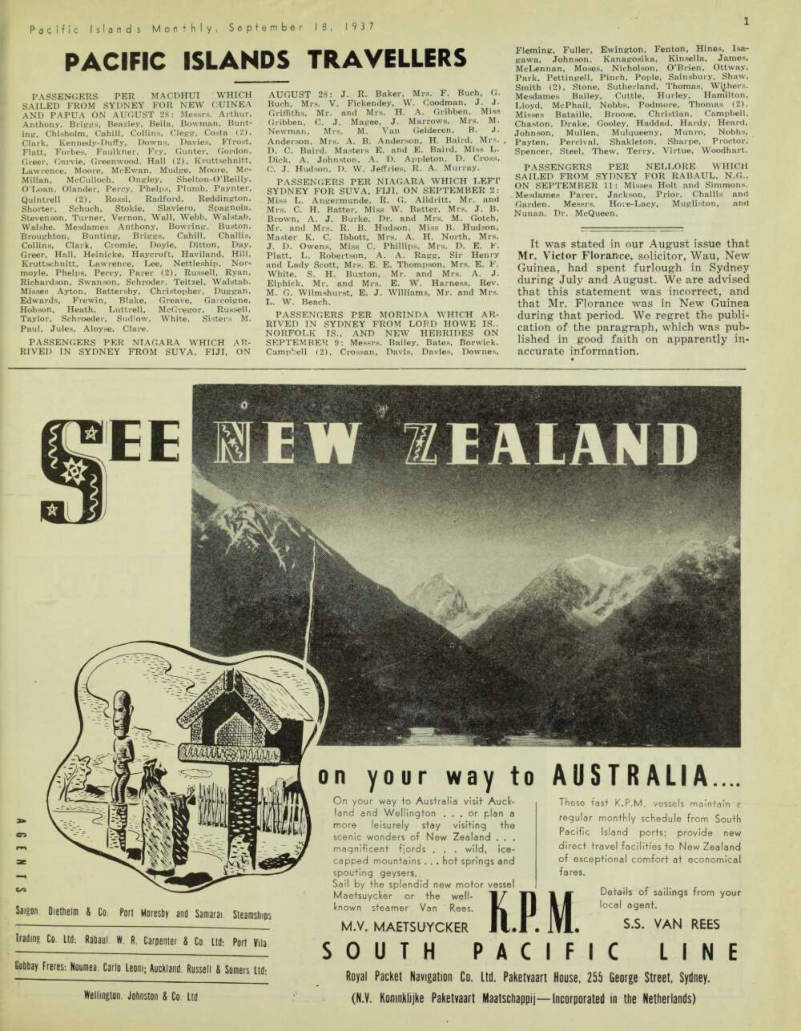
your way to AUSTRALIA.
r m i
Saigon Diethelm & Co ; Pori Moresby and Samarai. Steamships trading Co. Ltd; Rabaul W. R, Carpenter & Co. Ltd; Port Vila Gubbay Freres-. Noumea. Carlo Leoni; Auckland. Russell & Somers Ltd; Wellington. Johnston & Co. Ltd On your way to Australia visit Auckland and Wellington ... or plan a more leisurely stay visiting the scenic wonders of New Zealand . . . magnificent fjords . . . wild, icecapped mountains . . . hot springs and spouting geysers..
Sail by the splendid new motor vessel Maetsuycker or the wellknown steamer Van Rees.
These fast K.P.M. vessels maintain e regular monthly schedule from South Pacific Island ports; provide new direct travel facilities to New Zealand of exceptional comfort at economical fares.
KM Details of sailings from your local agent.
M.V. MAETSUYCKER 11. 1 . 111. S.S. VAN REES
SOUTH PACIFIC LINE
Royal Packet Navigation Co. Ltd. Paketvaan House, 255 George Street, Sydney. (N.V. Komnklijke Paketvaart Maatschappij—lncorporated in the Netherlands)
Advertisers
Amalgamated Wire less of Aust. Ltd 76 Angus & Coote Ltd 13 Arnott’s Biscuits 34 “Aspro” 73 Ausoline 44 Aust. Nat, Travel Association 67 B. and S. Agency „ 23 Baker, W. Jno 22 Bank of N.S.W. 77 Berger & Sons Ltd 44 Blau (Aust.) Robert 64 Booth & Manning ... 70 Brandt & Steele 49 Broomfields Ltd 50 “Broughton” School 17 Brunton’s Flour 32 Bullivants Ltd 56 Burns, Philp & Co. 2 Burns, Philp & Co. 28
B.P. (S.S.) Co 54
Buzacott Pty Ltd 52, 63 Carpenter, W. R.
Limited ii Chemist - Michael, H. P. 75 Chivers & Sons Ltd 33 Clyde Engineering Co Ltd 57 Coleman Lamp Co 20 Coral Starch 35 Cosmopolitan Hotel 80 Cfossle, Duff and Macintosh Ltd ... 69 “Cuprinol” 72 “Cystex” 53 Del Cott Pty Ltd ... 73 Dewar’s Whisky 14 Doan’s Pills 78 Dobell & Co Ltd ...*... 20 Docke, Carl Aug. 36 Donald, A. B. Ltd 60 Dunne, H. F. S 20 Eaton, Ltd, J. W. 45 Electrolytic Co Ltd 68 Enos Fruit Salt 60 Excelsior Supply Co. 38 Fairbanks - Morse Limited 51
“Fairholm” College 32 Finau, Wm 21 Fletcher & Sons ...:.. 43 Ford, Sherington Ltd 30 Ford, W. M „ ; ... 77 “44 Macleay Street” 41 Foster Clark (Aust) Limited 66 Fryer, A. C 55 Garden Vale Pro ducts Ltd 35 Garrett & Davidson 72 Gillespie’s Flour 25 Grand Pacific Hotel 59 Grove & Sons, W. H. 22 Guinea Airways Ltd iii Hallstroms Pty Ltd 49 Halvorsen Sons, Ltd 79 Holbrook’s Ltd 39 Horlicks Malted Milk i 15 Horne, W. & Co 58 Hotel Moresby 80
1.C.1.A.N.Z. Ltd 50
Jones & Co Ltd, H. 37 “Kambala” School ... 16 Kodak Pty Ltd 21 Kopsen & Co Ltd ... 47 Kork-N-Seal Ltd 33 Lane & Qirvan Ltd 45 Levenson’s Radio ... 74 Levy, Sol 19 Lloyd & Co Pty Ltd 12 Lustre Ltd 31 McGowan & Co, A. 59 Mcllrath’s Ltd 18 McKay’s Bookstall ... 41 Maleham & Yeomans Limited 44 Master Sewing Machine Co 43 Maxwell Porter Ltd 45 Miller & Co Pty Ltd 78 Morris. Hedstrom Limited 61
N.D.L 80
Nelson & Robertson Pty Ltd 23. 68 Nestle’s Milk 40 Newland Bros. Ltd 42
New Zealand Distri butors Ltd 54 Nordman, Oscar G. 58 Noyes Bros. Ltd 56 Oxymel Oil and Paint Co Ltd 48 Olsson, T. A 30 Pabst Canned Beer 23 Pacific Islands Club 12 Pacific Islands Co ... 65 Page. S. B 57 Papua Hotel, The ... 80 Philatelic Investment Trust 53 Pike Bros. Ltd 14 Prescott Ltd 38 Price’s Radio Serv. 16
Prouds Ltd 17 Ransomes Sims and Jefferies Ltd 62 Reed, William E. ... 42 Reid, W. M 24 Riverstone Meat Co Limited ...: 29 Rohu, Sil 66 Royal Packet Co 1
“R.U.R.” 72
Ruston & Hornsby 55 St. Ignatius College 26 Scott’s Emulsion 25 Scott Ltd. J 50 Scott & Sons 62 Springwood L. Coll. 65 Stanley, Chris. ...-. 37
Stanley & Co 34 Stead & Baker 70 Steamships Trg. Co 39 Sterling Varnish Go 11 Sullivan Ltd, C. 22 Sullivan Ltd, J. J. 28 Swallow & Ariell ... 75 Sydney Steel Co 68 Talkeries 13 Taylor & Co, A 72 “Tenax” Soap 61 Thompsons Engr. & Pipe Co Ltd 71 Til lock & Co Ltd ... 37 Tooheys Ltd 19 “Top Dog” Men’s Wear 27
Tooth & Co iv Trufood 64 Vincent’s A.P.C 31 Warburton Franki Limited 69 Webb & Co, A 46 Wentworth Hotel 12 West, Harry 56 Weymark & Son 33 Wills. W. D. and H. O. Ltd 27 Williams & Gosling Limited ... 77 Williams Ltd, S. 48 Williams, W. H 62 Wright & C. Ltd. E. 46 Wunderlich Ltd 45
Contents
Pacific Islands Travellers 1 What Will Happen If Japan Over- Runs China? 3 Papua Prospers 4 All Quiet on the Western Samoan Front 5 •Memories of Chas. Savage in Fiji 5 Copra Market Nervous 5 South Pacific Air-Mail in December 6 Hides Party on Lower Fly 7 N.G. Miner’s Conviction Quashed 7 English Capital for S.I. Gold Co 7 New Fiji Legislative Council 7 Was. Oil Found in New Guinea? 8 Eruption in Bougainville, T.N.G 9 New Bulolo Dredges 9 Rabaul’s Future 10 Death of Tahiti Bishop 10 Sydney—Rabaul Air Service 10 Tropicalities ... 11 About Islands People 12 R.L.S. In Pacific 13 Stir in Fiji Civil Service 14
“Old Jew” —A Frank Pryke Poem 18 N.G.’s Juryless Court 21 Pacific Planes as Germ Carriers 23 Anthropologists! 25, 54, 62 A Dog-Lover’s Nightmare 26 Gold Royalty for Papua 32 A Torrid Affair in Fiji 33 Old Stone Idols in Fr. Oceania 34 Mixed Marriages in Polynesia 36 One Very Dead Whale in 8.5.1 39 Origin of Name of Papua 40 World War on Malaria 42 The “Giant Pahua” of Reao 48 Tragedy of the “Moaroa” 50 “Uncle Sam” Means Business 55 Cook Islands Fruit Industry 57 Historic Tongan Letter 59 Gentlemen, the President! 63 Mining Notes ... 69 Premature Reports About New Hebrides ... ... 71 Radio Programmes for W. Pacific 73
Advertisements & other items, p. 4 (1 item)
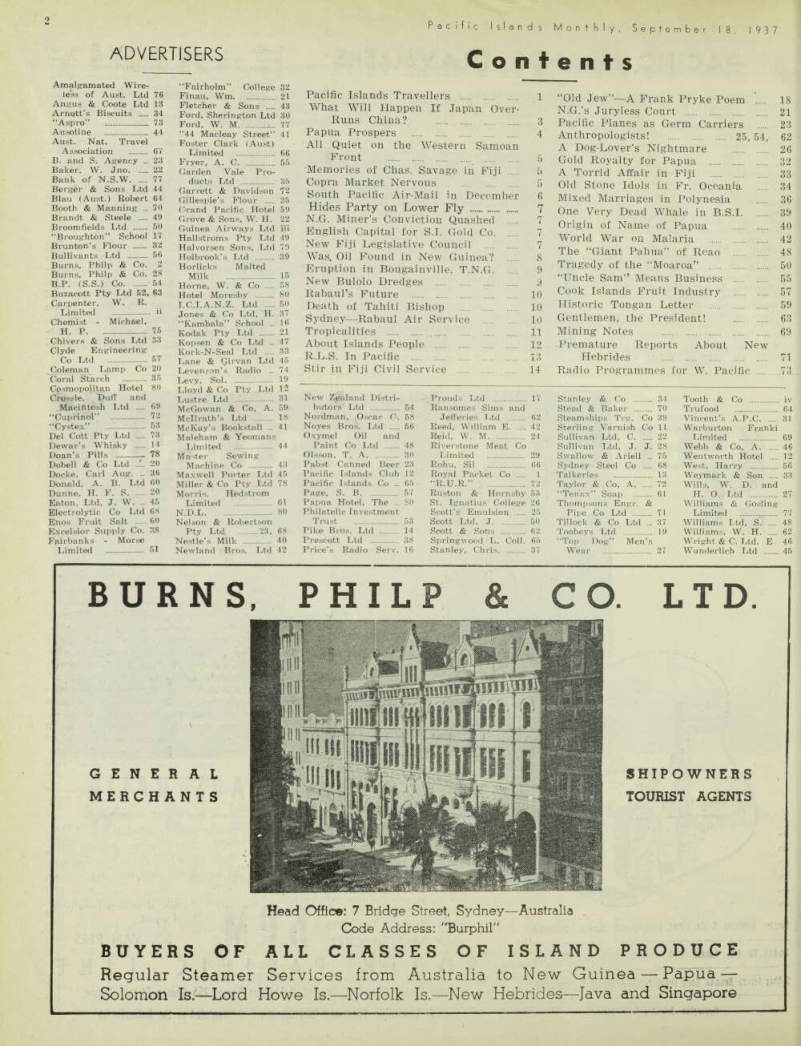
Burns, Philp & Co
GENERAL
MERCHANTS
IPil era m mu* m in
ill HI
111 i|i m m
LTD.
SHIPOWNERS
TOURIST AGENTS
Head Office: 7 Bridge Street, Sydney—Australia Code Address: "Burphil"
BUYERS OF ALL CLASSES OF ISLAND PRODUCE Regular Steamer Services from Australia to New Guinea Papua Solomon Is. —Lord Howe Is. —Norfolk Is. —New Hebrides —Java and Singapore
Pacific Islands Monthly
The IVewspaper-MagazIne of the South Seas
[Registered at the O.P.O., Sydney for transmission by post as a newspaper. ] Published Once Each Month and Circulated in Australia and New Zealand and in the following Pacific Territories and Islands Groups:
Crown Colony of Fiji.
Australian Territory of Papua.
Mandated Territory (Australia) of New Guinea, Bismarck Archipelago and Northern Solomon Islands.
Mandated Territory (Japan) of Marshall, Caroline and Marianna Islands.
French Territory of New Caledonia.
British and French Condominium of New Hebrides.
American Territory of Eastern Samoa.
American Territory of Guam.
Mandated Territory of Nauru.
British Crown Colony of Gilbert and Ellice Islands.
Mandated Territory (New Zealand) of Samoa.
British Solomon Islands Protectorate.
British Protectorate of Tongan Islands.
New Zealand Territory of Cook Islands.
Australian Territory of Norfolk Island.
French Colony of Oceania (Tahiti, etc.).
American Territory of Hawaiian Islands.
Owned and Produced by Pacific Publications Pty. Ltd., Union House, 247 George Street, Sydney.
Telephone Bw 5037
P.O. Box 8408 R
Registered Address of Telegrams, Radiograms, and Cables: “Pacpub,” Sydney.
Contributions
Articles. Stories, and Photographs dealing with Pacific Islands subjects are invited, and will be paid for on publication at usual rates.
Subscription Rates
Per Annum, within British Empire, Prepaid, Post Free - 8/- Per Annum, elsewhere, prepaid, Post Free 107- Single Copies Bd.
Editor and Publisher:
R. W. Robson. F.R.G.S.
Advertisements
Advertising rates furnished on application.
Colours, etc. - by Arrangement Process Blocks made at Advertiser’s expense when required. Screen, 100.
Changes of Advertising Copy should reach this Office by Bth of each month, otherwise previous advertisement may be repeated.
Agents
The following are authorised to receive subscrip tions for the Pacific Islands Monthly:— Islands Branches of Burns, Philp & Cos. Ltd., and Burns Philp (South Sea) Cos., Ltd.
Islands Branches of W. R. Carpenter & Cos., Ltd.
All Branches of Morris, Hedstrom & Cos., Ltd.
G. Thomas & Cos., Rabaul, New Guinea.
Whitten Bros., Ltd., Samarai. Papua.
Steamships Trading Cos., Papua. All Branches.
P. Costello, Suva. Fiji, J. Muir. Suva, Fiji.
All Branches and Representatives of W. H. Grove and Sons, Ltd., Auckland, New Zealand.
Cook Islands Trading Cos., Rarotonga, Cook Is.
A. C. Rowland, Papeete, Tahiti.
Representative in London: W. C. HARVEY. Coronation Building, 4 Lloyds Avenue, London, E.C.2. from whom may be obtained copies of Pacific Islands Monthly, Pacific Islands Year Book, advertising schedules, etc.
Vol. VIII.. No. 2.
Sydney, September 18, 1937.
PnVp ( 8d - Per C°py r live ( Prepaid: 8/- p.a.
What Will Happen If Japan Over-Runs China?
TO a degree that few of them realise, residents in the Pacific territories are affected by what is happening just now on the China coast.
Japan is throwing her whole weight against China. She will, of course, beat China, in a military sense—although the Chinese, in view of their lack of heavy artillery and aircraft, are offering a sur prising resistance; and if, eventually, she gets control of China, then the Pacific territories had better look to their gun powder. A Japan supreme in Eastern Asia will not remain in Eastern Asia.
But it is by no means certain, even if she lands huge armies in China, and occupies large areas, that Japan will have command of China. Britain has £200,000,000 invested in China; and American and French interests are very large. The purchase of manufactured goods and foodstuffs by China represents a large and valuable market for all the nations. Sooner or Igter, if Japan were in control of China, China would be closed to European investment and trade.
Nothing has been said: but it is be yond any doubt that Japan’s unprovoked attack on China is now the subject of the gravest debates behind the closed doors of the Chancelleries of Europe and America. The European powers dare not
let Japan over-run China, as she over ran Manchukuo.
There is the ethical consideration. How can civilisation stand by, inactive, while an independent nation is assassinated?
It happened in Manchukuo and Abyssinia, but will it happen again? There is the consideration of international safety. A Japan, triumphant in China, most cer tainly will attempt to dominate other Pacific countries. And there is the selfish consideration. Other nations cannot re main indifferent while Japan, without a semblance of right, destroys their huge investments and trade interests in China.
But, what to do? If the democratic Western Powers (Britain, United States, and France) intervene, what will happen? One of two things. Either Japan will be forced to stay her hand, and limit her campaign to about the dimensions of 1932 and content herself, for the moment, by grabbing the northern dis tricts around Peiping; or she will invoke the help of Germany, and perhaps, Italy.
It is that latter possibility which causes the democratic powers apparently to quail and quibble. One of the shrewdest comments on international affairs heard in recent years was this: “There will be no wars between European nations, be cause they all realise that, under modern
conditions, they both must lose, no mat ter who wins. But, inevitably, there will be war between social or political systems.” There seems to be developing a struggle between Democracy, as seen in Britain, France, and United States, and Fascism, as seen in Germany, Italy and, now, Japan. For it must be clearly understood —and this is the crux of the Sino-Japanese problem that Japan, in recent months, has surrendered herself completely to the dictation of the Mili tary Party, and the latter are establish ing what is virtually Fascist government in the place of whatever semblance of democratic government Japan once pos sessed. Already, Germany is linked with Japan by treaty, and if Germany must ally herself with Japan in a possibility of war, she will try to take Italy with her, and probably will succeed.
On the one side, we have Britain, France, and the United States, richly endowed with territory, democratic in government, and naturally eager to pre serve the status quo. On the other side,
Germany, Italy, and Japan, all desperate
ly overcrowded, all demanding new ter
ritory for colonisation, all imbued with the spirit of war, and all dominated by the idea of the totalitarian state (Fascism). Is it surprising that the Franco-American-British policy in China seems curiously weak and hesitant?
In this situation, there are two uncer tain factors the United States, and
Russia. The Americans are quite safe, at home; and they do not wish to become involved again in any European struggle.
But, against that, there are two things concerning which American public opin ion will not remain indifferent. One is the rape of China, as now planned by Jo pan; and the other is any alteration in the Pacific status quo.
Russia is the traditional enemy of Japan; and, if the Communist Govern ment were half as strong, in a military and naval sense, as it is reputed to be, Russia probably would have gone to the assistance of China* But the fact is that Russia has murdered most of her mili tary leaders: and, in any event, Russian armies could not effectively fight the Japanese at the end of four thousand miles of Siberian railway. Russian planes from around Vladivostock, however, could do a lot of damage in Japan.
France has an alliance with Russia; but Britain, emphatically, does not wish to be associated with the Soviet nation in any enterprise.
The foregoing outlines as pretty an international problem as the Pacific has ever seen. No one can see the end of it.
But this is certain: If Japan is allowed “to get away with it,” there will be very little safety in future for Europeans in the Pacific territories.
Indications, at the moment, are that Japan will not be interfered with, for the present. Economic conditions in Japan are far from happy; the Chinese are putting up a strong resistance; and it may be good policy to let Japan become deeply involved, and expend her force, before any attempt is made to deal with a very difficult situation.
N.G. Overseer on Trial
Rabaul, Sept. 15.
TTHE young plantation overseer, G. A. * M. C. Ffrost, whose appeal against extradition to New Guinea was dismissed by the High Court in August, was brought to Rabaul by the Macdhui. and immediately charged before the District Court (Assistant District-Officer J. K.
McCarthy) with unlawfully killing a native labourer, Mulmul. A boss-boy, Bonri. found guilty, many months ago. of manslaughter, in connection with Mul mul’s death, is now serving three months’ gaol.
Mr. R. C. Ollerenshaw and Mr. J. Irwin Cromie are appearing for the defence. If the Crown case (now being heard) is sustained, Ffrost will be committed to the Supreme Court.
Rise In Copra Freights
recent rise in copra freights has * affected Pacific copra shippers very severely. The rise was imposed by the shipping companies practically without notice. One big Sydney firm was thus “caught” with no less than 6.000 tons of copra which it had lined up for shipment.
Our information is that another rise in
copra freights will take place shortly.
Drifting Launch
Gets To Safety in New Hebrides
TPHE New Hebrides launch, reported in * Sydney in August to be missing, north of Vila, with several Europeans aboard, was found several days later.
The engine of the launch broke down, and the party drifted for some time.
Fortunately, the weather was fairly fine.
Those aboard used the boathook, some old canvas and some boxes, to make a kind of sail; and, thus propelled, they were able eventually to get ashore on the coast of Malekula.
Shipping Impeded at Rabaul
Choked With Pumice
"DECENT reports from Rabaul state that masses of floating pumice are again impeding shipping in Rabaul Har bour and adding considerably to the cost of working cargo in that port.
The trouble was acute, early in June, when the Vulcan eruption left enormous quantities of pumice dust floating on the surface of the water. The dust caked, 20 to 30 ins. thick; and its buoyancv was so great that it would carry a man. These caked masses drifted to the top of the harbour, and made it very difficult at times for vessels to get alongside the wharves.
The position improved in August, but now is bad again. The trouble is that as soon as one mass drifts away to sea, another mass forms from the dust that is continually being blown off the newly arisen Mount Vulcan.
Another trouble is that this pumice is drawn into and clogs up the water cooling systems of the steamers and motor-vessels which use the port.
Figures
Papua Prospers
Good Year Shown In Officia l Figures
From Our Own Correspondent
Port Moresby, Aug. 28.
nPHE annual accounts of the Territory * of Papua, closed on June 30, showed a satisfactory position. In fact, owing to the higher prices of copra, rubber and coffee, and the increased trade brought by the active search for oil, Papua has completed one of the best years in its history. The figures speak for themselves:
*lncludes £17,000 of Commonwealth grants to rubber and mining, which were not continued in 1936-7.
The official estimate of revenue for 1937-8 is £169,552, and expenditure £170,067.
The items for expenditure include new residences for magistrates, plantation buildings, new Lands Offices, vessels for magisterial work, Diesel roller for roads, improvements to Kila aerodrome, and road repairs—all items that have been held in abeyance for years, awaiting the necessary funds.
Trade
1932-3 1934-5 1936-7 £ £ £ Imports 218,016 269,299 452,568 Exnorts 275,866 294,743 524,001 Exports include: Copra, tons 9,686 8,570 13,600 Des. Coconut, tons 1,117 1,462 1.499 Rubber, tons ... 953 1.069 1,112 Gold, oz 15,268 21,732 33,580
Public Finance
1934-5 1935-6 1936-7 £ £ £ Revenue ... 152,611 165,688* 171,791 Expenditure 152,473 165.820 171,900 Customs and Excise ... 43,427 46,131 57,443 Public works expre. _. 15.504 17,596 23,503
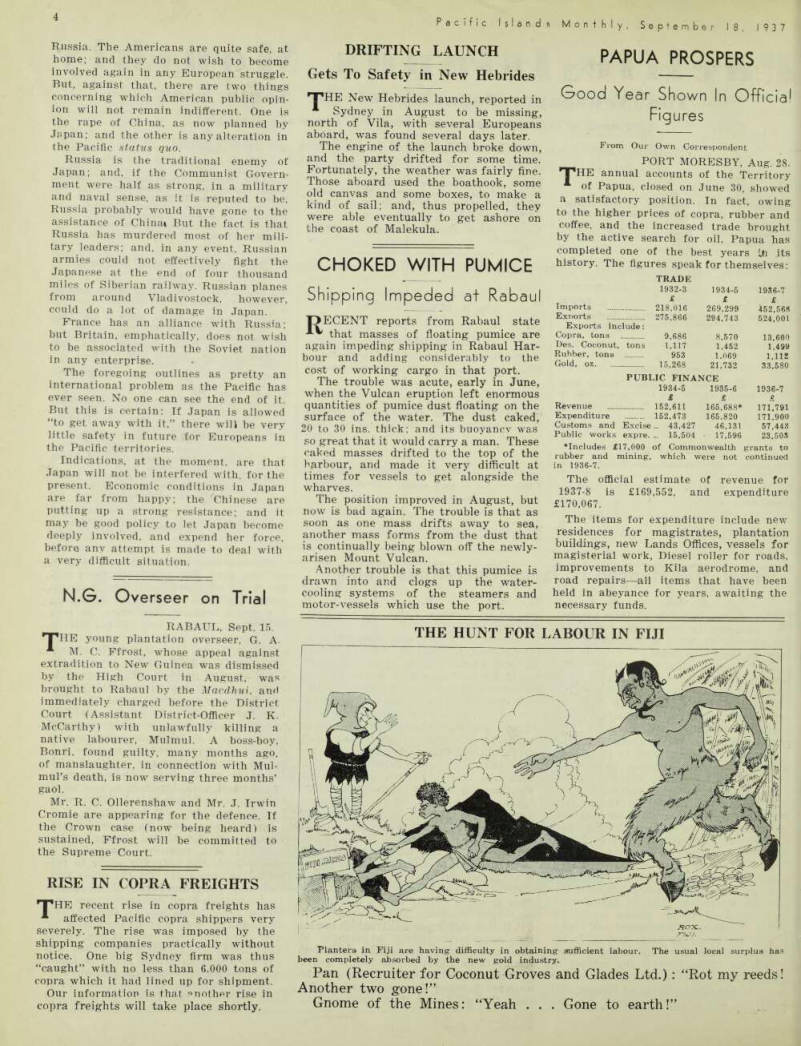
The Hunt For Labour In Fiji
Planters in Fiji are having difficulty in obtaining sufficient labour. The usual local surplus has been completely absorbed by the new gold industry.
Pan (Recruiter for Coconut Groves and Glades Ltd.): “Rot my reeds!
Another two gone!”
Gnome of the Mines: “Yeah... Gone to earth!”
Samoan Front
All Quiet On The Western
Mr. Nelson Gives a Party
From a Special Correspondent APIA, Sept. 1.
HAVING stirred officialdom to a frenzy, and brought the New Zea land Government to a serious considera tion of whether it would not perhaps be better if the edict of banishment were renewed, Mr. O. F. Nelson gave a mag nificent party at his home, “Tuaefu,” near’ Apia, and apparently put everyone into a good temper.
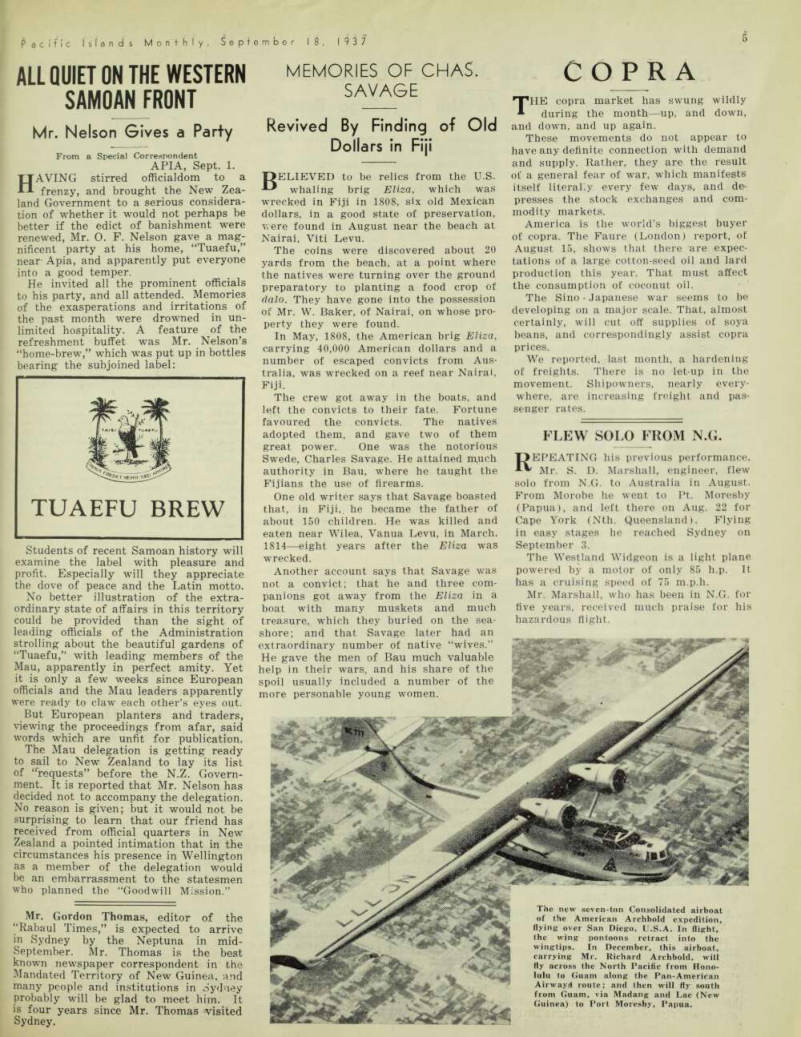
He invited all the prominent officials to his party, and all attended. Memories of the exasperations and irritations of the past month were drowned in un limited hospitality. A feature of the refreshment buffet was Mr. Nelson’s “home-brew,” which was put up in bottles bearing the subjoined label:
Tuaefu Brew
Students of recent Samoan history will examine the label with pleasure and profit. Especially will they appreciate the dove of peace and the Latin motto.
No better illustration of the extra ordinary state of affairs in this territory could be provided than the sight of leading officials of the Administration strolling about the beautiful gardens of “Tuaefu,” with leading members of the Mau, apparently in perfect amity. Yet it is only a few weeks since European officials and the Mau leaders apparently were ready to claw each other’s eyes out.
But European planters and traders, viewing the proceedings from afar, said words which are unfit for publication.
The Mau delegation is getting ready to sail to New Zealand to lay its list of before the N.Z. Govern ment. It is reported that Mr. Nelson has decided not to accompany the delegation.
No reason is given; but it would not be surprising to learn that our friend has received from official quarters in New Zealand a pointed intimation that in the circumstances his presence in Wellington as a member of the delegation would be an embarrassment to the statesmen who planned the “Goodwill Mission.”
Mr. Gordon Thomas, editor of the “Rabaul Times,” is expected to arrive in Sydney by the Neptuna in mid- September. Mr. Thomas is the best known newspaper correspondent in the Mandated Territory of New Guinea, and many people and institutions in Sydney probably will be glad to meet him. It is four years since Mr. Thomas visited Sydney.
Revived By Finding of Old
Memories Of Chas.
Savage
Revived By Finding of Old Dollars in Fiji
OELIEVED to be relics from the U.S. whaling brig Eliza, which was wrecked in Fiji in 1808, six old Mexican dollars, in a good state of preservation, were found in August near the beach at Nairai, Viti Levu.
The coins were discovered about 20 yards from the beach, at a point where the natives were turning over the ground preparatory to planting a food crop of dalo. They have gone into the possession of Mr. W. Baker, of Nairai, on whose pro perty they were found.
In May, 1808, the American brig Eliza, carrying 40,000 American dollars and a number of escaped convicts from Aus tralia, was wrecked on a reef near Nairai, Fiji.
The crew got away in the boats, and left the convicts to their fate. Fortune favoured the convicts. The natives adopted them, and gave two of them great power. One was the notorious Swede, Charles Savage. He attained m,uch authority in Bau, where he taught the Fijians the use of firearms.
One old writer says that Savage boasted that, in Fiji,, he became the father of about 150 children. He was killed and eaten near Wilea, Vanua Levu, in March, 1814—eight years after the Eliza was wrecked.
Another account says that Savage was not a convict; that he and three com panions got away from the Eliza in a boat with many muskets and much treasure, which they buried on the sea shore; and that Savage later had an extraordinary number of native “wives.”
He gave the men of Bau much valuable help in their wars, and his share of the spoil usually included a number of the more personable young women.
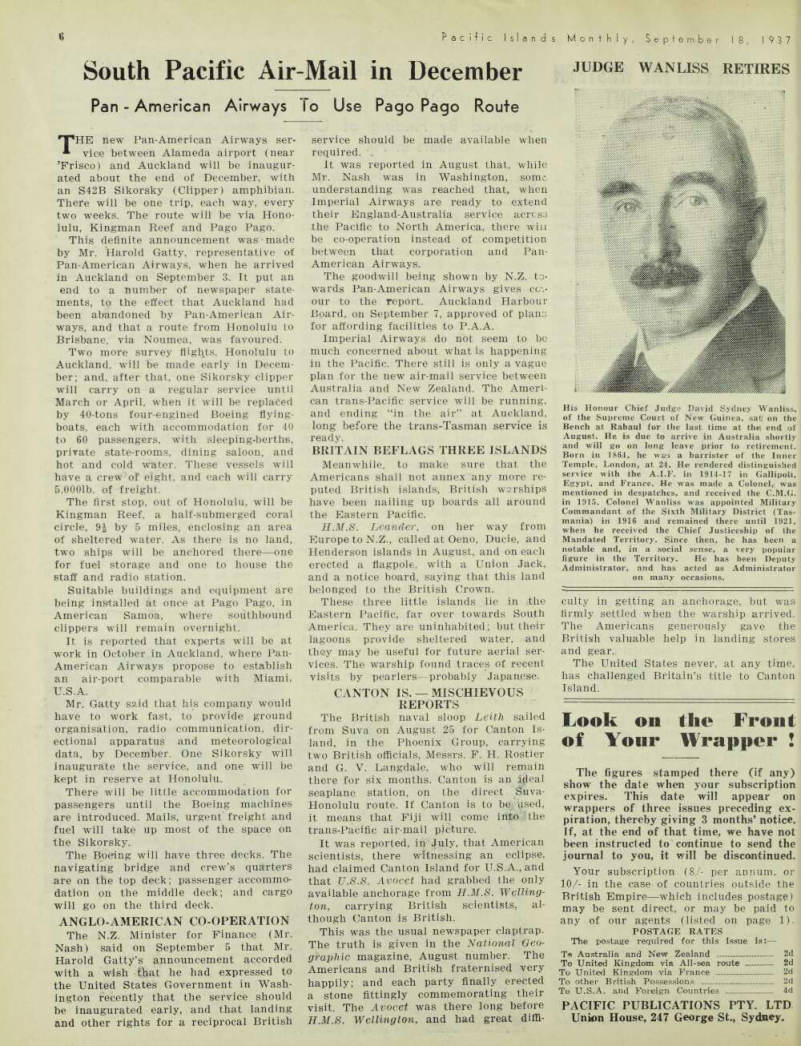
The new seven-ton Consolidated airboat of the American Archbold expedition, flying over San Diego, U.S.A. In flight, the wing pontoons retract into the wingtips. In December, this airboat, carrying Mr. Richard Archbold, will fly across the North Pacific from Hono lulu to Guam along the Pan-American Airways route; and then will fly south from Guam, via Madang and Lae (New Guinea) to Port Moresby, Papua.
Copra
THE copra market has swung wildly during the month —up, and down, and down, and up again.
These movements do not appear to have any definite connection with demand and supply. Rather, they are the result of a general fear of war, which manifests itself literally every few days, and de presses the stock exchanges and com modity markets.
America is the world’s biggest buyer of copra. The Faure (London) report, of August 15, shows that there are expec tations of a large cotton-seed oil and lard production this year. That must affect the consumption of coconut oil.
The Sino - Japanese war seems to be developing on a major scale. That, almost certainly, will cut off supplies of soya beans, and correspondingly assist copra prices.
We reported, last month, a hardening of freights. There is no let-up in the movement. Shipowners, nearly every where, are increasing freight and pas senger rates.
Flew Solo From N.G.
REPEATING his previous performance, Mr. S. D. Marshall, engineer, flew solo from N.G. to Australia in August.
From Morobe he went to Pt. Moresby (Papua), and left there on Aug. 22 for Cape York (Nth. Queensland). Flying in easy stages he reached Sydney on September 3.
The Westland Widgeon is a light plane powered by a motor of only 85 h.p. It has a cruising speed of 75 m.p.h.
Mr. Marshall, who has been in N.G. for five years, received much praise for his hazardous flight.
South Pacific Air-Mail in December
Pan-American Airways To Use Pago Pago Route
THE new Pan-American Airways ser vice between Alameda airport (near ’Frisco) and Auckland will be inaugur ated about the end of December, with an 5428 Sikorsky (Clipper) amphibian.
There will be one trip, each way, every two weeks. The route will be via Hono lulu, Kingman Reef and Pago Pago.
This definite announcement was made by Mr. Harold Gatty, representative of Pan-American Airways, when he arrived in Auckland on September 3. It put an end to a number of newspaper state ments, to the effect that Auckland had been abandoned by Pan-American Air ways, and that a route from Honolulu to Brisbane, via Noumea, was favoured.
Two more survey flights, Honolulu to Auckland, will be made early in Decem ber; and, after that, one Sikorsky clipper will carry on a regular service until March or April, when it will be replaced by 40-tons four-engined Boeing flying boats, each with accommodation for 40 to 60 passengers, with sleeping-berths, private state-rooms, dining saloon, and hot and cold water. These vessels will have a crew of eight, and each will carry 5,0001 b. of freight.
The first stop, out of Honolulu, will be Kingman Reef, a half-submerged coral circle, 9| by 5 miles, enclosing an area of sheltered water. As there is no land, two ships will be anchored there —one for fuel storage and one to house the staff and radio station.
Suitable buildings and equipment are being installed at once at Pago Pago, in American Samoa, where southbound clippers will remain overnight.
It is reported that experts will be at work in October in Auckland, where Pan- American Airways propose to establish an airport comparable with Miami,
U.S.A.
Mr. Gatty said that his company would have to work fast, to provide ground organisation, radio communication, dir ectional apparatus and meteorological data, by December. One Sikorsky will inaugurate the service, and one will be kept in reserve at Honolulu.
There will be little accommodation for passengers until the Boeing machines are introduced. Mails, urgent freight and fuel will take up most of the space on the Sikorsky.
The Boeing will have three decks. The navigating bridge and crew’s quarters are on the top deck; passenger accommo dation on the middle deck; and cargo will go on the third deck.
Anglo-American Co-Operation
The N.Z. Minister for Finance (Mr.
Nash) said on September 5 that Mr.
Harold Gatty’s announcement accorded with a wish that he had expressed to the United States Government in Wash ington recently that the service should be inaugurated early, and that landing and other rights for a reciprocal British
service should be made available when required. .
It was reported in August that, while Mr. Nash was in Washington, some understanding was reached that, when Imperial Airways are ready to extend their England-Australia service across the Pacific to North America, there win be co-operation instead of competition between that corporation and Pan- American Airways.
The goodwill being shown by N.Z. to wards Pan-American Airways gives ccv our to the report. Auckland Harbour Board, on September 7, approved of plans for affording facilities to P.A.A.
Imperial Airways do not seem to be much concerned about what is happening in the Pacific. There still is only a vague plan for the new air mail service between Australia and New Zealand. The Ameri can trans-Pacific service will be running, and ending “in the air” at Auckland, long before the trans-Tasman service is ready.
Britain Beflags Three Islands
Meanwhile, to make sure that the Americans shall not annex any more re puted British islands, British warships have been nailing up boards all around the Eastern Pacific.
H.M.S. Leander, on her way from Europe to N.Z., called at Oeno, Dude, and Henderson islands in August, and on each erected a flagpole, with a Union Jack, and a notice board, saying that this land belonged to the British Crown.
These three little islands lie in The Eastern Pacific, far over towards South America. They are uninhabited; but their lagoons provide sheltered water, and they may be useful for future aerial ser vices. The warship found traces of recent visits by pearlers—probably Japanese.
Canton Is. —Mischievous
Reports
The British naval sloop Leith sailed from Suva on August 25 for Canton Is land, in the Phoenix Group, carrying two British officials, Messrs. F. H. Rostier and G. V. Langdale, who will remain there for six months. Canton is an ideal seaplane station, on the direct Suva- Honolulu route. If Canton is to be used, it means that Fiji will come into the trans-Pacific air mail picture.
It was reported, in July, that American scientists, there witnessing an eclipse, had claimed Canton Island for U.S.A., and that U. 8.8. Avocet had grabbed the only available anchorage from H.M.S. Welling ton, carrying British scientists, al though Canton is British.
This was the usual newspaper claptrap.
The truth is given in the National Geo graphic magazine, August number. The Americans and British fraternised very happily; and each party finally erected a stone fittingly commemorating their visit. The Avocet was there long before H.M.S. Wellington, and had great diffi
culty in getting an anchorage, but was firmly settled when the warship arrived.
The Americans generously gave the British valuable help in landing stores and gear.
The United States never, at any time, has challenged Britain’s title to Canton Island.
Judge Wanliss Retires
His Honour Chief Judge David Sydney Wanliss, of the Supreme Court of New Guinea, sat on the Bench at Rabaul for the last time at the end of August. He is due to arrive in Australia shortly and will go on long leave prior to retirement.
Born in 1864, he was a barrister of the Inner Temple, London, at 24. He rendered distinguished service with the A.I.F. in 1914-17 in Gallipoli.
Egypt, and France. He was made a Colonel, was mentioned in despatches, and received the C.M.G. in 1915. Colonel Wanliss was appointed Military Commandant of the Sixth Military District (Tas mania) in 1916 and remained there until 1921, when he received the Chief Justiceship of the Mandated Territory. Since then, he has been a notable and, in a social sense, a very popular figure in the Territory. He has been Deputy Administrator, and has acted as Administrator on many occasions.
Advertisements & other items, p. 8 (1 item)
of Your Wrapper !
Look on the Front
The figures stamped there (if any) show the date when your subscription expires. This date will appear on wrappers of three issues preceding expiration, thereby giving 3 months’ notice.
If, at the end of that time, we have not been instructed to continue to send the journal to you, it will be discontinued.
Your subscription (8/- per annum, or 10/- in the case of countries outside the British Empire—which includes postage) may be sent direct, or may be paid to any of our agents (listed on page 1).
POSTAGE RATES
The postage required for this issue is:— T® Australia and New Zealand 2d To United Kingdom via All-sea route 2d To United Kingdom via France 2d To other British Possessions 2d To U.S.A. and Foreign Countries 4d
PACIFIC PUBLICATIONS PTY. LTD
Union House, 247 George St., Sydney.
Solomons Gold
English Group Finances Guadalcanal Project
FOLLOWING an unsuccessful attempt by Solomon Islands Gold Develop ment N.L. to launch a £50,000 company in Australia, to carry out sluicing opera tions on their Guadalcanal leases in 8.5.1., a large English mining group has financed the project.
At the end of August, Guadalcanal Sluicing and Dredging Co. Ltd. was registered in Melbourne with a nominal capital of £200,000 in 5/- shares the whole of which was underwritten by the English syndicate. Directors of the new concern are Messrs. J. W. Russell, F. A.
Rich, and J. F. Beacham.
The property, which has been pur chased by Guada canal Sluicing and Dredging Co., is on the central Sorvohio River and comprises 1,500 acres esti mated to contain 20 million yards of material. The vendor company—S.l. Gold Development N.L. has done a fair amount of preliminary work there, with results which are reported by Messrs.
Ault and Thomas, mining engineers, to be most satisfactory. The new company will thoroughly test the area by pitting.
Conviction Quashed
N.G. Miner Released From Gaol
THE Full High Court of Australia on August 31 quashed the conviction recorded against William Christie Abbie, who had already served seven months of a sentence of 21 months’ gaol imposed in New Guinea, on a charge of gold-stealing.
In January, Abbie pleaded not guilty to a charge of having stolen two ounces of bullion, valued at £l5/4/-, between September 16 and October 20, 1936, the property of a partnership of G. W. Os borne, E. C. N. Helton and W. C. Abbie, but he was convicted.
Owing to lack of funds to appeal, Abbie, who is a retired engineer-lieuten ant commander of the navy (in which he served for 25 years), has been under going, in Long Bay Goal, Sydney, the sentence passed on him in January.
The Chief Justice (Sir John Latham) said that the trial judge in New Guinea had admitted certain evidence that should not have been allowed. In ordinary cir cumstances, a new trial would have been ordered. There was now in the Territory, however, only one Supreme Court judge, namely Mr. Justice Phillips. If Abbie were sent to N.G. for trial he would be deprived of a trial by a new tribunal.
In view of the fact that Abbie had al ready served seven months in gaol, -the Chief Justice ordered that the conviction be quashed, and Abbie discharged.
The N.G. Administration cancelled the order of deportation against Mr. Abbie, and he was informed that, when he was ready, he would be provided with a first class steamer passage to Salamaua.
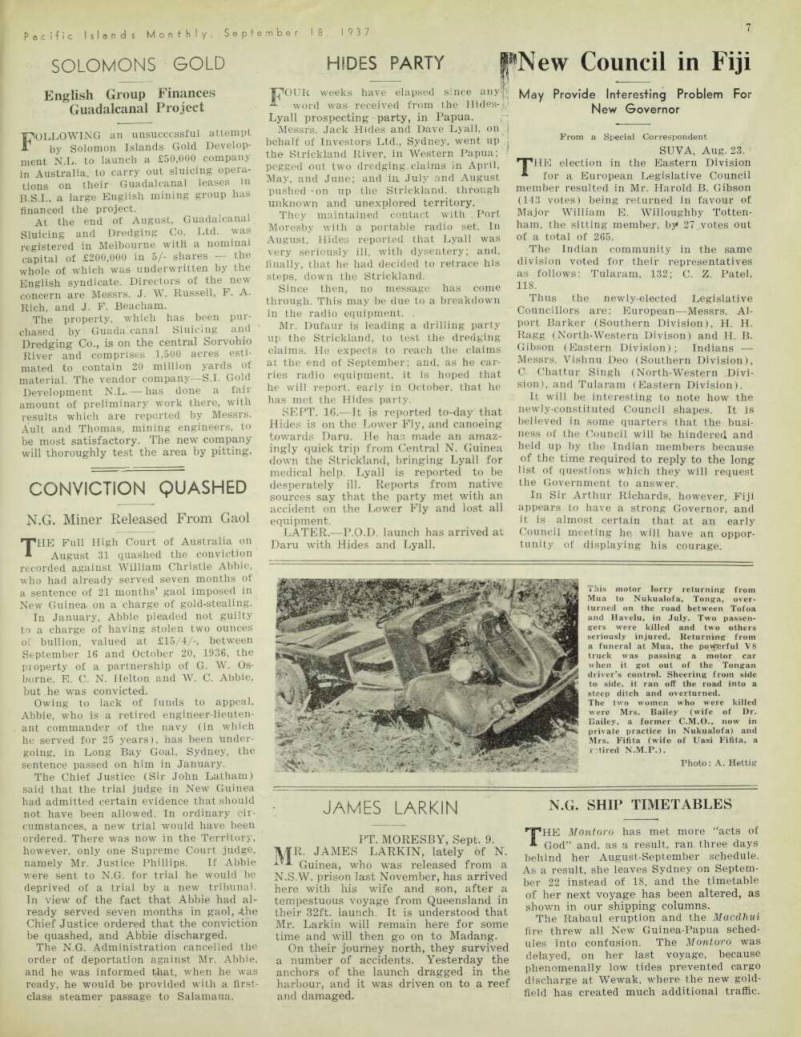
This motor lorry returning from Mua to Nukualofa, Tonga, over turned on the road between Tofoa and Havelu, in July. Two passen gers were killed and two others seriously injured. Returning from a funeral at Mua, the powerful V8 truck was passing a motor car when it got out of the Tongan driver’s control. Sheering from side to side, it ran off the road into a steep ditch and overturned.
The two women who were killed were Mrs. Bailey (wife of Dr.
Bailey, a former C.M.0., now in private practice in Nukualofa) and Mrs. Fifita (wife of Uasi Fifita, a retired N.M.P.).
Photo: A. Hettig
Hides Party
weeks have elapsed since any|'i| word was received from the Hides- i Lyall prospecting party, in Papua, Messrs. Jack Hides and Dave Lyall, on j behalf of Investors Ltd., Sydney, went up j the Strickland River, in Western Papua; pegged out two dredging claims in April, May, and June; and in July and August pushed on up the Strickland, through
unknown and unexplored territory.
They maintained contact with Port Moresby with a portable radio set. In August, Hides reported that Lyall was very seriously ill, with dysentery; and, finally, that he had decided to retrace his steps, down the Strickland.
Since then, no message has come through. This may be due to a breakdown in the radio equipment. .
Mr. Dufaur is leading a drilling party up the Strickland, to test the dredging claims. He expects to reach the claims at the end of September; and, as he car ries radio equipment, it is hoped that he will report, early in October, that he has met the Hides party.
SEPT. 16. —It is reported to-day that Hides is on the Lower Fly, and canoeing towards Daru. He has made an amaz ingly quick trip from Central N. Guinea
down the Strickland, bringing Lyall for
medical help. Lyall is reported to be desperately ill. Reports from native sources say that the party met with an accident on the Lower Fly and lost all
equipment.
LATER. —P.O.D. launch has arrived at Daru with Hides and Lyall.
James Larkin
Pt. Moresby, Sept. 9.
jl/TR. JAMES LARKIN, lately of N.
Guinea, who was released from a N.S.W. prison last November, has arrived here with his wife and son, after a tempestuous voyage from Queensland in their 32ft. launch. It is understood that Mr. Larkin will remain here for some time and will then go on to Madang.
On their journey north, they survived a number of accidents. Yesterday the anchors of the launch dragged in the harbour, and it was driven on to a reef and damaged.
New Council in Fiji
May Provide Interesting Problem For New Governor
From a Special Correspondent
Suva, Aug. 23.
THE election in the Eastern Division * for a European Legislative Council member resulted in Mr. Harold B. Gibson (143 votes) being returned in favour of Major William E. Willoughby Totten ham, the sitting member, by 27. votes out of a total of 265.
The Indian community in the same division voted for their representatives as follows: Tularam, 132; C. Z. Patel, HB.
Thus the newly-elected Legislative Councillors are: European—Messrs. Al- Port Barker (Southern Division), H. H.
Ra gg (North-Western Divison) and H. B.
Gibson (Eastern Division); Indians Messrs. Vishnu Deo (Southern Division), C Chattur Singh (North-Western Divi sion), and Tularam (Eastern Division), 4t will be interesting to note how the newly-constituted Council shapes. It is believed in some quarters that the busi ness of the Council will be hindered and held up by the Indian members because of the time required to reply to the long list of questions which they will request the Government to answer, In Sir Arthur Richards, however, Fiji appears to have a strong Governor, and it is almost certain that at an early Council meeting he will have an oppor tunity of displaying his courage.
shipping columns.
N.G. Ship Timetables
THE Montoro has met more “acts of 1 God .. anC l as a result, ran three days beh j n( j her August-September schedule.
A& a resulti she leaves Sydney on Septem -22 instead of lg and the timetable h next e has been altered, as
shipping columns.
The Rabaul eruption and the Macdhui New Guinea-Papua sched , „ rQC >” to conf " slo "' t The was flayed, on her last voyage because phenomenally low tides prevented cargo discharge at Wewak, where the new go field has created much additional traffic.
Lively Argument in Papua
Pensions Or Water?
Port Moresby, Aug. 28.
it was announced, in August, that the Government proposed to set aside £lO,OOO, from its now healthy funds, as a special reserve to assist the Public Service Superannuation Fund, there was a shout of protest from the non-official Europeans.
“If there is money to spare,” said the critics, “it surely is time that some greater public utilities were provided.
Why not a water-supply system for Port Moresby, for example—a thing most ur gently needed?
“Why should men in the sheltered public service, who bore none of the troubles and burdens of the bad years, be allowed to have first bite at the first funds made available by the good years?
Papuan public servants already have a liberal system of leave and pensions, and retire after only 20 years’ service. What about something for the planters and traders, who have lived in the country, and suffered in health and pocket, in order to keep its industries going; and who have no government to provide for their declining years?”
The criticism was led by Mr. E. James, in the Papuan Courier, and he received hearty support from the non-official classes.
The Lieutenant-Governor’s sympathies apparently were divided. He appreciated the civilian point of view; but, as Ad ministrator, he was obliged to “tidy up” the superannuation funds, which has been for years in an unsatisfactory con dition.
It is a fundamental of good govern ment in a tropical country that there shall be an effective pensions scheme, so that competent men may be attracted to the service, and held there. Almost al ways, pensions funds are created by pay ments from employer and employee, usually in the proportion of 50-50, The Papuan Fund was established on May 1, 1918; and, up to June 30, 1937, officers have paid into it, out of their salaries, £66,946. Interest earned has brought their actual contributions to £92,712i By 1928, it was found that in come was not sufficient to take care of pensions payable; and, from January 1, 1929, the Government provided for de ficits by irregular payments out of public revenue. Government payments to June 30 last, totalled £27,593.
This is a Government obligation, which it cannot escape. The Government, at the beginning, guaranteed the pension fund, on condition that officers contributed five per cent of their salaries.
The Government calculates that, if this £lO,OOO is put into a reserve to support the pension fund, the latter will there after be self-supporting; and the Govern ment thus will be freed from the em barrassing necessity of having to call upon the public revenue to make good the deficit.
Was Oil Found?
Terrific Row In Federal House
"THE oil search in Papua and New Guinea led to a series of lively “scenes” in the Federal House on Sep tember 9 and 10. .
The trouble was caused by Messrs. Ward and Beasley, Lang Labourites and political hoodlums. Mr. Ward, on the 9th, asked the Prime Minister whether oil in com mercial quantities had been found in Dutch New Guinea, near the British border. The Prime Minister said he had no information.
Later, Messrs. Ward and Beasley declared that, in view of this announce ment, a prospectus issued by Oil Search Ltd., of which Sir Charles Marr was said to be a director, appeared incorrect.
Either the Prime Minister’s answer was incorrect or Sir Charles Marr was as sociated with a fraudulent company.
Mr. Beasley said the prospectus claim ed that the company had a concession over territory in British New Guinea, adjoining an area in Dutch New Guinea, in which both the Shell and Standard oil companies were interested. He said that the prospectus continued —“Two years ago the Administrator of the Man dated Territory reported to the Prime Minister that ‘splendid oil wells some few miles from Bongu had been tempor arily sealed.’ ”
Sir Charles Marr was away. Ministers, obviously surprised, promised an inquiry.
Next day, there was a terrific row.
Sir Charles Marr was able to show that he was not connected with Oil Search Ltd., in any shape or form. But the political hoodlums, while accepting the statement, made no apology.
The Prime Minister said that Mr.
Ward’s original question had been a & cepted as applying to the present day.
Inquiry had shown that 3i years ago, on January 30, 1934, General Griffiths, Ad ministrator of New Guinea had sent to Canberra a report by D. 0. Townsend, at the Sepik. The latter, referring to oil in Dutch New Guinea, said: “I was in formed that the former was being over produced at the moment and that the splendid oil wells some few miles from Bongu had been temporarily sealed. Ap parently boring is still being carried out . . . The sealed oil wells at Bongu are 800 metres deep.”
A copy of the report was given to Oil Search Ltd., in August, 1934; and it was referred to by that Co. in a circular to shareholders on November 14, 1936. It never was included in a prospectus.
But Mr. Ward would not accept these perfectly feasible explanations. With the Lang Labourites howling and yelling sup port, he declared that the report had been “suppressed;” and that there had been racketeering. He defied the Speaker, and was suspended for one week, and ordered out of Parliament, amid tremendous up roar.
It was a typical “mare’s nest;” and the scene it caused has reacted sharply against the Labour Party in public opinion.
Messrs. Beasley and Ward made grossly libellous statements under the shelter of “privilege.”
Three months ago, the chances of a Labour success in next month’s election were about 10 to 1. To-day, the chances are about even.
Nothing has been heard, since 1934, about that oil find in Dutch New Guinea.
It obviously was an exaggerated report.
Sir Charles Marr is a director of Papuan Apinaipi Petroleum Co. Ltd., a small concern which was floated recently.
Lord Gowrie at Wau, Now Guinea
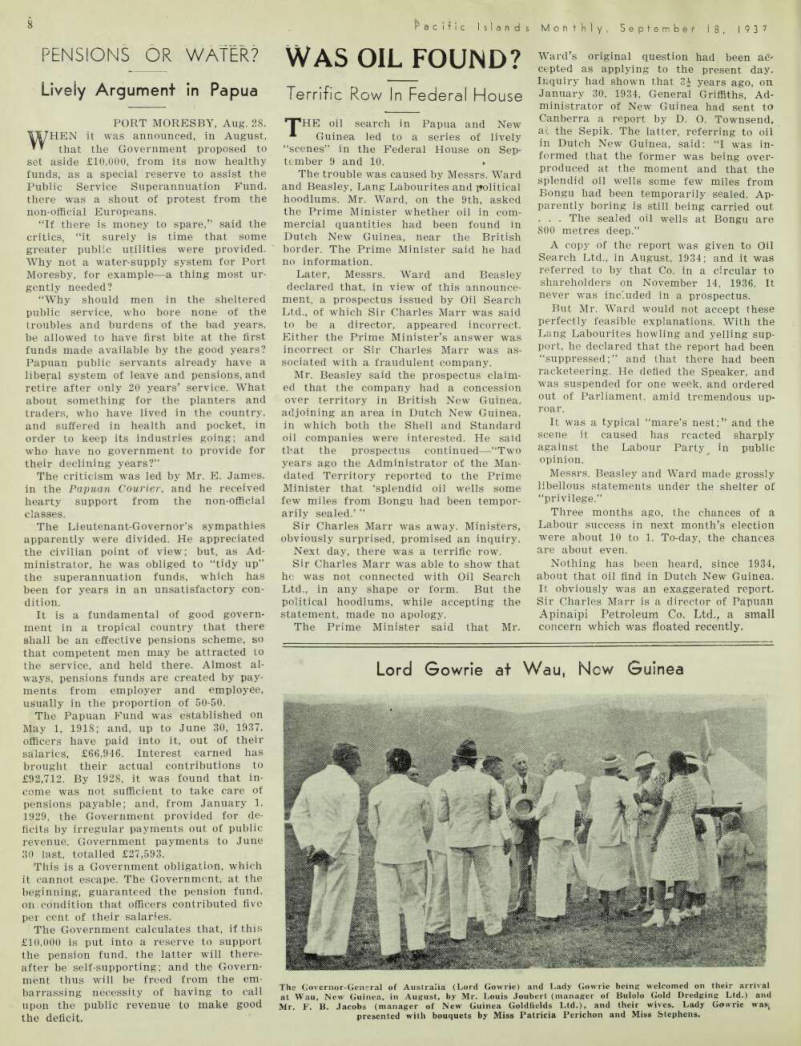
The Governor-General of Australia (Lord Cowrie) and Lady Cowrie being welcomed on their arrival at Wau, New Guinea, in August, by Mr. Louis Joubert (manager of Bulolo Gold Dredging Ltd.) and Mr. F. B. Jacobs (manager of New Guinea Goldfields Ltd.), and their wives. Lady Cowrie was presented with bouquets by Miss Patricia Perichon and Miss Stephens.
Bougainville, T.N.G.
Violent Eruption In Bougainville, T.N.G.
OBSERVERS at Kieta, in Bougainville Island (Northern Solomons, but part of the Mandated Territory of New Guinea) reported by radio on Tuesday, September 7, that Mount Bagana had commenced active eruption at about 8 a.m. Activity increased violently during the day, and by the afternoon, enormous masses of smoke and steam, rising more than 15,000 feet, had caused a “black-out” over the surrounding country.
No damage was done, except maybe to the few natives living thereabouts. Mt.
Bagana, 6,560 feet, is in the mountainous, jungle-clad interior of Bougainville, about 35 miles west of Kieta. Some 20 miles north of Mt. Bagana is Mt. Balbi, 10,170 feet, which also is a volcano, and fre quently active.
There was much interest in the event in Rabaul, 250 miles away, as the char acter of the eruption resembled that of Mt. Vulcan, on May 28.
There is no European, and only sparse native settlement in the interior of Bou gainville.
Later reports indicated that the erup tion was continuing, but with diminish ing force.
Banana Disease
A N Australian plant pathologist, Mr. C.
J. Magee, returned from Fiji during the month after having spent several weeks on the Rewa River and its tributaries studying the production of bananas.
He was trying to find out why the Fiji bananas, apparently without any organized system of control, threw off the “bunchy-ton” disease several years ago.
Doubt About Its Fate
Captain Cook's Body
From Our Own Correspondent
Honolulu, Sept. 1.
WHAT happened to the body of the famed British navigator, Captain James Cook, after he was murdered by natives at Napoopoo in Kealakekua Bay of the island of Hawaii?
The records conflict. Ralph S. Kuyan dall, a present day authority on Hawaiian history, writes: “Most of the bones of Captain Cook were recovered and then buried beneath the waters of the bay.”
However, an equally well known his torian, Alexander, declares: “His remains were taken to a heiau (graveyard). His flesh was removed from the bones and burned. The bones were tied up with red feathers and deified.”
In a footnote Alexander added: “Some of the bones were kept in the temple of Lano on the east side of Hawaii and worshipped until 1819 when they were removed to some secret place.”
This week a roving journalist met an old Hawaiian woman, Komoku Naihi. who has lived all of her 107 years in Kealakekua Bay overlooking the spot on the beach where Cook met his death.
Through an interpreter, she told how in her youth she knew men who saw Cook die. This is her version of the great voyager’s untimely death in Feb., 1779: “His men had killed one of our chiqfs.
The news of this came while Captain Cook was ashore. The Hawaiians killed Cook in revenge.
“He was an enemy and was treated like one. No, they had not eaten him.
His flesh was used for fish bait and his entrails were hung on a tree. Some of his bones were returned to the white men later on.”
Bulolo Dredges
New Deep-Digger Ready In November
WHEN he returned to Sydney this month, after acting as host to the Governor-General and Lady Gowrie on the Morobe goldfield, New Guinea, Mr.
L. Y. Waterhouse (director of Bulolo Gold Dredging Ltd.) reported that the installation of new dredges at Bulolo is proceeding according to programme.
Four dredges, shallow diggers, are operating steadily: and new and bigger dredges, designed to reach the recently discovered deep levels, are now being erected.
Mr. Waterhouse said that No. 5, a big dredge of 2,000 tons weight, would prob ably be ready to commence operations by the middle of November. This plant was going to dig to a depth of 85 feet below water level. No. 6, a smaller dredge, was being installed nearer to Wau, where the Company had a small limited area to dig out. Another dredge. No. 7, was being assembled in Sydney. This would be of similar capacity to No. 5,
Important Land Case In
Western Samoa
From Our Own Correspondent
Apia, Aug. 26.
TOURING the present sitting of the ** Lands and Titles Commission at Mulinu’u, an important case heard was one in which the ownership of a large area of land was disputed by no less than nine claimants, amongst whom were the High Chiefs Malietoa Tanu, 0.8. E., and Tamasese, the Mau leader. Hundreds of Samoans gathered at Mulinu’u to await the result of the litigation.
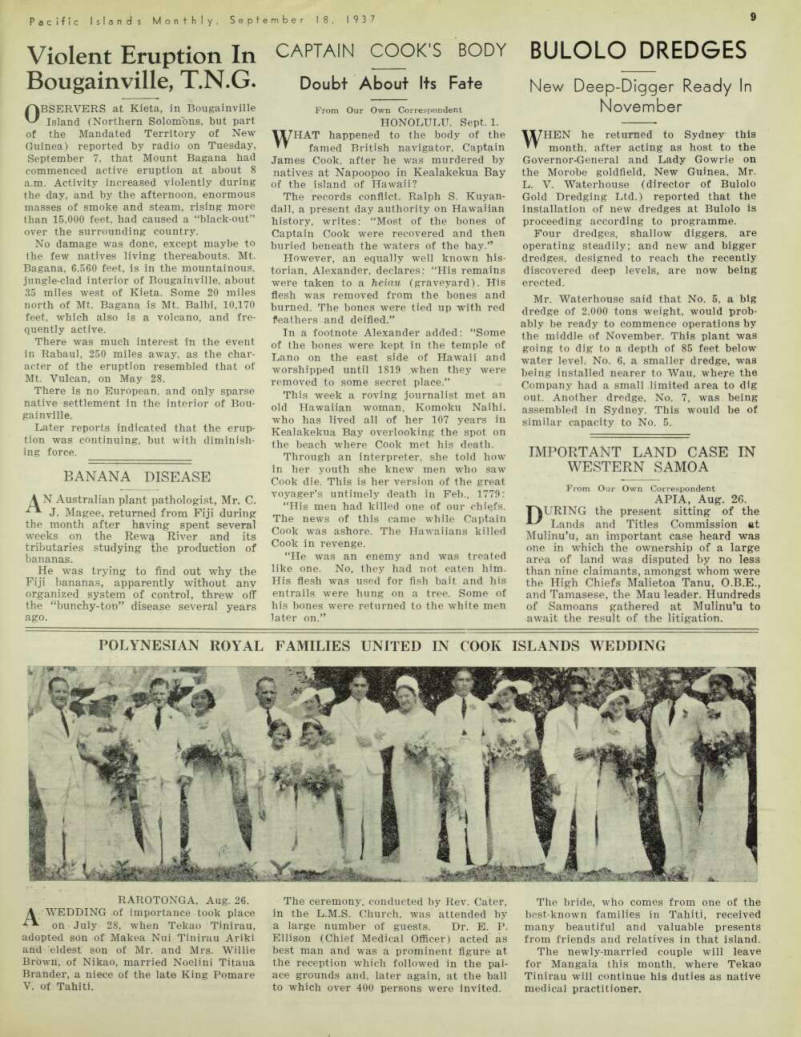
Polynesian Royal Families United In Cook Islands Wedding
Rarotonga, Aug. 26.
A WEDDING of importance took place on July 28, when Tekao Tinirau, adopted son of Makea Nui Tinirau Ariki and eldest son of Mr. and Mrs. Willie Brown, of Nikao, married Noelini Titaua Brander, a niece of the late King Pomare V. of Tahiti.
The ceremony, conducted by Rev. Cater, in the L.M.S. Church, was attended by a large number of guests. Dr. E. P.
Ellison (Chief Medical Officer) acted as best man and was a prominent figure at the reception which followed in the palace grounds and, later again, at the ball to which over 400 persons were invited.
The bride, who comes from one of the best-known families in Tahiti, received many beautiful and valuable presents from friends and relatives in that island, The newly-married couple will leave for Mangaia this month, where Tekao Tinirau will continue his duties as native medical practitioner.
Submit Report
Rabaul's Future
No Move Until the Experts Submit Report
SPECULATIONS about the future of Rabaul —most of them ill-informed and ridiculous—continue to appear in the Australian newspapers.
The Sydney Morning Herald reporter who accompanied the Governor-General to New Guinea in August has published his opinion of the matter. He examines all the suggested alternatives to Rabaul —Madang, Lae, Salamaua, Wau and Kavieng— and rejects the lot, though he apparently thinks kindly of Kavieng. The reporter was Mr. David McNicoll. a son of the Administrator of New Guinea; and it may not be a coincidence that the Administrator has been rather fierce in his denunciation of all plans for removing the capital from Rabaul.
There are two things which all these people appear to overlook. One is the ever-present danger of another eruption.
It may come tomorrow; it may not come again for 100 years—hut come it certainly will. The other point is the need for Hie development of New Guinea as a white man’s country. If it is necessary or prac ticable to move the capital, it should go to the mainland, as part of a plan for bringing into usefulness those magnifi cent inland plateaus, recently discovered and as yet only partly explored—a vast, fertile, well-watered and comparatively cool region, capable of supporting very large agricultural and pastoral industries.
Officialdom, however, will do nothing until it gets the reports of the experts— and no one can guess when that wilf be.
Dr. W. G. Woolnough, Commonwealth geologist, on arriving in Sydney in Aug ust from Rabaul, said that until his re port on the recent volcanic disturbances was completed it would not be possible to say whether there were any geological considerations against retaining Rabaul as the administrative centre.
Dr. Woolnough and Dr. C. E. Stehn (vulcanologist to the Netherlands East Indies Government) were appointed to inquire into the geological aspects of the disturbances at Rabaul. Dr. Stehn and Mr. N. H. Fisher, geologist to the New Guinea Administration, in early Septem ber were still carrying on researches.
The clouds of steam rising from Matupi Crater, on the eastern side of the har bour, and the still dense clouds of wind blown dust from the newly formed crater of Vulcan Island in the west, Dr. Wool nough added, were constant reminders of the recent disaster. In the district there were many wrecked and mud - covered native villages, hillsides scored by deep gullies, and devastated plantations.
The town itself was mournful, with piles of volcanic mud everywhere. The luxuriant tropical growth, however, was asserting itself. The problems of remov ing the mud and restoring drainage and maintaining health were being solved.
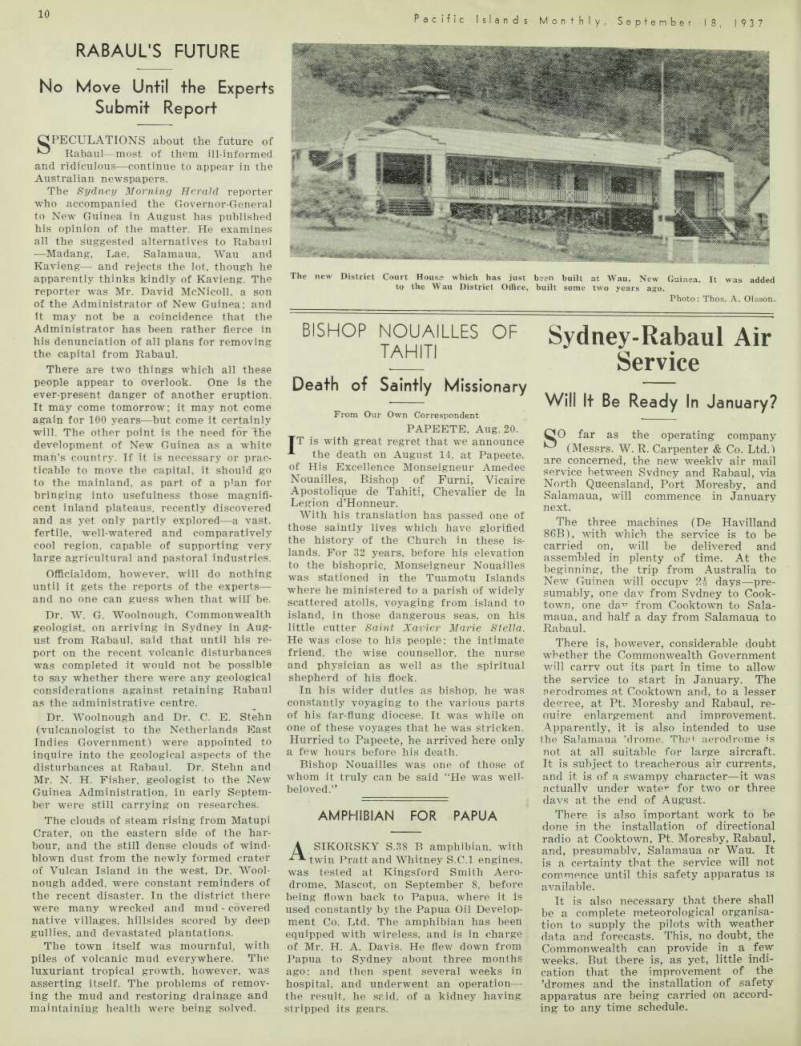
The new District Court House which has just been built at Wau, New Guinea. It was added to the Wau District Office, built some two years ago.
Photo: Thos. A. Olsson.
Death of Saintly Missionary
Bishop Nouailles Of
Tahiti
From Our Own Correspondent
Papeete, Aug. 20.
TT is with great regret that we announce the death on August 14, at Papeete, of His Excellence Monseigneur Amedee
Nouailles, Bishop of Furni, Vicaire
Apostolique de Tahiti, Chevalier de la Legion d’Honneur.
With his translation has passed one of those saintly lives which have glorified the history of the Church in these is lands. For 32 years, before his elevation to the bishopric, Monseigneur Nouailles w r as stationed in the Tuamotu Islands where he ministered to a parish of widely scattered atolls, voyaging from island to island, in those dangerous seas, on his little cutter Saint Xavier Marie Stella.
He was close to his people: the intimate friend, the wise counsellor, the nurse and physician as well as the spiritual shepherd of his flock.
In his wider duties as bishop, he was constantly voyaging to the various parts of his far-flung diocese. It was while on one of these voyages that he was stricken.
Hurried to Papeete, he arrived here only a few hours before his death.
Bishop Nouailles was one of those of whom it truly can be said “He was well beloved.”
Amphibian For Papua
\ SIKORSKY 5.38 B amphibian, with Pratt and Whitney S.C.I engines, was tested at Kingsford Smith Aero drome. Mascot, on September 8, before being flown back to Papua, where it is used constantly by the Papua Oil Develop ment Co. Ltd. The amphibian has been equipped with wireless, and is in charge of Mr. H. A. Davis. He flew down from Papua to Sydney about three months ago: and then spent several weeks in hospital, and underwent an operation— the result, he said, of a kidney having stripped its gears.
Sydney-Rabaul Air
Service Will It Be Ready In January?
OO far as the operating’ company (Messrs. W. R. Carpenter & Co. Ltd.) are concerned, the new weekly air mail service between Sydney and Rabaul, via North Queensland, Port Moresby, and Salamaua, will commence in January next.
The three machines (De Havilland 86B), with which the service is to be carried on, will be delivered and assembled in plenty of time. At the beginning, the trip from Australia to New Guinea will occupy 2i days—pre sumably, one dav from Sydney to Cook town, one from Cooktown to Sala maua, and half a day from Salamaua to Rabaul.
There is, however, considerable doubt whether the Commonwealth Government will carry out its part in time to allow the service to start in January. The aerodromes at Cooktown and, to a lesser degree, at Pt. Moresby and Rabaul, re cmire enlargement and improvement.
Apparently, it is also intended to use the Salamaua ’drome. That aerodrome is not at all suitable for large aircraft.
It is subject to treacherous air currents, and it is of a swampy character —it was actually under wate 1 * for two or three davs at the end of August.
There is also important work to be done in the installation of directional radio at Cooktown, Pt. Moresby, Rabaul, and, presumably, Salamaua or Wau. It is a certainty that the service will not commence until this safety apparatus is available.
It is also necessary that there shall be a complete meteorological organisa tion to supply the pilots with weather data and forecasts. This, no doubt, the Commonwealth can provide in a few weeks. But there is, as yet, little indi cation that the improvement of the ’dromes and the installation of safety apparatus are being carried on accord ing to any time schedule.
Tropicalities
FLYNN, lately planter in Papua and recruiter in New Guinea, and now world-famous film-star, has written a book Beam Ends, just pub lished by Cassells. It contains much about his adventures in these territories, and should be well worth reading. Re cently, in the Sydney home of a woman well-known and esteemed in New Guinea, I was permitted to examine a diary kept by Errol Flynn, about 1934, when he was away by himself in the jungle behind Finschhaven, T.N.G. Apparently, sitting at nights in his camp, he set down his thoughts on life in general, not dreaming that the pages ever would be read by anyone else. They throw an interesting sidelight on the character of a very clever and remarkable man. He certainly can write. The book, very battered and water stained, came into the hands of my friend by a series of curious chances.—R. ♦ ♦ « THERE has been a good deal in the * Australian newspapers lately about the presentation to the Australian National Museum by the Government of Japan of two of the queer stone “coins” which were at one time used as currency by the natives of the Line Islands. The two specimens under nbtice came from Yap, in the Caroline Group.
These tokens are large limestone discs, about the size of a small grindstone, and with a hole in the centre. In pre-Euro pean times, they were regular currency, and they ranged in size from small discs, weighing only a few pounds, to huge shaped stones weighing several tons.
These stone currencies, of course, are of value now only as curios—but as curios their value is considerable. ♦ ♦ ♦ AS my friend and I sat in a small boat, waiting to return to our ship, which was anchored outside the reef, we threw our sun-glasses to two Fijian lads who had been our escorts on the island. Mine accidentally fell in deep water, and sank.
Wili, being dressed in his Sunday best, was loath to dive in for them, so he ordered a little native lad, who was standing nearby and was clad in his birthday suit only, to do the job for him.
But alas! the child came up without the glasses. By this time Wili was greatly distressed and after some deep thought he commenced to disrobe. First his scar let neckerchief, then his shirt, and next his sulu. We were amused as we watched the alarmed expressions of some of the older ladies in the boat. But Wili was quite respectable, for he was still dressed in singlet and shorts. Diving in, he immediately retrieved the glasses.
When on shore again, he proceeded to take off his singlet, which he hung out to dry. My pal whispered: “If he takes off his trousers now, those dear old ladies will faint.” But Wili, still remembering his best manners, politely turned his back, put on his siCu, stepped out of his
wet shorts, hastened into his shirt and, looking as immaculate as ever—plus sun glasses waved us a smiling farewell with his scarlet neckerchief. —“CROTON” * * * TN the days before 1914, the arrogance * of German naval men and colonists in the Pacific often was a sore trial to the British. One famous instance was pro vided by a German geography book. In the edition intended for use in British or near-British countries, there occurred this reference to a certain Pacific island: ‘Under the glorious sway of the late T .ord Beaconsfield, this island was fortunate enough to become part of that Empire upon which the sun, etc.”
But, in the original German edition, the same passage read thus: “This island has recently been seized by the rapacious British, who with their wonted hypo critical pretences of introducing Christianity and civilisation, are fast exterminating Its unhappy natives.” ♦ ♦ ♦ OINCE the recent alteration in the value of the franc, public servants in the Condominium of the New Hebrides are suffering worse headaches than ever before. They receive half their salaries in sterling, and half in francs. As Aus tralian currency is used mostly in the territory, and as it is the fixed practice there, in calculating government amounts to keep to the old exchange rate of 124 francs to the £ sterling, public servants tihere have been more or less in clover.
An official on £3O per month, for instance, received £l5 sterling, and 1,860 francs (being £l5 sterling converted into francs at 124). Then he could convert this into Australian currency, at £l/5/- A. to £1 sterling, and 62 francs to £AI. This gave him £4B/10/- per month in Australian money. But, this month, he is not so
happy. About 102 francs are required to buy £1 Australian, and his monthly sal ary now is equal to £36/15/- Australian. ♦ * ♦ T)AGAN Island, in the Mariana Group, * now under Japanese control, has been in the news lately. It has some historical interest for Germans, because it has a deep, sheltered anchorage, and it was a rendezvous for the German warships in 1914. Admiral von Spee’s squadron ■— Scharnhorst, Gncisenau, Eurnherg, Leip zig and Dresden secretly assembled there in the early days of August, 1914. and took in supplies for that fateful cruise that ended in the Falklands battle.
The raider Emden also made Pagan a kind of base, and from there she went to the Indian Ocean, to destroy shipping until she was herself destroyed at Cocos Island in November, 1914.
Fortunate Fiji
From a Special Correspondent
Suva, Aug. 17.
is indeed one of the favoured * colonies.
Copra planters are now operating at a fair profit. Sugar is sure to be good for the next five years. The Colonial Sugar Refining Co. Ltd. is going ahead progressively with its plan to erect a pineapple factory at Lautoka, alongside the sugar mill. And 1938 should be the year that gives the true position and future of the Tavua goldfields.
With half a million pounds in reserve, Fiji is certainly well off.
Mr. Frank Hambridge, Sydney ore buydr and metallurgical accountant, who is well known in Papuan and New Guinea mining circles, departed with his wife for London by the Straithaird on September 7.
A new vessel, the Notou (4,200 tons) has been purchased in France by the Sodete le Nickel (formerly the Societe Caledonickel), to operate from Point Doniambo, New Caledonia,
Advertisements & other items, pp. 13-14 (1 item)
Flat Oil
FINISH
WATERPROOF
DRIES IN HAIP HOUR
I
CREAM
Write for a Colour Card . . .
STERLING VARNISH CO.
Dries In half an hour on plaster walls, ceilings, cement, fibre, wood and iron.
Also Excellent as an Undercoat for lacquers, paints and enamels. 11/- per gallon
HIGHLY DURABLE
Alexandria, N.S.W.
THE PACIFIC ISLANDS CLUB
Visitors from the Islands to Sydney (or those interested in Islands affairs, are advised to communicate with the honorary secretary of the above Club, which has been formed to study the history, traditions, economics, and political developments of the Pacific Islands.
Monthly social gatherings at the Hotel Carlton, Sydney. Address communications to: The Honorary Secretary,
THE PACIFIC ISLANDS CLUB,
C/o Pacific Publications, Union House, George St., Sydney.
CREMO COFFEE
PACIFIC COFFEE
FIRST CALL COFFEE
BULK COFFEE
(HAW WHOIE P
A.S.F MILK
CSM 'EETENED
CORAL COCOA
BULK TEAS
(BOXES OR CHESTS)
6 o & o 0 o V < V Ml 'tp SS**k ‘'Red ! OK v>:
PTY. ltd
SYDNEY
janumi fiat Jea and (ojjee frf 50 l^fecotA * n If n it it P f H 2fc ■** %-m
THE WENTWORTH
. . . Your home
while in SYDNEY
You'll enjoy a stay at the Wentworth. Whether your trip be business or social the Wentworth is ideal. Close to business and social centres, the Wentworth is noted for its restful comfort; Its service and cuisine. Wire or write for reservations . . .
WENTWORTH HOTEL
SYDNEY
C. D. MACLURCAN
J. S. LEVY
Managing Director Manager
About Islands People
Miss Margaret Devitt, of the New Guinea Mission, has completed the me moirs of the late Canon Tomlinson, covering his 45 years’ service in Papua.
Mr. H. S. Mount, of Suva, was absent from Fiji between August 3 and 26 attending the Australian Dental Con ference.
Miss J. Christopher, of South Aus tralia, sailed from Sydney by the Macdhui at the end of August to join the nursing staff of the Methodist Mission in New Britain.
Rev. R. Hanselmann, of the American Lutheran Church in New Guinea, recently issued, through the Lutheran Book Con cern, Columbus, Ohio, U.S.A., an illus trated pamphlet entitled “In the Jungles of New Guinea,” giving his impressions of the flora, the fauna, and the natives.
It tells of his experiences with the latter, and of the work of the Lutheran Mission in the Mandated Territory.
Mr. and Mrs. Fred R. Isom, of the Melanesian Mission Press, Solomon Is lands, will sail from England by the Narkunda on October 15, after spending long leave in Europe. They will spend a month in Australia and arrive back in the Solomons in December.
Mr. G. Bright, superintendent of the Suva Fire Brigade, who has been in New Zealand on leave, returned to Fiji by the August Aorangi.
Miss Elsie Smith, who has been a missionary in Fiji among the girls at the Indian Orphanage conducted by the Methodist Mission, arrived in Sydney by the August Monterey from Suva. After spending a few weeks’ furlough in Vic toria, she departed for India, where she will undergo a period of study at the Language School in Lucknow.
Archdeacon R. de Veil, who has been at Rabaul, New Guinea, for a number of years, has advised the Melanesian Mis sion that be cannot return to the tropics at the end of his present leave, which is being spent in England.
Mr. Arthur Bunting, M.L.C., of Samarai, Papua, who has been in Aus tralia receiving medical attention, re turned to the Territory by the last Macdhui. Mr. Bunting’s health is still bad—he arrived at the wharf to join the Macdhui in an ambulance.
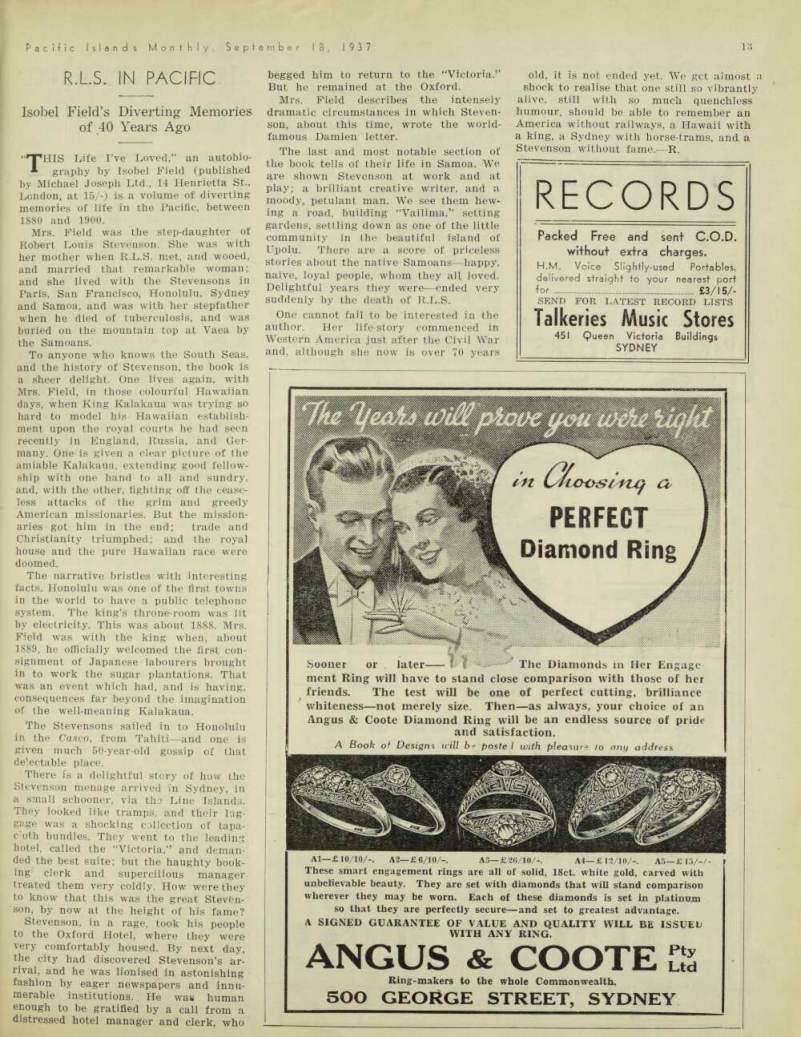
Rev. M. G. Wilmshurst, B.A., who sailed from Sydney by the Niagara on September 2 to join the Methodist Mission in Fiji. He will work among the Indian population at Ba.
Photo: “Missionary Review”
R.L.S. In Pacific
Isobel Field’s Diverting Memories of 40 Years Ago
THIS Life I’ve Loved,” an autobio graphy by Isobel Field (published by Michael Joseph Ltd., 14 Henrietta St., London, at 15/-) is a volume of diverting memories of life in the Pacific, between 1880 and 1900.
Mrs. Field was the step-daughter of Robert Louis Stevenson. She was with her mother when R.L.S. met, and wooed, and married that remarkable woman; and she lived with the Stevensons in Paris, San Francisco, Honolulu, Sydney and Samoa, and was with her stepfather when he died of tuberculosis, and was buried on the mountain top at Vaea by the Samoans.
To anyone who knows the South Seas, and the history of Stevenson, the book is a sheer delight. One lives again, with Mrs. Field, in those colourful Hawaiian days, when King Kalakaua was trying so hard to model his Hawaiian establish ment upon the royal courts he had seen recently in England, Russia, and Ger many, One is given a clear picture of the amiable Kalakaua, extending good fellow ship with one hand to all and sundry, and, with the other, fighting off the cease less attacks of the grim and greedy American missionaries. But the mission aries got him in the end; trade and Christianity triumphed; and the royal house and the pure Hawaiian race were doomed.
The narrative bristles with interesting facts. Honolulu was one of the first towns in the world to have a public telephone system. The king’s throne-room was lit by electricity. This was about 1888. Mrs.
Field was with the king when, about 1889, he officially welcomed the first con signment of Japanese labourers brought in to work the sugar plantations. That was an event which had, and is having, consequences far beyond the imagination of the well-meaning Kalakaua.
The Stevensons sailed in to Honolulu in the Casco , from Tahiti—and one is given much 50-year-old gossip of that de’ectable place.
There is a delightful story of how the Stevenson menage arrived in Sydney, in a small schooner, via the Line Islands.
They looked like tramps, and their lug gage was a shocking collection of tapa c oth bundles. They went to the leading hotel, called the “Victoria,” and deman ded the best suite; but the haughty book ing clerk and supercilious manager treated them very coldly. How were they to know that this was the great Stevbn son, by now at the height of his fame?
Stevenson, in a rage, took his people to the Oxford Hotel, where they were very comfortably housed. By next day, the city had discovered Stevenson’s ar rival, and he was lionised in astonishing fashion by eager newspapers and innu merable institutions. He was human enough to be gratified by a call from a distressed hotel manager and clerk, who
begged him to return to the “Victoria.”
But he remained at the Oxford.
Mrs, Field describes the intensely dramatic circumstances in which Steven son, about this time, wrote the world famous Damien letter.
The last and most notable section of the book tells of their life in Samoa. We are shown Stevenson at work and at play; a brilliant creative writer, and a moody, petulant man. We see them hew ing a road, building “Vailima,” setting gardens, settling down as one of the little community in the beautiful island of Upolu, There are a score of priceless stories about the native Samoans —happy, naive, loyal people, whom they all, loved.
Delightful years they were—ended very suddenly by the death of R.L.S.
One cannot fail to be interested in the author. Her life-story commenced in Western America just after the Civil War and, although she now is over 70 years
old, it is not ended yet. We get almost ; shock to realise that one still so vibrantly alive, still with so much quenchless humour, should be able to remember an America without railways, a Hawaii with a king, a Sydney with horse-trams, and a
Stevenson without fame.
R.
Rev. C. Rich, of the L.M.S., Lapua, has arrived in Sydney from London.
Advertisements & other items, pp. 15-16 (1 item)
Records
Packed Free and sent C.O.D. without extra charges.
H.M. Voice Slightly-used Portables, delivered straight to your nearest port for £3/15/-
SEND FOR LATEST RECORD LISTS
Talkeries Music Stores
451 Queen Victoria Buildings
SYDNEY
wm it* a cn locrsi ruj c*
PERFECT
Diamond Ring
■< Sooner or later 1 I - v The Diamonds in Her Engage ment Ring will have to stand close comparison with those of her friends. The test will be one of perfect cutting, brilliance whiteness—not merely size. Then—as always, your choice of an Angus & Coote Diamond Ring will be an endless source of pride and satisfaction.
A Book of Design s will b ? pastel with pleasure to anu addres Q r~. a IV IV Al—£lo/10/-. A2—£6/10/-. A3—£26/10/-. A4—£l2/10/-. As—£l3/-/- These smart engagement rings are all of solid, 18ct. white gold, carved with unbelievable beauty. They are set with diamonds that will stand comparison wherever they may be worn. Each of these diamonds is set in platinum so that they are perfectly secure—and set to greatest advantage.
A SIGNED GUARANTEE OF VALUE AND QUALITY WILL BE ISSUEL
WITH ANY RING.
ANGUS & COOTE S
Ring-makers to the whole Commonwealth.
500 GEORGE STREET, SYDNEY
Tropical
Outfitters
T>IKE BROTHERS LIMITED,
*“■ of Queen Street, Brisbane, specialise in all Tropical Wear for men. . . .
Write, or, when vis’ting Brisbane, call at the Leading Men’s Store and obtain particulars of Pike’s Tropical attire, including Suits, Helmets, Underwear, etc.
PIKE BROTHERS
LIMITED
Of Queen Street Brisbane
Sir Arthur Richards Returns
From Pacific Tour
From Our Own Correspondent.
Suva, Aug. 26.
\ FTER a tour lasting two months, the Governor of Fiji (Sir Arthur Richards) returned to Suva from the is lands of the Western Pacific High Con\mission territory in H.M.S. Leith on August 18.
His Excellency, who made the tour in his capacity of High Commissioner for the Western Pacific, was accompanied by the Central Medical Authority (Dr. A. H.
B. Pearce) and the Secretary to the High Commission (Mr. H. H, Vaskess).
The tour embraced extensive visits to New Hebrides, Solomon Islands, and the Gilbert and Ellice Islands, as well as an inspection of the Mandated Territory of Nauru. At all the High Commission terri tories visited, His Excellency met the natives and discussed their problems with them, and was, by this means, able to get a thorough insight into the territories he administers.
Stir In Fiji Civil Service
A Revolutionary Report By Reorganisation Committee
From Our Own Correspondent.
Suva, Aug. 31.
A PPOINTED by Sir Murchison Fletcher to make recommendations for the reconstruction of the Fiji Civil Service, the Reorganisation Committee has at last produced its report; and certain ranks of the service have been seething with indignation since it has been made public.
As considerable extra expenditure for leave passages is involved, it is anti cipated that there will be lively debate when the report comes before the Legis lative Council for discussion. The Council has been summoned to meet on Sept. 24.
A lay reading of the report seems to reveal that there is to be even greater discrimination between the privileges of Home and Colonial appointees than there has been in the past. Judging by the remarks of those in the Clerical Service, this branch has been hardest hit.
Under the old regime, clerks joining the Service in Fiji could rise as high as £6OO a year; but now it appears that only a few will ever get as far as £4OO, while the majority will remain on £270, the present maximum for a third class clerk.
This virtually means that there will be no inducement for locally-born European youths to enter the Service. Consequently, this will mean an increase in the number of Indians and Fijians employed.
In the past, officers have been entitled to furlough every three years. Under the Committee’s recommendations, senior officers will get leave every three years, and other ranks only every four years.
There has been much comment on the fact that almost every departmental head will have a substantial salary increase if the recommendations of the Committee are adopted. In this respect, several ano malies creep in, but the most glaring is in the Judicial and Legal Department.
At present, the Chief Justice draws a salary of £1,200 a year and also receives £4OO a year from the Western Pacific High Commission. The Attorney General, who is an officer of the Fiji Service only, draws at present £l,lOO. The Committee recommends that the Attorney General’s salary be increased to £1,250, but makes no recommendation with regard to the Chief Justice. If this goes through, it will mean that an officer of the Supreme Court will be drawing more than the head of the Court, so far as the Fiji Service is concerned.
Allowances paid to various officers for special qualifications are in most in stances to be abolished. In several in stances, Government Medical Officers, who at present have the privilege of private practice, are to be denied this. Many fore cast that this will mean the wholesale resignation of capable Medical Officers, who will do much better as private prac titioners in some populous districts.
There has been bitter complaint re garding other proposals in connection with the Medical Department. At present, there is a Medical Officer at Lautoka and one at Nadroga, 67 miles away. It is proposed to station both these men at Lautoka. What is going to happen in the case of a serious accident at Sigatoka, Nadroga, or miles up the Sigatoka Valley, with the nearest doctor sixty miles away!
It is proposed to remove the M.O. from Savu Savu altogether and place this district under the Taveuni Medical Officer. The report points out that, though there is 50 miles of open sea between the two places, one doctor could quite easily handle the two districts if a suitable vessel were provided. The report naively adds that the “suitable vessel” could also be used by the District Commissioner for administrative purposes.
Those who know Fiji, and what 50 miles of open sea can be like in this Group, ridicule the idea and ask what is going to happen if the doctor, in Taveuni, is urgently wanted at Savu Savu and there happens to be a hurricane blowing up. This is altogether apart from the consideration that the District Commis sioner might have the boat away on an administrative tour.
Those are a few of apparent anomalies which appear in the report, which has been the principal topic of conversation in Fiji Service circles ever since it appeared.
Of course, it is only a report and re commendations as yet, and it remains to be seen what will be done with it when it comes before the Legislative Council.
Advertisements & other items, p. 16 (1 item)
Dewars
The sea has a charm of its own, and so has DEWAR’S Whisky. As invigorating as the winds that blow from out of space, DEWAR’S, like a well-found ship, brings content; boundless and satisfying.
lAe SCOTCH WHISKY
Aeroplane Wrecked
Crash at Wau, T.N.G.
A STINSON Reliant single-engined aeroplane, owned by Guinea Airways Ltd., and piloted by Mr. W. J. Robins, crashed soon after taking off from Wau aerodrome on the morning of Friday, August 27.
The machine was loaded with refriger ating machinery and the ’drome was partly blanketed in a heavy fog. The aeroplane, apparently, got out of control soon after leaving the aerodrome, and it came down near the edge of the golf links, crashing into one of the native labour houses in the Government com pound.
A native, employed by Amalgamated Wireless (A’sia) Ltd. as an engine boy, was struck by falling timbers and died subsequently in hospital. Mr. Robins miraculously escaped serious injury, but suffered severely from shock. The ’plane was completely wrecked, and has been written off as a total loss.
This is the first serious accident recorded in New Guinea for a long time. This freedom from accident is the more remarkable because prac tically the whole of the mainland gold fields traffic is carried on by aeroplanes, and both the country and the weather are by no means ideal for flying.
Mr. A. S. de Montalk, who has been headmaster of the Boys’ Grammar School at Suva, Fiji, since 1933, returned to New Zealand at the end of August by the Niagara.
Mr. W. M. Greer, of Aropa Plantation, Kieta, returned to New Guinea from Sydney by the Macdhui on August 28.
Advertisements & other items, pp. 17-18 (1 item)
cksh
make it\
always ' >
e tire a/ ©.
cant
I
OUT
wake Y
j should \
e Horlicks.
tak
3 WAKING tired reduces a man’s efficiency at work and play—he cannot concentrate properly—he cannot do his best work—he is unfairly handicapped.
Your body uses up energy even while you sleep—failure to replace this energy means “NIGHT STARVATION.”
If you wake tired, start taking Horlicks regularly at bedtime. Horlicks stores your body with the necessary vitality to face the most exacting climate. Horlicks makes a delightful beverage cold, mixed with iced milk or cold water in the Horlicks mixer.
There is milk in Horlicks already, so where milk is scarce you can use water only—just add rather more Horlicks, that is all.
Ask your Chemist or
Storekeeper to-day for
a bottle of Horlicks. size costs 3/- in all main towns throughout the British Pacific Islands.) %//
cksh
sut OH c/ e j *o r °U S ct e oh ,f 'k Wr, Po r Ofn °U t fet "'■n **1 0 OH ><k >Ou JHf 07 *7// '•'if/
LIONEL MODEL
TRAINS
WHAT EVERY BOY WANTS.
REAL TRAINS IN EVERYTHING
BUT SIZE.
Clockwork Models complete from 15/-.
Electric Models complete from 60/-. (Electric models operate from A.C. mains or batteries) Write tor Illustrated Catalogue
PRICE'S RADIO SERVICE
5 and 6 ANGEL PLACE,
SYDNEY
Dr. Hogbin's Reply
Marriages In The
Solomons
Letter to the Editor I SHALL be grateful if you will grant -*■ me spacci to reply to the letter by Mr. Norman Deck, published in your August issue, criticising certain state ments alleged to have been made by me at a lecture delivered to the Anthropolo gical Society of N.S.W.
He accuses me of jumping to the con clusion that the customs throughout the island of Malaita are everywhere the same. I can assure him I have done no such thing. My own firsthand knowledge of the island is confined to the To’amba ita-speaking people of the northern end, and at the lecture referred to, as well as in the various papers I have communi cated to scientific journals, I have been careful to make explicit statement of fact.
Then he implies that I did not seek information regarding the policy of the South Sea Evangelical Mission from its members while I was staying in Malaita.
Mr. Deck called on me, I think, twice, when his vessel, the Evangel , was visiting Malu’u, where I lived, and we discussed mission policy in certain par ticulars at length. Further, I had many conversations with the native catechist, Shem.
The position with regard to “bride price” in North Malaita I do not propose to discuss here. I have already given a brief summary of my views in the jour
nal Oceania (1934). These have been criticised at length in the same place by Mr. Deck (1935), and I have myself re plied to him there. I have also gone into the matter in detail in a book which I am now completing. I hope to have this published in a few months, under the title Experiments in Civilisation.
My remarks about “illegal” marriages performed by native clergy according to Christian rites referred, not to Malaita, but to Ysabel, and the organisation con cerned is the Melanesian Mission, not th£ South Sea Evangelical body. I have not studied the Ysabel natives, myself; but, during my last visit to the Solomons in 1933, I was informed by the then District Officer, Mr. Fowler, and also by the Judi cial Commissioner, Mr. Hubbard, that in the Protectorate marriages are legal only if performed “according to native cus tom” or by the Resident Commissioner or a European minister of religion regi stered by the Administration.
In Ysabel, so they said, the Melanesian Mission has abolished marriage by native custom (which included payment of “bride-price”) and substituted instead a ceremony performed by a native minister of religion, who is, of course, not regi stered. The result is that at the present time no one on the island is legally mar ried, though every couple has the bles sings of the Church. I may say that when I visited Fiji last year I inquired at the High Commissioner’s office whether this is, in fact, the position. It is!
I am, etc.,
H. Ian Hogbin.
University of Sydney, September 6, 1937.
Advertisements & other items, p. 18 (1 item)
Kambala
CHURCH OF ENGLAND
SCHOOL FOR GIRLS
A Day and Boarding
School for Girls.
KINDERGARTEN TO LEAVING
CERTIFICATE HONORS.
RESIDENT QUALIFIED SPORTS
MISTRESS.
Prospectus on application to the Principal . . .
FOUNDED 1887
MS? immm ■Hi ■■ 'A
“ KAMBALA "
Ideally situated in 5 acres of ground 5 Tennis Courts KAMBALA SCHOOL, tivoli heights, rose bay, Sydney Principal: MISS F. HAWTHORNE, B.A.
Matron : MISS M. COLLINS. A.T.N.A.
When Vulcan Roared
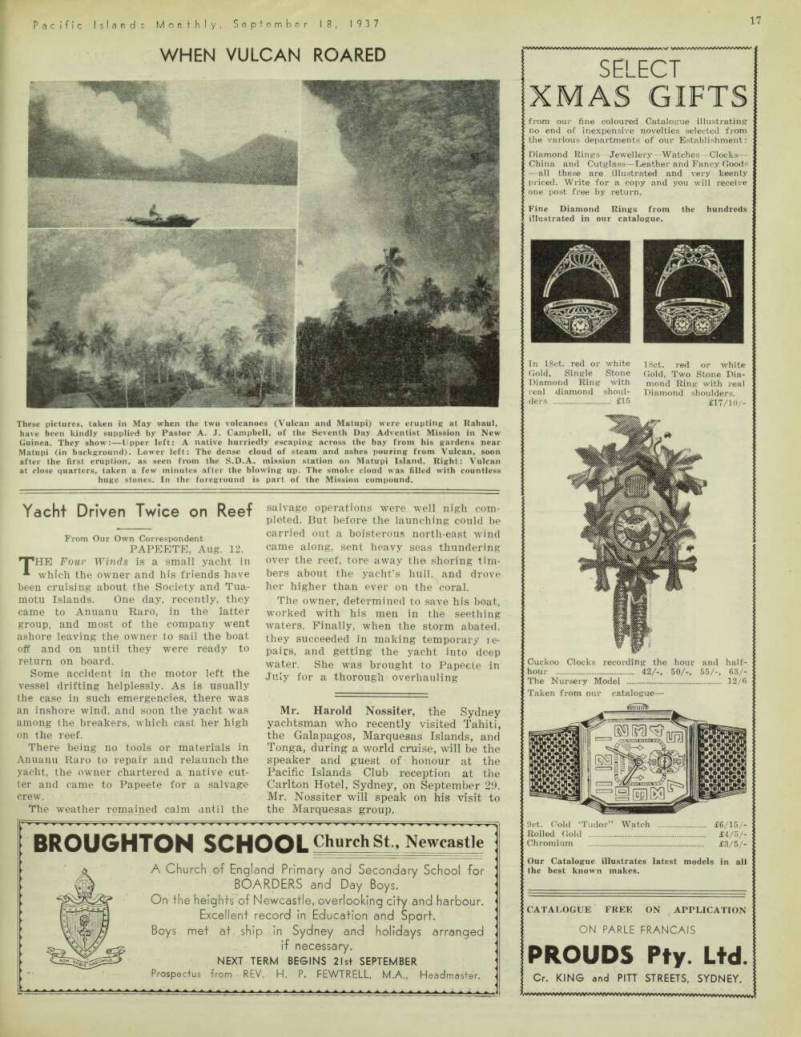
These pictures, taken in May when the two volcanoes (Vulcan and Matupi) were erupting at Rabaul, have been kindly supplied by Pastor A. J. Campbell, of the Seventh Day Adventist Mission in New Guinea. They show: —Upper left: A native hurriedly escaping across the bay from his gardens near Matupi (in background). Lower left: The dense cloud of steam and ashes pouring from Vulcan, soon after the first eruption, as seen from the S.D.A. mission station on Matupi Island. Right: Vulcan at close quarters, taken a few minutes after the blowing up. The smoke cloud was filled with countless huge stones. In the foreground is part of the Mission compound.
Yacht Driven Twice on Reef
From Our Own Correspondent
Papeete, Aug. 12.
Four Winds is a small yacht in * which the owner and his friends have been cruising about the Society and Tua motu Islands. One day, recently, they came to Anuanu Raro, in the latter group, and most of the company went ashore leaving the. owner to sail the boat off and on until they were ready to return on board.
Some accident in the motor left the vessel drifting helplessly. As is usually the case in such emergencies, there was an inshore wind, and soon the yacht was among the breakers, which cast her high on the reef.
There being no tools or materials in Anuanu Raro to repair and relaunch the yacht, the owner chartered a native cut ter and came to Papeete for a salvage crew.
The weather remained calm until the
salvage operations were well nigh com pleted. But before the launching could be carried out a boisterous north-east wind came along, sent heavy seas thundering over the reef, tore away the shoring tim bers about the yacht’s hull, and drove her higher than ever on the coral.
The owner, determined to save his boat, worked with his men in the seething waters. Finally, when the storm abated, they succeeded in making temporary le pairs, and getting the yacht into deep water. She was brought to Papeete in July for a thorough overhauling Mr. Harold Nossiter, the Sydney yachtsman who recently visited Tahiti, the Galapagos, Marquesas Islands, and Tonga, during a world cruise, will be the speaker and guest of honour at the Pacific Islands Club reception at the Carlton Hotel, Sydney, on September 29.
Mr. Nossiter will speak on his visit to the Marquesas group.
Advertisements & other items, p. 19 (1 item)
Xmas' Gifts
SELECT
from our fine coloured Catalogue illustrating no end of inexpensive novelties selected from the various departments of our Establishment: Diamond Rings—Jewellery—Watches—Clocks— China and Cutglass—Leather and Fancy Goods —all these are illustrated and very keenly priced. Write for a copy and you will receive one post free by return.
Fine Diamond Rings from the hundreds illustrated in our catalogue. 24 m a In 18ct. red or white igct. red or white Gold, Single Stone Gold, Two Stone Dia- Diamond Ring with mond Ring with real real diamond shoul- Diamond shoulders, ders £l5 £l7/10/- Cuckoo Clocks recording the hour and halfhour 42/-, 50/-, 55/-, 63/- The Nursery Model 12/6 Taken from our catalogue— (RuiTiTfr w 5*3 m 9ct. Gold ‘Tudor” Watch Rolled Gold Chromium £6/15/- £4/5/- £3/5/- Our Catalogue illustrates latest models in all the best known makes.
CATALOGUE FREE ON APPLICATION
ON PARLE FRANCAIS
PROUDS Pty. Ltd.
Cr. KING and PITT STREETS, SYDNEY.
BROUGHTON SCHOOL Church St., Newcastle
A Church of England Primary and Secondary School for BOARDERS and Day Boys.
On the heights of Newcastle, overlooking city and harbour.
Excellent record in Education and Sport.
Boys met at ship In Sydney and holidays arranged if necessary.
NEXT TERM BEGINS 21st SEPTEMBER
Prospectus from REV. H. P. FEWTRELL, M.A., Headmaster.
Cook Is. M.O. On Leave
From Our Own Correspondent
Rarotonga, Aug. 16.
and Mrs, E. P. Ellison leave this ” week on four months’ furlough.
Many residents who are only familiar with the C.M.O.’s perennial geniality are unaware of the continual and tremendous strain his work entails, responsible as he is for the health and hygiene of the
whole group with its irregular inter island communication and shortage of trained assistants.
Top-heavy with expenditure, the Ad ministration has in the past been unable to devote adequate funds to the needs of the Medical Department, although the recent purchase of a large house and grounds adjoining the Rarotonga Hos pital now points to a move in the right direction.
"Old Jew"
TVERY “old hand” in Papua and New Guinea knows Mr. Les Joubert, who was the late Frank Pryke’s mate and partner in many a hazardous prospecting, exploring and mining enterprise. Mr. Joubert returned recently from New Guinea, and was in Sydney when his old mend died.
Frank Pryke was always scribbling; and his verses which have been published in the P T M show more than anything else, the kindness and wide-hearted tolerance of the man.
“He was an amazing fellow,’’ said Mr. Joubert, recently. “He could not bear to hurt anyone.
I remember an occasion, in Papua, when we were attacked by wild natives. After it was over, Frank had a couple of arrows sticking in him : yet he would not let us shoot the natives. ‘The poor cows naturally think we are their enemies,' he said. ‘Don’t kill them unless you’ve absolutely got to.’ He was a marvel with natives—he could do anything with them,”
We found, among the verses sent in by Mr.
Pryke to the P.1.M., the following tribute to his old-time mate, written when Mr. Pryke was living at Komiatum.
A MAN of French extraction.
Born on good Australian soil, A man who stands for action— Though no lover of hard toil!
And I have always found in him A comrade tried and true; Tho’ prone to many a wayward whim— My friend and mate. Old Jew.
He’s been a shanty-keeper And skipper of a boat; He’s tapped the rubber creeper To make his credit float.
He’s been among the divers.
And has traded in pearl-shell.
Of the woolly Orokaivas Weird stories he can tell.
He’s been in jams, both tight and queer.
And wrecked on coral sands; He’s been a planter’s overseer In far-off northern lands.
And in him I have always found A comrade staunch and true.
Wherever we have battled round— My mate and friend. Old Jew.
He’s tried to make a living In a hundred different ways; But was much too fond of giving— A plan that rarely pays.
Men only had to tell a tale In sad and mournful tone, / And few were ever known to fail To sting him for a “loan.”
He’s lived his life quite gaily, In his harum-scarum way— E’en danced with Binandele, On the shores of Buna Bay.
And now wherever he is bound, Whate’er he finds to do.
May good luck always stick around My mate and friend. Old Jew.
Frank Pryke.
Samoa Settles Down Again
From Our Own Correspondent
Apia, Aug. 17
\ FTER last month’s political incidents, excitement on the Beach has died down and outwardly things are quiet.
Residents of Apia have been devoting a lot of time to various social functions held during the month. Government offi cials and a large number of private resi dents attended a monster “At Home” given by Mr. 0. F. Nelson at his residence Tuaefu, where the usual lavish hospi tality was extended.
Advertisements & other items, p. 20 (1 item)
Mcilrath’S
GOODWILL HAMPERS
CONCENTRATED AUSTRALIAN SUNSHINE
FOR FRIENDS OVERSEAS
THE EASIEST GIFT SCHEME EVER I
Simply lodge your order with Mcllrath's and they will guarantee safe delivery of a hamper right to the home of your friend in England, Scotland, or Northern Ireland without further charge.
GOODWILL HAMPER No. 1
I x 30 oz. tin "I.X.L" Peaches in Syrup.
I x 30 oz. tin "1.X.L." Apricots In Syrup.
I x 30 oz. tin "1.X.L." Pears in Syrup.
I x 30 oz. tin 'M.X.L." Sliced Pineapple.
I x 16 oz. tin "Ardmona" Grapes, lx 4 oz. tin "1.X.L." Passionfruit.
I x 16 oz. tin "V.C." Tropical Fruit Salad, I x 12 oz. tin "1.X.L." Pineapple Jam.
I x 16 oz. tin "Summerland" Cape Gooseberry Jam.
I x 12 oz. tin "1.X.L." Melon and Ginger Jam.
I x 32 oz. tin Best Western Honey.
I x 15 oz. jar "KrownaH" Mango Chutney, I x 16 oz. tin “Excello" Dripalc Prunes.
I x 16 oz. carton Best Sunraysed Sultanas.
I x 16 oz. carton Best Sunraysed Currants.
I x 16 oz. carton Best Sunraysed Raisins.
I x 12 oz. tin "Victory" Sheep's Tongues.
I x 16 oz. tin Rex Pye.
You have the choice of Five Hampers, priced from 20/- to 42/-.
Nos. 1,2 and 3 contain Assorted Australian Products of Unexcelled Quality, and Nos. 4 and 5 Assorted Australian Wines.
DESCRIPTIVE LEAFLETS AVAILABLE ON APPLICATION
Delivery guaranteed within thirty days of lodgment of order.
Mail Orders and Enquiries to
McILRATH’S PTY. LTD.
HEAD OFFICE:
202 PITT STREET - SYDNEY - AUSTRALIA London 20/- England (beyond London) 21/- Scotland and Northern Ireland 21/6
Seesaw Sailing
The Tale of a Jaunty Schooner, a Fiery Sea-dog, and a Sleepy Atiu Man.
IN this mechanical age when the daily duty of a ship’s captain usually con sists of shaving himself with a safety razor, glancing over the calculations by his officers as to the vessel’s position, pressing a button to notify the chief engineer he is awake, and devoting the remainder of the day to amusing the passengers, the tribulations of his fore bears are well nigh forgotten—except in the pages of fiction written by land lubbers.
In foregone days, master mariners fought as man to man with the elements of sea and sky. They wore beards to give them the strength of Samson, and their speech was as strong as their mighty arms and as full-flavoured as the salty spume torn by the winds from the crests of storm waves.
One such mariner was captain of an Islands schooner trading among the Cook and Society Islands. He battled with the sea and the sea battled with him, until his body was gnarled and toughened as a mountain cedar, and his vocabulary as sonorous as the brass choir of a Wagner ian orchestra. The story of one of his experiences may explain how he became moulded into that form.
The schooner was at Manihiki (North ern Cooks) bound for Penrhyn Island.
There was need for haste as the ship had been delayed by contrary winds and the captain was impatient to take his copra cargo to Rarotonga before the arrival of the mail steamer.
A smart breeze sprang up at sunrise, the sails were hoisted, the ship glided gaily over the smooth sea, and Manihiki soon disappeared over the horizon astern.
All went well until sunset when the wind died down. The captain chafed a bit; but there was nothing to do except make the best of it. So he left an Atiu man at the tiller with directions to keep watch, and all hands turned in for a well-earned rest.
The Atiu man kept an attentive ear until he heard the rumble of the captain’s slumbers. Then he, too, spread a mat be side the steering wheel and departed to the Land of Nod.
When rosy fingered Aurora painted the eastern skies, the captain arose, looked through the porthole of his cabin, and saw—land. He went on deck with the double purpose of swearing at the Atiu native for not awakening him and of commending him for bringing the ship safely to its destination. But a glance ashore told him instantly that this was not Penrhyn. Furthermore, the hand of the Atiu man was not on the tiller; he was still far away in the fairyland of dreams.
The land abeam was Manihiki. A strong current of the sea, during the calm night, had carried back the ship to the place whence she came.
The captain’s remarks were not nice; but he did not unmask more than a few
of his batteries of artillery. After all, such things do happen on the best regu lated of ships. He quenched his wrath, ate a hearty breakfast, and took advan tage of the morning breeze to bear away for Penrhyn.
At sunset the wind died down. The captain, threatening the Atiu sailor with all the pains and torments of the nether most Gehenna if the performances of the night before were repeated, went below to take a well-earned rest.
The Atiu man listened attentively at the skylight of the cabin until he heard the snortings and quakings of the cap
tain’s slumbers. Then he spread his mat beside the tiller and again departed for the Land of Nod.
At dawn the captain arose, looked through the porthole, and saw land. He rushed on deck. There lay the Atiu native wrapped in peaceful dreams. On the
sapphire sea, abeam, lay Manihiki.
The captain choked, hissed, then raised his arms on high and cursed the winds, the sea, the things under the sea, Mani hiki, and the Atiu man in a classic whose rounded periods drew their riches from every dialect in the speech of man. Mani hiki should have shrivelled to cinders, the ocean fled away, and the native dis solved to a mist of charred atoms before that withering blast.
But nothing happened. On a peaceful, smiling sea, Manihiki lay green and radi ant; the morning zephyrs crinkled the calm waters, and the Atiu man just grinned.
The captain gave up, and went below to refresh himself.
For six days and nights the same thing happened. The schooner sailed merrily
toward Penrhyn until nightfall. The fol lowing morning Manihiki stared at the
captain through the porthole of his
cabin.
On the seventh day, a waterspout came along. It missed the schooner by less than a hundred feet, as it roared savagely across the bow. That, however, seemed to change the fortunes of the voyage; for the wind continued and the schooner arrived in good time at Penrhyn.
In the meantime, the captain had ex hausted his vocabulary and his face had assumed a permanent bluish colour—like the face of Captain Flint of “Treasure Island” fame. The Atiu man and the native crew said merely “Aita Peapea” (What does it matter!), which in two words expresses the whole body of Poly
nesian philosophy.
A.C.R.
Advertisements & other items, pp. 21-22 (1 item)
HEflLr//'
THE GIFT FOR XMAS OR NEW YEAR These illustrations are of genuine
“BARLING” BRIAR PIPES
No. I—Genuine Silver Mounted Barling Briar For 15/6; usually 22/6 No- 2 —Genuine Super Barling No. 46, containing a cooling and self-cleansing system Inquiries of any description I welcome.
Write to 713 George St., Haymarket, Sydney, Australia No. V For 17/6; the honest value, 25/-.
SOL
Established 36 years
HEflLr//'
BREWED FROM
FINEST
MALTED
OATS
AND BREWED
FOR HEALTH
RJGINAL
• V i
TO STOREKEEPERS AND TRADERS
H. F. S. DUNNE
BUYING AGENT AND EXPORTER
Packer and Exporter of Islands Necessities.
Island Produce Sold.
All Enquiries , . .
Box 1167 K, G.P.0., Melbourne, Aust.
Or . . . P.O. Box 1646, Auckland, N.Z.
The ONLY
Portable Typewriter
with standard 4'bank keyboard
A beautiful, compact and sturdy machine. It does almost everything - a big typewriter can do. Every possible modern feature giving better speed, accuracy, simplicity, durability, and quieter operation. Contained in a handsome case. The best value you can buy.
IMPERIAL
'Good Companion
for home & office
SMART, SMOOTH
SPEEDY ...
A handy little machine invaluable for every type of work in the home and office. Saves hours of laborious writing. May be carried anywhere. AGENTS: Dobell Pty. Limited, 107 Pitt Street, Sydney.
W. R. Carpenter & Co. Ltd., Rabaul, Salamaua, Kavieng, Madang, New Guinea.
W. R. Carpenter & Co. (Sol. Is.) Pty., Ltd., Tulagi, Solomon Is.
On Chong & Co. Pty. Ltd., Butaritari, Gilbert Islands.
Brown & Joske Ltd., Suva, Fiji.
T. E. Page & Co. Pty. Ltd., Rotuma, Fiji.
Coleman
ART-S I LK
MANTLES
By actual severe tests, Coleman Mantles have proved throughout the world: They are the Strongest Made; They give the Greatest Live Light; They are Denitrated and Moisture Proof; They will not deteriorate; They are Lowest in Price Will last Longest.
BEST BY TEST BEST BY EXPERIENCE
- •c-'t ,
Co I
*AO( Being Perfectly Designed and Shaped—Reinforced—with no Side Seams; made of Highest Quality Material and Chemicals, they increase the Brilliance from 300 candle power to 500 candle power of Real Eye-Saving Light.
The huge sale of Coleman Hi-Power Mantles suitable for every kind and type of Pressure Lamp and Lantern is made possible only by the* ever-increasing number of satisfied users.
On sale throughout the Islands together with Coleman Lamps and Lanterns, Irons and Stoves from: Burns, Philp & Cou Ltd., W. R. Carpenter & Co. Ltd., Morris, Hedstrom Ltd., Steamships Trading Co. Ltd., Whitten Bros. Ltd., or from Coleman Quick-lite Co., 500 Kent St., Sydney, and COLEMAN LAMP AND STOVE CO., TORONTO, CANADA.
Polynesians In Europe
PROPOS the visit of a party of Maoris to Sydney recently on their way to Europe, a party of Samoans were taken on a similar expedition many years ago. Apparently it was not all plain sailing for the promoter. The story is told in the faded pages -of loi Karanpn. a belligerent little sheet that was pub lished in Rarotonga (Cook Group) to wards the close of last century.
The Samoan party numbered 24 “fine, handsome, strapping girls,” and thev were taken to Europe “with the idea of making a fortune out of the dusky dancers.” “But the promoter has re cently returned with his cargo in good order and condition.” wrote loi Karanaa on June 11, 1898, “and devoutly thanks Heaven to be rid of the beauties. He had signed a heavy bond to restore the girls to their South Sea homes, and declares that he would not take such a contract again for all the jewels in Asia.” The struggle to keep his charges from eloping with Con tinental swains, it was stated, had al most proved too much for him.”
As a matter of fact, more than one Polynesian girl has married a Continen tal, and an aristocrat, too. A part Tongan girl is an Austrian countess. On the death of her husband some years aero, she married another member of the Vienna nobility: she has resided in Europe for many years, and has not returned to her native island. There was also the more recent case of Anna Chev alier, the Papeete born film star of “Tabu.” When Anna went to Europe she married a Polish count, but a year or so ago she returned to Tahiti.—E.R.
Mr. J. J. Peddie, who has been Bacteriologist and Dispenser for the Administration of Western Samoa for some time, left Apia for Wellington, New Zealand, by the Maui Pomare in
August.
Mr. James Burns, chairman of direc tors of Messrs. Burns. Philp & Co. Ltd., returned to Australia after visiting Europe and America bv the Mariposa on
September 7. He was accompanied by
his wife and family.
Judicial System
New Guinea's Juryless Court Urgent Need for Revision of Judicial System
TT is to be hoped that persons and insti tutions who have an important stake in New Guinea will take the present opportunity of insisting that the Aus tralian Commonwealth authorities should revise the judicial system in the Man dated Territory.
Judge Wanliss has retired from the chief court in the Territory and a suc cessor has not yet been appointed. Only one judge—Mr. F. B. Phillips—remains in the Territory. The way, therefore, is clear for consideration of the whole position.
The chief court of New Guinea has been under unfavourable notice during the past year on account of the number of its decisions which have been upset on appeal to the High Court of Australia.
This aspect becomes the more serious when it is remembered that practically every decision which was upset was in the criminal jurisdiction. In other words, men who have been committed to prison by the New Guinea court have been re leased by the High Court. The most recent case was reported on September 1. Details are published elsewhere in this issue. Expressed in a sentence, the High Court said that a man convicted at Wau of gold-stealing should not have
been convicted, and he was released by the High Court after serving seven •months of the twenty-one months’ im prisonment imposed.
These several reversals of New Guinea decisions by the High Court are serious in themselves; but they become more serious when it is remembered that they give colour and justification to the many protests that have been made during several years past by New Guinea resi dents against the character of their principal court. The comments of plant ers and traders especially, concerning the quality of the punishment imposed by the court in cases involving ill-treatment of natives, have been particularly bitter.
Responsible residents, again and again, have insisted that the minds of the learned judges unconsciously were pre judiced by certain aspects of the native policy pursued in New Guinea.
We have heard so much concerning this subject, for and against the New Guinea judicial system, that we hesitate to give an opinion. The issues involved in any case are far too important to be merely the subject of a journalistic debate. In stead, we would strongly urge that the time has come when the responsible authorities should decide whether New Guinea has the best possible judicial system.
We would say, however, that the New Guinea European population probably is too small to permit of the proper work ing of the jury system in connection with criminal trials. On the other hand, it is apparent that we cannot leave the judges of this court in their present difficult and vulnerable position. Prob
ably the simplest solution of the problem would be to provide a simple and easy channel of appeal against the decisions of New Guinea’s juryless court. An appeal to the High Court of Australia is a tremepdously cumbersome, slow, and expensive business.—R.W.R.
Mr. H. A. Gregory, of the District Services Department of the N.G. Ad ministration, is relieving Mr. J. I.
Merrylees at Kieta, Bougainville, while the latter is on recreation leave.
Dr. V. W. T. McGusty, Secretary for Indian Affairs in Fiji, and Dr. Sylvester M. Lambert, director of the Rockefeller Foundation’s medical work in the South Seas, arrived in Sydney by the Nieuw Zeeland early in September, after attend ing a conference of International Rural Hygiene at Java.
Mr. J. Kruttschnitt, chairman of direc tors of New Guinea Goldfields Ltd., visited the Company’s properties in New Guinea, early in September. He will return to Australia by the next Macdhui.
Advertisements & other items, p. 23 (1 item)
it’s worth using KODAK FILM
WILLIAM FINAU
Photographer
NUKUALOFA. TONGA. OCEANIA
Have you seen the tiniest kingdom of the Pacific? Do so without leaving home— Sets of well-represented pictures will bring these islands of your dreams to you, 5/- complete.
Pretty native hand - Tapa Cloth, 5/- per piece.
Any information, confidential or otherwise, 57-
ALL POST PAID
Money-hack Guarantee if dissatisfied
m ■o <r~ .
If it’s worth on ex
it’s worth using KODAK FILM
Whatever kind of picture you want . . . whatever kind of camera you use . . . whether you are a beginner or an expert . . . there's a Kodak Film of a grade best suited to your particular purpose.
Always fresh and dependable manufactured in accord with the latest advances in photographic research and practice.
There's a Kodak Film ready to give you better results with every picture opportunity. You just can't help getting wonderful snaps !
Kodak Verichrome Kodak Panatomic Kodak Super Sensitive Panchromatic and Kodak Regular Film. • Of all Kodak Dealers throughout the Islands and
KODAK
(Australasia) PTY. LTD.
379 GEORGE STREET, SYDNEY
In Samoa
Official Visits Exchanged
From Our Own Correspondent
Apia, Aug. 26.
TTHE official visit paid to American Samoa in July by an official party from Western Samoa, headed by the Acting Administrator (Mr. A. C. Turnbull)
has been returned by our American neighbours.
Captain M. Milne, Governor of Ameri can Samoa, arrived at Apia by the U.S.B.
Ontario on Friday, August 20, with an official party. Captain Milne was the guest of Mr. and Mrs. Turnbull at Vai lima, and a ball was given there in hon our of the visitors on August 23.
Water
Without Food Or
Natives’ 400 Miles Sea Journey to Tahiti
From Our Own Correspondent
Papeete, Aug. 14.
THE Maria Islands are a group of * islets scattered about a triangular reef, which lies some 60 miles north-west of Rimatara in the Australs (French Oceania). They are uninhabited, except at such times as people from Rimatara and Rurutu go there to fish or to clear land for the planting of coconuts.
One such party went to the Marias in July on their schooner Manureva. They had landed their food and water supplies and about 40 were still on the schooner gathering their personal belongings pre paratory to going ashore when a strong gale sprang up from the south. It made further expeditions through the heavy surf to the shore impossible.
There is no pass through the reefs into the lagoon nor any safe anchorage out side the line of roaring surf that makes approach to the islands perilous in even the best of weather. There was nothing to do, therefore, but make with all speed to Rimatara.
The Manureva is a clumsy craft in a head wind, and in the teeth of this storm she could make no headway toward Rima tara. The situation soon became desper ate. Without food or water it was only a matter of days before those on board would perish of hunger and thirst. So it was decided to set a course for Tahiti nearly 400 miles away to the north-east.
They arrived at Papeete on July 21, famished and thirsty; but, fortunately, before any of the company had succumbed under their privations.
They were more fortunate than were the crew of a vessel in the same seas a few years ago. This vessel voyaging from Rimatara to Rurutu was overtaken by a storm which carried away her mast and shattered her rudder. During 50 days this derelict drifted with the cur rents that brought her finally within sight of Tahiti, Some keen-eyed natives at Hitiaa. on the east coast of Tahiti, saw the drifting wreck as a mere speck on the water far out at sea. They went to investigate and found those on board still alive, but in the last stages of prostration. Another day or two and all would have been dead.
Advertisements & other items, p. 24 (3 items)
22
Pacillc Islands Monthly, September |g,
Superpan
! 1
W. Jno. BAKER GS
3 HUNTER ST
SYDNEY
C2l FOLDING SHAVING OUTFIT, made of
fine leather. Size when folded, 8} x 6i x 2 i inches. Containing W. Jno. Baker brand Razor, Shaving Brush, Shaving Soap and Container. Tooth Brush and Container, Hair Brush, Comb and Mirror, 50/- complete.
ACCEPTABLE
XMAS
GIFTS
W. JNO. BAKER
STANDARD
RAZOR, |in. wide blade, 10/6. Ready for use.
Post Free fo with order. cash
W. H. GROVE & SONS, Ltd
ISLAND TRADERS. AUCKLAND, NEW ZEALAND
Shippers of all classes of New Zealand products, specially prepared for the Islands trade.
REPRESENTING
Rylands & Sons (Col.) Lid., of London & Manchester (including the famous "Dacca" Mills' products) for all classes of soft goods.
J. Blair King of London World-famed Shirts.
Agfa Photographic Corporation, Berlin, Germany.
Parbury Henty & Co. Pty. Ltd., Sydney & Kobe.
Burrell & Co. Ltd., London—Oil, White Lead and all classes of Paint. safe
USE . . .
“Agfa”
CAMERAS AND
PHOTOGRAPHIC
MATERIALS
FOR BEST
RESULTS
4
SUPERPAN
ifalll
Telephones : MJ 4657 (4 lines) and M 2585 Cable Address : "Vichy," Sydney
379 KENT STREET, SYDNEY
Original Invoices Furnished. 22 Years Islands Trade gUYERS of all Islands' requirements on Commission Experience.
JSLANDS Produce Sold on Shippers' Account - Liberal Advances against Consignments.
Bankers : Bank of New South Wales. CORRESPONDENCE IN ENGLISH, FRENCH AND GERMAN
“Dangers are Real”
Planes as Germ Carriers in the Pacific
From Our Own Correspondent
Honolulu, Aug. 11.
DR. ARTHUR TORRANCE, associate of the Royal Society of Tropical Medi cine, who has been studying the possibili ties of international aeroplanes carrying infectious germs in Africa, India, the Orient and the Pacific, this week stated that the dangers are very real.
“Like man, the yellow fever mosquito no longer must depend on his own power to travel,'’ said Dr Torrance. “An infected mosquito in Africa can easily travel by plane to India where the same type of mosquito exists, uninfected. It only takes a few visits with his cousins from overseas to pass on the yellow fever.
“To combat these obvious dangers there must be a rigid system of fumi gating every plane. Fleas and every type of insect and bug can hop into planes.
They secrete themselves in people’s clothes, in baggage, in the mail, any where, The fumigation, for example, which takes place inside each trans pacific clipper before it lands at every port is not potent enough, and does not penetrate enough, to kill the infections.
It cannot be, because the passengers are exposed to the fumes.
“My attention has been drawn to the new air line which is to be opened shortly between Australia and New Guinea. This is packed with infectious possibilities and the Government, I hope, will strictly supervise all the flying,” he concluded.
Editorial Note
Dr. Torrance appears, to a layman, to have got his views a little out of focus.
We are not prepared to argue about the transmission of yellow fever from one country to another by mosquitoes, be cause we know nothing about yellow fever, except that it is endemic in tro pical Africa and Central America. But there is evidence, right here in the Pacific, that the danger of the transmis sion of a similar disease from one terri tory to another, ini the body of an insect, is exaggerated.
Malaria is found all over the Western Pacific; but it stops dead at a line drawn north and south, at about meridian 170
Easi Why?
Why is there bad malaria in the Solo mons and New Hebrides, and none in the other Pacific groups, from 170 East right across to the Americas? Why is there no malaria in Fiji, which is only 500 miles east of the New Hebrides, and which has the anopheles mosquito and malarial swamps, just as in the Heb rides? For over 100 years, there has been direct maritime traffic between Solomons and Hebrides ports (malarial) and Fijian, Samoan, Gilbert, Ellice, and other Polynesian ports (non-malarial) ; but the disease, in endemic form, never has been established east of the line indicated. No special precautions have been taken against it.
It seems that, while diseases like small pox, cholera, bubonic plague, have to be stringently guarded against—and here the examination of aeroplanes would ap pear essential there are others, like malaria, which appear almost regional.
Dr. Torrance’s statement about the new Sydney—New Guinea airmail service ap parently was made in ignorance. There are no diseases endemic in New Guinea
which can be transferred to Australia by either ships or aeroplanes. It is much more important that the airmail service which now rung between Asia and Aus tralia, via Darwin, be carefully watched.' Mr. H. A. Bentley, who is a member of the Administration staff at Ocean Island, Gilbert and Ellice Colony, arrived in Sydney in August on leave. He will spend a short time in Australia before proceeding to New Zealand.
Mr. S. C. Beazley, of Western Aus tralia, arrived in Rabaul, New Guinea, bv the Macdhui in September to join the Methodist Mission as a carpenter.
Advertisements & other items, p. 25 (2 items)
23
Pacific Islands Mo n i hI y , September 18, 19 3 7
Pabst Canned Deed
B. & S. Estate Agency
II ROSEVILLE. SYDNEY
! Specialising in Flat reservations, any suburb, for Island Residents |i visiting Sydney. Correspondence invited. ’Phone J 6269.
Proprietor - - Campbell M. Smith
H.M.C.
DIESEL
MARINE ENGINES
First-class Quality . . . Prices Moderate
LATEST INSTALLATION
KETCH
"MANUAN 11. M
45 H.P. "H.M.G."
• Sydney - Rabaul 13 days, without even minor adjustments, speaks for itself. ★
AGENTS :
NELSON & ROBERTSON PTY. LTD.
12 SPRING STREET - - SYDNEY
The Manuan II." in Sydney Harbour
PABST CANNED DEED
Brewed in one of the world's largest and
" KEGLINED
comes to you in genuine most modern breweries, PABST
NON-REFILLABLE CANS
TWO TYPES • i PABST EXPORT BEER —A light Lager Beer.
L PABST OLD TANKARD ALE—An English Type stronger and heavier than Export. ® Packed in Cartons containing 24 x 12 oz. cans and sold throughout the Pacific; but, in case of any difficulty In obtaining supplies
BOX 186IK. G.P.0., SYDNEY
NO LIGHT CAN STEAL ITS FLAVOUR"
write to :
Australia's Governor-General Pays Official Visit To New Guinea
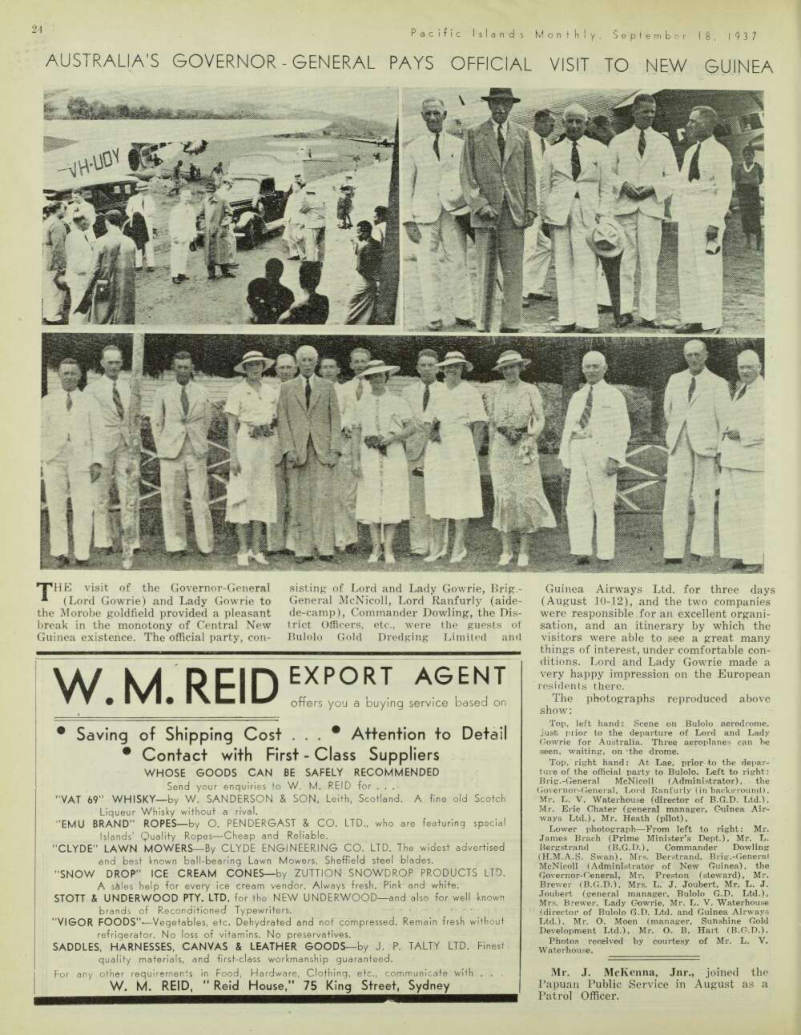
visit of the Governor-General * (Lord Gowrie) and Lady Gowrie to the Morobe goldfield provided a pleasant break in the monotony of Central New Guinea existence. The official party, con
sisting of Lord and Lady Gowrie, Brig.- General McNicoll, Lord Ranfurly (aide de-camp), Commander Dowling, the Dis trict Officers, etc,, were the guests of Bulolo Gold Dredging Limited and
Guinea Airways Ltd. for three days
(August 10-12), and the two companies
were responsible for an excellent organi sation, and an itinerary by which the visitors were able to see a great many things of interest, under comfortable con ditions. Lord and Lady Gowrie made a
very happy impression on the European
residents there.
The photographs reproduced above
show: Top, left hand: Scene on Bulolo aerodrome, just prior to the departure of Lord and Lady Cowrie for Australia. Three aeroplanes can be seen, waiting, on "the drome.
Top, right hand; At Lae, prior to the depar ture of the official party to Bulolo. Left to right: Brig.-General McNicoll (Administrator), the Governor-General, Lord Ranfurly (in background), Mr. L. V. Waterhouse (director of B.G.D. Ltd.).
Mr. Eric Chater (general manager, Guinea Air ways Ltd.), Mr. Heath (pilot).
Lower photograph—Prom left to right: Mr.
James Brach (Prime Minister’s Dept.), Mr. L.
Bergstrand (8.G.D.), Commander Dowling (H.M.A.S. Swan), Mrs. Berstrand, Brig.-General McNicoll (Administrator of New Guinea), the Governor-General, Mr, Preston (steward), Mr.
Brewer (8.G.D.), Mrs. L. J. Joubert, Mr, L. J.
Joubert (general manager, Bulolo G.D. Ltd.), Mrs. Brewer, Lady Gowrie, Mr. L. V. Waterhouse (director of Bulolo G.D. Ltd. and Guinea Airways Ltd.), Mr. O. Moen (manager. Sunshine Gold Development Ltd.), Mr. O. B. Hart (B.G'.D.).
Photos received by courtesy of Mr. L. V.
Waterhouse.
Mr. J. McKenna, Jnr., joined the
Papuan Public Service in August as a Patrol Officer.
Advertisements & other items, p. 26 (1 item)
W M Reid Export Agent
* » mmm I offers you a buying service based on • Saving of Shipping Cost . . . Attention to Detail • Contact with First - Class Suppliers
WHOSE GOODS CAN BE SAFELY RECOMMENDED
Send your enquiries to W. M. REID for ...
"VAT 69" WHISKY— by W. SANDERSON & SON, Leith. Scotland. A fine old Scotch Liqueur Whisky without a rival.
"EMU BRAND" ROPES —by O. PENDERGAST & CO. LTD., who are featuring special Islands' Quality Ropes—Cheap and Reliable.
"CLYDE" LAWN MOWERS— By CLYDE ENGINEERING CO. LTD. The widest advertised and best known ball-bearing Lawn Mowers, Sheffield steel blades.
"SNOW DROP" ICE CREAM CONES— by ZUTTION SNOWDROP PRODUCTS LTD.
A sales help for every ice cream vendor. Always fresh. Pink and white.
STOTT & UNDERWOOD PTY. LTD. for the NEW UNDERWOOD—and also for well known brands of Reconditioned Typewriters.
"VIGOR FOODS"- —Vegetables, etc. Dehydrated and not compressed. Remain fresh without refrigerator. No loss of vitamins. No preservatives.
SADDLES. HARNESSES, CANVAS & LEATHER GOODS— by J. P. TALTY LTD. Finest quality materials, and first-class workmanship guaranteed.
For any other requirements in Food, Hardware, Clothing, etc., communicate with . .
W. M. REID, "Reid House," 75 King Street, Sydney
"Olo0Ists"
A Broadside At The
Letter to the Editor.
WHILE we quiver with the sympathy of a broad and deep understanding, we fear that your correspondent “Edu cationalist of 20 Years’ Standing” (June P.1.M.) has navigated, as yet, only the shallow waters of his sea of trouble and will have need to gird his loins against the tribulations of the wrath to come; for the anthropologists are advancing in serried ranks on the defenceless shores of New Guinea.
We know what is in store for the in digenes of Melanesia. Our long-suffering natives have been for years pinned as specimens on laboratory tables. Their heads have been clamped in calipers; their noses tweaked and measured; the locks of their hair scissored; the inti mate relationships of their family life peered into; and the skulls and bones of their ancestors ravished from burial caves.
Distressing as this may be, it is, never theless, mild compared with the deso lation following a visitation of ornitho logists. The anthropologist spares the victim’s life; the ornithologist leaves in his wake a soundless, melancholy wilder ness.
One of these gentry went through Poly nesia after the manner of the Black Death through Europe during the Middle Ages. He had with him a pack of hench men who were crack shots. Together they slaughtered thousands of the already decimated native birds. Many species never recovered from ’ his massacre and are now extinct.
Neither the ornithologist nor the mus eum which sent him gained any new knowledge through this indiscriminate devastation. All of the birds had been described, pictured, and given Latin names generations before.
Why is this sort of thing permitted?
W© presume, because to the mentality of the modern world the term “Science” has become the omniflc word.
Any ukase sealed with the rubber stamp of “Science” (be it pseudo or gen uine) has the same paralysing effect on the intellect as did a Papal Bull in the 10th century or an Imperial Edict of Augustus Caesar in the days of the Roman Empire: officials, patricians, burg hers, and commoners tremble and obey!
I am, etc.,
Pro Bono Publico
Raiatea, Fr. Oceania.
August 4, 1937.
Demand For N. Caledonian
Nickel
IT is reported that the world’s nickel interests are seeking to make arrange ments for the purchase of large quanti ties of nickel in New Caledonia.
Mr. W. H. Caporn, formerly of Noumea but who now lives in Australia where he is a merchant buyer of metals, minerals, and iron ores, visited New Caledonia last year and he returned early this year to the French colony with Mr. Cunnyham Dunlop, an engineer attached to a Cana dian armaments firm. They are interested in the low 3 to 5 per cent nickel ore and are endeavouring to arrange for the pur chase of a large amount of ore. Mr.
Caporn has entered into negotiations with the owners of several mines.
Between now and 1938 the world’s nickel interests hope to buy 200,000 tons of New Caledonian ore.
The engagement has been announced of Irmgard Hermine, elder daughter of Dr. and Mrs. Kroening, of Toboroi Estate, Kieta, New Guinea, and Mr. James Mur ray Joyes, of Iwi Plantation, Bougain
ville, T.N.G.
Right Rev. John Manwaring Steward, 8.A., who was Bishop of Melanesia from 1919 to 1928, is at present seriously ill in England. An Oxonian, he served faithfully with the Mission in the South Seas for 26 years before retiring to live in Sussex.
Mr. E. Kenyon, a representative of Messrs. Lewis Berger & Sons (Aust.) Pty. Ltd.,' paint manufacturers, will leave Sydney by the Macdhui in October on a business trip to Papua and New Guinea.
Advertisements & other items, p. 27 (1 item)
Mother
FEEDS GIRL
WELL!
Why isn’t she strong ?
HEN baby was born, my one thought was to make her strong and healthy. But now that she is six she isn’t half as bonny as my friend’s little girl, who is only a month or so older. My friend gives her child Scott’s Emulsion in winter, but I give my child a cod liver oil preparation, too,” writes a mother.
Vhat a bitter worry this must be for a mother ! It all goes back to the fact that children especially have a delrate digestion.
A famous Medical Res :arch Body working in London has recently confirmed that it maices a big difference to a-child's health which kind of winter tonic mothers give.
“ Because,” states this Research Body.
“ only when cod liver oil is given in the white creamy form of Scott’s Emulsion can children digest it properly and get all the goodness out of it.”
Mothers who go into the chemist’s shop to buy a protectiveand body-building tonic this winter should ask themselves, “Am I buying the kind my child can digest ? ” In Scon’s Emulsion every drop of oil is finely divided to form a white digestible cream. 30 minutes after a spoonful has been swallowed every drop has gone to strengthen your child’s chest. At once she begins to build up a resistance to winter illness such as she has never had before.
Within two or three weeks you’ll notice an amazing difference in your child. She’ll put on weight, grow sturdy, rosy-cheeked and free from coughs and colds.
Start your child on Scott’s Emulsion from to-day and watch her go through the winter much better than other children.
But see that it is SCOTT’S Emulsion.
11
ANCHOR" FLOUR
THE STANDARD OF QUALITY
-jr * m ■ m
GILLESPIE BROS., LTD
SYDNEY - AUSTRALIA
A Dog-Lover's Nightmare
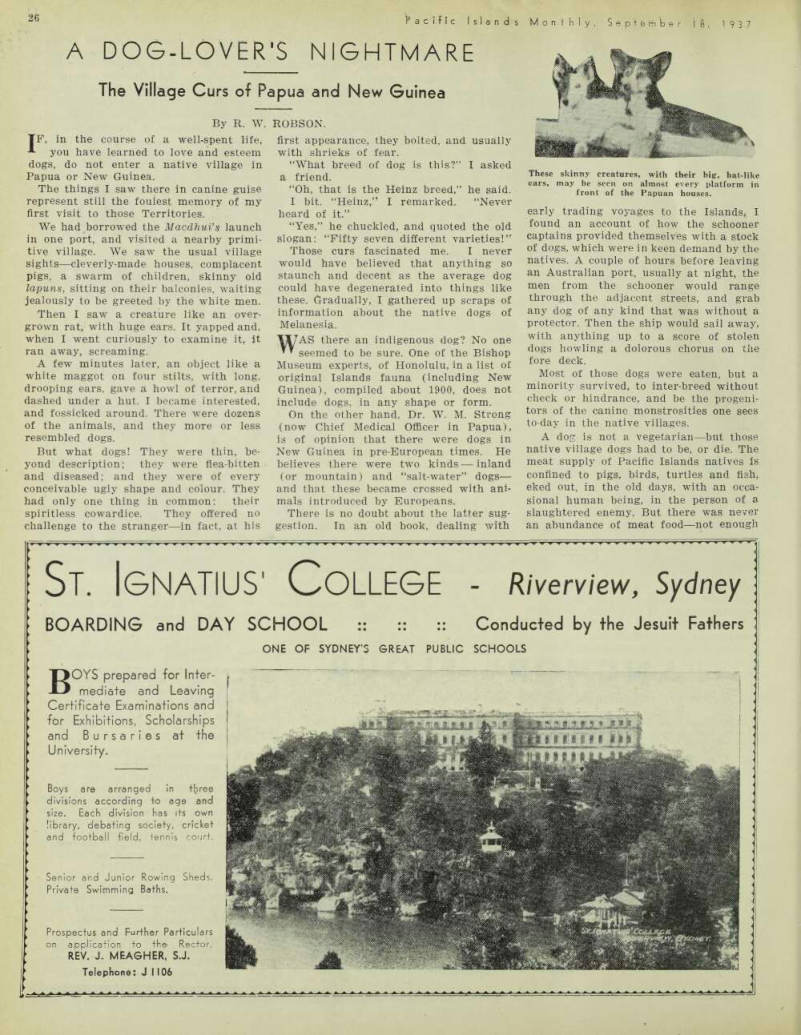

The Village Curs of Papua and New Guinea
By R. W. Robson.
TF, in the course of a well-spent life, * you have learned to love and esteem dogs, do not enter a native village in Papua or New Guinea.
The things I saw there in canine guise represent still the foulest memory of my first visit to those Territories.
We had borrowed the MacdhuVs launch in one port, and visited a nearby primi tive village. We saw the usual village sights—cleverly-made houses, complacent pigs, a swarm of children, skinny old lapuns, sitting on their balconies, waiting jealously to be greeted by the white men.
Then I saw a creature like an over grown rat, with huge ears. It yapped and, when I went curiously to examine it, it ran away, screaming.
A few minutes later, an object like a white maggot on four stilts, with long, drooping ears, gave a howl of terror, and dashed under a hut. I became interested, and fossicked around. There were dozens of the animals, and they more or less resembled dogs.
But what dogs! They were thin, be yond description; they were flea-bitten and diseased; and they were of every conceivable ugly shape and colour. They had only one thing in common: their spiritless cowardice. They offered no challenge to the stranger—in fact, at his
first appearance, they bolted, and usually with shrieks of fear, “What breed of dog is this?” I asked a friend.
“Oh, that is the Heinz breed,” he said.
I bit. “Heinz,” I remarked. “Never heard of it.”
“Yes,” he chuckled, and quoted the old slogan: “Fifty seven different varieties!”
Those curs fascinated me. I never would have believed that anything so staunch and decent as the average dog could have degenerated into things like these. Gradually, I gathered up scraps of information about the native dogs of Melanesia.
VI7AS there an indigenous dog? No one seemed to be sure. One of the Bishop Museum experts, of Honolulu, in a list of original Islands fauna (including New Guinea), compiled about 1900, does not include dogs, in any shape or form.
On the other hand, Dr. W. M. Strong (now Chief Medical Officer in Papua), is of opinion that there were dogs in New Guinea in pre-European times. He believes there were two kinds inland (or mountain) and “salt-water” dogs— and that these became crossed with ani mals introduced by Europeans.
There is no doubt about the latter sug gestion. In an old book, dealing with
early trading voyages to the Islands, I found an account of how the schooner captains provided themselves with a stock of dogs, which were in keen demand by the natives. A couple of hours before leaving an Australian port, usually at night, the men from the schooner would range through the adjacent streets, and grab any dog of any kind that was without a protector. Then the ship would sail away, with anything up to a score of stolen dogs howling a dolorous chorus on the fore deck.
Most of those dogs were eaten, but a minority survived, to inter-breed without check or hindrance, and be the progeni tors of the canine monstrosities one sees to-day in the native villages.
A dog is not a vegetarian—but those native village dogs had to be, or die. The meat supply of Pacific Islands natives is confined to pigs, birds, turtles and fish, eked out, in the old days, with an occa sional human being, in the person of a slaughtered enemy. But there was never an abundance of meat food—not enough
These skinny creatures, with their big, bat-like ears, may be seen on almost every platform in front of the Papuan houses.
for dogs—and so the dogs made out as best they could on rubbish, and scraps of taro, coconut, etc. Is it surprising that, within a few generations, unregulated breeding, lack of care and a vegetable diet produced a species of animal that has to be seen to be believed?
A peculiar thing is that these village curs seem to realise that they are a disgrace to dogdom—they display a kind of inferiority complex. Real dogs know it, too. God help the curs when they meet a white man’s dog!
IN the Territories, a white man’s social status often is indicated by his dog.
Islands residents import the best animals that their money can buy; and these fine fellows —fox and Irish terriers, Aire dailes, Alsatians, setters, Scotties, bull dogs, for the most part—bear themselves right cockily. They know that they count for something in a world where racial and social values are closely calculated.
The white man’s dog is respectful to all white men; but he only tolerates natives. He bears with the native ser vant, though the effort is obvious; and one actually can see him waiting pati ently for the day when circumstances will justify him in biting four square inches out of a black calf. The native, who treats the village mongrels with dis dain, walks warily always in the pre sence of “dog belong white master.” For that reason, these imported animals are almost priceless as watchdogs. The ever prowling natives give a wide berth to the house where a good dog is on duty.
Hundreds of Europeans out in the jungle—patrol officers, prospectors, re
cruiters, traders —have dogs as their most trusted and loyal companions. Rarely, if ever, do they “go native.” There ipay be a hundred natives in the party, some ot them good men and dog-lovers; but the dog acknowledges only one friend and master—the lone white man —and he will protect him with his life.
THE better the white man’s dog, the more ready is he tp massacre the native cur, wherever and whenever he meets h.m. Many times, in New Guinea, I have been startled by a sudden outburst of frightful noise—screams of terror and shrieks of pain—and across my field of vision would come a native dog, literally going for its life, with an eager and relentless European dog in murderous pursuit. No mercy is given, or expected.
The real dog seems to think there is upon him a duty to exterminate his disgraceful flea-ridden relations from the villages.
There is a third class of dog in New Guinea—“dog belong Kong.” The China man’s dog seems to have a half-way place in the canine social scale. The European’s dog will have nothing to do with either the “Kong’s” dog or the village cur. But the Chinaman’s dog, while giving the European dog a wide berth, will pursue the native’s dog with the same male volent fury.
The hand of every man, and the teeth of every real dog, are turned against the village mongrel. And he knows it.
Some of the curs that “grace” Papuan and New Guinea villages.
Advertisements & other items, pp. 28-29 (1 item)
St. Ignatius 1 College - Rivemew, Sydney
BOARDING and DAY SCHOOL
Conducted by the Jesuit Fathers
BOYS prepared for Inter-
mediate and Leaving Certificate Examinations and
for Exhibitions, Scholarships
and Bursaries at the
University.
Boys are arranged In tljree divisions according to age and size. Each division has its own library, debating society, cricket and football field, tennis court.
Senior and Junior Rowing Sheds.
Private Swimming Baths.
Prospectus and Further Particulars on application to the Rector,
REV. J. MEAGHER, SJ.
Telephone: J 1106
ONE OF SYDNEY’S GREAT PUBLIC SCHOOLS
ss&ul
yi i
m .
I i! m ■
Ifc
A!'. m wm M 23 .. . v 71 .. $ i m
REG D
% 3r Stylish Comfortable and Faithfully Made from Tested Materials
"TOP DOC"
Clothing, Hats, Shirts, Pyjamas, Mercery Hosiery and Knitted Goods will give full satisfaction They Look Well and They Wear Well
EVERY GARMENT GUARANTEED
CAPSTAN
CIGARETTES
CORK-TIPPED
OR PLA I N
tip*:
tMr.
CAPSTAN
NAVY CUT TOBACCO
m/idef'um the (fittest
Vi/ufumn,
Cruise
Modern Munchausen on a Cruise
From Our Own Correspondent.
Papeete, Aug. 10.
The small yacht Mundiamo, of Los * Angeles, arrived at Papeete late in July, after several weeks of cruising among the Marquesas and Tuamotu Is lands.
We enquired how the captain managed to navigate through the dangerous Tua motus—especially at night—without land ing his boat on one of the many coral reefs of that treacherous archipelago. He replied that his yacht was equipped with hydraulic brakes. All he had to do when night came w T as to lock the brake lever
and the ship stayed in one place until it became light enough to see his sur roundings!
We did not pursue our inquiries. Rut we can foresee in the newspapers of the United States a stirring epic of the sea: of nereids and giant octopii, of submar ine volcanoes and waterspouts, of cor* sairs and cannibals, when the Mundiamo drops anchor once more in her home port.
To acquire lands, buildings, machinery, and rubber plants held by Tropical Pro ducts Pty. Ltd., Mariboi (Papua) Rubber Estates Limited was registered in Sydney in August with a capital of £50,000. Head office is in Port Moresby, Papua, and the N.S.W. agent is Mr. P. J. Egan, 60 Hun ter Street, Sydney.
"Officialdom"
Madang As Capital
Of New Guinea
Residents Fearful of Rabaul "Officialdom"
From Our Own Correspondent
T Madang. Aug. 1.
HE possibility of Madang being made the capital of New Guinea does not meet with the complete approval of local people. It seems to be the general hope of everybody in the district that the Administration will look elsewhere for a suitable seat of Government, despite the benefits gained by having the Admini strative centre here.
The main reason for this opposition to the so-called “elevation” of Madang is undoubtedly the dread of Rabaul “official dom,” and the introduction of Rabaul methods in dealing with natives and native labour. It is not necessary here to expound what a curse this can be!
Should the Administration decide to make Madang their headquarters, it will be necessary for planters and others in this district to have the Administrator explain fully the Government’s policy in regard to the administration of natives and native labour. At present we are enjoying a regime which, although slightly inclined towards the native, has proved quite satisfactory to all concerned.
Nothing would be gained in any way by the Administration introducing a “pam pering policy.”
However, Madang residents are of opinion that the Administration will fol low where the “big firms” go, and, there fore, they cannot do better than watch their movements.
Bishop Museum Scientists
In Fiji
From Our Own Correspondent.
Honolulu, Aug. 11.
T\R PETER H. BUCK, head of the Bishop Museum, Honolulu, announces that Dr. Harold St. John (botanist) and Dr. Joseph Manson Valentine (entomo logist) will continue with their research work for the Museum in Fiji for at least two more months.
Dr. Valentine, a Bishop Museum Yale Fellow, has just joined the Museum’s active staff for two years. While he will make a general collection of Fijian in sects, he will specialise in studying ‘the Carabids (beetles) of the interior of Viti Levu.
Dr. Buck, incidentally, is considering taking a vacation soon in the Tongan Islands. The Museum has a vast collec tion of Tongan exhibits which he is anxi ous to identify more accuately.
Mr. B. W. Collins, B.Sc., a New Zea-> land geologist, and Mr. M. Ongley, M.Sc., surveyor, sailed from Sydney for
Madang, New Guinea, by the Macdhui
on August 28 to join the staff of Islands Exploration Limited.
Advertisements & other items, p. 30 (1 item)
J. J. Sullivan Ltd.
Sullivan's Buildings
168 -174 SUSSEX STREET, SYDNEY, N.S.W.
Cable and Telegraphic Address: “SULLGREN,” Sydney.
GEN ERAL MERCHA NTS IMPORTERS
EXPORTERS SHIPPERS
ALL COMMODITIES HANDLED
Best Roller Fiour . . . Best Biscuit Flour
HIGHEST GRADE "CORAL" BRAND SHARPS
" Pony" Brand Oats* Dried Fruits, Prunes, Sultanas, etc.
Canned Meats . . . Canned Fruits Jams, etc. • PROMPT ATTENTION TO CABLE AND MAIL ENQUIRIES. WHICH
ARE APPRECIATED
Telephone: M 6268 (3 lines)
READ THE
B.P. MAGAZINE
SPRING NUMBER
NOW ON SALE
Short Stories Pictures Travel Articles Pages for the Children Stage Latest Fashions Screen A
ONE SHILLING PER COPY
ON SALE AT ALL NEWSAGENTS AND BOOKSELLERS » BP
Early Tahiti Records
How The Documents Were Discovered
Letter to the Editor THE century-old British Consulate papers relating to early Tahiti, which were discovered recently in Papeete, have been placed in the Mitchell Library, Sydney. The facts of the unearthing of these records may now be made clear.
In research work concerning old-time Tahiti, I had need of securing the name of the first British Consul. Not finding it generally known by the educated of Papeete, I naturally went to the then British Consul, Dr. W. J. Williams. He was entirely ignorant of the name, but said, “I have a large collection of old time papers and correspondence here which I have never looked into, not being particularly interested in the past.
You are very welcome to peruse them at your leisure.”
The huge pile was mine, and besides promptly securing the name I sought, a veritable mine of valuable information for my purpose was available to me.
Not being selfish over such treasure trove, I told many local friends of my “find.” When Mr. Eric Ramsden, of Sydney, came upon the scene, keen for all possible information re Tahiti, both past and present, I was only too ready to let him know the wonderful discovery I had casually and all ignorantly made.
He communicated the “find” to his friends at the Mitchell Library, who sent their head librarian (Miss I. Leeson) for inspection.
As the result, through the exceptional kindness of the Foreign Office, the pre sent British Consul (Mr. Garton) for warded the papers to Australia.
Instead of the documents “rusting” away, unknown even to those at Home, it has been my fortunate chance to secure them for the general public. No thanks are due to me: I have had fullest reward in securing the one name I sought: the rest was unexpected and represents over flowing riches for me and others inter ested in the past of the island.
The papers start from Charlton’s ap pointment as Consul in 1825.
I am, etc..
W. W. Bolton. M.A.
Papeete. Tahiti, 4/8/37.
Captain and Mrs. Suffern left Sydney by the Hauraki for Tahiti in August, after spending several months’ holiday in Victoria. Their home is on Makatea Island in the Tuamotu Archipelago, where Captain Suffern is employed by the Compagne Francaise des Phosphates de POceanie.
Mr. E. Taylor, District Officer at Sala maua, New Guinea, was formally pre sented with the M.B.E. (Membership of the Order of the British Empire) by the Australian Governor - General (Lord Gowrie) on August 10. Mr. Taylor is one of the best known and most highly esteemed officials in New Guinea.
“Tin Can” Mail In Hawaii
From Our Own Correspondent.
Honolulu, Aug. 13.
•THE bright idea of Niuafoou’s “Tin *• Can” mail system this week bore excellent fruit when a local Japanese fishing sampan, off the coast from Hono lulu, was suddenly approached by the German freighter Friesland, tooting shrilly upon her siren.
Nearing the sampan, the Friesland’s crew tossed a large tin can into the sea and by signs urged the Japanese to pick it up. This the Japanese did, and on the can found printed; “Please send! this letter box to the post office in Honolulu.”
The Japanese waved that they would, and the Friesland happily tooted in grati
tude and sped away to her destination.
Opened by U.S. post office officials, the can contained 24 letters, 18 postcards and two dollars in currency, more than enough to pay postage on the mail to its destinations in Germany. No note was enclosed in the can explaining the un usual method of mailing. The Germans took everything for granted.
Mr. Frederick Midson, who lived in Fiji for nearly 30 years, died at Narra been, Sydney, on August 26, aged 72.
Settling in the Colony in 1902, he joined the Department of Public Works and was foreman until he retired in 1931. He is survived by Mrs. Midson and a son, Mr.
John Midson, of the Electricity Depart ment, Suva.
Advertisements & other items, p. 31 (1 item)
Sheep Tongues
You just try delicious
W '
Served these 3 new ways...
orned
LOAF
BEEF
Ozs • SHEEP TONGUE SHAPE.—Turn out a can of Imperial Sheep Tongues and slice thinly, arrange in a prepared mould; then pour over them hot stoclc, flavoured with salt and pepper. Allow to set, turn out and garnish with slices of beetroot and cucumber or shredded lettuce and parsley.
• DEVILLED SHEEP TONGUES.—Bread
crumb Imperial Sheep Tongues, then fry brown, make a sauce with a little stoclc or milk, add I tablespoonful each of catsup, tomato sauce, Worcestershire sauce and mixed pickles cut small; stew 5 minutes.
Heat Ton gues through in sauce and serve.
• SHEEP TONGUE COMPLETE.—Mince
Imperial Sheep Tongues, fry for 2 or 3 minutes in a little butter; beat in the yolks of 6 eggs with a little pepper and salt, then stir In the Tongue. Pour into an omelette pan and stir till it thickens, then fold In edges; brown nicely and serve as soon as possible.
Try it To-day:
Imperial CRUSTLESS CHEDDAR CHEESE
A delicious crustless cheese with the real old time cheddar flavour. It makes a nourishing I lunch * or children and gives added piquancy to egg dishes, salads and macaroni.
Buy Imperial Foods Today Eat Imperially Tonight Products of W. ANGLISS & Co. (Aust.) Pty. Ltd., 5-7 O'Connell Street. SYDNEY
“Deluged With Lava”
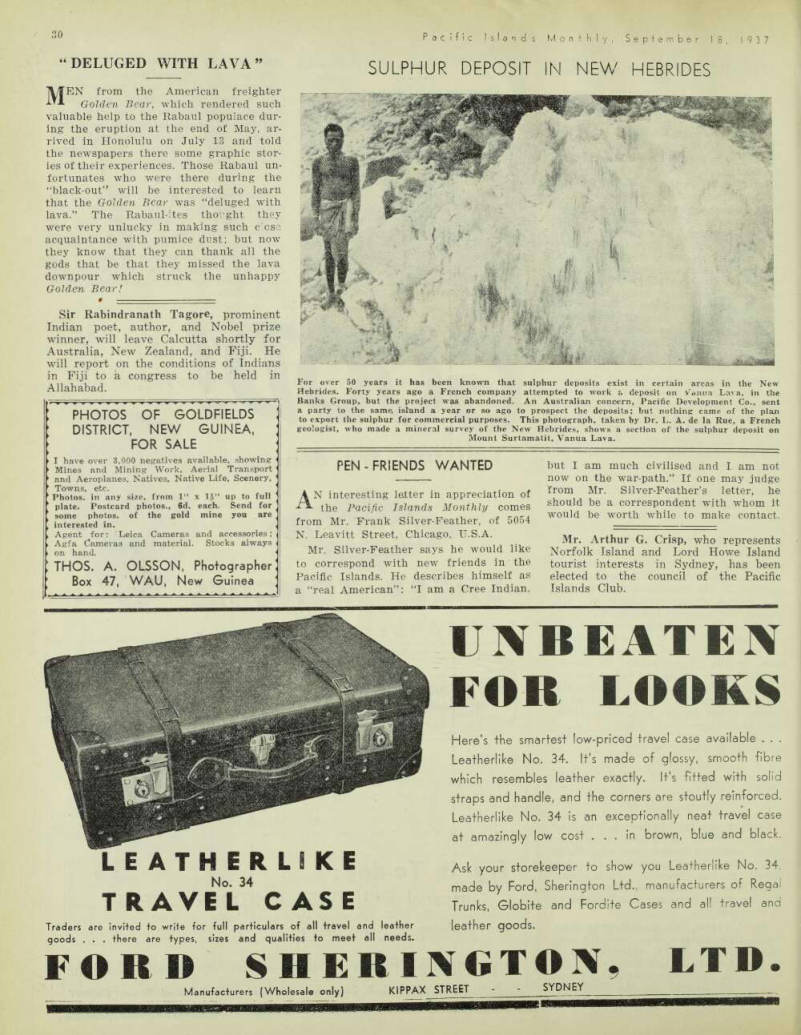
TVTBN from the American freighter Golden Bear, which rendered such valuable help to the Rabaul populace dur ing the eruption at the end of May, ar rived in Honolulu on July 13 and told the newspapers there some graphic stor ies of their experiences. Those Rabaul un fortunates who were there during the “black-out” will be interested to learn that the Golden Bear was “deluged with lava.” The Rabaul-ites tho-ght they were very unlucky in making such c ose acquaintance with pumice dust; but now they know that they can thank all the gods that be that they missed the lava downpour which struck the unhappy Golden Bear! Sir Rabindranath Tagore, prominent Indian poet, author, and Nobel prize winner, will leave Calcutta shortly for Australia, New Zealand, and Fiji. He will report on the conditions of Indians in Fiji to a congress to be held in Allahabad.
Sulphur Deposit In New Hebrides
For over 50 years it has been known that sulphur deposits exist in certain areas in the New Hebrides. Forty years ago a French company attempted to work a deposit on Vanua Lava, in the Banks Group, but the project was abandoned. An Australian concern. Pacific Development Co., sent a party to the same, island a year or so ago to prospect the deposits; but nothing came of the plan to export the sulphur for commercial purposes. This photograph, taken by Dr. L. A. de la Rue, a French geologist, who made a mineral survey of the New Hebrides, shows a section of the sulphur deposit on Mount Surtamatit, Yanua Lava.
Pen-Friends Wanted
AN interesting letter in appreciation of the Pacific Islands Monthly comes from Mr. Frank Silver-Feather, of 5054 N. Leavitt Street, Chicago, U.S.A.
Mr. Silver-Feather says he would like to correspond with new friends in the Pacific Islands. He describes himself as a “real American”: “I am a Cree Indian,
but I am much civilised and I am not now on the war-path.” If one may judge from Mr. Silver-Feather’s letter, he should be a correspondent with whom it would be worth while to make contact.
Mr. Arthur G. Crisp, who represents Norfolk Island and Lord Howe Island tourist interests in Sydney, has been elected to the council of the Pacific Islands Club.
Advertisements & other items, p. 32 (2 items)
THOS. A. OLSSON, Photographer
PHOTOS OF GOLDFIELDS
DISTRICT, NEW GUINEA,
FOR SALE
I have over 3,000 negatives available, showing Mines and Mining Work. Aerial Transport and Aeroplanes, Natives, Native Life, Scenery, Towns, etc.
Photos, in any size, from 1" x IX" up to full plate. Postcard photos., 6d. each. Send for some photos, of the gold mine you are interested in.
Agent for; Leica Cameras and accessories; Agfa Cameras and material. Stocks always on hand.
THOS. A. OLSSON, Photographer
Box 47, WAU, New Guinea
Unbeaten
ra m
LEATHERLIKE
No. 34
TRAVEL CASE
Traders are invited to write for full particulars of all travel and leather goods . . . there are types, sizes and qualities to meet all needs.
UNBEATEN
FOB LOOKS
Here's the smartest low-priced travel case available . . .
Leatherlike No. 34. It's made of glossy, smooth fibre which resembles leather exactly. It's fitted with solid straps and handle, and the corners are stoutly reinforced.
Leatherlike No. 34 is an exceptionally neat travel case at amazingly low cost ... In brown, blue and black.
Ask your storekeeper to show you Leatherlike No. 34, made by Ford, Sherlngton Ltd., manufacturers of Regal Trunks, Globite and Fordite Cases and all travel and
leather goods.
FORD SHERINGTON, LTD.
Manufacturers (Wholesale only) KIPPAX STREET
SYDNEY
Primitive Intelligence
A BOOK that should be read by every person interested in race relations has just been published (at 12/6) by the Macmillan Company of New York • Primitive Intelligence and Environment, by Dr. Stanley D. Porteus, Victorian-born psychologist at the University of Hawaii, who formerly was with the Victorian Education Department and on the staff of the Melbourne University.
Dr. Porteus’s book, in comparing the aboriginals of Central Australia with the bushmen of the Kalahari desert of South Africa, soundly refutes the notion that the Australian aboriginals are the lowest ol mankind. He concludes that on one count only did the bushmen excel, and that is ir* their remarkable skill in rock painting. In knowledge and use of their environment they are adjudged the equals of the Australians, but asl regards social organisation and tested intelli gence, the bushmen are hopelessly be hind.
The material upon which the book is based was collected by Dr. Porteus dur ing a . field expedition in 1929 to the interior of Australia undertaken at the invitation of the Australian National Re search Council, supplemented by a simi lar excursion to the Kalahari desert in 1934, backed by the Carnegie Corporation of New York. Psychology of a Primitive People, in which Dr. Porteus described the life and tribal customs of the abori gines, in November, 1931, was chosen as the book of the month by the American Scientific Book Club, and the c'ub again has honoured Dr. Porteus by voting his latest book the July, 1937, book of the month.
Throughout the new book Dr. Porteus keeps admirable poise. He happily i* not impaled on either horn of the opposing propositions that people are made what they are by the place where they live, or that they live where they do because that is the kind of people they are.
Nor does he mistake racial differences for racial inequalities, though inequali
ties, too, may exist.
John Williams.
Notes From Wau
From Our Own Correspondent WAU, Aug. 19.
TV/fR. KEVIN PARER, a well known N.G. pilot, who until recently was flying for Mandated Airlines Ltd., has entered commercial flying at Wewak on his own behalf, with a new Fox Moth.
This is a further indication that business prospects at Wewak are promising.
Although the frequent sight of several mules being chased off the Wau aero drome by a Ford machine is a comical one, it is not without its serious side, too.
Proper precautions should be taken to prevent the access of animals to the ’drome. The danger to pilots of such a state of affairs needs no elaborating.
The wedding of Miss Eileen Owens to
Mr. Austin Ireland was a popular one in Wau. The marriage ceremony took place at St. Augustine’s Church of England, Wau, on August 7, and was solemnised by Rev. V. H. Sherwin. The bride and bridegroom are both well known in Wau district ,the former having been a Sister at the Wau European Hospital for some years, Mrs. Maclean, of Rabaul, is at present residing in Wau. Her son, Mr. Colin Mac lean, is now on the Administration staff here.
Oil Search In N. Guinea
A CONSIDERABLE number of young New Zealanders have been selected by Islands Exploration Limited for their oil search staff in Papua and New Guinea.
Within the past two months the company have gone to New Zealand for five geolo gists and four surveyors. Some of these young men left by the Macdhui on Aug ust 28 for Madang, in which area Islands Exploration Limited are developing con siderable activity.
Advertisements & other items, p. 33 (1 item)
Pai H's
MASTER
(\e*££fSi
POWDERS &
TABLETS
1/6 AND 2/6.
SINGLES 2d. ea.
STOPS SAFELY
HEADACHE
FLU & COLDS
RHEUMATISM
NEURALGIA
SCIATICA
NEURITIS
LUMBAGO
AND ALL NERVE AND
MUSCULAR PAINS
Reduce temperature and relieve feverishness with Vincent’s A.P.C. It diminishes the likelihood of complications and leaves no after effects. Doctors recommend it because it is prepared on the scientific hospital formula and has stood the test of experience for over 18 years. Keep a packet of Vincent’s A.P.C. always at hand.
FOR SAFETY'S SAKE, SAY " VINCENT'S A. P.C.'
o w I \ //
THE MOST DELIGHTFUL
getle
ij
Thomas Lewis' Death In Tahiti
in 1799
Letter to the Editor Vl/HILE we do not take issue with your ** correspondent “Fiame,” ( P.1.M. , June 23, 1937), as to the Christian virtues of Thomas Lewis, we find he has followed William Ellis in the latter’s error in regard to the date of Lewis’ death. The date, November 22, 1799, in the Polynes ian Researches , is a printer’s error or careless proof-reading on Ellis’ part.
Ellis is incorrect in other p aces: e.g he says the graves are on the “north side of Matavai Bay”—the north side of Matavai Bay is the Pacific Ocean. Ellis also states that the first chapel was raised on “March 5, 1797”; which date was, of course, the date of the Duff's arrival at Tahiti.
From the Journal or daily diary writ
ten by Jefferson (published under the title Transactions , Vol. 1, 1795 —1802) the following is the entry for the date Nov ember 22, 1799, showing that Lewis was very much alive: “Mr. Lewis came to Brother Eyre’s to grind a number of axes.” It gives the day of Lewis’ death (November 27) as follows: “November 28, 1799: Early this morning a man ar rived from Ananoo to Pitea, the deputy chief, to inform him that Mr. Lewis died about sunset last evening.” The burial took place on the 29th.
The L.M.S. bound volume, Register of M'ssionaries, etc. (1796 —1896), giving details of each of its 926 men sent out, puts the date of Lewis’ death as Novem ber 27.
The memorial stone reads correctly.
I am, etc.,
A. C. Rowland.
Papeete, Tahiti. 28/7/1937/
Gold Royalty
For Papua
Bill Passed at Legislative Council’s Annual Session
From Our Own Correspondent
Pt. Moresby, Aug. 20.
’T'HE Legislative Council of Papua com- A menced its annual sittings on Aug. 9.
In the absence of Sir Hubert Murray (due to an accident to his eye), the Government Secretary (Hon. H. W.
Champion) presided until the following week when the Governor, having suffi ciently recovered, took the Chair.
Members present were Hons. W. M.
Strong, H. L. Murray, J. T. O’Malley, E.
C. Harris, J. G. Nelsson, A. Jewell, T.
Nevitt, and Rev. R. L. Turner.
Among the various bills introduced during the session, a measure relating to Customs duties caused some surprise.
It provides for the imposition of a royalty up to five per cent ad valorem on all gold won from the Territory, at such rate as the Governor may from time to time proclaim. The royalty will come into force on a date to be fixed by the Administrator.
In reply to objections to the imposition of a gold royalty, it was pointed out that royalties are imposed in nearly every gold producing country in the world. Amend ments to the bill were not discussed, and it passed all stages and was assented to.
Public Servants’ Investments
Before the Supplementary Estimates for the past year and the Estimates for 1937-8 were presented and discussed, a bill was introduced to limit investment by public servants in companies carrying on business in the territory. It states that no officer, without permission in writing from the Governor, may directly or indirectly hold shares or other pecuni ary interest in any public company in Papua. Shares held in the name of an officer’s wife shall be deemed indirectly to be held by him. Officers contravening the provisions of this Ordinance are liable to suspension.
Port Moresby Water Supply
In regard to the question of a water supply for Port Moresby, the Council was informed that His Excellency had already communicated with Canberra re newing the application for a loan. No answer had as yet been received to this request.
A bill to amend the Petroleum (Min ing) Ordinance was also passed. It deals with purely technical and formal amend ments.
Mr. A. J. Strathearn, of the Supreme Court, Rabaul, New Guinea, arrived in Sydney by the August Malaita on his way to South Australia to spend two
months’ holiday.
Mr. G. H. Massey-Baker, of Kerema, Papua, who has been in Port Moresby Hospital for some time, arrived in Aus tralia by the Marella in mid-August to undergo medical treatment.
Advertisements & other items, p. 34 (2 items)
32
Pacific Islands Mon + h'ly, September 13, 1937
"Fairholme"
PRODUCING UNIFORM GOOD RESULTS SINCE 1868
ALWAYS ASK FOR IT
A Mountain School for Giri:
m m Dormitory Wing
PRESBYTERIAN GIRLS' COLLEGE
Toowoomba, CP'land. 2,000 feet above sea level :: Unrivalled Climate
ACADEMIC HOME SCIENCE AND COMMERCIAL COURSES
Tennis :: Swimming :: Organised Games
PRINCIPAL: MISS D. E. CULPIN, B.A.
For Prospectus, apply to Secretary, R. T. PHELPS, F.A.A., Toowoomba
A Torrid Affair In Fiji
CAME an impatient ting-a-ling from the telephone.
It was the neighbour’s son, disturbing the peace and quietness of a glorious summer day.
“Would you people care to see a foot ball match this afternoon?”
I roused myself from the lethargy in duced by 90 degrees in the shade.
“Football match?” quoth I. “In this heat? Don’t be funny.’’
The N.S. got annoyed.
“I tell you I’m not being funny. The game is to take place on the village ra-ra at two o’clock sharp.”
“Oh yeah?” said I, knowing full well how sharp a Fijian “sharp’’ would be.
“Well we shall be there, so please calm down. You make me dizzy.”
Whereupon, in the vicinity of 1.30 pip emma, we ambled along the road to the village, where, on arrival, we were given the place of honour under a green canopy on a slight elevation.
Apparently, we were disgustingly early according to native standards. The vil lagers were still in the midst of kai-kai. judging by the evidence of bulging cheeks and masticating jaws that ap peared around the doorposts of various huts. Kai-kai. with the Fijians, is a lin gering affair.
Play commenced at 3.30 p.m. I thought it would.
The finer points of the art of football quite escaped me. but I was entertained by the antics of the players.
The ground space was rather limited — a few huts dotted the arena. Around these the players dodged in dexterous fashion. Such a trifle as a hut or two worried them not at all. In fact. I think it added spice to the game.
Occasionally, a mob would vanish al together, to stage a private tussle behind a hut, and we palpitating spectators were in an agony of doubt concerning the outcome. Spasmodic sounds of grunts, thumps, smacks, and pounding of leather were wafted out to us, until suddenly a perspiring player emerged in triumph with the ball at his toe. Loud cheers!
When the game had been in progress for half an hour and no goals to either side, Peni. of one team, and Joe, of the other, collided head-on —both seeing stars, no doubt.
Peni vowed, with flashing eyes, that Joe had done it with malice aforethought which Joe hotly denied—also with flash ing eyes.
In two ups, sparks were flying, fists were swinging and the two combatants were well on the way to a black eye apiece.
Everybody bellowed at everybody else —I almost felt like doing.my bit—and whenever the referee opened his mouth, someone almost jumped into it. So he gave up trying to speak, and wandered into a hure to console himself with a lump of taro!
The uproar continued unabated, until an old chief appeared and commanded silence. t»
With stern looks, stern words and stern gestures, he quelled them. Weren’t they ashamed of themselves, he de manded, for behaving like madmen, in front of the vava lagisf He gestured in our direction, and we tried to look suit ably horrified and disgusted.
Of course, any further thought of foot ball was banished, and the chastened warriors, with their respective teams, ad journed to the bures to discuss the up heaval.
We were still chuckling as we trod our homeward way. and I could not resist a parting shot at the neighbour’s son: “Oh; Bill, did you say ‘football’ or ‘footbrawl’?”
Amel.
Mr. E. A. Feldt, District Officer in the N.G. Administration, sailed from Bris bane with his wife by the August Mon toro.
Mr. J. Downs, at one time a sawmiller ; n Papua for several years, and who has been settled down as a trader in Bris bane for some years, has returned to the tropics as a sawmiller, in connection with the promising timber trade that is opening up in New Britain.
Advertisements & other items, pp. 35-36 (1 item)
E Ii S
Kork-N-Seal
FOR HOME USE
£3 Hand Applied Airtight Pressure Proof
FOR ALL HOME BOTTLING
—THE LITTLE CAP THAT
Wll
Re - seal 1,000 Times
KORK - N - SEAL (Aust.) LTD.
106 COMMONWEALTH STREET
SYDNEY, AUSTRALIA
We are Specialists . . .
\ Let us have your confidence. Sixty years is our record of supplying the leading Houses throughout the World in
FRESH FRUIT VEGETABLES PRODUCE
'Phones: MA 3(12 (4 lines) Cable Address: “Weymarkson’* Codes—Bentleys Private
WEYMARK & SON LTD.
FRUIT AND PRODUCE MERCHANTS
14-18 STEAMMILL STREET - . SYDNEY
1H I V
cvv
Obtainable from all Leading Grocery Stores Chivers and Sons Ltd., Hlston, Cambridge.
E. 76
E II S
PUKE
FOODS
SOLD MEDAL JAMS
CANNED ENGLISH FRUITS
CANNED ENGLISH VEGETABLES
CUSTARD POWDER
OLD ENGLISH MARMALADE
JELLY CRYSTALS, ETC.
" ‘ ‘ ■ Write to Department A., England, for attractive Recipe Boole.
Cables : "Stancarr." Tel. MA 4416
ESTABLISHED 1841
Stanley & Co.
325 SUSSEX STREET
SYDNEY
WHOLESALE & RETAIL
PRODUCE MERCHANTS
Fruiterers and Greengrocers Shipping Providers •
PACKING FOR ISLANDS TRADE
A SPECIALTY
EUROPEAN and CHINESE VEGETABLES
always available in any qua ntify.
FAVOURITE FOR
HALF A CENTURY
p OR over 60 years the biscuit par excellence where masculine taste is concerned is Arnott’s Famous Ginger Nuts.
Crisp, brown, warmly delicious in flavour and crunchy in texture, they hold pride of place as a hardy he-man’s biscuit which has never been equalled in either quality or popularity. Try some with your next order.
ARNOTTiS
FAMOUS
GINGER NUT
BISCUITS
Always ask your Grocer for Arnoff’s
“THEY ARE BETTER THAN EVER”
Old Stone Idols
How Their Removal Nearly Caused Panic in Tahiti
From Our Own Correspondent PAPEETE, Aug.lo TN the grounds of the Museum at Papeete are two ancient stone idols of colossal proportions.
They were brought—four years ago— to the Museum from the beautiful little island of Raivavae—far to the south of Tahiti and just outside the Tropic of Capricorn—where they had stood, since time out of mind, in the thick forest of the interior.
The removal of these idols from their ancient resting places stirred up the awe and terror of the old gods—always lat ent in the native mind—to an extraor dinary degree. The idols themselves were so old that no one on Raivavae, or anywhere else, had any memory as to what supernatural powers they had been dedicated.
But the natives of both Tahiti and
Raivavae remembered that Raivavae was the particular bailiwick of the fierce old sea god, Ruahatu. And to offend Ruahatu by violating the sacred precincts of his favourite island was to call down on the offenders, and all connected with them, a terrifying and fatal vengeance.
Everyone knew the legend of how two unsuspecting fishermen, casting in the depths of the ocean where Ruahatu lay sleeping, had entangled their hooks in his hair. Whereupon the awakened god had rushed to the surface and in the tempest of his anger, caused the sea to rise above the mountain tops of the neighbouring island.
When the idols were landed at Papeete, the whole native population were in a state of apprehension. Many predicted a devastating tidal wave and had their moveables packed in readiness to flee to the mountains. Their fears took sub stance when, a few days later, flashes of fire were seen issuing from the waters of the harbour. Ruahatu had come to wreak vengeance. Perhaps it would take the form of a fiery instead of watery up heaval.
Then, to cap all, the man responsible for the removal of the idols was stricken with a mysterious sickness. Alarm spread. There was serious talk of peti tioning the authorities to command the return of the idols to Raivavai.
As time passed, and no tidal wave or volcanic outburst materialised, public attention became centred on the sick man. The warlocks and wizards became convinced that if Ruahatu had not come himself, he had sent his TVi (or fetchers) to destroy the violator of his images.
Crowds of natives filed by on the public roadway, staring at the house where the sick man was.
No doubt they hoped to see the demons of Ruahatu dancing on the roof or prow ling about the garden paths. And, per haps, they brought their wizards along to mutter incantations to keep the TVi from wandering out of bounds.
However, after a time, the sick man recovered, and the prophets of doom were not a little disappointed because their prediction had failed to eventuate.
Then it transpired that the flames on the water had been caused by a pot of phosphorus and flour (a mixture used on schooners to poison insect vermin) which had been tossed overboard from some passing vessel. The phosphorus, coming in contact with sea water, had generated a gas which ignited as the bubbles burst on the surface.
That revelation put an end to the panic.
And now the idols stand on their new sites, gazing calmly over the gardens of the Museum —as they had stared for centuries through the gloomy shadows of their Raivavae forest.
During the recent visit to Apia of the Katoomha with a large party of Australian tourists on board, movietone pictures were taken for the first time in Western Samoa at the Faleula Mis
sion grounds.
Trading and Copra-Buying
Profits
Letter to the Editor AS a comparison with trading condi tions in the Solomons, it has been interesting to read in the P.I.M. of the supposed unfair treatment the New Guinea natives have received from the traders there.
For a great number of years, now pas sed, to the present day, the native of the Solomons has never received less, and as a general rule, a good deal more, than 50 per cent of the ruling Tulagi price, for his copra. 1 To go back to the boom years, 1919-20. is sufficient. Copra then was fetching £35 per ton at Tulagi, and the native received at his front door. 20/- to 25/- a bag. usu ally 16 to the ton (hags, twine, and often labour to fill, supplied by the trader). So it has gone on to the present day. A few months ago, with copra bringing £l6 to £l7, at Tulagi the native got the lion’s share, viz.; 10/- to 15/- a bag in bulk at his door, and at that same door, as far away from Tulagi as 200 miles he has a trading vessel calling, if not daily, at least twice a week, with plenty of cash and a well-stocked store on hoard.
I hear someone say; “Ah! I knew there was a catch in it somewhere. That well stocked store is just to lure the innocent on board and relieve him of his roll.”
Now, at the risk of being condemned and sent to Coventry by my fellow con spirators, I will point out “that catch” by divulging prices and profits of a few of the main lines: Sold for Cost at Tulagi
It certainly was not on those lines that that trader in Rabaul made £B,OOO in one year, during the copra “depresh.”
I am, etc..
A.M.A.
Tnlagi. 22/7/37.
s. d.
Tobacco. 3 sticks for 1/- -— per stick 0 3 Rice. 15/- per 1001b. bag per baj? 12 6 Meat, 9d per 12oz. tin per tin 0 74 Kerosene, 10/- per 4-j?al. tin per tin 8 9 Small Lantern. 2/- each each 1 8 Wood Pipes. 1/- each each 0 10 Matches, 6d packet packet 0 3 Calicos, 1/- to 2/- per fathom yd. 5d to 0 10
An Experiment With
Samoan Labour
From Our Own Correspondent
Apia, Aug. 9
THE New Zealand Reparation Estates are at present conducting an experi ment, on one of their cocoa plantations, wherein they are employing only Samoan labour instead of Chinese coolies as pre viously. The experiment was ordered by the N.Z. Government, to investigate the possibility of running a cocoa plantation with local labour only.
Rev. D. P. Misra, an Indian missionary, who is proceeding to Fiji, where he will join the Church of England Mission, arrived in Sydney by the Strathaird in mid-August.
New Oil-Seeking Co.
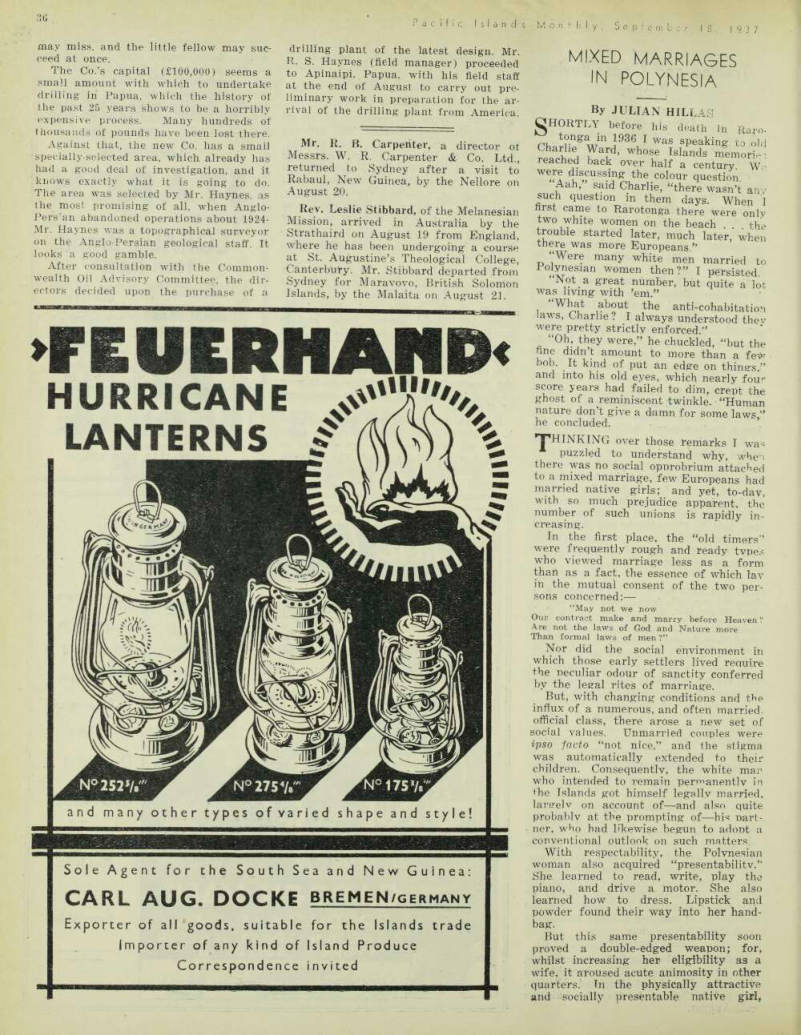
For Papua
WHEN Papua, for purposes of an oil search, was divided up between Papua Oil Development Ltd. (Shell), Islands Exploration Ltd. (Vacuum), and Oil Search Ltd. (formerly Oriomo), an area carrying marked petroliferous signs was reserved from the Oil Search Ltd. concession. It had been applied for, over 12 years ago. by a Mr. R. S. Haynes, and Mr. Haynes, assisted by Mr. Walter Marks, had kept the application alive ever since.
This area has been the subject of a “float” in Australia. The Papuan Aninaini Petroleum Co. Ltd. offered 400.000 57shares to the public and allotted an other 100,000 5/- shares, under certain restrictions, to Messrs. Marks and Haynes, and their associates- The obiect of the new Co. is to acnuire and'develop the area referred to —48,000 acres, near the coast of Papua, 86 miles north-west of Port Moresby and 45 miles south-west of Kerema.
It is an interesting speculation. Papua is on the “oil belt,” and there are signs of oil all over the Territory. Sooner or later, a well will be found. The chances, most definitely, are in favour of those concerns, which can undertake the search
with a large, expert staff and unlimited resources, and can simply carry on until oil is located. That is what is now, being done in Papua by the three major com panies. But it is all a matter of luck.
The big fellow, after years of drilling,
may miss, and the little fellow may suc ceed at once.
The Co.’s capital (£100,000) seems a small amount with which to undertake drilling in Papua, which the history of the past 25 years shows to be a horribly expensive process. Many hundreds of thousands of pounds have been lost there.
Against that, the new Co. has a small specially-selected area, which already has had a good deal of investigation, and it knows exactly what it is going to do.
The area was selected by Mr. Haynes, as the most promising of all, when Anglo- Pers’an abandoned operations about 1924- Mr. Haynes was a topographical surveyor on the Anglo-Persian geological staff. It looks a good gamble.
After consultation with the Common wealth Oil Advisory Committee, the dir ectors decided upon the purchase of a
drilling plant of the latest design. Mr.
R. S. Haynes (field manager) proceeded to Apinaipi. Papua, with his field staff at the end of August to carry out pre liminary work in preparation for the ar rival of the drilling plant from America.
Mr. R. B. Carpenter, a director of Messrs. W. R. Carpenter & Co. Ltd., returned to Sydney after a visit to Rabaul, New Guinea, by the Nellore on August 20.
Rev. Leslie Stibbard, of the Melanesian Mission, arrived in Australia by the Strathaird on August 19 from England, where he has been undergoing a course at St. Augustine’s Theological College, Canterbury. Mr. Stibbard departed from Sydney for Maravovo, British Solomon Islands, by the Malaita on August 21.
Advertisements & other items, pp. 37-38 (1 item)
Starch
PURE RICE
Always ask for . . .
CORAL” Brand
100% PURE
CORAL BRAND
RICE STARCH
Noted for Its
QUALITY
and
WHITENESS
Coes Farthest and gives Lasting Finish
WILL NOT
STICK TO
IRON
Obtainable from Leading Island Store* Manufactured by
AUSTRALIAN RICE LTD.
Sydney, N.S.W.
I % Products : Choicest Australia’s Brussels Sprout* White Turnip* Sweet Coro Tomato Puree Tomato Sauce Tomato Soup Tutti Fruit Saoce (Worcestershire flavor) Beetroot Spinach Cabbage Carrots Parsnips Celery Green Peas French Beans Cauliflower m
CARD-EN VALE
manufacture .BY
s& V PRODUCTS LIMITED
VV . '2-4 BROWN STR-E-ET, N-CWTOWN
SYDM-EY. AUSTRALIA
Always ..
make sure you have at hand an ample Reserve of these Delicious . .
Garden
Vale
Ready-toserve Vegetables
fEUERHAND<
HURRICANE
LANTERNS ''
s * Ct % 1 ft I* < > V, s.® m m s m and many other types of varied shape and style!
Sole Agent for the South Sea and New Guinea:
CARL AUG. DOCKE BRE MEN/germany
Exporter of all goods, suitable for the Islands trade importer of any kind of Island Produce Correspondence invited
Mixed Marriages
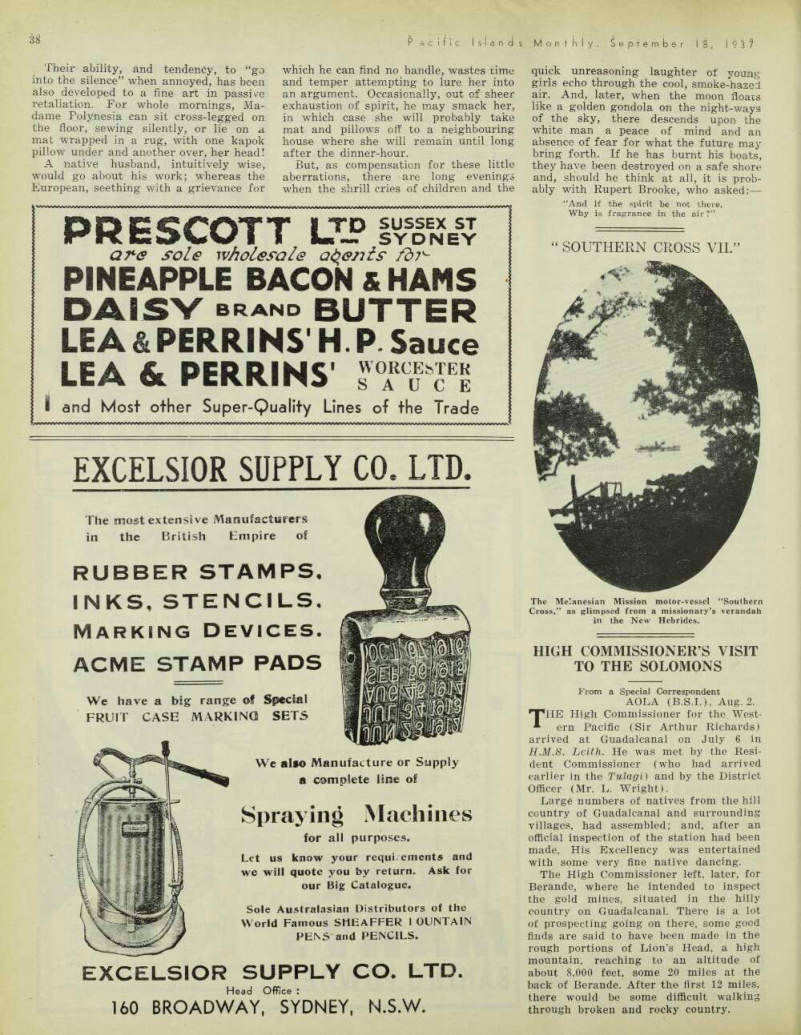
In Polynesia
By Julian Hill As
SHORTLY before his death in Raro- Ch.rZ ga w Ul 9S6 J WaS S P old a r d ' wkose Islands memories reached back over half a century. W ' were discussing- the colour question.
Aah, said Charlie, “there wasn’t anv such question in them days. When I first came to Rarotonga there were only two white women on the beach . the trouble started later, much later, when there was more Europeans.”
“Were many white men married to Polynesian women then?” I persisted.
Not a great number, but quite a lot was living with ’em.”
“What about the anti-cohabitation laws, Charlie? I always understood thev were pretty strictly enforced.”
“Oh they were,” he chuckled, “but the fine didn’t amount to more than a few bob. It kind of put an edge on things,” and into his old eyes, which nearly four score years had failed to dim, crept the ghost of a reminiscent twinkle. “Human nature don’t give a damn for some laws ” he concluded.
THINKING over those remarks I wa* puzzled to understand why, when there was no social opprobrium attached to a mixed marriage, few Europeans had married native girls; and yet, to-dav, with so much prejudice apparent, the number of such unions is rapidly in creasing.
In the first place, the “old timers” were frequently rough and ready tvpes who viev/ed marriage less as a form than as a fact, the essence of which lav in the mutual consent of the two per sons concerned:— “May not we now Our contract make and marry before Heaven ?
Are not the laws of God and Nature more Than formal laws of men ?”
Nor did the social environment in which those early settlers lived require the neculiar odour of sanctity conferred by the legal rites of marriage.
But, with changing conditions and the influx of a numerous, and often married, official class, there arose a new set of social values. Unmarried couples were ipso facto “not nice,” and the stigma was automatically extended to their children. Consequently, the white mar who intended to remain permanently in the Islands got himself legally married, largelv on account of —and also quite probably at the prompting of—his nart ner, who had likewise begun to adopt a conventional outlook on such matters.
With respectability, the Polynesian woman also acquired “presentabilitv.”
She learned to read, write, play the piano, and drive a motor. She also learned how to dress. Lipstick and powder found their way into her hand bag.
But this same presentability soon proved a double-edged weapon; for, whilst increasing her eligibility as a wife, it aroused acute animosity in other quarters.’ In the physically attractive and socially presentable native girl,
European women saw a serious rival.
Sons, brothers, even husbands, might go the way pf all flesh in the wake of some black-haired, flower-wreathed, marzipan skinned daughter of the Islands, whom it was no longer possible or expedient to dismiss contemptuously as a “savage. ’
On more than equal terms, and in her own element, she now claimed recog nition As a defensive reaction to such a challenge, this attitude was intelligible, but it did not make for a frictionless state of affairs. By marriage with a native girl, a European to some extern jeopardized his social position. Occasion ally, he lost it altogether. But. at ail times, he was made to feel, by gentle inference, that he had done something reprehensible.
THE whole question of white man and brown woman has its roots buried somewhere in the far past. Whether the explanation lies purely in the attraction for opposites or is simply a lingering trace of civilised man’s primordial self asserting itself under favourable con ditions, the fact remains that in countries where the two races meet on a common ground, white men readily form relation ships with native women.
Eminent sexologists like Ivan Bloch and Havelock Ellis*have both stressed the universality of this attraction. Nor can it be accounted for only on grounds of promiscuity. The evidence for deliber ate selection is too strong.
During the last 20 years, intermar riage has not only increased quantitively, but qualitively. A new, and for the most part, intellectually superior class of European has settled in the Islands, and it is from their ranks that the majority of these marriages have originated.
The question which immediately rises in one’s mind is why should these men have deliberately chosen native girls ?
To dismiss this on the assumption that each and all of them were psychologic ally predisposed towards the women is as ridiculous as to suppose that they would have been unable to obtain wives from among the women of their own race or station in life.
The obvious answer is that they found the Polynesian better adapted to the con ditions of life in Polynesia. In other words, she filled the picture. The Is lands are notoriously unkind to European women. Many of them find it imperative to make frequent visits to colder climates.
Furthermore, they seem less able than men to adjust themselves to local foods.
Much expensive tinned food is consumed and, unless a man has considerable means, the drain on his income from these two sources alone is soon felt.
On the other hand, the native or half caste girl of moderate education is ad mirably suited to the mode of life to which such an alliance raises her, since marriage with a European invariably means a step up, socially, and generally financially.
IT has frequently been said that mixed marriages fail through inability on the part of the wife to provide her husband with “mental companionship.”
Frankly, I think that is all bunkum.
The supposition that most men are anxious to share their mental lives with someone else is a fallacy which one sus pects is of feminine origin. As a species, the male is a curiously reticent creature, the possessor of opinions about which he has no particular desire to argue or even discuss with his wife, much less to have changed by her. There is a blessed ness that must be experienced to be believed in living with a person upon whom one can safely rely not to invade tMs sphere There are no “soul mates” in Polynesia; but there are many loyal and faithful companions who, in return for little, give much, and whose com plete freedom from the senses of “time” and “worry” come as a welcome anodyne to civilisation-wearied nerves.
A GAINST the material advantages of a mixed marriage there must, in all fairness, be set those more subtle and at first scarcely noticeable factors which intimacy gradually brings into bolder relief.
There is a vague air of remoteness which clings to so many Islands girls like a faint aura of other-worldliness, so that they can sit, hour after hour, detached from their surroundings, star ing back along the untenanted alleyways of an ancestral past in which the white man has no share. Baffled, the latter will grasp out, but will meet nothing tangible.
Their ability, and tendency, to “go into the silence” when annoyed, has been also developed to a fine art in passive retaliation. For whole mornings, Madame Polynesia can sit cross-legged on the floor, sewing silently, or lie on a mat wrapped in a rug, with one kapok pillow under and another over, her head!
A native husband, intuitively wise, would go about his work; whereas the European, seething with a grievance for
which he can find no handle, wastes time and temper attempting to lure her into an argument. Occasionally, out of sheer exhaustion of spirit, he may smack her, in which case she will probably take mat and pillows off to a neighbouring house where she will remain until long after the dinner-hour.
But, as compensation for these little aberrations, there are long evenings when the shrill cries of children and the
quick unreasoning laughter of young girls echo through the cool, smoke-hazed air. And, later, when the moon floats like a golden gondola on the night-ways of the sky, there descends upon the white man a peace of mind and an absence of fear for what the future may bring forth. If he has burnt his boats, they have been destroyed on a safe shore and, should he think at all, it is prob ably with Rupert Brooke, who asked:— “And if the spirit be not there.
Why is fragrance in the air?”
Advertisements & other items, pp. 39-40 (3 items)
37
I' aci f I c Islands Monthly, September (8, 1937
Mary’S
H.JONES e-co
AUSTRALIA’S BEST
H. JONES & CO., LTD.
Darlington, Sydney Hobart, Tas.
Fruit, Vegetables, and Produce For— Fresh Islands Residents can rely on th old-established Shipping Providers:
OP^ tR
St A’
421 Island Agents : NELSON & Only Address: Sussex Street, SYDNEY All Orders Promptly Attended
ROBERTSON PTY. LTD.
A new, simple lid for your
convenience; a new
patented parchment seal
to ensure perfect fresh-
ness.
AUNT
MARY’S
BAKING POWDER
MAR
0 Send I/- plus 2d. postage to Tillock and Co.
Ltd., Sydney, for "Aunt Mary’s" Cookery Book.
It's the best.
PRESCOTT L T D
ar-e sole wholesale agents fdi'-
PINEAPPLE BACON s HANS
DAISY BRAND BUTTER
LEA & PERRINS'H P Sauce
LEA & PERRINS' J'ToTe
i and Most other Super-Quality Lines of the Trade
EXCELSIOR SUPPLY CO. LTD.
The most extensive Manufacturers in the British Empire of
RUBBER STAMPS,
INKS, STENCILS.
Marking Devices.
ACME STAMP PADS
We have a big range off Special
FRUIT CASE MARKING SETS
mt We also Manufacture or Supply a complete lane of
Spraying Machines
for all purposes.
Let us know your requirements and we will quote you by return. Ask for our Big Catalogue.
Sole Australasian Distributors of the World Famous SHEAFFER I OUNTAIN
PENS and PENCILS.
EXCELSIOR SUPPLY CO. LTD.
Head Office :
160 BROADWAY, SYDNEY, N.S.W.
“Southern Cross Vii.”
The Melanesian Mission motor-vessel “Southern Cross,” as glimpsed from a missionary’s verandah in the New Hebrides.
High Commissioner’S Visit
To The Solomons
From a Special Correspondent
Aola (8.5.1.), Aug. 2.
High Commissioner for the Western Pacific (Sir Arthur Richards) arrived at Guadalcanal on July 6 in H.M.B. Leith. He was met by the Resi dent Commissioner (who had arrived earlier in the Tulagi ) and by the District Officer (Mr. L. Wright).
Large numbers of natives from the hill country of Guadalcanal and surrounding villages, had assembled; and, after an official inspection of the station had been made, His Excellency was entertained with some very fine native dancing.
The High Commissioner left, later, for Berande, where he intended to inspect the gold mines, situated in the hilly country on Guadalcanal. There is a lot of prospecting going on there, some good finds are said to have been made in the rough portions of Lion’s Head, a high mountain, reaching to an altitude of about 8,000 feet, some 20 miles at the back of Berande. After the first 12 miles, there would be some difficult walking through broken and rocky country.
One Very Dead Whale
And the Trouble it Caused
By D.M.
IN the drab, uncertain light of a stormy morning (at Vella Lavella, Solomon Islands) recently, my attention was drawn to what appeared to be an out size in logs, adrift in the bay.
It was so unusually large that I examined it with binoculars. Seen through the glass, the flotsam seemed more nearly to resemble a vessel float ing bottom up, and I decided to investi gate at closer range. A boat was launched and manned, and we set out to discover what manner of tragedy had taken place.
Arrived within hailing, or rather, smelling distance of the object, the crew became restive under the stimulus to olfactory senses. “Oil fish! Oil fish!” they shouted excitedly: and an “oil fish,” or whale, it proved to be, of considerable tonnage and unmistakably defunct. by this time, the unwelcome visitor had stranded on an inshore reef, and as it had touched bottom so recently I thought it might be possible to tow the monster out to the ocean current and speed it on its malodorous way.
A rope was made fast to the huge tail —or what the sharks had left of that appendage—and we levered and tugged lor an nour. The mammal budged not an inch. It had obviously given up a seafaring career and, satisfied with a near-shore location, settled down with tne malevolent intention of stinking us out.
Whilst I pondered a plan of campaign, a member of the crew became reminis cent. A whale had once come ashore in Ins “passage” on Malaita; it was “fresh,” and in that condition the flesh was good eating. The tribe feasted generously on this gift from Neptune, and as a con sequence their movements could easily be traced for weeks afterwards. Indeed, the more observant became so expert in the art of diagnosis that they claimed to be able to identify individual oil patches. But the most disturbing legacy was the aroma from what remained of the carcase, which tainted the atmos phere almost unbearably for many months.
Appalled at such a perfumed prospect, I determined that my “oil fish” should have strictly limited opportunities in that direction. If the monster would not depart in a piece, it must do so in pieces.
A dozen brawny Malaita men hailed the proposition with joy; it appealed to a latent instinct for destruction, besides promising a pleasurable break from the monotonous round of plantation work.
They set to with a will, wielding axes, knives and other improvised surgical instruments. It was manifest that knowledge of the fine points of whale carving was lacking, and the technique displayed would probably give experts of the Antarctic a “pain in the neck.
Nevertheless, they gradually worked their way into the interior, hacking off large chunks, which were towed away.
Sometimes, these morsels reached the open sea; occasionally, tit-bits would be snapped oft the lines by pursuing sharks. ai times, the boys "on board ' the whale almost disappeared from view, i tnought of Jonah's adventure, and was convinced that if the hero of the fame succeeded in navigating the gunet ne would not lack accommodation amidsnipo.
At one stage of the post-mortem, when several boys, up to tneir waists m water, were slashing at tne outer nuu of tne whale, they were chased by a shark, which evidently resented numans butting in on his banquet. They eiuaed it by scrambling into a boat; but tne shark, intent on the hunt, was exceeding the speed limit, and beiore the brakes could be applied it stranded in shoal water.
The commotion and threshing that en sued were ternhc. Tne water was churned, and spray sent hying as oy tne propellers of a liner, hiventuaiiy, tne m innated brute succeeded in hurling itsen into a deep cnannel and, apparently scared, made on at great speed. .butchering and towing operations oc cupied three strenuous, odoriferous days, adverse weather conditions hampering tne work to some extent.
The mammoth head had sunk into the sand and coral. When at last it was levered out and towed away —the last instalment—l drew a long, deep breath.
The air tasted much sweeter and added piquancy to the delectable “Jimmy Woodser” that was the necessary and logical finale to the mammalian drama.
Advertisements & other items, pp. 41-42 (2 items)
39
Pacific Islands Monffihy, September (6, 193 7
Pickles
1 he High-grade - -
PICKLES
made by The House of Holbrook contain the finest vegetables grown in many countries and prepared in the most hygienic and skilful manner.
HOLBROOKS Sweet or Unsweetened GHERKINS are the finest imported Gherkins, firm and deli-
cately flavoured. They may
be used in the preparation of many dainty and appetising savory novelties, and like all Holbrook products their quality is entirely dependable.
HOLBROOKS Pearl
White ONIONS. These tiny white onions are imported and preserved in
sweetened liquor. They are
delicious and so elegant for savories.
HOLBROOKS Pickled WALNUTS. Sweet and Unsweetened, MIXED
PICKLES and PICCA-
LILLI, are all equally fine, and must be tried to be • appreciated.
Holbrooks [A/sia]
Ltd.
WATERLOO. N.S.W,
STEAMSHIPS TRADING COMPANY LIMITED
PORT MORESBY PAPUA SAMARAI
Chairman and Managing Director: A. S. FITCH.
Shipowners, Wholesale and Retail Merchants and Traders; Shipping, Customs and insurance Agents; Copra and Rubber Plantation Owners.
MAIL CONTRACTORS TO COMMON WEALTH AND PAPUAN GOVERNMENTS.
AGENCIES: —At Port Moresby: Coral Sea Insurance Co.; Phoenix Insurance Co.; Delta Sawmills, Ltd.; Acme Bakery Co.; Vacuum Oil Co. Pty. Ltd. At Samara:: Coral Sea Insurance Co. ; Delta Sawmills, Ltd.; Bankers and Traders’
Insurance Co.; National Mutual Life insurance Co.; Kularo Shipyards; Mamai Plantations.
BRANCHES:—In Papua; Hanuabada, Sivitoi, Aroma, Koki, Hula, Ela Beach, Duga Duga, Yule Island.
SYDNEY: NELSON & ROBERTSON PTY. LTD., 12 Spring St.; Melbourne. 396 Flinders Lane; London, E. Whiteaway & Co., 7 Chiswell Street, Finsbury, London.
Cable Address: “STEAMSHIPS.” Code- Bentley’s.
MUST
; CON&|||i|j^
WllL
5? fSSSn
7 NESI BRAND r.
Trad* HAXh
Anglo-Swiss Condensed Mi
SYDNEY
YOUR FIRST
CONSIDERATION
NESTLE S MILK
remains PURE and
FRESH under all climatic conditions
) You cannot afford to take risks with milk . . . only the best is good enough . . that's why you should always use Nestle's Milk. It is made from the finest full cream country milk. From start to finish every process of manufacture is carried out under the strictest supervision. It never become contaminated while unopened, and it is fully guaranteed to stand up to ANY climatic conditions. To protect your own health and the health of your family always insist on Nestle's the safest, most nourishing and most economical milk you can buy.
NESTLES
FULL CREAM
MILK
BEST, THEREFORE CHEAPEST o „ t
Origin Of Name Of

Papua
T*HE origin of the name “Papua” is the subject of an interesting letter from Mr. A. J. Vogan, F.R.G.S. He says that he had disliked the name, because “it had no ancestral rights and meant noth ing.”
“But now,” he continues, “I have just found that its claim to historical pres tige is beyond Question. In a very old world map ‘par Guillaume De Lisle,’ show ing the ‘new’ discoveries, made in 1739 by Lozier Bouvet, for the French Com pagnie des Indes, the outlined form of New Guinea is depicted joining with Northern Australia which is named from which, doubtless, our Gulf of Carpentaria.
“But here we find, printed: ‘Nouvi Guinee ou Terre des Papous, which means, I suggest, the Land of Paw-paws, or as our French friends (and most Is lands folk) have it ‘Papaye.’
“This fruit was originally called by the discoverers, the Portuguese, ‘Mamao? from their resemblance to the mammil lary-glands; and its original, or native name, was given for similar reasons, and approximated to that given the island on Bouvet’s old map. This is interesting to anyone afflicted with the archaeologi cal complaint; because the fruit origin ally came from Mexico, where, in 1677, an Indian child was called “Papoose,’ and ‘beyond the Philippines,’ in 1578, by Lindschoten, who knew it by the name ‘Paparios.’ L. C. D’Oyle informs us re garding North America: ‘ln that queer contrivance the squaws carry their papooses.’ In Persia (past and present) the bag-like slipper is called ‘Papoosh’— all another instance of how our names and civilisation originated from one centre.”
EDITORIAL NOTE: Our old friend’s hypothesis is ingenious, but it does not agree with that of at least four or five writers on the early history of the Pacific. They have explained that the original name given to New Guinea, probably by Antonio de Abreu (Portugese) in 1511. or by d© Meneses in 1526, was “Os Papuas.” which had some reference to the natives’ bushy hair. Thus the “Handbook of Papua,” published in 1912: “In 1526 another Portugese, Don Jorge de Meneses, sailing from the Malay Peninsula to take charge of the Moluccas, instead of adopting the known route to the south of Borneo, sailed round the north of that island and Gilolo, and so overshot his mark that he came to a land inhabited by natives called ‘Papuas,’ a name given to them by the inhabitants of the Moluccas, on account of their frizzly hair.’
Philatelists will be interested in the new Paris Exhibition 1937 series of stamps, just issued for French Oceania.
The series consists of six values: 1 franc 50 centimes, and 90, 50, 40, 30 and 20 centimes—each a different design. The new Exhibition issue is probably the same in design for all the colonies of France, the name of the colony, in each case, being printed in the space left for that purpose as was the practice in the old colonial issues before picture stamps characteristic of each colony became the vogue.
Historic Occasion in the Cook Islands in 1900
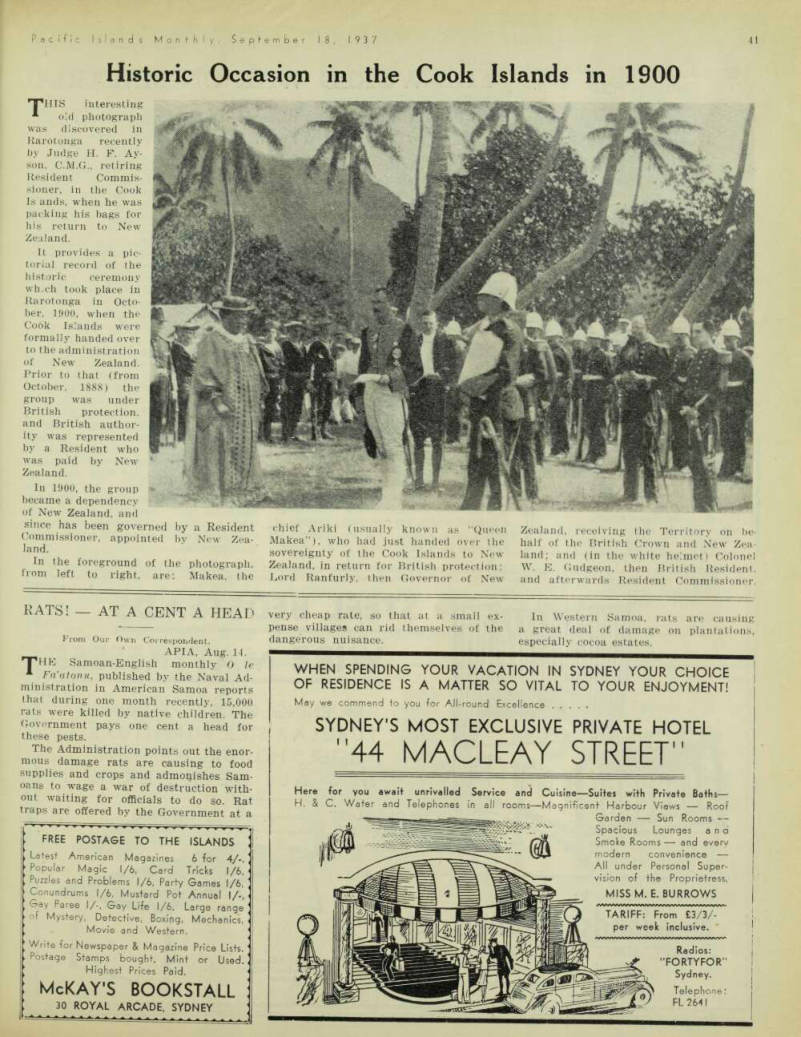
T'HIS interesting old photograph was discovered in Rarotonga recently by Judge H. F. Ay son, C.M.G., retiring Resident Commis sioner, in the Cook Is ands, when he was packing his bags for his return to New Zealand.
It provides a pic torial record of the historic ceremony wh.ch took place in Rarotonga in Octo ber, 1900, when the Cook Islands were formally handed over to the administration of New Zealand.
Prior to that (from October, 1888) the group was under British protection, and British author ity was represented by a Resident who was paid by New Zealand.
In 1900, the group became a dependency of New Zealand, and
since has been governed by a Resident Commissioner, appointed by New Zea land.
In the foreground of the photograph, from left to right, are: Makea. the
chief Ariki (usually known as “Queen Makea”), who had just handed over the sovereignty of the Cook Islands to New Zealand, in return for British protection: Lord Ranfurly, then Governor of New
Zealand, receiving the Territory on be half of the British Crown and New Zea land; and (in the white helmet) Colonel W. E. Gudgeon, then British Resident, and afterwards Resident Commissioner.
Rats! - At A Cent A Head
I" rom Our Own Correspondent.
Apia, Aug. 14.
The Samoan-English monthly O le 1 Fa'atonu, published by the Naval Ad ministration in American Samoa reports that during one month recently, 15,000 rats were killed by native children. The Government pays one cent a head for these pests.
The Administration points out the enor mous damage rats are causing to food supplies and crops and admoijishes Sam oans to wage a war of destruction with out waiting for officials to do so. Rat traps are offered by the Government at a
very cheap rate, so that at a small ex pense villages can rid themselves of the dangerous nuisance.
In Western Samoa, rats are causing a great deal of damage on plantations, especially cocoa estates.
Advertisements & other items, p. 43 (1 item)
"44 Macleay Street"
WHEN SPENDING YOUR VACATION IN SYDNEY YOUR CHOICE OF RESIDENCE IS A MATTER SO VITAL TO YOUR ENJOYMENT!
May we commend to you for All-round Excellence
SYDNEY'S MOST EXCLUSIVE PRIVATE HOTEL
"44 MACLEAY STREET"
Here for you await unrivalled Service and Cuisine—Suites with Private Baths— H. & C. Water and Telephones in all rooms—Magnificent Harbour Views Roof i v- Garden Sun Rooms Spacious Lounges and Smoke Rooms and every modern convenience All under Personal Supervision of the Proprietress,
MISSM. E. BURROWS
a a* & a
TARIFF: From £3/3/-
per week inclusive.
Radios:
FORTYFOR"
Sydney.
Telephone: FL 2641
FREE POSTAGE TO THE ISLANDS
Latest American Magazines 6 for 4/-.
Popular Magic 1/6, Card Tricks 1/6, Puzzles and Problems 1/6, Party Games 1/6, Conundrums 1/6, Mustard Pot Annual I/-, Gay Paree I/-, Gay Life 1/6. Large range of Mystery, Detective, Boxing, Mechanics, Movie and Western.
Write for Newspaper & Magazine Price Lists.
Postage Stamps bought, Mint or Used.
Highest Prices Paid.
McKAY'S BOOKSTALL
30 ROYAL ARCADE, SYDNEY
Sectarian Strife In The
Mission Field
“ \ POINT that is often made against Christian missions,” Mr. W. R.
Croker, ex-administrative official, in a book on Nigeria, writes in a chapter dealing with missions and missionaries, “is that they give rise to competition between various Christian sects.
“The point has been overdone. Com petition is in the African’s blood, and strife between religious sects may be come a sublimated outlet for the compe tition that formerly led to head-hunting.
Also, it involves some kind of energy of mind and spirit, and it sets up a rallying point around which the sense of loyalty to a community can be fostered.
“Nor, again, is it a defect that the Christian religion is propagated by men who often are of small intellectual stature, preaching crudities and dispro portions. The African is now in a state where a message delivered with faith and conviction, and where the example of disinterested living, make an appeal that no intellectual gifts can equal.”
The World War On Malaria
How John D. Rockefeller, Recently Dead, Gave New Health and Life To Pacific Islands Races
John D. Rockefeller, Multi
** millionaire, died a few months ago, when almost 100 years old. The masses did not grieve. Rockefeller made his mil lions by becoming a successful mono polist, and monopolists are public enemies.
But Rockefeller also established the Rockefeller Foundation, and the enor mous good he did thereby for humanity far outweighs any harm he did by his ruthless control of world commodity markets. There is not a community in the Pacific Islands which has not cause to thank Rockefeller for better health.
Whenever we hear that the Polynesian people are increasing in numbers, we may be sure that the Foundation has had something to do with it.
The story of the Foundation was told, a few months ago, before Rockefeller died, by Dr. Victor Reiser, in one of the finest books of the year, An American Doctor's Odyssey. Dr. Heiser spent the later part of his life in the service of the Rockefeller Foundation, Dr. Heiser says that Rockefeller asked a group of scientists if they could name a disease which affected large masses of people, and which could be removed if attacked on a large scale by an organi
sation with plenty of money. They named hookworm. Rockefeller gave them one million dollars, and the work commenced.
Since then, hundreds of thousands —probably millions —of people, have been freed from this scourge.
The initial success of the hookworm campaign pleased Rockefeller; and he then established the Rockefeller Foun dation, and endowed it with 100,000,000 dollars. The work of the Foundation has been extended all over the world. Where ever there are large numbers of people who can be made healthier and happier by organised hygiene and large-scale treatment —especially by injection—there will be found the officers of the Foun dation, quietly and steadily at work.
They have attacked hookworm, yellow fever, malaria, etc. Their successful cam paigns against hookworm and yaws, in the Pacific territories, are well known.
The substantial annual payment made by the Rockefeller Foundation to the Suva Medical School makes it possible for that splendid institution to turn out, year after year, fine types of young native medical practitioners—Fijians, Tongans, Samoans, Cook Islanders, Solomon Is landers, Gilbertese, etc. —who have been specially trained for work among their own peoples.
DR. HEISER, in his fascinating book describes one of the greatest curses of humanity, malaria. The following is taken directly from his text: Of ail tropical diseases, malaria is the most persistent, the most destructive, the most widespread, and the most difficult to control. Plague is terrible, but rats can be eliminated. Cholera and smallpox have no excuse for being. Dysentery and typhoid could be wiped out. Though leprosy creates horror it seldom inter feres with the march of progress.
But entire races touched by the shak ing finger of malaria have undergone pro gressive decadence. The “glory that was Greece” faded out before its onslaughts and will not shine again until the minute pools in her rocky river beds cease to be a threat. The “grandeur that was Rome” paled centuries ago, assailed by recurrent waves of malaria. In the New World, half the inhabitants of Jamestown, encircled by the miasmic Virginia marshes, died within six months of their arrival. The disease was once bad enough in Washing ton to interfere with the sittings of Con gress.
From earliest times the connection of marshland and malaria had made itself apparent. Miasmas arising, particularly at night, from these moist regions were blamed for the disease, and malaria, “bad air,” was first so called by an Italian in 1753, and introduced into England in 1827 as a specific name for the malady known variously as marsh miasma, ague, jungle fever, or intermittent fever.
Malaria is often deadly in its action.
In the cerebral form, parasites become so thick in the blood that they clog the capillaries of the brain and cause almost immediate death, and the same may be true if they lodge in the kidneys. But a far larger number of cases are chronic; the parasites gradually destroy so many red blood corpuscles that extreme anemia results. The patient’s liver does not func tion properly, he has frightful headaches, cannot eat, and takes no interest in any thing.
Long before the disease was given its present name, its remedy was known in South America. In 1600, Spanish mission aries used the bark quincu quina in Peru.
It became known as Jesuit’s Powder, because the Jesuit order had a monopoly of quinine sales. The priests received its weight in gold from those who could afford to pay; to the poor it was free.
The supply was never equal to the de mand, and in the efforts to adjust the balance, the trees of South America were stripped of their bark and largely des troyed.
The failure of the South American gov ernments to protect the source of supply from destruction brought efforts to culti vate cinchona, so named by the Swedish naturalist, Linnaeus, in 1742, elsewhere.
In 1852 seeds and plants were introduced into the Botanical Garden in Java, where the Dutch tended them carefully. Per fecting a technique of cultivation, the Dutch found they had a monopoly of the quinine supply. And the price was kept so high that thousands died because they could not afford to buy.
To break the Dutch monopoly seemed hopeless, but, because the price of quinine was a matter of world-wide importance, at my suggestion the Health Section of the League of Nations began a campaign of “pitiless publicity.” Its effectiveness lay in its simplicity. The figures of quinine production appeared at stated intervals in League bulletins. “Over 900 tons out of a 1000 were produced in the Dutch East Indies. The price in 1890 was such and such; now in 1917 it has risen to such and such.” The great difference between the early low cost and the later high one told its own story.
On each of my European trips I visited Geneva, and each time I talked cheaper quinine. The campaign continued
with vigour. Nothing was said d'roctly; no attack was made. But the Dutch found the shoe fitted and began to be sensitive.
In time the opprobrium became so great that the cost of quinine was voluntarily reduced.
Quinine is not a prophylactic for mal aria. The drug has not yet been found which will kill all forms and stages of the parasite promptly. But as long as quinine is taken there will be no attack. iS to the actual source of the disease, it was not until the end of the 19th century that the anopheles mosquito was found to be the carrier.
An anopheline is usually distinguish able because of the little black dots on her wings, and because she looks as
though she were standing on her head when biting. A tremendous number of enemies are ready to destroy her; she
cannot even stand wind or bright sun shine. Her life history occupies only about one month, but as long as she lives, she has a meal every two to three nights.
Malaria can only be contracted if she has previously fed on someone who had mal aria parasites in his blood. The swelling from her bite is not large, nor the itch particularly annoying sometimes a persons does not even know he has been bitten—yet one bite is enough to cause malaria.
Malaria flourishes in a broad zone on both sides of the Equator, but the largest centres are in Asia. In India it is the arch-destroyer; half the 350,000,000 popu lation are estimated to suffer from it, and one million die annually. Turkey, Syria, Palestine, Malaya, Siam, Indo-China, Java, Sumatra, the Philippines, and China are all intensely malarial.
In every survey, the first task was to study the habits of the local mosquitoes.
The culprits had to be run down, and then enough facts detected about them so that the proper offense measures might be taken.
For instance, in the Philippines, where there were approximately two million cases of malaria a year, all our attempts at control were unsuccessful. When I returned to the Islands in 1921, Governor General Wood had secured a million dol lars to spend on malaria. And he sug gested that we drain the swamps, as had been done successfully in Panama. I pointed out that we were running into many contradictions in the study of mal aria, that possibly swamps might not be responsible for malaria in the Philip pines.
“They have been everywhere else. Why not here?”
“Nobody’s proved it, and it’s not a scientific way of finding out.”
“Well, that’s the way I want it done!” was General Wood’s categorical response.
“In that case, General, I’d better stop,”
I said. “It won’t be difficult for you to find someone to work on the problem as you may direct, and your method may be right.”
The subject was dropped; but next day the General was apologetic. “What do I know about malaria? Forget every thing I said.”
I then suggested asking the Inter national Health Board to make a survey.
Wood agreed, and all sorts of experiments began. Among others, beds were arranged in trees so that the biting habits at dif ferent elevations might be studied. The beds were baited with men and the sides of the mosquito bars left open. At about eleven, the first mosquito arrived, but the bars were not closed until many had entered. At two o’clock, after having fed, the insects were becoming distinctly un easy, at three they were agitatedly seek ing an exit, at four they were practically committing mass suicide, jamming their heads between the interstices of the net tings, and even breaking off their wings.
They were obvious', y motivated by some tremendous homing instinct.
After having been sprayed with car mine, the prisoners were released and immediately a hunt was organised. Stones were overturned, blades of grass and leaves scrutinized, tree trunks examined.
The search continued for two years and cost thousands of dollars but ultimately the hiding place of the mosquitoes was ferreted out. In the Philippines the streams were always lined with bamboo, and where the current undercut the banks, the bamboo roctlets formed a tangled mass into which the elusive mos quitoes would retreat in the daytime.
It was thus proved that malaria in the Islands was associated not with marshes but with the swift-running waters of the foothills. Had Wood’s million been spent in draining swamps, it would have been completely wasted.
This discovery gave us a fresh start in malaria control. Rice chaff was scat tered on the streams, and as it floated along, an observer noted where it stopped in the little eddies. In those places larvae or wrigglers were often found in abun dance.
Paris green, mixed with 99 parts of fine dry road dust, was then released in clouds above the stream. The mixture is extremely effective in killing the larvae, and has the additional advantage that water treated with it can be used for bathing, washing clothes, or even be drunk with impunity, whereas pouring oil on water renders it unfit for use. A
recent development is a machine run by a paddle wheel in the stream, which scat ters the Paris green automatically.
In almost every problem of malaria, the basic approach is to survey local conditions and then apply the remedy.
It may be as simple as having carabao walk through a stream to disturb the larvae, or compelling natives to turn their discarded coconut shells upside down, or it may consist of the most elaborate and expensive engineering operations. Even drainage operations, when not correctly planned, have some times done great damage by creating breeding places where none existed before.
The Rockefeller Foundation now has engineers who travel from country to country with the sole object of advising on malaria problems. Until some method can be devised which is capable of gen eral application, there is little hope of bringing the disease under complete con trol. The most that can be said to-day is that if enough money is spent, a malarial district can be made healthy; but it is a long and persistent task, and only un remitting care meets with success.
Advertisements & other items, pp. 44-46 (2 items)
William E. Reed
TO PLANTERS AND TRADERS
(Established 1913) Union House, 247 George St., Sydney For all Island Requirements.
Island produce sold.
Prices right. Enquiries welcomed.
Newlands Brothers Ltd
STEEL BEDSTEADS
WIRE MATTRESSES
"MORNING GLORY" BEDDING
TUBULAR STEEL FURNITURE
" LISTER " HOSPITAL EQUIPMENT
SHIPS' ALL METAL BERTHS
WE WILL GLADLY
FORWARD OUR
COMPLETE SETS OF CATALOGUES
Produced in Australia by
Newlands Brothers Ltd
RILEY STREET :: SYDNEY. N.S.W.
Australia's Largest Manufacturers of Modern Sleeping Equipment.
Cable Address “Newlandbed,”
Sydney
WE ALSO STOCK . . .
HEAVY LEATHER CANVAS
LIGHT LEATHER CAR TRIM-
MING BOOT PATCHING
HIGH SPEED DRESSMAKING
& HEMSTITCHING MACHINES.
• All Machines Guaranteed.
Master Sewing
Machine Co.
15 ENMORE ROAD
NEWTOWN - SYDNEY
RECONDITIONED SEWING MACHINES
Singer Dropheads £8 to £l4
White Dropheads )
New Century Dropheads ) £6 to £9
New Home Dropheads )
Singer Uprights £4 to £6 Singer Hand Machines, £4/10/- to £5/10/- Other Hand Machines £2 to £4 Please stipulate the particular type required.
No delay. All goods carefully packed.
NEEDLES and PARTS for all makes of Machines.
OIL supplied. Any quantity.
Do You Know that the Famous . . .
YOUNGER
STOVES and
RANGES
made with extended Firebox specially for long Wood fuel, are Self-Setting and, provided sufficient Flue Piping is attached, can be used in almost any position?
The No. 7W "Younger" Ranger can now be supplied fitted with Legs, as per illustration.
Ask for quotation for this Range, also Illustrated Catalogue and Price List for both Single and Double Oven Stoves.
Younger Stoves are Widely Used Throughout the Pacific Islands.
G. FLETCHER & SON
50 Oxford Street, Sydney
1 I
ALSO
QVACYC
STAIN
'RXiVCW'
SILVE PA
*Q\i\CYs'
CLEAR
for renewing woodwork and furniture easily and quickly.
Agents throughout the Islands
DRY IN
4
HOURS
IT ATTRACTS
riNo \
THEY EAT IT THEY DIE I
USOLINE
NEVER
KNOWN
TO FAIL !
A USOLINE CO..
314 CROWN STREET, SYDNEY
(Established 1919)
COCKROACH
DESTROYER
IT'S A PASTE!
TRICES:
Mb. 5/- . . . 3lbs. 10/- Postage Extra.
Remit Cash with Order.
Obtainable also from Islands stores of;
BURNS, PHILP & Co. Ltd.
W. R. CARPENTER & Co. Ltd.
Maleham & Yeomans
LIMITED
BOWDEN STREET, SHEFFIELD, ENG.
Manufacturers of all kinds of Butchers', Sticking and Sheath Knives Razors and Scissors Specialty Hairdresser Scissors
PRICE LIST ON APPLICATION
Samoans Do Well At Suva
Medical School
From Our Own Correspondent
Apia, Aug. 16.
f JNDERGOING training to become native medical practitioners, six young Samoans are receiving tuition at the Central Medical School, Suva, Fiji, and encouraging reports have been received by the Administration of their progress.
The following particulars are taken from the Medical School’s last quarterly report.
First Year—Siaosi Tuioti: General progress, excellent, w«s top student in the First Year class: chemistry, 90 per cent; physics, 91 per cent; biology, 92 per cent. Uale*i Toelupi: General progress, very good ; chemistry. 83 per cent; physics, 80 per cent; biology, 85 per cent.
Second Year—Amosa Sio: General progress, very good; anatomy, 84 per cent; physiology. 84 Per cent. Sale leremia: General progress, fair only; anatomy, 68 per cent: physiology, 49 per cent.
Third Year Siaosi Talofou Faale: General progress, good; medicine. 70 per cent; surgery. 60 per cent; public health and hygiene, 86 per cent, Peti Tofaeono: General progress, very good; medicine, 78 per cent; surgery. 69 per cent ; obstetrics, 70 per cent; public health and hygiene, 90 per’cent.
Mr. Ivan Champion, of the Papuan Administration, who made a notable patrol through Western and Central Papua last year, and who has been on leave in Australia, sailed for Port Moresby by the Van Rees on August 20.
Mr. John Farrow, an American author and scenarist, has written a book on the life of Father Damien (Joseph de
Veuster), the Belgian Catholic priest
who laboured for 18 years among Hawaiian lepers on Molokai Island. It is entitled “Damien the Leper” and already has run into several editions. Mr. Farrow is the husband of Miss Maureen O’Sul livan, the film actress.
Five Sunday Is. Settlers
Evacuated
TT\ESCRIBED as “disillusioned”, four New Zealanders and an Englishman, who had settled on Sunday Island, in the Kermadec Group, were evacuated by the N.Z. Government steamer Maui Pomarc early in August.
The men made an appeal to be removed when the British cruiser Achilles called at the island in June. They reported an acute food shortage. They said that they had been existing on fruit, fish, mutton birds, goats, and an occasional turtle.
The seven settlers had been reduced to helping themselves to each other’s crops.
Announcing the evacuation, the Acting Minister of Internal Affairs (Mr. Langs tone) said that the Auckland—Sunday Island Association’s settlemejit plan was “hair-brained and not really deserving of pity, but public censure.”
Advertisements & other items, p. 47 (1 item)
Wunderlich
Timber, Joinery
ETC.
PREPARED BUILDINGS ready for erection a speciality.
SHIP AND BOAT BUILDING.
TIMBERS specially catered for.
FIBROLITE, PLYWOODS, GALVANISED
IRON, CANEC.
CONSIGNMENTS shipped
by RETURN STEAMERS
to the Islands.
John W. Eaton
LTD.
WEST CRESCENT STREET
NORTH SYDNEY
TELEPHONES : X 5051 (5 lines)
WUNDERLICH
Hi
duratile
These asbestos cement sheets give walls a tiled appearance at less cost. See examples in our showrooms or write for leaflet.
WUNDERLICH LTD.
Crown & Cleveland Sts., Redfern, Sydney
REMEMBER THE NAME
BITUMENOID ROOFING
MADE IN AUSTRALIA
Bitumenoid Roofings, Dampcourse and Insulating Felts are made from the world’s best raw materials. Warranted to stand the most rigid tests.
BITUMENOID THE BEST
Roofing. 1, 2. 3-ply; Flooring, Wate-proof Materials; Saturated Felt; Resilient Road Jointing; Natural Asphalt Dampcourse: 2 and 3-ply Dampcourse; l-21b. Lead-core Dampcourse; Roofing Cement; Asphalt Paints; Roofing Compound.
SAMPLES AND PRICE LISTS ON APPLICATION
MAXWELL PORTER & SON LTD.
ESTABLISHED 1888. BUILDERS’ SUPPLIES
107 REDFERN ST., REDFERN, SYDNEY, N.S.W. Phone, M 3157. Cables Bitumenoid
Ste
The
"Caledonia Dover"
A COOKING STOVE guaranteed to give complete satisfaction and now recognised as THE BEST on the market.
Suitable for coal, coke, or wood fuel.
Illustrated Catalogue on request.
LANE & GIRVAN, LTD.
BONNY BRIDGE, SCOTLAND
Centenary Of Tongan

Missionary
P T , HIS is the centenary of the birth of the Rev. Jabez Bunting Watkin, for years a stalwart of the Tongan Free Church, and the son of the Rev. James Watkin. who served in Tonga from 1831 to 1837. J. B. Watkin was born at Vavau on March 31, 1837, and entered the ministry in 1863. As a child he lived in New Zealand with his parents, where his father was one of the first Methodist ministers in the South Island.
J. B. Watkin was a minister of the Methodist Church in Tonga from 1866 to 1886, when he threw in his lot with the Rev. Dr. Shirley Baker in establishing the Free Church, a split that clove Tonga
in twain, and has not yet been really cemented. Baker’s object was political as well as religious. Although Queen Salote has done much to bring the fac tions together, there are still a number of “die-hards” in Tonga who refuse to join the Methodist Church as now con stituted. J. B. Watkin died in 1925, and is buried in Nukualofa. James Watkin, who died the year that his son retired from the orthodox Methodist fold, is buried at Rookwood, near Sydney. —Eriki.
Major-General Sir Charles Rosenthal will assume office as Administrator of Norfolk Island on November 4. Until then, Captain C. R. Pinney, the retiring Administrator, will carry on.
”Nothing To See"
Concerning Unimaginative World- Wandering Yachtsmen
From Our Own Correspondent
Papeete, Aug. 16.
VI /E often wonder why the majority of travellers leave home. Apparently, they see nothing of the places they visit.
Once, when we stood at the brink of that august chasm of blazing splendour, the Grand Canyon of Colorado, we heard a bored nasal voice nearby exclaim, “Ain’t Nature wonderful;” and in the next breath start an endless and ani mated recital about the price of gasoline at Albuquerque, the merits of sundry hot-dog stands encountered en route, and a Greta Garbo cinema picture seen in Kansas City.
So. too, at Tahiti. The average visitor functions as a motor for a rocking chair on a hotel verandah, interested only in the petty gossip of the town and totally oblivious to the flaming glory of the flamboyant tree overhead, the incandes cent green of the mountain peaks under the brilliant sunlight, or the flashing emerald, ruby, and sapphire of the coral sea.
Yachtsmen after spending most of their time at Papeete chaffering over the price of a few deceased pigs and cases of Scotch whisky—usually go to Raiatea, an island above all others, abounding in pre-historic monuments, fascinating bays, and quaint native villages.
Moored at the wharf at Uturoa, blind to the beauties all about them, they pass two or three days bitterly complaining that “there is nothing to see in these bloody islands.” Then they sail away to Samoa.
Perhaps, if we could stage a parade of the Ancient Arabic Order of the Mystic Shrine, on the Papeete waterfront, with the Grand Potentate riding a camel and the chanters in red fezes singing.
“Hail, Hail, the Gang’s all here”: or provide a few “honky tonks” with a night club show in “the altogether,” and a few other comforts of home —then these so journers would proclaim our island a “whale of a place” and feel amply repaid for their long voyage.
Mr. A. P. Matthews, manager of the Bank of New Zealand in Suva, Fiji, left the Colony during September on trans fer to Ashburton, N.Z. He will be suc ceeded in Fiji by Mr. O. M. Samuel, of Paeroa, New Zealand.
Monsieur P. Imbault, President of the Tribunal of First Instances in New Cale donia, arrived in Sydney from Noumea with his daughter by the Pierre Loti in August. They later sailed for France.
Lieutenant-Colonel Laurence Reding ton, of the Quartermaster Corps of the United States Army, arrived in Sydney by the Mirrabooka recently. He is on furlough and sailed by the Macdhui on August 28 to visit the Bulolo goldfield in New Guinea,
Advertisements & other items, p. 48 (1 item)
A. 'Webb & Company (Manchester) Ltd.
Woven Wire for all Industry
COPRA DRYING TRAYS, FLOORS. Etc.
FRUIT DRYING TRAYS. MINING SCREENS
Heavy Mosquito Gauze in Phosphor Bronze and other Metals Impervious to Salt Sea Air WIRE DOOR MATS AND GENERAL WIRE WORKS
E. WRIGHT & CO. LTD.
Office and Works: 148-152 Cleveland Street, Sydney, N.S.W.
Telegraphic Address: “Wrightmake,” Chippendale
ysn
Buy Direct from Manchester !
Pacific Traders can save money and obtain High Quality Goods and Dependable Service by writing to us for Quotations. We are manufacturers of —
GREY, WHITE AND COLOURED TEXTILES
Rami materials of every description.
Para Reds.
White and Blue Drills.
Grey and White Calicos.
Super Drill.
Ecru Tussore.
Dyed Poplins.
Woven-striped Poplins.
Table Cloths.
Serviettes.
Sheets. • It will be to your Interest,
in the end, to Buy and
Distribute British - made
goods.
Pillow Cases.
Quilts.
Bedspreads.
Art Silk Piece Goods.
Bath Wraps.
Glass Cloths.
Sweat Rags.
Bias Binding.
Braids.
Printed Calicos.
Poplins.
Woven Coloured Ginghams, etc.
Extract from a letter sent to us by an Islands storekeeper who recently retired: — Milne Bay . Papua, 1/10/34.
“ a success due—in a great measure—to the excellent service rendered for so many years hy your
firm. Yours faithfully,
H. DEXTER .”
A. 'Webb & Company (Manchester) Ltd.
86 GEORGE STREET - - MANCHESTER
Contractors to H.M. and Foreign Governments. Bentley's Code, and ABC Code Uh and sth Editions. Telegraphic Address: “ WASTOCKManchester.
Matson Subsidy Reduced
American Liners
From Our Own Correspondent
Honolulu, Aug. 2.
THE American Government, as from July, has drastically reduced the payments made to the Matson Line for carrying mails between America and Sydney, according to an announcement by the U.S. Maritime Commission.
President Roosevelt ordered that the truth be admitted: the huge payments formerly made were called mail con tracts, but he insists they have been straight out subsidies, because the amount of mail carried has been negligible compared with the millions of dollars paid out.
Under the new subsidy plan, the Mat son Line will be paid only $287,000 for a period of six months instead of $428,000 at the old rate. At the end of every six months the Government will revise the payment according to actual operating results.
Because the companies concerned owe the Government so much money for con struction loans during the open-handed Hoover regime, the Government is delay ing agreements with other steamship companies. Thus affected are the Matson liners trading between the mainland and Hawaii. Also affected is the Dollar Com pany, which owes the Government $15,000,000 according to the Commission.
It was announced, too, that the Com mission is investigating wage scales and working conditions, and has arranged for conferences between the union leaders and the companies. The Commission, through the post office laws, has the right to insist upon the companies treating the labour right if subsidies are accepted.
Administration
Sister Ships for N.G.
TWO sister ships, the Sirius and the Leander, which have been built in Sydney for the New Guinea Administra tion, departed for Rabaul under their own power early in September.
Captain C. J. R. Webb, harbourmaster at Rabaul, and Captain A. McLeod, of the N.G. Administration staff, came to Australia to take command of the ships— Captain Webb in the Sitius and Captain McLeod in the Leander. They were manned by white crews for the voyage to Rabaul, and, after overhaul following the long trip, will be engaged in patrol work for the Government, with native crews.
Each vessel is 70ft long and 16ft wide.
They are equipped with an opposite rotation pair of two-cycle Petter diesels, which will develop 42 h.p. each to turn 30-inch diameter propellers 500 r.p.m. on direct drive. Of the air-starting type, each engine is equipped with its own compressor.
Household “Hints” For
The Tropics
nPHE upper waters of the Bariji River.
Papua, are in high country, covered by a thick growth of bamboo. The women there have no pots and pans wherein to prepare meals for their husbands. A 3ft. length of young bamboo is all they need.
Cutting the food into convenient pieces, they stuff it into the bamboo, seal up the end, and place it in hot ashes. When the bamboo blackens and shows 'signs of cracking, the food is cooked, and has a pleasant appearance.
In the Purari Delta, where sago is the staple food of the large communities living in the mud and, slush of the laby rinth of densely-grown waterways, grubs,
mussels, and shrimps are used to vary the monotonous diet. Sandwiched between layers of moist sago, they are enveloped in sago leaves folded lengthwise, and pinned together with small twigs. The torpedo-shaped bundles are covered in hot ashes and roasted brown. The result
is appetising.-
M.L.
Rev. G. F. Jones, who has been Seventh Day Adventist pastor at Lord Howe Is land for three years, arrived in Sydney by the Morinda on August 16 to attend an Adventist Conference.
Mr. Skov Boye, formerly of the staff of Burns Philp (South Sea) Co. Ltd., at Makambo, Solomon Islands, has taken over the management at Vanikoro Island, Southern Solomons.
Advertisements & other items, pp. 49-50 (1 item)
Pienta Katm;
ALL SIZES UP TO 100 B.H.P.
MODEL FI B.H.P. 2 stroke for petrol or kerosene, complete in every detail, including completely enclosed and oiled Reverse Gear, Stern Gea:, Tanks and fittings Export Price £45 MODEL Kl I B.H.P., 4 cycle, I cylinder, complete with Reverse Gear. Stern Gear, etc - Export Price £65 MODEL K2I 710 8.H.P., 4 cycle, 2 cylinders, complete with Reverse Gear, Stern Gear, Chain Starter, etc Export Price £B5 PRICES OF 4 AND 6 CYLINDERS ON APPLICATION Write for Illustrated Catalogue of all Models. • Precision built. • Silent and vibrationless running. • Low fuel consumption. ® Compact and oil tight no fumes. ® Ample power for the rated capacity. ® Reliable and easy to manage. & 7L
W. KOPSEN & CO. PTY. LTD.
70 CLARENCE STREET - - SYDNEY
COMPLETE STOCKS OF ALL BOATING AND MINING GEAR Write for 44-page Catalogue of Boat Gear.
TILLEY LAMPS up
LARGE STOCKS OF SPARE PARTS FOR ALL MODELS Write for Catalogue and Price List. i
OXYMEL
HIGH GRADE
TIME TESTED
HOME and SHIP
Paints, Enamels, Varnishes,
Lacquers, etc.
"OXYMEL" Co. have been manufacturing Paints, etc., for just on 30 years.
We require distributing agents for our products. They are not cheap, shoddy goods.
Catalogues, Colorcards and Leaflets, &c., on request from . .
THE OXYMEL OIL & PAINT
Co. Pfy. Ltd.
47-51 YARRA BANK ROAD. SOUTH
MELBOURNE. VICTORIA, AUSTRALIA
Telephone M 2375
BUILD AN ATTRACTIVE PERMANENT
HOME OF STEEL
ILLUSTRATED is an attractive “Comet" steel bungalow recently erected by us.
This building is In no sense a special order, but shows just what can be done with the patented "Comet" principle of Steel Building Construction.
The "Comet" Steel Building, by reason of its patented sectional construction, is easily enlarged and where required, conveniently
portable.
The buildings are white-ant proof, fireresisting and economical to erect.
They have definitely proved themselves the best proposition tor the islands.
SIDNEY WILLIAMS &
EMINENTLY SUITABLE
FOR:—
BUNGALOWS
STORES
WORKSHOPS
COPRA SHEDS
BOYS’ HOUSES
HANGARS, ETC.
"COMET"
Steel Buildings
CO. (PTY.) LTD.
Steel Building Specialists, Builders and Contractors
DULWICH HILL, SYDNEY.
ROCKHAMPTON BRISBANE TOWNSVILLE
(Incorporated in Queensland)
Tough!
The People of Reao and Their "Giant Pahua"
From Our Own Correspondent.
Papeete, Aug. 16.
REAO is the most easterly island of Tuamotu Archipelago. Not so very long ago it was isolated and seldom visited. The inhabitants were primitive, wore few clothes and subsisted on fish, pandanus, and patina.
Palma is a shell fish found on coral reefs. The meat is of the appearance and digestibility of caoutchouc.
The people of Reao were accustomed to dry the patina and string it in garlands and necklaces, so as to have a food supply always at hand. The air in their neigh bourhood resembled that which emanates, on a very hot day, from Chinese restaur ants in the byways of Papeete when a bale of dried fish from Canton has been broached. Travelogues and tourist pam
phlets call this smell “the aura of the mysterious and exotic East.”
One day, during a storm, a sailing ship was wrecked on the outer reefs of Reao.
As she broke up, cases of strange mer chandise floated in and were cast up on the beach. Some of these were found to be full of objects that looked and tasted like patina of giant size; but were so tough that even the strong teeth of Reao ans could make no impression on them.
“We will cook them,’’ said the chief.
A big cauldron, from some ship of the far past whaling days, was filled with water and put on the fire. All that day and far into the night relays of natives gathered firewood to stoke the flames.
But the stubborn toughness of the giant patina was undiminished.
A second day of furious boiling—and the same result.
The Reaoans were desperate. They could not bear the thought of all this good ma'a (food) going to waste for the want of proper cooking. So they stoked the • fires and boiled the giant patina through a third day. Still it resisted their efforts to chew it. Roasting gave no better success. It only produced a blue smoke and a smell which nearly suffo cated those about the fire.
Then, by chance, a schooner came in from Papeete. The captain was told the story of the wreck and asked if he knew of any method to make this ma’a popaa edible.
When he saw the objects, and heard of the three days’ boiling, he laughed so hard and so long that he had to lie down and beat the ground with his fists to re cover his breath.
The giant patina were rubber overshoes.
It was not long before all the islands had the story.
The Polynesian loves a good joke par ticularly if it gives occasion to twit the people of another island.
The men of Reao have never been per mitted to forget the giant patina. They have been so tormented that even the casual mention of rubber overshoes is likely to produce a brainstorm.
Reao is still primitive, but thoroughly aware of the marvels of European inven tion. They have radio machines now, and can listen daily to the tumult of all the world and laugh at the absurdities of other races. But they can see no humour in rubber overshoes.
Mr. Alan Villiers, the Australian writer and former owner-captain of the
little full-rigged sailing ship Joseph Con
rad, who navigated her around the world in 1935-36, calling at Papua, the Solo mons, and French Oceania, will shortly have his book “Cruise of the Conrad”
published by Messrs. Hodder & Stough
ton, of London. The volume will contain a section devoted to the voyage through the South Seas and will be illustrated by photographs and charts by the author.
Mr. G. Peacock, superintendent of the Seventh Bay Adventist Mission in New Guinea, arrived in Sydney by the Malaita in August. He lived on Matupi Island, New Guinea, and was there when the
volcanic eruption occurred recently.
Gaiberi's Medal
Governor of Papua Presents It To His Widow
From Our Own Correspondent.
Pt. Moresby, Aug. 14.
July 29 at Tufi (North-Eastern ” Division of Papua), His Excellency Sir Hubert Murray presented the late Senior Sergeant Gaiberi’s widow with the King’s Long Service Medal, which ar rived a short time after Gaiberi’s death in March this year.
Before a large gathering of natives and a detachment of police, and with the Resident Magistrate of the Division in attendance, Sir Hubert made the follow ing address, before handing over the medal to Gaiberi’s widow with the re quest that she look after it well and not lose it, or give it away.
“I am going to present the King’s Long Service Medal to the widow of the late Senior Sergeant Gaiberi,” Sir Hubert announced, “and I want everyone to hear this talk. Gaiberi was a policeman for a long time. He was a good policeman in Papua, everyone knows that. He had been all over Papua, and had been in plenty of fights. He was a brave man; he never ran away but always stood his ground and fought back.
“The King heard about him, and sent out the news that he was going to give him a medal for being such a brave man. but Gaiberi died. I wrote to the King and asked him what I would do with the medal. The King answered, saying Ts Gaiberi’s wife alive, and is she a good woman?’ I said, ‘Yes.’ So the King said. ‘Give the medal to his widow.’
“This is a very good medal and only a few men in the world have received it.
Gaiberi is the only man in the whole of Papua to get one.”
Disappearance Of Amelia
Earhart
Letter to the Editor T SHOULD like to correct some errors A in your article in the July issue regarding the disappearance of Amelia Earhart on her flight from Lae to How land Island.
The plane was heard only five times on the while flight from New Guinea to Howland Island, where the U.S. Coast guard Cutter Itasca was stationed with fuel, oil and spares.
The navigator did not answer repeated requests for his position and speed, and the only complete message sent was that they had half an hour’s supply of fuel, no land in sight, and an estimated posi tion of 281 miles northwest of Howland.
Nothing more was heard by any ship, least of all by the H.M.S. Achilles . which was quite some distance south.
At the time when the plane last heard the U.S. freighter Golden Bear was the closest to the position given, the British freighter Moorhy was north, and the Itasca south.
Some 36 hours elapsed before any ship was asked to search the area.
The Moorhy and Itasca began a search;
but, as the Achilles was very short of oil, she was unable to join in.
The Golden Bear was nearly 400 miles north and running short of fuel and water, owing to having been held up in the Rabaul eruption, and after notifying the Itasca of the position, she maintained her course.
None of the radio stations or ships along the route even knew that a plane was due, otherwise a radio watch would have been set up to intercept her signals.
I am, etc.,
J. W. Faulkner.
M.V. Macdhui, 29/7/37.
Rai Coast Quiet
'rom Our Own Correspondent
Madang, Aug. 1.
ly/TR. RGE GREATHEAD, of the Admi. tration staff, has been in town. He reported that the unruly native element on the Rai Coast have had the riot act read to them, and everything is now peaceful in that part of New Guinea.
Mr, Greathead did a good job, and his well-earned rest was received with open arms. Climbing Rai Coast mountains is the next best thing to emulating a moun tain goat!
Advertisements & other items, pp. 51-52 (1 item)
ulall
Announcing the New . . .
OPTIMUS
1
op rr mus
200 OB 300
CANDLE POWER
LANTERN
HURRICANE LAMP
Strongly made ot solid brass, heavily nickel plated. This lamp has an automatic cleaning device for cleaning the nipple. It is a general utility lantern suitable for all outdoor requirements.
Storm-proof and insect-proof gives a strong, steady, bright, light SOOcandle power.
Catalogue No. 200.
KEROSENE
OR BENZINE
DUAL HANGING
and
TABLE LAMP
This model is adaptable for use as a swinging lamp or, by merely removing the hanger, is easily converted to a table lamp of standard design.
Gives a 200 - candle power, bright, clear light. Inscct-proot and draught-proof.
Catalogue No. 253-A.
WRITE FOR ILLUSTRATED PRICE LIST TO THEI SOLE DISTRIBUTORS
BRANDT & STEELE !SU? M6 '
ulall
KEROSENE OPERATED...
StfOm REFRIGERATORS
POLICY
ANNOUNCE NEW EXPORT
AND THE BEST REFRIGERATOR VALUE EVER OFFERED To enable us to obtain Full Advantage from the enormous Output Capacity of the new Hallstrom Manufacturing Plant, covering 20 acres and including the finest machinery of its type In Australia, we have decided on a policy of More Sales at Lower Prices We now offer the Model as illustrated at £3l-10-0 F. 0.8. Sydney.
This ever popular Hallstrom model has, over a number of years, stood all tests under all conditions, and may be ordered direct from the factory, or is obtainable, at the new price, from all branches of Burns, Philp & Co. Ltd. and W. R. Carpenter & Co. Ltd.
HALLSTROMS PTY. LTD., Willoughby, Sydney
DUXBACand
"ICIL SPECIAL'
WATERPROOF CARTRIDGES
ALWAYS R LIABLE
High .Velocity—
Hard Hitting—
Long Range
2|" Loads in2£* Shells
I\o Excessive- Eressu e or Recoil
“AIEOFLAK ’
LOADED
“Neoflak” has become the most popular powder on the Austral i a n market in record time. o 1 2* fm 409 a in
Ship Chandlery Hardware
/Write for 7 Ship Chandlery / Catalogue J Special "In Bond" Prices for all Islands enquiries quoted on application.
Sole Agents for:
P. H. MUNTZ
PEACOCK &
BROOMFIELD'S LIMITED
152 SUSSEX STREET :: ::
Cables "Boom," Sydney Large and Complete Stocks of
SHIP CHANDLERY
IRONMONGERY OF ALL KINDS.
WHITE LEAD AND OILS
SYDNEY
PAINTS,
& CO.'S 3-CROWN BRAND METAL SHEATHING.
BUCHANS' ENGLISH READY - MIXED PAINTS.
Scott's Renown Brand Rope
Cable Address Ropeyard, Sydney ZM
Cordage and
Binder
Twine
of Every
Description
MANUFACTURED AT
MASCOT. N.S.W.
By
J. SCOTT
PTY. LTD.
Head Office and Slore:
163 CLARENCE STREET,
SYDNEY
N.S.W.
Tragedy Of The "Moaroa"
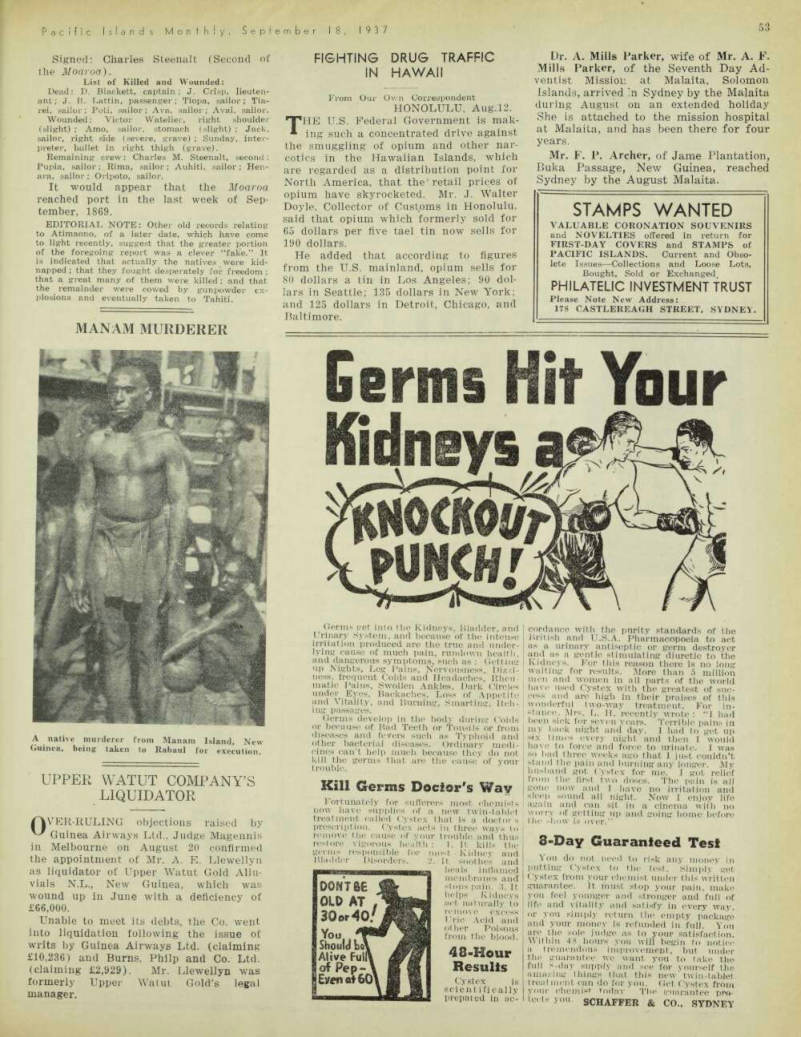
Fierce Fight Aboard Labour Vessel in 1869
By W. W. BOLTON, of Papeete.
THE Moaroa, owned by a Mr. Stewart, 13ft Atimaono, Tahitf, carrying a cargo of cotton to Auckland, New Zea land, and was ordered on its return to collect and bring back native labourers from the Line Islands, under wages, for the large and then prosperous plantation.
It was during the second portion of his orders that Captain Blackett and a num ber of his crew met a terrible death, and the ship was saved only by the gal lantry of its second mate, a Dane.
Herewith, lately come across, is given the report to the owner by the man who brought her home. ♦ ♦ * Three-masted barque of Tahiti Moaroa , in the Pacific Ocean, July 24, 1869.
Latitude; 7 degrees 32 minutes South; longitude: 175 degrees 45 minutes 45 seconds East.
Sir.—In hope of meeting before my arrival at Atimaono a ship en route for
the Society Islands, I have the honour to transmit to you the following report.
I will commence with a portion of the log since the day when we arrived in sight of the Gilbert Islands up to to-day, and I will then continue it up to the day when I shall encounter a ship or arrive in port.
Wednesday, June 16, 1869: At 11 in the morning we had seen Hope Island, or Arurai. We were approaching the island in the afternoon. Many canoes and a large ship’s boat reached us offering mats, coconuts, and other produce of the island in exchange for tobacco and red materials. We remained near this island till June 20, till 2 p.m. when we left for Byron Island, or Nukunau.
Monday, June 28: At six in the evening we were near Byron Island, and before nightfall 300 to 400 natives came aboard.
Some remained throughout the night.
June 29 and 30, and July 1 and 2: We remained off Byron Island, buying coco nuts, etc. On the 2nd the captain went ashore in an effort to persuade natives to embark with him.
July 3; We arrived off the island of Peru (Nonuiti); but as a white man of Byron Island had sent three men to warn the natives that we had need of men, none came aboard. The next morning, we met the three-masted barque Annie, of Me l bourne, which had 159 natives, but no water. The captain made arrangements to embark these natives for Tahiti, but as I am ignorant as to the conditions, it is impossible for me to note them here.
Mr. J. B. Lattin came aboard, at the same time, as a passenger to Tahiti and, besides, we had engaged as interpreter, for 20 piastres a month, a native who had resided a long while in the Fijian Islands. This man, having left the Annie. with his woman, came on board.
Having embarked the natives, and re ceived a quantity of powder provided by the Annie, we headed towards Hope Is land where we arrived July 12, at 5 p.m.
Two large ship’s boats came alongside w'th 37 natives all of whom remained on board' with the exception of two. On the 13th 19 natives came on board and on the 14th, six women arrived to join their mates. At 4 p.m. we headed for Byron Island where we arrived on Fri day, July 16. Passing the island we took aboard 68 natives and then set our course for Tahiti. Herewith further extract from the log.
July 17, 1869: Commenced with a calm, Byron Island to N.N.E., six miles off. At 5 a.m. the captain had given permission for all the natives (287) to come on deck, and there he distributed to them shirts and tobacco. All appeared to be tranquil, but the upper deck was crowded, near to 300 men were there en masse.
The men of the watch were behind the deck house, employed in preparing some
boards to construct a partition between the square and the orlop deck, when sud denly and without any warning (I had, however, seen a boy steal the knife of one of our men, and had thereupon beg ged the captain and Mr. Lattin to pass to the stern) suddenly, I say, the natives launched themselves upon the stern and attacked my watch.
I was then standing near the door of the deck cabin, where I saw a native kill Mr. Lattin with a hatchet. The latter was then near the rigging of the main mast. I seized a carbine and ran to the aid of the captain, but it was too late — he had received a knife thrust in the back, and another in the face, and had fallen dead near the door of the deck cabin. I sent one man below, who had received a very dangerous wound in the back (a knife thrust). Besides the knife thrust, the captain had received a ter rible blow from a hatchet in the face.
This hatchet had been stolen by one of the natives from the box containing tools, which he found on the deck.
At 6 o’clock, I retired to the mess room with one man, the only one who remained by me of my watch, and there I met the lieutenant (first mate) and the steward with a gun. In trying to aid the captain, the steward had been wounded in the right shoulder, but I did not know it then for he had not told me of this for fear of discouraging the rest.
We defended the mess room against all the natives and I have the conviction that we should have been successful in
retaking the deck house immediately if we had had good guns. Once safe in the mess, the natives blockaded us there com pletely, hurling at it firebricks secured from the kitchen, and covering the sky light and the hatches with anything they could find on deck; they even raised the staysail to put it over the skylight, but we prevented them from doing so with our carbines.
At 7 a.m. the men of the starboard watch were attacked in the bows but, having four old swords that I had put there the day before, they defended them selves, and the space was so narrow, leav ing room for only one man at a time, that the natives ceased to attack them.
At 9 a.m. two of these men had suc ceeded in joining us by detaching some boards of the partition, and as I held open the door of the mess leading to the storeroom, we saw them arrive. They told me that the three others would not be long in coming also, which in truth took place. I had then five men in all, but few arms, our long cavalry swords being well nigh useless in a hand-to-hand struggle.
Towards 11 a.m. the lieutenant insisted, despite me, to call in the interpreter, who was then lying bound by the natives in his cabin under deck. I forewarned him many times that the natives had seized the double-barreled gun of the interpreter and that it was loaded. But he paid not the least attention and was killed by a native wdth that gun. He fell dead. The ball entered his right shoulder after hav
ing smashed the frame which carried the skylight, and passed out about four inches from his heart.
When the natives saw him fall they indulged in a diabolical yelling on the upper deck, I then ceased to fire with my gun, thinking that by doing so the nat ives would take confidence and I should then be able to take them by surprise.
They all massed upon the upper deck, continuing to laugh and yell, without doubt thinking of the great quantities of tobacco and materials that the captain had shown to them and which they counted upon to seize in a short time. I had resolved to retake the ship, but it was not so easy with two guns and a revolver which did not work.
Then I decided to take a desperate measure which was to blow up the upper deck in the mid part of the ship and, during the disorder resulting, to throw myself across the smoke and retake the deck house.
We had received from the three-masted barque, the Annie, 45 boxes (in tin plate) each containing a half-pound of gun powder. Of these I emptied 34 into a small wide barrel; and. after having placed mats and sail cloth under the barrel to protect the ’tween decks with six other of the boxes I laid a train from the barrel to a large panel on the orlop deck.
I then gave orders that everyone should go below, even the steward, to the safest possible spot in the stern, so that they could all mount upon the upper deck
immediately after the explosion, and not to attend me, because they were more numerous than I alone, and less near to the explosion, and I could not say what might happen to me being so close. But I had confidence and I have never been calmer in my life.
After having seen the men in safety, and having made a short prayer for the protection of my wife and children, I set fire to the train, at the same moment hurling myself below. The explosion was immediate and I was nearly choked by the smoke. I regained the upper deck where I found the men, who had arrived before me, also the interpreter, who had been set free by his woman.
I cou’d not see a single native: but the sea was completely covered with black heads making for land.
My first care was to send two men below to extinguish the fire, and with the others I took all necessary measures against the natives seeking to return on board with their knives and other arms.
Thank God, the ship was completely ours and nothing had taken fire with the ex ception of the sail cloth which had been placed under the barrel, and which was completely extinguished by two buckets of water.
I examined the pumps immediately afterwards and, as they had not been worked since 4 a.m. and there was only two feet of water in the hold, not more than we habitually had in the same period. I felt sure that the vessel had not been materially damaged by the explo
sion, though it had trembled like an earthquake.
I went below later_ to see the state of affairs. The partition of the crew’s sleep ing quarters was in part demolished but it had not suffered as had the cabin in the stern. All the damage had there been done by the oars with which the natives had attacked us through the skylight.
The chronometer appeared to be working well. The clock was broken and entirely out of action; the thermometer was broken and the aneroid barometer had its glass broken. I noticed other damage which it is needless to mention. At noon we struck the time and hoisted the flag at the mainmast head.
I believe that all the natives arrived at Byron Island except two women, who had remained on board to go to Tahiti.
I have omitted to say that all our stern cargo had been lifted by the natives dur ing their blockade of the mess room.
Sunday, July 18: Commenced calm and finished with a light breeze. At 1 o’clock pumped the ship and commenced the repair of the deck which was as follows: under pools of water, planks and other things used by the natives to barricade the skylight, and on the port side near the door of his cabin was the captain whose head alone could be seen. It took me much time to disengage everything, having only five men capable of work.
The captain was literally covered with wounds, the left side of his face almost wholly gone. We laid him upon a mat and after having cleared the deck, re
paired the rigging, and whilst I was tending the wounded I had the men wrap the captain and the lieutenant each in anew mat and. having attached 50 fire bricks to each, and wrapped them in flags, at sunset after I had read a prayer for the dead, all being present and weep ing like children, we launched them into the deep.
After having fulfilled our duties to wards the dead, I bethought me of the survivors and the safety of the ship. I found that the deck between the bows and the final panel at the stern had been lifted nearly nine inches, and in the middle two planks had been completely torn up and hurled to the starboard side; the supports were demolished and seven of the beams of the deck either broken or more or less damaged; not sufficiently however to prevent the voyage to Tahiti under light sail. Having on board an old mainsail I had it cut in pieces and nailed over the open parts of the deck after having tarred it to prevent water pene trating, so far as possible. All the stan chions had fallen; we replaced them, and I hope with the reparations we have been able to make I shall be able to conduct the ship to Atimaono.
Having thus placed on record as the circumstances as well as I have been able to do, I beg you to excuse the faults of orthograph: lam not English but a Dane.
I trust that you may receive this re port before my arrival at Tahiti, shortly.
Signed: Charles Steenalt (Second of
the Moaroa).
List of Killed and Wounded: Dead: D. Blackett, captain; J. Crisp, lieuten ant; J. B. Lattin, passenger; Tiopa, sailor; Tia rei, sailor; Poti, sailor; Ava, sailor; Avai, sailor.
Wounded: Victor Watelier, right shoulder (slight) ; Amo, sailor, stomach (slight) ; Jack, sailor, right side (severe, grave) ; Sunday, inter preter, bullet in right thigh (grave).
Remaining crew: Charles M. Steenalt, second : Pupia, sailor; Rima, sailor; Auhiti, sailor; Hen ara, sailor; Oripoto, sailor.
It would appear that the Moaroa reached port in the last week of Sep
tember, 1869.
EDITORIAL NOTE: Other old records relating to Atimaono, of a later date, which have come to light recently, suggest that the greater portion of the foregoing report was a clever “fake.” It is indicated that actually the natives were kid napped ; that they fought desperately for freedom ; that a great many of them were killed ; and that the remainder were cowed by gunpowder ex plosions and eventually taken to Tahiti.
Advertisements & other items, pp. 53-55 (2 items)
Model 36
F. M, MARINE DIESEL ENGINES
ILLUSTRATING
10 HP.
MARINE DIESEL
POPULAR ISLANDS' MODEL
FULL PARTICULARS ON REQUEST
ENGINES FROM 10 TO 60 H.P.
CARRIED IN STOCK IN SYDNEY
SPARE PARTS ALWAYS AVAILABLE
FAIRBANKS-MORSE CO. (Aust.) LTD.
BOX 2672 EE,
G.P.0., SYDNEY
A Week’s Work in si Day
That's what you can accomplish with the Digger Winch.
For clearing land with a minimum of time and effort, there is no method which can nearly equal the use of the Digger " Winch.
And when the trees are down, get the Buzacott New Record Drag Saw on the job. It will cut the thickest and hardest logs on the ground, and will work while you go on grubbing.
The blade cannot break in the case of jambing, because the engine will run free until the saw is cleared.
These machines are in use by : Buiolo Gold Mines (4), Lever Bros. Pacific Plantations Ltd. (7), New Guinea Administration (2), and All Australian Government Departments.
V The . . .
Digger Winch
The Buiacott
I *
DRAG SAW
7TO II MARKET STREET SYDNEY.
Manam Murderer
A native murderer from Manam Island, New Guinea, being taken to Rabaul for execution.
Liquidator
Upper Watut Company’S
objections raised by ” Guinea Airways Ltd., Judge Magennis in Melbourne on August 20 confirmed the appointment of Mr. A. E. Llewellyn as liquidator of Upper Watut Gold Allu vials N.L., New Guinea, which was wound up in June with a deficiency of £66,000.
Unable to meet its debts, the Co. went into liquidation following the issue of writs by Guinea Airways Ltd. (claiming £10,236) and Burns, Phllp and Co. Ltd. (claiming £2,929). Mr. Llewellyn was formerly Upper Watut Gold’s legal manager.
Fighting Drug Traffic
In Hawaii
From Our Own Correspondent
Honolulu, Aug.L2.
TTHE U.S. Federal Government is mak * ing such a concentrated drive against the smuggling of opium and other nar cotics in the Hawaiian Islands, which are regarded as a distribution point for North America, that the'retail prices of opium have skyrocketed. Mr. J. Walter Doyle, Collector of Customs in Honolulu, said that opium which formerly sold for 65 dollars per five tael tin now sells for 190 dollars.
He added that according to figures from the U.S. mainland, opium sells for 80 dollars a tin in Los Angeles; 90 dol lars in Seattle; 135 dollars in New York; and 125 dollars in Detroit, Chicago, and Baltimore.
Dr. A. Mills Parker, wife of Mr. A. F.
Mills Parker, of the Seventh Day Ad ventist Mission at Malaita, Solomon Islands, arrived !n Sydney by the Malaita during August on an extended holiday She is attached to the mission hospital at Malaita, and has been there for four years.
Mr. F. P. Archer, of Jame Plantation, Buka Passage, New Guinea, reached Sydney by the August Malaita.
Advertisements & other items, p. 55 (1 item)
Germs Hit Your
STAMPS WANTED
VALUABLE CORONATION SOUVENIRS
and NOVELTIES offered in return for
FIRST-DAY COVERS and STAMPS of
PACIFIC ISLANDS. Current and Obsolete Issues—Collections and Loose Lots, Bought, Sold or Exchanged
PHILATELIC INVESTMENT TRUST
Please Note New Address:
178 CASTLEREAUH STREET, SYDNEY.
Germs Hit Your
r Si A \
KHOCKO^p
X
PUHCH/
\ Germs tret into the Kidneys, Bladder. and Urinary System, and because of the intense irritation produced are the true and underlying cause of much pain, rundown health, and dangerous symptoms, such as : Getting up Nights, Leg Pains, Nervousness, Dizziness, frequent Colds and Headaches, Rheumatic Pains, Swollen Ankles, Dark Circles under Eyes, Backaches, Loss of Appetite and Vitality, and Burning, Smarting, Itching passages.
Germs develop in the body during Colds or because of Bad Teeth or Tonsils or from diseases and fevers such as Typhoid and other bacterial diseases. Ordinary medicines can’t help much because they do not kill the germs that are the cause of your trouble.
Kill Germs Doctor's Way
Fortunately for sufferers most chemists now have supplies of a new twin-tablet treatment called Cystex that is a doctor s prescription. Cystex acts in three wavs te remove the cause of your trouble and’thus restore vigorous health: 1. It kills the germs responsible for most Kidney and Bladder Disorder-
DON!66
OLD AT
30 or 40,
You
Should Lol
Alive Full
of Pep- ,
Even at 601
It soothes and heals inflamed membranes and stops pain. :t. It helps Kidneys act naturally to remove excess Uric Acid and other Poisons from the blood.
48-Hour
Results
Cystex is scientifi callv prepared in accordance with the purity standards of the British and U.S.A. Pharmacopoeia to act as a urinary antiseptic or germ destroyer and as a gentle stimulating diuretic to the Kidneys. For this reason there is no long waiting for results. More than 5 million men and women in all parts of the world have used Cystex with the greatest of success and are high in their praises of this wonderful two-way treatment. For instance. Mrs. L. H. recently wrote: “1 had been sick for seven years. Terrible pains in my hack night and day. 1 had to get up six times every night and then I would have to force and force to urinate. I was so had three weeks ago that 1 just couldn’t stand the pain and burning any longer. My husband got Cystex for me. I got relief from the first two doses. The pain is all gone now and I have no irritation and sleep sound all night. Now I enjoy life again and can sjt in a cinema with no worry of getting tip and going home before the -how is over.”
8-Day Guaranteed Test
You do not need to risk any money in putting Cystex to the test. Simply get Cystex from your chemist under this written guarantee. It must stop your pain, make you feel younger and stronger and full of life and vitality and satisfy in every way. or you simply return the empty package and your money is refunded in full. You are the sole judge as to your satisfaction.
Within 48 hours you will begin to notice a tremendous improvement, but under the guarantee we want you to take the full S-day supply and see for vourself the amazing things that this new'twin-tablet treat ment can do for you. Get Cystex from your chemist today The guarantee protects you SCHAFFER & CO.. SYDNEY
Mod E Rn Version Of Goose That
Laid Golden Egg
WHEN Mr. Leo Poland, of Wau, New Guinea, killed one of his ducks recently he found fine gold worth £2 in the crop of the bird. Mr. Poland thought furiously—and then went out and pegged a mining area just below the township of Wau, where the duck customarily roamed. The incident has greatly inter ested Wau, and Mr. Poland is now treated with the deference due to the original owner of the goose that laid the golden egg.
Mr. Leo Gibbons, of Gold Mines of
Papua Ltd., Misima Island, arrived in
Australia in August by the Montoro,
Anth Ropophagology
(Inspired by certain aspects of the report of the Conference on Native Education held last year in Honolulu.) IN lovely Hawaii, where the sea and the sky (And the girls) are attractive and kind, A coterie small, anthropologists all.
Assembled to talk themselves blind.
“Though the world may deride,” one orator cried, “And scientists gurgle with mirth.
Yet at last here we are in our own Seminar And WE KNOW we’re the salt of the earth.”
The others applauded. Reporters recorded The speech and were hungry for more.
But they w r aited in vain; no one spouted again, So they all went to sleep on the floor.
And the president said, as he scratched his bald head And removed a sea-slug from his ear, “The meeting’s a wow! It’s all clear to me now.
We’re the salt of the Ocean. Hear, hear!
Still the conference sat, and its members grew fat And took all the pleasure they could.
They had lobsters for tea; and between you and me They ate very much more than they should.
They »ay on the beach with a girl side by each.
And they dallied and dithered and dozed Till young Clarence one morning, without any warning.
Spoke thus e’er the conference closed; “As regards education, the nativization Of civilised custom must hold.
Native culture must live; nor must cannibals give Up their habits because they are told.
Let the head-hunters thrive, and their customs survive As the basis of solid advance.
I’m all for sensation; and civilisation Don’t give our great science a chance.’’
They gave him a cheer and they bought him a beer.
And they put him to bed on the beach With his head in the sand and some Aspro at hand And a large block of ice within reach.
When they waked him at dawn he sat up with a yawn And reached for the pants by his bed.
But they shouted, “Go slow! You are nativized now!’’
And they gave him a sulu instead.
They dressed him in that and a panama hat And a pair of tan shoes for his feet.
And they shipped him “with care’’ on a second class fare To Papua’s peaceful retreat.
As he sat in his camp in a pestilent swamp Some two hundred miles up the Fly, In deep meditation on nativization, A cannibal party came by.
Young Clarence cried “Halt! If you’ve pepper and salt And some dishes and cutlery too, I’ll show you the way to eat man. And I’d say I know far more about it than you.”
So he started a class, the fatuous ass.
Good manners with custom combining.
And recited the rules to those cannibal ghouls Till he’d taught them the whole art of dining.
“Now A is for appetite. B is for belch (please don’t do it so close in my ear).
And C for the corpse, and D for the dish.
And E for the strict etiquette that I wish To instil into ev’ry one here.
“F is for fingers, but also for fork; G the gravy you drink without noise.
H for the habits I teach ev’ry day, I for the innards the cook throws away.
And J for the joint’s juicy joys.
“K is the knuckle-bone, nutty to gnaw; L for liver, and M is for meat.
And N for the napkin you always should use; And O for the orgies I’ll never refuse; P the pain if you once over-eat.”
So, the alphabet through, he instructed his crew' Of crude but ambitious man-eaters Till they’d learned such a lot they neglected the pot And grew thin as the hungry mosquiters.
Then the chief took a stand with a club in his hand Facing poor little Clarence. “The fact is, I’ve a concept,” said he. “It’s a new one to me, And I’m going to put it in practice.
“Now A is for anger as well as for art; and B is for brain soft and sweet.
And C is for club and for cranium, too.
And D’s for a dinner with which we could do.
And E is for esculent; that must mean you— And we’re all wanting something to eat.”
The speaker stopped there; but his murderous stare Caused Clarence to gasp and to shiver.
Then he shouted, “My hat! You must never do that!”
And he flung himself into the river.
As he swam with the stream he awoke from his dream To the facts of his own situation; And he cried: “I for one have quite finally done With the concept of nativization.”
Advertisements & other items, p. 56 (1 item)
Burns Philp
ST All LINE
CHINESE LACQUER
For all Indoor and Outdoor Decoration
1/- fin covers 18 sq. feet
"STARLINE" CHINESE LACQUER : Is guaranteed to withstand the severe elements to which paint is subjected in the Tropics, including Salt Water, Heat and Rain, etc., and will not lose its gloss or permanence.
To give some idea of the covering capacity, one gallon will cover over 1200 sq. ft. 42 colours to choose from . . . Dries in a few hours.
Won't chip or crack.
MADE IN ENGLAND
Write to us for Colour Chart and full particulars regarding attractive sole agency for territories still vacant.
For Fiji, Tonga and Samoa, Messrs. MORRIS HEDSTROM LTD.
AGENTS: p or T a hifj anc J Cook Islands, Messrs. A. B. DONALD LTD.
Factory Representative for all Islands and New Zealand : NEW ZEALAND DISTRIBUTORS LTD., Box 530, AUCKLAND, N.Z.
BURNS PHiLP
(SOUTH SEA) CO. LTD.
Inc. in Fiji
Island Traders and Shipowners
Also Branches at: Registered Office:
SUVA
FIJI
\ Code Address: "Burnsouth."
Fiji: Levuka, Lautoka, Labasa, Ba, Sigatoka, Rotuma.
Tonga: Nukualofa, Haapai, Vavau.
Samoa: Apia, Pago Pago (American Samoa).
Solomons: Makambo, Gizo, Faisi.
New Hebrides: Vila.
Gilberts: Tarawa.
Norfolk Is. Niue. Wallis Is. Futuna Is.
“Uncle Sam" Means Business
Huge Amounts Being Spent on Hawaiian Air Bases
From Our Own Correspondent
Honolulu, Aug. 16.
OECAUSE it is determined to control rigidly all the incoming and outgoing trans-Pacific aviation in Hawaii, the U.S.
Federal Government has set aside a large harbour and land area five miles from Honolulu as an international land and seaplane base.
Undoubtedly first to use it will be the cl.ppers of Pan-American Airways Sys tem, although it probably will be avail able to Australasian planes on the pro posed service to Vancouver. This Kalihi Harbour base runs into Honolulu Har bour proper, and it will be approximately half way between the city and Pearl Harbour navy base and the 18,000,000 dollar Hickam army aviation field now under construction, Hickam will be easily the largest mili tary airfield in the world. The runway alone, one mile long and 600 yards wide, is costing 1,000,000 dollars to construct.
It is designed especialy for heavily loaded long range military planes.
Further signs of the times that “Uncle Sam” means business within the Pacific is to be found in President Roosevelt’s approval of a new U.S. naval air station to be built at Alameda, across the San
Francisco harbour at the site of the pre sent Pan-American Airways System’s headquarters for the trans-Pacific route.
Initial cost will be 13,000,000 dollars.
P.A. Airways will shift to facilities al ready leased at San Francisco municipal airport.
The Hawaiian Territorial Government, also, acting under Washington approval, immediately will set about improving ex isting commercial airports in the islands at a total cost of 600,000 dollars. On the army side, a sum of 3,300,000 dollars has been approved to be spent this year in improving army facilities on Oahu, the most heavily defended spot in the stra tegic islands, which are called the key stone of America’s defence against the Orient.
At the same time, Japan, through spokesman Foreign Minister Naotake Sato, has emphatically declared that she has not nor does intend to fortify her mandated islands in the Pacific.
Said Mr. Sato, however: “It is true Japan is widening and improving har bour facilities at Saipan Island in order to admit vessels of 3,000 tons and to cheapen and expedite the movement of sugar and other increasing Islands pro ducts.’’ Saipan is 100 miles north of Guam, the U.S. navy possession which is a closed port.
America is improving harbour facilities at Wake and Midway Islands between Guam and the Hawaiian Group. They are stops on the American trans-Pacific air route.
Papuan Road To Be
Repaired
From Our Own Correspondent
Pt. Moresby, Aug. 24.
SATISFACTION has been expressed by residents of the Sogeri District, Papua, at the vote of £BOO in the coming year’s Estimates for repairs to that por tion of the road known as Magigi-Sogeri. which has for past years been neglected owing to lack of funds.
The district is well known and holds large areas of rubber lands under culti vation. The section of road in question leads over rocky ridges of the Astrolabe Range. Owing to its rough and broken surface, it has hindered transport to and from Port Moresby, preventing cars and lorries going the whole distance.
The Southern Pacific Insurance Com pany Ltd., which was registered in 1935 as a subsidiary of W. R. Carpenter & Company Ltd., made a net profit of £2618 for the year ended March 31. A dividend of 6 per cent, per annum is recommended.
Issued capital is £43,750, in 25,000 shares, fully paid to £1 each, and 75,000 shares, paid to 5/- each.
Mr. Jim Leahy, of the well-known Leahy brothers in New Guinea, left Bris bane by the Macdhui on August 30 for Port Moresby en route to the N.G. goldfields.
Mrs. S. Costello, of Rabaul, arrived in Australia from New Guinea by the Nellore on August 20. After spending 10 days’ holiday in Sydney, she went on to Inverell, N.S.W., her former home, where she is now staying with her parents, Mr. and Mrs. W. Errington Gray.
Advertisements & other items, pp. 57-58 (1 item)
Ruston
Huon Pine Boat Planks
Practically Borer Proof and Everlasting, also Spotted Gum Timbers—Prices Right.
A. C. Fryer
110 Miller St., Pyrmont, N.S.W.
RUSTON
Marine Diesel Engines
Size Range:- 10 H.P. to 800 H.P.
RUSTON & HORNSBY (AUST.) PTY. LTD.
RUSTONS have proved
their supremacy in the marine
engine field all over the world.
The following is an extract from a testimonial received from a Ruston engine user who has an 18 h.p. Ruston Marine Diesel Engine installed in a boat Sift long by 10 ft 6iws beam with a 2ft Gins drgw.
In response to your request for particulars of my 18 H.P. Ruston Engine I have pleasure in handing to you the following: "I am pleased to state that the engine has been everything you claimed it to be, so much so that I infend installing another one of 14 H.P. in my other boat. The boat that this engine was installed in, previously had an [8 H.P. petrol engine of well known make, but in two seasons of approximately 14 months in all the difference in the cost of operation has fully paid for the new engine. Two points I would like to stress are that the engine uses practically no lubricating oil, and the ease with which it operates under varying loads. The speed obtained from this engine is I 1.5 knots per hour. ' The last report received from this Ruston user indicates that the engine is still giving every satisfaction.
MELBOURNE SYDNEY
174 King Street 642-4 Jones Street
BRISBANE
Barry Parade
ADELAIDE
20 Franklin Street Sole Agents in the Mandated Territor ai© . . .
BURNS. PHILP & CO. LTD.
fdf
Sir Henry Scott Entertained
by Pacific Is. Club
6O guests, representing Government and commercial interests in the South Seas, attended a luncheon in honour of Sir Henry Milne Scott, K.C., of Suva, and Lady Scott, given by the Pacific Islands Club at the Hotel Carlton in Sydney on August 26.
Among those present were the Consul for Italy, feir Charles Rosenthal (the new Administrator of Norfolk Island), Hon.
Gerald Hogan .(Crown Law Officer in New Guinea), directors of Messrs. Burns, Philp and Co. Ltd., W. R. Carpenter and Co. Ltd., Colonial Sugar Refining Co., Dalgety and Co., Lever’s Pacific Plan tations Ltd., Mr. H. A. Bentley (Ocean Island), Mr. Thomas Horne (Suva).
Sir Henry, who was Fiji’s senior offi cial representative at the Coronation, spoke of his impressions of that historic occasion. In his description of the cere mony and subsequent events, he gave a fund of little human incidents concern ing the Royal Family, the great, cheerful London crowds with their loyal and sin cere devotion for the King and Quden,
and that pillar of commonsense the English “bobby.”
The foremost impression of his visit to Europe, declared Sir Henry, was that Britain, under Neville Chamberlain, is, and for a long time will be, the best pos sible bulwark for world peace.
Mr. W. Taylor, N.Z. Government Trade and Tourist Commissioner, presided over the gathering.
Sir Henry and Lady Scott left Sydney for Suva by the Niagara on September 2.
J. C. Waldron Retires
For 13 Years Engineer on Papuan Government’s “Laurabada”
Fiom Our Own Correspondent
Pt. Moresby, Aug. 15.
11/fR. J. C. WALDRON, the popular and ■L** well-known engineer of the Papuan Governor’s vessel Laurahada, resigned from the service in July. He left the Ter ritory for Australia on July 30.
Mr. Waldron, who has been engineer on the Laurahada for over 13 years, came to Papua 27 years ago. In his capacity as engineer of Government vessels he has had many interesting experiences, and has visited numerous outlying and little known parts of the territory.
In 1922 when in charge of the Nivani conveying Mr. Leo Austin (then Assis tant Resident Magistrate of the Western Division) on his well-known patrol up the Fly River to the Alice and Star Mountains, Mr. Waldron proceeded 50 or more miles up the Fly above D’Albertis Junction, where an island was named in his honour. There the Nivani was forced to anchor, owing to bars and torrential waters, the main stream narrowing to little over 60 yards.
Mr. Waldron’s pleasing personality will be missed along the Papuan coast. His ready humour and fund of anecdotes have for past years entertained many a lonely settler on outlying stations.
Dr. William L. Moss, for many years a member of the Harvard (U.S.A.) medi cal faculty, arrived in Sydney by the Monterey during August. He went on to Canberra to seek permission, as leader of the Crane-Peabody expedition, to enter the territory west of Mt. Hagen in Cen tral New Guinea.
Advertisements & other items, p. 58 (2 items)
Paxman Ricardo
" Comet - Head " High Speed
DIESEL ENGINES
STATIONARY MARINE TRACTION
Special Features:
Great Accessibility.
Invisible Exhaust at all Loads.
Low Fuel and Oil Consumption.
Big Overload Capacity.
Great Flexibility.
Easy Starting from cold.
Full Diesel Engines available from to 1,200 h.p. in Stationary, Traction and Marine Types.
Sole Agents :
NOYES BROS.
j 40 K.W. Paxman-Ricardo six-cylinder High-speed Diesel Engine Generating Set.
Manufactured by :
DAVEY PAXMAN & CO.
(Colchester) LTD., ENGLAND
(Sydney) LTD.
115 CLARENCE ST.
SYDNEY
197 ELIZABETH ST.
BRISBANE
II WATT ST.
NEWCASTLE
Bullivants' Wire Ropes
w
THE WORLD'S STANDARD 1
I LARGEST STOCKS IN AUSTRALASIA :: :: FOR ALL PURPOSES .
Also Blocks, Hooks, Shackles, Thimbles, Strand, Seizing, Aircraft Cord, etc, ii Prompt Attention! Efficient Service!! Complete Satisfaction!!!
BULLIVANTS' Australian Co. Pty., Ltd.
Letters* Incorporated in Victoria.
Box 1298 J, G.P.o. 331 KENT STREET, SYDNEY Telegrams: Sydney “Bullivants Ltd.’' ♦
Cl Fruit
N.Z. Govt. Offers £35,000 Loan for Cool Storage Plant
From Our Own Correspondent
Rarotonga, Aug. 15.
August 3 an informal meeting of the Cook Islands Council and the Fruit Advisory Committee was held to discuss a loan of £35,000, free of interest for all time, which had been offered by the N.Z. Government for the purpose of erecting a cool storage plant in Raro tonga. Pending further details a definite decision was postponed.
Government control of the banana in dustry on similar lines to those govern ing the export of citrus fruit was also discussed and a decision postponed. In the interim, as a departure from the pre vailing system under which all bananas must be packed in the village sheds, 12 of the larger and more responsible native growers are to be permitted to pack on their own plantations. Many planters claim that transport of bananas in bunches over long distances is detrimen tal to their condition on arrival in New Zealand, At an earlier meeting of the Fruit Ad visory Committee, it was decided to cable to Australia regarding the purchase of 1.000 young Valencia orange trees for distribution among reliable local planters.
Bounty On Rats
The rat problem was also raised and it was agreed to restore the bounty of Id per dead rat. Old hands on the “beach” have memories of a time when certain enterprising persons, remembering that in French Oceania a similar bounty was being paid on receipt of rat ears, ar ranged with friends resident there to for ward them parcels of tails, neatly chopped to standard length and looking remark ably like packets of dried vanilla beans!
This “tail and ear” exchange did a brisk business until a suspicious Administration rather unkindly insisted on production of the whose corpse!
Resident Commissioner’S
Interest
The Resident Commissioner (Mr. S. J.
Smith) to whom the. credit for introduc ing “fruit control” is practically entirely due, has created something of a prece dent by making a point of establishing personal contact with individual growers in the various districts and also by his informal inspection of plantations. For this latter purpose, Mr. Smith has im ported a good riding horse, and by this means is now enabled to visit many an inland kainga and valley inaccessible to
the transport usually favoured by those in exalted positions.
Between Mr. Goodwin (Director of Agriculture) and the Resident Commis sioner, there is complete agreement and co-operation on the question of control.
This situation makes for general smooth running since on the former rests the practical, and on the latter the final, responsibility for the success of the whole system.
To raise funds for a British Antarctic expedition, 80 passengers will be taken on a world cruise at the end of this year in the schooner Westward. The voyage will be under sail the whole way and she will call at Easter Island, Pitcairn, Ta hiti, Fiji, New Zealand, and Australia.
Drought Broken On
Christmas Island
Papeete, Aug. 19.
'THE Tahiti schooner Denys (Captain Alexander Mervin) voyaged to Christ mas Island late in July and returned to Papeete on August 11.
Captain Mervin reports that the drought there has broken and the plan tations on Christmas are rapidly recover ing from the effects of the long season of dry weather.
There was a British warship at Christ mas Island while the Denys was there.
Mr. C. R. Christian has been elected chairman of the Norfolk Is. Hospital Board.
Advertisements & other items, p. 59 (2 items)
the jar
4 m 1
Theres a diinn in
iliwi
r not —there really is a djinn in the Jar Battery ... a kindly and ever-so-helpful djinn who will operate your refrigerator, refresh you with cool breezes, heat your iron or light your home at the snap of a switch. Into this jar of the Clyde Batteries is packed an astonishing amount of energy.
For an incredible number of hours this djinn of trical energy will expend itself on your behalf The djinn in the jar of Clyde Batteries is a better, stronger djinn than in other batteries, because in Clyde Batteiies the plante plates wherefrom the energy is released are thicker and the fine rubber insulator preserves the power producing lead paste. Instal Clyde Batteries and see for yourself how much better they are.
All Clyde Batteries are fully guaranteed.
HOME LIGHTING BATTERIES
The Clyde Engineering Co. Ltd.
61-65 WENTWORTH AVENUE.
Island Agents:
SYDNEY
Burns. Fhilp & Co. Ltd. W. R. Carpenter & Co. Ltd Kabaul: John L. Peadon Ltd.
Fiji: Morris, Hedstrom Ltd.
Stamps
Packets of stamps containing no common issues, world-wide variety, airmails, etc., best value -Australia. at 1/-, 2/6, 5/-, 10/-, 15/-, 20/-. 3O/-, 40/-. Money back guarantee. Also beginners packets. Larger quantities at same prices Albums: 4/6, 7/-, 13/6; with maps, 16/-, 27/6; loose-leaf. 10/-, 20/-, 40/-, etc. All post free.
Wanted, immediately, for cash, quantities of 100 and more Papua Sd and 2d; also Tongans and Coronations.
S. B. PAGE, Yolande, Coonamble. N.S.W., Aust.
Health of Central Pacific
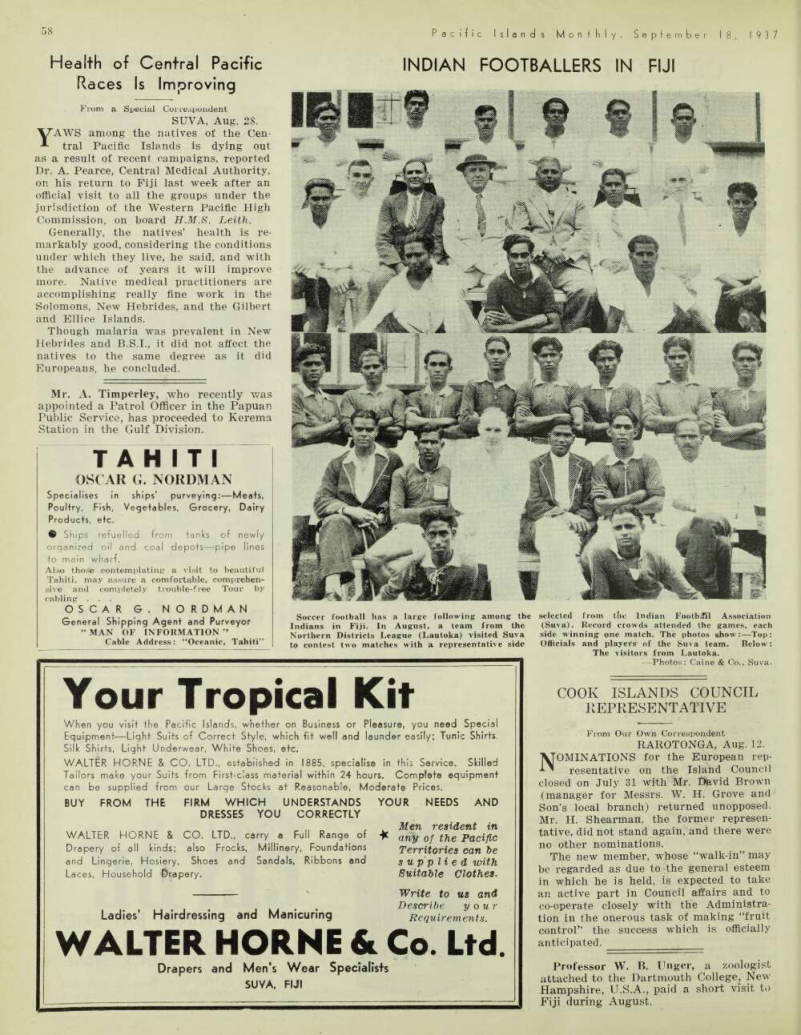
Races Is Improving
From a Special Correspondent
Suva, Aug. 28.
VTAWS among the natives of the Cen -*■ tral Pacific Islands is dying out as a result of recent campaigns, reported Dr. A. Pearce, Central Medical Authority, on his return to Fiji last week after an official visit to all the groups under the jurisdiction of the Western Pacific High Commission, on board H.M.S. Leith.
Generally, the natives’ health is re markably good, considering the conditions under which they live, he said, and with the advance of years it will improve more. Native medical practitioners are accomplishing really fine work in the Solomons, New Hebrides, and the Gilbert and Ellice Islands.
Though malaria was prevalent in New Hebrides and 8.5.1., it did not affect the natives to the same degree as it did Europeans, he concluded.
Mr. A. Timperley, who recently was appointed a Patrol Officer in the Papuan Public Service, has proceeded to Kerema Station in the Gulf Division.
Indian Footballers In Fiji
Soccer football has a large following among the Indians in Fiji. In August, a team from the Northern Districts League (Lautoka) visited Suva to contest two matches with a representative side
selected from the Indian Football Association (Suva). Record crowds attended the games, each side winning one match. The photos show:—Top: Officials and players of the Suva team. Below: The visitors from Lautoka. —Photos: Caine & Co., Suva.
Cook Islands Council
Representative
From Our Own Correspondent
Rarotonga, Aug. 12.
NOMINATIONS for the European rep resentative on the Island Council closed on July 31 with Mr. D&vid Brown (manager for Messrs. W. H. Grove and Son’s local branch) returned unopposed.
Mr. H. Shearman, the former represen tative, did not stand again, and there were no other nominations.
The new member, whose “walk-in” may be regarded as due to the general esteem in which he is held, is expected to take an active part in Council affairs and to co-operate closely with the Administra tion in the onerous task of making “fruit control” the success which is officially anticipated.
Professor W. B. Unger, a zoologist attached to the Dartmouth College, New Hampshire, U.S.A., paid a short visit to
Fiji during August.
Advertisements & other items, p. 60 (1 item)
Your Tropical Kit
TAHITI
OSCAR G. NORDMAN
Specialises in ships' purveying:—Meats, Poultry, Fish, Vegetables, Grocery, Dairy Products, etc. Ships refuelled from tanks of newly organized oil and coal depots—pipe lines to main wharf.
Also those contemplating a visit to beautiful Tahiti, may assure a comfortable, comprehensive and completely trouble-free Tour by cabling . . .
OSCAR G. NORDMAN
General Shipping Agent and Purveyor
“ MAN OF INFORMATION ”
Cable Address: “Oceanic, Tahiti”
Your Tropical Kit
When you visit the Pacific Islands, whether on Business or Pleasure, you need Special Equipment—Light Suits of Correct Style, which fit well and launder easily; Tunic Shirts.
Silk Shirts, Light Underwear, White Shoes, etc.
WALTER HORNE & CO. LTD., established in 1885, specialise in this Service. Skilled Tailors make your Suits from First-class material within 24 hours. Complete equipment can be supplied from our Large Stocks at Reasonable, Moderate Prices.
BUY FROM THE FIRM WHICH UNDERSTANDS
DRESSES YOU CORRECTLY
WALTER HORNE & CO. LTD., carry a Full Range of Drapery of all kinds; also Frocks, Millinery, Foundations and Lingerie. Hosiery, Shoes and Sandals, Ribbons and Laces, Household Drapery.
Ladies' Hairdressing and Manicuring
YOUR NEEDS AND
Men resident in * any of the Pacific Territories can be supplied with Suitable Clothes.
Write to us and Describe your Requirements.
WALTER HORNE & Co. Ltd.
Drapers and Men's Wear Specialists
SUVA, FIJI
By King's Descendant
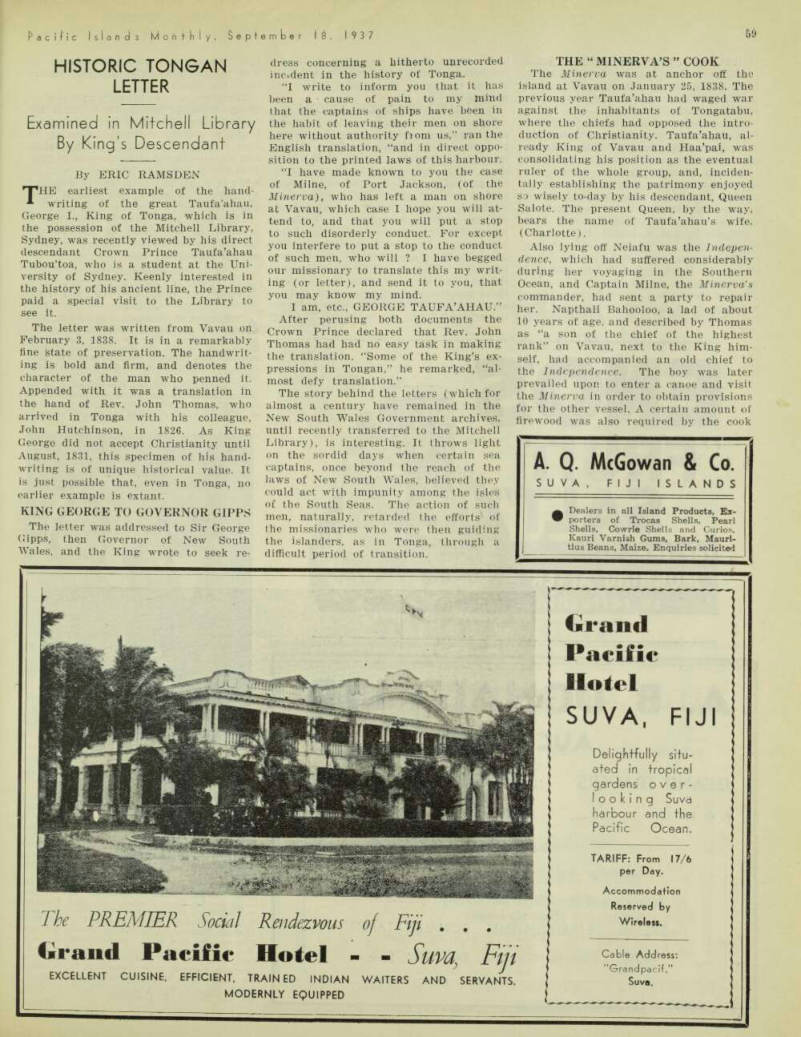
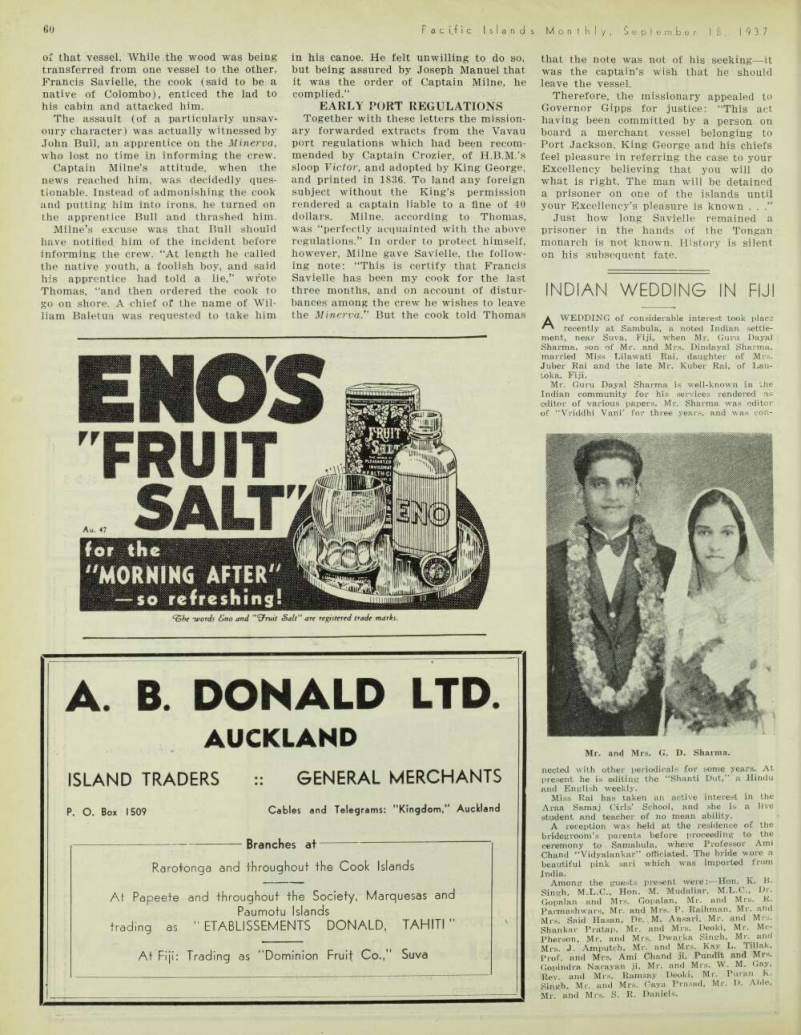
Historic Tongan
Letter
Examined in Mitchell Library By King's Descendant
By Eric Ramsden
'"PHE earliest example of the hand * writing of the great Taufa’ahau, George 1., King of Tonga, which is in the possession of the Mitchell Library, Sydney, was recently viewed by his direct descendant Crown Prince Taufa’ahau Tubou’toa, who is a student at the Uni versity of Sydney. Keenly interested in the history of his ancient line, the Prince paid a special visit to the Library to see it.
The letter was written from Vavau on February 3, 1838. It is in a remarkably fine state of preservation. The handwrit ing is bold and firm, and denotes the character of the man who penned it.
Appended with it was a translation in the hand of Rev. John Thomas, who arrived in Tonga with his colleague, John Hutchinson, in 1826. As King George did not accept Christianity until August, 1831, this specimen of his hand writing is of unique historical value. It is just possible that, even in Tonga, no earlier example is extant.
King George To Governor Gipps
The letter was addressed to Sir George Gipps, then Governor of New South Wales, and the King wrote to seek re
dress concerning a hitherto unrecorded incident in the history of Tonga.
“I write to inform you that it has been a cause of pain to my mind that the captains of ships have been in the habit of leaving their men on shore here without authority from us,” ran the English translation, “and in direct oppo sition to the printed laws of this harbour.
“I have made known to you the case of Milne, of Port Jackson, (of the Minerva), who has left a man on shore at Vavau, which case I hope you will at tend to, and that you will put a stop to such disorderly conduct. For except you interfere to put a stop to the conduct of such men, who will ? I have begged our missionary to translate this my writ ing (or letter), and send it to you, that you may know my mind.
I Am, Etc., George Taufa’Ahau.”
After perusing both documents the Crown Prince declared that Rev. John Thomas had had no easy task in making the translation. “Some of the King’s ex pressions in Tongan,” he remarked, “al most defy translation.”
The story behind the letters (which for almost a century have remained in the New South Wales Government archives, until recently transferred to the Mitchell Library), is interesting. It throws light on the sordid days when certain sea captains, once beyond the reach of the laws of New South Wales, believed they could act with impunity among the isles of the South Seas. The action of such men, naturally, retarded the efforts of the missionaries who were then guiding the islanders, as in Tonga, through a difficult period of transition.
The “ Minerva’S ” Cook
The Minerva was at anchor off the island at Vavau on January 25, 1838. The previous year Taufa’ahau had waged war against the inhabitants of Tongatabu, where the chiefs had opposed the intro duction of Christianity. Taufa’ahau, al ready King of Vavau and Haa’pai, was consolidating his position as the eventual ruler of the whole group, and, inciden tally establishing the patrimony enjoyed so wisely to-day by his descendant, Queen Salote. The present Queen, by the way, bears the name of Taufa’ahau’s wife, (Charlotte).
Also lying off Neiafu was the Indepen dence, which had suffered considerably during her voyaging in the Southern Ocean, and Captain Milne, the Minerva's commander, had sent a party to repair her. Napthali Bahooloo, a lad of about 10 years of age. and described by Thomas as “a son of the chief of the highest rank” on Vavau, next to the King him self, had accompanied an old chief to the Independence. The boy was later prevailed upon to enter a canoe and visit the Minerva in order to obtain provisions for the other vessel. A certain amount of firewood was also required by the cook
of that vessel. While the wood was being transferred from one vessel to the other, Francis Savielle, the cook (said to be a native of Colombo), enticed the lad to his cabin and attacked him.
The assault (of a particularly unsav oury character) was actually witnessed by John Bull, an apprentice on the Minerva, who lost no time in informing the crew.
Captain Milne’s attitude, when the news reached him, was decidedly ques tionable. Instead of admonishing the cook and putting him into irons, he turned on the apprentice Bull and thrashed him.
Milne’s excuse was that Bull should have notified him of the incident before informing the crew. “At length he called the native youth, a foolish boy, and said his apprentice had told a lie,” wrote Thomas, “and then ordered the cook to go on shore. A chief of the name of Wil liam Baletua was requested to take him
in his canoe. He felt unwilling to do so, but being assured by Joseph Manuel that it was the order of Captain Milne, he complied,”
Early Port Regulations
Together with these letters the mission ary forwarded extracts from the Vavau port regulations which had been recom mended by Captain Crozier, of H.B.M.’s sloop Victor, and adopted by King George, and printed in 1836. To land any foreign subject without the King’s permission rendered a captain liable to a fine of 40 dollars. Milne, according to Thomas, was “perfectly acquainted with the above regulations.” In order to protect himself, however, Milne gave Savielle, the follow ing note; “This is certify that Francis Savielle has been my cook for the last three months, and on account of distur bances among the crew he wishes to leave the Minerva .” But the cook told Thomas
that the note was not of his seeking—it was the captain’s wish that he should leave the vessel.
Therefore, the missionary appealed to Governor Gipps for justice: “This act having been committed by a person on board a merchant vessel belonging to Port Jackson, King George and his chiefs feel pleasure in referring the case to your Excellency believing that you will do what is right. The man will be detained a prisoner on one of the islands until your Excellency’s pleasure is known . .
Just how long Savielle remained a prisoner in the hands of the Tongan monarch is not known. History is silent on his subsequent fate.
Advertisements & other items, pp. 61-62 (1 item)
Suva. Fiji
A. Q. McGowan & Co.
SUVA. FIJI ISLANDS
• Dealers in all Island Products, Exporters of Trocas Shells, Pearl Shells, Cowrie Shells and Curios, Kauri Varnish Gums, Bark, Mauritius Beans, Maize. Enquiries solicited
The PREMIER Social Rendezvous of Fiji . . .
Grand I’ariKh* - - Suva, Fiji
EXCELLENT CUISINE. EFFICIENT. TRAINED INDIAN WAITERS AND SERVANTS.
MODERNLY EQUIPPED
Grand
Pacific
Hotel
SUVA. FIJI
Delightfully situ-
ated in tropical gardens over-
looking Suva
harbour and the Pacific Ocean.
TARIFF: From 17/6
per Day.
Accommodation Reserved by Wireless.
Cable Address: "Grandpacif,"
Suva.
ENOS
FRUIT
SALT
Au. 47 for the
"MORNING AFTER"
—so refreshing! <£pui' inn* m
IB S
c&he -words Gno and ” < vFruit Salt” are registered trade marks.
A. B. DONALD LTD.
AUCKLAND
ISLAND TRADERS :: GENERAL MERCHANTS
P. O. Box 1509 Cables and Telegrams: "Kingdom," Auckland Branches at Rarotonga and throughout the Cook Islands At Papeete and throughout the Society, Marquesas and Paumotu Islands
trading as " ETABLISSEMENTS DONALD, TAHITI
At Fiji: Trading as "Dominion Fruit C 0.," Suva
Indian Wedding In Fiji
A WEDDING of considerable intei’est took place recently at Sambula, a noted Indian settle ment, near Suva, Fiji, when Mr. Guru Dayal Sharma, son of Mr. and Mrs. Dindayal Sharma, married Miss Lilawati Rai, daughter of Mrs.
Juber Rai and the late Mr. Kuber Rai, of Lau voka, Fiji.
Mr. Guru Dayal Sharma is well-known in the Indian community for his services rendered as editor of various papers. Mr, Sharma was editor of “Vriddhi Vani’ for three years, and was con-
nected with other periodicals for some years. At present he is editing the “Shanti Dut,” a Hindu and English weekly.
Miss Rai has taken an active interest in the Araa Samaj Girls’ School, and she is a live student and teacher of no mean ability.
A reception was held at the residence of the bridegroom’s parents before proceeding to the ceremony to Samabula, where Professor Ami Chand “Vidyalankar” officiated. The bride wore a beautiful pink sari which was imported from India.
Among the guests present were:—Hon. K. B.
Singh, M.L.C., Hon. M. Mudaliar, M.L.C., Ur.
Gopalan and Mrs. Gopalan, Mr. and Mrs. K.
Parmashwars, Mr. and Mrs. P. Raihman, Mr. and Mrs. Said Hasan, Dr. M. Ansari, Mr. and Mrs.
Shankar Pratap, Mr. and Mrs. Deoki, Mr. Mc- Pherson, Mr. and Mrs. Dwarka Singh, Mr. and Mrs. J. Amputch, Mr. and Mrs. Kay L. Tillak, Prof, and Mrs. Ami Chand ji. Pundit and Mrs.
Gopindra Narayan ji, Mr. and Mrs. W. M. Gay, Rev. and Mrs. Ramsay Deoki, Mr. Puran K.
Singh, Mr. and Mrs. Gaya Prasad, Mr. D. Able.
Mr. and Mrs. S. R. Daniels.
Mr. and Mrs. G. D. Sharma.
Advertisements & other items, p. 62 (1 item)
60
Faci.fic Islands Monthly, September 18, 1987
Rarotonga Missed
“Maunganui’s” Tourists Could Not Land
From Our Own Correspondent.
Rarotonga, Aug. 13.
r T*HE keenest disappointment felt for some considerable time was experi enced on August 7 when the Union Co.’s liner Maunganui, carrying 250 tourists, was unable to land her passengers here.
Extensive preparations had been made, both by Europeans and natives, for the reception of the visitors, who were ex pected—since Rarotonga was their first port of call —to spend freely. A fleet of cars had been arranged to transport them to Muri Sports Ground where a pro gramme of Polynesian dancing had been mapped out.
The day was unquestionably one of the best. A light beeze, insufficient to extin guish a match lit on the wharf, blew gently, while the reef passage at Avarua was in such a condition that the occu pants of one-man fishing canoes experi enced no difficulty in navigating it.
Anticipating bumper business, the waterfront was lined with the small stalls of native curio vendors long before the vessel—running late —hove in sight. To the amazement of all on shore she con tinued steaming in circles beyond the anchorage long after the local authorities had boarded her. At 1 p.m. she was still maintaining these inexplicable manoeuv res.
A number of prominent N.Z. business men with interests here being on board, several branch managers went out to the ship. On their approach, the gangway was hastily raised and such satisfaction as they managed to get was by way of lung-power, gesticulation, and pantomime.
Later, a barge containing the Muri dan cers also went out, but received a similar reception.
Round about 2 p.m. the vessel steamed off for Tahiti, and the same afternoon a radio message was received from Captain Morgan expressing regret at his inability to land the passengers.
The regret was mutual.
Interviewed later, the local manager for the Union Co. said that in Captain Morgan’s opinion it was inadvisable to disembark the tourists, the majority of whom were elderly people and might sus tain injuries whilst entering the boats.
To have permitted younger members to land would have been unfair to the others, he contended.
Rarotonga residents, whilst unwilling to criticise hastily the action of a man whose decision in such matters must al ways be final, nevertheless cannot help reflecting that were they dependent on better weather conditions for their regu lar monthly mail and fruit service, it is unlikely that more than one or two ship ments or landings would be effected annually.
Samoa’S Visitors
From Our Own Correspondent
Apia, Aug. 19.
QUITE a number of overseas travellers have visited Samoa during the past few months and spent an enjoyable holi day with friends and relations.
Among them were: Miss L. Penn, of Stratford, N.Z.; Mr. F. I. Jones (who stayed with his son at Vaitele Planta tion); Contessa Airoli, of Rome (a guest of Mr. and Mrs. R. G. Bruce); Mr. W. H.
Fortune (a former school teacher in Samoa in 1919-20 )j Mrs. J. A. Paul, of Los Angeles: and Mr. W. C. Lishman (formerly wireless operator in Samoa).
Several of the prominent tourists
aboard the cruise liner Maunganui, which has just called at Apia, were: Hon. T.
O’Byrne, M.L.C. (who made the trip for the second time and who has been men tioned in the N.Z. press as a candidate for the position of Administrator of Samoa); Mr. and Mrs. H. J. Kelliher, of Auckland, N.Z. (who took the opportunity to visit their many Islands friends); and Mr. J. B. Grove, of Auckland (head of the well-known Islands firm of W. H.
Groves and Sons Ltd.), accompanied by his daughter.
Mr. E. M. Turner, of the Salamaua Carrying Co., returned to New Guinea early in September after a visit to Australia.
Mr. Ellis H. Davies, chief engineer of Messrs. C. Ruwolt Pty. Ltd., Melbourne, returned to Victoria from Fiji by the Mariposa on September 7, after inspec tion of the new treatment plants for the Emperor and Loloma goldmines at Tavua.
Advertisements & other items, pp. 63-64 (1 item)
Tenax
V
iAj
w
GUARD AGAINST
INFECTION Muy
Tropical Diseases
Hold No Terrors
—if you use TENAX Daily
The perms of Diphtheria, Malaria, Dhobie Itch, Tinea and Surfer’s Foot, cannot harm you if you are protected by the rich “Ti-trol” later of TENAX.
TENAX is the ONLY soap containing oil distilled and marketed by Australian Essential Oils Ltd., under the registered trade-mark of “Ti-trol,” eleven times quicker than carbolic as a germicide, but NON-POISONOUS and
NON-IRRITANT.
“The Medical Journal of Australia” says: “TENAX is a satisfactory germicidal soap which may be recommended with confidence.”
A PRODUCT OF AUSTRALIAN SOAPS
LIMITED
TENAX
TOILET SOAP
MORRIS, HEDSTROM, LTD.
Registered Office - - Suva, Fiji.
BRANCHES THROUGHOUT FIJI. TONGA AND SAMOA
T Agents for; >
LLOYD'S
NOBELS (AUSTRALIA) LIMITED—EXPLOSIVES
MATSON NAVIGATION COMPANY
RUSTON & HORNSBY LIMITED
IMPERIAL CHEMICAL INDUSTRIES LIMITED
JOHN LYSAGHT (AUST.) LTD.
VACUUM OIL COMPANY PROP'TY. LIMITED
FORD MOTOR COMPANY LIMITED
i, GOODYEAR TIRE & RUBBER EXPORT COY. j.
SYDNEY OFFICE: DALTON HOUSE, 115 PITT ST.
FIND OUT WHAT’S INSIDE
before you buy a low-priced Saddle.
THE KINS OF 'EM ALL
are assured of its genuine foundation. Its soft, pliant kip flaps are hard-wearing, while the sweepy seat gives superb riding comfort.
Fitted with Best Leather, rc /r / Folded Girth, Stirrups X/0/3/“ Write for Catalogue P. 1935.
SYDNEY’S HIGH-CLASS SADDLER
NEWMARKET SADDLERY
W. H. Williams for "Safer" Saddles
18-20 WILSON ST.. NEWTOWN, N.S.W.
Is a "Safer"
Saddle
NARROW
RIP A
With Capped Pads Freight Free l5- extra
Copra Mats and Matting .. .
Send your enquiries to us for Woven Wire Mesh in Rolls or framed for Copra Drying and all Screening purposes, Bird Cages, Sieves and Riddles, Builder’s Gravel Screens, Rat Traps, Door Mats, Garden Arches, Chain Wire Mesh, Crimped Wire Mesh for Window Guards, etc.
SCOTT AND SONS
WIREWOEKS: RAILWAY PARADE AND MURRAY STREET MARRICKVILLE d M e n a
5 Widths
These ploughs will do good work in new or old land.
Ample clearance is provided for ploughing in thick surface growth. thick surtai
tßansomcs
hi
CUB ”
PLOUGHS
Write for Illustrated literature and all information.
MORRIS, HEDSTROM LTD. - Suva, Lautoka and Ba Made by: RANSOMES, SIMS & JEFFRIES, LTD., IPSWICH, ENGLAND
An Indignant Anthropologist Replies
That Honolulu Education Conference Again!
Letter to the Editor MY attention has been drawn to a letter in your June issue (P. 48). Its subject is anthropologists, and it is signed, “Educationalist of 20 Years’ Standing.”
I must apologise for asking you to publish so belated an answer as this. The immediate controversy (if it can be called one) may be dead; but the anthropolo gy sts aren’t. However regrettable that must seem to your correspondent, and as one of them. I feel sufficiently outraged to offer a reply in print.
Since the letter was written from Port Moresby, I have mentally ticked over my neighbours in the hope of discovering its author. But, while it is conceivable that some of them might write so splenetically on other subjects, I cannot imagine that the letter in question emanated from any one whom I know as an educationalist.
I dare not risk offending my friends by suggesting that any of them could have written in such a manner. In fact I am quite at a loss to know who the irritable old gentleman may be. But that is no matter.
The recent Conference on Education in Pacific countries, held at Honolulu, made no “recommendations.” It merely dis cussed problems. Though if it had made recommendations, one feels sure, from the consensus of opinion among its
members, that they would have been just the sort of thing to make your corres pondent wilder than ever.
He writes as if the Honolulu Confer ence were composed of anthropologists.
As a matter of fact they numbered about a dozen in a total membership of over 70.
The pernicious modern doctrines of which he complains as disseminated by the Conference cannot be attributed solely to this small minority. The 60 accredited educationalists who were also present must have had something to do with them.
It may also be remarked, incidentally, that in Honolulu educationalist and an thropologist hit it off very well together.
One is sure that even “E. 20 Y. 5.,” had he been present, would have melted a lit tie.
There are, it is sure, many aspirants in the anthropological lists, and one is bound to agree with your correspondent in his implication that some of them sometimes talk rubbish. What anthro pologist is there who does not often think this way about his colleagues? But then, so do we all, including educationalists of many years’ standing.
It is surely rather severe, however, to speak of anthropologists as a “frantic band of job-hunters,” and of their pub lications as “frantic efforts for pub licity.” Most would perhaps agree that a man who happens to have no job may be excused for seeking one; while, as f or publication, a man need not be called a publicity-seeker because, in writing what he thinks, he signs his name to it. The written word is the main weapon in a campaign which certain anthropologists, who are in league with a great many advanced educationalists, see fit to wage against old-fashioned and, as they think, mistaken methods in native education.
Anthropologists seldom fill more than an advisory capacity, and their advice may be taken or left.. But they can hardly be blamed if, in the interests of a cause, they give it. They do not wish as “E. 20 Y.S.” implies, to bolster up “obsolete practices and customs” in native life.
Neither do they have any sympathy for obsolete practices and customs in native education.
I am, etc..
F. E. Williams,
Government Anthropologist of Papua.
Pt. Moresby, 23/8/37.
Citizens' Association For
Madang
From Our Own Correspondent
Madang. Aug. 1.
are being made to organise a branch of the Citizens’ Association in Madang to foster and safeguard the interests of the community in general.
Such an organisation has long been required in this District, as we have yet to witness the residents acting as a col lective body, and taking the interest they should in common affairs. It appears at the present time that prospects of success for this organisation have never been better.
Gentlemen, The President!

Tahitian Sidelight on a South American Drama
By “Pinaki”
ISOLATED as is Tahiti on the vast expanse of the Pacific, it has more than once been the theatre of dramatic happenings, the roots of which have lain in distant countries. Not the least inter esting of these events was the staging at Papeete, some years ago, of a scene in the drama of South American revolution.
One day, from a responsible source at Paris, a cablegram arrived requesting the despatch of a schooner to Easter Is land to transport thence a company of cinematograph operators to Papeete. The schooner was duly despatched.
When, some weeks later, her return was signalled from Semaphore Hill, a large crowd gathered at the'wharf (as is the Papeete custom) to inspect the new arrivals.
As the schooner tied up at the landing place, the spectators saw come ashore, not a company of photographers, but four dignified Spanish gentlemen whose papers revealed them to be: a general of the Chilean army; a colonel in the same service; a barrister of Valparaiso; and the Chilean Governor of Easter Island.
They established themselves at the Hotel Diadem in the town, where the writer (in his capacity of correspondent of the Associated Press of America) sought an interview.
He was most courteously received by the colonel and barrister, who alone of the four spoke the English language.
He listened, then, to an extraordinary tale of tyranny and corruption, of oppres sion and confiscation, of imprisonments and exile. The barrister, while recount ing the story, became as eloquent as though pleading the wrong of his country before an International tribunal.
An abortive coup d'etat had compelled the colonel and the general to flee to the Argentine. The barrister had been seized and interned at Punta Arenas (in Magel lan Strait) whence, later, he had escaped to join his colleagues at Buenos Aires.
From there, through secret agents in Chile, the three, together with other exiles, had engineered a new revolution.
Report came that all was in readiness.
The military forces in Southern Chile awaited only the arrival of the leaders to raise the standard of revolt. The gen eral, colonel, and barrister went to Men doza, in the Western Argentine, where an aeroplane waited to take them over the Andes. They arrived safely at the city of Concepcion (Chile), headquarters of the Southern Army.
Something had gone wrong, however.
Instead of cheering regiments, the aero plane, on landing, was surrounded by stern-faced gendarmes who seized the passengers and hurried them off to San tiago. the capital. There they were court martialled and condemned to death; but the sentence was commuted to exile and they were sent to Easter Island.
The Governor of Easter Island was a secret member of their party. Together, they contrived to get word to the junta at Buenos Aires, and means for their escape from Easter were arranged through Paris.
A few weeks after their arrival in Tahiti a Chilean warship sailed into Papeete Harbour. This seemed to pre sage a determined effort by the Chilean Government to negotiate the extradition
of the exiles; but nothing of the kind happened.
On the contrary, the next thing we heard of was a banquet at one of the country hotels given by the colonel to the officers of the warship. Rumour had it that at the end of the dinner the colonel delivered a fiery speech; whereon the officers rose to their feet and cheered and hailed him as their next President.
This rumour was confirmed when, sometime later, the colonel and his com panions took passage on the Messageries Maritimes steamer bound for Panama.
The officers of the warship assembled on the wharf, gave the colonel a rousing ovation, and publicly proclaimed him the next President of the Republic. (Continued Overleaf)
Months passed. We heard nothing of the subsequent fate of these heroes of revolution until the United States jour nals announced a new coup d'etat in Chile, which actually had carried the colonel into the Presidency. Then fol lowed a counter-revolution, which de posed the new President and again sent him into exile —this time to the Robinson Crusoe island, San Juan Fernandez.
Of the fortunes of his three companions nothing was ever heard.
Mrs. W. E. Grose, whose husband is a well-known planter and a member of the Legislative Council in New Guinea, and whose home is at Kavieng, arrived in Sydney by the Nellore recently to spend a year’s holiday. She is at present staying with her mother, Mrs. L. F. S.
Hore, of Moss Vale, N.S.W., and will shortly be joined by Mr. Grose.
Miss N. Sudlow, who sailed from Sydney for New Britain by the Macdhui late in August, was married on her arrival at Rabaul early in September to Rev. T. N. Simpson, of the Methodist Mission, who is stationed at New Hanover, off the coast of New Ireland.
Advertisements & other items, pp. 65-66 (1 item)
Power
Wlfl a L m
Smooth
The moderate speeds of the British-built "Petter" Diesel Marne Engines and their simplicity of design assure a constant supply of smooth power over years of trouble free, economical operation. The extreme simplicity makes a breakdown most Improbable, and the moderate speeds mean less wear, long life and low operating cost.
Put In a "Petter" the popular engine for all types of craft. New, illustrated literature on request. /
ATOMIC-DIESEL & SEMI-DIESEL
MARINE ENGINES
5 to 480 B.H.P.
These engines can be supplied ex-Bond, free of Australian Customs Duty.
uzaco'
7TO II MARKET STREET SYDNEY
Get your
rung copy
of the
NEW TRUFOOD
RECIPE BOOK
*9 specially tested recipes—all kinds of new ideas for attractive things to cook cakes, pastry, puddings, custards, desserts, savouries, sauces, etc.
“ Recipe Department/ c/- Box 3922TT G.P.O.
Sydney.
Please send me POST FREE, a copy of The Trufood Book of 69 Tempting Recipes Name
(BLOCK LETTERS)
Address
e SP o* tvt r lVv c u 3^o W * V ee P tteS \ ne t» ttd * « V °\ '4711' Ge f ( W a5 °‘ x 0 , A ixo* \M z r ; \o^ e - CO
'dsfc °
* a .ad nee k»S ta AVet^' ei - * .
t <o^ A .
ot vo u atG tVxctc V aUC tVxc r\StS mu' Representatives
ROBERT BLAU (Aust.),
A.C.A. Building, Cnr. King &. York Stress#,
SYDNEY.
//, i
ifEATDE
COLO^
m
\JDE
k
HOCKeMS
4711
Pattern Service
VA/E have arranged with a well-known Sydney ’ * firm of pattern-cutters to publish each month a diagram of a seasonable frock, patterns of which may be obtained by our readers direct from this office, post free, on payment of the sum stated under the diagram. Address your letter to “Pat tern,” Pacific Islands Monthly, Box 3408 R, Sydney, and enclose a note giving the number of the pattern wanted and bust size, and enclose also the price of the pattern in postal note or stamps. The pattern will be sent by return maU.
4216—A smart sports spectator frock with front fastening extending below the waist. The skirt is shaped, terminating in a pleat. Blouse is gathered where it joins the yoke; this is cut in a deep V, in front, and has a roll collar. The cool sleeves feature an inverted pleat; these are partly stitched down. Material (for 36in, bust) : 31yds. 36ins. wide. Bust sizes 32 to 40 inches.
Miss Lucy Hawkes, who has been Matron at the Norfolk Island Hospital for five years, arrived in Sydney by the August Morinda. After a short holiday in New Zealand, she will proceed to Niue Island, Central Pacific, to take charge of the hospital there.
NuTse Callaghan, who has been in the employ of the Colonial Sugar Refining Co. in Fiji for over 11 years, left the Colony by the August Niagara, owing to continued ill-health.
Miss M. Battersby, of Blacktown, New South Wales, departed for New Britain, where she will reinforce the Methodist Mission’s nursing staff, by the Macdhui from Sydney on August 28.
Frock, 4216—1s. 1d.
Fashion Hints for Islands Women
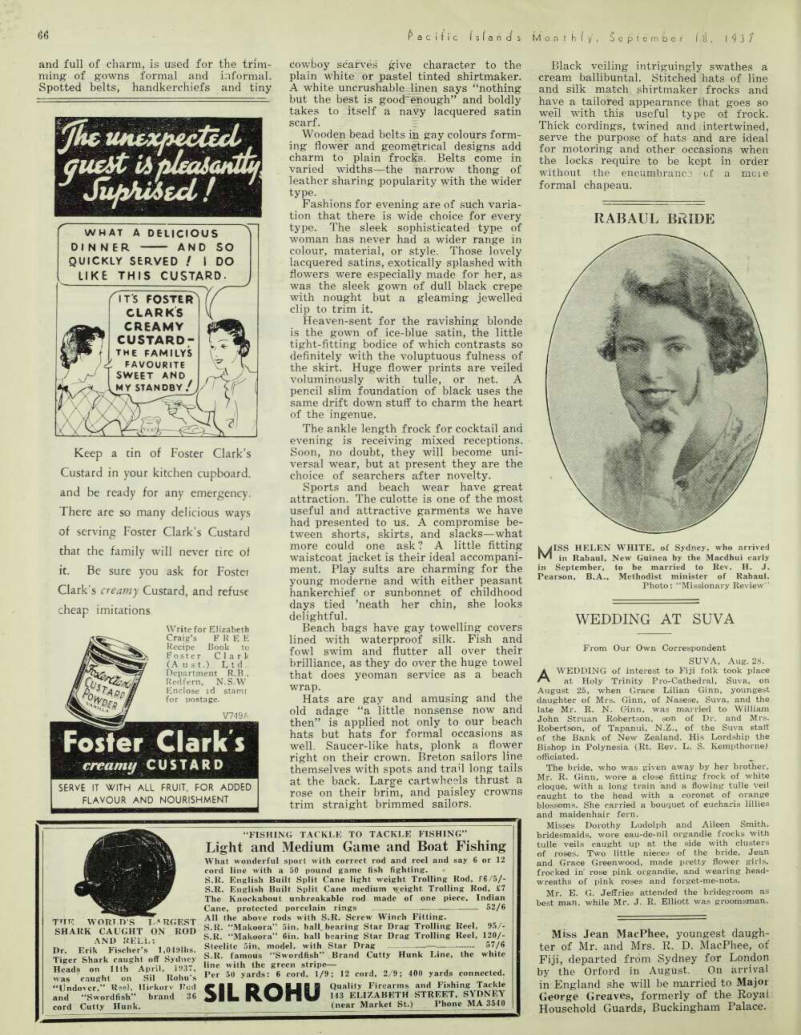
By Therese
is in the air, and so our loveliest materials take unto themselves all the flowers of this lovely season.
Every variety and type of material is flower sprinkled with the most devast ating results.
Crinkled organdies in delicious pastel shades scatter flowers lavishly over their crispness. Party frocks of this exquisite material are an absolute joy.
Creaseless voile is one of the greatest standbys of a tropical wardrobe. The voile is beautifully fine, has marvellous washing propensities, and comes in de signs and colourings that rejoice the heart. Whether the hour be morning, noon, or night, a voile can be found for the occasion.
Linens and washing silks come in for their share of popularity. Deservedly, too, since they lend themselves to almost all types of frocks.
Paisley patterned silks, luxurious crinkled things with organdie backs, rustle their way to success in evening frocks and coats. Pastel tinted chiffons and taffetas weave gold and silver threads through their loveliness.
Exotic flowers run riot over satins, lacquered and plain, and go to the mak ing of some of the most striking evening gowns the season has to offer. They require no trimming, depending solely on their cut to make the most of their riotous beauty.
Lace, that feminine of all materials, is insidiously weaving itself into the forefront again. It comes in formal afternoon frocks as well as in frocks for the cocktail hour.
Silk jersey gives serviceable wear and makes especially nice sports wear.
Reversible figured materials make en sembles that are the essence of chic for formal occasions.
The navy frock with quaint little whitq unicorns disporting themselves over it, uses the reverse side of the material— white patterned with navy—to make the well cut three-quarter coat. A navy hat with white ribbon band tops the ensemble.
Navy is unbelievably cool for summer wear when gayed with lots of white.
A white silk hip length coat with wasp like waist, goes over a trim navy frock, thus ooeying fashion’s decree —light over dark for afternoon, dark over light for morning. Top a light skirt with a dark jacket and you will be unmistakably new.
Boleros in gay cabalero style add them selves to the multitudinous types of coats presented this season. Redingotes combine plain coats with figured mater ials for the frocks. Short chubby jackets have square shoulders, and boxy swag gers swing wide as you walk.
Neutral shades have new importance in the scheme of things. Beige and grey in varying shades—and since neutral shades ally themselves so faultlessly with whatever colour your errant fancy pleases, their importance cannot be too greatly stressed. Navy and black lend them absolute distinction. Green and
flame-red lift them to undreamed of heights, and so on till every colour is exhausted.
Blues, from electric to navy, are all brought to the limelight. Postman’s blue is a new shade which is receiving more than its fair share of attention.
Shirtmaker frocks teem with detail.
Round yokes, square yokes, pointed yokes, no yokes at all; collars of every size and shape; and skirts flared, pleated, or circular. Novel buttons trim their blouses—birds, beasts, fish, and flowers add their quota to the detail.
Blouses are trumps, and whether for
bridge, cocktail, formal, or sports wear they are spared the same attention to detail as our frocks. The Russian peasant blouse returns to favour and there is much rejoicing among the very youthful. Soft little feminine lingerie blouses find success for afternoon wear, while the übiquitous shirt blouse serves us on divers occasions.
Rick-rack braid, quaint, old-fashioned,
and full of charm, is used for the trim ming of gowns formal and informal.
Spotted belts, handkerchiefs and tiny
cowboy scarves give character to the plain white or pastel tinted shirtmaker.
A white uncrushable linen says “nothing but the best is good enough” and boldly takes to itself a navy lacquered satin scarf.
Wooden bead belts in gay colours form ing flower and geometrical designs add charm to plain frocks. Belts come in varied widths—the narrow thong of leather sharing popularity with the wider type.
Fashions for evening are of such varia tion that there is wide choice for every type. The sleek sophisticated type of woman has never had a wider range in colour, material, or style. Those lovely lacquered satins, exotically splashed with flowers were especially made for her, as was the sleek gown of dull black crepe with nought but a gleaming jewelled clip to trim it.
Heaven-sent for the ravishing blonde is the gown of ice-blue satin, the little tight-fitting bodice of which contrasts so definitely with the voluptuous fulness of the skirt. Huge flower prints are veiled voluminously with tulle, or net. A pencil slim foundation of black uses the same drift down stuff to charm the heart of the ingenue.
The ankle length frock for cocktail and evening is receiving mixed receptions.
Soon, no doubt, they will become uni versal wear, but at present they are the choice of searchers after novelty.
Sports and beach wear have great attraction. The culotte is one of the most useful and attractive garments we have had presented to us. A compromise be tween shorts, skirts, and slacks—what more could one ask? A little fitting waistcoat jacket is their ideal accompani ment. Play suits are charming for the young moderne and with either peasant hankerchief or sunbonnet of childhood days tied ’neath her chin, she looks delightful.
Beach bags have gay towelling covers lined with waterproof silk. Fish and fowl swim and flutter all over their brilliance, as they do over the huge towel that does yeoman service as a beach wrap.
Hats are gay and amusing and the old adage “a little nonsense now and then” is applied not only to our beach hats but hats for formal occasions as well. Saucer-like hats, plonk a flower right on their crown. Breton sailors line themselves with spots and trad long tails at the back. Large cartwheels thrust a rose on their brim, and paisley crowns trim straight brimmed sailors.
Black veiling intriguingly swathes a cream ballibuntal. Stitched hats of line and silk match shirtmaker frocks and have a tailored appearance that goes so well with this useful type of frock.
Thick cordings, twined and intertwined, serve the purpose of hats and are ideal for motoring and other occasions when the locks require to be kept in order without the encumbrance of a mcie formal chapeau.
Advertisements & other items, pp. 67-68 (1 item)
Santa Claus
At Blue Mountains —Springwood, N.S.W.
Springwood Ladies' College
Est. 1897. Kindergarten to Leaving Certificate. Tennis, Riding, Swimming, Team Games. Unequalled climate. Pure Jersey Milk. Senior and Junior Houses. Open-air sleeping. Inclusive fees. Special vacation arrangements for Island pupils.
M. E. DURAND, Principal.
MEASURE YOUR VALUE
and see what
SANTA CLAUS
sends you when you order from
PACIFIC ISLANDS CO.
728 GRACE BUILDING
77 YORK ST., SYDNEY
AUSTRALIA
WHAT A DELICIOUS
DINNER AND SO
QUICKLY SERVED / I DO
LIKE THIS CUSTARD
MTS FOSTER
CLARKS
CREAMY
CUSTARD-
THE FAMILYS
FAVOURITE
SWEET AND
MY STANDBY /
Keep a tin of Foster Clark’s Custard in your kitchen cupboard, and be ready for any emergency.
There are so many delicious ways of serving Foster Clark’s Custard that the family will never tire of it. Be sure you ask for Foster Clark’s creamy Custard, and refuse
cheap imitations
Write for Elizabeth Craig’s FREE Recipe Book to Foster Clark (A ust.) Ltd.
Department R.B .
Redfern, N.S.W Enclose id stami for postage.
SERVE IT WITH ALL FRUIT, FOR ADDED
FLAVOUR AND NOURISHMENT
THE WORTH’S LARGEST
SHARK CAUGHT ON ROD
AND REEL:
Dr. Erik Fischer’s 1,0491b5.
Tiger Shark caught off Sydney Heads on 11th April, 1937, was caught on Sil Rohu’s “Undovcr,” Reel. Hickorv Rod and “Swordfish” brand 36 cord Cutty Hunk.
“FISHING TACKLE TO TACKLE FISHING”
Light and Medium Game and Boat Fishing What wonderful sport with correct rod and reel and say 6 or 12 cord line with a 50 pound game fish fighting.
S.R. English Built Split Cane light weight Trolling Rod, £6/5/- S.R. English Built Split Cand medium weight Trolling Rod, £7 The Knockabout unbreakable rod made of one piece, Indian Cane, protected porcelain rings 52/6 All the above rods with S.R. Screw Winch Fitting.
S.R. “Makoora” Sin. ballbearing Star Drag Trolling Reel, 95/- S.R. “Makoora” 6in. ball bearing Star Drag Trolling Reel, 120/- Steelite Sin. model, with Star Drag - 57/6 S.R. famous “Swordfish” Brand Cutty Hunk Line, the white line with the green stripe— Per 50 yards: 6 cord, 1/9; 12 cord, 2/9; 400 yards connected.
Quality Firearms and Fishing Tackle
143 ELIZABETH STREET. SYDNEY
(near Market St.) Phone MA 3540
SILROHU
Rabaul Bride
MISS HELEN WHITE, of Sydney, who arrived in Rabaul, New Guinea by the Macdhui early in September, to be married to Rev. H. J.
Pearson, B.A., Methodist minister of Rabaul.
Photo: “Missionary Review”
Wedding At Suva
From Our Own Correspondent
Suva, Aug. 28.
A WEDDING of interest to Fiji folk took place at Holy Trinity Pro-Cathedral, Suva, on August 25, when Grace Lilian Ginn, youngest daughter of Mrs. Ginn, of Nasese, Suva, and the late Mr. R. N. Ginn, was married to William John Struan Robertson, son of Dr. and Mrs.
Robertson, of Tapanui, N.Z., of the Suva start of the Bank of New Zealand. His Lordship the Bishop in Polynesia (Rt. Rev. L. S. Kempthornej officiated. The bride, who was given away by her brother, Mr. R. Ginn, wore a close fitting frock of white cloque, with a long train and a flowing tulle veil caught to the head with a coronet of orange blossoms. She carried a bouquet of eucharis lillies and maidenhair fern.
Misses Dorothy Ludolph and Aileen Smith, bridesmaids, wore eau-de-nil organdie frocks with tulle veils caught up at the side with clusters of roses. Two little nieces of the bride, Jean and Grace Greenwood, made pretty flower girls, frocked in' rose pink organdie, and wearing head wreaths of pink roses and forget-me-nots.
Mr. E. G. Jeffries attended the bridegroom as best man, while Mr, J. R. Elliott was groomsman.
Miss Jean MacPhee, youngest daugh
ter of Mr. and Mrs. R. D. MacPhee, of
Fiji, departed from Sydney for London
by the Orford in August. On arrival in England she will be married to Major
George Greaves, formerly of the Royal
Household Guards, Buckingham Palace.
Advertisements & other items, pp. 68-70 (2 items)
66
Pacific isfaric/s Monthly, September I* 8, 1*53/
January 26 To April 25, 1938
r ini\TlF'W' pleasure city of the southern hemisphere, v-y iiVrfrliL I W LL BE the centre of the special carnival PROGRAMME AND ROUND OF INTERNATIONAL SPORTING EVENTS WHICH AUSTRALIA IS PLANNING TO CELEBRATE THE ATTAINMENT OF THE FIFTH
CONTINENT'S FIRST ISO YEARS OF SETTLEMENT!
S€ME IMDCCIANT EVENTS
JANUARY 26— Historical pageantry, re-enacting the arrival of Captain Phillip with the First Fleet.
JANUARY 26 Australia's March to Nationhood"—a parade through the city streets of colourful floats.
JANUARY 26— Anniversary Australian Jockey Club Meeting.
JANUARY 26 —Anniversary Regatta on Sydney Harbour.
JANUARY 29 —Army, Navy, and Air Force Parade.
JANUARY 29 —Venetian Carnival on Sydney Harbour.
JANUARY 31 to FEBRUARY s —lnternational Lawn Tennis.
FEBRUARY 5-12 —British Empire Games.
APRIL 9-23 —Sydney Royal Agricultural Show combined with All-Australian Exhibition.
APRIL 16-18-20 —Australian Jockey Club Easter Meetings.
APRIL 19-22 —P010 Tournament (Australasian Gold Cup).
APRIL 23 —Air Force Pageant.
APRIL 25 —Naval, Military and Air Force Tattoo. and— Golf, Cricket, Bowls, Swimming and Rifle-shooting; Surf Life-Saving Displays; National Musical Festival; Band Championships; Big-game Angling Competitions; Conventions and Conferences; and, in the country districts, Agricultural Shows, Picnic Race-meetings, and other fixtures.
Details available at all shipping and travel offices, from AUSTRALIAN NATIONAL TRAVEL ASSOCIATION, Endeavour House, 33 Macquarie Place, Sydney, or from AUSTRALIA'S 150th ANNIVERSARY CELEBRATIONS COUNCIL, Commonwealth Bank Chambers, Martin Place, Sydney.
IPUMPMOBIL
JJL LIGHT AND PORTABLE
MOTOR PUMP
■; * Complete Plant’s weight, 110 lbs. Capacity up to 12,0 0 gallons per hour.
All heads from 10 to 115 feet.
Fuel consumption. A gallon per hour.
Pressure 551 b. square inch.
Especially suitable prospecting and all Sluicing Requirements.
NELSON & ROBERTSON PTY. LTD
12 SPRING STREET SYDNEY
WE DID THE WHOLE CONTRACT
NEW OVERHAUL
SHOP
AND STORE AT LAE
for
GUINEA AIRWAYS
LTD.
your_ confidence in our service will not be misplaced contracts.
F, few undertakings do reliability, expedition, and efficient service count more than in Structural Steel
Cbe Sydney Steel Company Od.
MARRICKVILLE - N.S.W.
Cable Address: "Sydsfeel"
Steel Merchants and Structural Engineers
COLD...
HIGHEST PRICES, PROMPT
SETTLEMENT, ACCURATE
WEIGHTS AND ASSAYS.
are assured to producers and sellers of gold bullion who forward their consignments to The Electrolytic Refining and Smelting Co. of Aust. Ltd. for treatment and realisation.
RECORD PRICE.—On 6th March. 1935, this company paid to its clients at the rate of £9/4/6 net per fine ounce, which is the highest price ever paid for gold in Australia.
SPECIALLY ORGANISED SER-
VICE is available to clients m New Guinea, Fiji and other Pacific Island centres.
Address consignments from outside Australia to the Company's Weighing a Pacific Islands consignment of Sydney office. gold bullion at an E.R. & S. receiving office.
The Electrolytic Refining & Smelting Co.
OF AUSTRALIA LIMITED
Melbourne: Works: Sydney: Collins House. Port Kembla, N.S.W. 25 O'Connell Street.
PURCHASERS AND REFINERS OF GOLD. SILVER, COPPER IN ANY FORM BANKERS:—The English, Scottish and Australian Bank Ltd. r
A History of Pacific Shipping
TN two bulky volumes, Captain F. * Rhodes, of Rockhampton, tells the story of shipping in the Pacific, from the first appearance of Europeans there, right up to the present time. The work is entitled Pageant of the Pacific, and it has been published by the F. J. Thwaites Publishing Co., Sydney, at two guineas for the two volumes.
The author devoted the last 20 years of his life to its compilation. It has no great literary value, and no attempt has been made to make a connected story of it; but within the two volumes is a list, in chronological order, of every shipping event in the Pacific—a stupendous collec tion of names and dates, with indexes which cover names of ships, names of names of persons, and names of There is also—arranged in al phabetical order—a list of the Islands groups of the Pacific and a further list of the names of individual islands, show ing in which group they are placed. There is a useful appendix which sets out in chronological order/ from
1788, the names of all English Secretaries of State for the Colonies, and of Gover nors of Australian States, New Zealand, and Fiji, Another tabulation of value to persons dealing with Pacific subjects shows what happened in Pacific exploration from the year 1524, when the Portuguese Meneses entered the Pacific, right up to the middle of last century.
With such a compilation as this before one, one can forgive the author’s short comings—which are chiefly that he, ap parently on many occasions, accepted unconfirmed statements in published books as fact, and mcluded the same in his own compilation. Taking one or two particular lines of inquiry, we checked through the indexes and found that he had perpetuated the errors of certain early writers. As apparently Captain Rhodes has examined thousands of vol umes in the course of his research, he has no doubt unconsciously brought into his work a number of inaccuracies which he would gladly have omitted.
But it would be improper to condemn or even criticise the work on that ac count. On the contrary, Captain Rhodes should be praised, because he has brought together in these two volumes an almost incalculable amount of data in a handy and accessible form. Any research worker dealing with Pacific subjects may save weeks and months of time by getting his line through Captain Rhodes’ indexes, and thence checking up the statements, dates, etc., in other books, to which the Pageant of the Pacific will guide him.
This is a work of reference which must find a place in the principal libraries of the world.
Cost Australia
What The Territories
of the leading Australian news ” papers has been publishing some interesting figures dealing with the fin ances of the Australian Commonwealth Government. Among other things it is pointed out that the Commonwealth spends annually a huge sum upon its various territories and the following table shows the expenditure:
Territories—
On these figures it would appear that the Australian taxpayer maintains some rather expensive luxuries in the way of tropical territories. The way in which money has been poured into the Northern Territory is astonishing. Is Norfolk Island worth £4,000 per annum to Australia?
Mr. J. J. Wolf, of Wellington, who is an official of the New Zealand Audit Department, arrived at Niue Island with his wife by the Maui Pomare at the end of August to make the annual audit of the island’s finances.
1929-30 1932-33 1036-7 1937-8 £ £ £ £ Fed. Capital 315 290 590,827 871,556 1.132,090 Northern 138,925 145,013 343.402 454,370 Papua „ 49,853 52.136 55,821 48,810 New Guinea ... 12,911 2,740 13,431 3,651 Norfolk Is. 4,000 3.500 4,409 4.0SO Total 520,979 794,216 1,288,709 1,643,00'
Pacific Islands Mining Notes

From Fiji
Loloma (Fiji) Gold Mines N.L.
THE treatment plant of Loloma (Fiji) Gold ' Mines N.L., Tavua, Fiji, after undergoing a trial run in the first week in September, has commenced milling operations. The minimum capacity of the plant is 500 tons of ore a week.
Profitable values were reported by the Com pany in August in extending operations at the 224 ft. levelf at the main shaft. A progress report advised that the south drive off the main oast crosscut at 60ft had been advanced from 94ft to 104 ft. The average assay value of the last 10ft was 18 dwt. a ton over a width of 39 inches.
The present face assayed 21 dwt. a ton over 43 inches. This is the lowest depth at which the Company is operating, and the continuance of profitable values southward will augment! the ore reserves.
Share prices advanced sharply on the Melbourne stock market following the announcement.
Emperor Mines Ltd.
Emperor Mines Ltd. advise that the option over a further 52,450 shares paid to 10/- each has been exercised, and the shares have been issued. Application has been made to the Mel bourne Stock Exchange for the listing of these shares.
Production figui'es for the last three months compare as follows:
Mandated Gold N.L.
Shareholders of Mandated Gold N.L., at an extraordinary meeting held in Melbourne on August 12, were asked to pass a resolution to wind up the Company voluntarily. The directors reported that Fiji Mining Corporation N.L., in which 100 shares were taken up, had abandoned its area in Fiji, and funds would not permit any return to shareholders. It was considered that no
good purpose would be served by keeping the Company in existence.
Tons crushed July 10 2333 Aug. 8 2550 Sept. 6 2176 Head value, dwt 9.4 8.3 9.8 Fine gold, oz 953.7 951.4 963.1 Dwt. per ton 8.1 7.46 9.12
From New Caledonia
Chrome Alluvials Ltd.
THE manager of Chrome Alluvials Limited, * Noumea, New Caledonia, reported on August 23 as follows:—.
“Road to dajn site and bridges completed.
Work on dam resumed. Constructing buildings to house machinery. Proceeding satisfactorily.
Four more quality analyses of chomite secured by panning samples from proposed working faces received from Mr. D. Carter. Three exceed 63 per cent, and one oyer 51 per cent. Pegged additional area near dam upon which race cutting disclosed body of ore. Governor granted special privilege of taking up land, as accorded to Frenchmen.”
From New Guinea
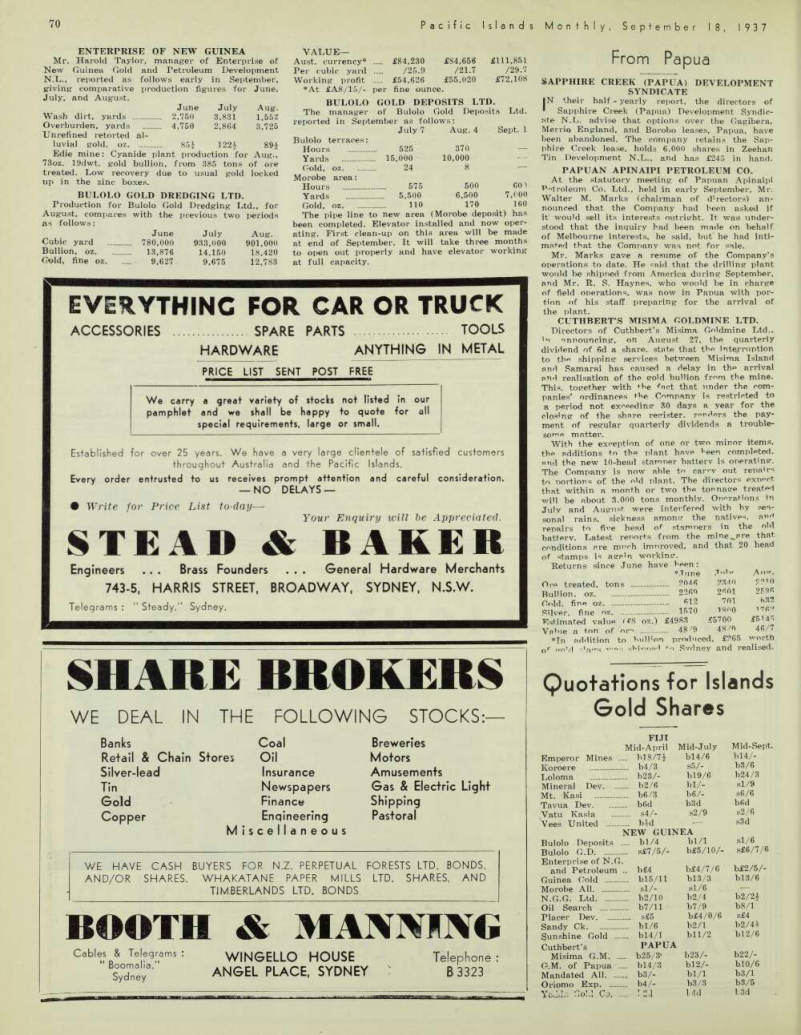
Sandy Creek Gold Sluicing Ltd.
IT was reported, at the annual meeting of Sandy 1 Creek Gold Sluicing (New Guinea) to shareholders in Sydney on August 24. that values on the Sandy Creek area averaged 3/-'per cubic yard, and on the Poverty Creek area, 6/2. When No. 2 plant was installed on Poverty Creek, boxing operations were moved higher up, and in May, June, and July values gave the highly satisfactory average of 8/4 per cubic yard. During the current year, No. 1 plant will work Sandy Creek, and the new area recently acquired, worth about 2/9 per yard : No. 2 plant will work Poverty Creek ; and boxing will continue on Upper Poverty Creek. The prospects of the Company appear good.
Production since May has been:
During August No. 1 plant could not be oper ated in the bed of Sandy Creek owing to floods caused by abnormal rain and a ten-ace deposit containing relatively low values was? worked. No. 2 plant commenced full-time production during
the last week of the month, the gold recovered being included in the return.
Sunshine Gold Development Ltd.
Sunshine Gold Development Ltd. has declared its first dividend of 6d. per share. The dividend is payable on October 1. Transfer books close on September 20.
In the quarter ended August 31, the Company won 856 ounces of gold from its sluicing property in New Guinea.
Recent returns were:—
May June July Aug.
Cubic yards 8.590 8,125 14,560 14,139 Cold, oz 132 232 308 185 Per cubic yard ... 2/3* 4/3* 3/2 1/11*
Yards Hours Gold, oz.
June ... 28,000 448 186 July 32,644 748 324.1 August 16,000 373 346.7
Enterprise Of New Guinea
Mr. Harold Taylor, manager of Enterprise of New Guinea Gold and Petroleum Development N.L., reported as follows early in September, giving comparative production figui'es for June, July, and August.
Edie mine: Cyanide plant production for Aug., 730 z. 19dwt. gold bullion, from 385 tons of ore treated. Low recovery due to usual gold locked up in the zinc boxes.
Bulolo Gold Dredging Ltd,
Production for Bulolo Gold Dredging Ltd., for August, compax-es with the previous two periods as follows :
Value—
Aust. currency* ... £84,230 £84,656 £111,851 Per cubic yard /25.9 /21.7 /29.7 Working profit £54,626 £55,020 £72,108 *At £AB/15/- per fine ounce.
Bulolo Gold Deposits Ltd.
The manager of Bulolo Gold Deposits Ltd. reported in September as follows:
The pipe line to new area (Morobe deposit) has been completed. Elevator installed and now oper ating. First clean-up on this area will be made at end of September. It will take three months to open out properly and have elevator working at full capacity.
June July Aug.
Wash dirt, yards .. 2,750 3,831 1,552 Overburden, yards .. 4,750 2,864 3,725 Unrefined retorted alluvial gold, oz 85* 122* 89*
June July Aug.
Cubic yard 780,000 933.000 901,000 Bullion, oz 13,876 14,150 18.420 Cold, fine oz. 9,627 9,675 12,783
July 7 Aug. 4 Sept. 1 Bulolo terraces; Hours 525 370 Yards 15,000 10,000 Gold, oz 24 8 Morobe area: Hours 575 500 60) Yards 5,500 6,500 7,000 Gold, oz 110 170 160
Advertisements & other items, pp. 71-72 (1 item)
Delco-Licht
Mining Ore
Treatment
Machinery
COMPLETE CYANIDE
PLANTS SUPPLIED
Dorr Classifiers Dorr Thickeners Dorr Agitators Oliver Filters Merril Crowe Zinc Dust Gold Precipitation Richardson Mine Fans •
FANS AND AIR HEATERS
For Ventilation, Copra Drying Rooms, etc. • Enquire from
CROSSLE. DUFF AND
MACINTOSH LTD.
52 Bridge Street. SYDNEY
NOW-Even Bigger and Better
DELCO-LICHT
GIVING 33% more power output, and even greater efficiency than previously, the 2812 and 286 range of Delco-Light plants, provides briHiant electric light for your home, camp or boat, also power tor your radio at a touch of a switch.
Generating 200 watts, this Delco-Light plant is remarkably economical, consuming one gallon of petrol in 16 hours. The generator will supply e.ght 25 watt lamps and the 12 volt 105 A.H. battery five 25 watt lamps for 10 hours when fully charged. The quality and construction of Delco-Light has been outstanding for over 20 years.
SPECIFICATIONS: ENGINE, single cylinder four-cycle, L head, air-cooled by forced draught.
DYNAMO, 6 pole, capacity 200 watts, voltage (2BI2) 12 volt (286 6 volt. Self cranking from battery through manual starting switch.
The complete generating unit weighs only 44-lbs.
Write to Desk PI for full details now; the plant requires no particular skill to operate - you can install it yourself - and you'll marvel at its efficiency.
Distributors :
WARBURTON, FRANK), LTD.
Melbourne 307 -15 KENT STREET. SYDNEY A 1 2812 (12 volt) with 83 A.H. £25 10 0 battery Brisbane (car type.) 2812 (12 volt) - £2B 10 0 with 105 A.H. battery (individual cell?.) 286 (6 volt) - £2G 0 0 with 105 A.H. battery (individual cells.)
IN BOND —SYDNEY
EVERYTHING FOR CAR OR TRUCK
ACCESSORIES SPARE PARTS TOOLS
HARDWARE ANYTHING IN METAL
PRICE LIST SENT POST FREE
We carry a great variety of stocks not listed In our pamphlet and we shall be happy to quote for all special requirements, large or small.
Established for over 25 years. We have a very large clientele of satisfied customers throughout Australia and the Pacific Islands.
Every order entrusted to us receives prompt attention and careful consideration.
—NO DELAYS
• Write for Price List to-day — Your Enquiry will he Appreciated.
STEAD & BAKER
Engineers .. . Brass Founders .. . General Hardware Merchants
743-5, HARRIS STREET, BROADWAY, SYDNEY, N.S.W.
Telegrams : " Steady," Sydney.
SHARE BROKERS
WE DEAL IN THE FOLLOWING STOCKS:—
Banks Coal Retail & Chain Stores Oil Silver-lead Insurance Tin Newspapers Gold Finance Copper Engineering Miscellaneous Breweries Motors Amusements Gas & Electric Light Shipping Pastoral WE HAVE CASH BUYERS FOR N.Z. PERPETUAL FORESTS LTD. BONDS, AND/OR SHARES. WHAKATANE PAPER MILLS LTD. SHARES, AND
TJMBERLANDS LTD. BONDS
BOOTH & MAMING
Cab| es& Telegrams : WINGELLO HOUSE Telephone: Svdnev ' ANGEL PLACE, SYDNEY B 3323
From Papua
Sapphire Creek (Papua) Development
Syndicate
IN their half - yearly report, the directors of * Sapphire Creek (Papua) Development Syndic ate N.L. advise that options over the Gagibera, Merrio England, and Borobo leases, Papua, have been abandoned. The company retains the Sap phire Creek lease, holds 6,000 shares in Zeehan Tin Development N.L., and has £245 in hand.
Papuan Apinaipi Petroleum Co.
At the statutory meeting of Papuan Apinaipi TMroleum Co. Ltd., held in early September, Mr.
Walter M. Marks (chairman of d ; rectors) an nounced that the Company had been asked if it would sell its interests outright. It was under stood that the inquiry had been made on behalf of Melbourne interests, he said, but he had inti mated that the Company was not for sale.
Mr. Marks gave a resume of the Company’s operations to date. He said that the drilling plant would be shipned from America during September, and Mr. R. S. Haynes, who would be in charge of field operations, was now in Papua with por tion of his staff preparing for the arrival of the plant.
Cuthbert’S Misima Goldmine Ltd.
Directors of Cuthbert’s Misima Goldmine Ltd., m nnnouncing, on August 27, the quarterly dividend of 6d a share, state that the interruption to the shipping services between Misima Island and Samarai has caused a delay in the arrival and realisation of the gold bullion from the mine.
This, together with +he fact that under the com panies’ ordinances +h e Company is restricted to a period not exceeding 30 days a year for the closmg of the share register, renders the pay ment of regular quarterly dividends a trouble some matter.
With the exception of one or two minor items, the additions to the plant have I'een completed, and the new 10-head stamper battery is operating.
The Company is now able to carry out repairs to portions of the old plant. The directors expect that within a month or two the tonnage treated will be about 3.000 tons monthly. Onm-ations in July and August were interfered with by sea sonal rains, sickness among the natives. a"H repairs to five head of stampers in the old battery. Latest reports from the that conditions ere much improved, and that 20 head of stamps is again working.
Returns since June have been:
♦June T” Au".
Oi-p treated, tons 2046 234U ?° 1 ** Bullion, oz 2260 2*01 258* 0-old. fine oz *12 701 hS2 Silver, fine oz 1R70 1«"0 ’767 Kstimated value 1 f 8 oz.) £4983 £5700 £5145 Va’ue a ton of or 48/0 46/7 *In addition to bullion produced, £265 worth 0 c ,u a o-c, qPioon'l A o Svdney and realised.
Quotations for Islands
Gold Shares
Fiji
Mid-April Mid-July Mid-Sept.
Emperor Mines .. ... b!8/7| b!4/6 b!4/- Koroere b4/3 s5/b3/6 Loloma ... b23/b!9/6 b24/3 Mineral Dev b2/6 bl/sl/9 Mt. Kasi ... b6/3 b6/s6/6 Tavua Dev ... b6d b3d b6d Vatu Kasia s4/s2/9 s2/6 Vees United bid ■— s3d Bulolo Deposits .
New Guinea
bl/4 bl/1 sl/6 Bulolo G.D ... s£7/5/b£5/10/s£6/7/6 Enterprise of N.G and Petroleum ... b£4 b£4/7/6 b£2/5/- Guinea Cold b!5/ll b!3/3 bl3/6 Morobe All ... sl/sl/6 — N.G.G. Ltd ... b2/10 b2/4 b2/2i Oil Search b7/ll b7/9 b8/l Placer Dev s.€5 b£4/0/6 s£4 Sandy Ck bl/6 b2/l b2/4i Sunshine Gold ... b!4/l bll/2 bl2/6 Cuthbert’s Misima G.M. ...
Papua
... b25/3* b23/b22/- G',M. of Papua . ... bl4/3 b!2/blO/6 Mandated All ... b3/bl/1 b3/l Oviomo Exp ... b4/b3/3 b3/5 Yu’.u.: Cold Co, ... 12J I4d t3d
Fatal Brawl
Death of Chinese Baker in Samoa
From Our Own Correspondent.
Apia, Aug. 25.
A CHINESE coolie, employed as a baker, and a Samoan labourer, Nela, became involved in an argument at the bakery of Mr. Emil Fabricius, at Apia, early on the morning of August 20.
Apparently, the Samran had intruded into the bakery and the Chinese attempted to evict him.
A fight developed and the Chinese, Chong Wah, seized an axe while the Samoan grabbed a billet of wood as a weapon. Nela struck baker over the head with the piece of wood and knocked him down, allegedlv striking him again when he was on floor and inflicting '-''rioiw injuries. Wah was taken to Apia Hospital where he died later The Samoan was arrested and charged with manslaughter.
Poles On A Lons Voyage
young Poles, Messrs. Wagner and Kondratowicz, are at present some where in or near the South Pacific in a small yacht, the Zjawa 111. It was built in Ecuador with native labour, and the Poles are trying to sail it to Sydney, via French Oceania and the Cook Islands.
Thence they will go to Capetown, New York and Europe.
New Hebrides
Premature Reports of Plan To Introduce Australia
present appearances, the Condomi nium Government of the New Hebrides will have English (as distinct from Australian) officials for a long time yet.
When the Australian Ministers went to the Imperial Conference, they carried with them certain data relating to the Solomons and New Hebrides. Australian control of those territories was held to be desirable for defence reasons. Further more, Australian rather than English trading conditions and currency are com mon in both groups. In the case of the New Hebrides, both Burns, Philp and Co.
Ltd. and the Presbyterian Mission have presented to the Commonwealth Govern ment a strong case that Australia, rather than Britain, should share the admini stration with France.
The matter came up at the Imperial Conference and the British Colonial and Foreign Offices apparently offered no ob jection to the New Hebrides plan. Im mediately, there were excited and. exag gerated reports in the Australian news papers. One irresponsible Sydney news paper said that Australia was going to take over all the Western Pacific terri tories, including Fiji. Others began to select an Australian staff for Port Vila.
Actually, there has been nothing more
than a talk in London. It does not appear that France, even yet, has been con sulted. The Australian Ministers since the’r return, have said not one word about the New Hebrides.
All the reports, up to date, seem to have been the outcome of contacts in London between babbling politicians and irresponsible reporters. Before any change occurs, a number of things must happen. First, the Australian Government must survive the general election in October: then Australia must reach an agreement with England; next, England must negotiate with France, and obtain French approval of the proposal.
The interests of France are much greater than those of the British in the New Hebrides; and, while it is unlikely that France has any objection to Aus tralia replacing England in the Condomi nium, it is possible that the French Colonial Office will take a view of the matter that has not been foreseen.
It is clear, now. that the whole position has been vitiated by premature reports and irresponsible newspapers.
Mr. E. J. Harman has resigned on account of ill-health from the directorate of Mandated Alluvials N.L., and Dominion Gold Ltd., Papua. Mr. L.
Wright has been elected to the board of Mandated Alluvials.
Mr. G. B. Lincoln, a Melbourne con sulting electrical engineer, returned to
Victoria by the September Mariposa
after reporting on the Suva electricity undertaking for the Town Board.
Mr. J. B. Gordon, a mining engineer, left Sydney for Samarai, en route to Misima Island, Eastern Papua, by the August Macdhui.
Sub-Inspector C. W. Tucker, of the Fiji Constabulary, returned to Suva from leave spent in Australia and New Zealand, by the Aorangi in August.
Advertisements & other items, pp. 73-74 (1 item)
Mining Machinery
Improved Type Gravel Pump.
SEND YOUR ENQUIRIES TO-
of all classes, including—
Dredging and Sluicing Plants
Gravel and Water Pumps
Elevators Nozzles Piping
and Valves.
Mining Plants have been supplied to a number of Companies in New Guinea, and we are, therefore, fully conversant with local conditions.
Hydraulic Elevator, with Swivelling Suction Pipe.
THOMPSON’S ENGINEERING & PIPE CO. LTD.
CASTLEMAINE, VICTORIA
Cable Address : "THOMPSONS." CASTLEMAINE."
SYDNEY OFFICE KEMBLA BUILDING 58 MARGARET STREET
Alien Taylor & Co. Ltd
SYDNEY
Sawmillers and Wholesale Suppliers of Hardwoods for Constructional Purposes GIRDERS . . . PILES . . . POLES . . . SLEEPERS, Etc.
EXPORTING TO PACIFIC ISLANDS SINCE 1893
Cables: Tuxedo, Sydney
Free Literature from
PAUL & GRAY LTD.
(Islands Distributors)
82 -84 SUSSEX STREET, SYDNEY
fop DRY ROT
DRY ROT or the attacks of White Ants or Borers can be permanently prevented by treating your timber with "Cuprinol. This scientific preservative is Insoluble In water, easy to apply] and can be painted or varnished over. "Cuprinol" will definitely eradicate these pests in timber that has already been attacked.
The life of Canvas, Nets, Cordage, etc., can be doubled or trebled by treating with "Cuprinol"—it prevents Mildew and Rot, adds to the tensile strength and doesn't affect flexibility. Full information on request.
rUPRINQI
The Revolutionary Wood and Fabric Preservative
WE PAY THE HIGHEST PRICES FOR
COLD
© We can honestly claim to hold the greatest proportion of tire gold business of the Islands, having among our many regular clients the leading gold mining companies of the Pacific.
We have, from our inception many years ago, steadily built our progressive business on the basic principles of accurate assays, prompt payment and integrity of methods.
We are assayers, bullion merchants, metallurgists, of repute and buy tor prompt cash GOLD. OSMIRIDIUM, PLATINUM, SILVER, etc., and pay the highest prices.
Send your next consignment to us for prompt payment.
GARRETT & DAVIDSONS;
BANK OF N.S.W. BUILDINGS
REGENT and GEORGE STS., SYDNEY
In Papua
Funds Wanted!
C. of E. Mission Work In Papua
■THE new Bishop of New Guinea, Right Rev. P. N. W. Strong, came to Australia at the end of August to make an urgent appeal for financial support for the work of his Mission in Papua.
He said that the New Guinea Mission was being starved through lack of funds and, unless more money was made avail able, its operations would be curtailed.
It should be explained, perhaps, that the diocese of the Bishop of New Guinea does not include any part of what is now officially New Guinea —it includes Papua only. The Mandated Territory of New Guinea, the Solomon Islands, and the New Hebrides are in the charge of the Melanesian Mission, and constitute the diocese of the Bishop of Melanesia, which is a diocese of the Church of the Province of New Zealand.
The Australian Board of Missions, which is the official missionary organi sation of the C. of E. in Australia, pro vides funds for the mission work car ried on by the Bishop of New* Guinea (in Papua) and also makes a small annual payment to the Melanesian Mis sion. The bulk of the funds of the Melanesian Mission comes from church donations in Britain, and the balance from New Zealand.
It is, therefore, a fact that the Church of England mission work in New Guinea, which should be the responsibility of Australia, is carried out by British and New Zealand people through the Melanesian Mission. It would be more fitting if the diocese of the Bishop of New Guinea (Papua) were extended to include New Guinea, and funds for the work were provided by Australia.
We understand that there is some talk of the Bishop of New Guinea being given authority over the mainland section of the Mandated Territory of New Guinea; but that it is most unlikely that the Bishop of Melanesia will abandon his responsibilities in New Britain and New Ireland, where a great deal of pioneer ing work has been done.
The curious geographical division be tween the dioceses of New Guinea and Melanesia is, of course, a reminder of pre-war conditions. Papua was then British New Guinea, and what is now the Mandated Territory was German New Guinea. In 1926 the Melanesian Mission, from its headquarters in the Solomon Islands, extended its operations into New Ireland and New Britain, the principal islands of the Bismarck Archi pelago.
Advertisements & other items, p. 74 (1 item)
The Original
RUR
RHEUMATIC REMEDY
M °y/JLJ! AC * guarantee “Obtainable from all branches of Burns, Philp and Co. Ltd., or Post Free from R.U.R. Pty., 841 George St., Sydney—7/6 for 6 weeks’ treatment, 4/- for 3 weeks’ trial size. Ask or write for Free Booklet.
Broadcast
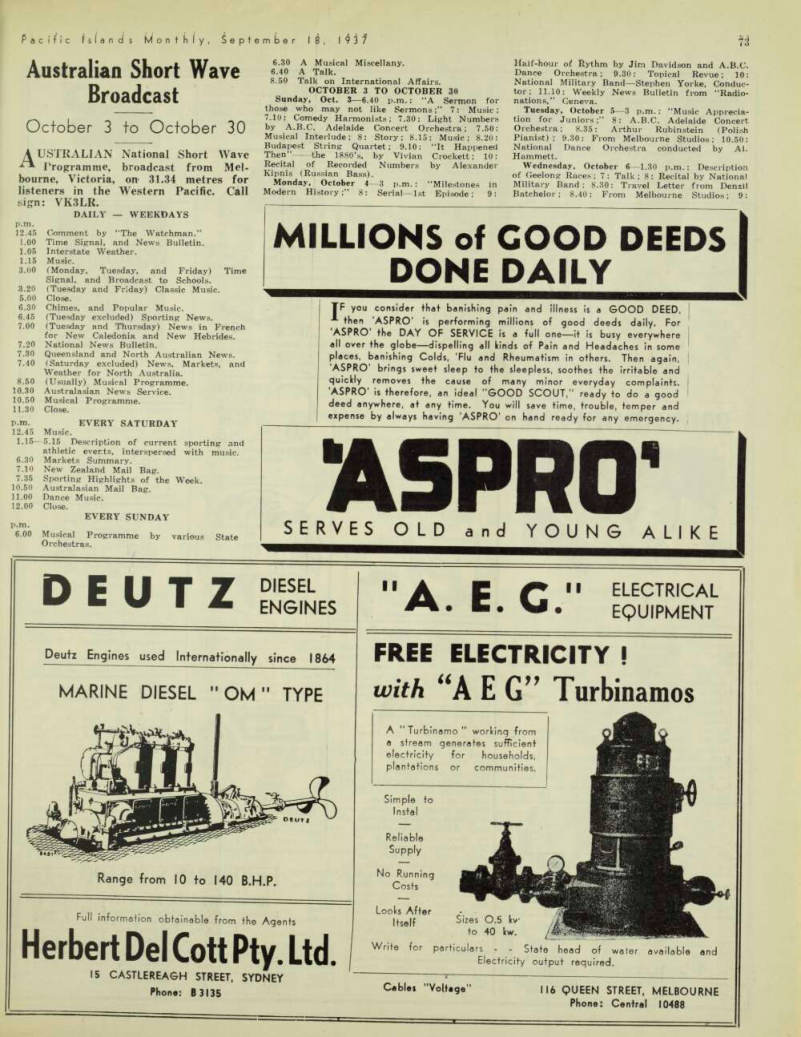
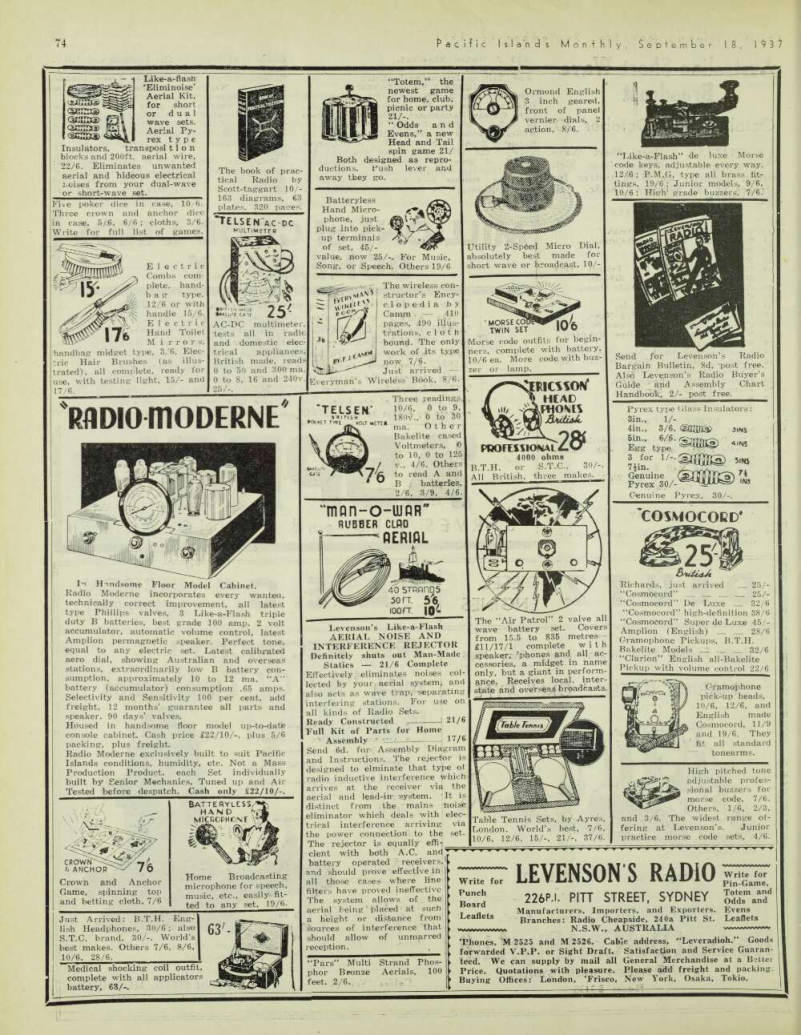
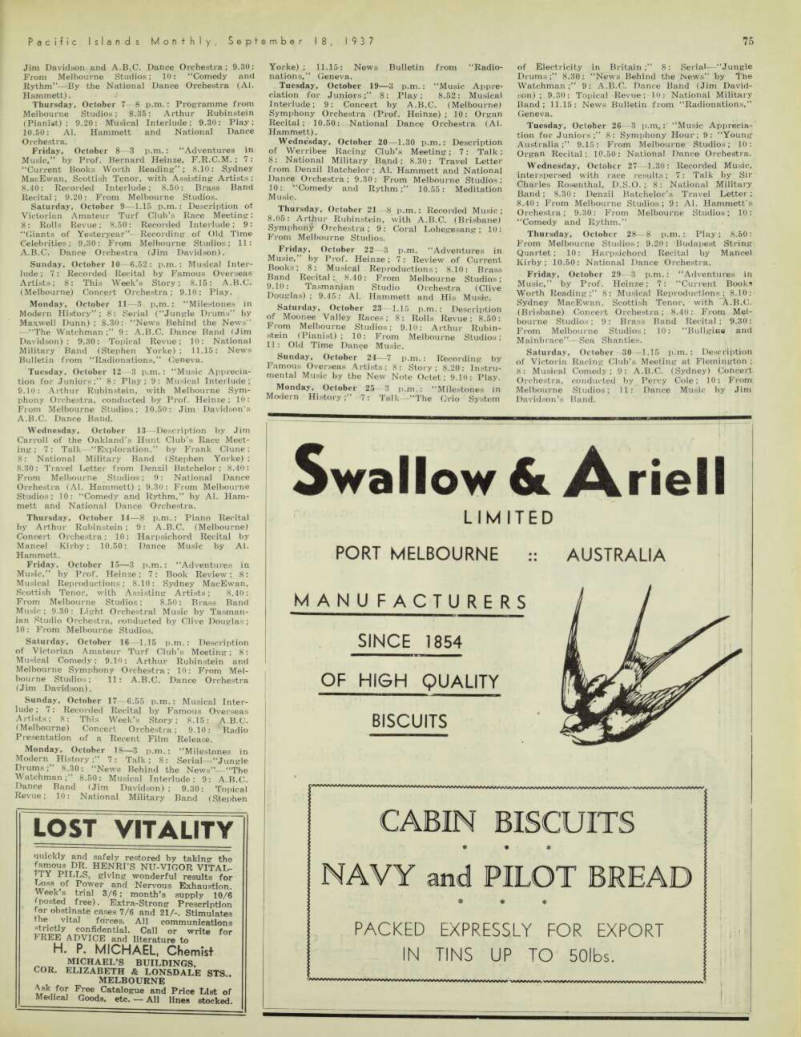
Australian Short Wave Broadcast October 3 to October 30
A USTRALIAN National Short Wave
Programme, broadcast from Mel
bourne, Victoria, on 31.34 metres for
listeners in the Western Pacific. Call
sign: VK3LR.
Daily Weekdays
p.m. 12.45 Comment by “The Watchman.” 1.00 Time Signal, and News Bulletin. 1.05 Interstate Weather. 1.15 Music. 3.00 (Monday, Tuesday, and Friday) Time Signal, and Broadcast to Schools. 3.20 (Tuesday and Friday) Classic Music. 5.00 Close. 6.30 Chimes, and Popular Music. 6.45 (Tuesday excluded) Sporting News. 7.00 (Tuesday and Thursday) News in French for New Caledonia and New Hebrides. 7.20 National News Bulletin. 7.30 Queensland and North Australian News. 7.40 (Saturday excluded) News, Markets, and Weather for North Australia, 8.50 (Usually) Musical Programme. 10.30 Australasian News Service. 10.50 Musical Programme. 11.30 Close.
P.M. Every Saturday
12.45 Music. 1.15 —5.15 Description of current sporting and athletic events, interspersed with music. 6.30 Markets Summary. 7.10 New Zealand Mail Bag. 7.35 Sporting Highlights of the Week. 10.50 Australasian Mail Bag. 11.00 Dance Music. 12.00 Close.
Every Sunday
p.m. 6.00 Musical Programme by various State Orchestras.
6.30 A Musical Miscellany. 6.40 A Talk. 8.50 Talk on International Affairs.
October 3 To October 30
Sunday, Oct. 3—6.40 p.m.: “A Sermon for those who may not like Sermons;” 7: Music; 7.10: Comedy Harmonists; 7.30: Light Numbers by A.B.C. Adelaide Concert Orchestra; 7.50: Musical Interlude; 8: Story; 8.15: Music; 8.20: Budapest String Quartet; 9.10; “It Happened Then” the 1880’s, by Vivian Crockett; 10: Recital of Recorded Numbers by Alexander Kipnis (Russian Bass).
Monday, October 4 —3 p.m. : “Milestones in Modern History;” 8: Serial—lst Episode: 9:
Half-hour of Rythm by Jim Davidson and A.B.C.
Dance Orchestra; 9.30: Topical Revue; 10:
National Military Band—Stephen Yorke, Conduc tor; 11.10: Weekly News Bulletin from “Radio nations,” Geneva.
Tuesday, October 5—3 p.m. : “Music Apprecia tion for Juniors;” 8: A.B.C. Adelaide Concert Orchestra: 8.35: Arthur Rubinstein (Polish Pianist); 9.30: From Melbourne Studios; 10.50: National Dance Orchestra conducted by Al.
Hammett.
Wednesday, October 6 —1.30 p.m.: Description of Geelong Races; 7: Talk; 8: Recital by National Military Band; 8.30: Travel Letter from Denzil Batchelor; 8.40: From Melbourne Studios; 9:
Jim Davidson and A.B.C. Dance Orchestra; 9.30: From Melbourne Studios; 10: “Comedy and Rythm”—By the National Dance Orchestra (Al.
Hammett). i Thursday, October 7—B p.m.: Programme from Melbourne Studios; 8.35: Arthur Rubinstein (Pianist): 9.20: Musical Interlude: 9.30: Play: 10.50: Al. Hammett and National Dance Orchestra.
Friday, October B—3 p.m.: “Adventures in Music,” by Prof. Bernard Heinze, F.R.C.M. ; 7: “Current Books Worth Reading”; 8.10: Sydney Mac Ewan, Scottish Tenor, with Assisting Artists ; 8.40: Recorded Interlude; 8.50: Brass Band Recital; 9.20: From Melbourne Studios.
Saturday, October 9 —1.15 p.m.: Description of Victorian Amateur Turf Club’s Race Meeting: 8: Rolls Revue; 8.50: Recorded Interlude; 9; “Giants of Yesteryear”—Recording of Old Time Celebrities; 9.30: From Melbourne Studios; 11: A.B.C. Dance Orchestra (Jim Davidson).
Sunday, October 10 —6.52: p.m.: Musical Inter lude ; 7: Recorded Recital by Famous Overseas Artists: 8: This Week’s Story; 8.15: A.B.C. (Melbourne) Concex-t Ox-chestra; 9.10: Play.
Monday, October 11 —3 p.m.: “Milestones in Modexux Histox^y”; 8: Serial (“Jungle Drums” by Maxwell Dunn) ; 8.30: “New r s Behind the News” —“The Watchman;” 9: A.B.C. Dance Band (Jim Davidson): 9.30: Topical Revue; 10: National Militax-y Band (Stephen Yox-ke) ; 11.15: News Bulletin fx-om “Radionations,” Geneva.
Tuesday, October 12 —3 p.m.: “Music Apprecia tion for Juniors;” 8: Play; 9: Musical Interlude: 9.10: Arthur Rubinstein, with Melboux-ne Sym phony Orchestra, conducted by Prof. Heinze ; 10: From Melbourne Studios; 10.50 r Jim Davidson’s A.B.C. Dance Band.
Wednesday, October 13 —Description by Jim Carroll of the Oakland’s Hunt Club’s Race Meet ing ; 7: Talk—“ Exploration,” by Frank Clune: 8: National Military Band (Stephen Yorke): 8.30: Travel Letter from Denzil Batchelor: 8.40: From Melboux-ne Studios; 9: National Dance Orchestra (Al. Hammett) ; 9.30: Fxom Melbourne Studios; 10: “Comedy and Rythm,” by Al. Ham mett and National Dance Orchestra.
Thursday, October 14 —8 p.m.: Piano Recital by Arthur Rubinstein; 9: A.B.C. (Melbourne) Concert Orchestra; 10: Harpsichord Recital by Mancel Kirby; 10.50: Dance Music by Al.
Hammett.
Friday, October 15—3 p.m.: “Adventures in Music,” by Px - of. Heinze; 7: Book Review; 8: Musical Repx’oductions; 8.10: Sydney Mac Ewan, Scottish Tenor, with Assisting Artists; 8.40: From Melbourne Studios; 8.50: Brass Band Music; 9.30: Light Orchestral Music by Tasman ian Studio Orchestra, conducted by Clive Douglas; 10: From Melbourne Studios.
Saturday, October 16—1.15 p.m.: Description of Victorian Amateur Turf Club’s Meeting; 8: Musical Comedy: 9.lft: Arthur Rubinstein and Melbouime Symphony Orchestra: 10: From Mel bourne Studios; 11: A.B.C. Dance Orchestra
(Jim Davidson).
Sunday, October 17 —6.55 p.m.: Musical Inter lude ; 7: Recorded Recital by Famous Overseas Artists; 8: This Week’s Story; 8.15: A.B.C. (Melbourne) Concert Orchestra: 9.10: Radio Presentation of a Recent Film Release.
Monday, October 18—3 p.m.: “Milestones in Modern History;” 7: Talk; 8: Serial—“ Jungle Drums;” 8.30: “News Behind the News”—“The Watchman;” 8.50: Musical Interlude; 9: A.B.C.
Dance Band (Jim Davidson); 9.30: Topical Revue; 10: National Military Band (Stephen
Yorke) ; 11.15: News Bulletin from “Radio nations,” Geneva.
Tuesday, October 19 —3 p.m.; “Music Appre ciation for Juniors;” 8: Play ; 8.52: Musical Interlude: 9: Concert by A.B.C. (Melbourne) Symphony Orchestra (Prof. Heinze); 10: Organ Recital: 10.50: National Dance Orchestra (Al.
Hammett).
Wednesday, October 20 —1.30 p.m.: Description of Werribee Racing Club’s Meeting; 7: Talk ; 8: National Military Band; 8.30: Travel Letter from Denzil Batchelor; Al. Hammett and National Dance Orchestra; 9.30: From Melbourne Studios; 10: “Comedy and Rythm;” 10.55: Meditation Music.
Thursday, October 21—8 p.m.: Recorded Music ; 8.05: Arthur Rubinstein, with A.B.C. (Brisbane) Symphony Orchestra; 9: Coral Lohegesang; 10: From Melbourne Studios.
Friday, October 22—3 p.m. “Adventures in Music,” by Prof. Heinze; 7: Review of Current Books; 8: Musical Reproductions; 8.10: Brass Band Recital: 8.40: From Melbourne Studios; 9.10: Tasmanian Studio Orchestra (Clive Douglas) ; 9.45: Al. Hammett and His Music.
Saturday, October 23—1.15 p.m.: Description of Moonee Valley Races; 8: Rolls Revue; 8.50: From Melbourne Studios: 9.10: Arthur Rubin stein (Pianist) ; 10: From Melbourne Studios; 11: Old Time Dance Music.
Sunday, October 24 —7 p.m.: Recording by Famous Overseas Artists; 8: Story; 8.20: Instru mental Music by the New Note Octet; 9.10: Play.
Monday, October 25 3 p.m.: “Milestones in Modern History;” 7: Talk—“ The Grio System
of Electricity in Britain;” 8: Serial —“Jungle Drums;” 8.30: "News Behind the News” by The Watchman ;” 9: A.B.C. Dance Band (Jim David son) ; 9.30: Topical Revue; 10: National Military Band; 11.15: News Bulletin from “Radionations,”
Geneva.
Tuesday, October 26 —3 p.m.: “Music Apprecia tion for Juniors;” 8: Symphony Hour; 9: “Young 1 Australia;” 9.15: From Melbourne Studios; 10: Organ Recital; 10.50: National Dance Orchestra.
Wednesday, October 27—1.30: Recorded Music, interspersed with race results; 7: Talk by Sir Charles Rosenthal, D.S.O. ; 8: National Militax-y Band; 8.30: Denzil Batchelor’s Travel Letter; 8.40: From Melbourne Studios; 9: Al. Hammett’s Orchestra: 9.30: From Melbourne Studios; 10: “Comedy and Rythm.”
Thursday, October 28 —8 p.m.: Play; 8.50: From Melbourne Studios; 9.20: Budapest String Quartet; 10: Harpsichord Recital by Mancel Kirby; 10.50: National Dance Orchestra.
Friday, October 29—3 p.m.: “Adventures in Music,” by Prof. Heinze; 7; “Current Books Worth Reading;” 8: Musical 8.10: Sydney Mac Ewan, Scottish Tenor, with A.B.C. (Brisbane) Concert Orchestra; 8.40: From Mel bourne Studios: 9: Brass Band Recital; 9.30: From Melbourne Studios; 10: “Bullgine and Mainbrace” —Sea Shanties.
Saturday, October 30 -1.15 p.m.: Description of Victoria Racing Club’s Meeting at Flemington ; 8: Musical Comedy: 9: A.B.C. (Sydney) Concert Orchestra, conducted by Percy Cole; 10: From Melbourne Studios; 11: Dance Music by Jim Davidson’s Band.
Advertisements & other items, pp. 75-77 (2 items)
73
Pacific Islands Monthly, September I$ , I 4 3 f
Aspro'
MILLIONS of GOOD DEEDS
DONE DAILY
TF you consider that banishing pain and illness Is a GOOD DEED, then 'ASPRO' is performing millions of good deeds daily. For ASPRO the DAY OF SERVICE is a full one—it is busy everywhere all over the globe—dispelling all kinds of Pain and Headaches in some places, banishing Colds, 'Flu and Rheumatism in others. Then again, 'ASPRO' brings sweet sleep to the sleepless, soothes the irritable and quickly removes the cause of many minor everyday complaints.
ASPRO is therefore, an ideal "GOOD SCOUT," ready to do a good deed anywhere, at any time. You will save time, trouble, temper and expense by always having 'ASPRO' on hand ready for any emergency.
ASPRO'
SERVES OLD and YOUNG ALIKE
DEUTZ
DIESEL
ENGINES
Deutz Engines used Internationally since 1864
MARINE DIESEL "OM " TYPE
tUT 14* Range from 10 to 140 B.H.P.
Full information obtainable from the Agents
Herbert Del CottPty. Ltd.
15 CASTLEREAGH STREET, SYDNEY
Phone; B 3135
"A. E. C."
ELECTRICAL
EQUIPMENT
FREE ELECTRICITY !
with “A E G” Turbinamos
A " Turbinamo " working from a stream generates sufficient electricity for households, plantations or communities.
Simple to Instal Reliable Supply No Running Costs Looks After Itself Sizes 0.5 kv to 40 kw.
Write for particulars - - State head of water available and Electricity output required.
Cables "Voltage”
116 QUEEN STREET, MELBOURNE
Phone: Central 10488
Like-a-flash ‘Eliminoise’
Aerial Kit, for short or dual wave sets.
Aerial Pyrex type Insulators, transposi t i o n blocks and 200 ft. aerial wire, 22/6. Eliminates unwanted aerial and hideous electrical i.oises from your dual-wave or short-wave set. ©errs® ©ecu® ©CS39® Five poker dice in case, 10 6.
Thi-ee crown and anchor dice case, 5/6, 6/6 ; cloths, 3/6- Write for full list of games. 176 Electric Combs complete, handla a g type, .12/6 or with handle 15/6.
Electric Hand Toilet M i rro r s, handbag midget type, 3/6. Electric Hair Brushes (as illustrated), all complete, ready for use, with testing light. 15/- and 17/6.
The book of practical Radio by Scott-taggart 10/- 163 diagrams, 63 plates. 320 paves.
*T£ LSEN ac
MULTIMETER
\ : A t AC-DC multimeter, tests all in radio and domestic electrical appliances British made, reads 0 to 50 and 300 ma 0 to 8, 16 and 240 v 25/-.
“Totem,” the newest game for home, club, picnic or party 21/-.
“ Odds and Evens,” a new Head and Tail spin game 21/ Both designed as reproductions. Push lever and away they go.
Batteryless Hand Microphone, just plug into pickup terminals of set, 45/value, now 25/ For Music, Song, or Speech. Others 19/6 , The wireless constructor’s Encyclop ed i a by Camm .. 410 pages, 490 illustrations, cloth bound. The only work of its type now 7/(5. arrived Ever jonah’s Wireless Book, 8/6.
RADIOMODERNE
In Hondsome Floor Model Cabinet.
Radio Moderne incorporates every wanteo, technically correct improvement, all latest type Phillips valves, 3 Like-a-Flash triple duty B batteries, best grade 100 amp. 2 volt accumulator, automatic volume control, latest Amplion permagnetic speaker. Perfect tone, equal to any electric set. Latest calibrated aero dial, showing Australian and overseas stations, extraordinarily low B battery consumption, approximately 10 to 12 ma. “A” battery (accumulator) consumption .65 amps.
Selectivity and Sensitivity 100 per cent, add freight, 12 months’ guarantee all parts and speaker. 90 days’ valves.
Housed in handsome floor model up-to-date console cabinet. Cash price £22/10/-, plus 5/6 packing, plus freight.
Radio Moderne exclusively built to suit Pacific Islands conditions, humidity, etc. Not a Mass Production Product, each Set individually built by Senior Mechanics, Tuned up and Air Tested before despatch. Cash only £22/10/-. crown <:^^;/ - 7 L
r > ANCHOR - /O
Crown and Anchor Game, spinning top and betting cloth, 7/6
BATTERYLESSr-
H A N D br
MICROPHONE
Home Broadcasting microphone for speech, music, etc., easily* fitted to any set, 19/6.
Just Arrived: B.T.H. English Headphones, 30/6 ; also S.T.C. brand, 30/-. World’s best makes. Others 7/6, 8/6, 10/6, 28/6.
Medical shocking coil outfit, complete with all applicators battery, 63/-. 63-
TELSEH'
76 Three readings. 10/6, 0 to 9. lBov.. 0 to 30 ma. Other Bakelitc cased Voltmeters, 0 to 10, 0 to 125 v., 4/6. Others to read A and B batteries 2/6, 3/9, 4/6
‘man-o-iURR
RUBBER CLRD
PEfilflL
40 STRPinDS
56 50 FT. 10- (00 FT Ormond English 3 inch geared, front of panel vernier dials, 2 action, 8/6.
Utility 2-Sp6ed Micro Dial, absolutely best made for short wave or broadcast, 10/- 10 O
MORSE CO
TWIN SET
Morse code outfits for beginners, complete with battery, 10/6 ea. More code with buzzer or lamp.
ICAtON
HEAD
moMis
BjuUaJc
PROFESSIONAL
4000 ohms
B.T.H. or S.T.C., 30/-
All British, three makes.
M I Levenson’s Like-a-Flash
AERIAL NOISE AND
INTERFERENCE REJECTOR
Definitely shuts out Man-Made Statics 21/6 Complete Effectively eliminates noises col lected by your aerial system* and also acts as wave trap, separating interfering stations. For use on all kinds of Radio Sets.
Ready Constructed 4 21/6 Full Kit of Parts for Home Assembly 17/6 Send 6d. for- Assembly Diagram and Instructions. The rejector is designed to elminate that type ot radio inductive interference which arrives at the receiver via the aerial and lead-irr system. It is distinct from the mains noise eliminator which deals with electrical interference arriving via the power connection • to the set.
The rejector is equally effi-| cient with bdth A.C. and battery operated receivers, and should prove effective in all those cases where line filters have proved ineffective The system allows of the aerial being r placed at such a height or distance fi*om Sources of interference that should allow of unmarred reception.
The “Air Patrol” 2 valve all wave battery set. Covers from 15.5 to 835 metres— £ll/17/1 complete with speaker,' •’phones all ac cessories, a midget in name only, but a giant in perform ance. Receives local, inter state and overseas br9adcasts.
Table Tennis Sets, by Ayres London. World’s best, 7/6 10/6, 12/6. 15/-, 21/-. 37/6 “Like-a-Flash” de luxe Morse code keys, adjustable every way. 12/6; P.M..G, type all brass fittings, 19/6 ; Junior models, 9/6, 10/6; High grade buzzers, 7/6. m Send for Levenson’s Radio Bargain Bulletin, Bd, post free.
Also Levenson’s Radio Buyer’s Chide dnd Assembly Chart Handbook, 2/- post free.
Pyrex type Glass Insulators: 3in., 1/- 4in., 3/6, (SCSS® jins 7iin° r 5,1 *0 pSi n 3 e o/-®®® ■« Genuine Pyrex, 30/-.
COSMOCOBD*
251 cyulcaA Richards, just arrived 25/- “Cosmocord” ... 25/- “Cosmocord” De Luxe ... 32/6 “Cosmocord” high-definition 38/6 “Cosmocord” Super de Luxe 45/- Amplion (English) 28/6 Gramophone Pickups, B.T.H.
Bakelite Models ...: 32/6 “Clarion” English all-Bakelite Pickup with volume control 22/6 Gramophone pi£k-up 1 heads, 10/6, 12/6, and English made Cosmocord, 11/9 and 19/6. They fit all standard tonearms.
High pitched tone adjustable professional buzzers for morse code, 7/6.
Others, 1/6, 2/3, and 3/6. The widest range offering at Levenson’s. Junior practice morse code sets, 4/6.
“Pars” Multi Strand Phosphor Bronze Aerials, 100 feet, 2/6.
Write for Punch Board Leaflets
LEVENSON S RADIO
Write for Pin-Game,
226P.1. PITT STREET, SYDNEY XT a”,"/
Manufacturers, Importers, and Exporters. Evens Branches: Radio Cheapside, 240 a Pitt St. Leaflets
N.S.W., AUSTRALIA
’Phones, M 2525 and M 2526. Cable address, “Leveradioh.” Goods forwarded V.P.P. or Sight Draft. Satisfaction and Service Guaranteed. We can supply by mail all General Merchandise at a Better Price. Quotations with pleasure. Please add freight and packing.
Buying Offices: London, ’Frisco, New York, Osaka, Tokio,
Swallow & Ariel!
LIMITED
PORT MELBOURNE :: AUSTRALIA
MANUFACTURERS
SINCE 1854
OF HIGH QUALITY
BISCUITS
CABIN BISCUITS
NAVY and PILOT BREAD
PACKED EXPRESSLY FOR EXPORT
IN TINS UP TO SOlbs.
LOST VITALITY
quickly and safely restored by taking the
famous DR. HENRI’S NU-VIGOR VITAL-
ITY PILLS, giving wonderful results for Loss of Power and Nervous Exhaustion.
Week s trial 3/6; month’s supply 10/6 fposted free), Extra-Strong Prescription for obstinate cases 7/6 and 21/-. Stimulates the vital forces. All communications stnctJy confidential. Call or write for FREE ADVICE and literature to
H. P. MICHAEL, Chemist
MICHAEL’S BUILDINGS,
COR. ELIZABETH & LONSDALE STS
MELBOURNE
A/k f °r Free Catalogue and Price List of Medical Goods, etc. All lines stocked.
Islands Produce
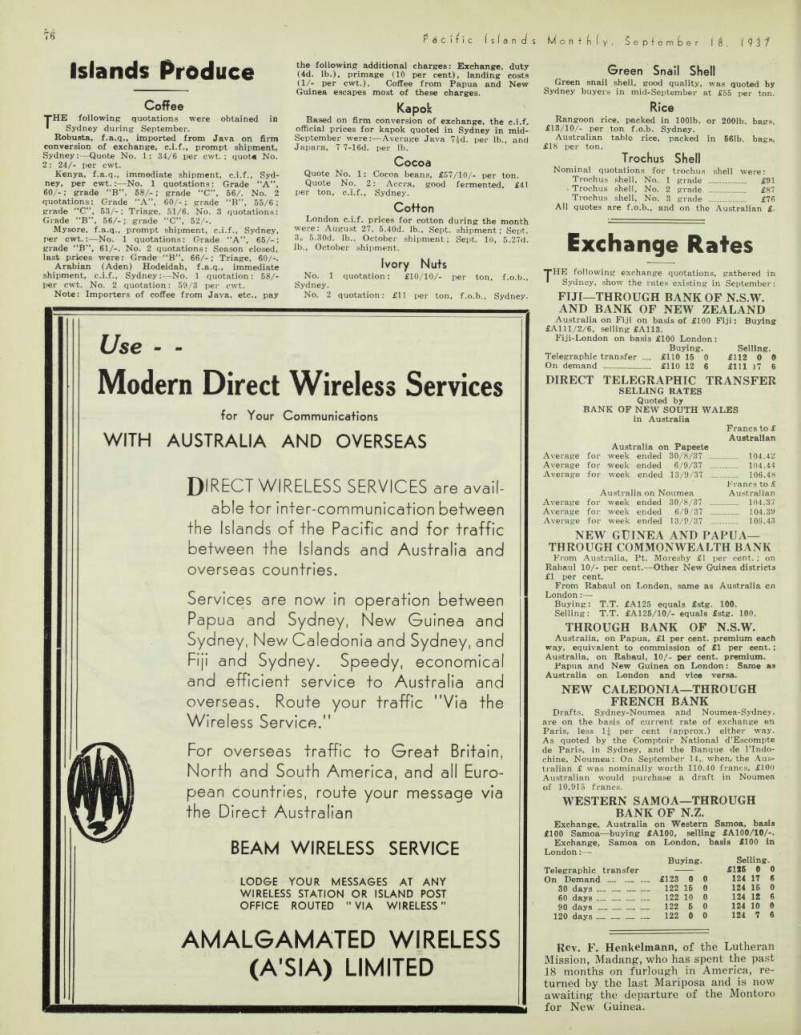
Coffee
THE following quotations were obtained in * Sydney during September.
Robusta, f.a.q., imported from Java on firm conversion of exchange, c.i.f., prompt shipment, Sydney:—Quote No. 1: 34/6 per cwt.; quota No. 2: 24/- per cwt.
Kenya, f.a.q., immediate shipment, c.i.f., Syd ney, per cwt.: —No. 1 quotations: Grade “A”, 60/-; grade “B”. 58/-; grade “C”, 56/, No. 2 quotations: Grade “A”, 60/-; grade “B”, 55/6; grade "C”, 53/-; Triage, 51/6. No. 3 quotations: Grade “B”, 56/-: grade “C”. 52/-.
Mysore, f.a.q., prompt shipment, c.i.f., Sydney, per cwt.: —No. 1 quotations: Grade “A”, 65/-: grade “B”, 61/-. No. 2 quotations: Season closed, last prices were: Grade “B”, 66/-; Triage, 60/-.
Arabian (Aden) Hodeidah, f.a.q., immediate shipment, c.i.f., Sydney:—No. 1 quotation: 58/per cwt. No. 2 quotation: 59/3 per cwt.
Note: Importers of coffee from Java, etc., pay
the following additional charges: Exchange, duty (4d. lb.), primage (10 per cent), landing costs (1/- per cwt.). Coffee from Papua and New Guinea escapes most of these charges.
Kapok
Based on firm conversion of exchange, the c.i.f. official prices for kapok quoted in Sydney in mid- September were: —Average Java 7£d. per lb., and Japara, 7 7-16 d. per lb.
Cocoa
Quote No. 1; Cocoa beans, £57/10/- per ton.
Quote No. 2: Accra, good fermented, £4l per ton, c.i.f., Sydney.
Co+fon
London c.i.f. prices for cotton during the month were: August 27, 5.40 d. lb., Sept, shipment: Sept. 3,. 5.30 d. lb., October shipment: Sept. 10, 5.27 d. lb., October shipment.
Ivory Nu+s
No. 1 quotation: £lO/10/- per ton, f.0.b., Sydney.
No. 2 quotation: £ll per ton, f.0.b., Sydney.
Green Snail Shell
Green snail shell, good quality, was quoted by Sydney buyers in mid-September at £55 per ton.
Rice
Rangoon rice, packed in 1001 b. or 2001 b. bags. £l3/10/- per ton f.o.b. Sydney.
Australian table rice, packed in 561 b. bags. £lB per ton.
Trochus Shell
Nominal quotations for trochus shell were: Trochus shell. No. 1 grade £9l Trochus shell, No. 2 grade £B7 Trochus shell, No. 3 grade £76 All quotes are f.0.b., and on the Australian £.
Exchange Rates
THE following exchange quotations, gathered in * Sydney, show the rates existing in September:
Fiji—Through Bank Of N.S.W.
And Bank Of New Zealand
Australia on Fiji on basis of £lOO Fiji: Buying £Alll/2/6, selling £AII3.
Fiji-London on basis £lOO London:
Direct Telegraphic Transfer
Selling Rates
Quoted by
Bank Of New South Wales
in Australia
New Guinea And Papua
Through Commonwealth Bank
From Australia, Pt. Moresby £1 per cent. ; on Rabaul 10/- per cent. —Other New Guinea districts £1 per cent.
From Rabaul on London, same as Australia cn London:— Buying: T.T. £AI2S equals £stg. 100.
Selling: T.T. £AI2S/10/- equals £stg. 100.
Through Bank Of N.S.W.
Australia, on Papua, £1 per cent, premium each way, equivalent to commission of £1 per cent.; Australia, on Rabaul, 10/- per cent, premium.
Papua and New Guinea on London: Same as Australia on London and vice versa.
New Caledonia—Through
French Bank
Drafts, Sydney-Noumea and Noumea-Sydney, are on the basis of current rate of exchange on Paris, less 11 per cent (approx.) either way.
As quoted by the Comptoir National d’Escompte de Paris, in Sydney, and the Banque de ITndo chine, Noumea: On September 14,, when/the Aus tralian £ was nominally worth 110.40 francs, £lOO Australian would purchase a draft in Noumea of 10,915 francs.
Western Samoa—Through
Bank Of N.Z.
Exchange, Australia on Western Samoa, basis £lOO Samoa —buying £AIOO, selling fAIOO/10/-.
Exchange, Samoa on London, basis £lOO in London: —
Rev. F. Henkelmann, of the Lutheran Mission, Madang, who has spent the past 18 months on furlough in America, re turned by the last Mariposa and is now awaiting the departure of the Montoro for New Guinea.
Buying.
Selling.
Telegraphic transfer £110 15 0 £112 0 0 On demand £110 12 6 £111 IT 6
Francs to £ Australian Australia on Papeete Average for week ended 30/8/37 .. 104.42 Average for week ended 6/9/37 .. 104.44 Average for week ended 13/9/37 . 106.48 Francs to £ Australia on Noumea Australian Average for week ended 30/8/37 104.37 Average for week ended 6/9/37 . 104.39 Average for week ended 13/9/37 . 108.43
Buying:. Selling.
Telegraphic transfer £115 0 0 On Demand .._ — ... £123 0 0 124 17 6 30 days ... 122 IB 0 124 15 0 60 days ... ...» 122 10 0 124 12 6 90 days ... 122 B 0 124 10 0 120 days ... ... 122 0 0 124 7 6
Advertisements & other items, p. 78 (1 item)
Modern Direct Wireless Services
Use - -
for Your Communications
WITH AUSTRALIA AND OVERSEAS
DIRECT WIRELESS SERVICES are avail-
able for inter-communication between the Islands of the Pacific and for traffic between the Islands and Australia and overseas countries.
Services are now in operation between Papua and Sydney, New Guinea and Sydney, New Caledonia and Sydney, and Fiji and Sydney. Speedy, economical and efficient service to Australia and overseas. Route your traffic "Via the Wireless Service."
For overseas traffic to Great Britain, North and South America, and all European countries, route your message via the Direct Australian
BEAM WIRELESS SERVICE
LODGE YOUR MESSAGES AT ANY
WIRELESS STATION OR ISLAND POST
OFFICE ROUTED "VIA WIRELESS"
AMALGAMATED WIRELESS
(A'SIA) LIMITED
Market Quotations
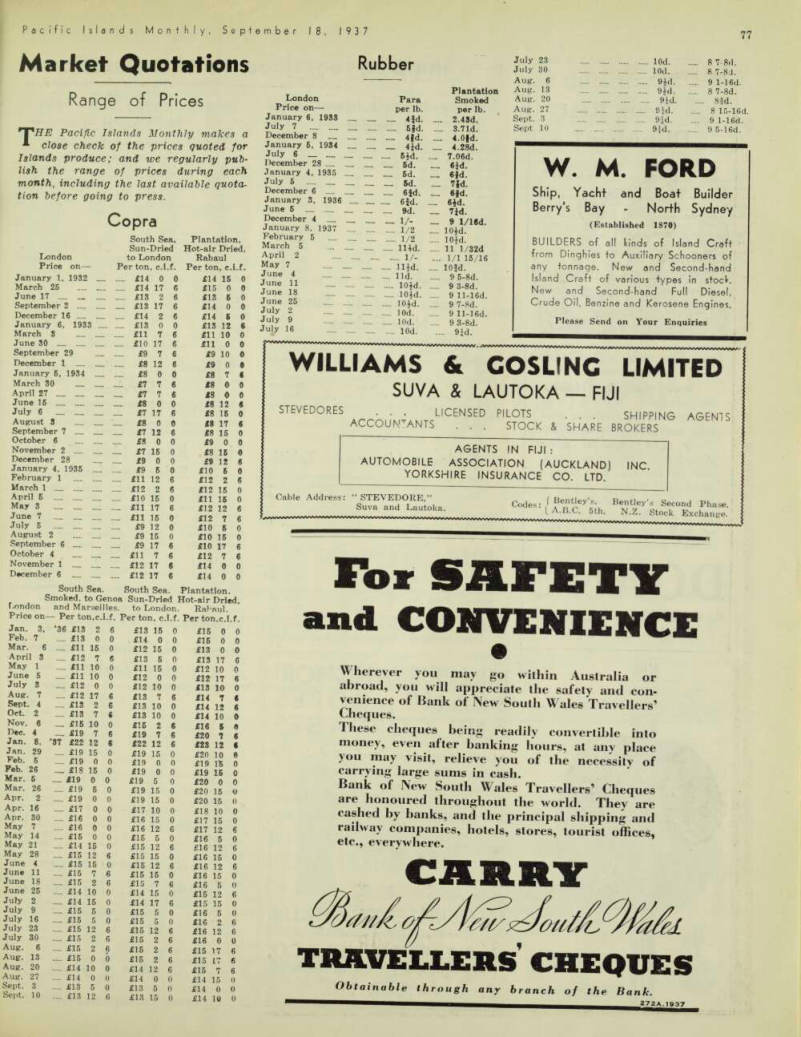
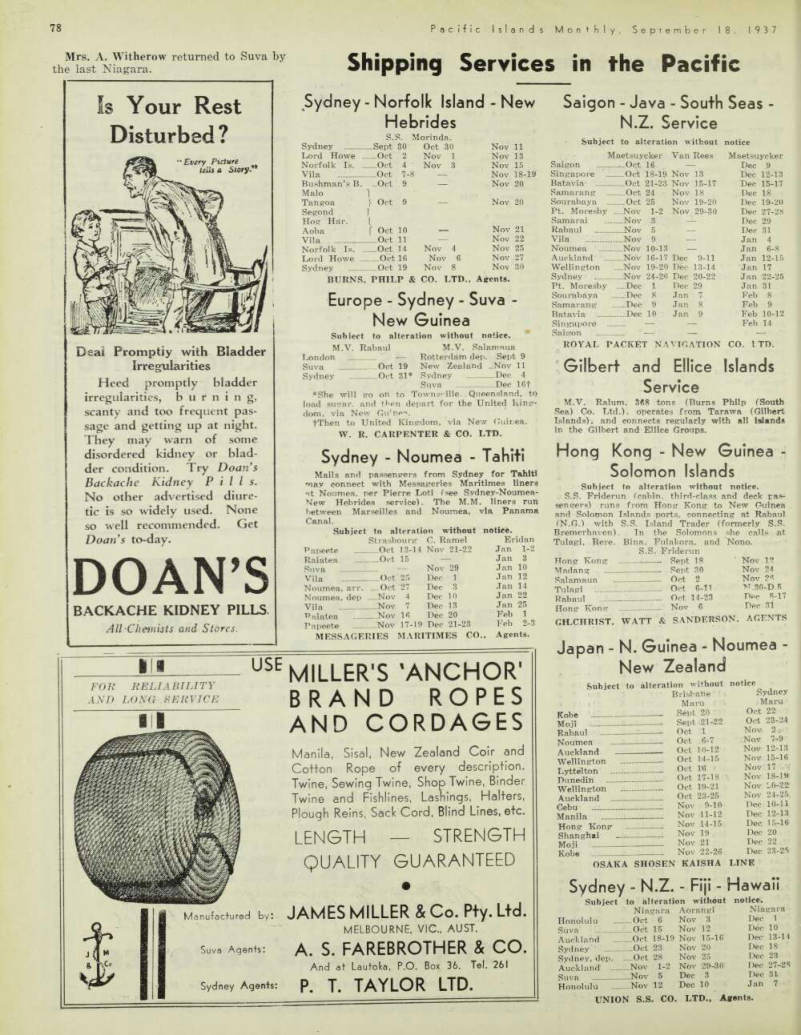
Range of Prices
r T % HE Pacific Islands Monthly makes a • close check of the prices Quoted for Islands produce; and we regularly pub lish the range of prices during each month, including the last available quota tion before going to press.
Copra
South Sea, Plantation, Sun-Dried Hot-air Dried, London to London Rabaul Price on- Per ton, c.i.f.
Per ton. c.i.f.
January 1, 1932 £14 0 0 £14 15 0 March 25 ... - £14 17 6 £15 0 0 June 17 , £13 2 6 £13 6 0 September 2 £13 17 6 £14 0 0 December 16 £14 2 6 £14 6 0 January 6, 1933 ... £13 0 0 £13 12 6 March 8 . £11 7 6 £11 10 0 June 30 ... £10 17 6 £11 0 0 September 29 £9 7 6 £9 10 0 December 1 £8 12 6 £9 0 0 January 5, 1934 , £8 0 0 £8 7 6 March 30 £7 7 6 £8 0 0 April 27 ... £7 7 6 £8 0 0 June 15 ... £8 0 0 £8 12 6 July 6 £7 17 6 £8 16 0 August 8 £8 0 0 £8 17 6 September 7 £7 12 6 £8 15 0 October 6 ... £8 0 0 £9 0 0 November 2 £7 15 0 £8 16 0 December 28 £9 0 0 £9 12 6 January 4. 1935 £9 6 0 £10 5 0 February 1 £11 12 6 £12 2 6 March 1 £12 2 6 £12 16 0 April 5 £10 15 0 £11 15 0 May 3 £11 17 6 £12 12 6 June 7 £11 15 0 £12 7 6 July 5 £9 12 0 £10 6 0 August 2 £9 15 0 £10 16 0 September 6 .. £9 17 6 £10 17 6 October 4 . , £11 7 6 £12 7 6 November 1 ... £12 17 6 £14 0 0 December 6 — — £12 17 6 £14 0 0 South Sea.
South Sea.
Plantation.
Smoked, to Genoa Sun-Dried Hot-air Dried.
London and Marseilles. to London.
Rabaul.
Price on— Per ton.c.i.f. Per ton, c.l.f.
Per ton.c.i.f.
Jan. 3. ’36 £13 2 6 £13 16 0 £15 0 0 Feb. 7 ... £13 0 0 £14 0 0 £16 0 0 Mar. 6 £11 16 0 £12 15 0 £13 0 0 April 3 £12 7 6 £13 5 0 £13 17 6 May 1 £11 10 0 £11 15 0 £12 10 0 June 5 £11 10 0 £12 0 0 £12 17 6 July 8 ... £12 0 0 £12 10 0 £13 10 0 Aug. 7 £12 17 6 £13 7 6 £14 7 < Sept. 4 ..._ £13 2 6 £13 10 0 £14 12 6 Oct. 2 £13 7 6 £13 10 0 £14 10 0 Nov. 6 „ £16 10 0 £15 2 6 £16 6 0 Dec. 4 ... £19 7 6 £19 7 6 £20 7 6 Jan. 8. ’37 £22 12 6 £22 12 6 £23 12 6 Jan. 29 £19 15 0 £19 15 0 £20 10 0 Feb. 5 ... £19 0 0 £19 0 0 £19 15 0 Feb. 26 £18 15 0 £19 0 0 £19 16 0 Mar. 5 £19 0 0 £19 5 0 £20 0 0 Mar. 26 ... £19 6 0 £19 15 0 £20 16 0 Apr. 2 ... £19 0 0 £19 15 0 £20 15 0 Apr. 16 £17 0 0 £17 10 0 £18 10 0 Apr. 30 ..„ £16 0 0 £16 15 0 £17 15 0 May 7 £16 0 0 £16 12 6 £17 12 6 May 14 £15 0 0 £15 5 0 £16 5 0 May 21 £14 16 0 £15 12 6 £16 12 6 May 28 £15 12 6 £15 15 0 £16 15 0 June 4 ... £15 16 0 £15 12 6 £16 12 6 June 11 £15 7 6 £15 16 0 £16 15 0 June 18 £15 2 6 £15 7 6 £16 5 0 June 25 £14 10 0 £14 15 0 £15 12 6 July 2 ... £14 15 0 £14 17 6 £15 15 0 July 9 £15 5 0 £15 5 0 £16 5 0 July 16 ._ £15 5 0 £15 5 0 £16 2 6 July 23 ._ £15 12 6 £15 12 6 £16 12 6 July 30 ... £15 2 6 £15 2 6 £16 0 0 Aug. 6 £15 2 6 £15 2 6 £15 17 6 Aug. 13 ... £15 0 6 £15 2 6 £15 17 6 Aug. 20 £14 10 0 £14 12 6 £15 7 6 Aug. 27 ... £14 0 0 £14 0 0 £14 15 0 Sept. 3 £13 5 0 £13 5 0 £14 0 0 Sept. 10 £13 12 6 £13 15 0 £14 10 0
July 23 lOd. ... 8 7-8d.
July 30 lOd. — 8 7-8d.
Aug. 6 9*d. — 9 l-16d.
Aug. 13 ... ... 9*d. 8 7-8d.
Aug. 20 9 id. ... 8fd.
Aug. 27 - ... 9 Jd. 8 15-16d.
Sept. 3 9id. ... 9 l-16d.
Sept 10 9{d. 9 5-16d.
London
Rubber
Para Plantation Smoked Price on— per lb. per lb.
January 6, 1933 — 4 Jd. 2.4Sd.
July 7 - 6|d. 3.71d.
December 8 — 4|d. ... 4.0|d.
January 5, 1934 ... 4 id. ._ 4.28d.
July 6 - Bid. 7.06d.
December 28 ... 5d. 6}d.
January 4, 1935 ... Bd. ... 6fd.
July 5 ... Bd. 7Jd.
December 6 — — 6Jd. ... 6fd.
January 3, 1936 - ... 6Jd. ... 6id.
June 6 ... -- — 9d. 7Jd.
December 4 — — 1/- 9 l/l«d.
January 8. 1937 ... ... 1/2 ... 10id.
February 5 1/2 ... 10id.
March 5 - lUd 11 l/32d April 2 - «... ... 1/- ... 1/1 1B/16 May 7 — Hid lOfd.
June 4 lid. 9 5-8d.
June 11 •- ... 10id. ... 9 3-8d.
June 18 ... ... 10 id, ... 9 ll-16d.
June 25 ... 10 id. ... 9 7-8d.
July 2 ... lOd 9 ll-16d.
July 9 lOd 9 3-8d.
July 16 ... lOd . 9Jd.
Mrs. A. Witherow returned to Suva by the last Niagara.
Advertisements & other items, pp. 79-80 (1 item)
For Safexv
W. M. FORD
Ship, Yacht and Boat Builder
Berry's Bay - North Sydney
(Established 1870) BUILDERS of all kinds of Island Craft from Dinghies to Auxiliary Schooners of any tonnage. New and Second-hand Island Craft of various types in stock.
New and Second-hand Full Diesel, Crude Oil, Benzine and Kerosene Engines.
Please Send on Your Enquiries
WILLIAMS & GOSLING LIMITED
SUVA & LAUTOKA FIJI
STEVEDORES .. . LICENSED PILOTS .. . SHIPPING ACCOUNTANTS . . . STOCK & SHARE BROKERS
AGENTS
AGENTS IN FIJI :
AUTOMOBILE ASSOCIATION (AUCKLAND) INC
YORKSHIRE INSURANCE CO. LTD.
Cable Address: “STEVEDORE.”
Suva and Lautoka.
Codes: [ Bentley’s. 1A.8.C. sth.
Bentley’s Second Phase.
N.Z. Stock Exchange.
For SAFEXV
and CONVENIENCE
• Wherever you may go within Australia or abroad, you will appreciate the safety and convenience of Hank of New South Wales Travellers’
Cheques.
These cheques being readily convertible into money, even after hanking hours, at any place you may visit, relieve you of the necessity of carrying large sums in cash.
Bank of New South Wales Travellers’ Cheques are honoured throughout the world. They are cashed by banks, and the principal shipping and railway companies, hotels, stores, tourist offices, etc., everywhere.
GARRY
TRXVEI.LERS' CHEQUES
Obtainable through any branch of the Bank. 272A.1937
Is Your Rest
Disturbed ?
Every Picture tells a Story' I Deal Promptly with Bladder Irregularities Heed promptly bladder irregularities, burning, scanty and too frequent passage and getting up at night.
They may warn of some disordered kidney or bladder condition. Try Doan’s Backache Kidney Pills.
No other advertised diuretic is so widely used. None so well recommended. Get
Doans to-day.
DOAN’S
BACKACHE KIDNEY PILLS
All-Chemists and Stores.
I«
FOR RELIABILITY
AND LONG SERVICE
USE MILLER'S ’ANCHOR'
BRAND ROPES
AND CORDAGES
Manila, Sisal, New Zealand Coir and Cotton Rope of every description.
Twine, Sewing Twine, Shop Twine, Binder Twine and Fishlines, Lashings, Halters, Plough Reins, Sack Cord, Blind Lines, etc.
LENGTH STRENGTH
QUALITY GUARANTEED
JAMES MILLER & Co. Pty. Ltd.
MELBOURNE. VIC., AUST.
A. S. FAREBROTHER & CO.
And at Lautoka, P.O. Box 36. Tel. 261 Sydney Agents: P. T. TAYLOR LTD.
Manufactured by: Suva Agents;
Shipping Services in the Pacific
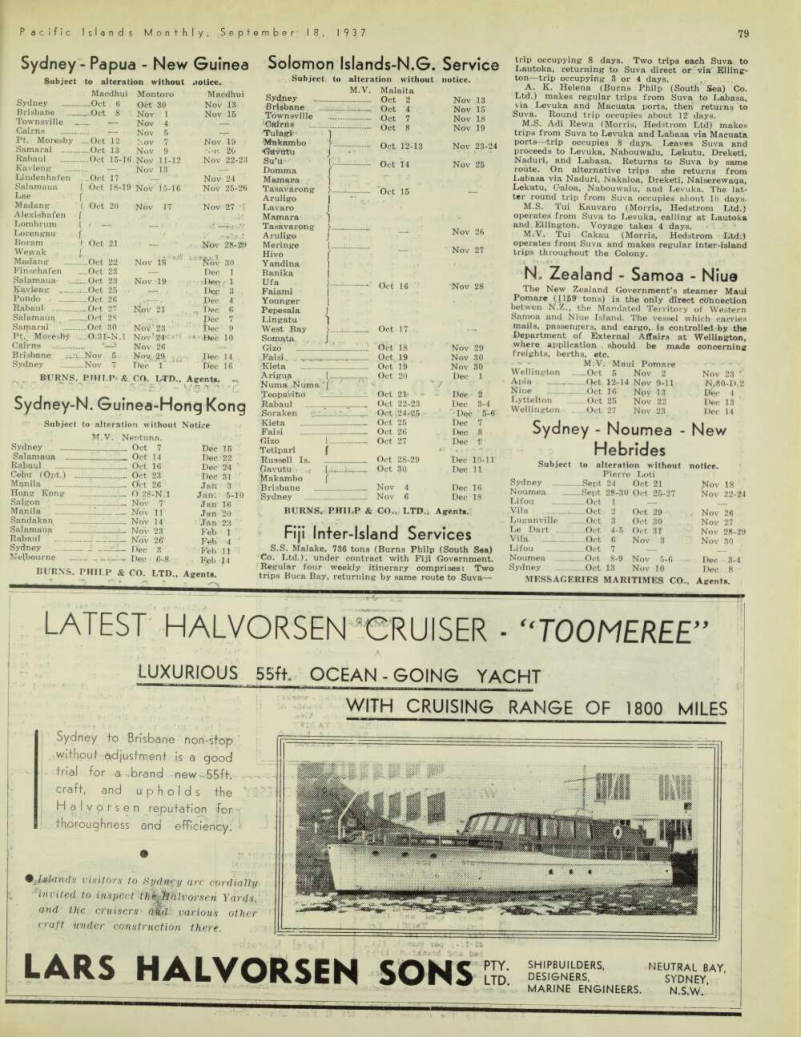
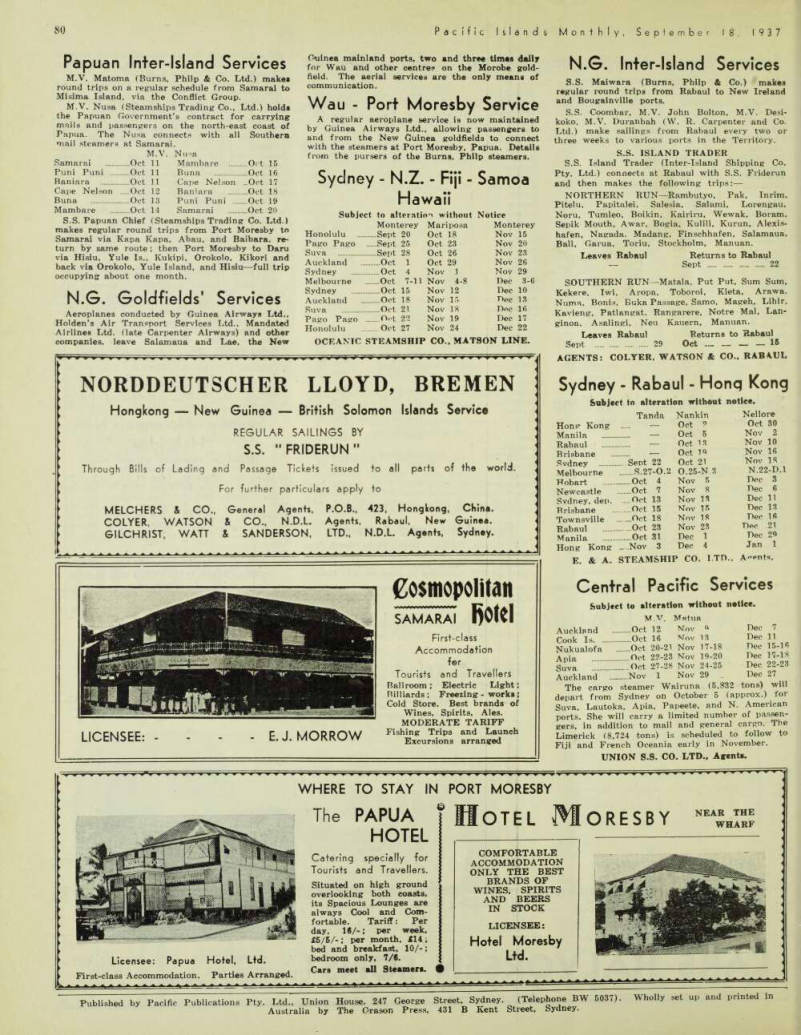
Sydney - Norfolk Island - New
Hebrides
S.S. Morinda.
Sydney Sept 30 Oct 30 Nov 11 Lord Howe .._ Oct 2 Nov 1 Nov 13 Norfolk Is Oct 4 Nov 3 Nov 15 Vila _Oct 7-8 Nov 18-19 Bushman’s B. ...Oct 9 Nov 20
Male 1
Tangoa ) Oct 9 Nov 20 Segond J Hog Har. [ Aoba f Oct 10 Nov 21 Vila . r ...„. Oct 11 Nov 22 Norfolk Is _Oct 14 Nov 4 Nov 25 Lord Howe Oct 16 Nov 6 Nov 27 Sydney Oct 19 Nov 8 Nov 30
Burns. Philp & Co. Ltd.. Agents.
Europe - Sydney - Suva -
New Guinea
Subiect to alteration without notice.
M.V. Rabaul M.V. Salamaua London Rotterdam dep. Sept 9 Suva Oct 19 New Zealand ...Nov 11 Sydney Oct 31* Sydney Dec 4 Suva Dec 16t *She will go on to Townsville. Queensland, to load sugar, and then depart for the United King dom, via New Gu : ne*>. fThen to United Kingdom, via New Guinea.
W. R. Carpenter & Co. Ltd.
Sydney - Noumea - Tahiti
Mails and passengers from Sydney for Tahiti may connect with Messageries Maritimes liners at Noumea, per Pierre Loti (see Svdney-Noumea- New Hebrides service). The M.M. liners run between Marseilles and Noumea, via Panama Canal.
Subject to alteration without notice.
Saigon - Java - South Seas - N.Z. Service Subject to alteration without notice
Gilbert and Ellice Islands
Service
M.V. Ralum. 368 tons (Burns Philp (South Sea) Co. Ltd.), operates from Tarawa (Gilbert Islands), and connects regularly with all islands in the Gilbert and Ellice Groups.
Hong Kong - New Guinea -
Solomon Islands
Subject to alteration without notice.
S.S. Friderun (cabin, third-class and deck pas sengers) runs from Hong Kong to New Guinea and Solomon Islands ports, connecting at Rabaul IN.G.) with S.S. Island Trader (formerly S.S.
Bremerhaven). In the Solomons she calls at Tulagi, Bere, Bina. Fulakora, and Nono.
S.S. Friderun Hong Kong Sept 18 Nov 1?
Madang Sept 30 Nov 24 Salamaua _. Oct 2 Nov 2* Tulagi Oct 6-11 "M.30-D.R Rabaul Oct 14-23 Her 8-17 Hong Kong Nov 6 Bee 31
Gilchrist. Watt & Sanderson. Agents
Japan - N. Guinea - Noumea -
New Zealand
Sydney - N.Z. - Fiji - Hawaii Subject to alteration without notice.
Strasbourg C. Ramel Eridan Papeete Oct 13-14 Nov 21-22 Jan 1-2 Raiatea Oct 15 — Jan 3 — Nov 29 Jan 10 Vila Oct 25 Dec 1 Jan 12 Noumea, arr Oct 27 Dec 3 Jan 14 Noumea, dep Nov 4 Dec 10 Jan 22 Vila Nov 7 Dec 13 Jan 25 Paiatea .Nov 10 Dec 20 Feb 1 Papeete .Nov 17-19 Dec 21-23 Feb 2-3
Messageries Maritimes Co.. Agents.
Saigon Maetsuycker Oct Ifi Van Rees Maetsuycker Dpp Q Singapore
' Oct
18-19 Nov 13 Dec 12-13 Batavia' Oct Samarang Oct Sourabaya Oct Pt. Moresby Nov Samarai Nov 21-23 Nov 15-17 24 Nov 18 25 Nov 19-20 1-2 Nov 29-30 3 — Dec Dec Dec Dec Dec 15-17 18 19-20 27-28 29 Rabaul Nov 5 Dec 31 Vila Nov 9 Jan 4 Noumea Nov 10-13 Jan 6-8 Auckland Nov 16-17 Dec 9-11 Jan 12-15 Wellington Svdnev Nov Nov 19-20 Dec 13-14 24-26 Dec 20-22 Jan Jan 17 22-25 Pt. Moresby Dec Sourabaya Dec Samarang Dec 1 8 9 Dec 29 Jan 7 Jan 8 Jan Feb Feb 31 8 9 Batavia :.Dec 10 Jan 9 Feb 10-12 Singapore Saigon Feb 14
Royal
f
Packet Navigation
Co. 1Td.
Subject to alteration without Brisbane Maru ir«K* - Sent "20 notice Sydney Maru Oct 22 IVTrm Sept 21-22 Oct 23-24 Oct "1 Now 2 1 Oct 6-7 Now 7-9 ... Oct 10-12 Nov 12-13 Oct 14-15 Nov 15-16 Lyttelton Dunedin Oct 16 Oct 17-18 Nov 17 Nov 18-19 Wellington Auckland Cebu Oct 19-21 Oct 23-25 Nov 9-10 Nov 20-22' Nov 24-25 Dec 10-11 Manila Nov 11-12 Dec 12-13 Hong Kong Nov 14-15 Dec 15-16 Shanghai ,,.
“ Nov 19 Dec 20 Moji Nov 21 Dec 22 Kobs Nov 22-26 Dec 23-25
Osaka
Shosen Kaisha
Line
Niagara Aorangi Niagara Honolulu Oct 6 Nov 3 Dec a Suva Oct 15 Nov 12 Dec 10 Auckland Oct 18-19 Nov 15-16 Dec 13-14 Sydney ...Oct 23 Nov 20 Dec 18 Sydney, dep ...Oct 28 Nov 25 Dec 23 Auckland Nov 1-2 Nov 29-30 Dec 27-28 Suva .Nov 5 Dec 3 Dec 31 Honolulu Nov 12 Dec 10 Jan 7
Union
S.S . Co.
LTD., Agents.
Sydney - Papua - New Guinea Subject to alteration without notice.
Sydney-N. Guinea-Hong Kong
Subject to alteration without Notice M.V. Nentuna.
Sydney Oct 7 Dec 15 Salamaua 1 Oct 14 Dec 22 Rabaul ... Oct 16 Deo 24 Cebu (Opt.) Oct 23 Dee 31 Manila - Oct 26 Jah 3 Ho.ng Kong .._ Jan. 5-10 Sa te° n , - Nov 7 Jan 16 Manila Nov 11 Jan 20 Sandakan Nov 14 Jan 23 Salamaua Ll ™ Nov 23 Feb 1 Rabaul Nov 26' Feb 4 Sydney i .. .j Dec 3 Feb 11 Melbourne ... Dec 6-8 l4
Burns. Philp & Co. Ltd.. Agents.
Solomon Islands-N.G. Service
Subject to alteration without notice.
M.V. Malaita Sydney Oct 2 Nov 13 Brisbane Oct 4 Nov 15 Townsville Oct 7 Nov 18 S**™* - - - Oct 8 Nov 19
Tulagt ]
i"--:;--” Oct 12-13 Nov 23-24 Su’u t...-...:...„:_ Oct 14 Nov 25 Domma Mamara Tasavarong )—... Oct 15
Aruligo
Lavaro
Mamara ")
Ta,_ j_ Nov 26 Nov 27 Yandina Banika J? f . a . ; —' Oct 16 Nov 28 Faiami Younger Pepesala J
Lingatu ]
West Bay Oct 17
Somata J
Gizo ...‘ I U Oct 18 Nov 29 FaisL . Oct 19 Nov 30 Kieta Oct 19 Nov 30 Arigua , . —... Oct 20 Dec 1 Numa Numa'[ v / jeopasino Oct 2V Dee 2 jßabaul Oct 22-23 Dec 3-4 Soraken Oct 24-'25 Dec 5-6 Kieta Oct 25 Dec 7 Faisi Oct 26 Dec 8 Gizo t - Oct 27 Dec P
Tetipari f
Russell Is Oct 28-29 Dec 10-11' Gavutu , U- « Oct 3Q Dec 11
-Makambo f
Brisbane Nov 4 Dec 16 Sydney Nov 6 Dec 18
Burns, Philp & Co., Ltd., Agent*.
Fiji Inter-Island Services
S.S. Malake, 736 tons (Burns Philp (South Sea) Co. Ltd.), under contract with Fiji Government.
Regular four weekly itinerary comprises: Two trips Buca Bay, returning by same route to Suva—
trip occupying 8 days. Two trips each Suva to Lautoka, returning to Suva direct or via' Elling ton—trip occupying 3 or 4 days.
A. K. Helena (Burns Philp (South Sea) Co.
Ltd.) makes regular trips from Suva to Labasa, via Levuka and Macuata ports, then returns to Suva. Round trip occupies about 12 days.
M.S. Adi Rewa (Morris, Hedstrom Ltd) makes trips from Suva to Levuka and Labasa via Macuata ports—trip occupies 8 days. Leaves Suva and proceeds to Levuka, Nabouwalu, Lekutu, Dreketi, Naduri, and Labasa. Returns to Suva by same route. On alternative trips she returns from Labasa via Naduri, Nakaloa, Dreketi, Naiserewaqa, Lekutu, Galoa. Nabouwalu, and Levuka. The lat ter round trip from Suva occupies about 10 days.
M.S. Tui Kauvaro (Morris, Hedstrom Ltd.) operates from Suva to Levuka, calling at Lautoka and Ellington. Voyage takes 4 days.
M.V. Tui Cakau (Morris, Hedstrom Ltd.) operates front Suva and makes regular inter-island trips throughout the Colony. in i > . ‘ i'i:
No Zealand - Samoa - Niue
The New Zealand Government’s steamer Maui Pomare (1169 tons) is the only direct connection betwen N.Z., the Mandated Territory of Western Samoa and Niue Island. The vessel which carries mails, passengers, and cargo, is controlled by the Department of External Affairs at Wellington, where application should be made concerning freights, berths, etc. ■ M.V. Maui Pomare Wellington Oct 5 Nov 2 Nov 23 v Apia Oct 12-14 Nov 9-11 N.BO-D.2 Niue ...Oct 16 Nov 13 Dec 4 Lyttelton Oct 25 Nov 22 Dec 13 Wellington ...Oct 27 Nov 23 Dec 14
Sydney - Noumea - New
Hebrides
Subject to alteration without notice.
Pierte Loti Sydney Sept 24 Oct 21 Nov 18 Noumea Sept 28-30 Oct 25-27 Nov 22-24 Lifou Oct 1 Vila Oct 2 Oct 29 , Nov 26 Luganville Oct 3 Oct 30 Nov 27 Le Dart Oct 4-5 Oct 31 Nov 28-29 Vila ..; Oct 6 Nov 3 Nov 30 Lifou Oct 7 Noumea Oct 8-9 Nov 5-6 Dec 3-4 Sydney Oct 13 Nov 10 Dec 8
Messageries Maritimes Co.. Agents.
Macdhui Montoro Macdhui Sydney Oct 6 Oct 30 Nov 13 Brisbane __,..Oct 8 Nov 1 Nov 15 Townsville Nov 4 Cairns — Nov 5 Pt. Moresby Oct 12 '-.ov 7 Nov 19 Samarai —Oct 13 Nov 9 •vr, 20 Rabaul Oct 15-16 Nov 11-12 Nov 22-23 Kavieng — Nov 13 — Lindenhafen Oct 17 ‘ ’■ M Nov 24 Salamaua ( Oct 18-19 Nov 15-16 Nov 25-26 Lae r Madang (, Oct 20 Nov 17 Nov 27 ' Alexishafen \ Lombrum I • - Lorengau r K»1 £ - Boram I Oct 21 Ndv 28-29 Wewak [.
Nov 18 Madang ...
Oct 22 31) Finschafen Oct 23 Dec 1 Salamaua ..„ —Oct 23 Nov 19 Dei< 1 Kavieng Oct 25 , Dec 3 Pondo - Oct 26 , Dec 4 Rabaul- , Oct 27 Nov 21 Dec 6 Salamaua —Oct 28 Dec 7 Samarai Oct 30 Nov 23 Dec 9 Pt. Moresby 0.31-N.l Nov 24 * Dec 10 Cairns •—* Nov 26 Brisbane Nov 5 Nov. 29 - Dec 14 Sydney Nov 7 Dec 1 Dec 16
Burns,
pnn.p & CO. LTD., Agents.
Papuan Inter-Island Services
M.V, Matoma (Burns, Philp & Co. Ltd.) makes round trips on a regular schedule from Samarai to Misima Island, via the Conflict Group.
M. Nusa (Steamships Trading Co., Ltd.) holds the Papuan Government’s contract for carrying mails and passengers on the north-east coast of Papua. The Nusa connects with all Southern mail steamers at Samarai.
M.V. Nusa Samarai Oct 11 Mambare Oct 15 Puni Puni Oct 11 Buna Oct 16 Baniara Oct 11 Cape Nelson ...Oct 17 Cape Nelson Oct 12 Baniara Oct 18 Buna Oct 13 Puni Puni Oct 19 Mambare Oct 14 Samarai Oct 20 S.S. Papuan Chief (Steamships Trading Co. Ltd.) makes regular round trips from Port Moresby to Samarai via Kapa Kapa, Abau, and Baibara. re turn by same route: then Port Moresby to Daru via Hisiu, Yule Is.. Kukipi, Orokolo. Kikori and back via Orokolo, Yule Island, and Hisiu—full trip occupying about one month.
N. Goldfields' Services
Aeroplanes conducted by Guinea Airways Ltd., Holden’s Air Transport Services Ltd.. Mandated Airlines Ltd. (late Carpenter Airways) and other companies, leave Salamaua and Lae, the New
Guinea mainland ports, two and three times daily for Wau and other centre? on the Morobe gold held. The aerial services are the only means of communication.
Wau - Port Moresby Service
A regular aeroplane service is now maintained by Guinea Airways Ltd., allowing passengers to and from the New Guinea goldfields to connect with the steamers at Port Moresby, Papua. Details from the pursers of the Burns, Philp steamers.
N.G. Inter-Island Services
5.5. Maiwara (Burns, Philp & Co.) makes regular round trips from Rabaul to New Ireland and Bougainville ports. 5.5. Coombar, M.V. John Bolton, M.V. Desi koko, M.V. Duranbah (W. R. Carpenter and Co.
Ltd.) make sailings from Rabaul every two or three weeks to various ports in the Territory.
S.S. Island Trader
5.5. Island Trader (Inter-Island Shipping Co.
Pty. Ltd.) connects at Rabaul with S.S. Friderun and then makes the following trips;— NORTHERN RUN—Rambutyo, Pak, Inrim.
Pitelu, Papitalei, Salesia, Salami, Lorengau, Noru, Tumleo, Boikin, Kairiru, Wewak, Boram, Sepik Mouth. Awar, Bogia, Kulili, Kurun, Alexis hafen, Nagada. Madang, Finschhafen. Salamaua, Bali, Garua, Toriu, Stockholm, Manuan.
SOUTHERN RUN—Matala, Put Put. Sum Sum.
Kekere, Iwi, Aropa, Toboroi, Kieta, Arawa.
Numa, Bonis, Buka Passage. Samo. Mageh, Lihir, Kavieng. Patlangat. Rangarere, Notre Mai, Lan ginoa, Asalingi, Neu Kauern, Manuan.
Sydney - Rabaul - Honq Kong Subject to alteration without notice.
Central Pacific Services
Subject to alteration without notice.
M V. Matua Auckland Oct 12 Nov « Dec 7 Cook Is Oct 16 Nov 13 Dec 11 Nukualofa Oct 20-21 Nov 17-18 Dec 15-16 Apia Oct 22-23 Nov 19-20 Dec 17-18 S uva Oct 27-28 Nov 24-25 Dec 22-23 Auckland Nov 1 Nov 29 Dec 27 The cargo steamer Wairuna (5,832 tons) will depart from Sydney on October 5 (approx.) for Suva, Lautoka. Apia, Papeete, and N. American ports. She will carry a limited number of passen gers, in addition to mail and general cargo. The Limerick (8,724 tons) is scheduled to follow to Fiji and French Oceania early in November.
Union S.S. Co. Ltd., Arenu.
Sydney
- N.Z. -F ■In-
Samoa
Hawaii
Subject to alteration without Notice Monterey Mariposa Monterey Honolulu Sept 20 Oct 18 Nov 15 Pagro Pagro Sept 25 Oct 23 Nov 20 Suva Sept 28 Oct 26 Nov 23 Auckland ...Oct 1 Oct 29 Nov 26 Sydney 4 Nov 1 Nov 29 Melbourne ...Oct 7-11 Nov 4-8 Dec 3-6 Sydney ...Oct 15 Nov 12 Dec 10 Auckland ...Oct 18 Nov 15 Dec 13 Suva ...Oct 21 Nov 18 Dec 16 Paso Pagro . Oot 22 Nov 19 Dee 17 Honolulu Oct 27 Nov 24 Dec 22
Oceanic Steamship
' CO.
„ Matson Line.
Leaves Rabaul Returns to Rabaul — Sept 22
Leaves Rabaul Returns to Rabaul Sept ... 29 Oct — — IB
Agents: Colter. Watson & Co.. Rabaul
Tanda Nankin Nellore Honf Kong — Oct 2 Oct 30 Manila — Oct 5 Nov 2 Rabaul — Oct 13 Nov 10 Brisbane — Oct IQ Nov 16 Svdney Sent 22 Oct 21 Nov 18 Melbourne 0.25-N 3 N.22-D.1 Hobart Oct 4 Nov 5 Dec 3 Newcastle Oct 7 Nov 8 Dec 6 Sydney, dep. „...Oct 13 Nov 13 Dec 11 Brisbane Oct 15 Nov 15 Dec 13 Townsville Oct 18 Nov 18 Dec 16 Rabaul Oct 23 Nov 23 Dee 21 Manila Oct 31 Dec 1 Dec 20 Hong Kong Nov 3 Dec 4 Jan 1 E. & A.
Steamship Co. I To..
Agents.
Advertisements & other items, pp. 81-84 (3 items)
Lars Halvorsen Sons
LATEST HALVORSEN ’CRUISER - “TOOMEREE”
LUXURIOUS 55f+. OCEAN-GOING YACHT
Sydney to Brisbane non-stop without adjustment is a good ' fdal for a-brand new-55ftv craft, and upholds the Halvorsen reputation for
thoroughness and efficiency.
9 9 visitors to Sydney are cordially invited to inspect the.Milvorsen Yards, and the cruisers mjd various other craft under construction there.
WITH CRUISING RANGE OF 1800 MILES
LARS HALVORSEN SONS
PTY. SHIPBUILDERS. NEUTRAL BAY.
LTD DESIGNERS, SYDNEY.
* MARINE ENGINEERS. N.S.W.
NORDDEUTSCHER LLOYD, BREMEN
Hongkong New Guinea British Solomon Islands Service
REGULAR SAILINGS BY
S.S. M FRIDERUN M
Through Bills of Lading and Passage Tickets Issued to all parts of the world.
For further particulars apply to MELCHERS & CO., General Agents, P. 0.8., 423. Hongkong, China.
COLYER, WATSON & CO., N.D.L. Agents. Rabaul, New Guinea.
GILCHRIST. WATT & SANDERSON. LTD.. N.D.L. Agents, Sydney.
LICENSEE: -
- E.J. MORROW
Cosmopolitan
SAMARAI fiotel
First-class Accommodation for Tourists and Travellers Ballroom; Electric Light; Billiards; Freezing - works ; Cold Store. Best brands of Wines, Spirits, Ales.
MODERATE TARIFF
Fishing Trips and Launch Excursions arranged
WHERE TO STAY IN PORT MORESBY
s
Licensee: Papua
First-class Accommodation.
Hotel, Ltd.
Parties Arranged.
The PAPUA
HOTEL
Catering specially for
Tourists and Travellers.
Situated on high ground overlooking both coasts, its Spacious Lounges are always Cool and Comfortable. Tariff: Per day, 18/-; per week, £5/5/- ; per month, £l4 ; bed and breakfast, 10/-; bedroom only, 7/6.
Cars meet all Steamers.
Q
COMFORTABLE
ACCOMMODATION
ONLY THE BEST
BRANDS OF
WINES. SPIRITS
AND BEERS
IN STOCK
LICENSEE:
Hotel Moresby
Ltd.
ORESBY
NEAR THE
WHARF
1
WHAT AERIAL TRANSPORT HAS
DONE FOR NEW GUINEA
S INCE 1927, when the development of the Morobe Goldfield commenced, the European population of the Territory has been trebled. The new industry has increased the Empire's gold production by nearly £2,000,000 per annum, and has added enormously to the trade turnover of New Guinea.
Only Aerial Transport makes this possible. There is no road between the Goldfields and the coast. Aeroplanes, running on Regular Schedules, without Difficulty or Delay, carry In Dredges, Crushing Mills, Cyaniding Plants, Motor Vehicles, Hydro - Electric Machinery, Thousands of Passengers, and every kind of goods needed by a large and growing European community.
OUINEA AIRWAYS LTD. were
established in 1927; and they have grown in the following way, until * The above photograph shov/s how aerial transporh Is assisting in the establishment of a pastoral industry on the Morobe tableland in New Guinea. Those dairy cows have just been unloaded from one of Guinea Airways' freight-carrying aeroplanes after being transported from the coast for a dairy farmer near Wau. —Photo : Thos. A. Olsson. —■ • ■ 'M■ - r i UJ I I CLjUIUI UI I 3CI VIUCO Ml MOW W Ull ICU aiMwJ I UjJUU, they use over 50 Aerodromes and Landing-grounds In the two Territories.
GUINEA AIRWAYS L™
LAE - SALAMAUA
HEAD OFFICE:
BROOKMAN BUILDINGS
GRENFELL STREET
ADELAIDE, S.A.
NEW GUINEA OFFICE:
LAE
MANDATED TERRITORY OF
NEW GUINEA
BRANCH OFFICES AND AGENTS AT WAU, SALAMAUA, PORT MORESBY. AND SYDNEY
P* a efi\ © &
EJV
/ 4 £ ER 'yi 9 & l/.O tt H t 0 0 1 t~ 0 0 0 7 o-PiP O .' * r\ V M
WELCOME CARGO
Lower away ” —and what a welcome cargo it is!
Resch's Pilsener—in the famous long bottle—the drink which eases the white man’s burden!
Call for a bottle to-night and relish its malt and
hop flavour.
RESCH'S
LONG BOTTLE
PILSENER
*3 Si f» tS . %) I I / S»
RESCHS
P V 27 !S
SI*CH
/ H-
,IS EN
ER F» . ?«s >uV, c * *s »r
80
Pacific Islands Monthly, September 18, 1937
Published by Pacific Publications Pty. Ltd., Union House. 247 George Street, Sydney. (Telephone BW 5037). Wholly set up and printed in Australia by The G'rason Press, 431 B Kent Street, Sydney.