A Dog-Lover's Nightmare
pp. 28-29 · Read in the full issue
The Village Curs of Papua and New Guinea
By R. W. Robson.
TF, in the course of a well-spent life, * you have learned to love and esteem dogs, do not enter a native village in Papua or New Guinea.
The things I saw there in canine guise represent still the foulest memory of my first visit to those Territories.
We had borrowed the MacdhuVs launch in one port, and visited a nearby primi tive village. We saw the usual village sights—cleverly-made houses, complacent pigs, a swarm of children, skinny old lapuns, sitting on their balconies, waiting jealously to be greeted by the white men.
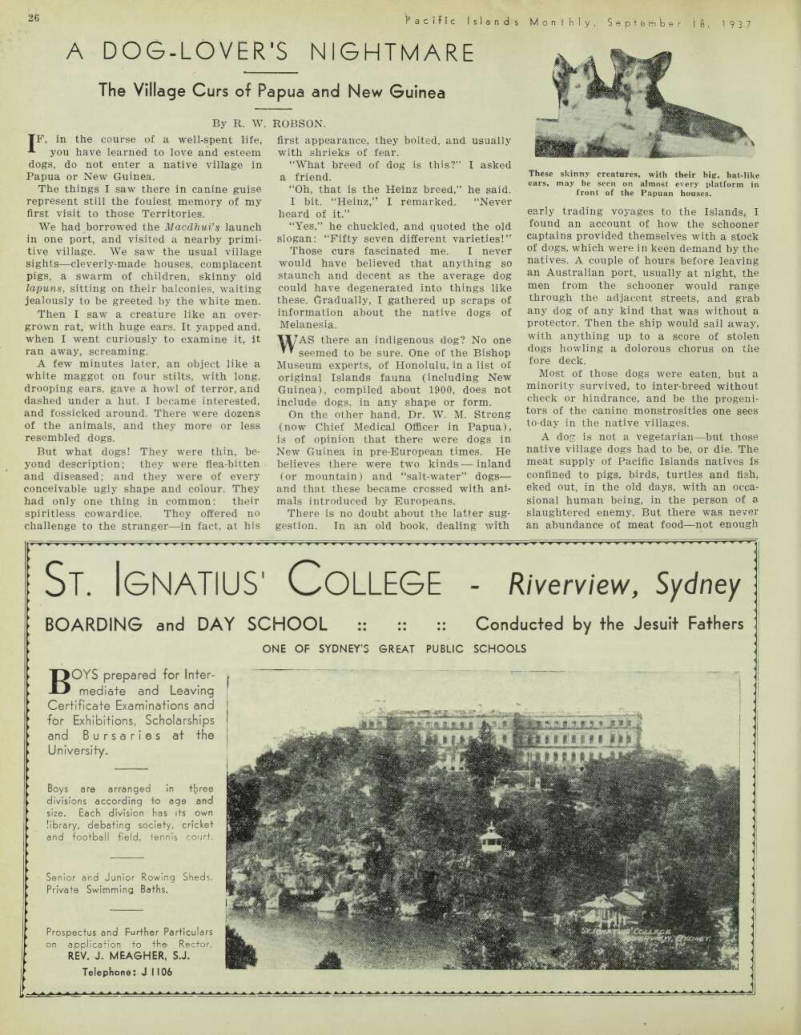
Then I saw a creature like an over grown rat, with huge ears. It yapped and, when I went curiously to examine it, it ran away, screaming.
A few minutes later, an object like a white maggot on four stilts, with long, drooping ears, gave a howl of terror, and dashed under a hut. I became interested, and fossicked around. There were dozens of the animals, and they more or less resembled dogs.
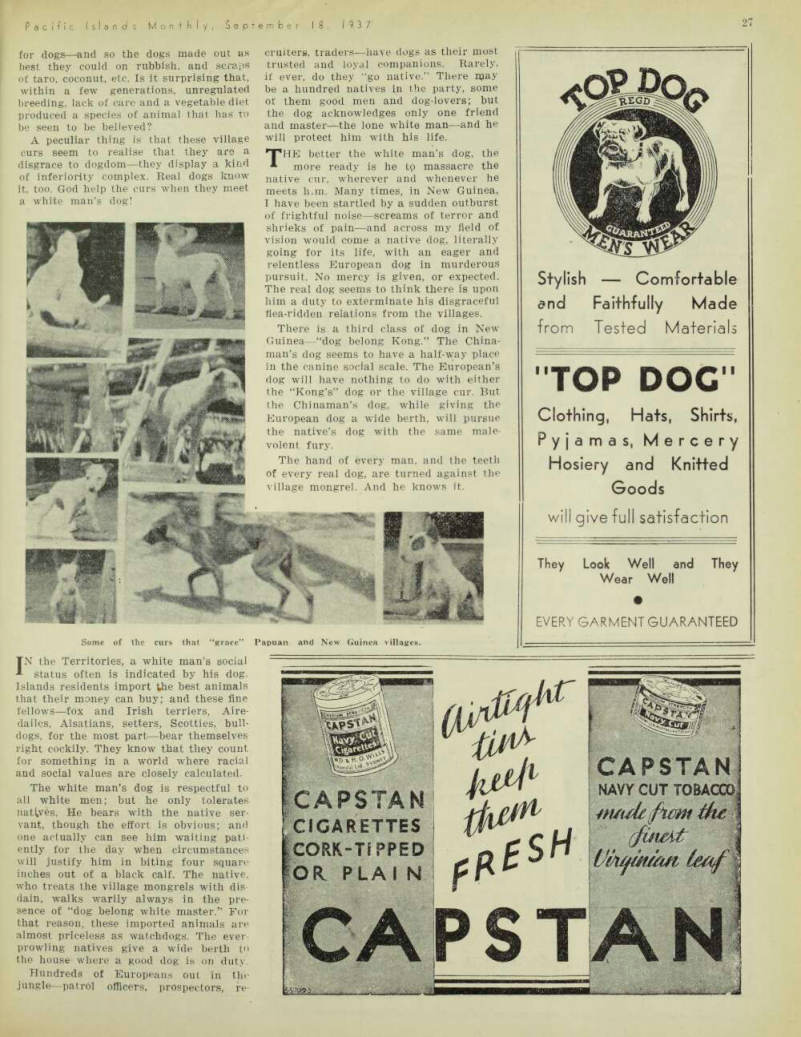
But what dogs! They were thin, be yond description; they were flea-bitten and diseased; and they were of every conceivable ugly shape and colour. They had only one thing in common: their spiritless cowardice. They offered no challenge to the stranger—in fact, at his
first appearance, they bolted, and usually with shrieks of fear, “What breed of dog is this?” I asked a friend.
“Oh, that is the Heinz breed,” he said.
I bit. “Heinz,” I remarked. “Never heard of it.”
“Yes,” he chuckled, and quoted the old slogan: “Fifty seven different varieties!”
Those curs fascinated me. I never would have believed that anything so staunch and decent as the average dog could have degenerated into things like these. Gradually, I gathered up scraps of information about the native dogs of Melanesia.
VI7AS there an indigenous dog? No one seemed to be sure. One of the Bishop Museum experts, of Honolulu, in a list of original Islands fauna (including New Guinea), compiled about 1900, does not include dogs, in any shape or form.
On the other hand, Dr. W. M. Strong (now Chief Medical Officer in Papua), is of opinion that there were dogs in New Guinea in pre-European times. He believes there were two kinds inland (or mountain) and “salt-water” dogs— and that these became crossed with ani mals introduced by Europeans.
There is no doubt about the latter sug gestion. In an old book, dealing with
early trading voyages to the Islands, I found an account of how the schooner captains provided themselves with a stock of dogs, which were in keen demand by the natives. A couple of hours before leaving an Australian port, usually at night, the men from the schooner would range through the adjacent streets, and grab any dog of any kind that was without a protector. Then the ship would sail away, with anything up to a score of stolen dogs howling a dolorous chorus on the fore deck.
Most of those dogs were eaten, but a minority survived, to inter-breed without check or hindrance, and be the progeni tors of the canine monstrosities one sees to-day in the native villages.
A dog is not a vegetarian—but those native village dogs had to be, or die. The meat supply of Pacific Islands natives is confined to pigs, birds, turtles and fish, eked out, in the old days, with an occa sional human being, in the person of a slaughtered enemy. But there was never an abundance of meat food—not enough
These skinny creatures, with their big, bat-like ears, may be seen on almost every platform in front of the Papuan houses.
for dogs—and so the dogs made out as best they could on rubbish, and scraps of taro, coconut, etc. Is it surprising that, within a few generations, unregulated breeding, lack of care and a vegetable diet produced a species of animal that has to be seen to be believed?
A peculiar thing is that these village curs seem to realise that they are a disgrace to dogdom—they display a kind of inferiority complex. Real dogs know it, too. God help the curs when they meet a white man’s dog!
IN the Territories, a white man’s social status often is indicated by his dog.
Islands residents import the best animals that their money can buy; and these fine fellows —fox and Irish terriers, Aire dailes, Alsatians, setters, Scotties, bull dogs, for the most part—bear themselves right cockily. They know that they count for something in a world where racial and social values are closely calculated.
The white man’s dog is respectful to all white men; but he only tolerates natives. He bears with the native ser vant, though the effort is obvious; and one actually can see him waiting pati ently for the day when circumstances will justify him in biting four square inches out of a black calf. The native, who treats the village mongrels with dis dain, walks warily always in the pre sence of “dog belong white master.” For that reason, these imported animals are almost priceless as watchdogs. The ever prowling natives give a wide berth to the house where a good dog is on duty.
Hundreds of Europeans out in the jungle—patrol officers, prospectors, re
cruiters, traders —have dogs as their most trusted and loyal companions. Rarely, if ever, do they “go native.” There ipay be a hundred natives in the party, some ot them good men and dog-lovers; but the dog acknowledges only one friend and master—the lone white man —and he will protect him with his life.
THE better the white man’s dog, the more ready is he tp massacre the native cur, wherever and whenever he meets h.m. Many times, in New Guinea, I have been startled by a sudden outburst of frightful noise—screams of terror and shrieks of pain—and across my field of vision would come a native dog, literally going for its life, with an eager and relentless European dog in murderous pursuit. No mercy is given, or expected.
The real dog seems to think there is upon him a duty to exterminate his disgraceful flea-ridden relations from the villages.
There is a third class of dog in New Guinea—“dog belong Kong.” The China man’s dog seems to have a half-way place in the canine social scale. The European’s dog will have nothing to do with either the “Kong’s” dog or the village cur. But the Chinaman’s dog, while giving the European dog a wide berth, will pursue the native’s dog with the same male volent fury.
The hand of every man, and the teeth of every real dog, are turned against the village mongrel. And he knows it.
Some of the curs that “grace” Papuan and New Guinea villages.