Submit Report
p. 12 · Read in the full issue
Rabaul's Future
No Move Until the Experts Submit Report
SPECULATIONS about the future of Rabaul —most of them ill-informed and ridiculous—continue to appear in the Australian newspapers.
The Sydney Morning Herald reporter who accompanied the Governor-General to New Guinea in August has published his opinion of the matter. He examines all the suggested alternatives to Rabaul —Madang, Lae, Salamaua, Wau and Kavieng— and rejects the lot, though he apparently thinks kindly of Kavieng. The reporter was Mr. David McNicoll. a son of the Administrator of New Guinea; and it may not be a coincidence that the Administrator has been rather fierce in his denunciation of all plans for removing the capital from Rabaul.
There are two things which all these people appear to overlook. One is the ever-present danger of another eruption.
It may come tomorrow; it may not come again for 100 years—hut come it certainly will. The other point is the need for Hie development of New Guinea as a white man’s country. If it is necessary or prac ticable to move the capital, it should go to the mainland, as part of a plan for bringing into usefulness those magnifi cent inland plateaus, recently discovered and as yet only partly explored—a vast, fertile, well-watered and comparatively cool region, capable of supporting very large agricultural and pastoral industries.
Officialdom, however, will do nothing until it gets the reports of the experts— and no one can guess when that wilf be.
Dr. W. G. Woolnough, Commonwealth geologist, on arriving in Sydney in Aug ust from Rabaul, said that until his re port on the recent volcanic disturbances was completed it would not be possible to say whether there were any geological considerations against retaining Rabaul as the administrative centre.
Dr. Woolnough and Dr. C. E. Stehn (vulcanologist to the Netherlands East Indies Government) were appointed to inquire into the geological aspects of the disturbances at Rabaul. Dr. Stehn and Mr. N. H. Fisher, geologist to the New Guinea Administration, in early Septem ber were still carrying on researches.
The clouds of steam rising from Matupi Crater, on the eastern side of the har bour, and the still dense clouds of wind blown dust from the newly formed crater of Vulcan Island in the west, Dr. Wool nough added, were constant reminders of the recent disaster. In the district there were many wrecked and mud - covered native villages, hillsides scored by deep gullies, and devastated plantations.
The town itself was mournful, with piles of volcanic mud everywhere. The luxuriant tropical growth, however, was asserting itself. The problems of remov ing the mud and restoring drainage and maintaining health were being solved.
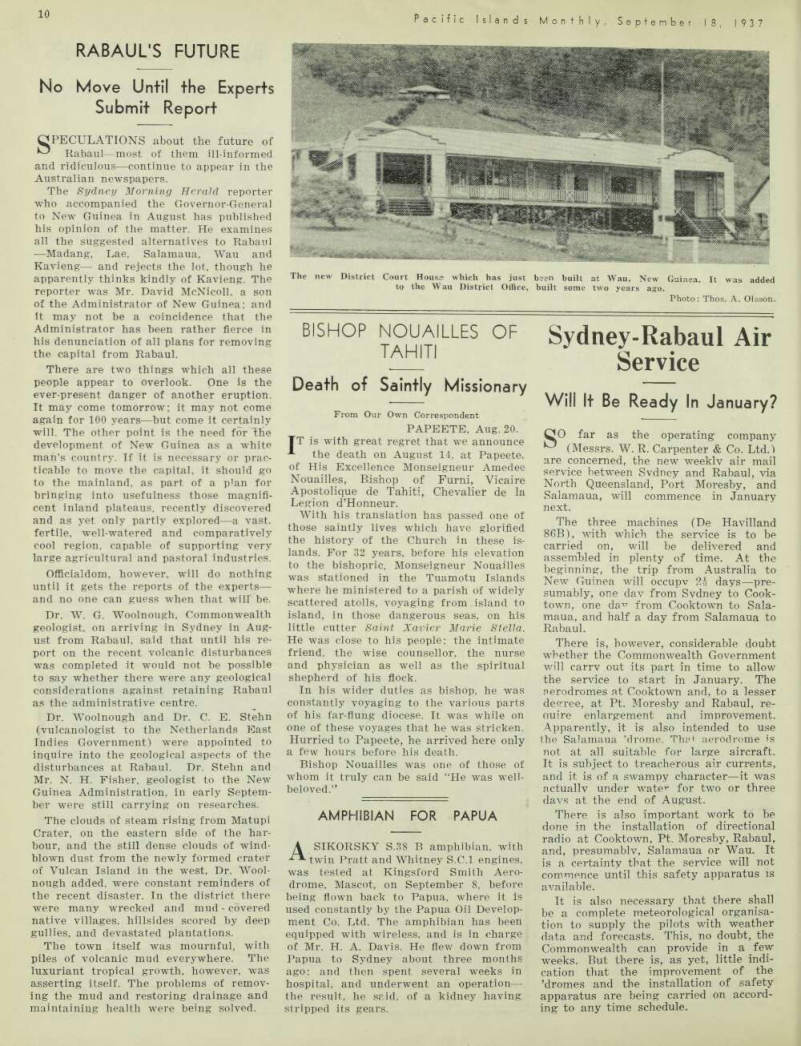
The new District Court House which has just been built at Wau, New Guinea. It was added to the Wau District Office, built some two years ago.
Photo: Thos. A. Olsson.