Revived By Finding of Old
Memories Of Chas.
Savage
Revived By Finding of Old Dollars in Fiji
OELIEVED to be relics from the U.S. whaling brig Eliza, which was wrecked in Fiji in 1808, six old Mexican dollars, in a good state of preservation, were found in August near the beach at Nairai, Viti Levu.
The coins were discovered about 20 yards from the beach, at a point where the natives were turning over the ground preparatory to planting a food crop of dalo. They have gone into the possession of Mr. W. Baker, of Nairai, on whose pro perty they were found.
In May, 1808, the American brig Eliza, carrying 40,000 American dollars and a number of escaped convicts from Aus tralia, was wrecked on a reef near Nairai, Fiji.
The crew got away in the boats, and left the convicts to their fate. Fortune favoured the convicts. The natives adopted them, and gave two of them great power. One was the notorious Swede, Charles Savage. He attained m,uch authority in Bau, where he taught the Fijians the use of firearms.
One old writer says that Savage boasted that, in Fiji,, he became the father of about 150 children. He was killed and eaten near Wilea, Vanua Levu, in March, 1814—eight years after the Eliza was wrecked.
Another account says that Savage was not a convict; that he and three com panions got away from the Eliza in a boat with many muskets and much treasure, which they buried on the sea shore; and that Savage later had an extraordinary number of native “wives.”
He gave the men of Bau much valuable help in their wars, and his share of the spoil usually included a number of the more personable young women.
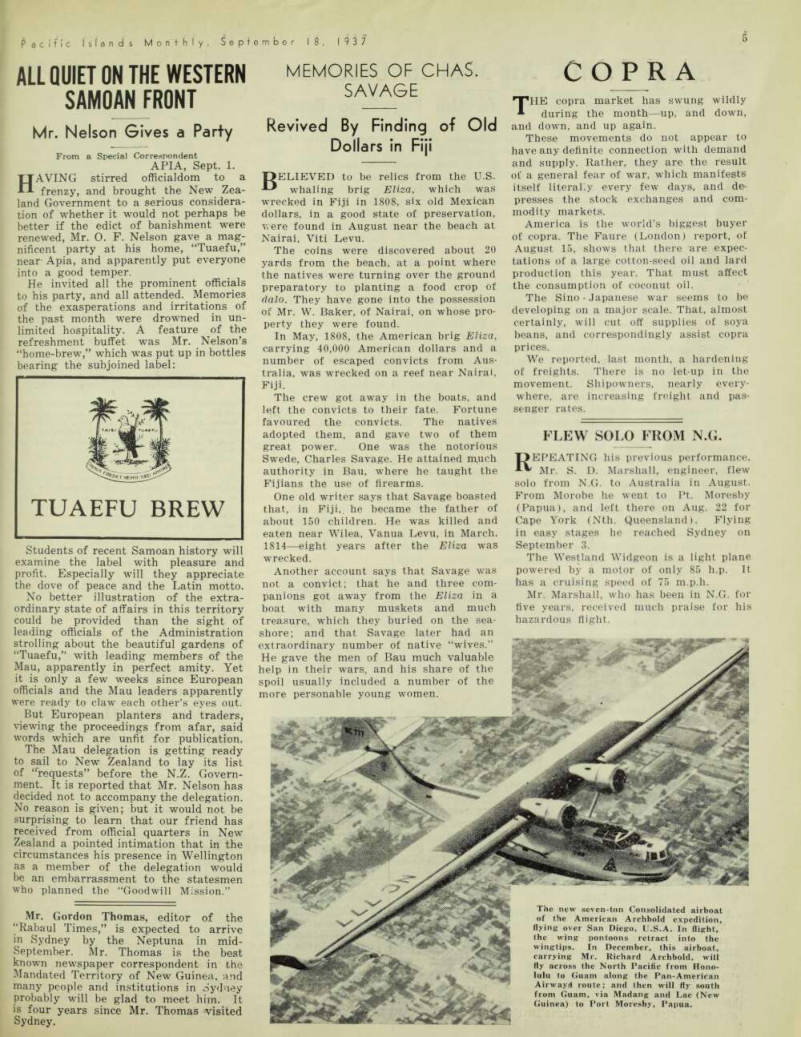
The new seven-ton Consolidated airboat of the American Archbold expedition, flying over San Diego, U.S.A. In flight, the wing pontoons retract into the wingtips. In December, this airboat, carrying Mr. Richard Archbold, will fly across the North Pacific from Hono lulu to Guam along the Pan-American Airways route; and then will fly south from Guam, via Madang and Lae (New Guinea) to Port Moresby, Papua.