New Hospital For
pp. 57-58 · Read in the full issue
Lepers
At Gemo Is., Near Port Moresby
From Our Own Correspondent.
Port Moresby, June 24.
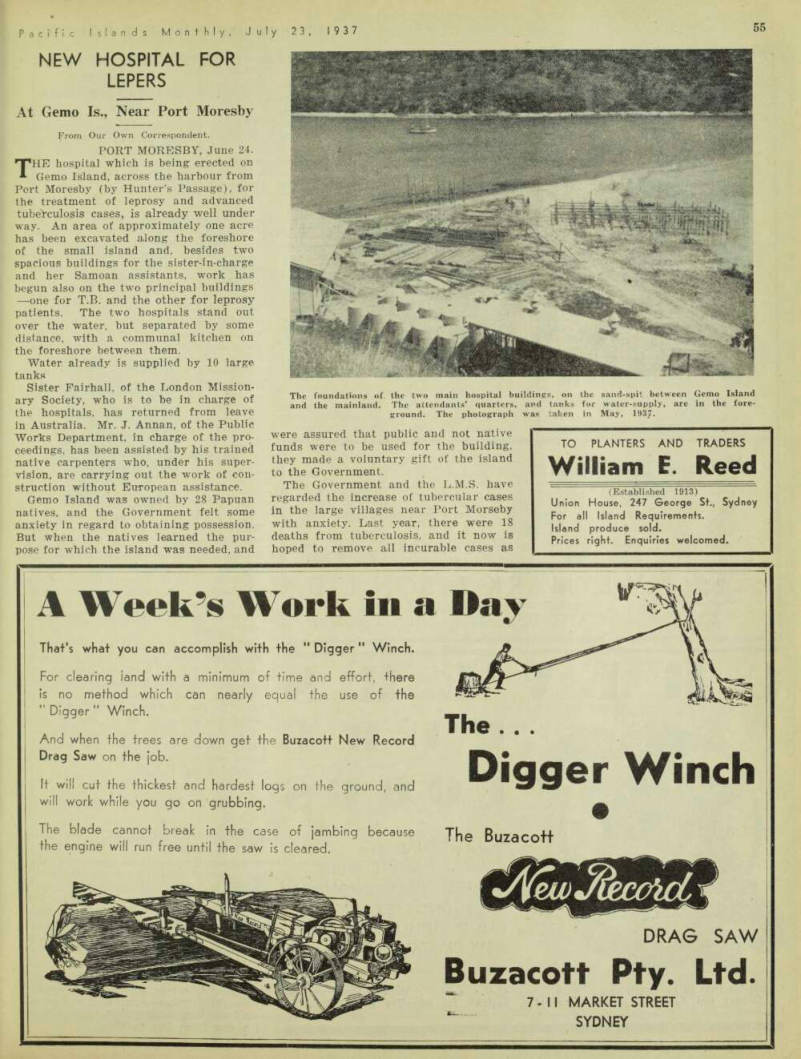
THE hospital which is being erected on Gemo Island, across the harbour from Port Moresby (by Hunter’s Passage), for the treatment of leprosy and advanced tuberculosis cases, is already well under way. An area of approximately one acre has been excavated along the foreshore of the small island and, besides two spacious buildings for the sister-in-charge and her Samoan assistants, work has begun also on the two principal buildings —one for T.B. and the other for leprosy patients. The two hospitals stand out over the water, but separated by some distance, with a communal kitchen on the foreshore between them.
Water already is supplied by 10 large tanks Sister Fairhall, of the London Mission ary Society, who is to be in charge of the hospitals, has returned from leave in Australia. Mr. J. Annan, of the Public Works Department, in charge of the pro ceedings, has been assisted by his trained native carpenters who, under his super vision, are carrying out the work of con struction without European assistance.
Gemo Island was owned by 28 Papuan natives, and the Government felt some anxiety in regard to obtaining possession.
But when the natives learned the pur pose for which the island was needed, and
were assured that public and not native funds were to be used for the building, they made a voluntary gift of the island to the Government.
The Government and the L.M.S. have regarded the increase of tubercular cases in the large villages near Port Morseby with anxiety. Last year, there were 18 deaths from tuberculosis, and it now is hoped to remove all incurable cases as
The foundations of the two main hospital buildings, on the sand-spit between Gemo Island and the mainland. The attendants’ quarters, and tanks for water-supply, are in the fore ground. The photograph was taken in May, 1937.
speedily as possible to the hospital at Gemo Island.
Though few cases of leprosy have been reported, the disease is considered seri ous enough to warrant the detention of patients in future in the newly estab lished hospital. Dr. W. Giblin (formerly Government medical officer here) visited Fiji last year to see the treatment of leprosy at Makogai, and it is understood that treatment here will follow upon much the same lines.