Mr. Blaikie Webster Resings-What Is the Mining Trust Going To Do?
pp. 52-55 · Read in the full issue
THE FUTURE OF NEW GUINEA GOLDFIELDS LTD.
By R. W. Robson
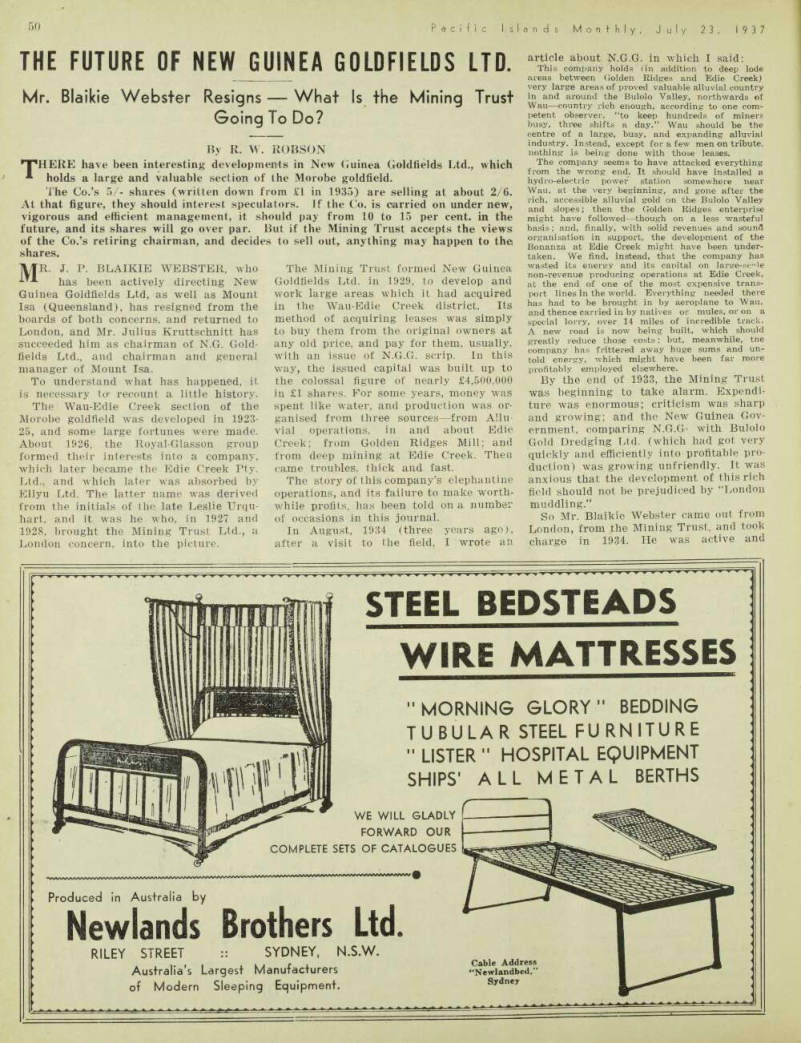
have been interesting developments in New Guinea Goldfields Ltd., which holds a large and valuable section of the Morobe goldfield.
The Co.’s 5/- shares (written down from £1 in 1935) are selling at about 2/6.
At that figure, they should interest speculators. If the Co. is carried on under new, vigorous and efficient management, it should pay from 10 to 15 per cent, in the future, and its shares will go over par. But if the Mining Trust accepts the views of the Co.’s retiring chairman, and decides to sell out, anything may happen to the shares.
Ivtr. J. P. Blaikie Webster, Who
has been actively directing New Guinea Goldfields Ltd, as -well as Mount Isa (Queensland), has resigned from the boards of both concerns, and returned to London, and Mr. Julius Kruttschnitt has succeeded him as chairman of N.G. Gold fields Ltd., and chairman and general manager of Mount Isa.
To understand what has happened, it is necessary to- recount a little history.
The Wau-Edie Creek section of the Morobe goldfield was developed in 1923- 25, and some large fortunes were made.
About 1926. the Royal-Glasson group formed their interests into a company, which later became the Edie Creek Pty.
Ltd., and which later was absorbed by Ellyu Ltd. The latter name was derived from the initials of the late Leslie Urqu hart, and it was he who, in 1927 and 1928, brought the Mining Trust Ltd., a London concern, into the picture.
The Mining Trust formed New Guinea Goldfields Ltd. in 1929, to develop and work large areas which it had acquired in the Wau-Edie Creek district. Its method of acquiring leases was simply to buy them from the original owners at any old price, and pay for them, usually, with an issue of N.G.G. scrip. In this way, the issued capital was built up to the colossal figure of nearly £4,500,000 in £1 shares. For some years, money was spent like water, and production was or ganised from three sources —from Allu vial operations, in and about Edie Creek; from Golden Ridges Mill; and from deep mining at Edie Creek. Then came troubles, thick and fast.
The story of this company’s elephantine operations, and its failure to make worth while profits, has been told on a number of occasions in this journal.
In August, 1934 (three years ago), after a visit to the field, I wrote an
article about N.G.G. in which I said: This company holds (in addition to deep lode areas between Golden Ridges and Edie Creek) very large areas of proved valuable alluvial country in and around the Bulolo Valley, northwards of Wau—country rich enough, according to one com petent observer, “to keep hundreds of miners busy, three shifts a day.” Wau should be the centre of a large, busy, and expanding alluvial industry. Instead, except for a few men on tribute, nothing is being done with those leases.
The company seems to have attacked everything from the wrong end. It should have installed a hydro-electric power station somewhere near Wau, at the very beginning, and gone after the rich, accessible alluvial gold on the Bulolo Valley and slopes; then the Golden Ridges enterprise might have followed—though on a less wasteful basis; and, finally, with solid revenues and sound organisation in support, the development of the Bonanza at Edie Creek might have been under taken. We find, instead, that the company has wasted its energy and its canital on non-revenue producing operations at Edie Creek, at the end of one of the most expensive trans port lines in the world. Everything needed there has had to be brought in by aeroplane to Wau, and thence carried in by natives or mules, or on a special lorry, over 14 miles of incredible track.
A new road is now being built, which should greatly reduce those costs; but, meanwhile, the company has frittered away huge sums and un told energy, which might have been far more profitably employed elsewhere.
By the end of 1933, the Mining Trust was beginning to take alarm. Expendi ture was enormous; criticism was sharp and growing: and the New Guinea Gov ernment, comparing N.G.G- with Bulolo Gold Dredging Ltd. (which had got very
quickly and efficiently into profitable pro
duction) was growing unfriendly. It was
anxious that the development of this rich field should not be prejudiced by “London
muddling.”
So Mr. Blaikie Webster came out from London, from the Mining Trust, and took charge in 1934. He was active and
shrewd; but he -tried to apply Napoleonic methods to Australian and New Guinea institutions, and he found himself op posed at many points by people who in stinctively resist dictatorships.
One of Mr. Webster’s first acts was to have the capital written down from £4,472,331 to £1,118,081, and pay a divi dend of 4 per cent on the old capital (equal to 16 per cent on the new).
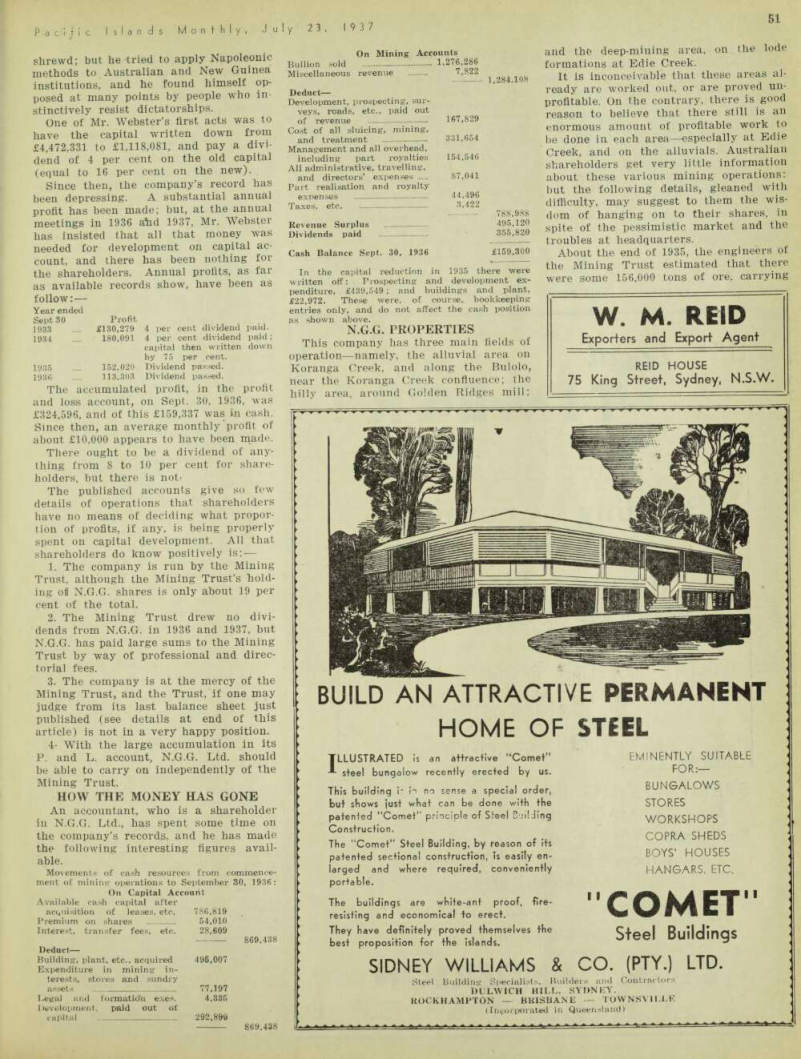
Since then, the company’s record has been depressing. A substantial annual profit has been made; but, at the annual meetings in 1936 ahd 1937, Mr. Webster has insisted that all that money was needed for development on capital ac count, and there has been nothing for the shareholders. Annual profits, as far as available records show, have been as follow: — Year ended Sept 30 Profit 1933 £130,279 4 per cent dividend paid. 1934 180,091 4 per cent dividend paid ; capital then written down by 75 per cent. 1935 152,020 Dividend passed. 1936 113,303 Dividend passed.
The accumulated profit, in the profit and loss account, on Sept. 30, 1936, was £324,596, and of this £159,337 was in cash.
Since then, an average monthly profit of about £lO,OOO appears to have been made.
There ought to be a dividend of any thing from 8 to 10 per cent for share holders, but there is not- The published accounts give so few details of operations that shareholders have no means of deciding what propor tion of profits, if any, is being properly spent on capital development. All that shareholders do know positively is: 1. The company is run by the Mining Trust, although the Mining Trust’s hold ing ofi N.G.G. shares is only about 19 per cent of the total. 2. The Mining Trust drew no divi dends from N.G.G. in 1936 and 1937, but N.G.G. has paid large sums to the Mining Trust by way of professional and direc torial fees. 3. The company is at the mercy of the Mining Trust, and the Trust, if one may judge from its last balance sheet just published (see details at end of this article) is not in a very happy position. 4- With the large accumulation in its P. and L. account, N.G.G. Ltd. should be able to carry on independently of the Mining Trust.
How The Money Has Gone
An accountant, who is a shareholder in N.G.G. Ltd., has spent some time on the company’s records, and he has made the following interesting figures avail able.
Movements of cash resources from commence ment of mining operations to September 30, 1936: On Capital Account Available cash capital after acquisition of leases, etc, 786,819 Px-emium on shares 54,010 Interest, transfer fees, etc. 28,609 869,438 Deduct— Building, plant, etc., acquix-ed 495,007 Expenditure in mining in tex-ests, stores and sundry assets ; 77,197 Legal and formation exes. 4,335 Development, paid out of capital 292,899 869,438
On Mining Accounts Bullion sold - - 1,276,286 Miscellaneous revenue 7,822 1,284.100 Deduct — Development, prospecting, sur veys, roads, etc., paid out of revenue 167,829 Cost of all sluicing, mining, and treatment 331,654 Management and all overhead, including part royalties 154,546 All administrative, travelling, and directors’ expenses . 87,041 Part x-ealisation and royalty expenses 44.496 Taxes, etc - 3,422 788,988 Revenue Surplus 495,120 Dividends paid 355,820 Cash Balance Sept. 30, 1936 £159,300 In the capital reduction in 1935 thex-e were written off: Prospecting and development ex penditure, £439,549 ; and buildings and plant, £22,972. These were, of course, bookkeeping entries only, and do not affect the cash position as shown above.
N.G.G. Properties
This company has three main fields of operation—namely, the alluvial area on
Koranga Creek, and along the Bulolo,
near the Koranga Creek confluence; the
hilly area, around Golden Ridges mill;
and the deep-mining area, on the lode formations at Edie Creek.
It is inconceivable that these areas al ready are worked out, or are proved un profitable. On the contrary, there is good reason to believe that there still is an enormous amount of profitable work to be done in each area —especially at Edie Creek, and on the alluvials. Australian shareholders get very little information about these various mining operations: but the following details, gleaned with difficulty, may suggest to them the wis dom of hanging on to their shares, in spite of the pessimistic market and the troubles at headquarters.
About the end of 1935, the engineers of the Mining Trust estimated that there were some 156,000 tons of ore, carrying
between 10 and 12 dwts. per ton, in the Edie Creek workings, all blocked out and ready to be brought out and milled, Little has been published since, but it is certain that the next body of available ore has not decreased in the meantime, In that 156,000 tons, no account was taken of the Karuka vein. This was proven over an extensive area ami shown by diamond drilling to run from 5 to 8 dwts. The Co. considered it of sufficient importance to put in a drive of 1,000 feet, from No. 4 shaft, on No. 2 lode, into the Karuka area, and to put down a 3-compartment shaft for the working of Karuka. On the last report, it was down 142 feet.
That estimate of 156,000 tons did not take the Surman vein into account. It is about 1,000 feet south-east of Edie No. 1
lode, and its value per ton is about 75/-, in gold and silver. Neither does it in clude Earl’s lode, on Merri Creek, north east of Edie No. 1.
The engineers, furthermore, have ex plored 400,000 tons of 3J dwt. country on Golden Peaks, below Golden Ridges. They say this is not profitable- Yet the Mining Trust is interested in the Co. which is working 3| dwt. ore at Big Bell, West Australia, on white men’s wages. At Edie Creek, they have the benefit of native labour.
Then the Mining Trust engineers also have up their sleeve, at Upper Ridges (above Golden Ridges mill), an area where five diamond-drill holes, at inter vals of 100 feet, have penetrated a lode, 18 feet wide, carrying 7 to 9 dwts. Upper Ridges area already is connected with
Golden Ridges mill by a ropeway, for the carriage of ore. In recently published accounts, it was stated that 10,000 tons from Upper Ridges had been treated at the mill: but nothing was said about values.
On their own plan, published a few years ago, the Trust engineers showed nine separate places where reef forma tions, carrying gold, had been located in the area between Golden Ridges and Edie Creek. Nothing appears to have been done with any of these areas.
Then there are thb Bulolo alluvials, where a lot of work has been done. Mr.
Webster, in a fairly recent report, said that it was estimated that the Co. had 1,000,000 yards of alluvial ground on the Bulolo River, worth 4/- per yard. But that seems to have been the end of it — probably, pending the investigation of the Koranga Alluvials, which gave much evidence of good values.
Nearly a year ago, the Co. brought Mr.
E- A. Lang out from England, and he has been at work on the Koranga Alluvials ever since. At the annual meeting, in February, shareholders were promised a report on Mr. Lang’s investigations with in four months. It is about due.
There are other gold-bearing areas around Wau held by N.G.G., about which little or nothing has been done.
Ultimatum And “Showdown”
By the end of 1936, the N.G.G. situa tion was being brought into some sort of perspective. Mr. Blaikie Webster seemed to stir up a deal of antagonism; but shareholders at least can thank him for forcing a “showdown.”
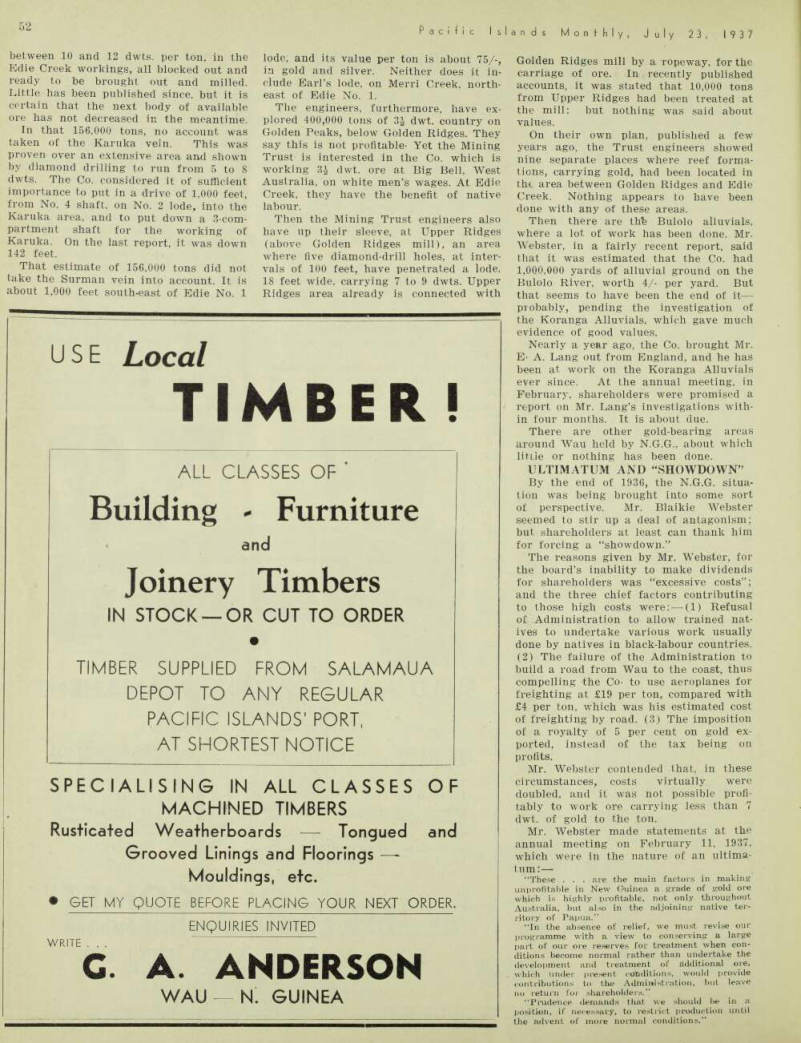
The reasons given by Mr. Webster, for the board’s inability to make dividends for shareholders was “excessive costs”; and the three chief factors contributing to those high costs were: (1) Refusal of Administration to allow trained nat ives to undertake various work usually done by natives in black-labour countries. (2) The failure of the Administration to build a road from Wau to the coast, thus compelling the Co- to use aeroplanes for freighting at £l9 per ton, compared with £4 per ton, which was his estimated cost of freighting by road. (3) The imposition of a royalty of 5 per cent on gold ex ported, instead of the tax being on profits.
Mr. Webster contended that, in these circumstances, costs virtually were doubled, and it was not possible profi tably to work ore carrying less than 7 dwt. of gold to the ton.
Mr. Webster made statements at the annual meeting on February 11, 1937, which were in the nature of an ultima tum: — “These . . . are the main factors in making unprofitable in New Guinea a grade of gold ore which is highly profitable, not only throughout Australia, but also in the adjoining native ter ritory of Papua.”
“In the absence of relief, we must revise our programme with a view to conserving a large part of our ore reserves for treatment when con ditions become normal rather than undertake the development and treatment of additional ore, which under present conditions, would provide contributions to the Administration, but leave no return for shareholders.”
“Prudence demands that we should be in a position, if necessary, to restrict production until the advent of more normal conditions.”
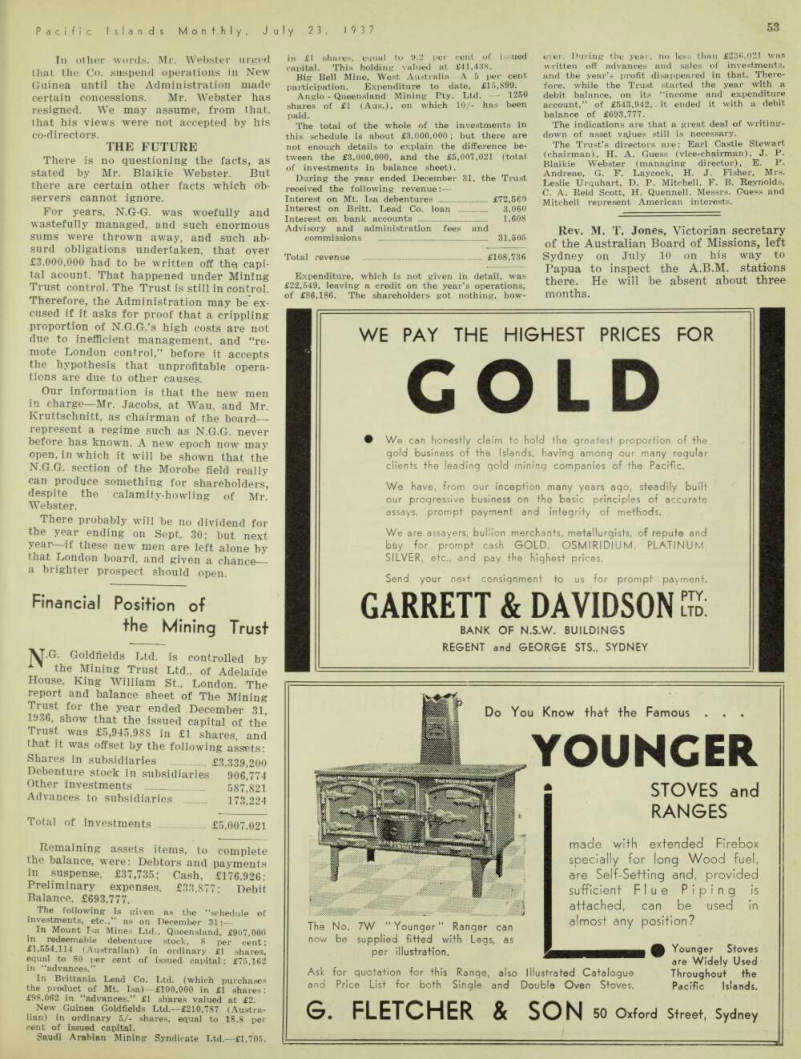
In other words, Mr. Webster urged that the Co. suspend operations in New Guinea until the Administration made certain concessions. Mr. Webster has resigned. We may assume, from that, that his views were not accepted by his co-directors.
The Future
There is no questioning the facts, as stated by Mr. Blaikie Webster. But there are certain other facts which ob servers cannot ignore.
For years, N.G-G. was woefully and wastefully managed, and such enormous sums were thrown away, and such ab surd obligations undertaken, that over £3,000,000 had to be written off the( capi tal acount. That happened under Mining Trust control. The Trust is still in control.
Therefore, the Administration may be* ex cused if it asks for proof that a crippling proportion of N.G.G.’s high costs are not due to inefficient management, and “re mote London control,” before it accepts the hypothesis that unprofitable opera tions are due to other causes.
Our information is that the new men in charge—Mr. Jacobs, at Wau, and Mr.
Kruttschnitt, as chairman of the board— represent a regime such as N.G.G. never before has known. A new epoch now may open, in which it will be shown that the N.G.G. section of the Morobe field really can produce something for shareholders, despite the calamity-howling of Mr.
Webster, There probably will be no dividend for the year ending on Sept. 30; but next year—if these new men are left alone by that London board, and given a chance a brighter prospect should open.