The Terror Of The Eruption
pp. 37-40 · Read in the full issue
Rabaul Journalist Describes His Experiences When "Black-out" Occurred
By GORDON THOMAS , Editor of The Rahaul Times.
I WAS toying with my dish of tea on the verandah on Saturday afternoon.
May 29, when the murmur of excited voices came to me from a distance. The clanging of the fire-bell and the blowing of ships’ sirens, and the distant boom of loud explosions all added to the excite ment.
Looking up, I saw people running to wards the foreshore. One never runs in Rabaul —normally. Something had hap-
pened. From somewhere came the word that an eruption had occurred. Then I saw clouds of smoke and dust rising high in the sky.
After a hasty arrangement to meet my wife on the North Coast, I jumped into the car and made for the wireless station which is situated on the foreshore.
Crowds had gathered to watch the pheno menon, excited voices filled the air in concert with the distant booming the explosion. “What will happen?” “What should one do?” were the questions asked —and left unanswered.
After a survey of the situation I scribbled out a press message and handed it to the operator, who was vainly trying to raise the outside world, which seemed cut off by the stupendous atmospheric disturbance. With a prayer that he would send my press at the first possible opportunity I left the operator standing by his key and motored quickly back to the house in search of my wife.
I found that she had already departed with Mr. and Mrs. Furter—l assumed, to the North Coast, for that was the safety
zone suggested to us by the late E. R.
Stanley, the well-known geologist, in the event of any eruption.
Earlier in the afternoon I had motored my niece and a friend to Ravuvu, the popular bathing resort, which is situated about two miles from the town, along the Kokopo road, and not far distant from the outbreak on Vulcan Island. I pictured the two women panic-stricken, and marooned there, so I “stepped on the gas” and made for the resort.
I passed natives hurrying in the op posite direction, and a few cars. High overhead hung the white-brown cloud, towering ever upwards; repeated explos ions boomed away at intervals. I re member seeing a couple of willy-wagtails flitting about the telephone wires, and thinking that it could not be very serious for bird life was still in evidence.
Ravuvu was deserted. After calling several times, and receiving no answer,
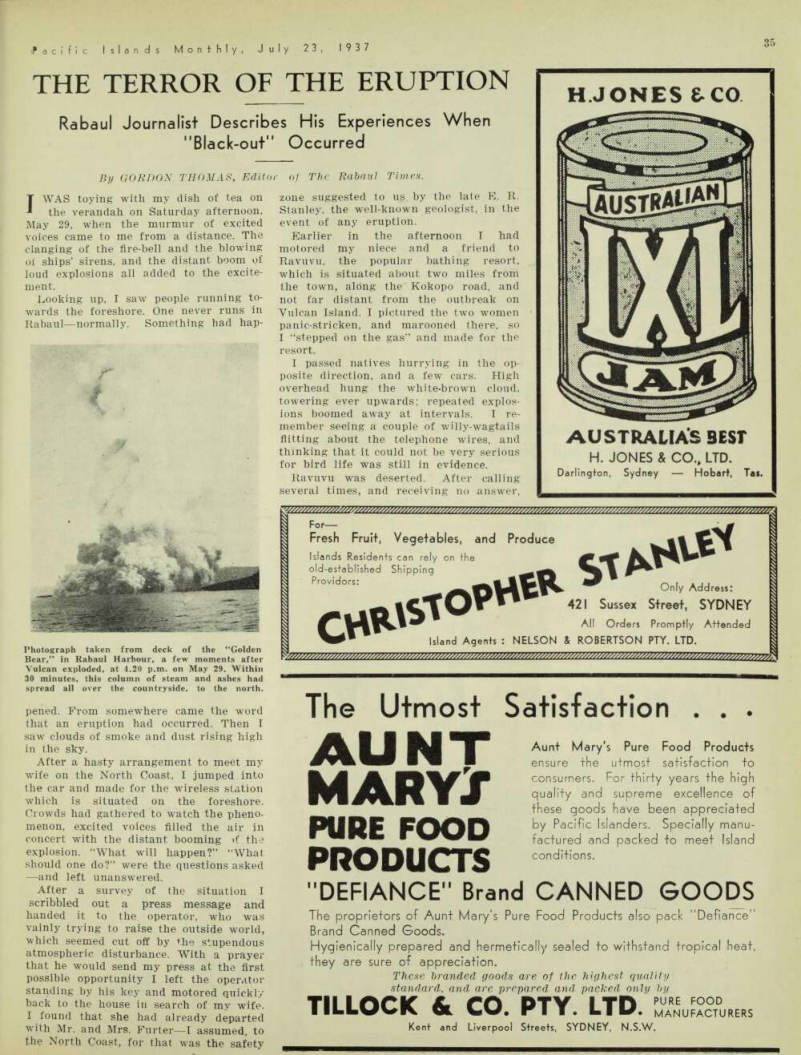
Photograph taken from deck of the “Golden Bear,” in Rabaul Harbour, a few moments after Vulcan exploded, at 4.20 p.m. on May 29. Within 30 minutes, this column of steam and ashes had spread all over the countryside, to the north.
I turned the car and speeded for the town.
Hardly had I left Ravuvu behind, when I saw before me a brown dust-cloud blot ting out the road. On I speeded, with lamps switched on, but the brown dust cloud became • intense blackness.
The road was blotted out, I slowed down, felt the car strike the ditch, and swerved to regain the road. For a short way, I was able to keep to .the highway.
Dust and small pebbles were falling everywhere, my eyes were filled with minute particles, my face and hair covered.
Suddenly the car bumped into the ditch again, and rested at an angle which I knew was impossible for me to right.
I switched off the lights and batteries and stumbled out on to the roadway.
Tying a handkerchief about my mouth I commenced walking slowly through the blackness. It was so dark that I could not see the proverbial hand before my face. It was like walking in a snow
storm; but, instead of snow, clean and refreshing, it was dust and dirt and stones, with a sickly heat, that fell upon me.
Several times I lost the road, and on my hands and knees I found it again— or thought I had. I found I was mistaken, for suddenly out of the blackness, right in front of me, I heard the “tweet-tweet” of small chicks and the mother-hen clucking reassuringly.
I searched the blackness with my out stretched hands, and found the wire netting of a hen-coop. This certainly could not be the main road, I thought; or was it a lorry, with a hen-coop aboard?
I called out into the blackness. From close at hand a voice answered: “Help!
Help!!” From another direction came a halloo, and then the flash of an electric torch.
Never was a light so welcome! I shouted again, and in a moment, two American sailors from the Golden Bear had joined me. Excitedly, they each grabbed one of my hands and started to walk at right angles to the road—or so I thought. I demurred. I wanted to stay on the road, I told them, and wrenched myself free. They argued excitedly, with repeated “Come, let’s go!” But I felt safer by myself, and so remained. One sailor thrust a pair of diving glasses into my hands and said; “Good luck, Bo! and we separated.
After I had been stumbling about amongst coconut palm trunks, for a few minutes, the blackness changed to dark brown; landmarks became discernible; and I found I was not far from the main road, near the road leading down to the Toboi wharf.
Regaining the main road, I stumbled on, trying to breathe only through my nose. I passed several natives, coming from Rabaul, and I warned them of the hohotoi (blackness) ahead, but they rdodded on, indifferent to my warning.
A white man approached me. walking ■ iftly; he was looking for his wife, whom he had left at Ravuvu. I told him there was no one there, and of the “black out” in between; but he pressed onwards I reached the radio transmitting stat ion. where the man in charge was vainly trying to get more power from the elec tric light station. I asked him for a drink, and then regretted it. He had worries of his own. and there was a tank, so I stooped down at the tap and washed mv mouth free of the dust and grit, and then swallowed deep draughts of wel come water.
The cloud was passing, and the light was equal to late twilight. A car came speeding from Rabaul and turned un the Ratavul Road: small parties of natives were scurrying along, their lavalavus thrown over their heads to protect them from the dust; others carried banana leaves. And all the time, from the dis tance, came the booming of the explo sions. ■Mv main idea was to make for the North Coast, where I exnected to find my wife. Where, exactly. I did not know: but, somewhere in the back of my mind.
I had the idea that in the vicinity of the
bottom of the Ratavul Hill there would be an assembly of cars waiting until the eruption had blown itself out. I decided, then, to walk over the hill. A car, per haps, would overtake me and give me a lift.
So off I started, refreshed from my recent drink. The uphill climb was strenuous, but the air was clearer as I trudged higher; a party of hurrying native boys passed me. I envied them their strong lungs and capacity for speedy climbing.
Half-way up the hill, the light grew less. There was a breeze blowing—and suddenly the whole world seemed blotted out again. Once again I was enveloped in a “black-out.” I joined hands with those natives and kept going, walking on slowly into the blackness.
Beside the roadside we could hear the murmur of praying natives: “A Tcalou Una belaure avet, via Una talue mule pire avet a kapa. ,f (0 God, protect us and send us light again.) From some spots came the crooning music of hymns. It was an eerie sound, coming from out of the darkness, and for a moment I compared those terrified natives with the early Christians, gath ered together in the centre of a Roman arena, awaiting the coming of the wild beasts to devour them.
We stopped at one group of singers, and I asked if they did not have any bom-boms with which to make a flare.
But, though I spoke in the native dialect, I received no answer—only the continued singing of hymns by* men, women and children in unison.
The native whose hand I was holding seemed to become impatient and restless.
I could feel that he was anxious for me to release my hold, but I clung on. It was better for three or four to walk together than to be singly stepping out into this blackness. But the native suc ceeded in his desire and, with a forceful
tug, he freed himself and passed into the blackness, with his comrades.
Simultaneously, the hymn - singing ceased, and I found myself alone. I do not think I have ever felt so lonely in my life, standing there in the middle of the road a dense blackness all about me, choking volcanic dust raining down upon me, with grit in my eyes, nose and mouth. In the bush, every now and then, the crash of falling trees; from back in the bay, the incessant booming of the volcano; and a fearful uncertainty of what would or could happen.
Suddenly the air became charged with sulphur fumes; it was sickly warm. This, I thought, was the beginning of the end.
At any rate, one might as well go out comfortably, so I squatted in the roadway and lit a cigarette. Its glow was com forting; the tobacco calmed my nerves.
From out of the blackness somewhere there came a native woman, asking for a light for her cigarette.
It may have been five or ten minutes that the sulphur lasted; but it seemed at least an hour, and then the “black-out” lifted once again and. coming up behind me, a party of natives trudged along with a hurricane lantern. What a blessing! I joined this party and on we struggled.
Blackness descended again; trees crashed in the bush; always, the inces sant sound of falling stones upon the leaves. Lights from buildings pierced the blackness, and the natives told me it was the Vlavolo Mission. It was to this sanctuary that the natives were going.
I glanced inside the church —it was filled with chanting natives. In the sac risty, the Father and two Sisters, and some other natives had gathered. It was here I knocked and, after some delay, gained admission. I explained the search for my wife, that I had lost my way in the blackness, and could I have a lan tern. The goodness of this Father will never be forgotten. He supplied me with
a lantern, freshly filled with kerosene, and gave me a most welcome drink of lime-water.
With his invitation to return and stay the night if I found it impossible to pro ceed, I went out into the blackness once
again. It was 6.30 p.m. when I left the Mission. I had been staggering through “black-outs” for about 1J hours. It seemed a life-time. On I went, the lan tern casting ghastly shadows on fallen trees and dust-covered shrubs and banana plants.
After walking for about 15 minutes I saw the headlights of a car. I signalled as it approached, and it stopped. It was Mr. Beaton, the new proprietor of Roberts’
Garage and with him were his wife, Mr.
Brereton, the Chinese cook, and the pet fox-terrier. Enquiries told me there was no hope of finding my wife on the North Coast, so I accepted their offer to return to Rabaul.
The trip over the Ratavul Pass was uneventful. The “black-outs” had ceased.
But the most vivid lightning, and the loud crashes of thunder, made the night terrible to live in. It was, indeed, remini scent of France in the War during heavy bombardment.
On gaining my home at 8 p.m., I wrote a message to my wife with my finger in the dust on the dining room table. The dust was about half an inch thick. Three days later I returned to the house, and found that the writing had scarcely any dust on it, indicating that the eruption from the Matupi crater (which occurred on the Sunday afternoon —the day after the first eruption) did not affect the in terior of the houses.
Walking along Mango Avenue on that Saturday night was like passing down a street which had been struck by a cyclone: fallen tree branches, borne down by the weight of the dust, were every where blocking the road. Here and there, street lights still shone and showed that everything was covered in a mantle of grey dust. I went to the Post Office and there found intact the telephone line to Namanula hospital where, sitting anxiously waiting for some word of me, was my wife. To Namanula I proceeded and there spent the night.