Geoff. Clift—An
pp. 32-34 · Read in the full issue
Appreciation
By “Sa-Sa”
/Geoffrey Edward Clift, Who
in the Solomon Islands early in June, took prominent part in getting together the small force that helped to gather in Basiano and his followers in the Malaita trouble of ’27. It was sheer grit that enabled him to stand up to that rough month in the hills behind Sinerango. His friends will recall his part in the rhyme that the late “Sparks”
Jordan of the Marsina wrote: Around the tropic waters our gallant Geoffrey scoots To help the worried Government, and gather in recruits.
They will remember, too: Poor old Basiano, not a bite or sup.
Not a drop of Dewar’s to keep his pecker up.
Geoff, Clift had the Australian pioneer ing spirit in his blood. He was a great-
grandson of Samuel Clift, who founded Breeza Station, in 1829, in the then re cently discovered Liverpool Plains of N.S.W- His great-great-grandfather was a sergeant in Governor Macquarie’s bat talion of the Black Watch that accom panied him to N.S.W. in 1809. This battalion had just been through the Peninsula Campaign, and formed part of the Highland Light Brigade.
With this ancestry, Geoff. Clift, after the outbreak of war, soon found himself in Palestine with the Light Horse, and many an amusing yarn he could tell of those stirring times.
By profession, G. E. Clift was a sur veyor, and, in that capacity, was em ployed by the C.S.R. in Fiji. Hearing good acounts of opportunities to establish plantations in the Solomons, he made the voyage from Fiji about ’OB or 09. in a small vessel returning time-expired nat ive labour to the groups —a ship swarm ing with natives and “totroaches ”
Afterwards, G.E.C., his brother (who
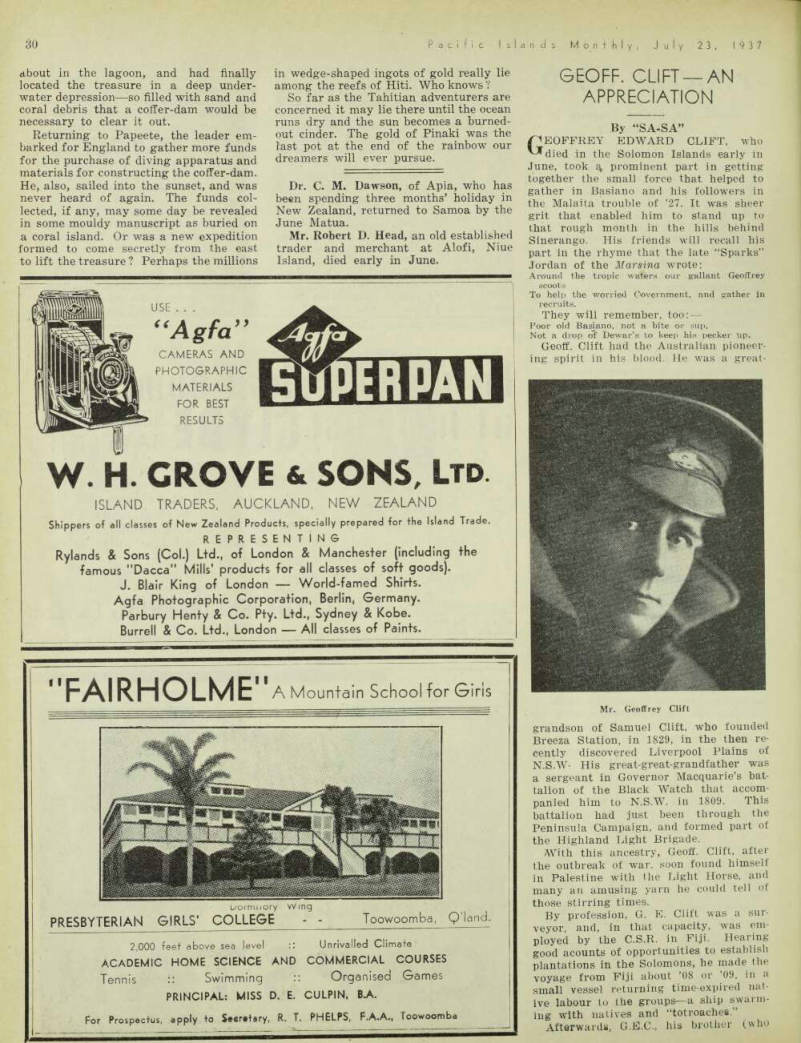
Mr. Geoffrey Clift
was later killed in action), and his cousin brought with them from Sydney to Tu lagi, on the old Moresby, an open sailing skiff. They camped in B.P.’s coal-shed, on Makambo, for a day or bfro, to lay in stores, and sailed off into the blue, and did not turn up again for a couple of
months. When one took into considera tion the fact that their craft was fitted only for sheltered waters, and was in all respects similar to those “midgets”, one sees under big baloon jibs any Saturday afternoon on Sydney harbour, the feat was a memorable one.
The Government steamer Bellama was getting up steam to search for them, when they turned up. They had bought the island of Fera, on the Ysabel coast, from the natives, and here, about 1910, Geoff. Clift established the main station of Clift and Clift’s three properties.
In the beginning, at Fera, he was sleep ing alone in a small native hut, when a party of runaway Malaita-men descended on him. He was bound hand and foot, and gagged with a particularly foul calico that a native had been wearing as a T piece. Geoff, never failed to spit when he came to that part of the yarn, be cause he had afterwards to gnaw through the calico to get free.
The natives took his sailing boat and most of his gear, and then had a debate about finishing him off before leaving for Malaita. When the boat was loaded, one or other of the natives would dash into the hut to see if anything more, that was portable and valuable, could be found. Geoff- naturally thought that these men had been sent to knock him on the head.
One always connected Geoff, with the Mendana, the graceful ketch he sailed so long and so successfully. The Mend<ma y too. has gone where all good ships go.
The writer can remember being be calmed one blistering day, when the Mendana lay “like a painted ship upon a painted ocean.” Geoff and his friend, Gor ringe spent quite a time whistling for a breeze. Eventually, the wind came, and that night we were running before a gale.
I can see Geoff. Clift now, looking up into the wild sky and asking the Almighty “if he hadn’t any sense of moderation.”
To those old comrades of the days “before the war,” to the few of them
who are still alive, sayings of Geoff. Clift will live while they live.
In those days, the Solomons held few white people and they were a happy band of brothers. Very few are left now. and another has gone. “Home is the sailor, home from the sea . • .”
Mr. D. W. Hore Lacy, of Rabaul, N.G., will leave Sydney in August for the Far East, en route to Europe and America.
The 30-years-old topsail schooner Firi (formerly Tangavoa ), built for the Pacific Cable Board to carry stores and pas sengers between Hawaii and Fanning Island, is soon to re-enter regular sea service after seven years’ idleness in New Zealand. Transformed into a fore and aft auxiliary schooner for Messrs. Nobel (A/sia) Pty. Ltd., she will carry cargo and explosives in the trans-Tasman trade.
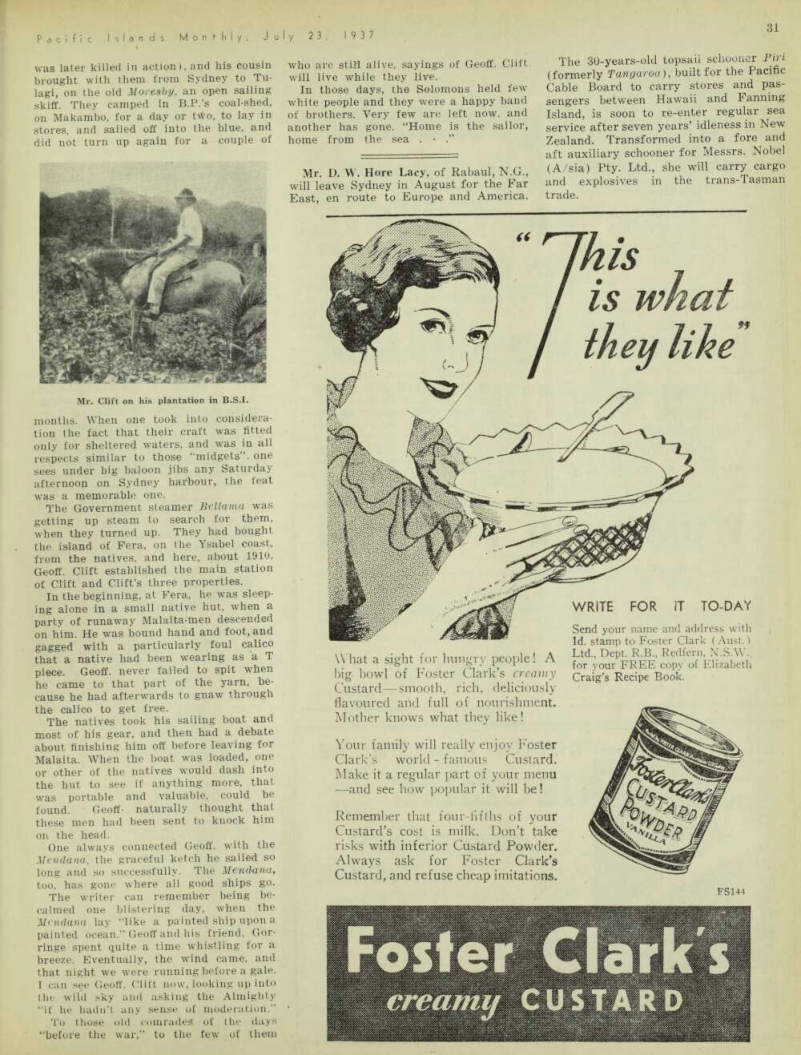
Mr. Clift on his plantation in B.S.I.
To preserve oranges use a wooden box and some dry sand. Place the oranges well apart in layers separating each orange and each layer with plenty of clean dry sand. The fruit will retain its true flavour almost indefinitely.