Men Who Knew Yesterday
pp. 28-29 · Read in the full issue
Captain S. Mortimer and His Pacific Memories
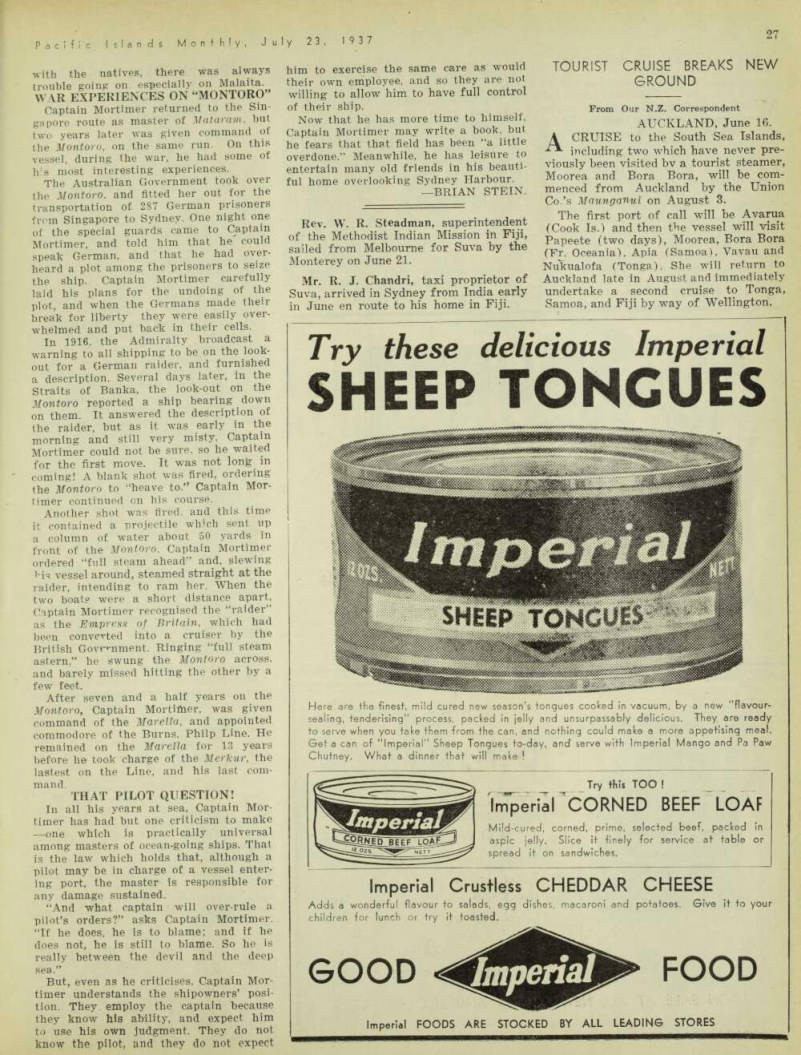
OMALL and slightly built, with white hair surmounting a kindly face lined by biting Pacific winds, and eyes a trifle dim after half a century of watching for hidden reefs and other maritime dangers, Captain S. Mortimer, R.N.R., has retired. Recently, at the age of 67, he made his last voyage as commander of the Merkur, and Commodore of the Burns, Philp Line.
Few sea-captains retire with a record as free from accident as that of Captain Mortimer. Hanging around the walls of his study are gifts of appreciation from passengers of some of the boats he has commanded, and who have seen him accomplish what were little short of miracles in navigating his ship through tropical gales and storms. Not once, in all his long career, did he lose a vessel, even though most of it was spent in the treacherous reefs and half - charted
waters of the Central and West Pacific.
Captain Mortimer was born in Berk shire, England, with a longing for the sea and foreign lands. At the earliest opportunity, he secured a position as cabin boy on the City of Nankin, bound for Sydney. She was a typical sailing vessel of the 80’s; and, after a voyage
o£ many months, he had his first glimpse of Sydney Harbour.
It was not long before he had a taste of the adventures he had been seeking.
He was a young man on the Glosehurn which was “running down her easting.’’ far south of Australia, when a fire broke out in one of the holds, and burned for several days, before being quelled. It was a mere shell of a ship that limped into port, after one of Captain Mor timer’s worst voyages.
Captain Mortimer saw, even then, that steam would eventually displace the old sailing ships. When the Canadian Australian Royal Mail Line was inaugu rated in 1893, he secured a berth as 4th officer on the Warimoo. In the next five years, he rose to be first officer of the Miowera , and. later, he became first offi cer on the old Aorangi, which was des tined, in later years, to meet her end at Scapa Plow. He secured his Master’s cer tificate when 21.
In 1901, after 14 years in the C. and A.
Line, he resigned to join the Burns.
Philp steamer Guthrie , on the Singapore run. Then he was transferred to the New Hebrides, where he remained for several years as Chief Officer of the Tnduna. and master of the Tamho, Mala ita and Makamho (the last named is still on the beach at Vila, where she was wrecked in 1935). He also held command of the Matunga, which, during the war, was captured by the German raider Wolf.
Even then, the Solomons and the New Hebrides were still in a primitive state, and although he never had any trouble
Captain Samuel Mortimer.
with the natives, there was always trouble going on. especially on Malaita.
War Experiences On “Montoro”
Captain Mortimer returned to the Sin gapore route as master of Mataram. but two years later was given command of the Montoro, on the same run. On this vessel, during the war, he had some of h s most interesting experiences.
The Australian Government took over the Montoro. and fitted her out for the transportation of 287 German prisoners from Singapore to Sydney. One night one of the special guards came to Captain Mortimer, and told him that he could speak German, and that he had over heard a plot among the prisoners to seize the ship. Captain Mortimer carefully laid his plans for the undoing of the plot, and when the Germans made their break for liberty they were easily over whelmed and put back in their cells.
In 1916, the Admiralty broadcast a warning to all shipping to be on the look out for a German raider, and furnished a description. Several days later, in the Straits of Banka, the look-out on the Montoro reported a ship bearing down on them. It answered the description of the raider, but as it was early in the morning and still very misty, Captain Mortimer could not be sure, so he waited for the first move. It was not long in coming! A blank shot was fired, ordering the Montoro to “heave to.” Captain Mor timer continued on his course.
Another shot was fired, and this time it contained a projectile which sent up a column of water about 50 yards in front of the Montoro. Captain Mortimer ordered “full steam ahead” and, slewing bis vessel around, steamed straight at the raider, intending to ram her. When the two boats were a short distance apart, Captain Mortimer recognised the “raider” as the Empress of Britain , which had been converted into a cruiser by the British Govrvnment. Ringing “full steam astern,” he swung the Montoro across, and barely missed hitting the other by a few feet.
After seven and a half years on the Montoro , Captain Mortimer, was given command of the Marella, and appointed commodore of the Burns. Philp Line. He remained on the Marella for 13 years before he took charge of the Merkur, the lastest on the Line, and his last com mand.
That Pilot Question!
In all his years at sea, Captain Mor timer has had but one criticism to make —one which is practically universal among masters of ocean-going ships. That is the law which holds that, although a pilot may be in charge of a vessel enter ing port, the master is responsible for any damage sustained.
“And what captain will over-rule a pilot’s orders?” asks Captain Mortimer.
“If he does, he is to blame; and if he does not, he is still to blame. So he is really between the devil and the deep sea.”
But, even as he criticises, Captain Mor timer understands the shipowners’ posi tion. They employ the captain because they know his ability, and expect him to use his own judgment. They do not know the pilot, and they do not expect
him to exercise the same care as would their own employee, and so they are not willing to allow him to have full control of their ship.
Now that he has more time to himself, Captain Mortimer may write a book, but he fears that that field has been “a little overdone.” Meanwhile, he has leisure to entertain many old friends in his beauti ful home overlooking Sydney Harbour.
Brian Stein.
Rev. W. R. Steadman, superintendent of the Methodist Indian Mission in Fiji, sailed from Melbourne for Suva by the Monterey on June 21.
Mr. R. J. Chandri, taxi proprietor of Suva, arrived in Sydney from India early in June en route to his home in Fiji.